Wellens’ syndrome represents a unique pathophysiological subset in ACS. While typical ACS is characterized by dominant thrombotic luminal occlusion, Wellens’ syndrome is a prototype for a low-thrombus-load .Curiously it can even be termed as “Zero thrombus” ACS. This is not a new revelation. It was underscored by de Zwaan and Wellens in their original landmark 1989 angiographic study of about 180 patients. Notably, angiography performed days after stabilization revealed a ubiquitous absence of any visible, active thrombus burden. Instead, most of patients showed a severe, fixed mechanical stenosis ( 90-100 %) in LAD , some of them showing good collateral circulation.
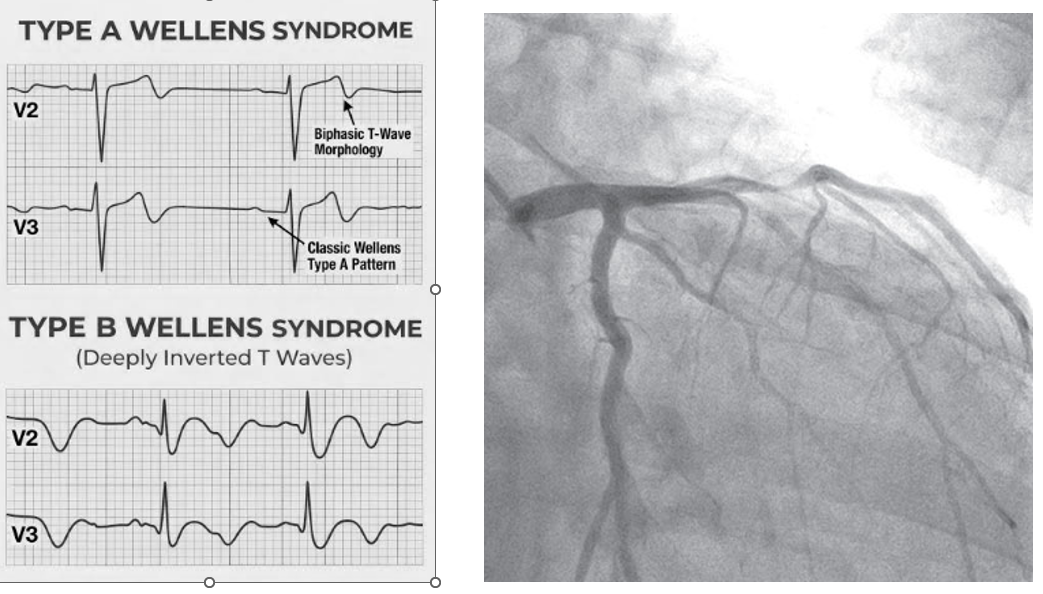
However , the temporary total occlusions that cause the rest angina are either due to transient thrombus or dynamic epicardial vasospasm that make the occlusion complete , only to reopen later to maintain the UA/NSTEMI status.
*Quantifying the content of the lesion in ACS is tricky . STEMI we know there is definitely thrombus dominates. In NSTEMI it is combination of both . But in Wellens , it is pre-dominatly mechanical for sure.
Clinical implication of low thrombus load
While the original study by Wellen’s did not mention about thrombus at all, the OCT based study Arteaga et al from Mexico documents thrombus in only about 20%.
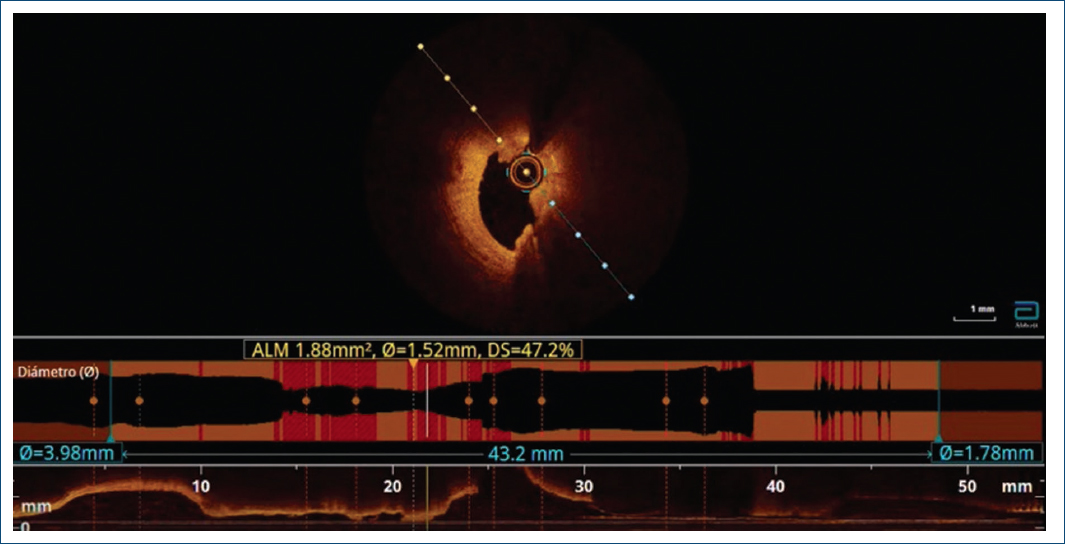
OCT image shows significant, eccentric, lipid-rich plaque in a patient with Wellens ( Ref 3)
This raises a highly provocative clinical question. If a meaningful thrombus burden is fundamentally absent during the stable phase of of Wellens , do these patients truly derive any clinical benefit from aggressive heparin infusions and dual antiplatelet therapy (DAPT)? It is still more concerning, many of text call Wellens as STEMI equivalent or occlusive myocardial infarction , suggesting a huge thrombus load which it rarely show.
Final message
Wellens’ syndrome demands better clinical , pathological and therapeutic reasoning.It probably demands an urgent PCI Some times, we have labelled them as refractory UA go on to receive given 2B -3A blockers* as well increasing the bleeding risk .The lesson learnt is , aggressive anti-thrombotic strategy is largely out of place and risky in Wellens.(Ironically, after the stenting the patient will require rigorous anti-platelet agents )
References
- de Zwaan C, Bär FW, Wellens HJ. Characteristic electrocardiographic pattern indicating a critical stenosis of high proximal left anterior descending coronary artery in patients admitted because of impending myocardial infarction. Am Heart J. 1982;103(4 Pt 2):730-736.
- de Zwaan C, Bär FW, Janssen JH, Cheriex EC, Dassen WR, Brugada P, Wellens HJ. Angiographic and clinical characteristics of patients with unstable angina showing an ECG pattern indicating critical narrowing of the proximal left anterior descending coronary artery. Am Heart J. 1989;117(3):657-665.
- Arteaga-Chan EI, Espinosa-Soto R, Castro-García CA, Gutiérrez-López JM, Aguilar-Silva A, Sandoval-Espadas RA, Huerta-Liceaga F. Intracoronary OCT findings and outcomes in Wellens’ syndrome: a case-control study. Arch Cardiol Mex. 2025 Oct 8;96(3):182-188. doi: 10.24875/ACM.25000090. PMID: 41061277.




