Feeds:
Posts
Comments

Archive for 2010

How  central cyanosis occurs  in primary pulmonary hypertension ?

While , peripheal cyanosis*  is easily explained in PPH ,the mechanism of central cyanosis is not straight forward.

The following explanations are offered

  1. PFO**  getting  opened due to high mean RA pressure
  2. Pulmonary arterio venous channels.(Neogeneis or dormant channels activated )
  3. Altered QP/QS .This effectively means lung shunts some blood without oxygenation(A right to left to shunt within lungs )
  4. Associated lung pathology -like pneumonia resulting in pathological right to left shunt across the alveolar circulation.

* Peripheral cyanosis can occur in PPH with cardiac failure

**PFOs are often anatomically patent in 20 % of normal population , which gets functionally patent  when exposed to high RA pressure

Cyanosis -A brief  description .

Cyanosis occurs when the arterial saturation goes below 85 % . Cyanosis  manifests in two ways . Central and peripheral.The term peripheral  does not  denote  peripheral parts of the body  rather it is  peripheral  circulation.(Capillary) The mechanism of peripheral cyanosis is somewhat  different from central cyanosis . It is generally due to sluggish circulation ,  more  oxygen extraction and resultant bluish discoloration .

Peripheral cyanosis is seen in finger tips, lips etc . Peripheral cyanosis can not occur in warm areas of the body for the  simple reason warmth  causes vasodilatation , better tissue perfusion  which prevents stagnation of  deoxygenated blood.

Central oxygenation defect alone can not result in  classical central cyanosis .

For central cyanosis  to occur ,  there need to be mixing of  deoxygented and oxygenated blood somewhere in the  circulation.(Right to left shunt in the heart or lungs )

Since it is a defect in central  oxygenation it  manifests  in both warm mucous membranes as well as cold extremities.

Read Full Post »

Infective endocarditis continues to be a challenge for the cardiac physicians.

While we have innovated too much( More than what is required !)  in the interventional arena little is progressed in the last few decades on  this vital  area  of  “Infections of heart”.

Globally , deaths continue to occur in prime ages due to rampant infections of the heart valves.

Prevention of IE was recently deglamorised by diluting the criteria for prophylaxis by ACC/AHA (Cost issues ,  overwhelming science ? )

So, what is left in the war against IE ?

Early diagnosis and recognition

How to diagnose it early ?

Suspicion is the key  . . .

When to suspect ?

Suspect in all with fever and h/o heart disease . So far  no case of afebrile IE reported !

Get rid of the common myths

  • You don’t require vegetations to diagnose IE
  • Blood culture need not be positive
  • Fever can be low grade
  • Rarely severe fatigue is the only sign

This effectively means , one can diagnose IE without a major criteria of Dukes.

One can diagnose IE with 5 minor criterias

If you wait for a major criteria to develop to start treatment , it could be a  costly miss .

So have a open mind, suspect IE, treat early.

Do not unduly worry about , overuse of antibiotics in case of  false diagnose of IE.This  attempt is worth in weight  of gold !


Million ton of antibitics are used indiscrininately in this world by all walks of physcinas for simple cold and surgeions  non existing peripopertaive infections .

While , the global medical community has  accepted this concept with total submission (Intentional harm condoned !) , it is funny to ask for 100% appropriateness in the therapy for a  deadly infection of heart.

It is absolute necessity  to  inject an  anticipatory antibiotic in all cases of suspected IE with high risk valve lesions. (Of course ,  it need to be a reasonably appropriate antibiotic with microbiologists consultation to avoid interference in the subsequent culture evaluation !)

Minor only infective endocarditis.

Please note IE can be diagnosed with the following 5 minor criteria

  1. Predisposing lesion
  2. Fever >38c
  3. Immunological / Vascular lesion
  4. Culture eqivocal
  5. No clear cut vegetation , but high suggestion of vegetaion, New valve regurgitation

A related article in this blog

Vegetation negative infective endocarditis .

Final message

Never hesitate to start empirical antibiotic therapy in suspected high risk IE

Let us err . . . for the patient’s sake  !

Fever + New murmur*= IE until proven otherwise (Oxford handbook of  clinical medicine  P 136 7th Edition )

*It can be read as , presumably new murmur to increase the sensitivity.

Read Full Post »

Patent foramen ovale is probably  the commonest  congenital heart defect.  (Bicuspid aortic valve will run close to it ! )

Note : PFOs  cannot be  called as a  true disease , since it is a  benign anatomical defect with little or no hemodynamic impact.

Consider  this scenario . . .

The incidence  of PFO could be as high as 20% of adult population. It means nearly 100 crore people of this planet  will suffer from this entity !

When does it become significant ?

Paradoxical embolism : In young persons with cerbro vascular accident , PFO s are more commonly observed , implicating some form form of venous to arterial embolus .

In some persons it is believed , it can shunt few CC of blood from right atrium to left atrium at times of right atrial hemodynamic stress. Like severe physical  straining  (valsalva like )

In seriously ill ventilated patients  PFOs can worsen the  hypoxia especially with  PAPP  mode .

When does it become a life saving savior ?

  • In patients with DTGV and intact IAS  even a a small PFO can sustain a life  till , emergency surgery or intervention is done .
  • In patients  with severe  pulmonary hypertension the PFO may act like a safety valve, opening at a critical moment and decompress the  right atrium and which  indirectly relieves  the RV wall stress as well .

Fancy relationships

Now , it is  considered PFO  is related to migraine by some means ! ( What means !)  The belief has strong evidence base that has lead  the aggressive  interventional cardiologists to  find a new hole to close  . This indication ,  if  approved will have a perennial supply of patients  as there are 100 crores of them .

How will you differentiate a PFO from a small ASD ?

Size alone can be a useful pointer in differentiating a ASD from PFO.

A PFO can  measure  between  2 to 10mm  ( most measuring between 4-6mm diameter)

Size matters !  The upper limit of PFO is the lower limit of ASD .

Practical experience suggest any defect  above 7mm should alert  us about the possibility of true ASD.

Other useful clues

  • PFO are always restrictive  (Use pulse doppler probe right across the PFO /ASD in subcostal view .If you pick up a gradient > 4mmhg (velocity 1 m /sec) PFO is confirmed.
  • Most ASDs do not show any significant  gradient
  • Right ventricle and right atrium should be normal in PFO  (Unless due to some other cause )
  • Doppler flow across  pulmonary valve can be very useful . If it exceeds 1.5m/sec , left to right  shunting is likely to be significant and PFO is unlikely.

Is there an entity called restrictive ostium secundum ASD ?

If so ,  how will you  differentiate it from PFO ?

Yes , we have ,especially in  cyanotic heart disease

Like TGA , Ebstien etc .

Isolated restrictive secundum ASD is extremely rare .

* There is no way to differentiate a restrictive ASD from a similar sized PFO .

What is the role of TEE in diagnosing PFO

It has a major  role in delineating the IAS anatomy .

Read Full Post »

Coarctation of aorta  continues to be an  important  acyanotic heart disease  . Now , early recognition  and intervention  is possible with the availability of sophisticated imaging and interventional modalities.

Our understanding of this  entity , even though appears complete  . . . it  is not ,   especially the complexities of the collateral  circulation and the associated malformation.Even in this 21 st century , unexpected circulatory  compromise are reported in the postoperative phase from various vascular  beds (Spinal, mesentric, limbs etc)

It is also  surprising to note ,  much innocuous entities like  ASDs ,VSDs  have  popular  anatomical and functional classification.It is a  rare excercise ,  for cardiology fellows  to classify co-arctation of aorta .This ,  in spite of the fact,  we have a  meticulous classification suggested by Amato , way back in 1991  published in Annals of thoracic surgery .

Let us  be  aware of this  . . .  Click  the link below for Amato’s classification

Amato’s  surgical classification of  coarctation of aorta

Type 1  Primary Aortic Coarctation

Type 2 Coarctation with Isthmus  hypoplasia

Type 3 Coarctation with Tubular hypoplasia of distal arch

3A- With VSD

3B-With complex LV outflow lesions

* Ideally  we need to include BCAV and status of ductus , suitability of aortic stenting in the classification.

Other old classifications

Bonnet’s classification 

Infantile :which later became known as pre-ductal, and adult which later became known as post-ductal . These became obsolete , as we came to know all coarctation or juxta-ductal .(Very difficult to separate into pre or post ductal coarctation  by simply  looking at it  , without knowing the hemodynamics )

Conte et all      **  Backer

1.Isolated coarctation  2.Co- arctation with  VSD 3.Co arctation with complex heart anomalies.


//

Read Full Post »

Aortic hypoplasia is a common observation in many congenital heart diseases  especially  acyanotic CHD. It is  important  to know the adequacy of systemic blood flow , in left-sided embryonic flow  defects like , co- arctation of aorta, interrupted aortic arch, shone’s complex etc .

The hypoplasia is thought to be due to two mechnaisms

1. Low flow state in utero( fetal heart) and the  resultant hypoplasia.

2.Ductal tissue migration into adjacent arch  which leads to  friendly arch  contraction !  when the  PDA gets closed

in the immediate new born period .

When do you suspect aortic hypoplasia ?

There is no strict definition available.But the Becker’s  data base provides a working rule.

Hypoplasia is diagnosed when ,

  • Isthmus is , < 40 % of  diameter of ascending aorta
  • Proximal  transverse arch  is ,  < 60 %  diameter of ascending aorta
  • Distal transverse aortic arch is , < 50%  of diameter of ascending aorta

Why ascending aorta is taken as reference ?

It is least likely to affected by the shrinking ductal tissue . Descending aorta can be a reference but it is at a  remote location and difficult to image .

Reference

Becker’s  CHD nomenclature and data base project . Annals of thoracic surgery  2000

Read Full Post »

It is a well known  cardiac auscultatory  sign,   S 1  becomes  variable in intensity with the onset of atrial fibrillation.

In physiology , the intensity of S 1 is determined by many factors.

  1. The valve morphology(Thickness, Calcium , Rigidity )
  2. Valve mobility
  3. PR interval
  4. Force of LV contraction
  5. Preceding RR interval (4 and 5 are inter related)
  6. Insulation and auditory factors (Thick chest wall  etc)

How does atrial fibrillation modify the intensity of  S1 ?

It is to be noted , atrial fibrillation alters only one  of the above factors, namely the RR interval which becomes irregular.

The mix of short and long RR intervals  occurs at random  . A short RR interval, results in a relatively softer S1  and vice versa . The mechanism is directly attributable  to the degree of LV filling and subsequent change in force of contraction .

Many times , at fast ventricular  rates (Say >150) the distinction between short- long cycles is  negligible in terms of net cardiac cycle.

If  the RR interval , is too prolonged there can be an  inverse relationship  with s 1 intensity .It gets  muffled as the  mitral valve floats back  to it’s  orifice and a partial or even complete  closure occurs , making  force of LV contraction irrelevant in the genesis of S1 .

The vanishing act of PR interval  in atrial fibrillation.

It does not require great brains  to  understand ,  if P waves are absent ,  PR interval must also be absent !

If PR interval is absent ,  there  can be no  influence of it on the first heart sound. Logic demands  absence of PR interval must have some sort of  influence on the intensity of S1. As far as i know cardiology  literature has not answered this query.

What are the two types of S 1 variation ?

Experince  has shown us , the variation of S1 can be of two types*.

Sequence 1 : Varying between , Loud -Louder- Loudest -pounding

Sequence 2: Varying between , Loud -Normal – soft -Muffled

* Applicable only for those with shrewed ears !

S 1 intensity with reference to underlying pathology : Valvular vs Non valvular atrial fibrillation

It is obvious the impact of  varying RR interval on  the intensity of S1 will directly depend upon the underlying pathology. The  intensity of   S1  in  non valvular AF (Like , lone AF, Thyrotoxic AF, Hypoxic  AF ,Ischemic AF etc)  are  more vulnerable to  changing   RR interval .

In rheumatic heart disease , the influence of valve morphology , rigidness, calcification and presence  of MR  generally prevail over the  impact  of changing RR interval .So,  in a case of tight mitral stenosis  and AF  it  is expected the sequence 1 is more common .

In lone AF or AF due to CAD , sequence  2 is more likely *  Associated LV dysfunction , and ischemic   MR may further dampen the intensity of  S1 .

Clinical implication

Hearing  few occasional  loud  S1 in AF , is an indirect indication that underlying LV function is good,  as it reflects the force of  LV contraction .

Silent AF

Some hearts are notoriously silent even in the midst of AF. If  the silence is not  due to obesity  or  other insulation defects,  it suggests a sinister diagnosis ,  like severely  dysfunctional ventricle  like  DCM etc.

As a corollary, it is often noticed ,  palpitations* are , often not  felt  by patients with dysfunctional  ventricles  in spite of atrial fibrillation. (As loud S 1 is rare with dysfunctional ventricle)

*Palpitation is a symptom that equates to Dp/Dt of ventricles.

What  happens to mid diastolic murmur in AF ?

The murmur length  varies  linearly with reference  to RR interval. The pre systolic  accentuation disappears ,but   pre-systolic component may persist .

Final message

Simple, bed side auscultation during atrial fibrillation can give us vital clues about the etiology, and the  underlying LV function .  Let us not be ashamed to talk about clinical cardiology  . . .at least in the bed side !

Read Full Post »
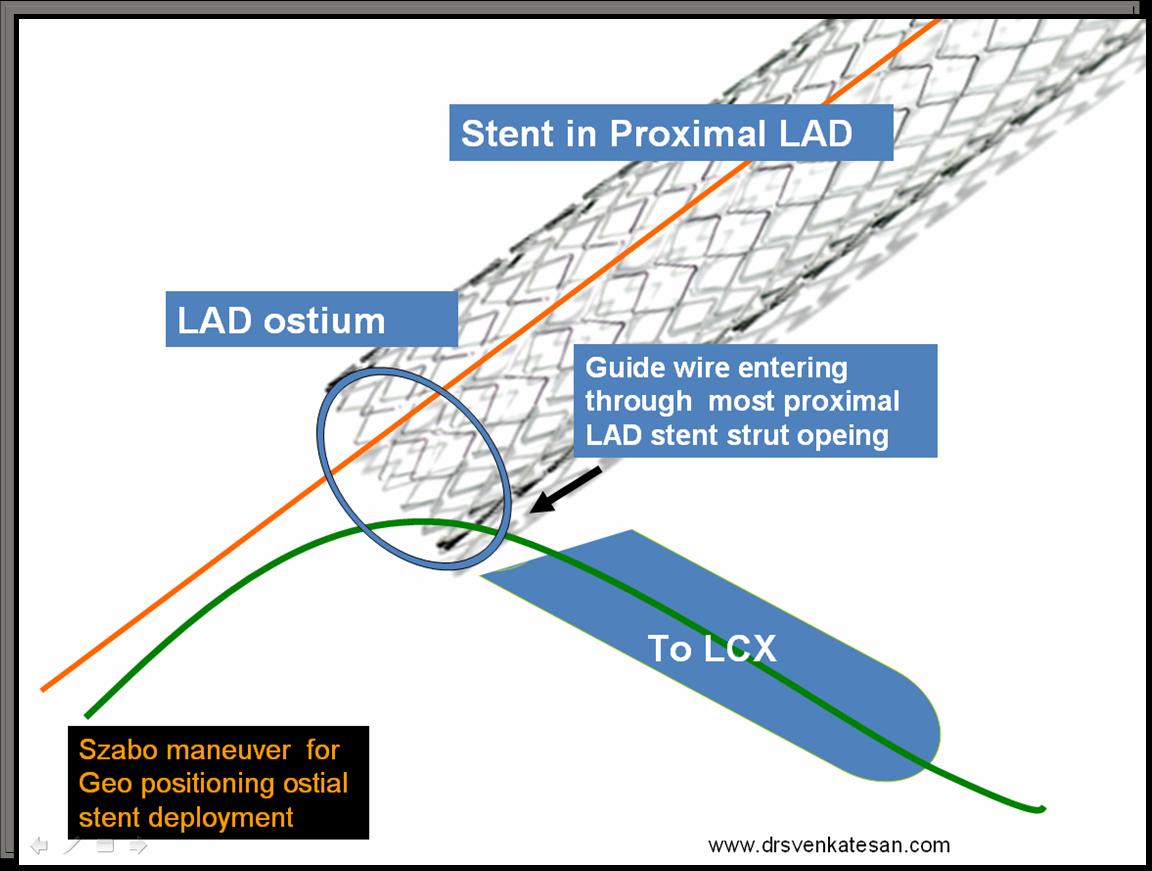
Bifurcation lesions and ostial lesions  continue to  challenge the expertise of   interventional cardiologists.

Variety of techniques have been described. Geo positioning of a ostial lesions ,  exactly on the rim of ostium  is required  . This is very difficult in  many patients  , as stent migration either into side branch or protrusion into the main branch is common. Both reduce  optimal  PCI outcome  .

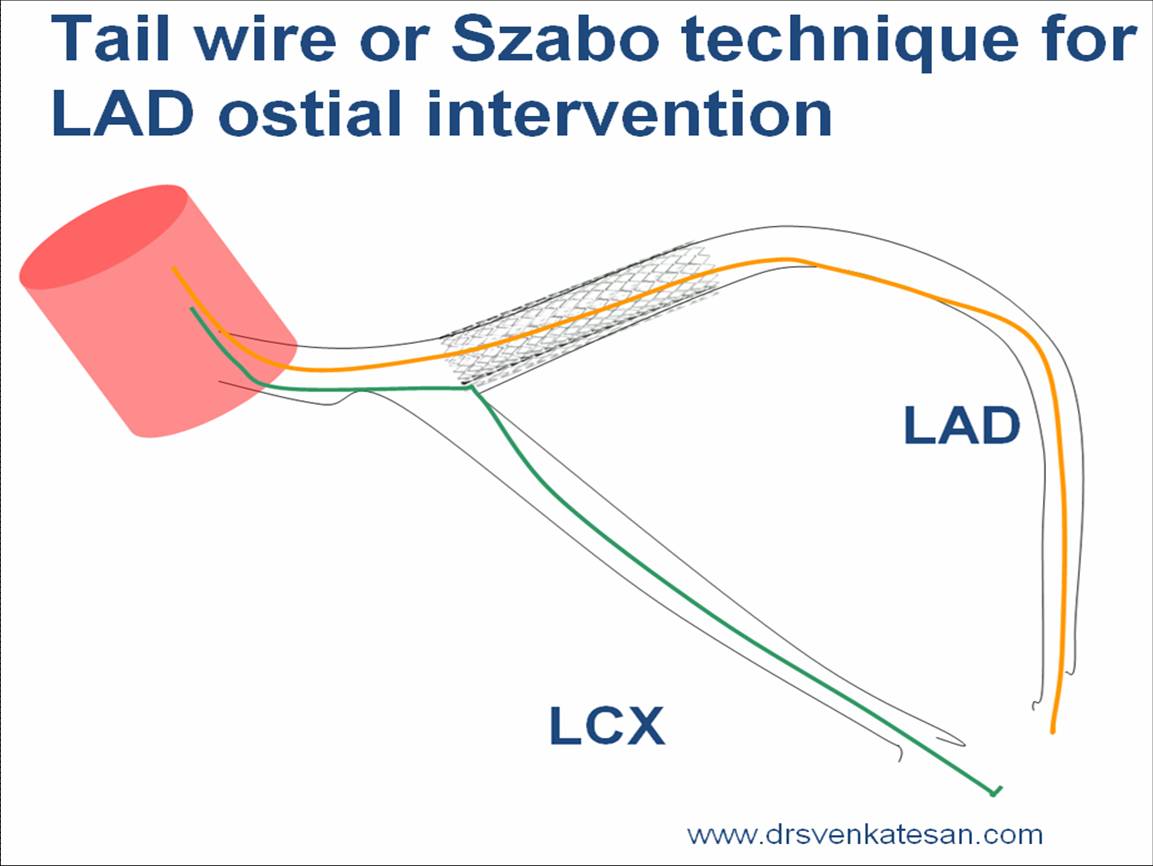
Here is a innovative  technique   described  first by  Szab0 in 2005 TCT conference .

Highlights of the technique

  • It is a twin guide  wire technique.
  • The Circumflex guide  wire  is threaded over the most proximal strut  of  balloon mounted  LAD stent .
  • The guidewire makes sure the LAD stent move beyond the LAD ostium .
  • Of course some technical limitation is  there, this seems to be a good option at least in some deserving  LAD ostial or LCX ostial lesions

Technical hitch

The balloon and stent is to be manhandled prior to deployment.  We are little awry to do it

The review article in the journal  Eurointervention

Read Full Post »

Japanese cardiovascular society publishes this journal  called as  “Circulation  journal” It has some great articles in every Issue .The Impact  factor is consistently rising.

Please do not get confused with AHA’s  “Circulation”

Read Full Post »

There are thousands of forums for medical science.

Most are aimed at research.  Few are available  to scrutinize  research.

Cardiac safety research consortium

This one from Duke university ,  is a great beginning in collaboration with FDA .

Let us welcome , this whole heartedly and wish all success in it’s motto !

Namely , exposing all safety issues in the modern cardiac therapeutics .

Read Full Post »

Learning (and of course unlearning! )  is a continuing process in the field of medicine. . We have exclusive  medical universities for various specialties . The popularity of  radial access for doing coronary interventions is progressing very fast and  the  femoral puncture technique  is expected soon to become   extinct !

Here comes a virtual on-line university for mastering radial artery interventions.

I wonder  , they issue a  Master’s degree  on the subject !

Thanks to Terumo for  initiating the concept .

Read Full Post »

« Newer Posts - Older Posts »