Feeds:
Posts
Comments

Archive for the ‘cardaic physiology’ Category

Normal  left atrial  (LA) volume is about  22ml/sq.meter body surfacearea  at all ages.Maximum LA volume in physiology is  about 46ml in  females and 56 ml  in males( Average 35 ml)

LV stroke  volume  for each beat is  about  70  ml . . . so where does  the remaining 35ml come from ?

Answer .

  • Pulmonary veins ?
  • Residual LV end systolic volume ?
  • Mix of the two ?

It is logical to assume about 35 ml of fresh  blood  from 4 pulmonary vein*  rushes into LV with every diastolic cycle  .It  never stays in LA  .It just uses LA as a transit  route ,

*In diastole the four PVs,LA  and LV all act like one single chamber .


Is this reasoning correct ?.

If we believe the continuity equation this explanation is correct . However still what  we need to know the fate of residual  LV volume (End systolic LV  volume which is also  about 35 ml that would be  in queue for ejection into Aorta  for the next beat !)

Further , we know the LV end systolic volume is not constant .During exertion it  can reach  negligible levels (<10 ml) .At times of vigorous contractions  it can touch near zero as well . Then , It become vital for the  pulmonary venous reservoir  to be act as a  major donor for  LV blood volume for  every ensuing beat.

If the hemodynamics of pulmonary vein LA interface is tricky even in physiology ,  one can imagine the complexities  if the LV diastolic function and left atrial compliance  is affected

Debit and credits of  LV end -diastolic volume .

Let us assume LVEDV is about  1o5  ml .LA blood volume is  roughly one third of LV volume .For every beat equal amounts of fresh blood  from pulmonary vein . These two (LA+PV)  adds to the  residual  blood in LV  to make LVEDV 105   ml . From this 70 ml is ejected as stroke volume leaving behind 35 ml.


lvedv lvesv stroke volume wiggers cycle left atrial volume pressure volume loop residual diastasis

Image template from http://www.cvphysiology.com

 Further questions

LA Chamber volume and blood volume need not be same .What  I struggle to understand is , total anatomical  LA volume  measures  35ml , while the amount of blood it is supposed to hold is also about the same .Does  it mean the LA is completely filled with blood . . . air tight !

Will the LA compliance make it accommodate twice or thrice the blood volume during exercise ?

What is quantum of residual end diastolic  LA volume ?


Reference.(Normal LV and LA volumes )

echopedia


Read Full Post »

Obesity is a major cardio vascular risk factor.We earnestly  believe  this  by  evidence from Framingham and other studies.However , epidemiological  truths   can be dissociated from individuals .

We now understand  some  of the obese  patients fare better in CHF outcomes  apparently because of the obesity ! Even patients who undergo PCI show some benefits.This concept  is being proved in large data base of  > 200,00 patients.

Possible mechanisms

The lay man’s logic may apply (Science hidden somewhere !) Obese persons  have basically a  large heart with better cardiac reserve and  muscle mass .These hearts are  pre-conditioned to extra burden of MVO2  in it’s life time . So it  is able to tackle  hypoxia better, takes more time  to get fully exhausted .After all heart can consume fatty acids for it’s energy requirement.

Adipose tissue may also  secrete favorable anti-inflammatory  chemicals , though majority of adipocytokines are detrimental  except adiponectin .Paradoxically  the tumor necrosis factor TNF  (Same as cachectin or Interleukin 6)  is less  in obese patients .


Reference

obesity paradox

obesity paradox 3

obesity paradox 4

obesity paradox 3 jama archives of internal medicine

Reference

The landmark Lancet article that first raised the question of obesity paradox

http://www.ncbi.nlm.nih.gov/pubmed/16920472

http://care.diabetesjournals.org/content/36/Supplement_2/S282.full.pdf+html

Counter to the  concept

obesity pardox does it exist

http://science.howstuffworks.com/life/human-biology/obesity-paradox.htm/printable

Obesity   paradox applies in stroke too ! This study (TEMPIS) from Berlin  Germany  suggest controversially though


Read Full Post »

Spinal cord is a busy  neurological  highway to brain .It  runs  24/7  non stop  with unlimited  horizontal and vertical lanes .It is such a compact  structure , it can  easily  get confounded   when multiple signals converge,  diverge, summate , deduct , reflect back,   or cancel out .
A 64 year old women came to me for  second opinion  regarding   chest pain . A  cardiologist  had  just adviced her  an  emergency   coronary  angiogram and also suggested she may require an  urgent  PCI  as well .
I listened to her history in my office  . . .  In  her own words .
Doctor , I am  getting  sudden   compressing  type of  pain which  starts in the centre of the chest and soon transmits to the left shoulder and  gradually reach the inner aspect of the hand up to the little finger . And occasionally it is very severe and some times i feel like sweating as well ! I am unable to predict when it comes doctor !
It was  so convincing  but one  feature was  not fitting In . She said , she used to walk  daily   and do all house hold work with no pain . She also  recalled about the  acid peptic disease , and neck pain periodically due to cervical spine problem.
Her resting ECG was normal .She was  afraid to do a stress test . After thinking  for a minute , I had no  other option  but  to endorse  my colleague’s view and asked her  to go for coronary angiogram .
One  thing I  suggested differently was , I told her it was not an  emergency , I also  conveyed my gut feeling  that it is unlikely to cardiac  pain . One week  later  CAG through radial route  was done . Both of  us were  happy  to find a  normal  coronary  angiogram !

Final message

Pain is a  feeling . It can be  perceived  at  multiple levels  . The site of origin , spill over on transit and at the level of brain .  A patient with multiple  potential source for pain can either summate , deduct , reflect  or cancel out .This can confuse the clinician in a dramatic fashion as it did to us ! . To complicate the matters  further , gastric pain can trigger a cervical  pain and vice versa . (Spill over effect)

Read Full Post »

  1. The concept of  FFR is based on pressure gradient  alone.In any hydraulic model (Both biological and non biological systems ) pressure difference  is the least   important parameter  that determines flow.
  2. FFR  is unphysiological  as hyperemia   is  artificially induced one .(Adenosine  is not the only parameter that determines it !)
  3. Serial obstructions and branch point hemodynamics are  conveniently ignored.
  4. Reproducibility  remains a big question mark .
  5. On safety  issues  FFR  is a suspect.( Often times , it  requires expertise comparable to  that of a  complex  PCI !) .Beware , the FFR unit has stiff catheter system and is an additional health hazard .  I have witnessed   atleast two cases  where  insignificant lesions were  made significant by  FFR related Injury .
  6. And  now the  knock out punch ,  ! Probably the most vital  issue for which FFR should be banished * , it is not taking into account of vulnerabilty of a plaque .( An FFR > .9 with a hanging , eccentric , mid LAD lesion was left alone by one of the  academically up to date ,  evidence  based interventional cardiologist!  )
           (*If perfomed  in isolation without IVUS/OCT  )
I am still wondering how this concept came into cardiologist domain and into the cath lab .It should have  never been let out of theoretical physics labs !
Final message
The best way to assess physiological significance of an anatomical obstruction is  to  do  exercise  stress test .
If  the lesion is  able to sustain good exercise capacity , it  can be deemed physiological unimportant.
While , this is an explicit  proof  in single vessel disease  ,  even  in   multivessel  CAD ,   EST  is   a  collective  measure of  coronary  reserve flow .( Something like instantaneous equivalent of virtual  multivessel  FFR  )
Moderated After thought
FFR is a highly specialized theoretical  tool , that has very limited role in cath lab .
The two major practical (Non academic)  use of FFR   is to shun away  those   internet fed ,  annoying, pseudo  intellectual patients ,  who constantly ask for  angioplasty  for  obliviously insignificant lesions !
FFR comes very handy  to  bail out  cardiologists at  times of distress   ! (To escape  from the wrath of our patients   after a sub optimal &  technically inferior   PCIs   and   in  the  long term confabulations  in   restenosis  after stenting !  )

//

Read Full Post »

The mechanical atrial function   during atrial fibrillation remain a mystery . In fact , the general  belief  is during  AF  the mechanical function of atria is zero. This is why AF  is promotes stasis and   LA clot formation. It may appear theoretically correct  , still   AF especially coarse  still imparts some amount of  mechanical motion .But this usually does not translate to any useful hemodynamic function .

If atrial booster pump is lost (which is said to be 25 % of  LV filling )  suddenly one expects dramatic symptoms  especially if there is associated LV dysfunction or aortic valve disease .

But in real world AF is well tolerated arrhythmia in most  .  We know by land  mark trials AF  is as good as sinus rhythm  if the rate is  is under control

This is a definite evidence the AF  may not compromise  LV filling   even if   it nullifies  the  atrial contractility .

There is one  more evidence for  retention of atrial mechanical activity in spite of AF .It is well recognised , pre-systolic accentuation is preserved  in many cases of mitral stenosis with AF.

*Crazy hemodynamics : For an attached LA clot to  dislodge ,   one needs some amount of LA contraction isn’t ?  Unfortunately  a fibrillating  atria always  tend to  have this one ! This again is a senseless  proof for some  mechanical activity of LA during AF !

How is this possible ?

Is it a  purely volume dependent filling   ? ( Or )  is it  the  Intrinsic LA starling forces that do not depend electrical atrial activation .

This is definitely an  issue to ponder over . A good LV contraction makes the atria empty more completely . This would  somehow  mean , LV relaxation  is facilitating atrial function . During  AF the LV  handles effectively  the additional burden  imposed by the loss of   25  %  booster pump of atria ( Accelerated LV relaxation ? )  A  constantly  changing  RR interval makes LV diastolic function a more complex event .

Final message

Atrial fibrillation is  a well tolerated  arrhythmia in vast  majority of patients  . This  implies either of the two things.

  1. The so called  physiological atrial  booster pump is redundant  or dispensable in otherwise healthy heart
  2. The booster pump is indeed important  . . . but it is less  affected by AF as long as the rate is under control !

It is to be  strongly emphasized , Heart rate and  LV function  will ultimately determine  , how one is going to tolerate the AF  !

It is  a small gesture  from LV  to LA  at it’s hour of crisis  . . . in return  for  it’s lifetime assistance  as a booster pump ! 

Postamble

How  rate control  prevails over rhythm control in spite  zero atrial contractility in the  former  ?

Comments welcome !

//

Read Full Post »

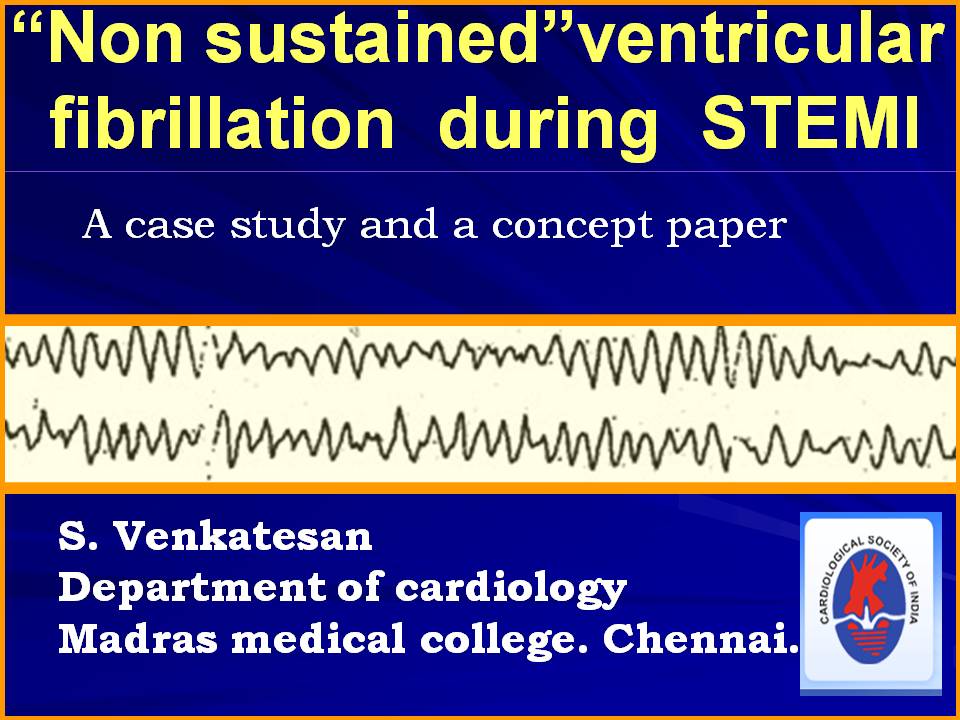
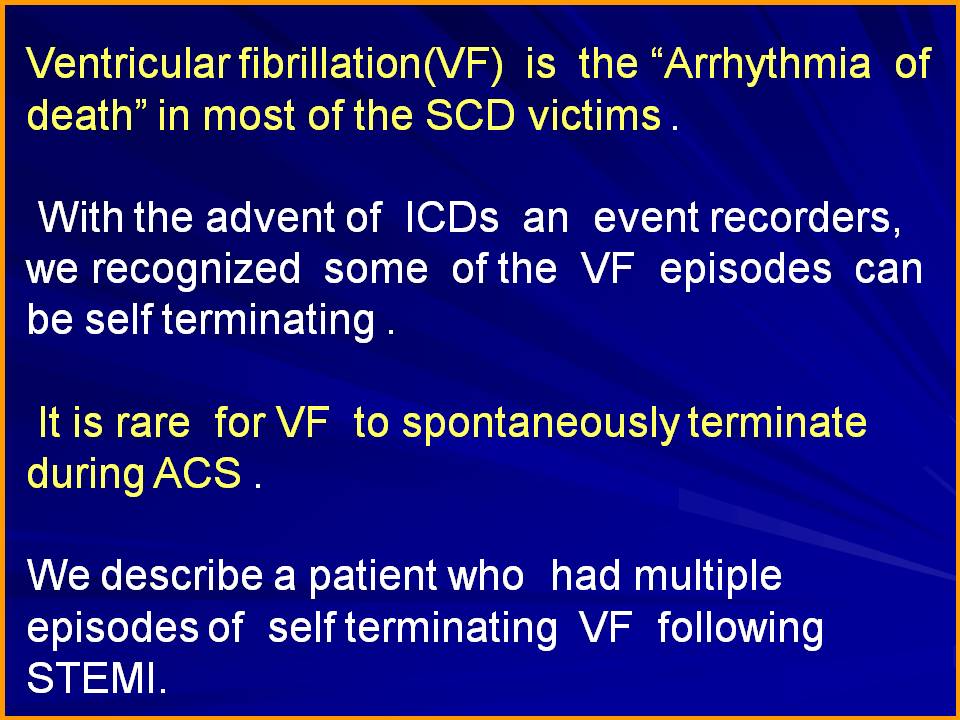
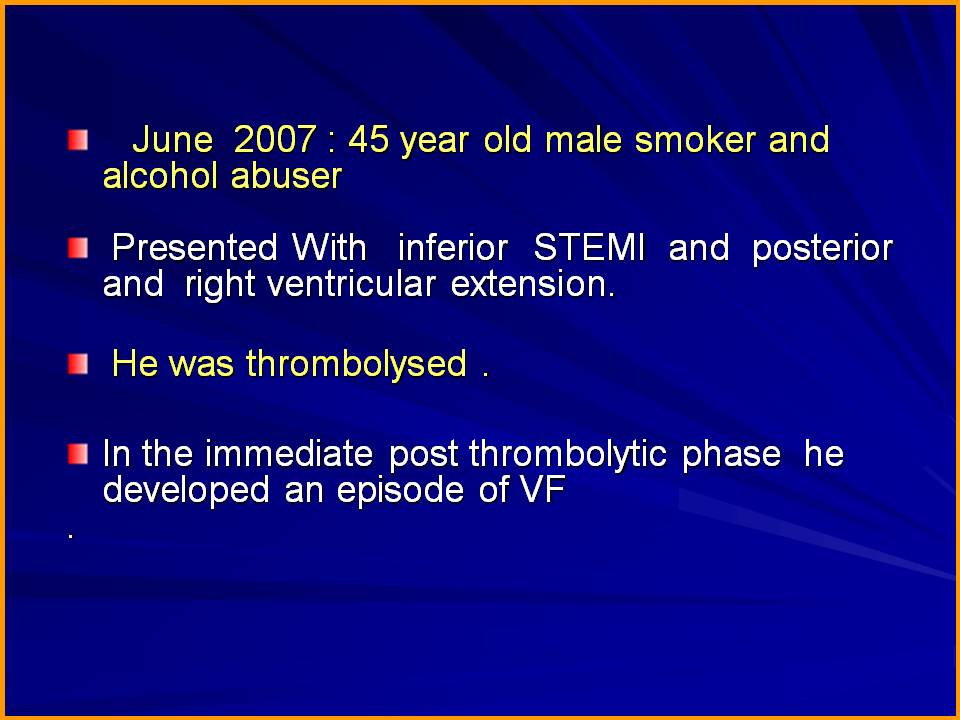
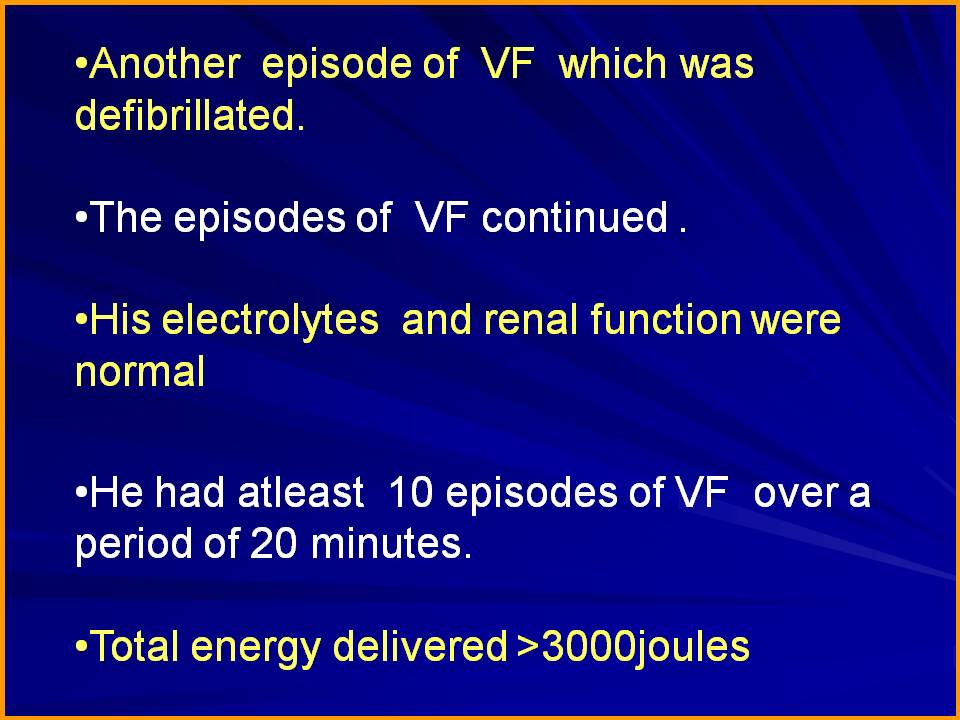
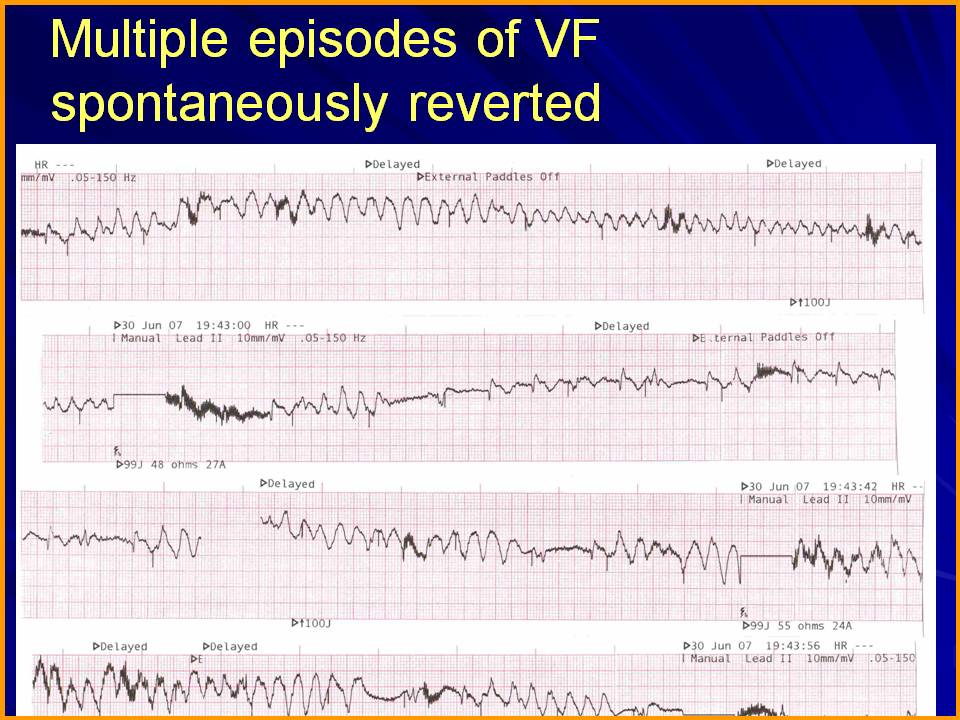
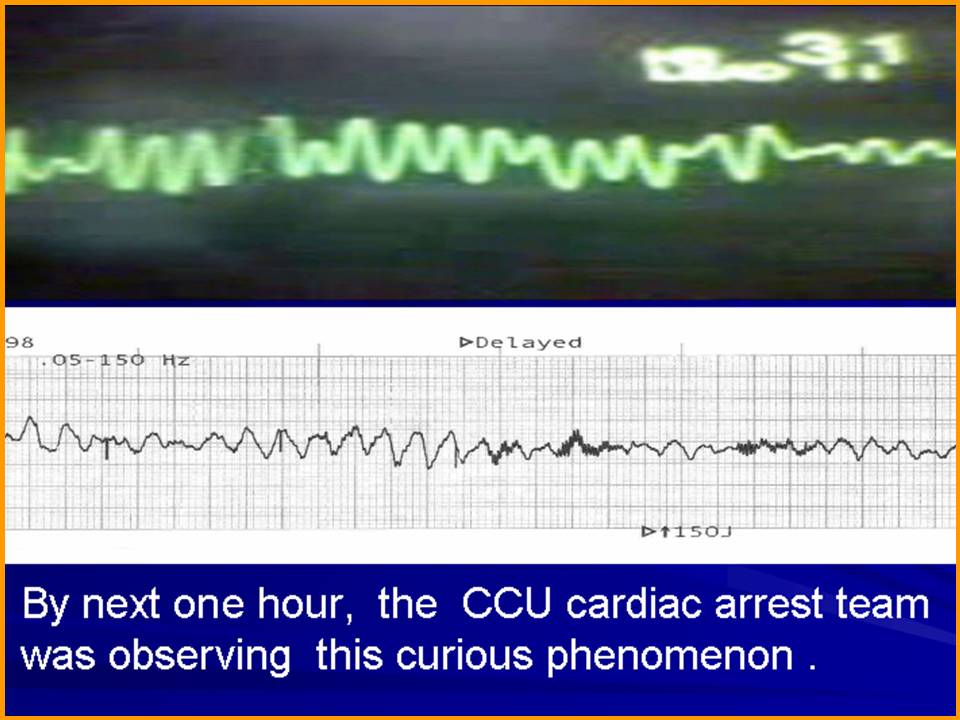
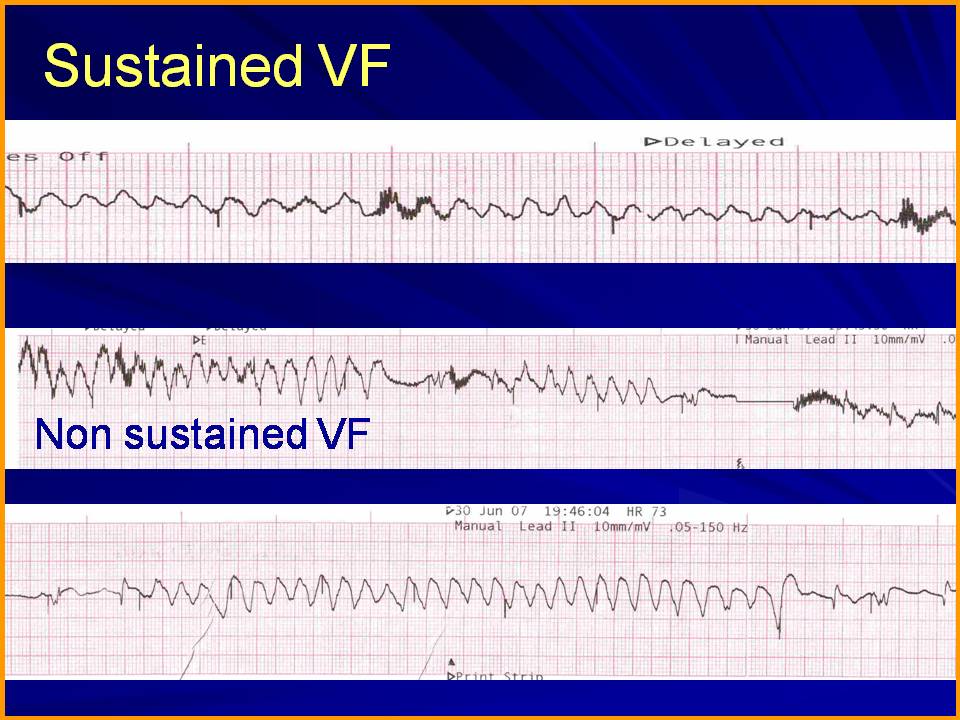
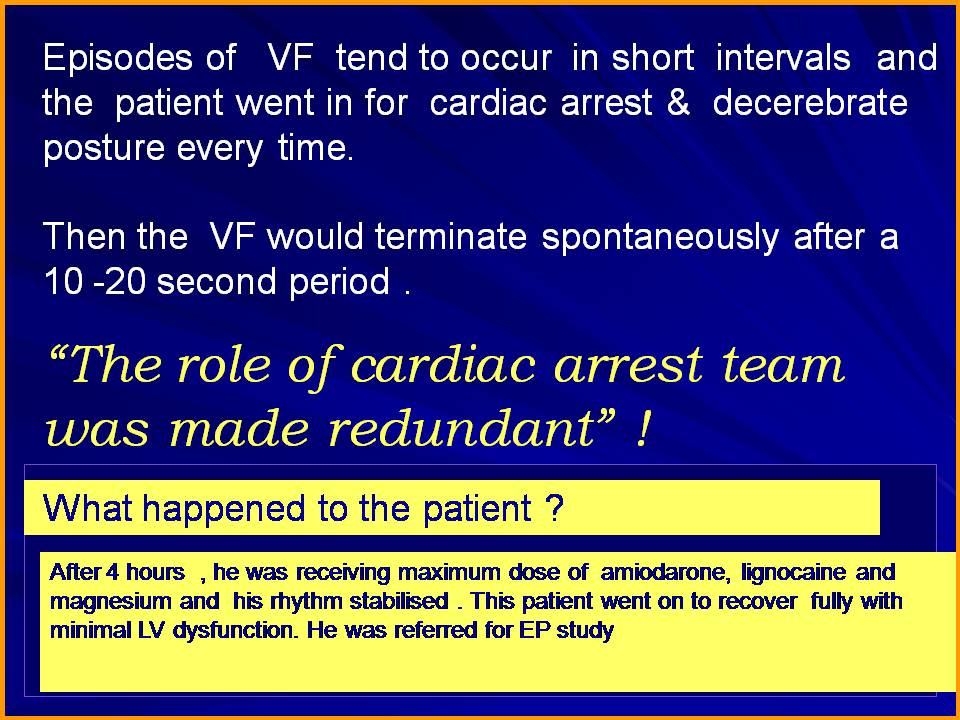
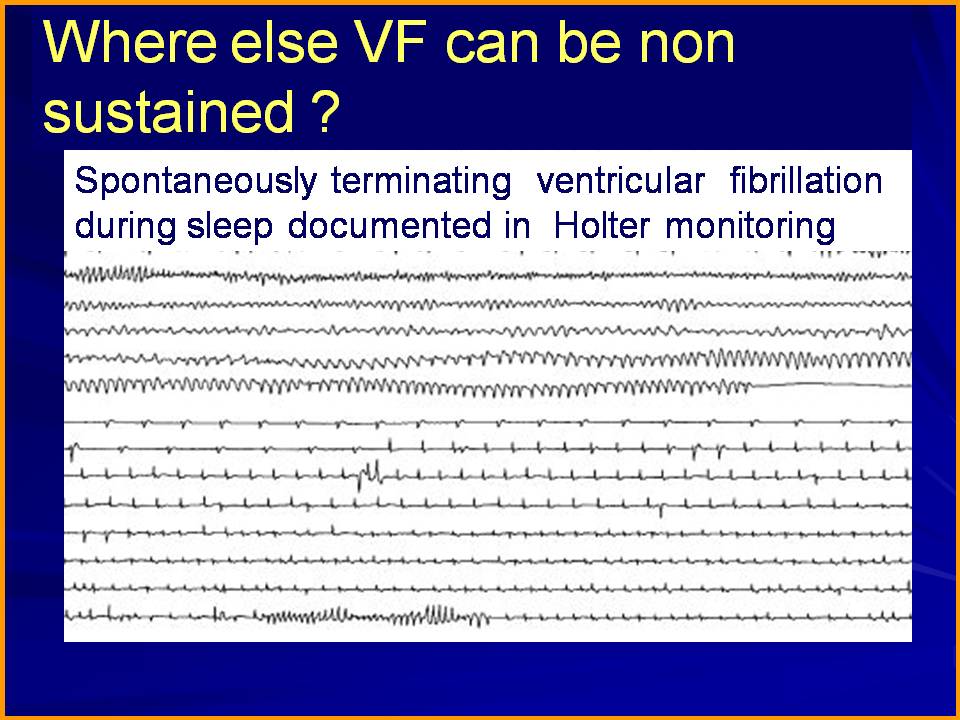
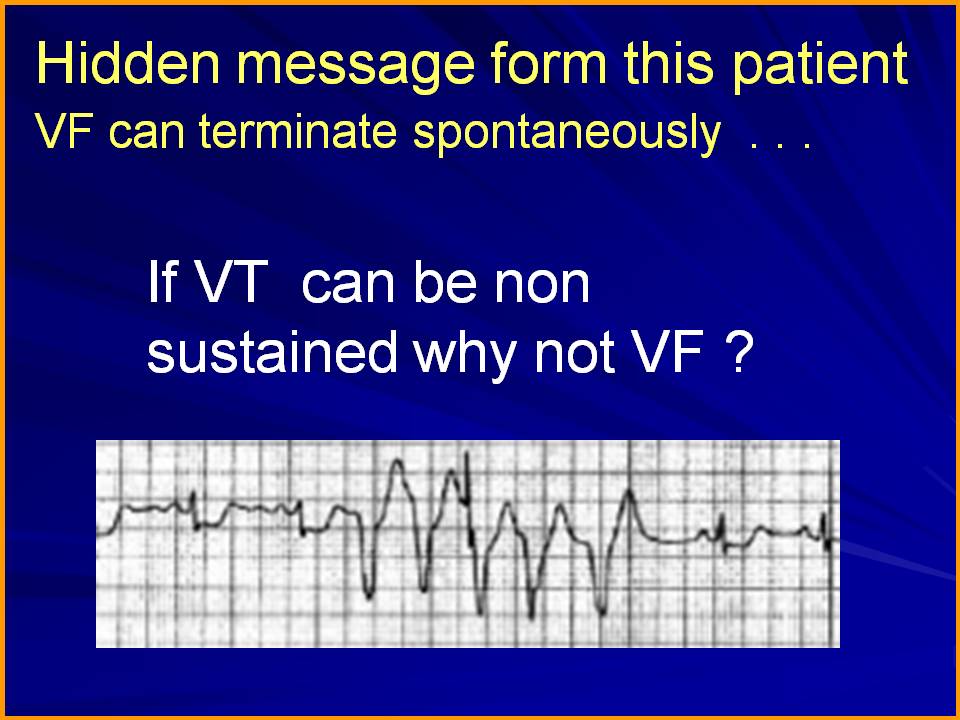
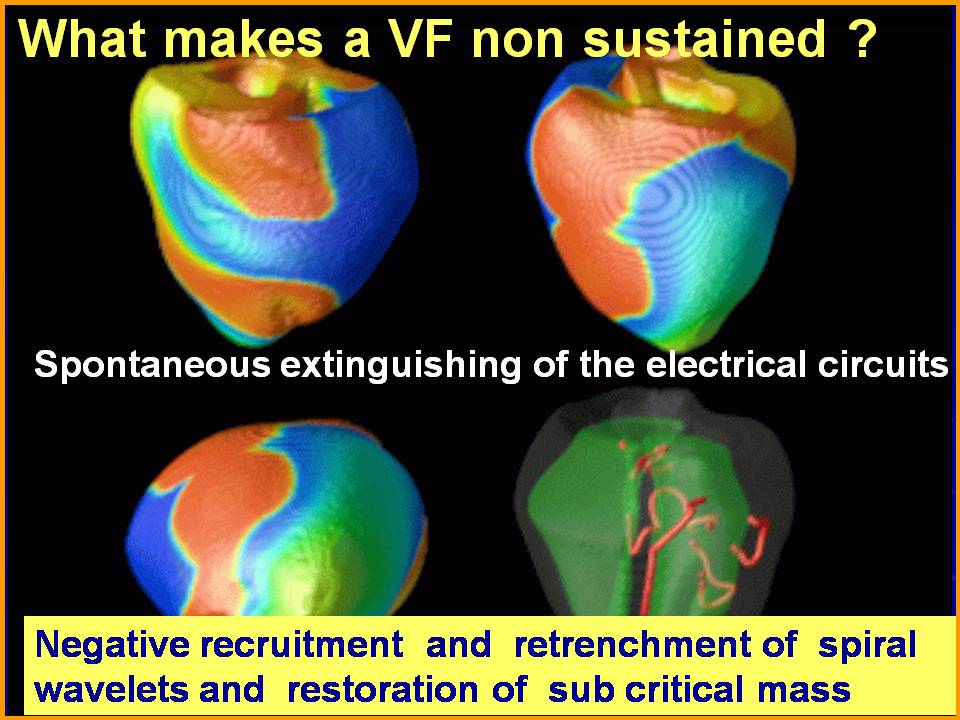
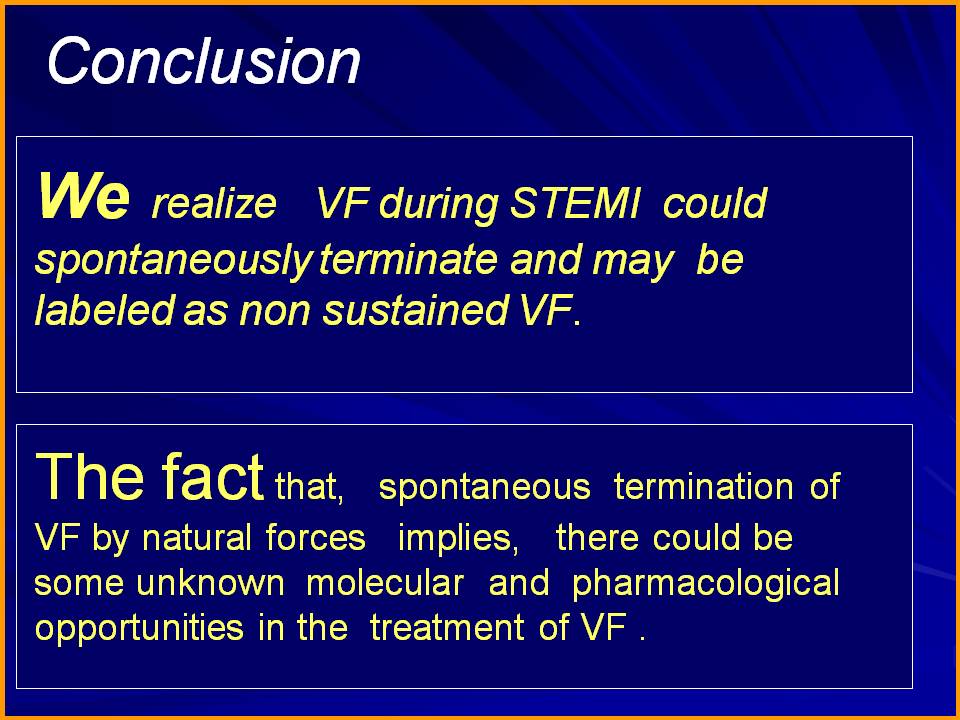
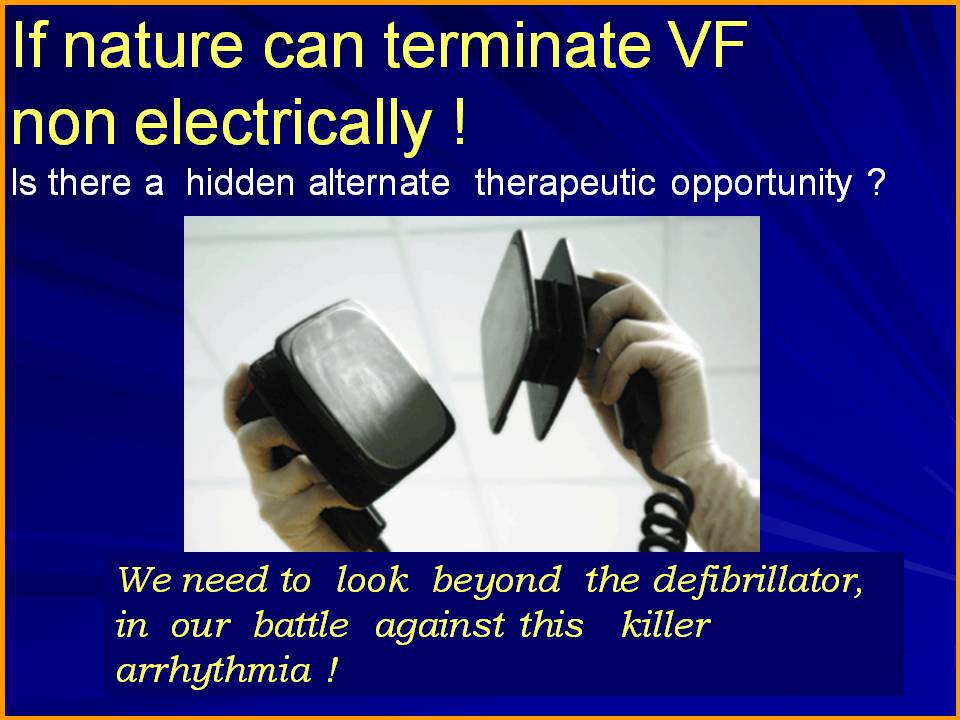
Can VF be a non sustained  arrhythmia ?   This question was raised and a single case report was presented

in the annual scientific sessions of  Cardiological society of India Meet in  year 2008 in  Chennai.

I am just reposting it from my archives .

Slide1 Slide2 Slide3 Slide4 Slide5 Slide6 Slide7 Slide8 Slide9 Slide10 Slide11 Slide12 Slide13

Slide14

Read Full Post »

Answer

Each of the above can be important in diseased heart .The most important component seems to be Inter- ventricular  synchrony .This is closely followed by AV synchrony .In dysfunctional  ventricles Intra-ventricular  synchrony  also becomes important .In  structurally  normal hearts  none seems to be important  (This statement can be debated  )

VVI pacemakers causes  both AV  and Inter-ventricular (VV ) dys-synchrony

DDD pacemaker  may still  induce  Inter-ventricular ( VV ) dys-synchrony  whenever  RV is paced for any reason .This may happen up to 60 % of pace making time in real world.

Some more facts

*Chronic VVI pacing may  induce adverse  remodeling of both atria and may worsen LV dilatation. In contrast isolated chronic organic LBBB is well tolerated and with paradoxical septal motion rarely worsen the LV function.

**Please note the paradoxical septal motion , which is  noted in  all LBBBs is  same as inter-ventricular  dyssynchrony .

***Inter atrial synchrony is a less discussed issue .It becomes  important in diseased atria which manifest gross   intra atrial conduction blocks  , atrial inhomogeneity and AF .Onset and offset  of AF has a major impact in the way DDD pacing is going to fire .

Read Full Post »

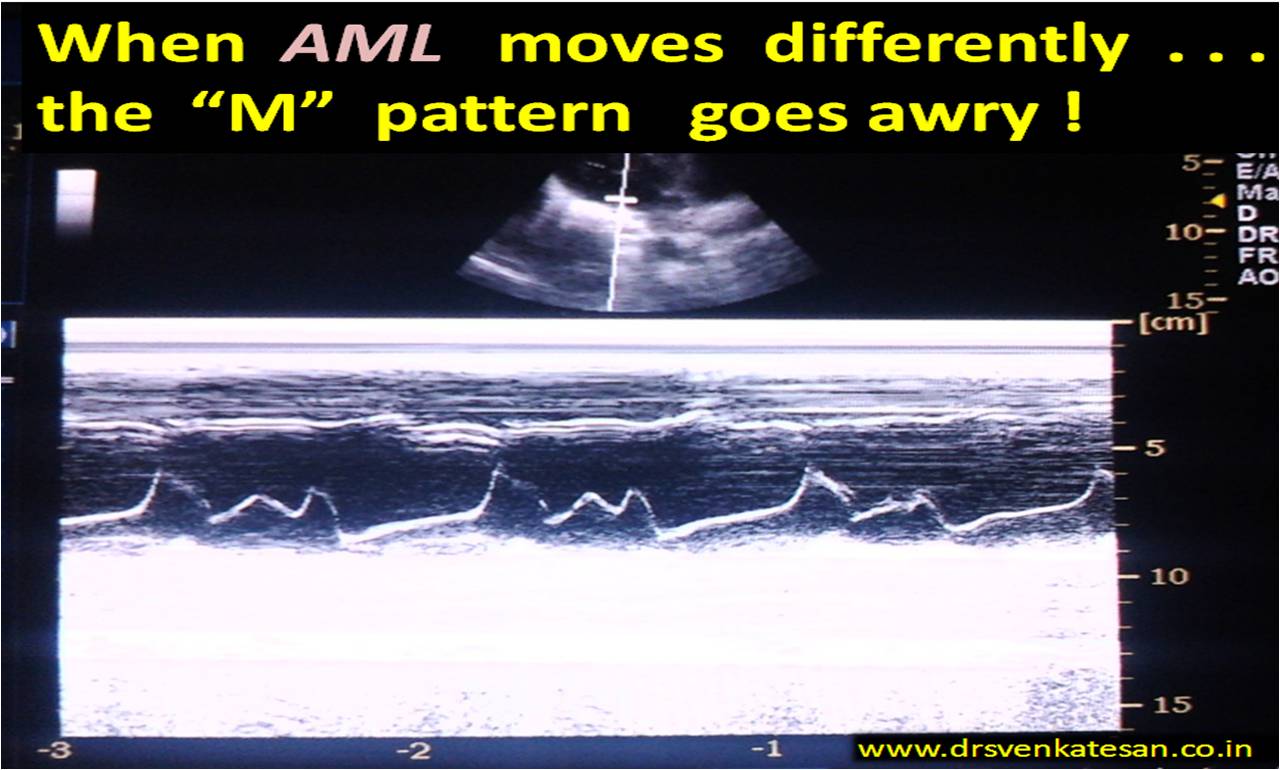
Anterior  mitral leaflet (AML)  is an  unique structure  in the heart .It is the fastest moving structure inside the heart . It is the first structure visualised by echocardiogram by  Elder and Hertz in early 1950s .

While AML is known for vigorous motion , the PML motion is subdued . By tradition AML shows a  motion which resembles alphabet M .

But AML is not be taken lightly .  It can change it’s  motion  not only  in pathological states but also in health . One such  pattern is trifid   motion of AML . Following is a Echo Image in  a  perfectly  normal Individual .

mitral valve motion trifid m pattern  in m mode echocardiography

mitral valve motion in m mode echocardiography trifid

Possible mechanisms underlying Trifid motion of AML

  •    The plane of  M-mode cut  will change the  mitral valve motion .(May  be this is most common ).M-mode at tip of mitral valve may be trifid  ,however a little beyond may record a  bifid-M pattern .
  • Redundant  mitral valve
  • Mid diastolic AML drag
  • Signs of elevated   LVEDP
  • Finally ,  it could be a   sign of  mitral valve  fatigue after excrcise  . Some of these persons   revert back to M pattern after a brief period of  Trifid motion following exercise .

Does trifid AML motion  result in Tri-phasic doppler  flow as well ?

Mitral valve filling is classical E and A .

This usually correspond to M pattern of anatomical  AML motion .

Do the anatomy goes hand in hand with physiology ? Will the mid diastolic  AML  drag result in augmented flow ?

We are looking  at this phenomenon .

Read Full Post »

Under physiological condition ,  pre-load , after load , and cardiac  contractility should be a sequentially matching parameters . After load mismatch is an important concept , where myocardial contractility is temporarily  depressed due to  lack of adequate pre-load for a given level of after load .

This is also  referred to as descending limb LV function paradox .

The three  common clinical situation  AL mismatch  occurs

  1. Critical Aortic stenosis              (High aortic after load )
  2. Acute Hypertension                   (High after Load -Normal and  low pre-load)
  3. Severe diastolic dysfunction  (Pre-load is high -After load is normal )

If it happens acutely the myocardium becomes dyfunctional  due to  mechanical non ischemic stunning .Once the after load comes down the contractility improves .

What  is the chronic adoptive response to after load mismatch ?

LVH is the major  chronic adoptive response to AL mismatch.

LVH reduces the wall stress which will reduce the after load  indirectly .

So LVH neutralises the   high  after load .Laplace law at work . (Wall stress is equal to  2 times the radius divided by thickness of the wall )

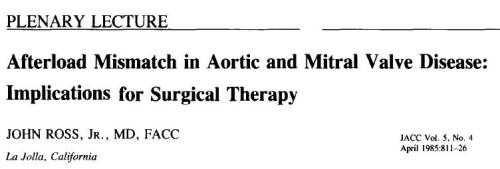
Here  is the Link to the great lecture by John Ross Jr  in LA Jolla , California in one of the annual scientific session of AHA   more than 25 years ago . http://www.ncbi.nlm.nih.gov/pubmed/966366 .The concept is alive and kicking even today .I am sorry to  note   this  important physiological concept   never received the attention it deserves .  I would vouch , it  can be as   important as Frank starling  principle .

Reference :

https://content.onlinejacc.org/data/Journals/JAC/22702/04186.pdf

//

Read Full Post »

Why Junctional rhythm has huge variation in P wave morphology ?

P waves in junctional rhythm can be

  1. Upright
  2. Iso-electric
  3. Inverted
  4. or  even absent

It depends upon the origin of junctional focus

  1. Site of  entry into RA
  2. Ability to capture inter -nodal pathways  and inter -atrial pathways ,
  3.  VA conduction velocity

Further ,the appearance and timing of P waves will be determined by the underlying structural heart disease also.

Final message

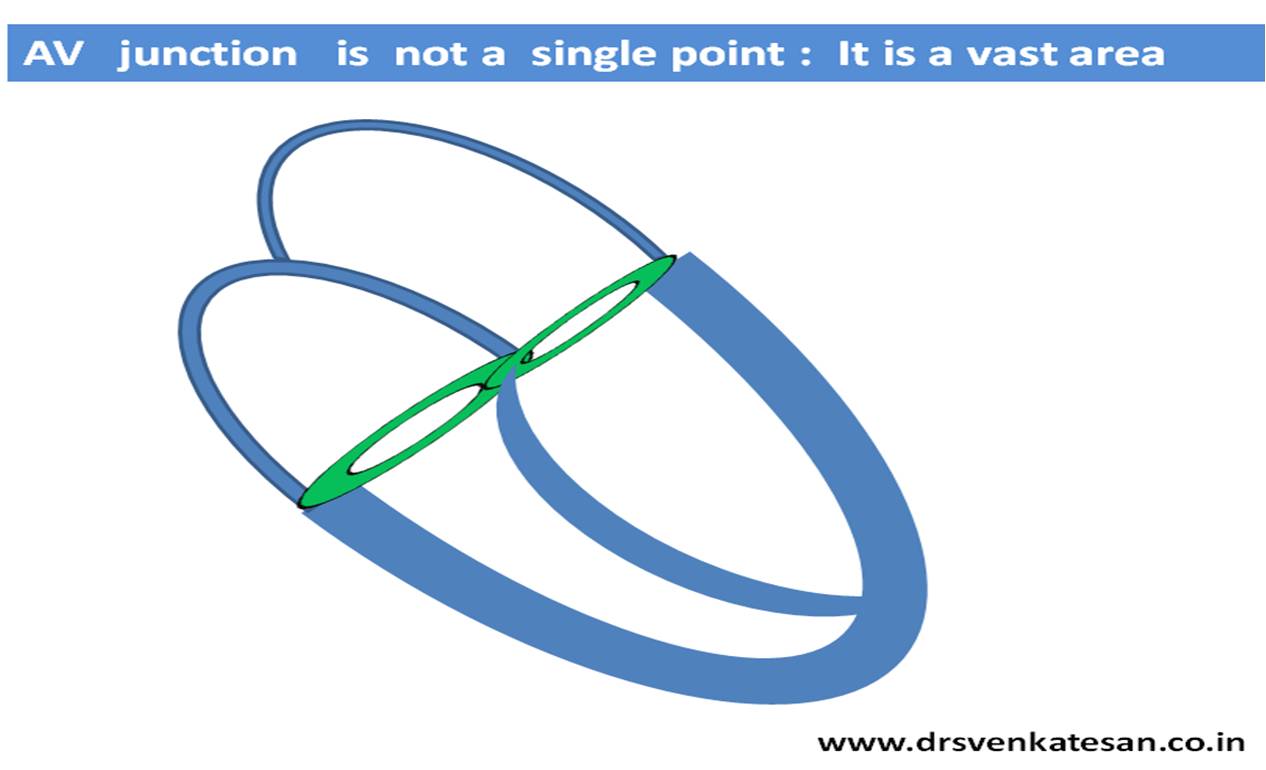
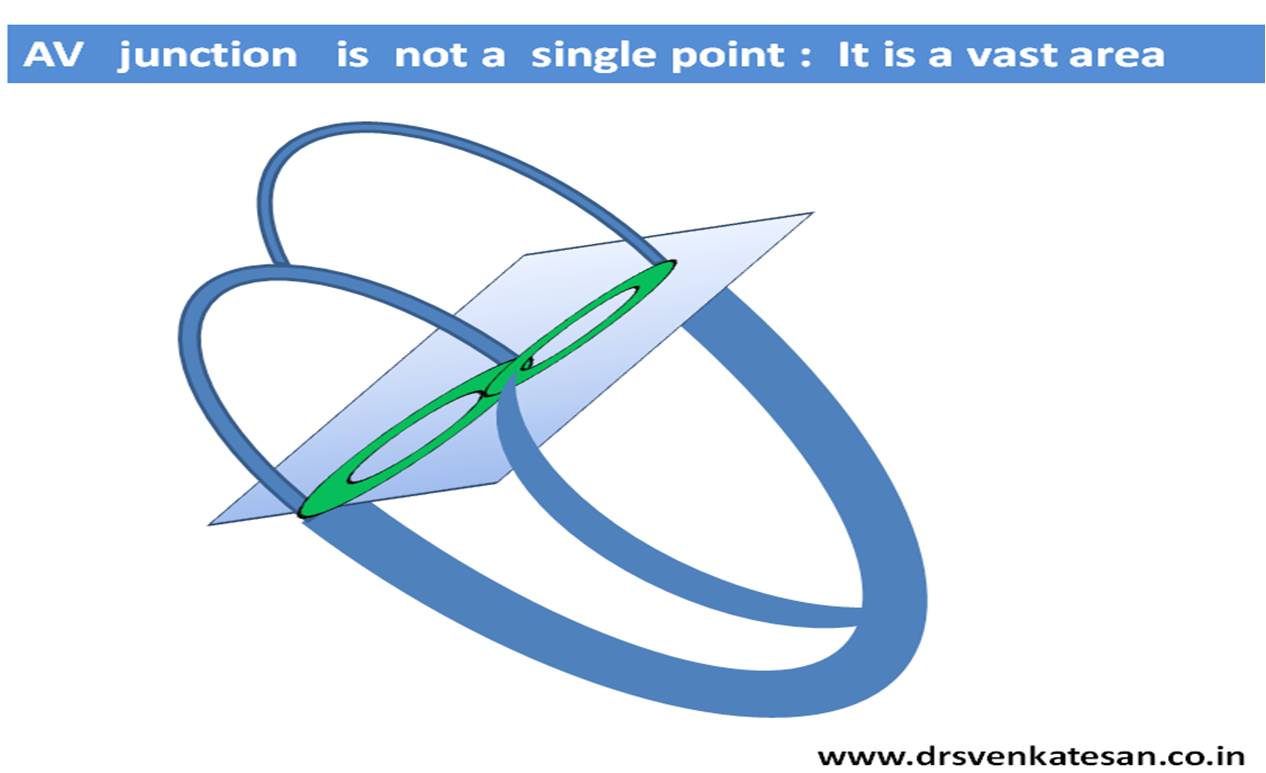
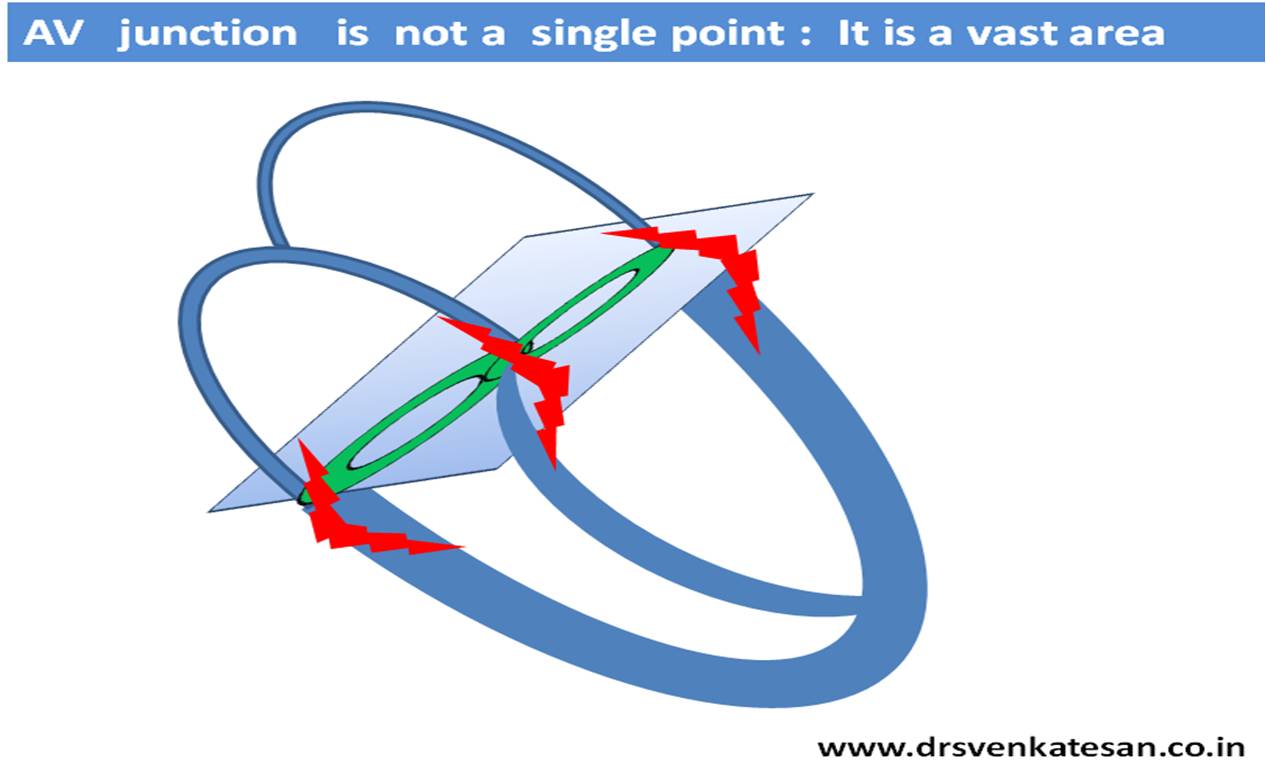
Medical  students  have  grown  up with the belief that  AV junction is a single  focused point .It is  true  in terms  of electrical circuitry  of  normal AV conduction .However  during pathological electrical disorders ( Which arise often because of structural disorder) it should be realised   the AV junction is a huge plane   .   Arrhythmia can occur anywhere from this plane .The entire plane  can become electrically active which may also  acquire the  ability to conduct bi-directionally .

Read Full Post »

« Newer Posts - Older Posts »