Feeds:
Posts
Comments

Archive for the ‘cardaic physiology’ Category

The primary determinant of pulmonary artery systolic pressure is . . . ?

  1. Pulmonary arterial tone
  2. Pulmonary venous pressure
  3. RV contractility
  4. Pulmonary blood flow

Answer : All of the above

But what is the relative contribution of each ?

I am  100 %  sure  ,  no  one can answer this question  correctly !

It is  true  , in some  pathological situations  one can  be  fairly certain about  cause of   elevated pulmonary arterial pressure .

When we confront a patient  with left heart disease  it is the transmission of  mean venous pressure .

Whatever be  our understanding ( Pre/Post capillary pulmonary hyper tension and the related stuff !  ), the one parameter that makes mystery contribution  to PA pressure is RV contractility !
In physiology  RV   generates  about 30mmhg systolic pressure that becomes the  pulmonary systolic  pressure .The  diastolic pressure  will be around 15 and mean around 20 . During exercise  contractility of both RV and LV increase .There has been documented PASP up to 50 mmhg in normal healthy adults during   exertion .

Here one can assume RV contractility is causing  a entity called transient Isolated  systolic  pulmonary arterial  hypertension.(ISPAH)

Consider a entirely different situation

A patient with COPD  with raised  PASP .  The right ventricle pressure has to equilibrate with PASP  during systole .For this to happen   it has to generate the 60mmhg .  If the RV fails  to augment it’s contractility for some reason ,  will the  ineffective RV contraction will  lower the  PASP  ? This is the perplexing question !

While the popular understanding is ,  RV dysfunction will under- estimate the severity of   pulmonary hypertension   . . . still  . . .  we are not sure whether RV dysfunction will  reduce the PASP   per-se  ( and  subsequently PA  diastolic pressure as well )

We often see a  good example  . A patient who develops tricuspid valve disease and RV  dysfunction get symptomatic relief  from  lung congestion .

Final message

The relationship between RV function and pulmonary artery pressure is a real enigma. Though hyper functioning  RV is expected to elevate PASP  and hypo functioning  RV would pull  it down  , the relationship  is not that simple. If only we decode this  mysteries   we can try  specific  RV negative inotropic  agents  as a  modality to treat pulmonary hypertension .

After thought

Total artificial hearts  are going to come in a big way in the coming decades .It  will specifically address this issue  ,  as RV and LV contractility  need to  be individually tuned to avoid pulmonary congestion.

Coming soon

While  RV function is critical for human survival  ,  Fontan  principle  simply says entire RV is dispensable . How ?
Read Full Post »

A pulse wave is generated  with each heart beat  when  the potential energy is converted into kinetic energy.

  • For the pulse wave  to travel from the heart to periphery  Aortic integrity is vital.
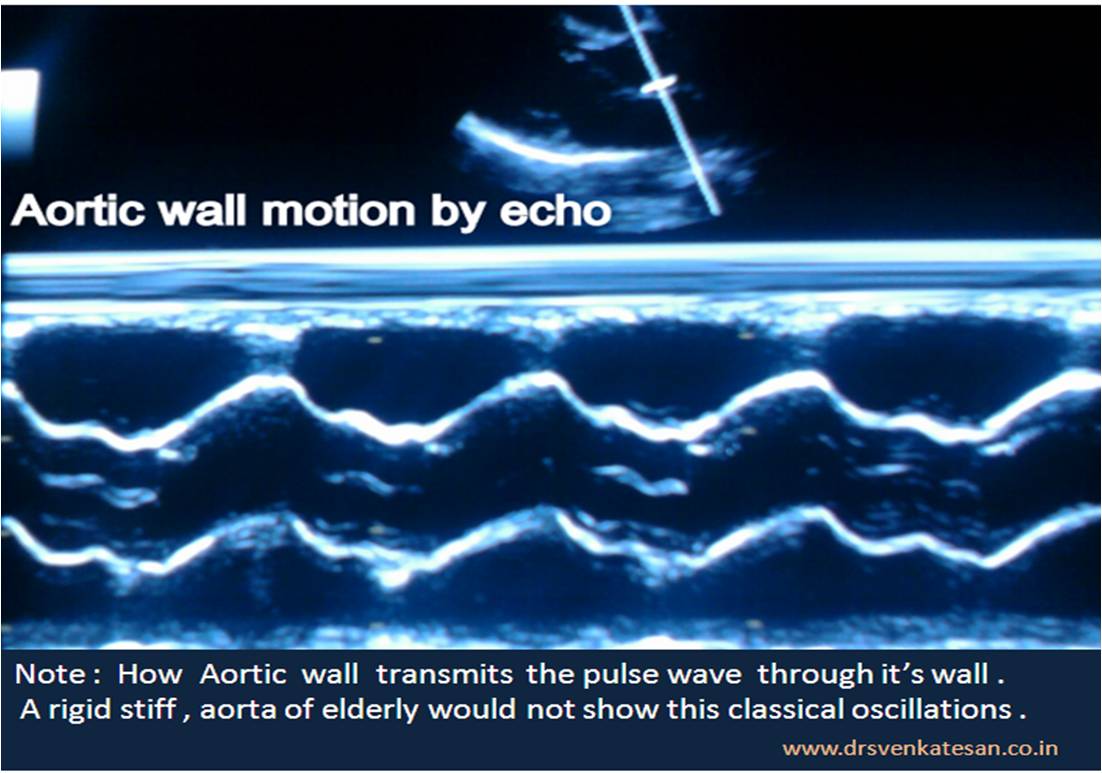
  • The pulse wave travels through the walls of arterial tree  , in the process the wall itself is set into oscillations .
  • Whether the  moving blood imparts the  pulse  on the walls or the walls itself  vibrate  independently is not clear .

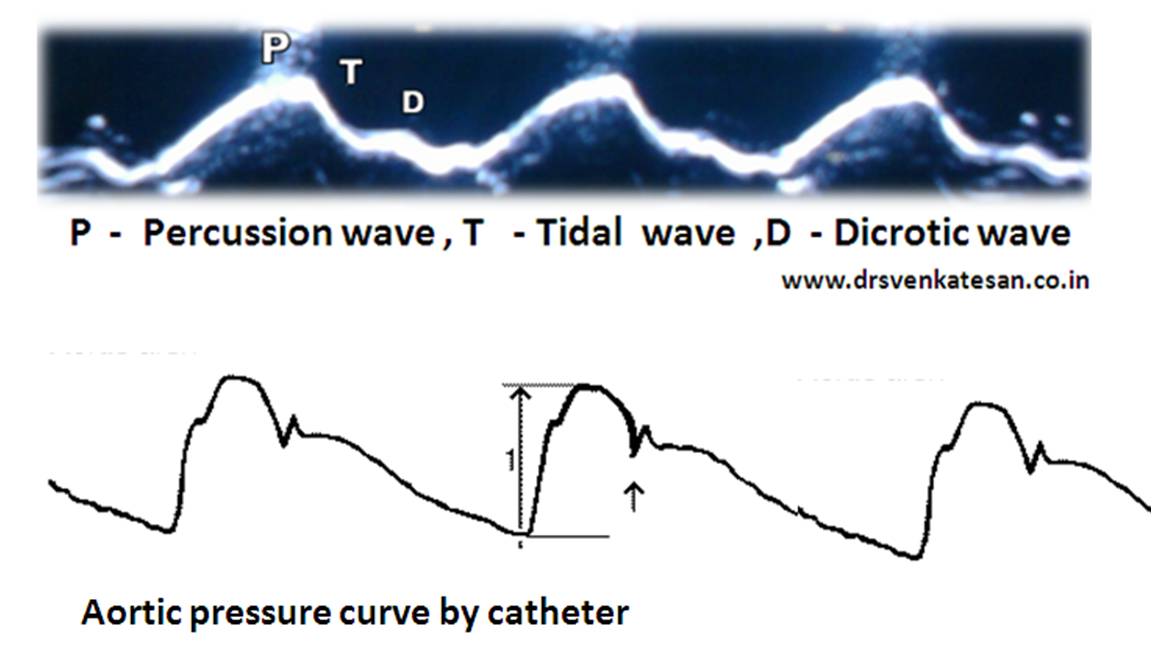
The following   M -Mode  echocardiogram  of  aorta from young man   stunningly  documents  the  morphology  of  central aortic  pulse  wave . Note how closely it resembles the  Intra- aortic  pressure curve recorded with a catheter.

The anterior aortic wall motion was sliced from the above motion image  to create a non invasive recording of aortic   pulse wave

This simple observation was made in  a crowded  echo lab our hospital. Cardiology fellows can explore  further  ,  the link between aortic pulse transduction (From mechano -hemodynamics)

Further studies are warranted regarding the  rate of raise (Slope)  of aortic  wall motion  , and the quantum of motion ,its correlation with central aortic pressure etc. This would unravel the the mechanisms  of Isolated systolic  hypertension  , where a stiff aorta amplifies  the systolic pressure due to loss of elasticity .

Read also

Rail roading of  Aorta in Severe  LV dysfunction

Wind Kessel effect

Read Full Post »

Identifying the P wave is the key to decode  any  narrow QRS  tachycardia . Though the  the relationship to  p and  qrs is vita ,  many times it is  not  easy to  relate them.More easily one  may  get  a  clue to the mechanism by analysing   P wave timing .This is the basis of calling narrow qrs tachycardia as short RP and long RP.

Wonder   . . .  why  the  relation “P to R” became  “R to P” here !

Since  in the   common narrow qrs tachycardias  AVNRT/AVRT  ,  atria  activates  the atria  in a  retrograde manner , we look  for the relationship of qrs complex on subsequent P wave . Hence the interval between R to P become the focus.

In other words RP interval indicates retrograde  conduction property of AV tissue .

If it is slow the P wave will be well separated from QRS .

If it is fast it will be close to QRS complex .

If it is ultra fast as in some AVNRT ,it can fall within the qrs complex and completely invisible .

(The so called  r’ prime in classical AVNRT is nothing but a distorted p wave on the terminal qrs complex.)

Based on  RP interval  the following classification is used (List is incomplete)

Short RP Tachycardia

  • AVNRT (Slow-Fast )
  • AVRT

Long  RP tachycardia

  • Atypical AVNRT(Fast -slow)
  • Atrial tachycardia*
  • Sinus tachycardia*
  • SA nodal re-entry*
  • Some forms of AVRT

* Please note ,  here the P wave is not determined by the preceding qrs unlike other tachycardia in the list.

What is the  cut off point to call it is Short RP /Long RP ?

It is arbitrary . Following may help

If RP interval > PR interval it is long RP.

If the absolute RP interval is >  100  ms  with the heart rate of > 160 it would  generally  Indicate a long RP tachycardia .

The timing  of  retrograde P can be very complex than we believe  as the following factors heavily influence it.

  • The autonomic tone
  • Site of retrograde atrial  breakthrough point .
  • Atrial size ,
  • Atrial  refractionaries
  • Effect of drugs
  • Intact-ness of inter atrial conduction
  • Chances of the retrograde atrial activation capturing Internodal pathway

Final message

The P wave location in narrow qrs tachycardia is primarily determined by the retrograde VA  conduction and less  on the antegrade AV conduction  . Looking at the interval between R and P is a  quick way of getting the VA conduction in the bed side.

Once we get an  idea how the VA  circuit  conducts , we can narrow down the possibilities  in  Narrow qrs tachycardias !

Comming  soon

What determines the morphology of retrograde P waves in AVNRT/AVRT ?

Read Full Post »

There was a big debate in one of my classes with cardiology fellows regarding the shunt quantification of ASD . We were talking about the significance of ASD shunting . We suddenly realised 2:1 left to right shunt is not a simple equation to comprehend . I was thinking 2:1 shunt would mean pulmonary flow would be twice the systemic flow . It was not to be !

Is the ratio of shunting and Qp/Qs convey the same thing ?

No . Qp /Qs is the ratio of pulmonary to systemic blood flow flow . When we want to quantify shunt we express it in two different ways .

1. The amount of blood shunted form left side to right side of the heart .

2. The amount of pulmonary blood flow to systemic blood flow in absolute terms .

Though both are closely linked entities they do not denote the same meaning . When we say 2: 1 shunt we refer to the shunted blood across the defect but when we calculate pulmonary blood flow we take into account venous blood which does not take part in the shunting .

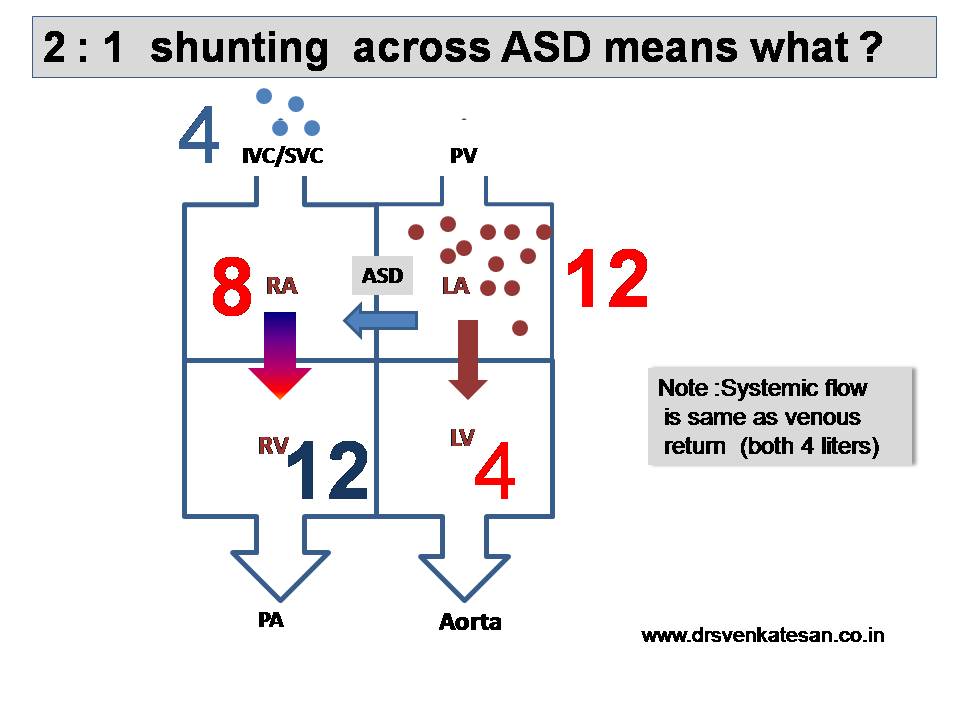
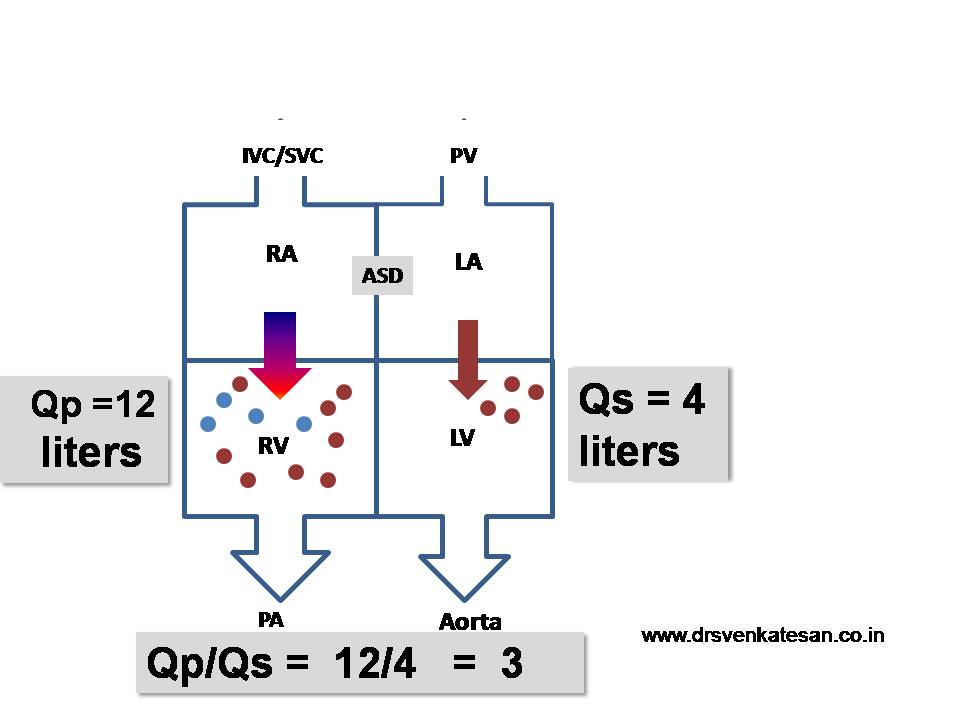
The confusion arises because we use both terms interchangeably.The following illustration will try to prove A 2: 1 shunt would actually correspond to a qp/qs of three (Pulmonary flow is 3 times the systemic flow !)

Let us begin with a hypothetical ASD patient who has systemic cardiac output of 4 liters.

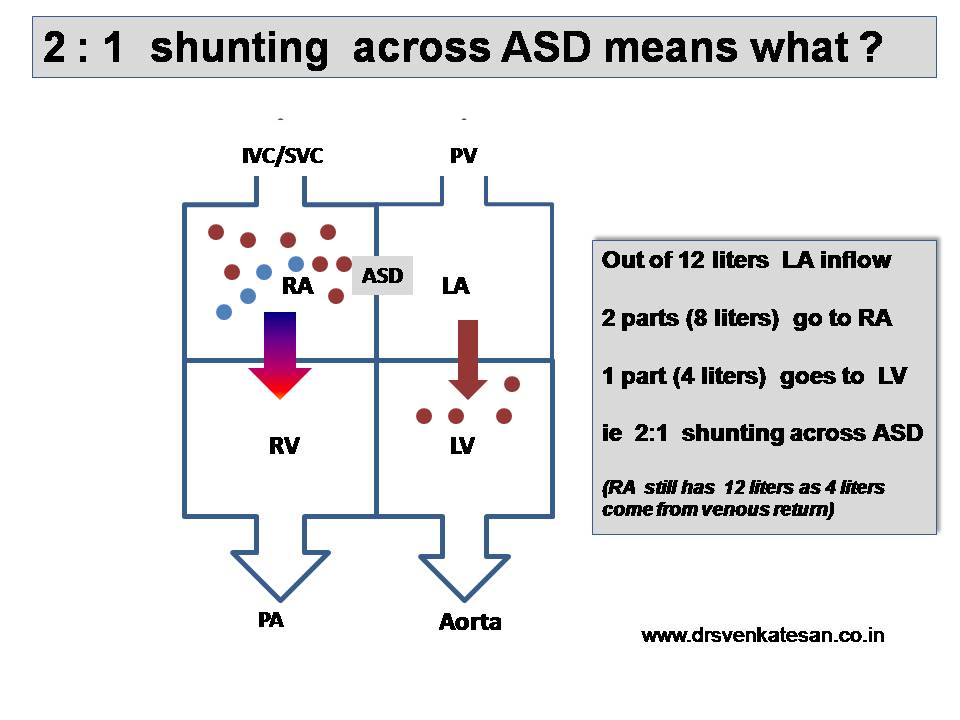
He shunts 2 : 1 from left to right . ie he shunts 2 /3 of three parts into RA (66% ) .

A patient who delivers 4 liters from LA in the presence of 2;1 ASD shunt would mean he would receive 12 liters from the lung as pulmonary blood flow.

Final message

I am still not fully convinced about the above reasoning . I guess it is correct. I argue the fellows to give further insight into this equation. The complexities in bi- directional shunt and effective pulmonary blood flow in Eisenmenger syndrome is going beyond my heads !

Answer found after a decade

All the above cartoons are wrong

The word shunt itself has been mis interpreted by us . Shunt at the level of ASD is different from Qp/ Qs ie excess flow to pulmonary circuit.

Correct explnnation for a 2:1 Shunt:

  • Right Atrium (RA): Receives 1 unit (venous return) + 1 unit (shunt) = 2 units total, which goes to the right ventricle and lungs (Qp = 2).
  • Left Atrium (LA): Receives 2 units from the pulmonary veins, of which:
    • 1 unit (~50%) crosses the ASD to the RA.
    • 1 unit (~50%) passes through the mitral valve to the LV (Qs = 1).
  • Pulmonary-to-Systemic Flow Ratio: Qp/Qs = 2/1 = 2, confirming the shunt ratio.

Read Full Post »

Brugada syndrome continues to fascinate  us for two reasons.

One , it deals with mysterious sudden  deaths of young  men and women

Two , it is one of the  fine  examples  of how  advances in molecular biology , links  physical defects in ionic channels to  sudden electrical  death (Most of them  are due to inherited defects  sodium channels  of myocyte cell membrane )

While high risk subsets of Brugada are easily managed , it is  the asymptomatic  ones  that bother us.

The following are some of the  difficult  questions ,   a  cardiologist faces when dealing with   patients , who exhibit  only Brugada pattern in ECG .

  1. Should I go for an EP study Doctor  ?
  2. Will  I  require an ICD  Doc ?
  3. Do I carry a significant risk of  dying  suddenly  ?
  4. Do  I need a genetic test for sodium channel mutation ?

Fortunately,  we can answer  all these questions with much  courage than before.

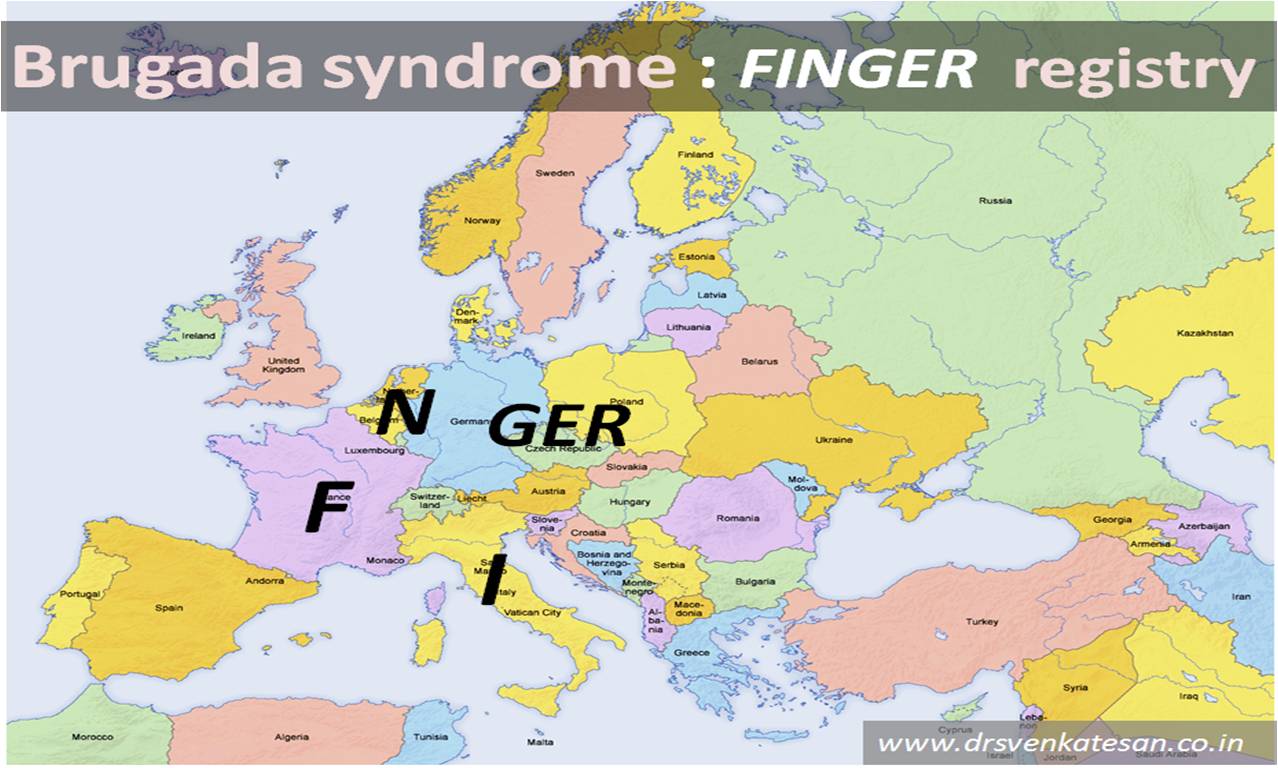
(Thanks  to the European Finger registry published in 2010  !)

“No” is the  clear  answer for all of them !

Summary from the FINGER registry. 

(France  , Italy, Netherlands, GERmany)

The registry included 1029 consecutive individuals

(1) Aborted SCD (6%);

(2) Syncope otherwise unexplained (30%);

(3) Asymptomatic patients (64%).

In the  follow-up of 31.9 (14 to 54.4) months . A total of  7 death occurred .

The cardiac event rates per  year was 

  • 7.7% in patients with Aborted SCD,

  • 1.9% in patients with syncope

  • 0.5% in Asymptomatic patients.

Predictors of cardiac  event

  1. Previous syncope
  2. Spontaneous type 1 ECG

Non predictors ( Surprisingly there were more non predictors ! )

  1. Gender has no predictive role
  2. Familial history of SCD,
  3. Inducibility of ventricular  tachy-arrhythmias during  EP study,
  4. Presence of an SCN5A mutation


Follow up

PRELUDE study  almost reaffirms  Finger data

(PRogrammed ELectrical stimUlation preDictive valuE)

Just publicized in JACC 2012 from the pioneer of   Brugada Silvia  Priori of   university of Pavia  Italy

Reference

http://circ.ahajournals.org/content/121/5/635.full.pdf+html

http://content.onlinejacc.org/cgi/content/abstract/59/1/37

Read Full Post »

Ventricular tachycardia is  a major cardiac electrical disorder. Even though it  connotes a deadly meaning the prognosis and outcome vastly vary.It can be a benign arrhythmia in  structurally normal heart that present as occasional fasicular VT  or Exercise  induced RVOT , to dangerous ischemic polymorphic VT which rapidly degenerate to VF and SCD if not reverted . It is ironical we are  trained  to put all VTs in a single basket and  propagate fear psychosis among   physicians and patients .

Management of VT has certain broad principles.

  • Identify the cause
  • Whether  specific structural heart diseases present or not
  • Identify the mechanism if possible
  • Rule out transient metabolic cause as a trigger

Therapeutic targets

  • Stabilising the cell of origin
  • Passifying the scars
  • Interrupting bundle branches in  BBR  mediated tachycardia
  • Ischemia related  Focus – Re-perfusion
  • Reversing LV dysfunction

Management

General

  • Correct Cell hypoxia /Acidois
  • Pharmacological ( Class 1A/1B /1C , class 3 and Beta blockers , Magnesium  )
  • Role of  beta blockers for VT management is largely under recognised.It has an important role to play in both acute and chronic  VTs)

Electrical (DC shock ,Ablation and ICD)

  • DC shock is treatment of choice  all emergency VTs
  • Ablation  aims  at preventing episodes of VT .Ablation needs EP study and  expertise of  an electro physiologist.
  • ICDs  revert it only after the VT emanates from the focus . ICD can be implanted without knowing the focus .May not require a EP consult.

Surgical

CABG + Surgical scar excision , Aneurysectomy  might help in certain refractory VT.

Read Full Post »

RR interval in Atrial fibrillation is irregular because . . .

  1. The Atria  fires irregularly
  2. AV node conducts irregularly
  3. Atria confuses the AV node  with  its random firing  and varying penetration *
  4. The ventricle just reflects  irregular  response of atria .

The answer is all of the above. Response 3  explains  best.

*Please note , the AV nodal property is predominantly  responsible for the irregular RR interval in AF  . Atria confuses the AV node  with its random firing .The varying penetration into different depths of AV nodal structure and  the resultant concealed conduction make the   the AV nodal refractory period into continuous oscillation .This  random delays in AV node  is reflected in RR interval as irregularity   )

The response we get in ventricles  in AF  can be summed up as  “A filtered atrial rhythm”

Paradoxically,  amidst the chaos in atria  the rate  is fairly constant within the atria (Fibrillatory   wave firing  at up-to 600/mt )  Of course  , the FF interval in the atria will also be varying  .  At a rate of 450-600 this is difficult to quantitate  especially in fine AF.

When does RR interval becomes regular in AF ?

  • When the patient develops complete heart  block.
  • Digoxin toxicity
  • Associated Sinus node dysfunction

For advanced readers in EP : A mystery explanation for irregular  rhythm in AF  in the offing ?

AV node is a physiological and electrical sink .

When atria fires at 600/mt it absorbs about 60-70  % of the atrial response .Whether it releases the original impulse or initiate a new rhythm in the junction  is not clear.

There is some evidence to suggest the rhythm that control the ventricle in AF may not be  filtered original rhythm from the atria .Instead it could be a fast junctional  escape rhythm (Is that a junctional fibrillation ?)


Read Full Post »

What will be the  pulmonary capillary wedge pressure ( PCWP ) in grade 1 LV diastolic dysfunction ?

  1. Significantly elevated
  2. Marginally elevated
  3. Usually Normal
  4. It depends upon  age, LA size and LV  function.

Answer is 3 . (Of course  it depends on  4 )  Normal PCWP  is  4-12mmhg

Are these patients with grade  1 LV diastolic dysfunction  are at  risk for  acute pulmonary congestion at times of stress ?

Probably not ( in  most )*

                                             The grade 1  LV diastolic dysfunction or defect is the most used (abused ! )  echo terminology .The diagnostic simplicity of this condition namely  a simple documentation of “a”velocity more than “e” , has made it  as an epidemic in echo labs  world wide. After all  , it reflects a simple  fact that  left ventricle  has  summoned   the atria  for assistance   (Which is  all the more  physiological   at times  of stress   !)

When does this physiology becomes pathology ?

As long as  the atria is  doing its job of assisting the LV without any fuss  ,  the mean pressure of LA(PCWP) is maintained  within  normal level . Only if the atrial function is stretched  beyond the limits ,  PCWP begins to raise.  It can happen  in a variety of  ways . Most commonly it happens   elderly hypertensive /Diabetics  especially with LVH .

It can also occur in healthy individuals when they become physically deconditioned. (Left ventricle   goes  for  disuse and find it difficult to relax)

Final  message

Isolated  grade 1 LV diastolic dysfunction in people  > 40 years   generally do  not indicate a serious  abnormality.

Only if they have DM/HT and myocardial  disease they need to be evaluated further.

One practical clue is ,  if LA size is normal one can rule out  significant  diastolic dysfunction.

Caution

* In elderly population ,   when they undergo any major  surgery ,  presence of even grade 1 LV diastolic dysfunction can be a marker for peri -operative LVF and  lung congestion .

Read Full Post »

Left main coronary artery is  considered as the sanctum sanatorium  for  the cardiologists .

One would wish  to rule out  disease of left main  in any given  patient with CAD.

Though there are strong clinical predictors of  LMD, this  segment of the coronary artery  tends to  throw   surprises.

A  strongly positive stress test,  ST elevation in AVR  , fall in blood pressure with exertion  are good markers of left main disease.

Still,  in the era of  optical coherence tomography (OCT )  and IVUS  , we do  have a simple tool that can image the left main coronary artery fairly accurately .

We know the  resolution power of  routine trans thoracic echo  is 3mm and above  . (It can detect vegetation of that size easily !)

So , it can easily accomplish  the task of  imaging the  left main ostium .(which is a minimum of  4-5mm diameter )

How to image left main by echo ?

  • Parasteranal long axis  or short axis  the ideal view. Short axis would also  help.
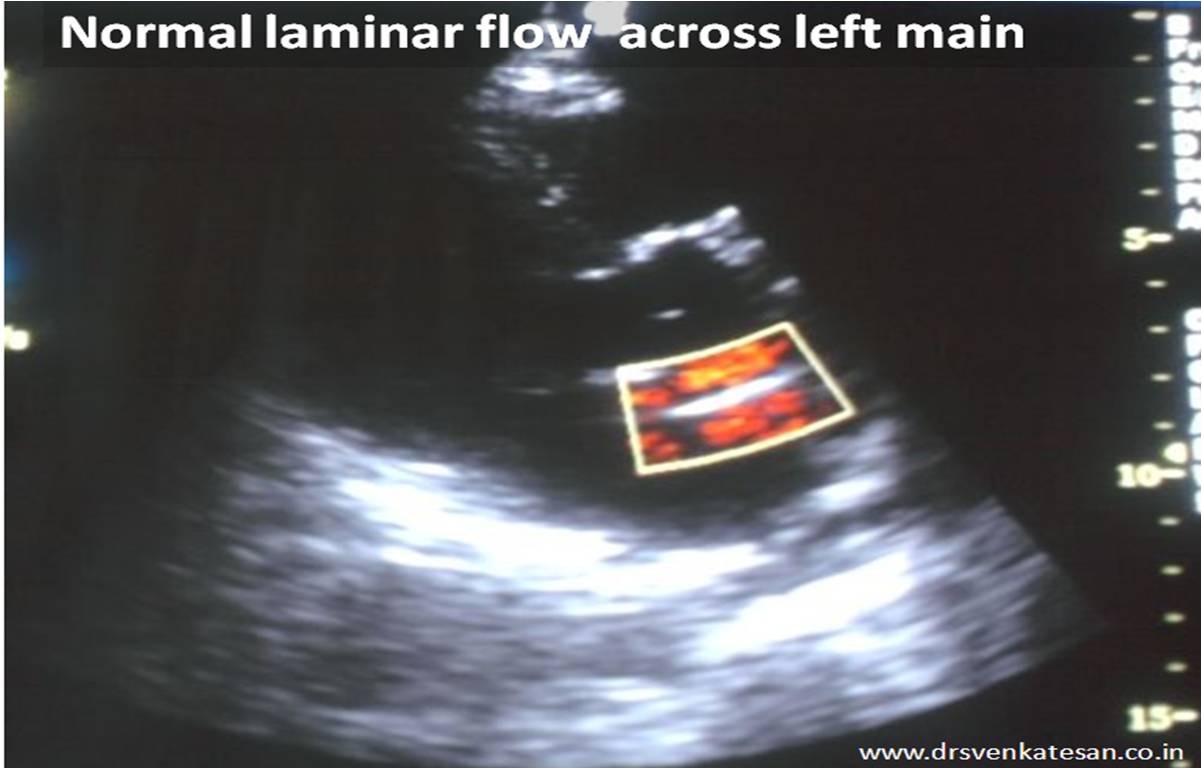
  • Normal left main is easily diagnosed  by two parallel  lines . ( See above picture )
  • Plaques are  diagnosed when this line is  distorted  and filled by haziness.
  • Significant ostio proximal  lesion must never be missed by TTE .However distal left main can not be assessed in most .
  • Doppler assessment may not be possible in all as pulse doppler sample volume can not be placed in left main.
  • Trans esophageal echo would increase the yield.

Final message

Processing power of echo machines  and  their image quality has improved  vastly over the years. The existing literature about left main imaging  by echo are based on old generation machines. The data are as obsolete as those  machines . This has to be kept in mind.

I wonder why most cardiologist are averse ( rather feel guilty ) to report  the  status of  left  main  artery  by  echo cardiography .

Every patient with  a  positive TMT must undergo a  focused echocardiogram  of  left main . You will be rewarded with a  good glimpse of the sacred segment  of coronary artery 9 out of 10 times  !

So , can we shoot the Left main  at the bed side  ?

Yes definitely  . . . if only we wish to !

* A correction

The left coronary visualised in this parasternal Long axis view is in fact exceptional. The ostium and shaft often better seen in short axis in around 3-4 O clock position.

Read Full Post »

Pulmonary  arterial hypertension (PAH ) is  an uncommon manifestation of dilated cardiomyopathy .While pulmonary venous hypertension of some degree is expected in most patients with DCM,  it is rare for these patients to go for severe arterial hypertension.

The reason for this may be the  natural history of DCM do not allow these patients to live that longer to manifest severe PAH.  Still ,  we encounter this problem  atleast in tertiary hospitals. Presence of moderate to severe PAH (> 50mm peak PAP) is a sinister sign in  DCM. They not only do badly , they also make  the transplant outcome dismal .

What causes this severe   PAH in DCM ?  The following observations are made in our institute .

Now we know , isolated  systolic dysfunction is  rarely associated with PAH  .It is the presence of  LV diastolic dysfunction (Often restrictive )  that raises the pulmonary pressures.  PAH of DCM is rarely progressive.

One important suggestion is the DCMs  which are associated with  severe  PAH may indeed represent  late stages of RCM , when the LV begin to dilate.

Associated mitral regurgitation   contributes  to PAH

Atrial fibrillation has a significant impact on elevating  pulmonary  venous and arterial  pressures in DCM.

Hypoxic PAH can occur in any medical situation  in susceptible population . DCM is no exception

For some reason  idiopathic DCM is more often result in PAH than ischemic DCM . (Is that possibel , some form of  idiopathic   PAH and DCM are etiologically  related ?)

Further , the positive inotropic agents when liberally used will worsen the diastolic  properties of LV.

Finally involvement of  right ventricle  in the cardiomyopathy  process can have an ameliorating effect on PAH.  A good RV function is essential to lift the PA systolic pressure. If RV failure is causing a low PAP , do not be happy .It simply means RV is going to  say  good bye  . . .  for the final  time !

How to manage PAH in DCM ?

There is no specific management strategy .

We do not know yet  whether Sildenafil ,  Bosentan, and Epoprostenol  have any role in this  form of  PAH. These are all basically vasodilators. It’s use in DCM is vested with a risk of  catastrophic hypotension . Of course ,  we do have a role for balanced vasodilators in cardiac failure .(As most of these patients would be already on adequate ACEI )

Presence of PAH should be considered as an independent indication for anticoagulants as in situ  pulmonary thrombus is common.

The effect of  cardiac resynchronisation therapy in reducing the PAH of DCM is not convincing.

Final message

PAH  in DCM is an unwelcome development. It makes the situation  tough .  The mechanisms are diverse  .Understanding the mechanism would help us deal  this problem better .  Conventional anti failure treatment may help  ,but  it is wiser to try  reserve drugs.

Read Full Post »

« Newer Posts - Older Posts »