Feeds:
Posts
Comments

Archive for the ‘cardaic physiology’ Category

Localising  WPW syndrome is a favorite  time pass  for cardiologists in spite of  serious  limitations of surface ECG .Still , it is vital to generate a rough idea about the location of  these pathways ,  so that we can focus  our efforts  on  some sort of ablation procedure .

Arruda algorithm is probably a simple and fairly useful technique to remember. It asks us to climb 4 steps   and pause at each  step and look sideways   for the accessory  pathways !

Step 1 (Left free wall step )

Initially one need to look only two leads .

Look at lead 1  and  V1 for   delta wave and R/S ratio .After Identifying delta wave look for the polarity of delta wave (This can sometimes be really difficult ) .If there is iso-electric or negative delta it immediately  fixes the pathway  in left free wall . Similarly if V1 R >  S it also fixes in left free wall. To locate more precisely in left free wall  look  for  delta  wave polarity in  AVF  and proceed down*

If none of these finding are present then  Go to step 2 .

Step 2 (Coronary sinus step )

It is the most simple step . If negative delta  located in lead 2 (often mimic inferior MI)

Here the pathway is often located in coronary sinus /middle cardiac vein often as diverticulum.

After excluding left free wall and coronary sinus origin one has to look at possible septal  pathway  .

For this  go to step 3

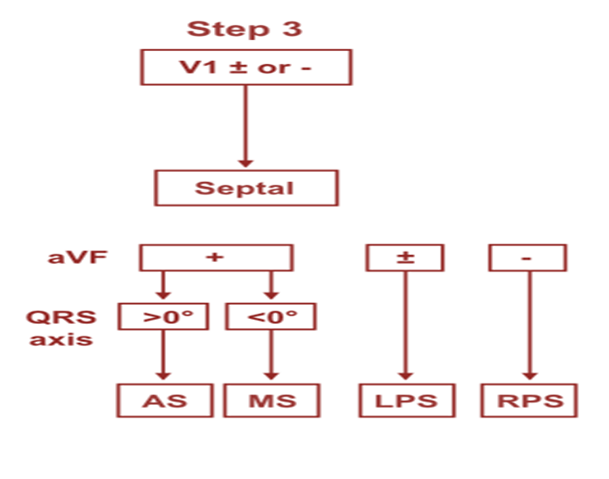
Step 3  (Septal step ) And  again v1 lead  becomes important if v1 shows negative or iso-electric  go down  to septal  pathway decoding

After ruling out septal origin the scheme takes us to right free wall by default.

Step 4  (Right free wall step)  If the delta wave does not fit in  any   of the above three steps (Including  positive  delta in V 1 )  it  fixes  the right free wall  pathway

Arruda scheme summary

Arruda scheme  guides  us  to scan  systematically  for pathway from left free wall  to  septum and lastly  the right free  wall  (The key  to  locate  the APs is  to look at  delta waves in lead  1, 2  AVF and R/S ratio In V1 )

Here is a  simplified version for basic localization

Reference

  1. Arruda MS, McClelland JH and Wang X , et al. Development and validation of an ECG algorithm for identifying accessory pathway ablation site in Wolff-Parkinson-White syndrome. J Cardiovasc Electrophysiol 1998;9:2–12.

Read Full Post »

Human life is a bundle of energy orchestrated by ions coming  in and  going out  of  every cell . Potassium is the life sustaining ion which  determines the  resting membrane potential  of our cells.

When the  heart  suffers a massive necrotic attack  what  would  happen to the potassium dynamics  inside the  myocytes ?

K  + is the dominant  intracellular cation  ,  when  about  100 million myocytes   die  suddenly ,  a chaos in the  potassium  metabolism  is expected  is it not ? .

When skeletal  muscles dies  it  releases  potassium  . We  know   this  from typical crush injuries and rabdomyolyis.

It is  more of a  common sense  to expect this   . . . from myocardium as well .


Which ion is responsible for the current of injury ?

We know a  strong and continuous  negative current that  emanates from the necrotic zone after STEMI  .  (It is so powerful it  shifts the baseline  itself  !), We do not know yet what exactly  is causing this current of injury .  It goes without saying sodium should sustain the depolarisation wave but  potassium will  also have a major role in the  propagation  of this injury current.

Do dying myocytes   excrete the potassium into the circulation   ?

Is    k+  a marker of extent of MI  ?

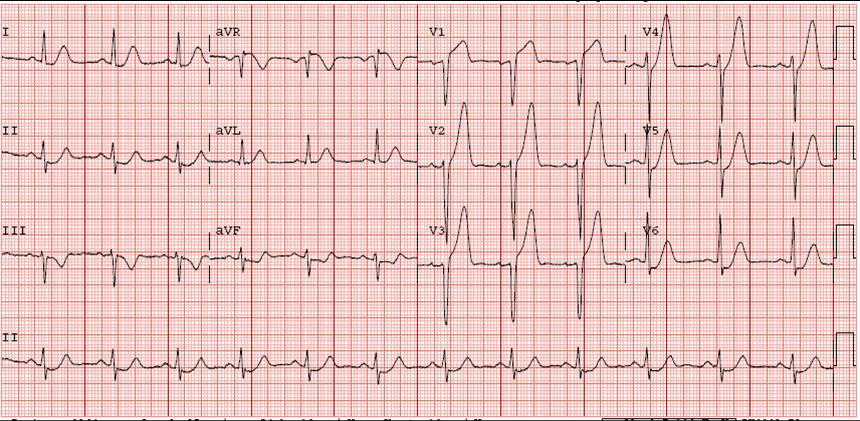
What is the mechanism of hyper acute tall T waves in  MI ?

Questions  galore  . . . Answers struggle !

When a  large  area of  cardiac muscle goes for necrosis  it  leads to  leaking   of   K +    . If it is true  , it  is expected to be a marker for extent of  infarct. In reality it is not . Why ?  This is because cardiac  potassium pool is much  small . A  leak from  an organ which weighs   400 grams   do not elevate the ECF  potassium .  Still , there is ample evidence  for   K + to accumulate  in the local  intracellular milieu. (Myocardial hyper-kalemia ) In fact ,  one of  the mechanisms  suggested  for tall T waves in  hyper-acute MI phase   potassium excess .

Image courtesey hqmeded-ecg.blogspot.in/2009/02/hyperacute-t-waves.html

http://hqmeded-ecg.blogspot.in/2009/02/hyperacute-t-waves.html

Potassium levels and incidence of  ventricular tachycardia.

Many of the primary ventricular arrhythmias  are  due to acute ischemia .  We  have conflicting evidence  for  the effect of ischemia on QT interval. How does ischemia trigger VT  ?
The answer to this question  remain as a missing link !  . Grossly simplifying ,  one could suggest it is  due to   ischemic cell membrane damage that alters the ion channel function  , resulting  in intracellular accumulation of calcium and triggered  activity  .

What is the effect of potassium  on cardiac contractility  ?

Myocardial paralysis.  (Please note  it is the  hypokalemia  that primarily  causes paralysis in skeletal muscles !)

It causes  myocardial  stunning  a manifestation of local potassium  leak ! A temporary myocardial paralysis.

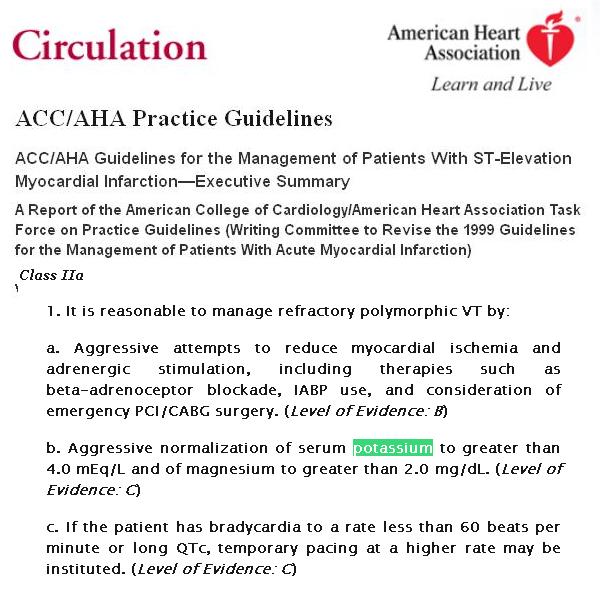
What does the current guidelines of ACC/AHA state about potassium hemostasis  in STEMI ?

It suggests   a fairly aggressive  maintenance of potassium levels  to  upper normal levels. Traditionally we are worried more about hypokalemia than the hyper. It is  surprising   we had the facts wrong . . .  for so long !

What is new in the regulation of potassium level during STEMI ?

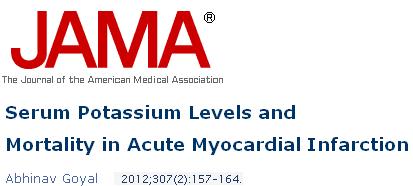
This landmark paper from JAMA seeks  to set right the misconceptions about potassium during STEMI. It suggests  K + levels  has a U shaped  morbidity curve in STEMI . One need to be cautious in  correcting borderline hypokalemia .  Serum   K +   is   absolutely useless  surrogate marker for myocardial K +   . We do not know how  K  +  behaves in the vicinity of MI  zone . So  extreme caution is required  when giving IV  K +  supplements in coronary care units .

Watch out :  Beta blockers /ACEI   may worsen  hyperkalemia

Early introduction of ACEI and ARBs   is a strong risk factor for systemic as well as myocardial  hyperkalemia . This  is  especially true  in diabetic individuals  who have  low rennin  levels due to diabetic micro circulation defect in kidneys .(Hypo-reninic  hypo-aldosternosim )

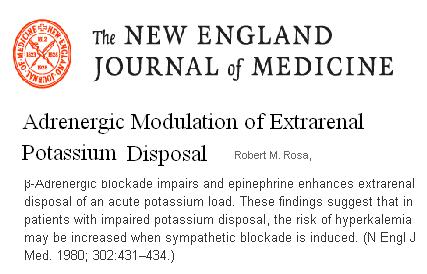
Beta blockers are also known to raise potassium by two mechanism

1.Blocking rennin

2.Reduced uptake of K + in to  the cells.

http://medicineforresidents.blogspot.in/2010/09/hyperkalemia-with-beta-blockers.html

Final message

In the management of STEMI  ,   revascularization  of  the myocardium    is  considered as  the only  therapeutic aim . We  need to realise it   is  much more than that .  There are some subtle but important ways of resuscitating and  protecting  myocardium .  Over  indulgence in electrolytic management  in coronary care  is to be avoided.

Reference

Importance of sympathetic drive and  potassium levels

http://www.nejm.org/doi/full/10.1056/NEJM198002213020803

http://ccn.aacnjournals.org/content/23/6/14.full.pdf+html

Read Full Post »

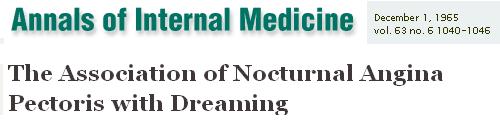
Angina occurring at night is relatively uncommon . It is  still  more rare  for angina to occur exclusively at night (With a possible exclusion of  syphilitic aortits with AR !) The underlying conditions and mechanism  of nocturnal angina  are largely unexplored. In most clinical situations nocturnal angina  is  associated with day time angina as well .

Various mechanisms are proposed

  • It is primarily due to  increased demand  (Holter monitoring has documented  brief bursts  of  HR acceleration  just before  nocturnal angina with  manifest  ST depression )
  • Increased demand  during  REM sleep .
  • Dreams  related adrenergic surge has been implicated.
  • Rarely it is due to supply side defect .
  • Coronary vaso-spasm ( Mostly  in a pre-exisiting lesion )
  • It could  simply  represent  paroxysmal nocturnal dyspnea (pnd)
  • Sleep apnea can precipitate angina  ( Ironically angina occur during   re-breathing  phase )
  • Altered hemo-rheology
  • Nocturnal gap in anti anginal medication *

* May be more  common than we realise.

Cardio vascular hemo-dynamics  at night

If we  believe , sleep is  the great relaxation , and the heart   would enjoy the   “night time”   we  are absolutely wrong . Even in sleep ,  heart has to pump the same 250 ml of blood every minute. Of course , the sleeping heart rate slows down considerably , still  it is interspersed with spikes of activity.  When the heart  rate  slows down  , diastole is prolonged , coronary blood flow  is expected to be copious  unless there is critical CAD.

                                      We  know , sleep is not a passive process  , even as the  autonomic nervous system takes complete control over the  somatic  system .The true colors of  our delicate autonomic system will come to light only during sleep.The muscle tone ,  the sympathetic drive fluctuates according  a pre-set degree . Dreams and REM sleep disturbance can have considerable impact on the sympathetic nerve terminals which ooze  catecholanines  .

Sudden awakening  from  early sleep  is vested with a risk of dangerous   spikes of adrenaline release  .This becomes especially  important in compromised coronary circulation .In fact , this is commonest  sleep -awake  sequence  in patients with nocturnal angina.

Silent ischemia at night

It is curious to note 24 hour Holter  monitoring  reveals  most episodes of ST depression at night are silent. There must be a  specific pain threshold above which a patient awakens  with angina.   The  available  studies   do not  answer this issue   and are not perfect  . We have no way to find  true   silent ischemia  during  sleep.(PET scan in thalamus ?)

Nocturnal angina  in  Aortic regurgitation

Aortic regurgitation  has special relationship with dusk  .For angina to occur AR must be severe and usually isolated .

  • Prolonged diastole at night   -Regurgitation time is prolonged .
  • Dilated LV . Increased  LV mass .Increased demand.
  • Raised LVEDP due high wall stress.
  • Diastolic coronary stealing . Venturi  effect of AR jet

Nocturnal Angina : Is it stable or unstable ?

Most  consider it   as a type of stable angina .Now ,we have reasons to suspect  it could a  marker of unstable angina as it is an  expression of rest angina .

Nocturnal angina vs nocturnal STEMI

How often an episode of nocturnal angina end up in STEMI ?

STEMI is more  common in the early hours of the day and is more related to the hemo-rheological factors  . Please  note ,  STEMI is  a supply side defect  while most episodes of nocturnal angina is due to  demand ischemia . However  it is possible   nocturnal angina episode can precipitate STEMI if  vasospasm is  the underlying mechanism  and if  it is prolonged can trigger thrombosis.

We do not know the answer as yet.

Nocturnal  Angina : Can  it  be PND equivalent ?

Paroxysmal nocturnal dyspnea (PND)  is a classic manifestation of  episodic LVF.  We  know dyspnea can be an anginal  equivalent.  What prevents angina  to  become a  dyspnea  equivalent ! ( Especially the nocturnal ones ,   since the  mechanism  of generation of PND   are very similar  to the  genesis of  angina ). It is distinctly possible  one  may  be mistaken for the  other .  Both occur when  sudden hyper-adrenergic  state  is evoked  which demands   high MVO2 .  An  ischemic heart has every reason to  respond with  angina  .

It is well known  ischemia can result in transient diastolic dysfunction and  elevate the PCWP simultaneously  and PND  would be  the sequel .  When we analysed the  nocturnal calls (  Our fellows ,  do get lots of  such calls from   general wards  at night ),  many  patients with LV dysfunction  who complained  of  classic  chest pain  had  some degree of  dyspnea  and few crackles over lung base as well  .

Nocturnal angina and obstructive sleep apnea

The incidence of nocturnal angina is more common in obese population with obstructive sleep apnea.

The reason is two-fold

1 .Hypoxia mediated

2. Inappropriate tachycardia during recovery phase

Is there any  specific management strategies  to control nocturnal  angina ?

  • General  principles apply .
  • The timing of  anti anginal medication can be adjusted . Long acting preparations taken  in  morning hours to be avoided as they do not cover night time.
  • A calcium   channel blocker   (with optional  beta blocker )  at night may be the best bet to prevent nocturnal ischemia.
  • Dinner to sleep time to be widened.
  • Heavy diet at night to be avoided.
  • Sedatives role is not clear. (Can Diazepam suppress nocturnal angina ?  If so . . .  we  can call it as anti anginal drug  . . .  is isn’t )

References

http://www.thelancet.com/journals/lancet/article/PIIS0140-6736%2884%2991693-3/abstract

http://www.ncbi.nlm.nih.gov/pubmed/8419815

http://www.nejm.org/doi/pdf/10.1056/NEJM199302043280502

  Obstructive Sleep apnea  and  Angina 1  : http://www.ncbi.nlm.nih.gov/pubmed/7715342

 Obstructive sleep apnea and Angina 2 http://content.onlinejacc.org/cgi/reprint/34/6/1744.pdf

Read Full Post »

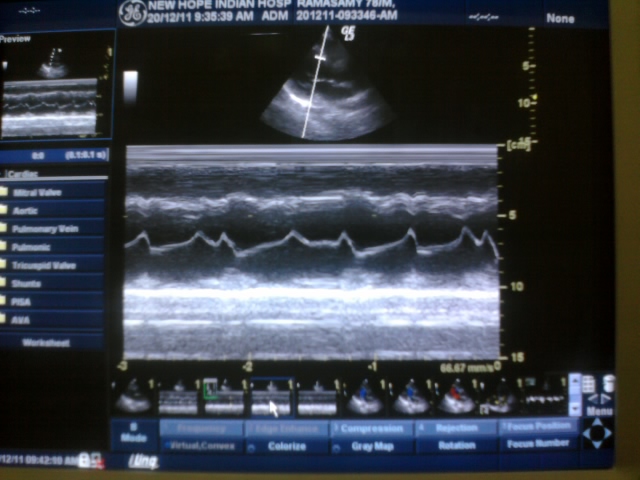
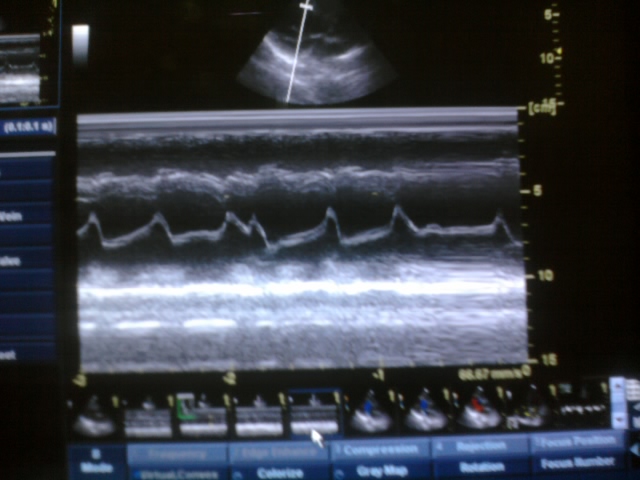
There are many  organic causes of mitral regurgitation. ( Ischemic , degenerative , valvular , cardiomyopathy etc.) It is not  rare for  pure  electrical events to result in valvular regurgitation.   A 70year old  man  with SHT   presented  with palpitation  and exertional dyspnea  .He was  later referred  for  Echocardiography.  Echo revealed LVH with intermittent MR and moderate LV dysfunction.

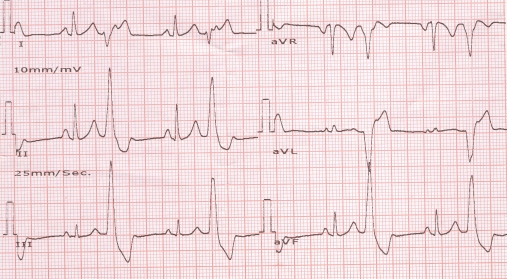
His ECG looked like
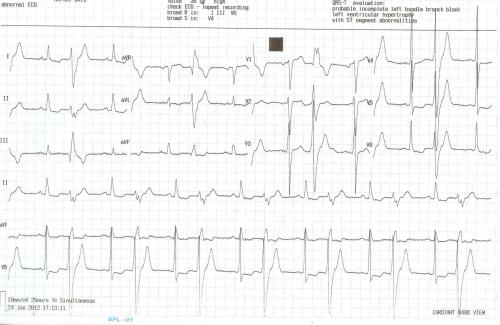
Ventricular ectopic recorded in bi-geminal rhythm

His  echocardiogram showed
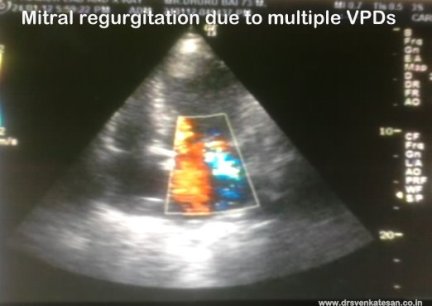
 

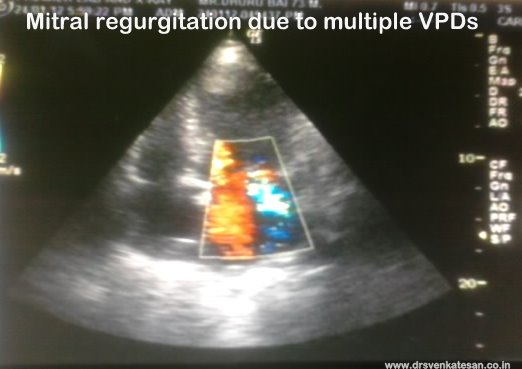
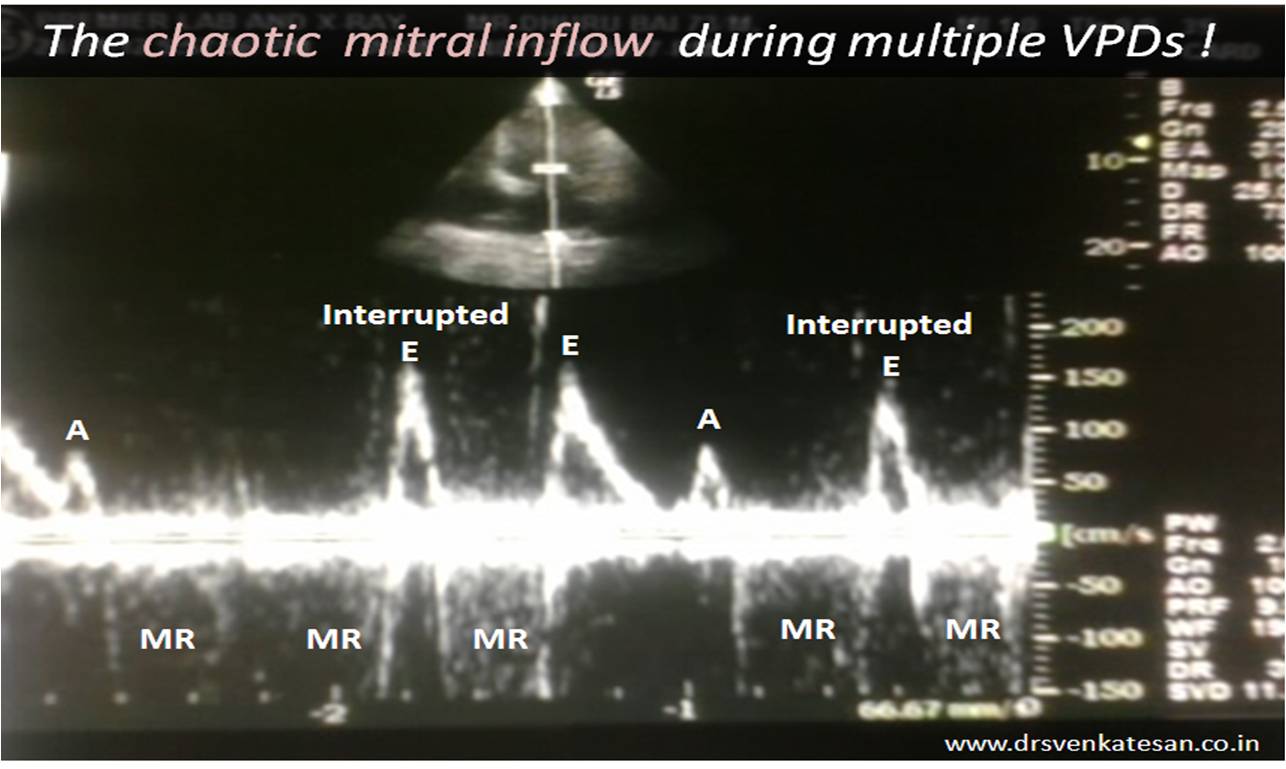
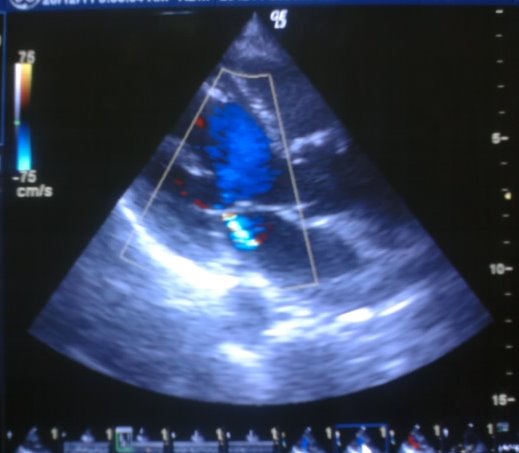
His echo showed randomly timed mitral regurgitation was detected .See the Doppler MR jets below.

We know ventricles are integral  part of mitral valve apparatus  .Hence  it  wouldn’t  be a surprise to note  abnormally timed ventricular contraction  can  have a major impact  on mitral valve function.

When ventricles  prematurely begin  to contract  ( As  during  VPDs) it  interferes with  opening of mitral valve. In other words every VPD  technically imparts a  sort of  diastolic dysfunction !

VPDs occur in which part of cardiac cycle ?

VPDs  occur  either in early   or mid  diastole . Thank fully VPDs can not occur in systole . (Refractory period )

What would be the status of mitral valve at times of  VPDs?

Though it depends upon the timing of VPD ,  generally it interrupts the rapid inflow period of diastole .

In fact ,  it converts the cardiac  cycle from diastole to a partial systole or  a combination( fusion ) of diastole   and systole ! *
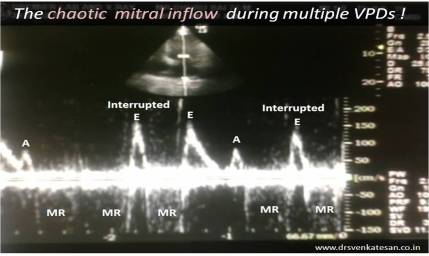
More MR jets are visualised than LV filling waves . Note the some of the E waves are sandwiched between two MR jets. ECG gating should have made this image more interesting .Any way , we have good MR jets to time systole nicely

* Is that a funny  imagination  ?

During   diastole ,  if  LV suddenly  begins  to contract   instead of  receiving the blood  ,  what will happen ?

VPDs are such a common arrhythmia , we  rarely  wondered  ,  it can have a dramatic  consequence  in a any  given cardiac cycle .While   the cardiologists think too  technically  their  patients observe with  shrewd  sense and tell us clearly  what  they feel  is  actually a   missed beat !

(Yeh  . . .  how simple  they describe the complex  hemo-dynamics  of  missing  diastole !)  .They also tell  us ,  next systole is felt as big thump as palpitation . (Post VPD potentiation )

Just imagine ,  if a patient  has  multiple VPDs  with  different  coupling intervals   that fall in different location of diastole  also  interspersed with sinus beats ,   how chaotic  would be the  the  mitral   filling .

This is what  is recorded in the above patient with multiple random MR jets .

Why all VPDs do  not cause MR ?

The timing is critical .We know all VPDs do  not generate a powerful contraction to cause MR. Atrial fibrillation, Prolonged PR intervals , heart blocks , critically raised LVEDP all can influence the trans mitral gradient . In fact these situation can result in  an  entity called diastolic MR that would be discussed later.

Can  VPD induced MR be  referred to  as diastolic MR ?

When VPDs  occur  in  diastole  , it  interrupts the diastole  and a new systole begins. In any  particular point of time there will be  leak into the LA  if the mitral valve is open .This is technically a new systole but in true sense it is the diastole of  the  previous beat . I wonder , whether   VPD induced MR  may be referred  to as one  form of  diastolic MR.  Of course ,  this MR can spill over to true  systole as well .

This also  makes  sense (Non !) as many of the VPDs do not open the  aortic valve ,   hence technically we can’t call the phase reset  by  all  VPDS   as a true systole !

What is the effect of VPDs  on pulmonary venous flow ?

Left atrial  cannon waves can occur that can elevate PCWP .This is the prime reason for resting or  exertional  dyspnea in these patients. Some may get a paradoxical relief  during exertion   as  exercise  suppress VPDs which are frequent at rest.

If VPDs can seriously interfere with mitral valve function , why  they are  often  considered benign  ?

VPDs are well tolerated* as long as  the  LV function is intact.  If VPDs are associated with  LV dysfunction  it  can initiate a vicious cycle of   hemodynamic deterioration .  Multiple VPDs  if left untreated can lead to progressive LV dilatation  in a  significant population .  Hence patients with  recurrent VPDS need some sort of  follow up. It  makes good medical sense to suppress VPDs in the long run. (Of course the  available anti VPD  drugs  are not very safe  !  The search for non toxic ,  ideal drug should go on !)

*”Well tolerated VPDs”   in no way  means  normal physiology.  Read a related article in my site.  “3 minutes crash course on VPDs”

Final message

VPDs  though considered  largely benign , can lead to dramatic  alterations in the  functions  of mitral valve , especially in diseased hearts.

We  must  realise  when ventricular  ectopic beats occur frequently  , it  interfere with the  both opening and closing of mitral valve.

It is really surprising  ,  the literature is  devoid of  major studies  about the  impact of  VPDs on  mitral valve  physiology . . . rather pathology !

Read Full Post »

VPDs are the most common arrhythmia  that  confront  us  in  cardiology clinics .While  it can be a totally  benign   manifestation in some  ,  it may signify a sinister condition in others. ECG  is the easiest  and surest way to identify VPD.However  a shrewd echocardiographer can detect the VPDs while imaging the heart.It is often missed if one do not concentrate on the mitral valve motion.

Note :The VPD convert the typical M pattern into a inverted U pattern in mitral valve.

One of the important hemodynamic side-effect of VPD is intermittent mitral regurgitation.

Effect of VPD on mitral valve opening .

By  conventional thinking   VPDs  are expected   to impact  more on the  mitral  valve closure than it’s  opening .In reality it has indirect influence on mitral valve  opening as well. The retrograde  conduction(VA conduction) of the VPD determine the timing of atrial contraction and hence the   mitral valve opening. If the VPD gets blocked retrogradely  within AV node , the normal sinus impulse will activate the atria in an antegrade fashion .Note ,  he atrial activity  occur randomly when multiple VPDs occur.This makes the cardiac cycle too complex to assess especially the diastole. (In fact true  physiological diastole  may  not occur here !)

If  the mitral valve opening  is interfered by a   VPD  (Early diastole is  the  favorite time  for VPDs to  appear  !  )   .When it occurs the AML is    suddenly pushed  upon superiorly  by the premature ventricular activity and hence resets the  mechanical diastole. Please note electrical resetting of atrium is different from mechanical resetting.

It is also possible atria and ventricle contract simultaneously .This is the time , a cannon wave  may occur inside LA .VPDs can result in pulmonary venous canons and may even elevate pulmonary venous pressure   if  this  occurs repetitively .

Another possibility  is ,  VPDs  may not initiate a ventricular  contraction at all .It may be  simply  be an electrical event. That’s why  we changed the name of extra systole  and premature contraction into just   premature depolarisations.

Why is it important to know about M Mode motion of VPDs

Cardiologists  continue to  engage wide qrs  tachycardias   in the  wrong side  of their   brain for many  decades .The ECG debate about wide qrs tachycardia  is expected to  continue  for generations . !  Few smart cardiologists would  rapidly put  the echo probe  over the mitral valve and able to  differentiate  instantly a VT form SVT   with fair  degree of accuracy.

Detection  of regular M shaped mitral AML  will exclude a VT with a high degree of precision .(AV dissociation by echo )*

Even  presence of trivial  MR*  (More often diastolic )   which occur  irregularly  will  definitely indicate it is VT . SVT  hemodynamically   can not result in this  MR is gives us evidence for AV dissociation

* No reference for these observed indices in our lab. (Class 1 Level C expert opinion(  No one calls me as expert though ! )

What is the mechanism  of VPD induced  mitral regurgitation ?

It is well-known VPDs can cause   mitral regurgitation .Not every VPD cause MR.

  • The timing is important .
  • It can be  either systolic or diastolic MR .
  • If VPD occur in early diastole (After the T wave , the MR jet  will collide with  diastolic mitral flow. )
  • Paradoxical septal motion induced by VPDs can alter the pap muscle alignment transiently and result in MR
  • We dot not know how a LV apical VPD  differ from RVOT  VPD in the genesis of MR.
  • Logic would suggest RVOT  VPDs are unlikely to result in MR as there is  a time lag for the impulse to reach the LV base

What is  the effect of  VPD and Aortic valve opening ?

While  every VPD promptly  hits the mitral valve ,  aortic valve may or may not open with VPDs .Again timing and focus of VPD could be  important.This is the reason during  multiple  VPDs  only few open the aortic valve , that  explains  pulse deficit. (The so called missed beat )

Final message

Anterior mitral leaflet (AML) is the most mobile structure  of  the heart . Hence ,  it is not surprising to note  sudden unexpected ventricular contraction will  have maximum impact on this valve .

When VPDs occur in clusters or at random it has a complex effect on the mitral valve motion. This is responsible for  palpitation , minimal mitral regurgitation and rarely trouble some pulmonary venous cannons and raise in pulmonary venous pressure .

Careful analysis of  AML motion can give us useful clues to differentiate VT from SVT during wide  qrs tachycardia

Read Full Post »

Third heart sound is a unique heart sound  because its   perfect physiology  to hear it  in the young  ,  while the same may denote  serious LV dysfunction in patients with myocardial disease.

It is a low pitched  early diastolic sound usually correspond to  the end of rapid filling phase.The mechanism of genesis of this sound has been debated for many years .(Still I think it is unsettled !)

We know genesis of intracardiac sound is contributed  by three factors

  • The blood flow
  • The valve motion
  • The myocardial contractile and  relaxyl  property

The above  three is collectively  called cardio-hemic system . When this system vibrates heart sounds are generated .In  the genesis of S3 all the three may be important . The only difference is ,  in physiological S3 the valvular and hemic component play a major role . In pathological S3 the  myocardial component has a pivotal  role .The distended LV facilitates chest wall impact during the rapid filling phase . It is now  accepted  LV S3 is  generated outside the LV  . It  was proved elegantly by Shaver et all with sound recording on either side of  LV /Chest wall.

It is to be emphasized  the mechanism of genesis of S3 is diagonally opposite in  physiology vs  pathological  S3 in some conditions . Rapid AV filling  can  rarely be  responsible for pathological  S3  associated with severe LV dysfunction , while chest wall  impact can contribute in both physiological as well as pathological S 3 .

 One can understand the complexity of genesis of  S 3  , as  there are  too many  determinants  that contribute in  varying degree of acoustics.

Factors determining the intensity of S3 is complex 

  1. Age,
  2. Atrial pressure,
  3. Rapidity of  flow across the atrio-ventricular valve,
  4.  Rate of early  diastolic relaxation 
  5.  Distensibility of the ventricle,
  6.  Blood  volume,
  7. Ventricular cavity size,
  8.  Diastolic momentum of the  heart,
  9. Degree of contact (coupling) with the chest wall, thickness
  10. Character of the chest wall
  11.  The position of the  patient.


It is ironical, pathological   S3 which is a  diastolic  sound  though ,  still  its genesis  is largely  determined by the systolic function of the heart .This mystery is partially solved as we recognise  now ,  LV S3 is equally common in  severe degrees of diastolic dysfunction. In fact ,  while we were studying the relationship  of LVS3 in DCM  , it  has strongly predicted the  presence of   severe restrictive pattern in them .


 Reference

1.Multimedia of S3

http://www.inovise.com/learn/s3causes.html

2.Importance of  S3 in cardiology NEJM 2001 article

http://www.nejm.org/doi/pdf/10.1056/NEJMoa010641

3.Chest wall impact theory of S3  by Shaver

Shaver JA, Salerni R. Auscultation of the heart. In: Hurst, ed. Heart. 8th ed. New York, NY: McGraw-Hill, Inc; 1994:291.

Read Full Post »

The other day when  I was  observing  my colleague   puncturing  the inter atrial septum  with heavy bore needle  during a PTMC  procedure  the patient   was  comfortably watching and   enjoying   the procedure .

Even as  multiple wires  criss-crossed  the left atrium  and  the  balloon  hitting  the mitral valve repeatedly   there was  absolutely no pain.

Next day ,   in an another  patient  when IAS was punctured  it got stained  along with pericardium  ,  the patient had   severe  back pain and procedure was  to be  stalled temporarily  .

What  is the lesson learnt  ?

The pericardium and the epicardium (same as visceral pericardium )  has rich  pain  fibers. The above  patient  who had  stain  of epicardium had severe pain .

The former patient who had a perfect IAS puncture did not develop pain while the  later  who  had an  epicardial track   experienced pain.

The same analogy can be seen in patients  with myocardial rupture .While  sever chest pain is a rule  with a free wall tear , it is very rare for  patients with ventricular septal  rupture  to complain  sever pain as  IVS   rupture do not cleave the epicardial layers  .It is also uncommon for papillary muscle or chodal rupture to generate  significant pain .

What is the difference between  epicardium and endocardium in terms of pain fiber  innervation ?

Sub- endocardium has less  dense nerve supply than sub-epicardium. This is one more reason why isolated sub-endocardial  stress  less commonly result   angina ( Eg Hypertension and sub endocardial strain  often silent  ) while  even minimal irritation or insult of sub-epicardium induce severe  pain.

Further , cardiac  pain receptors   respond differently to type of stimuli  .The density of these receptors also  vary depending on planes of myocardial  tissue  .

What are  triggers for cardiac pain ?

Any of the following can trigger cardiac pain.The pain receptors in heart are not well developed as that of somatic system.

It is not clear whether the layers of heart has specialized receptors for various sensations.

  • Stretch*
  • Prick
  • Guide wire poke ,
  • Needle prick
  • Temperature .
  • Infection ,
  • Inflammation of  myocardium , pericardium*
  • Pressure injections
  • Cardiac ischemia*

These  three factors   are responsible for bulk of the cardiac pain . Please note needle prick on the heart is least painful !

How does ischemia   generate pain ?

The ischemia of myocytes secrete

Bio chemical

Substance P ,  prostaglandins, serotonin, adenosine, bradykinin,   and other mediators are involved

Neural

Carried by  myelinated A-d and unmyelinated C fibers run in the cardiac sympathetic nerves . It is understood ,both the fibers  respond to mechanical stretch while Type C fibers also carry chemo signals from bio chemical mediators as well .

Vagus  nerve has a major role in carrying  afferent signals of pain . It is  well known ,   if pain stimuli  is substantial the vaso vagal reflex is activated and bradycardia  and hypotension  occurs.

How is infarct pain different from Ischemic pain ?

Necrosis of nerve terminal will result in more intense pain and lasts longer .

Clinical examples for stretch induced cardiac pain

  • Acute RV/LV dilatation of any cause
  • Pulmonary artery/Aortic dilatation
  • Pericardial stretch could contribute more in generating this   pain
  • Mitral valve prolapse (Stretches  LV free wall )

Interventional  cardiologist should thank god for not innervating  the heart extensively . This  only allows  us to  spend  hours  together  inside the patients heart , other wise one would require a general anesthesia for doing a PCI

Does pericardium  suffer from  ischemia or necrosis ?

Pericardium is not an  avascular  structure . Pericardium gets its blood supply from twigs  of LIMA and phrenic arteries.So there  must be some impact of ischemia on pericardium . Since pericardium has  rich nerve supply there  is every reason to suspect existence of ischemic  pericardial  pain as well .

But  pericardial pain induced by   mechanical stretch  and inflammation is much more common  .While acute pericardial stretch is painful chronic stretch as in slowly accumulating    pericardial effusion is  a painless event !

Pain relief  after CABG

One of the reasons for angina relief  post CABG is attributed to the interruption to  pericardial nerve supply.

Reference

This 1957 article from circulation still  rules cardiac pain literature . http://circ.ahajournals.org/content/16/4/644.full.pdf+html

http://www.annualreviews.org/doi/full/10.1146/annurev.physiol.61.1.143

Read Full Post »

V wave  is one of two positive  upstrokes   seen  in JVP.  Physiological  “v” wave is due to  atrial filling  and reaches the peak at late  systole , while pathological ” v” waves  are often  due to tricuspid regurgitation  . It is  a mid systolic wave .It is a fusion of  “c”and “v” waves .

Here is a patient  with dilated cardiomyopathy with severe tricuspid regurgitation  who presented with prominent neck veins.

there is no difficulty in identifying the  v wave . Careful acuity will reveal  a  sharp  “a”  wave as well !

JVP pressure wave form of tricuspid regurgitation showing classical systolic cv waves

How to measure the amplitude of  v waves ?

In JVP,  there is a baseline oscillating column . Individual wave  spikes  occur over and above this baseline . Hence  technically there  should be two measurements  , but we take only the  top most part of the oscillating  column.

What is the indirect evidence for tall  v waves ?

Physiologically “y” descend is  integral part of v wave (In fact ,  “y” descend  can be referred to as down stroke of  “v” wave )  .For every  tall “v” wave  there  must be  a prominent  “y”descent . (Probably  constrictive pericarditis is an important exception ! )

If  “y” descend is not rapid but shallow one can suspect two conditions

  • Tricuspid stenosis
  • Significant RV dysfunction

How to differentiate v waves from a waves ?

“V” wave  is a passive filling wave hence it raises  slowly , has  relatively   shallow summit and  occurs in   mid or late-systole  . “A”waves are  due to active contraction of atria . It is a  sharp pre-systolic wave . One practical way to recognise   “a” wave is ,  it  never stays in the eye , it just flickers.  If your eye sees a sustained wave for more than  a fraction of  moment it can not be  “a”  wave ! Another point that may be useful is  “a” is taller than “v” in  right atrium .

Reference

Click below to hear the murmur of TR (Courtesy of Texas heart institute )

http://www.texasheart.org/Education/CME/explore/events/upload/HSPS13_TricuspidInsuff.mp3

Read Full Post »

If  we   think we have  unraveled  all the  mysteries  of   human coronary  blood flow   we are  sadly  mistaken . Most cardiac physicians spend  their  prime life  in opening the  obstructed coronary arteries  playing  a role of coronary plumber.

Like any plumber ,  it is not going to be  one time job and   our patients  would  have to hire their  services  periodically  . Many times  it turns  out to  be a 108/  911 call  as well !

Unfortunately , hem0dynamics  of  coronary blood flow  do not follow  the principle of  water flowing across  a domestic  pipeline.The most dramatic   difference  between  the  coronary blood flow and   water pipe  is ,   in the later  ,   as  the water is being ferried   across the house  ,   neither the building   nor the   pipe    contracts    (Unfortunately all our understanding , derivations and research were  based on simple physical  modules  of  hydrodynamics in a static  delivery  system )

Pressure flow relations especially in biological system is  not  simple. Since  our  foundations on principles of   blood flow  is based on this simplistic model  ,  every assumption  could be proven  wrong. This  is what  is happening now . Nothing seems to work  in a  learnt  manner.

A patient  with  100% occlusion  walks comfortably  without damaging his muscle.While an other patient  would  develop cardiomyopathy even if the occlusion is  gradual   and  incomplete  ! Hemodynamic  logic tells us blood flows from high pressure to lower pressure  zones  like a water fall !

But coronary waterfall is not a simple and smooth affair. It is not a free fall  ,  even as the water falls there are  pumpy  interruptions .When these  pumpy ride  occur  even in physiology one can imagine  the pathological states  , when  the coronary  artery is blocked ,  the myocardium is  scarred and the systemic blood pressure fluctuates .

While every  organ welcomes   the systole  ,  as they are fed  with  blood  during this time of cardiac cycle  . Heart  is only organ which sacrifices  its own blood flow during this phase  as the systolic contraction  interrupts the blood flow .

Determinants of coronary blood flow

What we learnt over the years has been too simplistic. It is not the  patency of vascular  system that matters. The coronary micro vasculature, the metabolic demand, the neuro  humoral regulation etc.  For  most cardiologists  the epicardial  patency   or stenosis remains the only relevant  issue

The reality is  much complex  to comprehend

  1. The coronary perfusion pressure
  2. Coronary flow reserve
  3. Coronary wave forms
  4. Sub endocardial vs subepicardial flow ratio
  5. Effect LVH on myocardial flow
  6. Coronary venous tone and arterial ischemia.

Now,  we have an entirely new concept which proposes (Rather proven concept !)   the  integrity of  myocardial contraction and relaxation on the coronary blood flow. This land mark paper in circulation has identified  six wave forms of coronary blood flow This include 4 positive  waves and two negative waves

Questions need to be answered 

During diastole  myocardium relaxes . Only if  the myocardium  relax   optimally  the compressive effect of systole  on coronary  coronary   micro vasculature is reversed  ,  intra coronary resistance  falls so that coronary blood flow can occur smoothly. We do not know  whether diastolic dysfunction would  affect the diastolic coronary filling waves  jeopardizing the coronary flow.

Myocardial viability is important for one more reason  , in the distribution  of   coronary blood flow .A dysfunctional muscle can not receive  and  inject  the blood  deep into  sub  endocardium (Note this becomes  important  when  revascularising   severely  dysfunctional segment )

Does myocardium has a  calf muscle analogy   and  behave like  a  powerful  intramuscular perfusing pump .

A breakthrough concept  from Davies et all in circulation .  These are not new ( Buck -Berg  ?)thought  about this decades ago .  The interest is rekindled in recent years  ,  as  complex angioplasties  following myocardial infarctions  failed  to improve outcome and relive symptoms in many .

During primary PCI ,  no- reflow  often  denotes a meaning  of  failed  PCI .The issue involved  is  hydrodynamics of intra myocardial  blood flow .The following  article partly  answers the  issue  underlying no re flow .http://circ.ahajournals.org/content/113/14/1721.full.pdf+html

Final message

Young  physicians  need to  spend  more time  in  basic  cardiac sciences . Lest, what  we  do  in cath lab blindly  will become a laughing stock  ! We have to go back to the golden years of  research in cardiac physiology  (1960 -1970s)  . Mastering coronary  angioplasty  may increase the blood  flow  up to the  myocardium ,  but pushing the blood beyond the muscle requires more sense  and effort .

A simple  hemodynamic  model based  on  physical  principles alone is a  greatest error we make in cardiac science . * Further, human heart muscle is not only influenced by the quantum of blood  it receives  but to the great extent the content of blood.The blood caries all the ill effects of  systemic diseases and  damage   the vessels and muscle .The interaction  between the  blood and  the muscle  is never  an issue in  the pure  physical labs .( Even animals misbehave !)

Read Full Post »

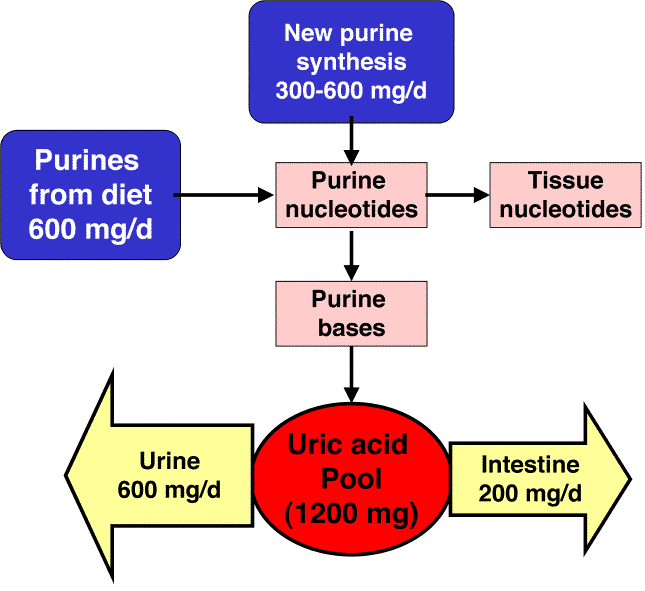
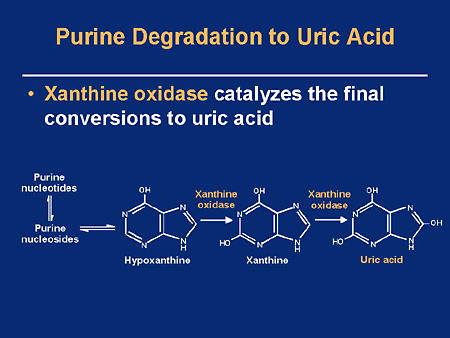
Uric acid is a  metabolite of purine metabolism.Purine is dynamically present in  every  active multiplying cell .Uric acid is formed when Xanthine oxidase  acts on   Xanthine and hypoxanthine  which are products of purine . The estimation of serum uric acid level can give us a rough estimate of cell metabolism and turn over. We need to  understand there is a dietary source for purines as well.

UA is mainly  excreted in urine . Normal levels of UA is   3-6mg in women and can be 1 mg higher  in men

Biological actions of uric acid

UA is a physiological molecule . It is more of an byproduct  and  devoid of any unique  action. Hence , most physicians still   believe it to be an unwanted  dangerous toxic molecule. What we fail to realise is ,  uric acid is a strong natural reducing agent .Hence it acts as an antioxidant .(Comparable to Ascorbic acid Vit C !)

Some believe excess uric acid is  a natural metabolic weapon against cellular degeneration . In fact , hypo- urecemia has a well known  association with multiple sclerosis and augmenting UA  is known to improve multiple sclerosis.

However, the problem with this  physiological molecule  is ,  we do not know yet,  when the  levels become pathological .We know uric acid in excess can lead to  urate stones  in kidney and Gout in joint . Does these crystals have any effect on coronary and cerebral circulation ?

Is uric acid a marker of inflammation and cell turn over ?

Yes it is.  What ESR  means to  inflammation , uric acid means for cell turnover . Since Inflammation induces white cell turnover  uric acid  level  becomes   a marker of inflammation as well .

Uric acid in  excess  is a  marker of vascular  damage as  atherosclerosis  is an inflammatory process  , especially  with  pulmonary endothelial damage. So , in patients  with primary pulmonary  vascular diseases  like PPH , uric acid levels   may indicate  the progression or regression of PAH.

Some studies have correlated right atrial pressure with uric acid levels.

Uric acid and hypoxic states

Uric acid formation is more in hypoxic states as hypoxia depletes ATP and adenine metabolism is promoted and more inosine and  Xanthines  are produced . Uric acid can be a simple  marker  of increased oxidation stress of human biological system.

No surprise  to note   pulmonary hypertension  an important hypoxic state  increase uric acid levels .

Why uric acid is rarely considered as a useful diagnostic marker in cardiology  ?

  • The major  reason is it is an old molecule and has  lost its  flavor .
  • The name is not exotic (Like BNP, Di dimer etc)
  • Finally it is  a  cheap investigation and hence  lacks the required glamor.

Technical limitations

  • Uric acid levels are non specific (Like any other  modern  molecules  Tropinin , CRP etc! ) No one  would like  to compare uric acid vs hs CRP one to one as a marker of inflammation in vascular  disease.
  • UA  levels depend on kidney function .
  • Dietary influence can be significant (Especially meat, Liver Beans, Cauliflower etc)

Knowing the  basal level of uric acid  in a given patient ,   help us  monitor the net cell turnover during medical   management of chronic illness.

UA’s Clinical utility in cardiology practice

Importance of UA in PAH   is well recognised now  . Most studies on PAH  use it as a marker  or even  to define a therapeutic endpoint  But , please remember  elevated uric acid is a  simple  index of elevated  cell turnover and oxidative stress and it mainly represent  the effect of  pathology rather than a pathology itself.

So , attempting to reduce uric acid levels   with drugs like  Allopurinol may not  improve the  vascular function as one would wish ! The only indication for  reducing uric acid level   is  when the levels   become  too much and it starts depositing   in body.

Final message

Uric acid is a useful bio marker for  vascular function. It can indicate  the  quantum of  inflammatory , metabolic  and cell turnover of any progressive vascular  disease. With serial measurements  it definitely helps us in monitoring   cardiovascular disease  especially pulmonary hypertension  as  lung tissue is major source of this molecule . Now , uric acid  is used  for prognosticating  cardiac failure also.

Reference

http://qjmed.oxfordjournals.org/content/93/11/707.full.pdf+html


http://ajrccm.atsjournals.org/cgi/reprint/160/2/487?ijkey=dc24281a22fcf54ed27ac4466393abd691047408

http://cel.webofknowledge.com

Read Full Post »

« Newer Posts - Older Posts »