Feeds:
Posts
Comments

Archive for the ‘Clinical cardiology’ Category

Murmur of Tetrology of  Fallot is generated at the level of

  1. VSD
  2. RVOT
  3. Aortic root
  4. Any of the above

Answer :   RVOT.

RVOT is the classical site of TOF  murmur , but  there is  a  rider . The murmur of TOF is  inversely proportional to the degree of RVOT obstruction. (Contrary to VPS with intact IVS) .In severe TOF especially during spells the murmur attenuate dramatically and may disappear altogether. Hence a silent and quiet heart do not necessarily  indicate  a mild form of TOF .

Other possibilities also  exist.

  • The VSD in TOF is  large and do not restrict  blood flow on either direction . Rarely  restrictive VSD can generate a murmur across VSD.
  • Aortic flow is increased in all severe cases of TOF ( Highest in pulmonary atresia and VSD)   Hence there is always a possibility of a soft systolic flow murmur across Aortic valve .
  • Other rare  cause for systolic murmur is due to  prolapse of   tricuspid  valve  that occludes the VSD  potentially causing  TR  and in the  process may  convert the  VSD  into restrictive type.
  • One more cause for  systolic murmur is sub Infundibular anomalous  muscle bundles criss crossing the RV body .
  • Peripheral pulmoanry arterial stenosis is recognised cause for distant faint systolic murmur.
  • Diastolic murmurs can also occur in TOF . Absent pulmonary valve and aortic regurgitation can result  in diastolic murmurs .

Question for analysis

What happens to TOF murmur during squatting  ?

Read Full Post »

Modern  day cardiology can do wonders. It can revive a sinking  patient in cardiogenic shock with IABP , LV  assist ,   multivessel angioplasty and bring back  life . On  the other  hand  , a young man with an infected mitral valve who is put on  intensive  antibiotic  regimen   , progressively deteriorates  throws an emboli into brain ,  raise his urea  creatinine  , cardiac   failure worsens and finally succumbs .

This is a clear case of failure  of medical therapy in infective endocarditis .  It is almost certain  surgery would have saved him .

Why  the delay ?

So the question that is been debated for so long is   “When to intervene with surgery in IE”  ?

While we show extreme  urgency for ACS , the same is not shown  with IE.This is going to change in the future .Thanks to the  EASE trial (Early surgery  in  endocarditis )  This land mark study from Korea  is likely to revolutionise  the way we will look into the  problem  of infective endocarditis. It was presented in the just concluded AHA annual scientific sessions  in Orlando

This was  our  observation  too . The issue was discussed in  the year 2008 .It reminds me ,  every  learned  thought or opinion is in fact a paper  but unfortunately modern science does not accept a  fact without evidence of a  study . Until then  it remains  as a crap !

I am glad  to note   genuine concepts will some day  get ratified . Kudos to the Korean team.It is a great study to do with  many ethical issues.

Click below to read the related article

Link to EASE Trial  http://www.theheart.org/article/1313215.do

Next question  on the cards

Should there be  a time window above which medical therapy should be   deemed (Doomed !) to have  failed  , so that the patient becomes a default candidate for surgery.

Read Full Post »

Read Full Post »

Third heart sound is a unique heart sound  because its   perfect physiology  to hear it  in the young  ,  while the same may denote  serious LV dysfunction in patients with myocardial disease.

It is a low pitched  early diastolic sound usually correspond to  the end of rapid filling phase.The mechanism of genesis of this sound has been debated for many years .(Still I think it is unsettled !)

We know genesis of intracardiac sound is contributed  by three factors

  • The blood flow
  • The valve motion
  • The myocardial contractile and  relaxyl  property

The above  three is collectively  called cardio-hemic system . When this system vibrates heart sounds are generated .In  the genesis of S3 all the three may be important . The only difference is ,  in physiological S3 the valvular and hemic component play a major role . In pathological S3 the  myocardial component has a pivotal  role .The distended LV facilitates chest wall impact during the rapid filling phase . It is now  accepted  LV S3 is  generated outside the LV  . It  was proved elegantly by Shaver et all with sound recording on either side of  LV /Chest wall.

It is to be emphasized  the mechanism of genesis of S3 is diagonally opposite in  physiology vs  pathological  S3 in some conditions . Rapid AV filling  can  rarely be  responsible for pathological  S3  associated with severe LV dysfunction , while chest wall  impact can contribute in both physiological as well as pathological S 3 .

 One can understand the complexity of genesis of  S 3  , as  there are  too many  determinants  that contribute in  varying degree of acoustics.

Factors determining the intensity of S3 is complex 

  1. Age,
  2. Atrial pressure,
  3. Rapidity of  flow across the atrio-ventricular valve,
  4.  Rate of early  diastolic relaxation 
  5.  Distensibility of the ventricle,
  6.  Blood  volume,
  7. Ventricular cavity size,
  8.  Diastolic momentum of the  heart,
  9. Degree of contact (coupling) with the chest wall, thickness
  10. Character of the chest wall
  11.  The position of the  patient.


It is ironical, pathological   S3 which is a  diastolic  sound  though ,  still  its genesis  is largely  determined by the systolic function of the heart .This mystery is partially solved as we recognise  now ,  LV S3 is equally common in  severe degrees of diastolic dysfunction. In fact ,  while we were studying the relationship  of LVS3 in DCM  , it  has strongly predicted the  presence of   severe restrictive pattern in them .


 Reference

1.Multimedia of S3

http://www.inovise.com/learn/s3causes.html

2.Importance of  S3 in cardiology NEJM 2001 article

http://www.nejm.org/doi/pdf/10.1056/NEJMoa010641

3.Chest wall impact theory of S3  by Shaver

Shaver JA, Salerni R. Auscultation of the heart. In: Hurst, ed. Heart. 8th ed. New York, NY: McGraw-Hill, Inc; 1994:291.

Read Full Post »

Sustaining a STEMI  may be a  pathological  end  point  for  coronary  artery disease. But ,  from the  management point of view it is  actually  a starting point for CAD evaluation  .Strategies to prevent further   cardiac  events   must be formulated .

How do you manage a asymptomatic  un-complicated  post  STEMI   patient*  at discharge ?

  1. Do a sub- maximal symptom limited EST and then discharge.
  2. Advised  to come back after 2 months for a  stress test or Perfusion imaging
  3. Continue  with intensive  medical management without EST or  CAG and monitor only the symptoms
  4. Advice coronary angiogram   in all and decide depending upon the lesions (Pre -discharge CAG )
  5. I am a modern day cardiologist  . This question does not arise . . .  as I do only primary angioplasty for all my cases !

( *Please note ,  this forms the bulk of  STEMI population (up to 60 %  )

Answer : Your guess is the correct answer!

Why we need to risk stratify STEMI at discharge ?

The  morality and outcome in STEMI  though appears  to be a   continuously falling  curve ,  the slope is not linear.

The classical   mortality till discharge is about 6-8  %. Between discharge and 3oth day there is 1-2 % additional mortality

At end of first year there is  further   2 % mortality. From  second year onwards there is an annual attrition rate up to 3 %.

The aim of doing  a pre-discharge  EST is to do identify  ” patient  subset ” who are destined to die  within 30 days of STEMI.  If you schedule the   EST  after 6-8  weeks  one can not prevent these two deaths out of 100 !

( Of course ,  we assume   a prompt revascularisation in those vulnerable would prevent this !).  By doing so , we can avoid the bulk of unnecessary PCIs  that  happen  with  routine CAG following STEMI.

Pre discharge EST can be done safely  within 5-7 days  with  a symptom  limited test (70 % of  THR or up to HR of  120 /mt ) This  simple test if it is negative can virtually R/O  a  critical proximal  lesion with near 100% sensitivity.

Should we  risk stratify patients  who have undergone pPCI as well ?

Most of us  would love to believe ,   once  pPCI is  done to the  patient , he  reaches  a therapeutic end  point. But  it is not the truth . It is  the degree of  LV dysfunction ,  extent of contrary coronary lesion  ,   co existing risk   factors  and  the  intensity of medical treatment  only  would  determine the long term outcome.

It is very important to  realise  the pPCI is aimed at opening the IRA  and other lesions are  often left alone. So never  believe  pPCI   per se  would confer total risk reduction following a STEMI  .  There is considerable evidence to suggest  the opposite may be true at least in high high risk pPCI  ,where  metals are   placed  in  complex ,   vulnerable thrombotic milieu.  Hence it  seems logical  to risk  stratify  all patients   after primary PCI   (In fact, this population require  more vigilance )  .

When will you advice an  EST following  pPCI ?

It is usually not needed in the immediate discharge phase in single vessel disease which  would have been  tackled during pPCI.In multi-vessel CAD , where  only the IRA was tackled during pPCI  ,the same guidelines that of  thromolysed  STEMI shall apply  .Since we know the coronary anatomy already ,  EST helps us to evaluate the hemodynamic status of non IRA lesions if  there are any  . While ,  this is a  logical debate , logics has a rare place in medicine . It is ironical ,  stress test   is rarely  done  even after 6months following pPCI  in most centers.

Final message

It is  a  pity  ,  anatomical risk stratification  has squarely beaten  the scheme of   physiological risk stratification in most cardiology centers . A pre -discharge EST* was a  good concept that gave us an idea about the coronary reserve  after the ACS.  It was a collective wisdom of cardiologists  that has hanged this useful concept.  It is still more shocking ,  to note even the  scheduled  6 week   EST is  dropped from the  post MI work up in some  institutions.

* Many would consider  ordering an early EST in STEMI is an act of bravery ! The fear seems to be genuine   and most will agree with that.  But , please remember a physiological test  (Cheapest and simple is EST or a  Nuclear perfusion )  should precede  CAG  in all  asymptomatic  post STEMI  population  whenever possible . If  EST could not be done  prior to CAG for some reason   , at least do it following the CAG . It  will have  an  important impact  on the downstream decision making  which is often an  inappropriate  PCI  !

Read Full Post »

V wave  is one of two positive  upstrokes   seen  in JVP.  Physiological  “v” wave is due to  atrial filling  and reaches the peak at late  systole , while pathological ” v” waves  are often  due to tricuspid regurgitation  . It is  a mid systolic wave .It is a fusion of  “c”and “v” waves .

Here is a patient  with dilated cardiomyopathy with severe tricuspid regurgitation  who presented with prominent neck veins.

there is no difficulty in identifying the  v wave . Careful acuity will reveal  a  sharp  “a”  wave as well !

JVP pressure wave form of tricuspid regurgitation showing classical systolic cv waves

How to measure the amplitude of  v waves ?

In JVP,  there is a baseline oscillating column . Individual wave  spikes  occur over and above this baseline . Hence  technically there  should be two measurements  , but we take only the  top most part of the oscillating  column.

What is the indirect evidence for tall  v waves ?

Physiologically “y” descend is  integral part of v wave (In fact ,  “y” descend  can be referred to as down stroke of  “v” wave )  .For every  tall “v” wave  there  must be  a prominent  “y”descent . (Probably  constrictive pericarditis is an important exception ! )

If  “y” descend is not rapid but shallow one can suspect two conditions

  • Tricuspid stenosis
  • Significant RV dysfunction

How to differentiate v waves from a waves ?

“V” wave  is a passive filling wave hence it raises  slowly , has  relatively   shallow summit and  occurs in   mid or late-systole  . “A”waves are  due to active contraction of atria . It is a  sharp pre-systolic wave . One practical way to recognise   “a” wave is ,  it  never stays in the eye , it just flickers.  If your eye sees a sustained wave for more than  a fraction of  moment it can not be  “a”  wave ! Another point that may be useful is  “a” is taller than “v” in  right atrium .

Reference

Click below to hear the murmur of TR (Courtesy of Texas heart institute )

http://www.texasheart.org/Education/CME/explore/events/upload/HSPS13_TricuspidInsuff.mp3

Read Full Post »

If  we   think we have  unraveled  all the  mysteries  of   human coronary  blood flow   we are  sadly  mistaken . Most cardiac physicians spend  their  prime life  in opening the  obstructed coronary arteries  playing  a role of coronary plumber.

Like any plumber ,  it is not going to be  one time job and   our patients  would  have to hire their  services  periodically  . Many times  it turns  out to  be a 108/  911 call  as well !

Unfortunately , hem0dynamics  of  coronary blood flow  do not follow  the principle of  water flowing across  a domestic  pipeline.The most dramatic   difference  between  the  coronary blood flow and   water pipe  is ,   in the later  ,   as  the water is being ferried   across the house  ,   neither the building   nor the   pipe    contracts    (Unfortunately all our understanding , derivations and research were  based on simple physical  modules  of  hydrodynamics in a static  delivery  system )

Pressure flow relations especially in biological system is  not  simple. Since  our  foundations on principles of   blood flow  is based on this simplistic model  ,  every assumption  could be proven  wrong. This  is what  is happening now . Nothing seems to work  in a  learnt  manner.

A patient  with  100% occlusion  walks comfortably  without damaging his muscle.While an other patient  would  develop cardiomyopathy even if the occlusion is  gradual   and  incomplete  ! Hemodynamic  logic tells us blood flows from high pressure to lower pressure  zones  like a water fall !

But coronary waterfall is not a simple and smooth affair. It is not a free fall  ,  even as the water falls there are  pumpy  interruptions .When these  pumpy ride  occur  even in physiology one can imagine  the pathological states  , when  the coronary  artery is blocked ,  the myocardium is  scarred and the systemic blood pressure fluctuates .

While every  organ welcomes   the systole  ,  as they are fed  with  blood  during this time of cardiac cycle  . Heart  is only organ which sacrifices  its own blood flow during this phase  as the systolic contraction  interrupts the blood flow .

Determinants of coronary blood flow

What we learnt over the years has been too simplistic. It is not the  patency of vascular  system that matters. The coronary micro vasculature, the metabolic demand, the neuro  humoral regulation etc.  For  most cardiologists  the epicardial  patency   or stenosis remains the only relevant  issue

The reality is  much complex  to comprehend

  1. The coronary perfusion pressure
  2. Coronary flow reserve
  3. Coronary wave forms
  4. Sub endocardial vs subepicardial flow ratio
  5. Effect LVH on myocardial flow
  6. Coronary venous tone and arterial ischemia.

Now,  we have an entirely new concept which proposes (Rather proven concept !)   the  integrity of  myocardial contraction and relaxation on the coronary blood flow. This land mark paper in circulation has identified  six wave forms of coronary blood flow This include 4 positive  waves and two negative waves

Questions need to be answered 

During diastole  myocardium relaxes . Only if  the myocardium  relax   optimally  the compressive effect of systole  on coronary  coronary   micro vasculature is reversed  ,  intra coronary resistance  falls so that coronary blood flow can occur smoothly. We do not know  whether diastolic dysfunction would  affect the diastolic coronary filling waves  jeopardizing the coronary flow.

Myocardial viability is important for one more reason  , in the distribution  of   coronary blood flow .A dysfunctional muscle can not receive  and  inject  the blood  deep into  sub  endocardium (Note this becomes  important  when  revascularising   severely  dysfunctional segment )

Does myocardium has a  calf muscle analogy   and  behave like  a  powerful  intramuscular perfusing pump .

A breakthrough concept  from Davies et all in circulation .  These are not new ( Buck -Berg  ?)thought  about this decades ago .  The interest is rekindled in recent years  ,  as  complex angioplasties  following myocardial infarctions  failed  to improve outcome and relive symptoms in many .

During primary PCI ,  no- reflow  often  denotes a meaning  of  failed  PCI .The issue involved  is  hydrodynamics of intra myocardial  blood flow .The following  article partly  answers the  issue  underlying no re flow .http://circ.ahajournals.org/content/113/14/1721.full.pdf+html

Final message

Young  physicians  need to  spend  more time  in  basic  cardiac sciences . Lest, what  we  do  in cath lab blindly  will become a laughing stock  ! We have to go back to the golden years of  research in cardiac physiology  (1960 -1970s)  . Mastering coronary  angioplasty  may increase the blood  flow  up to the  myocardium ,  but pushing the blood beyond the muscle requires more sense  and effort .

A simple  hemodynamic  model based  on  physical  principles alone is a  greatest error we make in cardiac science . * Further, human heart muscle is not only influenced by the quantum of blood  it receives  but to the great extent the content of blood.The blood caries all the ill effects of  systemic diseases and  damage   the vessels and muscle .The interaction  between the  blood and  the muscle  is never  an issue in  the pure  physical labs .( Even animals misbehave !)

Read Full Post »

Is there  an  anginal equivalent  in cerebral circulation ?

Coronary Ischemia produce  angina . . . Cerebral  ischemia do not produce  corresponding   ischemic cerebral pain ! Why ?

Exertional angina  is the dominant  event when coronary artery is  stenosed  . When cerebral artery is stenosed   exertional  head ache do not occur .  So , how does brain respond to  exertional  ischemia ? (EST is also  a stress  to our  cerebral circulation  .  If only we record  EEGs  during treadmill we will  know the truth !)

But in the clinical setting  ,  we are not only surprised by lack of head ache during cerebral  ischemia   , even  exertional   giddiness  is not a common presentation . Instead ,  brain  primarily   respond to ischemia  with focal neurological  deficit instead  of  generating  pain within the skull. This is often referred  to as TIAs .

But,  chronic ischemia  has its effect in the form of lacunar  infarct with its  clinical counter part  – vascular  dementia.

Electrical rhythm  disturbance   like   Ischemic cerebral  arrhythmia are also  known to occur .

The reason for these coronary vs cerebral stenosis behavior is  not clear . Number of possible explanations can be offered.

  1. Paradoxically ,   in spite  of  brain  being a central neurological  command , by itself  has less pain receptors  especially to ischemia
  2. The hypoxic threshold for cerebral cells may exceed many fold to  that of myocytes.
  3. Cerebral  auto-regulation is more developed than coronary regulation.
  4. The circle of  Willis  , though   do not help  much when individual  cerebral arteries are  occluded  suddenly , it does  play  a role in balancing cerebral circulation  at times of chronic  low flow states and  ischemia .
  5. Finally , even in physiology  many of us are comfortable with  little  brain function. One estimate says we  hardly  use   2-3 % of  brain’s processing power (Like our computer  CPU) .Hence  intellectual , deterioration  are  very  late  phenomenon of cerebral ischemia.


Reference 

How often head ache occur in  acute stroke ?

It occurs in less than 15 %  in acute ischemia .( In chronic ischemia it is very rare ? non existent ?)

The exact source of pain is not clear .

A stretch induced pain , dull infarct zone pain, cerebral edema induced transient  ICT may also contribute .

http://onlinelibrary.wiley.com/doi/10.1111/j.1526-4610.2009.01440.x/abstract

It  was a real surprise ,  when I found this journal exclusive for  head aches !


What is the mechanism of vascular head ache ?

It is ironical  ,  more often an excess blood flow by inappropriate vasodilatation that cause many episodes of vascular head ache . These confirm the complexities of  ischemic vs non ischemic pain within the brain .

Read Full Post »

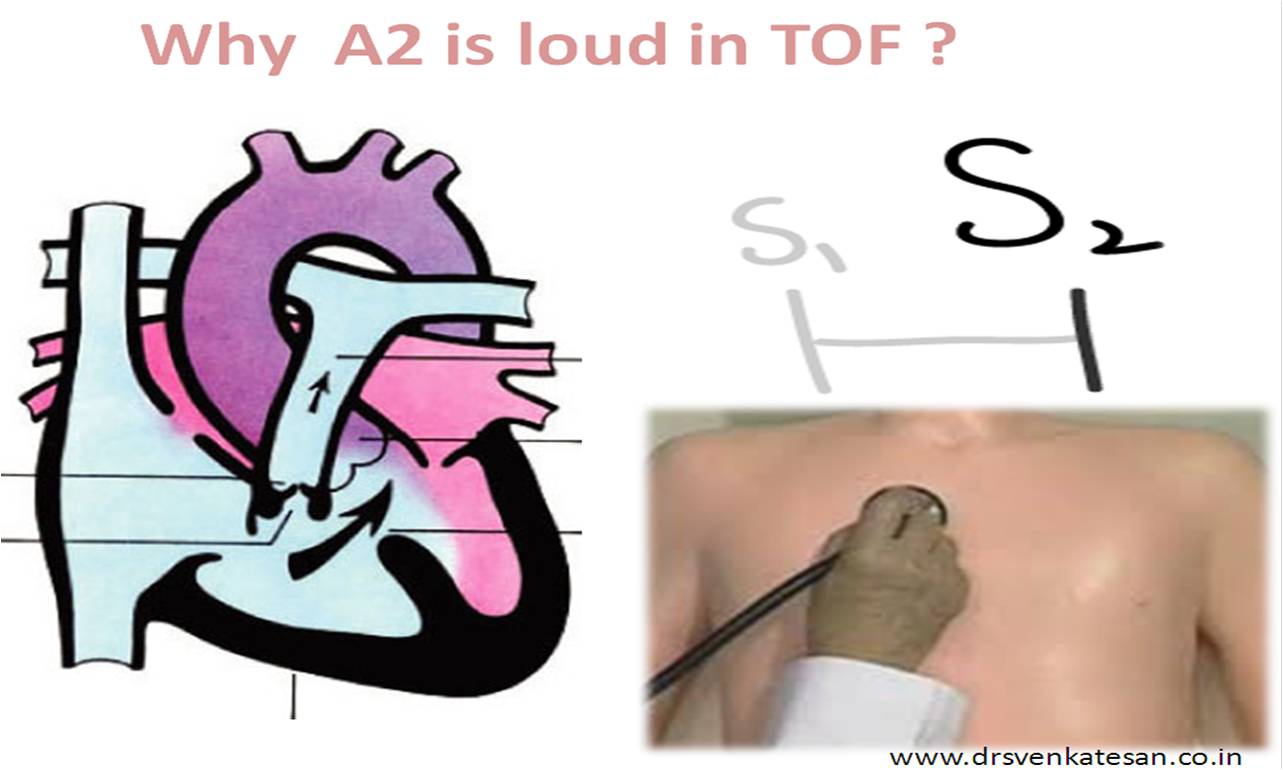
Second heart sound in TOF is often single and loud . It is often  best heard in left 2nd intercostal space as well as on right 2nd  space.

This is primarily due

  1. Presence of  pulmonary stenosis  and  resultant reduced pulmonary blood flow makes P2 soft or absent .Hence  A2 becomes loud by default.
  2. In tune with any  cono -truncal anomaly  , aortic root  is  anteriorly  malposed  in TOF. This brings the aorta  closer to chest wall  (Nullifying the  aquastic insulation  of main  pulmonary trunk  ) and results in a  booming aortic  second heart sound.
  3. Increased flow across  aortic valve . In cyanotic heart disease with reduced pulmonary blood flow aortic flow is augmented and may even result in dilatation of aorta . A large aorta with increased flow is perfect setting  for  generating a loud A2  . It  is common to hear a  aortic ejection click as well in these situations .

When you hear a single  second heart sound at  the base  of heart  , how do you recognise it to be   A2  or P2 ?

Will be answered shortly.

Read Full Post »

« Newer Posts