Feeds:
Posts
Comments

Archive for the ‘cardiology -congenital heart disease’ Category

Coarctation of aorta  continues to be an  important  acyanotic heart disease  . Now , early recognition  and intervention  is possible with the availability of sophisticated imaging and interventional modalities.

Our understanding of this  entity , even though appears complete  . . . it  is not ,   especially the complexities of the collateral  circulation and the associated malformation.Even in this 21 st century , unexpected circulatory  compromise are reported in the postoperative phase from various vascular  beds (Spinal, mesentric, limbs etc)

It is also  surprising to note ,  much innocuous entities like  ASDs ,VSDs  have  popular  anatomical and functional classification.It is a  rare excercise ,  for cardiology fellows  to classify co-arctation of aorta .This ,  in spite of the fact,  we have a  meticulous classification suggested by Amato , way back in 1991  published in Annals of thoracic surgery .

Let us  be  aware of this  . . .  Click  the link below for Amato’s classification

Amato’s  surgical classification of  coarctation of aorta

Type 1  Primary Aortic Coarctation

Type 2 Coarctation with Isthmus  hypoplasia

Type 3 Coarctation with Tubular hypoplasia of distal arch

3A- With VSD

3B-With complex LV outflow lesions

* Ideally  we need to include BCAV and status of ductus , suitability of aortic stenting in the classification.

Other old classifications

Bonnet’s classification 

Infantile :which later became known as pre-ductal, and adult which later became known as post-ductal . These became obsolete , as we came to know all coarctation or juxta-ductal .(Very difficult to separate into pre or post ductal coarctation  by simply  looking at it  , without knowing the hemodynamics )

Conte et all      **  Backer

1.Isolated coarctation  2.Co- arctation with  VSD 3.Co arctation with complex heart anomalies.


//

Read Full Post »

There are thousands of medical journal published worldover. Dozens are available in the field of cardiology .Only a few  are dedicated for pediatric cardiology.  Annals of pediatric cardiology is one .

It is all the more  creditable , as it comes from India , A country which is lesser known for scientific infrastructure  .  Full credit to the  pediatric cardiologist associataion of India and the medknow publishers for  bringing  this  highly specialised scientific content in this part of the world .

Read Full Post »

Association of pediatrics of India  has done a wonderful job .This may the first of it’s kind to formulate a excellent guidelines for managing CHD in India . This was made possible by the consensus conference on CHD held in AIIMS in 2007.

A must read for every physician, pediatrician and  cardiologist

It is recommended , this  guideline should be incorporated in every undergraduate curriculum of  medicine .This article which was published three years ago ,  should  have been published in the Indian  heart journal also.

Thanks to Indian association of pediatrics for providing this article  free

Link to article.2007 consenus conference on CHD Newdelhi

Read Full Post »

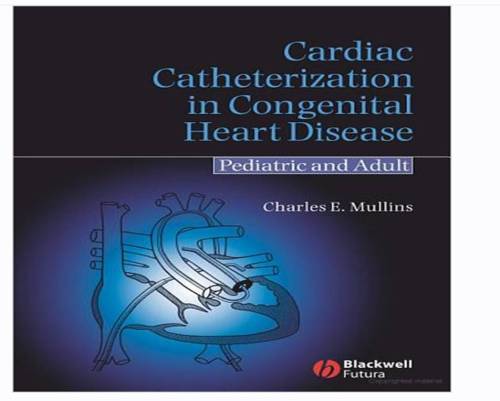
Here is one of   the  very good resource   for  all those basic questions we often ask  in pediatric cardiac catheterisation. Mind you ,  great books do not come free of cost .

Have a preview . Thanks to Google books

Click on the book to enter  , if  you are lucky you will get the  information you need   free  . . .

Read Full Post »

Even though it is a great vein , often the imaging pulmonary veins by echocardiography is a not a pleasant excercise.

This is due to the following facts

  • The pulmonary veins are posterior structures
  • They occupy the far field of echocardiographic window
  • The pulmonary veins often enter obliquely into the LA
  • The course of PVs are highly variable ( Like RCA origin !) especially in ASDs ,where identifying PVs becomes all the more important

Hence no fixed imaging angle can be advised . But generally a pattern is observed.

  • Right pulmonary veins are best viewed in apical 4 chamber or 5 chamber or in between (Especially RUPV is  seen best in 4.5 chamber view !)
  • Left pulmonary vein , can be seen in apical 4 chamber but best visualised in  Para sternal short axis view.

Other modalities for imaging pulmonary veins

TEE : Can be  very useful since it is brings the vein closer to the probe .But needs more expertice.

Contrast echo :Probably a simple and best modality often underutilised.

Very useful to clinch the diagnosis when PVs take abnormal course as in PAPVC .

MDCT , Spiral CT, MRI  are the new age modalities that can provide us  with dramatic  3d images of PVs.

The  echocardiogram will always prevail over these sophisticated gadgets for its simplicity and also it’s ability to give us the physiology of pulmonary venous flow which is vital in many diseases(Constriction, Diastolic function etc)

The following illustration is a gross attempt to simplify the imaging of PVs.Please note the rules may not be applicable in all.

Left upper and lower pulmonary veins in short axis view will be posted shortly .

Reference

The images are  based on  personal observations and  an  excellent insight  on the topic from  Department of Cardiovascular Medicine, Guangdong Provincial People’s Hospital, Guangzhou , China

http://ejechocard.oxfordjournals.org/content/9/5/655.full

Read Full Post »

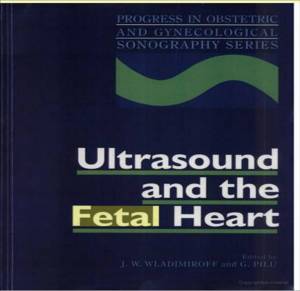
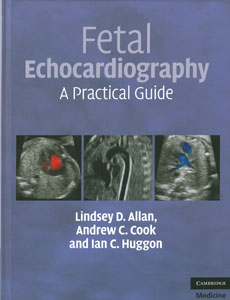
Fetal echocardiography is an important imaging modality for screening fetuses with congenital heart disease.Not all cardiologists are familiar with this imaging . Obstetricians are also not well versed in these techniques.So, finally,  it is left to few specialised radiologists to do this job. The issue here is  they are less  in number and the need for the experise is huge.  Further , the fetal cardiac hemodynamics and anatomy  are too complex to comprehend for a non cardiologist . So it is argued every clinical cardiologist to get trained in the basics of fetal echocardiography.

There are dedicated institutes and people who do this mode of imaging.

One such place is http://www.fetal.com

See for yourself the excellent information and knowledge resource in this site.

http://www.fetal.com/FetalEcho/04%20Standard.html

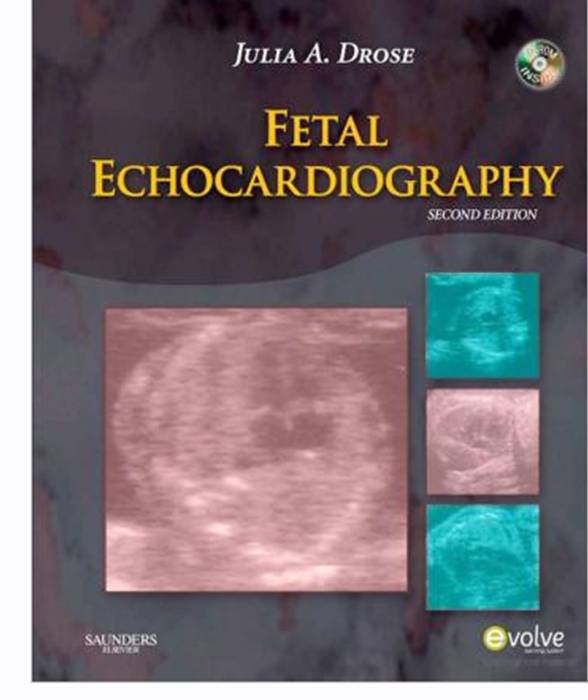
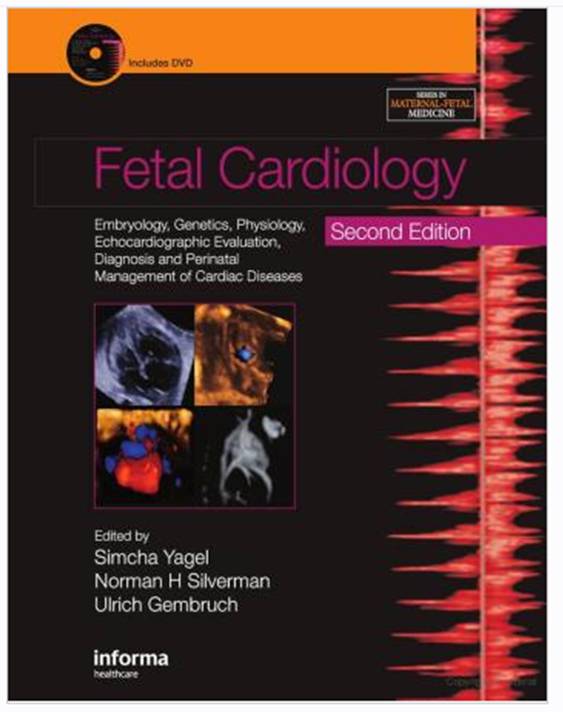
Other .popular books on fetal echocardiography

Julia A Drose

Simcha yagal

Juri W. Wladimiroff, G. Pilu

Lindsey Allan

Read Full Post »

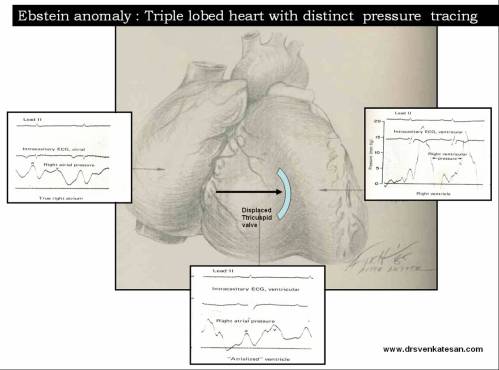
ebstein-anomaly

Down load high resolution PDF file

ebstein-anomaly

Ref:

An excellent article from H.Watson in british heart journal

HERNANDEZ FA  The intracavitary electrocardiogram in the diagnosis
of Ebstein’s anomaly. Amer J Cardiol 1: 181,  1958

Read Full Post »

Biochemical diagnosis for PHT and Eisenmenger syndrome

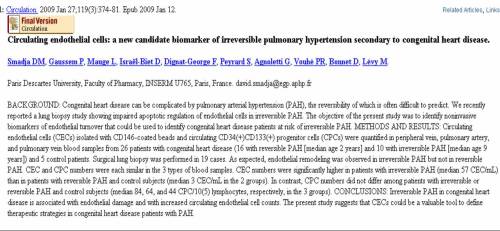
Identifying reversibility of pulmonary arterial  hypertension remains a difficult clinical problem.Heath edwards grading of pulmonary hypertension is based on lung pathology .Grade 4 and 5 constitute severe obstructive vascular pathology including pulmonary vascular necrosis.

Lung biopsy is an invasive procedure and has a  huge risk in patients with elevated pulmonary artery pressure.

Do we have an alternative ?

Does the pulmonary artery  sheds  necrosed  endothelial cells  into the circulation  ?

Yes it seems so , This month’s Nature cardiology  reveals a breakthrough concept

The CEC (Circulating endothelial cells count )  can be used as marker  and  may be considered a non invasive equivalent of lung biopsy

http://www.nature.com/nrcardio/journal/v6/n4/full/nrcardio.2009.18.html

nature1

pht

Read Full Post »

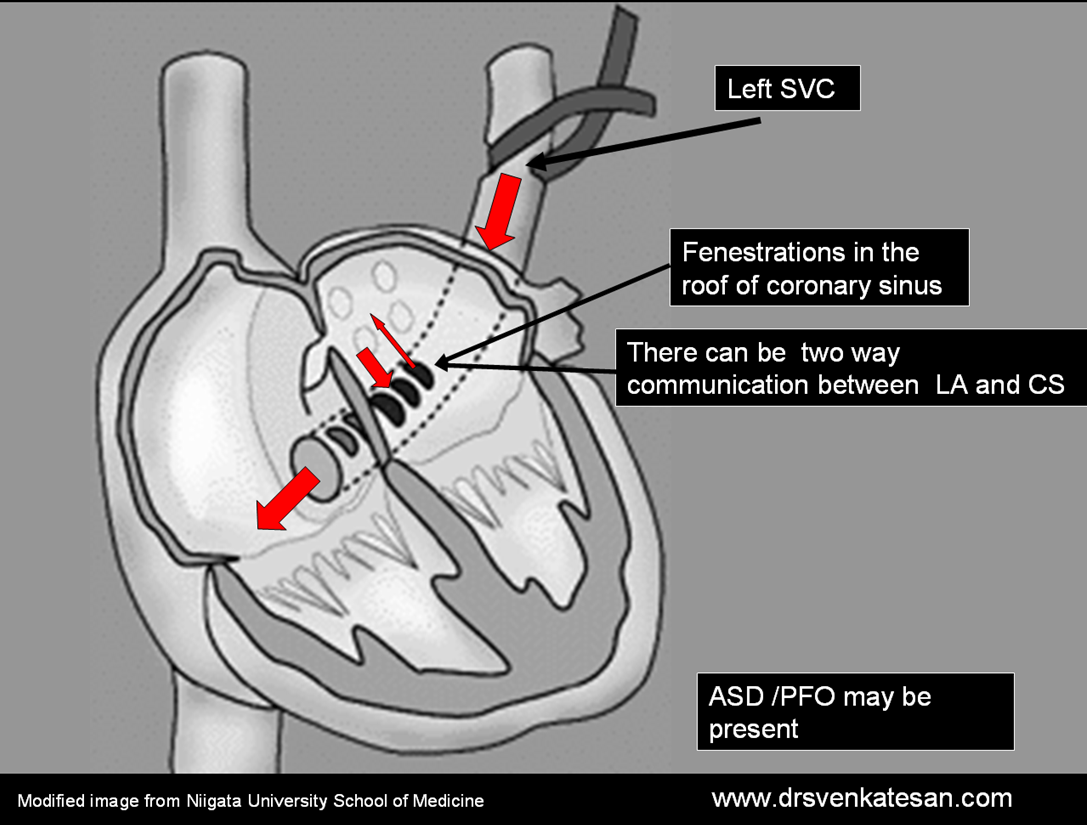
                                               The superior aspect of   coronary sinus and a portion of the left atrium share a common wall .Embryological defects in this area result in a communication between left atrium and coronary sinus. This defect  descriptively called as unroofed coronary sinus .This entity is most commonly associated with persistent left SVC. Extreme form of unroofing is some times termed as absent coronary sinus.

How to diagnose it ?

A high degree of anticipation is necessary in all patients with ASD or LSVC. A dilated coronary sinus in routine echocardiography warrants full investigation. A contrast echocardiography with agitated saline injection in left cubital vein will clinch the diagnosis as contrast enters LA after opacifying the dilated coronary sinus. During  right heart catheterisation catheter course entering coronary sinus and  advancing into LA through the fenestrations (Unroofing)  will confirm the defect.

How do you classify unroofed coronary sinus ?

The morphologic type of URCS was classified as Kirklin and Barratt-Boyes

 Type   I, completely unroofed with LSVC;

 Type II, completely unroofed without LSVC;

 Type III, partially unroofed midportion;

 Type IV, partially unroofed terminal portion

What is the clinical relevance of this entity ?

This entity should be suspected in every patient with persistent LSVC, ( and LSVC should be suspected in every patient with ASD). The hemodynamics is that of an ASD but if sufficient mixing of LSVC blood and LA blood takes place the child will have mild cyanosis.Some times when the coronary sinus is totally absent it will present as a typical dusky ASD picture which can closely mimic a TAPVC clinically.

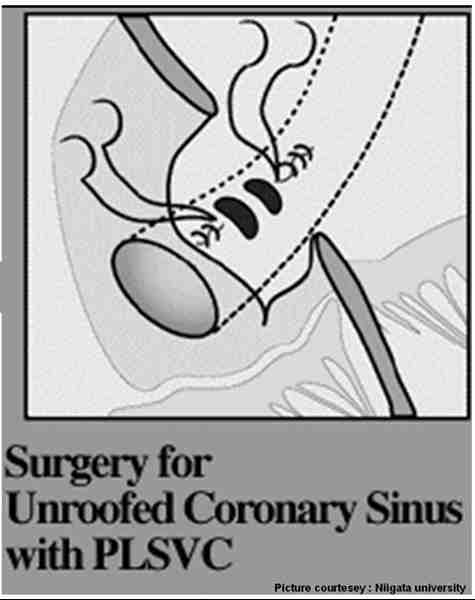
Surgeons have a greater role in recognising and treating this entity. A typical repair will be done like this


Links to some of interesting articles on this topic

Raghib circulation 1965

Read Full Post »

Atrial septal defect is one of the common congenital heart disese. Surgical correction or device closure is indicated in all patients  with significant shunts. Statistically for every  ASD diagnosed  with  more than 2:1 shunt there must be  is atleast three pateints  with ASD with less than 2:1 shunt in general population. Do we diagnose it ? . Some may be miss diagnosed as PFO.

Read Full Post »

« Newer Posts