Feeds:
Posts
Comments

Archive for the ‘cardiology- coronary care’ Category

Top 5 conditions that closely mimic and often mistaken for STEMI !

  1. Early repolarisation syndrome
  2. Left bundle branch block(LBBB)/ Left ventricular hypertrophy(LVH)
  3. Hyperkalemia
  4. Pericarditis
  5. Brugada syndrome

ERS

The repolarisation is due to  K + efflux . The  K channel porosity  is subjected to high degree of genetic  variations .If the repolarisation starts even by 10 milli- second earlier,  it would have early take off from descending  limb of R wave  and  the J point  ST segment appear elevated.

  • Common  in young  males . Especially in vago-tonic persons with relative baseline bradycardia
  • The ST elevation in ERS is often global .
  • Concavity is upwards .
  • ST elevation can be dynamic ( Further  confusing the picture ! )
  • On EST it  is expected to the  touch the baseline .
  • Benign entity in most . ( False alarm of STEMI is the major risk !)
  • There is some evidence ERS may confer a risk  of  primary VF ,  if they  experience a true STEMI  (Michel Haïssaguerre 2008  NEJM )

* STEMI in ERS :  The issue becomes too delicate ,  if  a  patient with ERS  develops  a true ACS .   ERS being a common ECG pattern in general population , it is not wise to label  every  chest pain in  ERS patient as benign . Suspicious  ones demand observation in step down units , at least !

LBBB

 “Any patient with  LBBB & chest pain . . . suspect  MI”  .

Unfortunately,  this rule is  too reverently followed by  physician community.  In fact ,  ACC/AHA guidelines  reinforced this behavior ,  as it  added a key word  in  their STEMI guidelines   “New onset”  or   “presumably new onset ”  LBBB is  an  indication for PCI/Thrombolysis    .( Physician presumption is a too delicate thread  to hang  our concepts !   )

               Every LBBB is new onset unless you have  a  documented proof otherwise  . . .   it seems to suggest !

Probably , this  is the reason many of the LBBBs are thrombolysed when they present to ER in an acute fashion . Of course , we can apply criteria of  Sgarbossa  to differentiate !  however flimsy it may appear . It  help us to exclude few benign LBBBs. Still ,  Sgarbossa will  struggle to  differentiate  an acute STEMI  in Chronic LBBB  from an  acute LBBB in  old AWMI .

Simply put . . . even old MIs  are at risk of  acute intervention if they have LBBB  and vague chest pain !

How to overcome this ?  Always rely on clinical  features  . If  STEMI is causing the LBBB ,  it  should be a large extensive one and you can not  expect the patient to be  comfortable .(Logic  would suggest necrosis of  large  parts of IVS is necessary to cause LBBB ) Chronic  LBBBs  are relatively comfortable  .

Of course , there  is one another  issue to comprehend  ie  transient ischemic LBBB .We do not know the true incidence  and long-term significance of this entity . Here , LBBB is  not due to necrosis of  the bundle but due to ischemia . (Almost impossible to differentiate it from  rate dependent LBBB  with  aberrancy  )

Role of enzymes and Echocardiogram in LBBB  and suspected STEMI .

You can always ask  for   Troponin  T / CPK MB .(They are helpful only  if 3 hours have elapsed , can we afford to wait ? ) . LBBB  due to STEMI  will  purge  a large quantum of cardiac enzymes from the infarcted zone . (So a marginal elevation is not going to help!)

Unfortunately,  LBBB  can induce wall motion defect in septum that may awkwardly simulate an ischemic wall motion. Even experts have erred in this . One clue  is,  the motion defects  can  not  extend   into anterior wall . It  is confined to septum ,the second clue  is a little delayed  post QRS  thickening of IVS (Septal beaking sign will vouch  for benign LBBB with fair degree of success  )

LVH

  • LVH can mimic a STEMI due to secondary ST/T changes . (Secondary to tall R wave )
  • LVH with incomplete LBBB  – A very common association that can further elevate ST segment in v1 to v3 .
  • Left ventricular hypertrophy  mimics old MI as poor R wave progression in V1 to  V3.
  • Contrary to our belief even Inferior  leads can  show q waves due to  inferior  septal hypertrophy.

Hyperkalemia.

With aging population and rampant  acute and chronic renal disorders it is becoming  a daily affair to get calls from medical units for ECG changes .We know  the rapidity of  efflux  potassium is responsible for ventricular re-polarisation .Phase 2, and 3 are K + exit zones. This is the same phase ST segment and T wave are inscribed.In hyperkalemia  K + accumulates inside the cell and keep  ST/T  segment  elevated .T wave also  becomes tall . It can mimic  both as hyper acute  STEMI .

Read a related article (Dialyisable current of Injury )

Pericarditis

  • ST elevation is not confined to an arterial territory
  • Can be global .(Regional ST elevation  does not exclude pericarditis)
  • ST elevation is concave upwards as in ERS

Link to Read regional pericarditis
Brugada syndrome

Brugada syndrome  is  an ECG -Clinical complex in which ST elevation in pre-cardial leads is associated with  ventricular arrhythmia. The defect lies in sodium channel . It reflects  a mis -match between RV and LV epicardial repolarisation forces .It keeps the RV epi-cardial current afloat and  the pre-cardial leads  facing the RV records ST elevation that  mimics  STEMI. It often  shows  a RBBB pattern and varying patterns of ST morphology  . The  ST segment is  also  subjected to dynamism  , due to change in autonomic tone and myocardial temperature  .(Febrile VTs)

After thoughts

Other close contenders for the top 5 slots

Myocarditis

Acute pulmonary embolism

Dissection of aorta

More

  • Acute stroke (Neurogenic ST elevation )
  • Stress cardiomyopathy (Takot Subo )
  • Acute abdominal conditions mimicking inferior STEMI.
  • Panic attacks /Anxiety states / chronic anti psychotic  medications which are known to elevate ST segments.
  • Contusion chest

(Cocaine hearts / Coronary arterial spasm / LV dyskinetic segments  and  LV aneurysms  were not nominees ! )

Read Full Post »

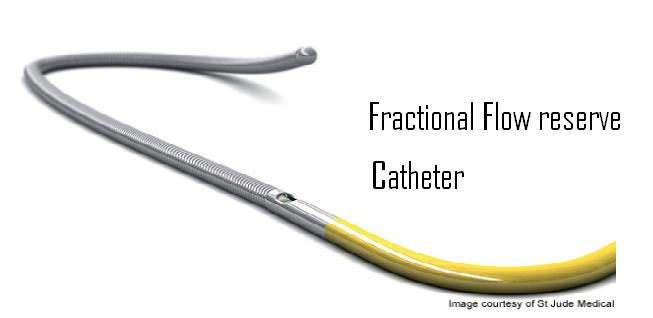
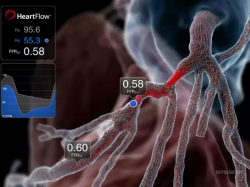
Fractional flow reserve is  a new coronary hemo-dynamic para meter used to assess physiological impact of border line lesions in coronary artery disease. The calculation is simple

FFR is  a terrible concept * for two reasons .

One ,  it never bothers about flow * across   a lesion. It simply  relies upon  pressure drop. We  know  there  is an intricate relationship   between pressure and flow . Simple pressure drop can never be  expected to translate into incremental flow in biological systems .

(FFR anology  in co-arctation of aorta . Can you take difference between upper limb  BP and lower  limb BP as a most accurate   Index of severity of co-arctation of aorta ?  )

How crude it would be   . . .  to  believe so ?

Two   it  ignores the  morphology of the lesion . We know an eccentric soft  lesion with a  good distal   FFR  is  live  coronary explosive .

The  FAME 1 and FAME 2 studies  glorified  FFR  !  I differ in many ways .

Some of  the  observations made about FFR.

  • FFR is to be  done only in discrete ,  safe looking  , intermediate lesions .(Do not ever attempt it in a eccentric lesion )
  • FFR wire is a  stiff ( stainless steel ) wire .  Careful maneuvering is necessary . Lesion crossing  and pull back  FFR wire require some expertise.
  • FFR / OCT  combo,   increase  not only the  fluroscopy time  ,  this procedure can be  more complex than  the intended   PCI .
  • My colleagues tell me FFR measurements are not often  reproducible .(I have little experience in this )
  • Adenosine induced vasodilatation  is not natural physiological model . Further it has  a potential for  a coronary steal if there is near critical lesion in contra lateral artery.
  • There are many occasions   FFR wire has caused  dissection  and  subsequent stenting was necessary  .(The very thing  the cardiologist wanted to avoid !)
  • Bifurcation lesion FFR measurement is prone for errors
  • FFR in two tandem lesions cannot be assessed   accurately
  • Post PCI FFR is not practiced routinely in may centers  the fear of  status quo of FFR.

Final message

This post is not to defame the FFR as a concept . Just to make you think  . . .  how often ,  we  are entrapped  in a  pseudo -intellectual  game in  the cath lab ! FFR  as a tool , can still  be valuable to assess coronary hemo-dynamics in a selected lesion population especially,  discrete,  single vessel ,  or left main disease  with around 70 % narrowing . But never go with FFR alone .Consider the morphology , location   of the lesion .

Finally do not forget  ,  the   good old  EST  can  give a stiff  fight  for supremacy over FFR  in terms of assessing physiological impact of a coronary stenosis (Especially in single vessel disease ) 

Reference

Fractional Flow Reserve versus Angiography for Guiding Percutaneous Coronary Intervention . http://www.nejm.org/doi/full/10.1056/NEJMoa0807611

Read Full Post »

Hi all ,

I get frequent comments about my blog. I do try to answer many of them . This is a very unique one , and it is making me think further.Since he has specifically wished his clinical data could be eye opener for others ,  I am jut posting it here . The comment was in response to my article  Who said coronary collateral circulation will not support exercise ?   here is  the extract

Dr. Venkatesan,

I read your blog with great interest and I think I may have something useful to contribute from my own personal experience. I am a 68 year old male with a long history of smoking (for fifty years), and a history of uncorrected hypertension over the years (it has been corrected to normal with medication for many years now). I am a non-smoker now for the past 18 months. I have PAD and a moderate aortic aneurysm of about 3.5CM (ascending and descending) which is being watched with regular vascular scans.
The common femoral arteries in both of my legs are nearly 100% occluded between my thighs and my knees, and yet my ankle and toe blood pressures (and my circulation in my ankles and feet) is almost normal. The reason for that is that according to the vascular scan, my deep femoral arteries are much larger caliber than normal with extensive vascular collateralization by passing the common femoral occlusions.
About twenty years ago before the PAD diagnosis, I realized that I had claudication in both of my calves when I walked a short distance. I expected this was being caused by an arterial blockage in my legs, so I went to the gym every day for about three years, and walked through the pain every day. I believe this contributed to the formation of the collaterals that have perhaps saved my legs and feet.
I also have heart disease, and had a fairly minor heart attack in 1999. No stents were placed nor angioplasty performed at that time. I recently had an arteriogram and cardiac stress MRI which showed that two of the three coronary arteries are now 100% occluded (apparently I had another cardiac event and did not know it). The cardiologist says that the LAD is in extremely good condition and has numerous collaterals branching from it. I have no symptoms whatever from all of this, except that my LVEF is low (about 35%). I walk at a very brisk pace six miles per day, five days per week, and I monitor my pulse rate with a pulse monitor when I walk. I keep my pulse between 115 and 120 which I calculate to be 80% of maximum for my age. I believe this cardio exercise / walking has also helped with the collateral formation, and I am hoping to bring the LVEF back up to a reasonable number with this exercise regimen.
My cardiologist has recommended an ICD, but I have decided against that since I have never had VT or VF or any other type of cardiac arrythmia (except for non-symptomatic PVC’s which I was born with).
I believe that I am the lucky recipient of good genetics to begin with, but also I am highly motivated now to take better care of myself, and know as much as I can about the conditions that I have. I plan to have an echocardiogram in six months to see if the LVEF numbers have improved, and I fully expect that they will have. I give credit to the smoking history for the vascular problems that I have including the cardiac problems. I am a lucky person I think, and suspect that not everyone has the fortunate ability to heal themselves the way I have.
I have asked for copies of my arteriogram and stress MRI records. If you are interested in looking at these I would be happy to share them with you.

The letter ends .

Dear Mr Weigel

Yours is an extremely interesting story  told in a most scientific manner.Thank you .

It gives me great insight  ,  how a  human vascular system  can  transform when confronted with  natural disasters like multiple blocks on its way .A flowing river will definitely reach its destination  however bizarre the path it takes . Human biology is vested with vast reserves of genetic building blocks put on sleep  mode. While billions of dollars are being pumped into do research in human angiogenesis we have tuned a  blind eye to the vast net work of natural collaterals.

Our clinical experiences also tell the same thing . In chronic total occlusion  majority of patients would develop good collaterals if only we do not  tamper  the  main vessel  .None of scientific studied available has proven opening CTOs (Chronic total occlusions) has improved the clinical outcome .

Regarding  the guidelines  for revascualrisation ,  I am yet to come across a standard scientific guidelines that includes the extent of collateral circulation  as one of the determinant for need for revascularisation !

I will definitely use your case study for the benefit of so many patients !  I always feel , a properly interpreted experience  , even from a  single patient   can make a tremendous impact in the growth of science .

Thanks again for sharing your personal health issues !

Dr Venkatesan
Chennai .India .

Read Full Post »

Rescue PCI rescues

  1. Myocardium
  2. Patient’s life
  3. Both
  4. None
  5. Cardiologist pride

Answer:

All of the above can be a correct response in varying situations.

Read Full Post »

Which is  the most important factor that determines thrombolysis failure in STEMI  ?

  1. Thrombus load .
  2. Drug efficiency
  3. Time delay
  4. Presence of a mechanical lesion
  5. Hemodynamic instability

Answer : 3 .(Though all 5 factors operate )

Failed thrmbolysis occur in about 40-50% after streptokinase and slightly less with TPA   and TNK-TPA . Delayed arrival and late thrombolysis are  most common cause of failed thrombolysis. As the time flies , the  myocardium gets damaged and the intra coronary  thrombus gets organised .Both these processes make delayed thrombolysis a futile exercise.

               Not all STEMI patients have large thrombus burden. There need to be a critical load of thrombus for thrombolytic to be effective

Some may have a major mechanical lesion in the form of plaque fissure, prolapse and it simply blocks the coronary artery mechanically like a boulder on the road  . The poor  streptokinse  or the rich Tenekteplace !  nothing can move this boulder .The only option here is emergency PCI .

How will you know when the patient  arrives in ER with STEMI whether his/ her coronary artery is blocked with soft thrombus or hard mechanical boulder ?

It is impossible to know.That’s why primary PCI has a huge advantage.  But still thrombolysis is useful as some amount of thrombus will be there in all patients with STEMI.Lysing this will provide at least a  trickle of  blood flow that will jeep the myocardium viable and enable us to take for early PCI.

Final message

The commonest cause for thrombolytic failure is the time of administration and the degree of underlying mechanical lesion  . So  it does not make sense  to blame  streptokinase always !

Read Full Post »

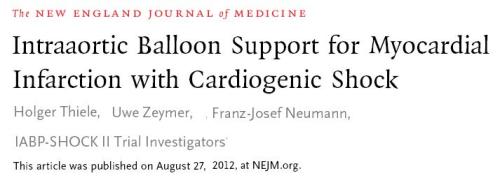
The last rites for routine   Swan Ganz catheterisation ( In STEMI ) was  performed  by a  land mark JAMA article  in 1996 .

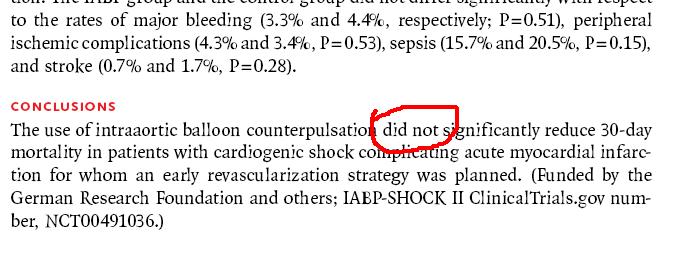
Now . . .  is the turn for intra aortic balloon counter pulsation (IABP) .

A conceptually attractive concept  was laid to rest in Munich ,West Germany , this week at annual  European society of cardiology ,  Scientific Sessions  .August 2012 .

What a crash for a great  hemo-dynamic  principle    in acute MI which ruled the roost for over three  decades !
Just Imagine ,   how many man hours , millions of  worth of consumables  wasted  . . .  better  not to talk about  associated   aortic injuries .

This is what we call   premature evidence based harm”

I  wonder  . . .  whether  I am  justified in making this extreme comment .

Please read for yourself  , this early online release alert  from  NEJM .

http://www.nejm.org/doi/pdf/10.1056/NEJMoa1208410

Reference

Connors A, Speroff T, Dawson N, Thomas C, Harrell FE Jr, Wagner D, etal. The effectiveness of right heart catheterization in the initial care of critically ill patients. JAMA 1996;276:  889-97.

http://www.ncbi.nlm.nih.gov/pmc/articles/PMC2352214/pdf/bmj00561-0005.pdf

Read Full Post »

Ventricular septal rupture is a major mechanical complication of STEMI . Excruciating  chest pain ,  is the sine qua non of  any myocardial tear , dissection and rupture . It is surprising ,   VSR  following STEMI  is rarely a painful event . I can recall number of  such events  , when a  stable   patient with persistent ST elevation  in the  coronary care unit ,   wakes up next morning  with a systolic murmur.And echo reveals a septal defect promptly.

Three  reasons  can be  proposed  for relatively  pain free rupture of IVS in STEMI.

  1. Typically  VSR  occurs in 3rd or 4 th day of infarct . By this time myocardium  can be as  soft as an ice cream ! . There is not much stress and strain at the site. The necrotic  debri just gives way to spikes of   LV systolic pressure .
  2. For rupture to occur there   must be  transmural infarct  .The pain nerve terminals also die in the process .
  3. Further , it is a cavity to cavity rupture  (LV to RV ) . Direct pericardial  stretch  does not occur .

* Ventricular free wall tear   is a near fatal event is extremely painful .This  often occurs  in the first 24 hours when  the nerve terminals are  alive . The free wall rupture is more of  a  tear in the plane of  myocardium . The  pericardial  (epicardium)  layer has  rich   somatic  nerve supply .

In summary

Early  myocardial  tear   involving the epicardial  surface can be severely  painful  .  Late giving way  of softened  , necrotic  often  hemorrhagic muscle ( especially in the IVS ) is less painful or totally painless.

Coming soon   . . .

By the    . . .  what happens  to  pieces of  septal myocardium as it  gives way  and enter the right ventricle   ?

Read Full Post »

Angina is the classical clinical counterpart   of  myocardial Ischemia.

True  Ischemia , by electro- physiological rules  must elicit some sort of  ST segment shift .(Usually  ST depression rarely Elevation  )

But  . . .  we know Ischemia and ST depression do not always go together !  Dissociation can occur in both ways.

ST depression without angina is more prevalent  (often referred to as silent ischemia)  , while angina without ST depression is  less common but by no means rare .

We observe both these  phenomenon  during EST.  The  critical issue  here is ,  any pain without ST depression during a EST , the physician is likely to reject it as  non cardiac.

How wise  it is ,  to ignore such chest pain  ?

If a patient  complaints  true  compressive , squeezing  pain  it should be taken as angina  and EST should be  stopped and labelled as positive   even without  ECG changes .

According to the much   famed (De ) theory on ischemic cascade chest pain is supposed to come last. Time and again the rule of ischemic cascade  goes awry in the bed side. Clandestine angina without any ECG evidence be more important clinical entity than we realize.

                                      The argument against this ,  “If you start believing  patient’s  word  more than  ST depression  then the very purpose of EST documentation is lost  !

According to the now  de-famed theory on ischemic cascade ,  chest pain is supposed to come last. Time and again the rule of ischemic cascade  is found to go awry in the bed side .Clandestine angina without any ECG evidence be more important clinical entity than we realize.

Another clinical situation where we  encounter  ST segment  : Angina dissociation is ,  during balloon inflation of PTCA.

Two  explanations can be offered  for Angina in the absence of ECG changes .

1 .Cancellation of ST vectors  due to ischemia of two diagonally opposite areas of ischemia.

2. Electrical  blind spots  in 12 lead ECG. This  is especially common with LCX ischemia  where most of the electrical events are directed to back of the chest.Conventional leads can easily miss .

Read Full Post »

Stress related wall motion defect  is a well-known entity . It is referred to as Takotsubo cardiomyopathy .

These stress are often

  • Emotional
  • Neurological
  • General systemic stress

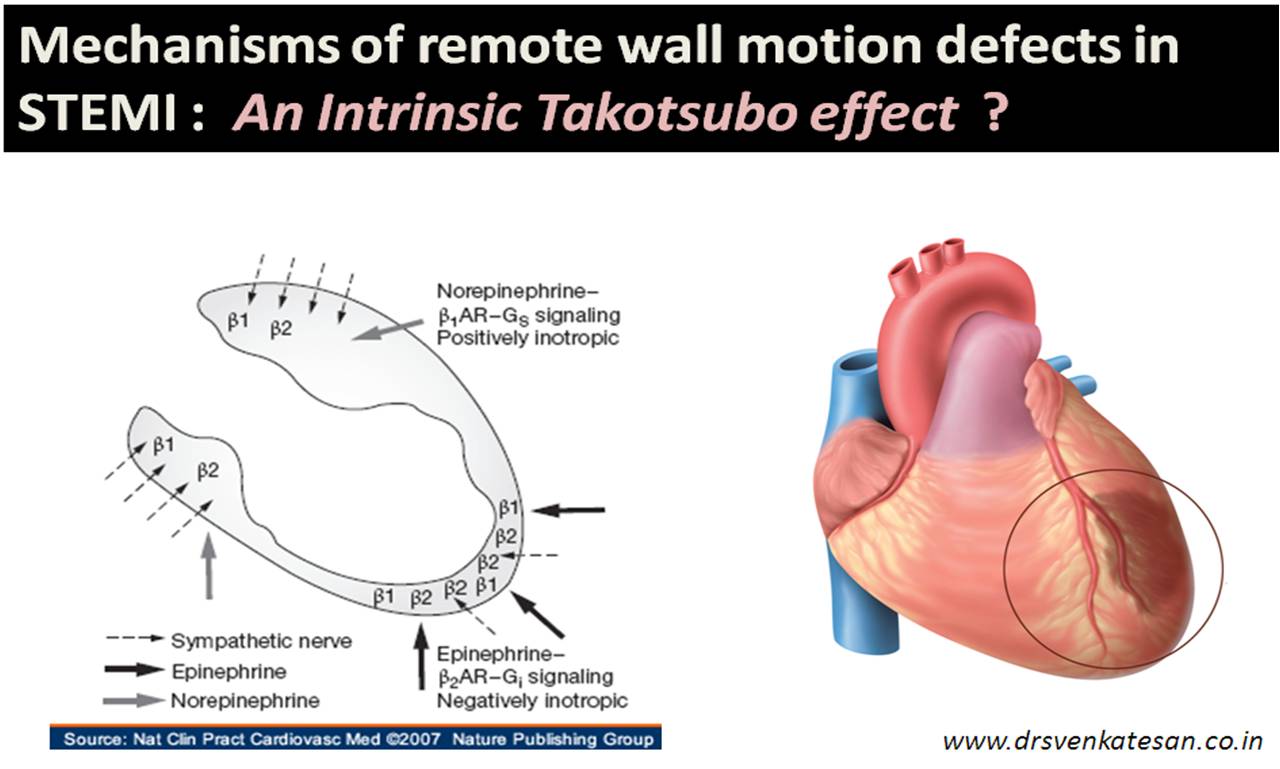
The culprit seems to be pooling of adrenaline and nor adrenaline in myocardium .These remote  neurogenic stress can cause significant wall motion defect due to adrenergic  downpour

The image depicts the wide variation in the density of beta receptors in heart.The stress of MI can result in varying degrees of wall motion defect .It is important to realise the wall motion defect in STEMI has two components .One is related to ischemia and other is due to excess catecholamines. This explains many of the unexplained remote wall motion defects during STEMI .This  may be referred to as Intrinsic Takosubo effect !

Then   . . . the following    questions arise

When systemic stress can have a profound  effect on myocardium , what   about local stress ?

Acute STEMI  is  a huge stress for the heart   . . .   isn’t  . If  so , can it   alter  the wall motion defect in adjacent  or remote myocardial segments  independent of ischemia ?

With the distribution  of adrenergic receptors  showing  huge variation ,  we do not know how an acutely ischemic heart  spills the adrenaline all over .  Is there a pattern to it  ?  or it happens at random ?  Further , the  response to  accumulated  catecholamines  is  not  going to be  uniform. This will explain why certain patients  go into ischemic  LVF  , very early in the course of STEMI  even before the myocardium is necrosed. It will  also explain  the  benefits that accrue in selected patients  who receive early IV beta  blockade  ( Which is  of course currently not popular after COMET study ! )

Final message

We  have seen at least  two patients  with severe  transient ballooning  wall  motion defect in LAD region  (LV apex)  with isolated RCA lesion and inferior Infarct .

The question raised is this 

Can  the  stress of  Inferior  STEMI   . . . result in  apical Takatsubo  like  effect ?

Reference

http://www.medscape.org/viewarticle/567069_4

http://www.takotsubo.com/

Read Full Post »

In the management of STEMI , many  of us  believe  , contraindication  exists only for thrombolysis . In fact  , there is  a big list  of contra’s for primary PCI as well  . Few  books mention about it and  few discuss about it  . It comes under many broad categories .Time , technical, patient  and  concept  related

  • Late presentation > 12 hours (This is the most important  contraindication  . 12 h is the time taken for  death of  myocytes . Myocardium will not  bother by which modality it is going to be rescued ! It simply  won’t give any  grace time  and never feel privileged to be rescued by PCI !)  The supposedly time independent beneficial effects of PCI  was  never proved convincingly !
  • Uncomplicated , fully evolved, spontaneously re-perfused   ( successful  )  STEMI  (At-least  10 % of STEMI population  ) . This is  common in RCA STEMI .
  • Primary PCI  should not be done in  low volume centers with poor expertise  ( less than  2 -3 per month ?)
  • Lack of sufficient hardware .
  • Co-Morbid conditions
  • Very elderly ( Controversial … some may call it as an  absolute  indication ! Such is the status of EBM in 21st century !)
  • Any recent bleeding conditions carry equal risk as that of thrombolysis

The list of relative contradictions  that are  widely reported in literature  for thromolysis may apply in PCI as well .The risk of bleeding is many fold higher when  multiple anti-platelet agent /Heparin are used .The usage of 2b -3a is also rampant in many centers .  A recent hemorrhagic  stroke is  an absolute contraindication  for PCI as well.(If only you do a PCI without anti-platelet  agents).With number of complex anti-thrombotic drugs knocking the d0ors of cath lab , the problem is set to grow further.

Final message

Never underestimate the  potential  peri -procedural bleeding risk during PCI  .It can easily  exceed that of a thrombolytic agent  in susceptible individuals !

Primary PCI is a great innovation and is a gift  of modern science to human race . But , when  selecting the patients  ,  many of us  continue to interpret  this issue  wrongly. We seem to think , in a given patient  , if  thrombolysis is contraindicated  ,  he or she will automatically become eligible for  primary  PCI It is a dangerous assumption and  is rarely true  . There are umpteen number of situations were both are contraindicated . I  argue the  intervention community to publish specific guidelines with absolute and relative contraindication  for primary  PCI as well .

After thought

If  a patient is not eligible for both thrombolysis  as well as PCI what to do ?  Is it not a crime to watch a patient with STEMI simply losing his myocytes ?

It may seem so  , when we look at  superficially   but  be reminded even simple heparin therapy has saved many lives in such a situations .

Link to related You tube video

Reference

That  elusive  uncommon  sense

Read Full Post »

« Newer Posts - Older Posts »