Feeds:
Posts
Comments

Archive for the ‘cardiology -ECG’ Category


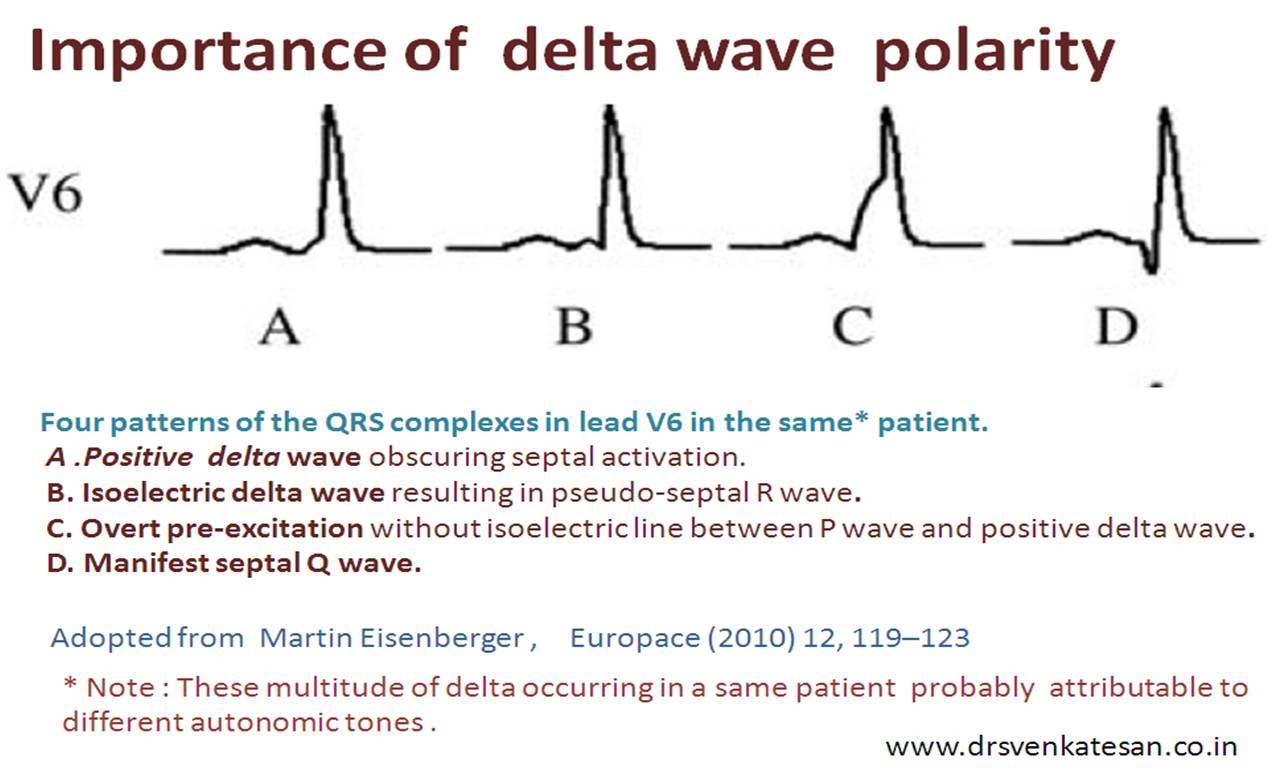
 Delta waves  are initial 20 ms  (or is it up to 40ms ?)  segment of  qrs complex that is  inscribed due to pre-excited depolarisation of the ventricle due to an accessory pathway .

It is more of a  fusion complex with  native normal qrs complex. The leads in which appear , the polarity and magnitude of these delta waves are determined by

  • Site of APs
  • Rapidity of  conduction through this AP
  • The quantum of native AV conduction
  • Influence of Autonomic tone  and the  refractory period of these accessory pathways .
  • Heart rate , distal conduction velocity , also can influence .
Can delta occur without AP ?
Like any other variation  isolated delta waves are reported in routine ECG finding.   It can be  be present in 0.15% to 0.25% of the general population. A higher  prevalence of 0.55% has been reported in first-degree relatives of   patients with accessory pathways.

How do you account for delta in general population ? We know concealed pathways can not record delta  . . . then it is possible some from of accelerated AV conduction  with twin pathway should be quiet common . ( It is very much possible  dual AV nodal pathway with grossly different conduction properties and distal insertion sites  inscribe a delta wave .)

  The crux of the discussion  of WPW syndrome revolves around  identifying delta wave and its direction .  If  the delta wave is well inscribed this job is easy  but at times  it  can be really difficult .

Many moods of delta wave

  • Positive delta  wave inscribes  above baseline. (See the above ECG  showing different delta in same patient )
  • Negative below baseline  and  iso-lectric on the baseline .
  • Please note , delta wave polarity and QRS polarity need not be in the same direction . If  they are in  the opposite  direction many time it appears as  small a pathological “q”  or pathological  “r”
  • It is likely  a delta wave can also drag  and  change the direction of qrs depolarisation  if  the  quantum pre-excitation  is large and with a fast conduction property.
  • It is also possible  the combined contribution of  negative delta with negative qrs together make a  deep  q waves . (Typical example is the LBBB type ECG in type B WPW in Ebstein anomaly )
  • Rarely the entire QRS can be  due to pre-excited  tract and native AV conduction contribute less.(This exactly happen in anti-dromic tachycardia ) but  this phenomenon is extremely rare to occur without tachycardia.

Final message

WPW  syndrome is such a dynamic  entity ,  one can realize how futile it will be to formulate fixed rules for ECG localization based on this wave .In fact,  we suffer from a  fundamental  electrical ignorance .How often delta wave polarity is discordant with qrs polarity and what is the  mechanism ? Standard text books do not discuss this issue . Many of the EPs skirt this question ! For this , we need  to critically decode the mechanisms of delta wave generation . Hope our youngsters take up the job !
Read Full Post »

“STEMI is Acute MI” , and   “Acute MI is STEMI”  !   This is  how we  have been taught over the years.

But   STEMI can present in any one of  the following  odd ways

1. Posterior MI with ST depression in V1 to V3 ( Manytimes mistaken for unstable angina , and reperfusion not considered !)

2.Only with tall T waves (TEMI)

3. Left bundle branch block

4. Present as ventricular tachycardia. Untill VT  it is reverted ST elevation  will not  manifest.

5. When a  STEMI presents with  complete heart block   ST elevation may not manifest.

6.Atypical ECGs and subtle ECG changes are especially common in elderly, diabetic and in patients with LVH.

7. Finally,  it is often quoted in text books  acute MI occurs with normal ECG in up to 10 % . This is  a  high estimate .We belive acute MI with normal ECG is very rare presentation < 1% . That too in the very early stages of evolving MI.

As of now  only condition No  1 and 3 are approved  for  thrombolysis or PCI.  The unfortunate few who fall in other categories will continue to lose their muscle in the golden hour without any intervention  as the guidelines has not addressed these issues.

Read Full Post »

A patient with  chest pain   is being rushed   into the ER  of  a medium sized cardiac facility in an urban county of India .The fellow briefs the senior consultant cardiologist about the arrival of  this  extensive anterior  STEMI  over phone.  The  consultant  enquires  about the “symptom to door time” and  was little concerned  when the fellow said ” it is only  2 hours sir”  .The fellow was amused with the consultant’s  reaction.

The consultant arrived in 15 minutes  and  began  the all important  discussion with the  patient  and his spouse  .(Meanwhile tablet clopidogrel and Aspirin was  loaded  per orally . Note : Heparin is not given yet )

Cardiologist : It is a  massive heart attack . One of your coronary artery  got  blocked suddenly , I have to remove the block at the earliest . There are  two ways of doing it .  One is fibrinolysis which lyses the clot .It can open up  your vessel  , though incompletely but would prevent myocardial damage  at the earliest .

The other one is PCI ,  which if performed rapidly  will completely  open up the vessel in question , what  we call TIMI 3 flow ,  But it has to be done within one hour.

Patient : Which is better doctor for me ?

Cardiologist : My cath lab  logistics  does not allow me to do a  PCI within the stipulated  time ,   still  I wish  to perform   a primary angioplasty  as i am not a believer  in thrombolysis !

So , even though you are  eligible for both modes of re- perfusion, in the strict sense doing a  PCI  which will  ultimately be  delayed  beyond the recommended time window  is technically contraindicated “

(Please  be notified : Currently , if the delay is during the procedure due to some technical issues after starting the procedure  or if the delay is at  the patient   level in arranging the required finance or insurance clearance it can be condoned without any ethical issues )

Patients spouse : Doctor please save my  husband . You  start  the fibrinolysis  every minute is risky isn’t doctor , and do the PCI once its ready doctor .

No . . . Fibrinolysis  does not combine well with PCI  in fact it will worsen the situation .   Thats what FINNESSE  study says . We can do only one of them . . . not both .

The patient and spouse (Terribly confused  by now )

Cardiologist:  By the way , what is  your insurance limit  sir ?

Patients spouse : Its 4 lakhs

Cardiologist : OK , that should be suffice  90 out of 100 times . Any way keep another lakh ready in case I need IABP.

Patient : My pain is worsening doctor at least relieve  my pain till this debate  is over !

(A patient’s relative  browses his  i phone  and argues  the  cardiologist   to administer streptokinase at the earliest . Suddenly  the patient family lobbies for fibrinolytic mode  empowered by the i phone guy )

One of them shouts “Please doctor you do something either take him inside cath lab or  start a fibrinolyitc therapy ”

How did the cardiologist  fight his way through ? ( He gulps a cup of coffee and  starts a fresh discussion)


Cardiologist : 
I am sorry , you have come too early  for PCI .  Guidelines do not allow me to choose PCI in the first hour  as our  anticipated delay for PCI is more than 3 hours . I wish you arrived after  the 3 hour window .

“Of course you are on time for thrombolysis”  which  unfortunately I am against !

Now, I am going to wait ( You may think it is a waste of time i call it as patient preparation time )  .This waiting period incidentally  allows us to cross  three  hour  time  window ,  then the issue of not lysing  does n’t creep in at all . A PCI done after 3 hours is not a race against time , while a PCI done early is like  a power play in cricket .

I do not know whether this delay which is happening  right now –  Intentional /Unintentional,  Scientific / unscientific reasons  would  damage your heart or not !

Since you have an extensive MI , I earnestly believe  with all my wisdom and knowledge, you will do well with primary PCI  even if  i do it  little late .  Please allow me to violate the standard criteria in the interest of your heart .

Cardiologist : I wonder , if you had arrived little late we wouldn’t be discussing this terrible conversation at all .Your myocardium  will also feel thrilled for getting a better mode of re-perfusion. You put me in an awkward situation by coming early !

Patient : But  . . . doctor every one  tells me ,  one should reach the hospital  after a heart attack  at the earliest  is it not ?   Please believe me doctor ,  I  made  extraordinary  efforts to  arrive early to your hospital , but you have put me on hold doctor !

Cardiologist :I agree  . . . but you won’t understand the modern jargons  in  interventional  cardiology ,  some times (Or is  it many times !) we will be doing the diagonally opposite to what  is   preached  in text books  .  Both intentional and unintentional delays are common  in the emergency cardiac  care . Do not bother about it   . . . science will take care of it !

Patient : You mean  . . . you are going to waste the golden hour in STEMI by simply arranging for cath lab staffs and machinery .

Cardiologist : You got the point right ! Just sit back enjoy the  flight !

Patient : Your wish is my wish doctor . Please handle with care doc !

* Please note this is an imaginary conversation ( Most often happens in silent mode !) in many of the cath labs which do not have 24 hour service. In a country  with  100 crore population like India ,  less than a dozen cathlabs  work round the clock . Guess  how often such a  situation would come in day to  day cardiology practice.


Read Full Post »

Primary PCI (pPCI) is probably*  the   best modality in the management of STEMI .

( *Probably because ,    we  know “Time” ( fate !) is  still the  most crucial determinate of ultimate outcome of STEMI )

Any experienced interventional  cardiologist will be aware of the surprises  and difficulties  they encounter during primary PCI.

The pPCI  is all about  opening up the IRA rapidly and  wheel  out  the patient  from cath lab at the earliest.

But ,  ironically , an often  under- reported   issue  is the difficulty in  identifying IRA itself  !

One may wonder  , how this can happen ?

Following difficulties  can occur  in identifying IRA during  primary PCI*

(* There are some  hyper-talented  cardiologists who would never consider IRA recognition as an issue  .This article is not meant for them.)

The problems can range anything between the following   queries

  • Where is the IRA?
  • Is that the IRA?
  • No IRA ?
  • Multiple IRAs !

Angiographic encounters during  pPCI  and  IRA  trouble shooting .

  • When there is diffuse multivessel disease.
  • Thrombus vs  eccentric plaque  both  showing  intra luminal filling defect .
  • Thrombus spill over to adjacent branch or A mid LAD lesion with  stagnating thrombus extending to LCX ostium  mimicking two IRA
  • A bifurcation lesion with both LAD and LCX  ostial occlusion.
  • Multiple active looking  plaques with thrombus
  • STEMI in patients with preexisting CAD . Is it a CTO ?  ATO ? (Acute total occlusion ) A  CTO  ,which is  fed by collaterals from contralateral artery  ,  if this feeding vessel is  occluded even  partially ,  STEMI will occur in CTO territory . Here  , for rapid salvage you need to open the vessel that feeds the CTO territory.
  • Post CABG and post PCI form a special subset . Some times it is very difficult or even impossible   to label a graft as an IRA

Finally and most importantly  , when  there is no visible lesion in any of the coronary arteries   and look  near normal  !   Is that  no IRA  ?  or Wrong diagnosis of STEMI ?  Every one blinks  in cath lab . The consultant  howls the fellow to verify the ECG . Finally it may  well turn out to be an early  repolarisation  syndrome . These are wages we  often pay for the modernity !

How to approach  the situation when one is confused with  identifying the IRA ?

The good old ECG will come to  our  rescue sometimes. Realise in a multivessel CAD  , ECG is also vested with errors.

Echocardiography  rarely  gives a convincing answer to localise IRA. (Segmental overlap , preserved sub epicardial  contraction , residual ischemia all tend to confound )

Most confusions occur between LAD and  diagonal /LCX as there can be a huge overlap in the ECG territory  anterolateral segments

In a infero posterior STEMI, if  you have both  RCA  / LCX lesion and you wonder which  is the IRA  it is easy to solve by looking for RV involvement. (LCX lesions however dominant they are  . 99/100 times can not infarct the RV significantly  !)

If the lesion  is in PDA  the  issue is made simple.

Doing a primary PCI  blindly without knowing the IRA

This is  modern-day cardiology  at its scientific  low ! . Cardiologists  indulge in such  things much more commonly than one would imagine.

Probably  they would reason ,  it is safe to stent every vessel that is potentiality  an  IRA  , rather than  missing it. Though the concept of  multivessel stenting in STEMI   may help   patients with complicated MI ,  like pump failure ,  it generally increases   risk of primary PCI outcome in otherwise stable STEMI. Primary PCI procedure must be as short as possible. The other option is to do plain balloon angioplasty in less deserving vessels.

Important considerations  in the setting of complex multivessel CAD  during pPCI .

  1. Fall back on medical therapy
  2. Staged PCI
  3. Deferred or Immediate CABG
  4. Hybrid procedures like PCI  with CABG

Final message

IRA identification can  indeed be a difficult task  during primary PCI.  Sound knowledge and experience about coronary anatomy and its draining territories especially  in  the setting  of  multivessel  CAD  is essential to avoid errors.

Read Full Post »

Surprisingly it is common !

A .Abandon the procedure call the surgeon for an emergency CABG

B. Open the most critical lesion.*

C.Attempt to open and stent all possible lesions.

D.Send the patient back to CCU for a conventional  thrombolysis or attempt a intracoronary thrombolysis.

Answer : All  can be a right response depending upon the available expertise ,  time window, associated complication and hemodynamic stability etc .

* Please note ,the most tight lesion may not be the culprit artery. Though there is high chance for that  being the culprit , it  can be very deceiving   especially when  there is multi-vessel  CAD with  chaotic collaterals.

The site of lesion and site of infarct can unimaginably remote.  (A traffic snarl at remote flyover  can have its impact  right on the busy commercial street due to diversions ! ).

What will happen if you open  a non culprit artery first mistaking it for a culprit ?

This could lead to  dangerous turn of events as whatever little perfusion the patient was getting through the ill-fated  IRA will be challenged by the fresh diversion  facilitated by non IRA angioplasty. Extreme caution is required.

Emergency CABG  within 3 hours  of MI even though advocated  by few ,  is still considered a risky  way to reperfuse  the heart.(In India  there  is  nothing called primary CABG!)

An energetic interventional  cardiologist would vouch for opening all lesions . Only thing  , he has  to  make sure is  , the patient also has enough energy to withstand  his  onslaught. Never   non culprit lesion if a patient is stable . 0ur aim is not that.If the patient  is in shock or impending LVF one can justify opening  few more lesions  that improve total muscle function which can be vital.

What about fall back on thrombolysis?

This may be seen a defeatist attitudebut  when the aim is  in the  well being of patient ,  there is no defeat or success. If severe  CAD is encountered and both  CABG / PCI  or not an option,  the cardiologist need not feel guilty or  humiliated to refer him back for thrombolysis. (Of course , Intracoronary thrombolysis  is  an option !)

Final message

Primary  PCI  is often made  to  appear ” As  a  kids play”  by many modern  day cardiologists . It is not so.  It requires a team effort. It is  race against time.   Feasibility depends largely on the coronary anatomy. The failure rate of  primary  PCI is often camouflaged .(Currently Success of pPCI is boasted at 95%)   Logically it should include pPCI ineligible anatomy as well . Many still do not understand the real purpose of pPCI.   The aim is to salvage the myocardium  at risk , sure and fast. Never attempt for total revascularisation in an emergency situation however tempting it is !

In young persons with discrete single vessel disease  the procedure is simple and outcome is straight forward. In elderly , diabetic , STEMI on  preexisting CAD,  diffuse  multivessel disease  ,   complex main left,  bifurcation lesions , one requires  lot of brain sense  to provide optimal outcome . Many times that sense includes abandoning the procedure !

Please read a related article in this site  Primary CABG

Read Full Post »

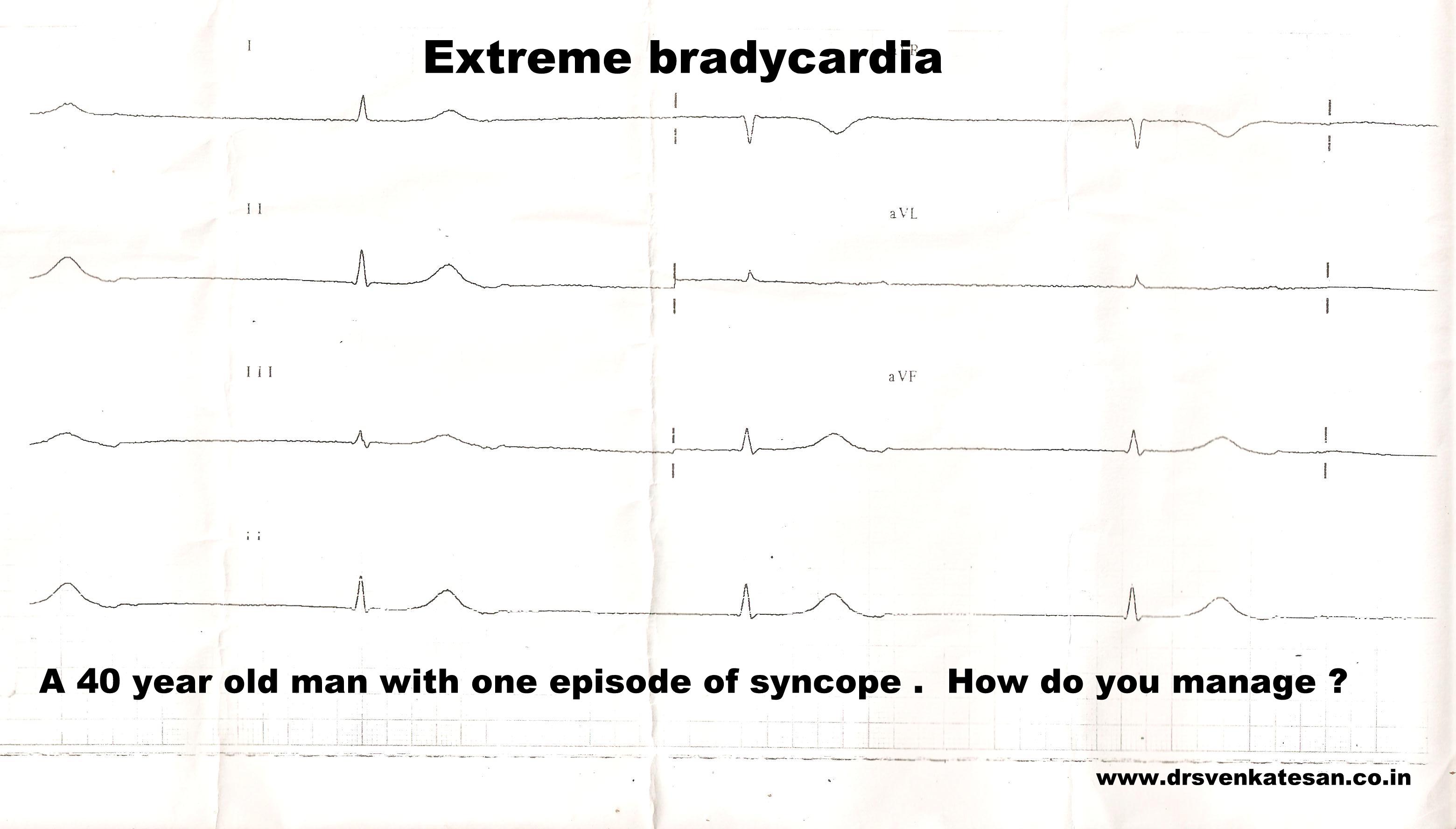
A man  in his 40s presented with an episode of syncope and followed by recurrent episodes of near syncope.

His ECG showed (See image)

  • ECG shows absolutely no evidence of sinus activity . That is  sinus arrest.
  • He lives by the mercy of his AV node.(“Great  escape” junctional rhythm  ! ) . Please note ,  It  fires at less than its intrinsic rate indicating AV nodal sickness as well.
  • The Heart rate is around 18/mt.

SA node is dead(Sinus arrest ) as evidenced by absent p waves. AV node is sick(Depressed) because the junctional rate is less than 20 /mt.

At what  heart rate a person  would develop syncope and near syncope ?

There is no fixed cut off rate for  syncope. It all depends upon the baseline LV function, his exercise capacity, vascular tone etc.

Most will develop some symptoms at  a heart rate less than  40/mt .

Dizziness occur and 30, syncope is sure  when hear rate  dwindles  less than 20 /mt.

A heart rate of 10-15 circulation tends to stall. But still few men are found alive at this rate.

What is the  risk of this patient dying suddenly ?

Contrary to the expectation SCD is not common in  isolated sinus node dysfunction .

It is more common with AV block. The reason being as long as the AV node is fine it will support the rhythm at least at about 30 or s0.

The cause of death in SND is extreme bradycardia induced phase dependent VT /VF.

Will you do a  EP study for him  ?

No. He  does not require it. He is symptomatic ,  and his  ECG shows  tell- tale evidence for SND with AV node depression.

So the there is not even the  necessity to assess  AV nodal status. But .one should  be aware  , there is a battery of tests for SND evaluation (SNRT, cSNRT SACT, etc*) .These are  done only when diagnosis is in doubt or for an academic purpose in teaching hospital.

What pacemaker will you use ?

  • DDDR
  • AAIR
  • VVIR

AAIR can not be used as we have evidence for AV nodal  slowing .

DDDR may be ideal.  In India we still  use VVI mode extensively . Ventricular pacing always safe when you have no EP facilities.  It makes EP study to assess AV nodal function  redundant.

* In all patients with severe bradycardia , a complete workup for systemic diseases like hypothyroidism and other chronic inflammatory pathology must be ruled out. Drug induced bradycardias can exactly mimic pathological  SND. Recognizing these entities could avoid  inappropriate pace maker implantation for  transient reversible bradycardias.

* SNRT – Sinus node recovery time. cSNRT -Corrected sinus node recovery time .SACT-Sino atrial conduction time.

Read Full Post »

In this politically and scientifically  uncertain world nothing is  in black and white. How can you  expect  EST to behave differently ?

Even as  we  are fully  aware of the  limitations  of EST  ,  it  does not make sense   to categorize  EST result into either positive or negative .

In fact , our  estimate suggests  a significant bulk of the patient would fall in the grey zone  .

It is referred  in various terms by  the reporters of EST .

  • Borderline positive
  • Mildly positive
  • Equivocal
  • Inconclusive

What does all these terms mean to the patient ?

It mans only one thing . . .

Physician  who reports  the  EST    is unable to  conclude whether  his patient has  significant  CAD  or not . It is a dignified way of  expressing  the  limitations .

Many factors may play a role. (See the illustration above )

  • Patient factors : Poor exercise stress levels and conditioning
  • Lesion factors:  Collateralised CAD, treated CAD  can result in partial or mild  changes.
  • Machine factors :Caliberation errors.
  • Interpreter : (Physician ) factors

Error in measurement of ST segment . What is borderline  for  one doctor may indeed be true positive  for the other and vice versa .

How will be the  EST in  a  revascularised  or  medically treated CAD ?

If revascularization is a complete success ,  stress test  would  revert back to normal or it can be a borderline as we have just mentioned.

To our  surprise ,  it may  remain  positive in spite of apparently successful procedure.(Residual wall motion defects , scar mediated  ?)

How to proceed  after this borderline EST/TMT ?

Few options are available for the physician/patient

Talk  with the patient again  , assess the  baseline risk  of CAD   if it is low ignore the TMT result and reassure.

  • Repeat  stress test after  a month.
  • Stress thallium
  • Doubutamine  stress
  • CT angiogram
  • Regular Cath  angiogram* (May be the best , of course it also carries a  risk of labeling  the condition as  mild  CAD / non critical CAD etc )

For the  patient  the  easiest  option  may be ,   self  referral to a different cardiologist .   (Also called second opinion )

Final message

There is indeed an entity called   borderline  EST  . Do not dare to  ignore it  or else  face the consequences .

Read  related articles in this site .

1.Can medical management convert EST positive to negative ?

2. Should every one with positive EST should undergo CAG ?

Read Full Post »

Ventricular  fibrillation is the most dreaded cardiac  arrhythmia  during  STEMI .If  it occurs  outside the hospital , it is usually a  farewell arrhythmia to most  patients . If it occurs within CCU , it is a well tackled arrhythmia  and has  little impact on long term mortality.

When it occurs in early hours of STEMI it is referred  to as primary VF.

Even though it is a killer arrhythmia ,   primary VF is  often  an  one time re- perfusion arrhythmia. There is no entity called recurrent primary VF  .

If recurrent VF occurs some other mechanism is to be suspected (Drug, hypoxia, scar, ion channel defect etc)

Mechanism

Primary VF is ischemia triggered and secondary  VF is  infarct area triggered .Hypoxia ,  LVF or old  scars  also could  contribute .

How to terminate primary VF ?

Immediate defibrillation  is the only option.

After a successful reversion of VF should we follow it up with anti arrhythmic drugs routinely ?

No . It is not routine.(This is  what  we are debating today !)

What if ,  multiple VPDs  and  non sustained VT  continue to occur in the ensuing hours after an episode of   primary VF ?

It is indeed  appropriate ,   to use an infusion of Amiodarone or lignocaine  in such situation . Following  it with oral Amiodarone is generally not required if the LV function is well-preserved.

Advantage and disadvantages of Amiodarone

  • Pro arrhythmia – A undermined issue.
  • Myocardial depressive action of Amiodarone is a deterrent  for its routine use.
  • Amiodarone induced bradycardia (If it is not a AV block )  may be an  advantage  as MVO2  may be reduced.

By the  way , Lignocaine  how  does it fare vis-a-vis Amiodarone ?

It is equally a good drug  with less side effects .But  the  ALIVE  study delivered a  death knock for this wonder drug. Many (At-least me !)   would still   believe  the unpopularity of    Lignocaine  among the    current generation   cardiologists   is  not due to   academic reasons .

So what is the final message  ?

  • Even though  popular  opinion and ( even some guidelines )  suggest  it may not be  necessary to give anti arrhythmic drugs  after successful reversion of primary  VF . It is prudent  to weigh  the risks. We can’t use it as  a routine .
  • Still , it is always   wiser to prevent further episodes of VF (Rare though ) .
  • If you have a well  performing   CCU , routine  post shock Amiodarone is not advised .
  • If you do not trust your CCU staff  one may  have to rely on  these drugs.
  •  Patients with complicated MI ,  high risk VPDs ( Akin to after shocks after an earth quake ! ) especially in large anterior MIs should receive intensive anti-arrhythmic  therapy (IV followed by oral )

Please note 

**Never plan  for an ICD in patient’s with primary  VF it is an absolute  contraindication.

***Recurrent VT/VF in the setting of STEMI  is  often  termed as electrical storm .It is a rare event which will require immediate CABG/PCI with VT ablation. Again ICDs are  contraindicated  here as the battery depletion will be fast .Further ICDs  it does not cure the VT rather it allows it to emerge from within and then try to tackle it,    while RF ablation eliminates VT focus and prevents it,s origin and provide a potential cure. But , remember only 20%  of VT are amenable for RF ablation ,  while ICD counters all VTs wherever it originates . So there is a role for combination of ablation and then putting an  ICD .

Read Full Post »

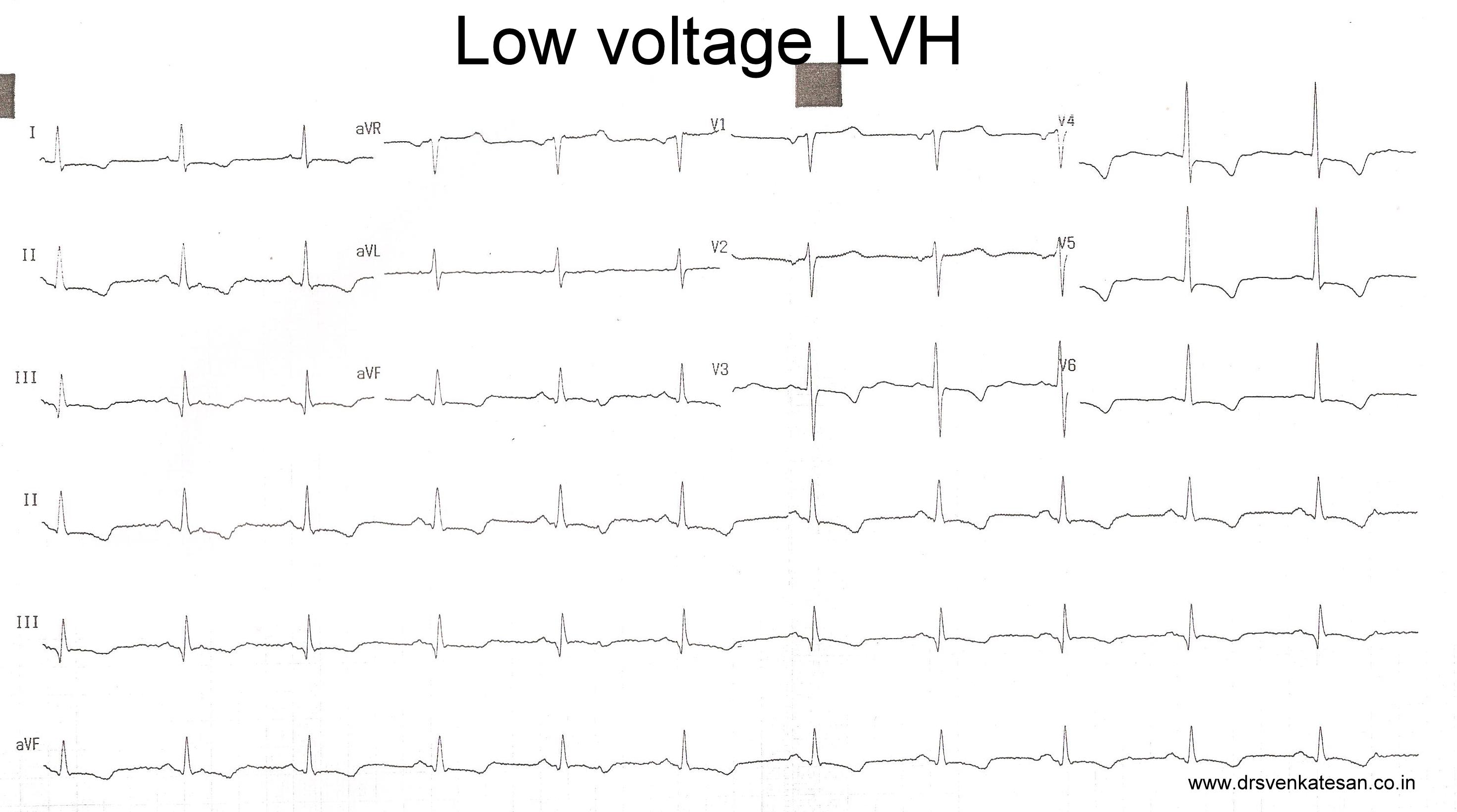
  • LVH is classically diagnosed with high qrs voltage either in limb or chest leads or both.
  • High voltage is a specific ECG  sign,   presence  of  which  would strongly suggest LVH  ,   absence of which  is not  useful to rule out true LVH.
  • LVH with   flattish  or  down sloping   ST segment ,  with or without  T inversion  , can be a sole presentation of LVH . This should not be taken as sign of ischemia.  Here is  patient  with such an  ECG

Mechanism for LVH without high voltage

  • Intrinsic muscle  electrophysiological  property – Arrangement of muscle fibre orientation  will determine the voltage .(Parallel vs perpendicular, disarray etc)
  • Pathological LVH with fibrotic process and interstitial hypertrophy may not  record high voltage.
  • Presence of  high voltage LVH  would indicate a dominant physiological muscle mass that lacks interstitial reaction.
  • Finally , technical cause like thick chest wall in obese can dampen the LVH voltage.

Read a related  topic in this blog

https://drsvenkatesan.wordpress.com/2010/07/21/why-lvh-generates-high-voltage-qrs-in-some-and-low-voltage-qrs-or-even-q-waves-in-others/

Read Full Post »

Possibly yes !

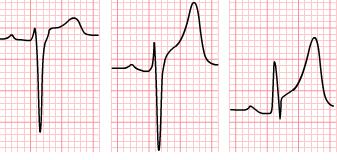
In a preliminary analysis of 50 consecutive ECGs with ERS pattern, only  3  were females .An  astonishingly low incidence of  6 % is it not ? . The 94 % exclusivity in males  demands a  detailed  EP analysis of this entity.


How often you see an ECG such as this one in young women ?

This finding may not be a  surprise ,  if  we  link  another fact  namely  ,  the   longevity of    QT interval  in  women. Repolarisation  begins   when  rapid  sodium channel extinguishes and  potassium  channel starts  firing and  efflux  this cation   from within the  cell  .This happens  during  interface between phase 0 and phase 1. This point  corresponds to the onset of repolarisation.

The onset of repolarisation is not entirely  related to K+ efflux  (Rather  K +  determines largely  the duration of  repolarisation).QT interval is prolonged in females because repolarisation is slow  in women .In men it is early ,  short  and swift .

The mysteries surrounding the ion channels especially the  K+  with vast genetic and gender  heterogeneity  is yet be unraveled. Influence of  sex hormones on  right from the early days of  fetus could be  one  such area for research.

Other  related  gender specific ECG findings include

  • In women T waves rarely grow beyond 5 mm. In young men tall T waves are the  rule
  • An iso- electric or even inverted T waves  especially in leads V 1 to V4  are  quiet a common finding in women.

Link  to  another article  on  Early repolarisation syndrome from this blog

Final message

It is a well recognised  fact  ,  repolarisation  is  brisk  in men  and slow in women  .It is  now  realised ,  the onset of repolarisation is also earlier in most men .  This has a direct bearing  in  the  impact  of ischemia  on fibrillation threshold . Arrhythmias  induced by EADs  are logically more common in  persons with ERS.

Statistics again reveal men are more likely  to have primary VF  during  STEMI  . ( Male Gender  by itself a  CAD risk factor !) .Recently Hassagure  et all   elegantly   documented  ,  ERS is  indeed a risk factor for primary  VF at times of ischemia

Reference:

In the above article , the  incidence of ERS was 72%   in males , considerably lower than our observation . Still ,  the male dominance is confirmed. We still feel  in our country true  ERS occurs in a negligible minority of women. This finding need to be  confirmed  with  data from other centers .

Read Full Post »

« Newer Posts - Older Posts »