Feeds:
Posts
Comments

Archive for the ‘Cardiology -Therapeutic dilemma’ Category

A STEMI patient arrives late after 48 hours with chest pain .There is  persistent ST elevation.

What is the likely mechanism of this chest pain ?

  • Index infarct pain continuing . . .
  • Post infarct Angina-IRA territory
  • Re-infarction following intermittent re-perfusion  and re-occlusion
  • Remote  ischemia from a branch of IRA
  • Ischemia from a possible  non IRA lesion in a multivessel CAD

If this patient  comes to a non PCI eligible centre. Will you lyse him  ?

If post infarct angina is  unstable angina  . Isn’t  thrombolysis  contraindicated in UA  ?

How to differentiate Post Infarct Angina from Re-Infarction ?

A very tricky issue indeed.

Unless fresh ST elevation with fresh enzyme peak is documented these entities  cannot be differentiated.

(Even  fresh ST elevation can be related to infarct expansion ,stretch or early acute remodeling.Fresh enzyme  release or new peak  may not represent new infarct always .It can be due to intermittent re-perfusion of IRA .It may  simply represent a  enzyme  flush from the index infarct zone)

What is the practical , realistic , (Unscientific !)  solution  ?

Why break our head ? Never bother to differentiate PIA   from Reinfarction  etc . Let  it  be any thing . Do a emergency CAG .Stent  whichever  lesion looks good  for the same . Of course , make sure he has enough insurance coverage .


Read Full Post »

This  query often  evokes  confusion  among fellows and General physicians .

              The answer is simple .Yes ,  you can.(With few conditions)

  • Thrombolysis  or PCI  is  done  with reference to  the  presence  or absence of ST elevation and chest pain.
  • If there is ongoing chest pain  and  significant new onset ST elevation  thrombolysis or PCI is indicated whether there is associated q  waves or not.

Clinical situations 

 Ischemic  q waves: Q wave can occur  with transmural ischemia which result in electrical stunning and loss of R waves . (Many of them  regenerate this R within few days after STEMI ,  indicating the q  waves can be  ischemic  in origin)

Reinfarction : Patients with  old  MI can develop fresh ST elevation  in q leads due to tachycardia and dyskinetic infarct segment .This group  of patients  should be carefully evaluated before labeling them as  re-infarction

* q RBBB in early hours of  anterior STEMI is fairly common which  may revert later. qRBBB is not a contraindication for re-perfusion .

Final  message

Presence of q waves does not  imply one should not  entertain  thrombolysis or PCI .The decision  to reperfuse  , rather  goes with  presence of  chest pain , ST elevation and  of course  within the  acceptable   time window!

Read Full Post »

IVC filter usage has increased many fold in recent years.Please note , it is not indicated in every case of recurrent DVT/or PE. There are specific indications.

Permanent IVC filters

  1. Patients at risk for DVT /PE  with  absolute contraindication to anti-coagulants.
  2. Recurrent DVT/PE in spite of adequate  anti-coagulation

Temporary /Retrievable filters*

  1. It is used during high risk periods  for DVT following major trauma or Bariatric/Spinal /Neuro surgery (PREPIC 2 study ) .*Some of the retrievable filters can be kept for months ,years or even permanently. (If the risk period extends or it has trapped a huge clot.)


indication for IV filter prepic study

Outcome  of IVC filter (PREPIC  -8  year follow up study )

  • Reduces risk of PE
  • Increases risk of DVT
  • No impact on long term  survival
  • Clogging of IVC remain  an important Issue

Reference

Read Full Post »

Fractional flow reserve(FFR) is an  Intra coronary hemodynamic  parameter  promoted recently to assess the physiological impact of a coronary lesion . Though it sounds logically attractive the concept  is sailing in rough seas  .I am afraid FFR is drowning  a fairly useful tool of IVUS  along with it  !

Read this large study on FFR (JAMA June 2014) .It seems to suggest  FFR is a costly and unnecessary accessory in cath lab

Image

Critical thoughts on FFR

It adds time , money , and procedural risk*  to any given patient .The only possible use is to reduce the proliferating stent usage !But the  irony  is complete as we do our daily business in  modern cath suits .To negate  one indulgence we need to  need to indulge  in  another ! (Junk begets Junk !)

It reflects lack of courage on the part of cardiologists to advice medical management even in obvious low risk lesions !

It is unfortunate ,we need a scientific or  a pseudo scientific tool to lift up our sagging medical intellect !


* crossing  delicate and often complex lesions  without any major purpose is bad wisdom !
(more…)

Read Full Post »

critical decision making cardiology cath lab tricks coronary  angiogram primary angioplasty ptca vs cabg acc aha guidelines esc guidelines

Answer

While our brain perceives  whatever option  we  choose is the best for the patient  , in reality it is rarely true !

The only comment I wish to make,  there is nothing called standard guidelines for complex and unusual problems .We need not be obsessed with protocols  !

Please remember , If you apply standard guidelines  in  non-standard situations  9/10 times we  are going to err !

So my  choice  would be, to  go with your gut feeling , of course  your gut should  be alive ,  up to date and periodically maintained !

If you don’t have the guts  . . . don’t worry  you have plenty of other options !


Read Full Post »


A 40 year old  women came  with acute dyspnea who had a prosthetic mitral valve implanted 2 years ago for RHD  .

An emergency  echo showed  a peak gradient of 35mmhg across the valve .She was on warfarin regularly and her last INR was 2.2.Heart rate  was 138/minute, lungs showed congestion .LA,LV were dilated. LV function appeared mildly compromised  but could not be accurately quantified as the  patient  was in distress.


The fellow on duty had no hesitation  in diagnosing prosthetic valve thrombus .He Initiated Inj streptokinse bolus followed by infusion  along with diuretics . After few hours the gradient regressed .Patient felt better .Every one was happy . The consultant congratulated the fellow for  the good job done .To recognize prosthetic valve obstruction early and  successfully lysing it too !  The fellow  felt gratified .

prosthetic valve obstruction thrombus 002

Since I  was hanging around the CCU , watching the proceedings , I Initiated  a debate which was  curious to the team that handled the  patient !

Was it really thrombotic obstruction that caused his symptoms ?

  • No one has visualized the thrombus
  • TEE was not done
  • Fluroscopic evaluation of disk motion was not performed
  • There was no documentation of raising FDP that would Indicate clot lysis.

All  we have  is an unexplained  tachycardia with raised  trans prosthetic gradient . . .

Why we are tuned to think  raised gradients  to be  synonymous with thrombus ?

There has  been lot of assumption here . Subsequent analysis of history and  clinical presentation revealed the patient had a febrile illness which triggered an  atrial tachycardia  that possibly  resulted in transient  LV dilatation and dysfunction.

Once the failure is controlled the gradient has come down , I argued !

Of course, this again could be  a guess work , How can you  still rule out a thrombus ? They wondered !

I told them ,  question here is not ruling in or ruling out prosthetic valve thrombus.

It is an important  lesson to learn , raised  prosthetic gradient is not equal to thrombus  in many  acute hemodynamic situations* .

Many factors other than prosthetic valve obstruction  can elevate the gradient.

After all ,  prosthetic valve orifice is inherently stenosed  .(MVO is  never >2.5sqcm in any prosthetic mitral valve) . So at times of tachycardia the gradient is bound to be elevated .

Other factors that can elevate trans – mitral gradient includes

  • LV dysfunction
  • Acute diastolic dysfunction
  • Acute peri-valvular MR
  • Loss of LA compliance

 *One of the  commonest (yet not recognised) cause for elevation of trans mitral prosthetic gradient is acute left ventricular failure due to any cause.It  can be either acute diastolic dysfunction or a sudden raise in  blood pressure that result in  after load mismatch.

Final message

Please remember flow across prosthetic valve is governed by  delicate  local hemodynamic rules .The gradient  is  critically dependent on heart rate, LA  size and compliance , LVEDP and after-load mismatch if any !

Transient raise can occur at times of tachycardia and falling LV function (Mitral valve has to push hard, in the process elevating the gradient)

Simple raise in trans-valvular gradient should be carefully interpreted. Since visualising thrombus in routine TTE is  difficult  in an acutely  dyspnic  patient  many of us have taken this  granted !

Nothing wrong in playing  guess games in medicine . . . but we  need to acknowledge it!

*Note:Other causes for chronically elevated gradients like pannus formation, mechanical defects of valve, degenerated prosthesis  should be addressed separately.


Read Full Post »

Can we close an  ASD in a  25 year old women  severe  pulmonary hypertension ?
Volumes of literature has been written  on the subject.Dedicated cath studies  have been done with multiple parameters .
Still , there is a lingering doubt !
Here is  a  3 minute  practical solution  based on 5 easily available parameters. (* Also referred to as  unscientific  in medical parlance !)
1.  O2 saturation
2. Pulmonary artery diastolic and pulse pressure
3. RV function,
4 .Systemic pressure
5. Functional class
  • If O2 saturation is > 90 % consistently  there is likely to be significant  left to right shunt  .Closure is to strongly considered
  • If 02  saturation is near 95 % there is absolutely no contraindication at any level of PVR.
  • Systolic pulmonary artery pressure derived by TR jet is least useful index.Pulmonary artery diastolic pressure reflects true vascular  reactivity of the pulmonary  circulation.A wide swinging pulmonary arterial pulse indicates dynamism in circulation and hence operablity.
  • If pulmonary artery  pulse pressure is  wide (>50)  , or PA diastolic BP is < 30 one can safely presume irreversible damage to pulmonary vasculature has not occurred and these patients would  benefit  from surgical closure .
  • RV  function should be assessed carefully in every patient.This is as important as PVR .Significant RV dysfunction is an absolute contraindication.
  • Never close the shunt in patients who is in class 4  symptoms.
  • Never close a shunt if the systemic blood pressure is low( 90mmhg)
  • Some believe  PDA may be closed at any given PVR , while  worst outcomes occur with ASD as supra-systemic pulmonary pressure is possible.
Always monitor these patients meticulously especially  in the initial days following surgery  for deterioration .Most patients will do well if they cross the first 30 days. The RV  learns to adopts with  new  pulmonary hemodynamics !


Read Full Post »

I share my thoughts after going through this  85 page  land mark document !

acc aha 2013 guidelines cholesterol ncep

In whatever way I look at it  ,It  keeps  both physicians and their patient population guessing  in a  confused sate regarding their cholesterol levels  the treatment modalities !

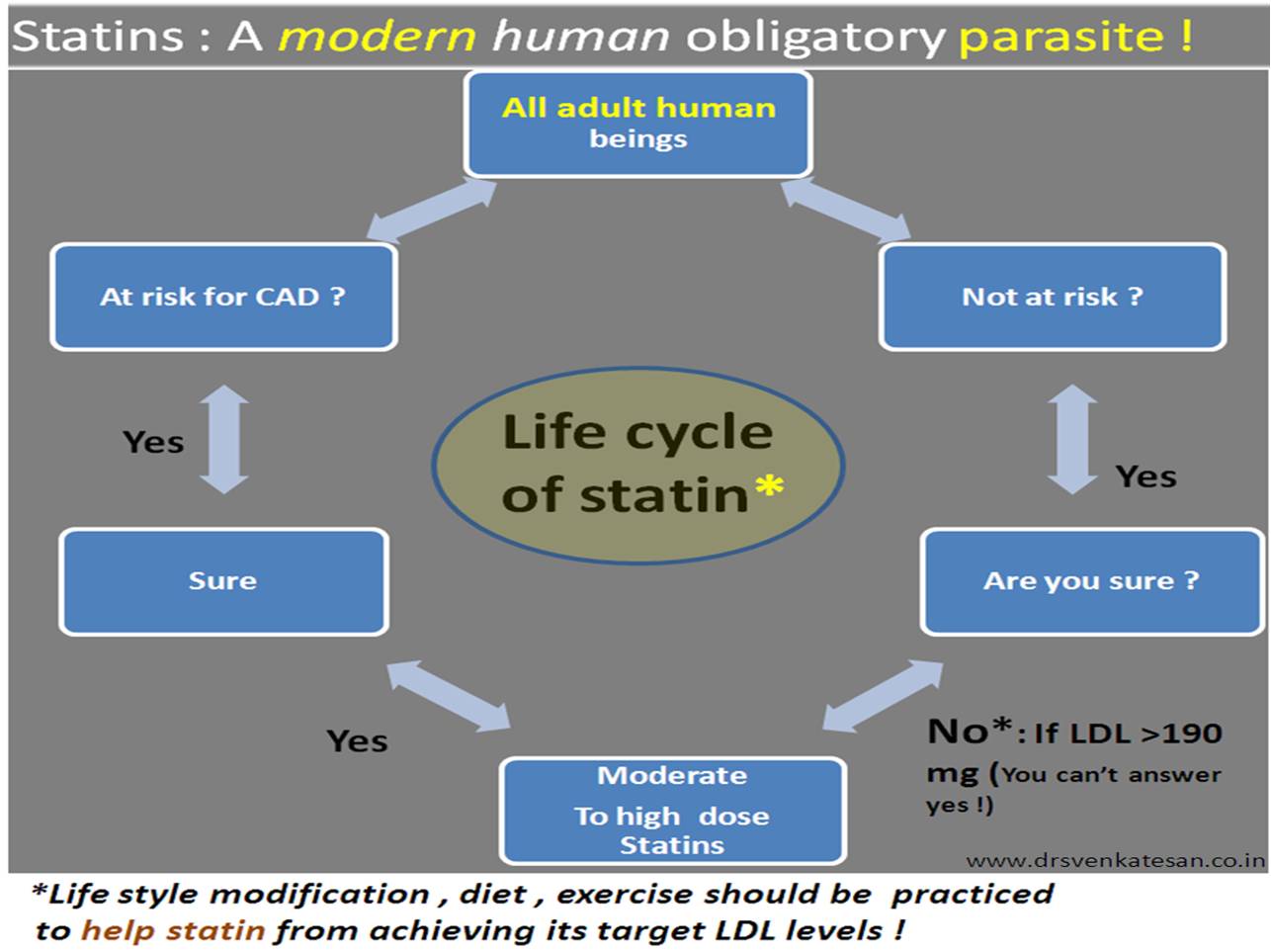
It seems to revolve around a single point agenda,  how to fit a single drug called statin in the scheme of things !

What  if  ,  a new  drug comes and statin is  proved  not an angel  in our fight against the evil  of  atheroscerosis !


acc aha lipid guidelines atp 3 ncep  nhlbi dyslipidemia

Summary as  I interpreted

“All healthy and unhealthy human beings should ask only one  question

whether they can some how  benefit from taking statins  ? “

If your answer is yes ,  administer the statin  not in  low dose but in moderately high dose ! (It  appears  there is little role for low intensity statins )

There  is generally no  need to to monitor the lipid levels as long as patient is comfortable.

Disclaimer :  *Sorry , the Intention is not to  hurt the hard work of a elite panel who toiled for years to bring this much awaited guidelines on lipids and atherosclerosis! but to express my view , biased though !)

A mini research

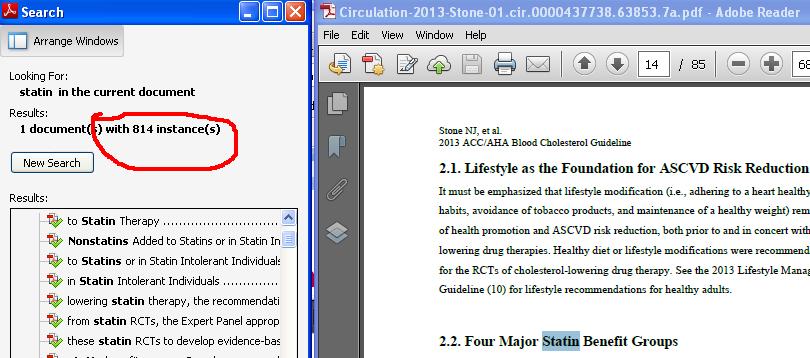
To confirm my assumption I did a curious word search in this 85  page document .

For words statin , diet and exercise

  1. Statin appeared  814 times
  2. Diet appeared 8 times
  3. and exercise just once in the entire document !

statin search acc document statin acc aha 2013 guidelines statin acc aha 2013 guidelines 2

The importance of  diet and  body activity  which  are  the  primary   determinant of serum lipid levels is mentioned  in a cursory fashion in this  global guideline meant to control the total  cholesterol load  and atherosclerosis of our population .

Meanwhile . a drug which  acts in a  physiological  cell servicing  metabolic path way in a complex fashion  is glorified 814  times !Do  you still  think this post is is biased ?


Read Full Post »

Modern  day cardiac scientists have legally defined a significant coronary  lesion as > 70 % obstruction. Unfortunately this rule is applicable more in  academic forums not in cath labs.

While the guidelines seem to be clear in chronic coronary syndromes , in ACS  the interventional strategies based on  severity of lesion is  not  clearly defined.

Many times  in a  recannalised coronary artery following STEMI  (Either  spontaneous  or pharmacological )  even a 10-20  % lesion is stented .(Mind you ,  coronary erosion  that  trigger  pure thrombotic  STEMI  will be stented by most  of the  proud  young cardiologists of today !) The guidelines conveniently  ignore this area  allowing  the cardiac physicians  to  indulge in the coronary exotica !

Is this logical ?

Why do you need to stent a successfully lysed coronary  lesion with TIMI 3 flow. ?(We do know , many  young infarcts have pure thrombotic STEMI with zero % lesion   (In India 40% of young STEMI has near normal CAG  )

This situation arises by an ill conceived concept called pharmaco- invasive approach where routine coronary angiogram is advocated even after successful thrombolysis  in patient  who is asymptomatic and complete salvage of myocardium has been achieved  by pharmacological means .

* The only way to prevent this excess  is to ban the  pharmaco -Invasive approach for  asymptomatic and apparently successful thrombolysis .(Better still  even CAG should be banned ! for  the  simple reason an inappropriate CAG  begets an Inappropriate PCI !)

A Narrow  gap  separates  Ignorance and  knowledge !

Does the  PCI  makes the  ill-fated site  less vulnerable   for future events  . . .  when compared to   well  re-cannlised native coronary artery with negligible lesion ?

The funny side of  cardiac science  can be appreciated , when  somebody  is implanting a latest generation stent for 10-20 % lesion  just because it is associated with an ACS ,  another would astutely   study  the significance of 70-80% lesion  by FFR  in  an adjacent lab !


Read Full Post »

I used to tell my students ,the relationship between the heart and kidney  is so close , it is never justified for  the  two departments of Nephrology and Cardiology  are  physically away by two blocks in our institute .

Kidneys are vital to maintain the volume and pressure of body fluids and heart is responsible for keeping this fluid circulating.

In clinical setting  it is a well known secret ,most deaths in patients who are on dialysis is cardiac while  most  deaths in patients  with CHF are renal.

It remains a mystery  why kidneys were   ever considered as a circulatory organ  , when  our medical pundits de-compartmentalised  human organ systems !

CKD is pre-cardiac failure and CHF is pre-renal failure

The Heart /Kidney affair is so intimate in many  pathological situations both either succeed or fail  simultaneous or sequentially.

While CKD  results in and pressure and volume overload of heart , cardiac failure cause pressure and volume under load (pre-renal  factor) which worsen the renal function and aggravate cardiac function alter.

In essence,  it is vicious cycle of two  serial organs  performing  the vital circulatory function with body fluids playing a  role of diligent mediator.Whenever the kidney  fails heart  is stretched and stressed  to its Frank starling limits by the volume  as well as the accompanying HT load.

While text books link these two organ as simple cardio-renal syndrome it is not happening at the level of patient’s bed side.

Cardiologists and  Nephrologists must realise they need do work in tandem like  their  respective  departmental  organs  which accomplish this task easily !

To tackle this much  maligned  cardio-renal conundrum

Consider CKD as CHF equivalent  and CHF as CKD’s

I would recommend this concept to be infused  right in the third year medical school and  try de- compartmentelise  clinical  medicine.

Need of the hour : How to Moderate ACEI dosing in CKD

ACEI has been a major pharmacological   revolution in controlling and reversing the adverse events of cardiac failure . Some where along ,  a significant fear complex arose regarding the damage it could cause to kidneys.

Recently , we know the role of  ACEI in CKD made U turn(Like what  Beta  blockers did to CHF) .Now, it is presumed ACEI are indeed  safe in most CKD and may  even regress  CKD. Still this concept  has not been fully disseminated  into general physician domain.

Let cardiologist and Nephrologist sit together and sort out this issue.

I guess ,  ACEI controversy is  a sort of  ongoing ego clash  between Nephrologist and Cardiologist . Both like it , both make fuss about it ! In my observation , if  a cardiologist titrate it upwards  Nephrologist would  lower it  and reverse happens if cardiologist express caution about it ! Do you agree ?

Final message

Mankind has  accrued  great benefits  from stunning break throughs in modern medical science . . . but it has come  only at a huge  cost ! Medical knowledge has completely fragmented the physician mind-set .Every good therapeutic concept is  hanging aloof .It requires periodic de-fragmentation (As we do it to our PCs by anti-viral soft ware !)

To begin with , let us  consider   CKD and CHF as single sequential circulatory  entity !

Let us vouch to  create new generation medical professional  devoid of skewed  medical vision !

Reference

Guidelines for ACEI in CKD

NKF national kidnye foundation

https://www.kidney.org/professionals/kdoqi/guidelines_bp/guide_11.htm

acc aha  accf guidelines chf 2013

Read Full Post »

« Newer Posts - Older Posts »