Feeds:
Posts
Comments

Archive for the ‘cardiology -Therapeutics’ Category

Primary PCI is presumed to be the ultimate  , undisputed reperfusion  strategy  in STEMI .  Still , time and again one study or  other strips down  this   “Numero Uno”  status of pPCI  .  If it is really supreme ,  such awkward  situation shouldn’t arise  too often . More importantly , the  major reason for  dubious real world record of  pPCI  goes beyond  the time and logistic factors (which is considered the only issue  for pPCI by most interventionist ! ) There is something more to it that is invisible ! (Is it the no reflow ?)

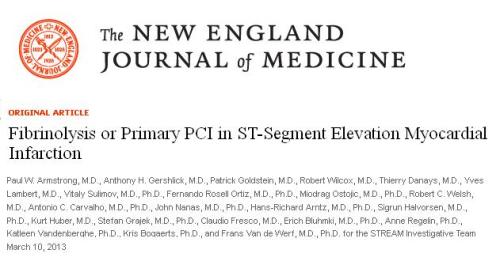
The nearly flawless study from Belgium ( STREAM Just released in ACC 2013/Sanfransisco ) , pre-hopsital or early fibrinolysis has proven to be superior in the prevention major end points at 30 days .

  1. Death
  2. Re-infarction
  3. CHF

STREAM STUDY NEJM PRIMARY PCI VS FIBRINOLYSIS

The major surprise was pre-hospital  fibrinolysis  showed less  incidence of cardiogenic shock . ( pPCI

group had more of this ( 4.4 VS 5.9 %  in STREAM )

Now . . .  shall I make a provocative statement ?

while pPCI may be treatment of choice for cardiogenic shock . . . but it may  also confer a risk of cardiogenic shock in otherwise low risk MI !

Caution  and  conclusion

STREAM population applies strictly to 1 to 3 hour time window . It does not apply to either before or after that ! Simply put,we do not have  guts to compare fibrinolysis and pPCI  in patients who arrive  within one hour into a facility where 24 hour cath lab facility is available .  We call it unethical to do a study like that !  I personally feel it is really unethical  if we do not do a study in this time frame . The reasoning is  simple and very personal .In a  large  Government  hospital   where  we do not have primary PCI program  our net mortality for STEMI never exceeded 7-8 %  over a period of 10 years  , Which  is almost at par with global data on pPCI. (Our door to needle time is an unbelivebale  8-12 minutes ! that  too only streptokinase !)

Adding Further controversy

pPCI  is indeed a superior reperfusion strategy . No one can dispute that .But its superiority  is not  realised  in  every patient  who gets it.  The benefits are accrued if and only if it is  used most judiciously . In Low risk , small regional  , branch vessel STEMI ,  pPCI has never been  shown superior . It is well recognised ,  upto 15 % of STEMI is likely to spontaneously abort or experience very good spontaneous recannalisation . By rushing these  patients very early into cath lab pPCI   meddles with the natural anti fibrinolytic mechanisms . It is this population who  invite all the procedural hazards. .

Is this the reason STREAM had  more  cardiogenic shocks in pPCI limb ?

I think STREAM has  strengthened the case in favor of fibrinolysis in this  ever ending debate .

I would  seriously believe  pPCI is hanging it’s superiority over fibrinolysis with a wafer thin mortality advantage . pPCI may  not be recommended in a routine fashion to all STEMI  population even if they arrive within 6 hours and able to perform the plasty fast .  Science is   . . .  after all . . .  continuing  confrontations with our  assumptions !

Counter point

STREAM is not an exclusive study comparing fibrinolysis and PCI . It is a  study comparing   Pharmaco Invasive approach vs  pure invasive approach . 80 %  of patients in the  fibrinolytic limb ultimately received PCI and  stenting . It simply doesnot make sense to conclude fibrinolysis is superior to PCI . Most of the beneficial  effects on 30 day outcome may reflect the timely PCI  in the lytic group.

//
Read Full Post »

Answer :

In cardiogenic shock it is A . In all others it is probably  C.

While D may be  considered as  an  essential target criteria  for completing the  rescue PCI

Read also

Why-we-often-follow-a-reckless-time-window-for-rescue-angioplasty ?

Read Full Post »

Answer

The tie is between “B” and “D ”

We know in hypertensive hearts LV primarily fails in diastole . Lungs get congested due to raised LVEDP .Here is a catch . . .  if diastole is  terribly dysfunctional  how can be systole be near  normal  ? (After all  . . . systole is not a  distant cousin of diastole !)

How is  that  high blood pressure maintained in spite of LV failure* ?

Is it due to  well-preserved  EF and cardiac Index ?  or Is it due to extreme levels of peripheral sympathetic activity mediated by catecholamine surge triggered by LVF.

We have attempted to measure  LVEF in patients with flash pulmonary edema and acute severe hypertension .It was a real messy echocardiography . We could not conclude much but one thing is  clear in acute hypertensive  LVF   the LV was vigorously contracting in , probably making the option D  more correct .

* The other way of  reasoning is    . . .  it is because  of high blood pressure the LVF  has occurred . LV contractility has no contribution in maintaining the high BP ( Not in line with  the age  old concept of LV contractility  a major determinant of systolic blood pressure !)

(Having said that  . . . we also see patients with severe LV dysfunction with  severely  stunned , ventricles in association with hypertension and LVF . In fact many of the reversible DCMs are due to sudden surge in blood pressure )

Other mechansims of LVF and lung congestion is

  • Extreme tachycardia and shortening of diastole
  • Mitral regurgitation
  • Assocaited  CAD unmasked by sudden raaise  in heart rate .

Postamble

If  this article has confused  you a little  , It has achieved  one of it’s  objective .  !  I expect more  from   young cardiology fellows to address the issue !

Reference

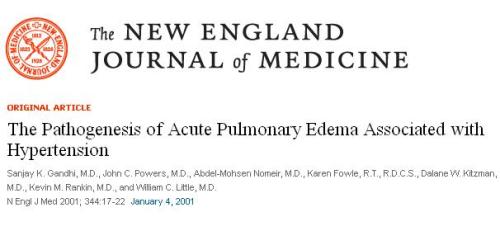
This NEJM article   authored by Sanjay  Gandhi  has almost answered the hemodynamics of acute LVF and HT .

mechanism of acute lvf in hypertension flash pulmonary edema lvedp in ht nejm 2005 sanjay gandhi

Read Full Post »

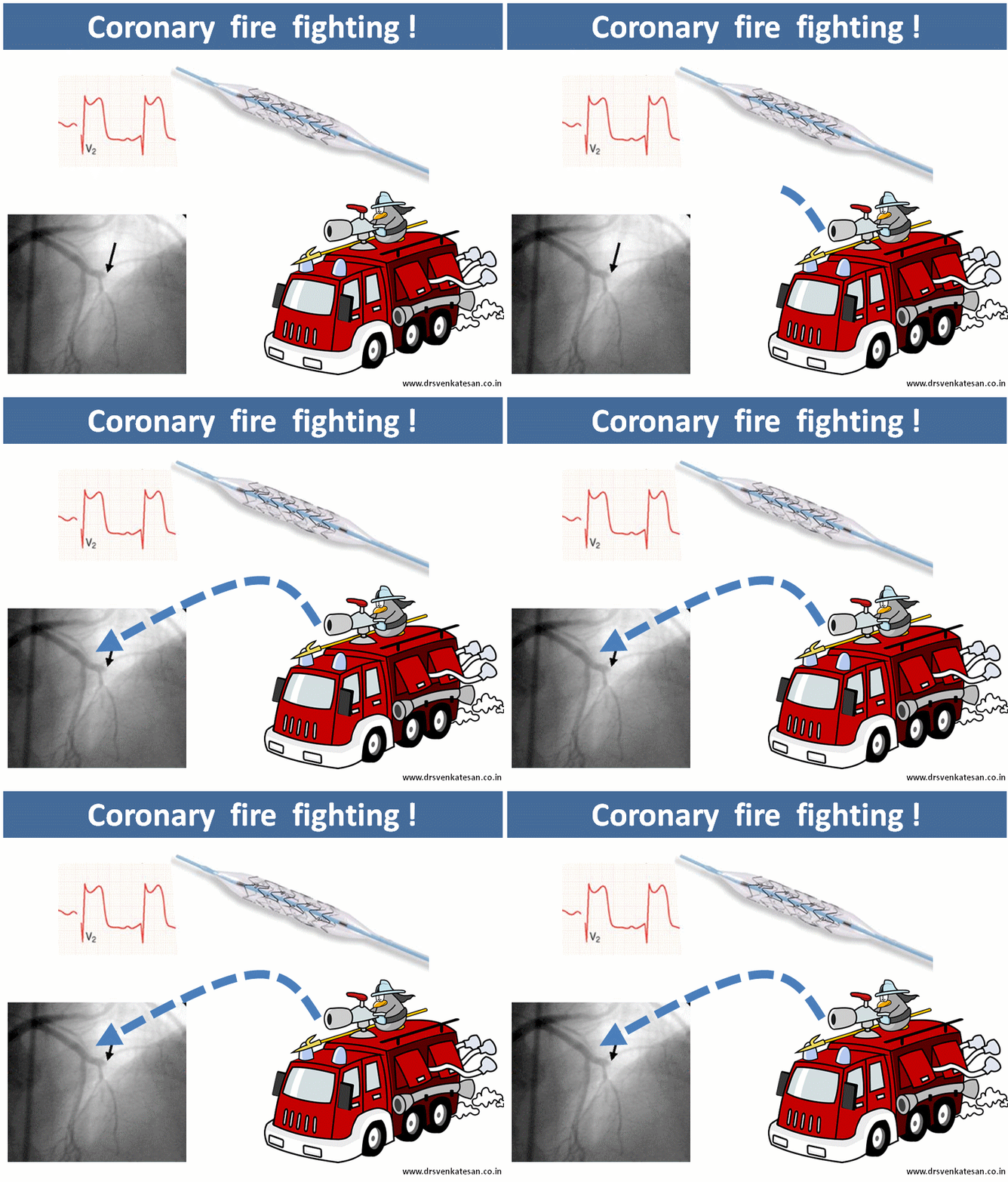
Myocardial salvage is like  coronary fire fighting.When fire is fought  very early after the accident  , benefits are accrued  more . Text book primary angioplasty is . . .  fire engine arriving at the scene when the house is on fire .

Rescue angioplasty is asking for more force ,  when the initial fire fighting  was inefficient to control the fire. So , it is obvious the rescue efforts should be fast and brisk.In fact the pace should me more than the primary (The the second engine should  reach the ground zero  faster than the first !  – Read as  door -balloon time ! )

But what happens in real world ? We would tell  time window for primary angioplasty even in sleep ! but will struggle to come   with clear cut  answer for the  same in  rescue angioplasty  even in a  fully awake state !

CaptureWiz

It is  an overwhelming fact , we have  not taken enough efforts to define strict time limit  for rescue .( Even though guidelines say it should not be beyond  24  hours , common sense will tell us rescue PCI should not go beyond 12-15 hour window ! .One more definition for rescue PCI could be within 3 hours after diagnosing failed thrombolysis. In real world  it is a race against time in a different perspective .In many centers  rescue angioplasty “enjoys time less windows “

I was funny witness in a big private  hospital  when a  colleague  of mine  has posted  a case for  “elective rescue angioplasty” and was  waiting in the side cabin  for his turn !

Coming back to the title question

Why we often follow  a reckless time window for rescue Angioplasty ?

The reason is simple

Time is not only  muscle . . . time  is  money too !

Read Full Post »

An elderly man  with past H/o CAD  was admitted with ischemic LVF and hypotension .Blood pressure was  90/60 mmhg  and pulse rate was 140 . Urine urine output  in the immediate past hour was 50 ml . Saturation was 95 % .He had fairly extensive  crackles in both lung fields.

A bed side echo showed  moderate LV dysfunction , with wall motion defect in LCX territory and  mild  MR .A dignosis of post  MI -ischemic LVF was made .

He  was  put on intensive anti failure protocol. I asked my  fellow to administer IV NTG  and left the ward .

On my next visit after few hours  . . . the patient was in much bad shape  , and when I enquired , I learnt  NTG was never administered . I was curious to know why the fellow  dis- obeyed my instruction .

He felt sorry  .  .  . But he earnestly told me  , he  could not comprehend the principle of administering NTG in a  patient  with shock ! . I was happy  to  note his  genuine concern  for   the patient  !  But  . . . I had to take a brief  lecture to convince the importance of NTG in some forms of shock !

What is the cause for hypotension in ischemic LVF ?

Lungs are flooded due to  very high LVEDP . Blood  not only struggles to  enter the LV  but also finds difficult to   leave the LV ,  former due to defective relaxation later due to poor pumping.

The extremely high pre-load actually stuns the left ventricle in diastole . (Primarily diastolic stunning  )  . Here is a hemodynamic paradox . Excess pre-load  occurs in  terms of pressure , but  in terms of volume there is miniscule amount  blood  that  traverses LV  .

This is pre-load mismatch  at play .Empty ventricles with high wall stress  and that is reflected in aortic afterword as well .

We have to some how reduce the  very high levels of LVEDP . IV NTG can  dramatically  reduce the pre load  ( and reduce the LVEDP .) The other major  benefit is ,  NTG   can reduce the MVO2 by improving sub endocardium coronary perfusion and de-stress the heart.

Once  LVEDP  is  lowered  , the ventricle will tend to recover and gain at least some  original elasticity ( Frank starling forces) . Of course it will be defective due to ongoing ischemia . Even slight fall of LVEDP (say from 25 to 18 mmhg  can have  significant benefits as the LV function curve labors on the steep shoulder region !) .

This is one situation where NTG can increase the blood pressure once the hemodynamics is favorably altered.

*Yes  . . . heavy doses  of  Frusemide injection can do the same job but it largely depends the kindey’s cooperation to flush out fluids  .In a shock like situation one can trust the kidney perfusion  !

Additional benefits of NTG

Mitral  regurgitation  is a serious destabilizer of LV function .NTG can reduce the regurgitant fraction in acute MR effectively .

Caution

NTG may worsen the hypotension of RV infarction . Make it very sure , you are not dealing with this unique  pre-load dependent circulation.

What happened to this patient ?

He  did show  improvement with IV NTG . Of course it was not dramatic as I have projected in this article .Still it was really helped him .He required simultaneous dobutamine infusion as well .The BP did not fall  further and lung congestion was relieved  .He went on to recover fully by 48 hours and was posted for elective cath study .

Final message

                                             We tend to  worry  more about falling blood pressure  when administering  NTG. . .It is a wonderfully effective drug especially in the setting of ischemia and cardiac failure  even if  the blood pressure is low !

Acute cardiac hemodynamics  is  complex phenomenon .No one has mastered it .Paradoxes are common . Hypotension in the back ground of  acute pulmonary edema  especially due to ischemic LVF  can be corrected by NTG . Of course physicians  need  some  courage to administer NTG in patients  with a systolic pressure of  80-90mmhg.

This should ideally be done with intra arterial line in place and a simultaneous inotropic line (Doubtamine /Nor-epinephrine ) back up in case of worsening perfusion pressure .

Read Full Post »

Acute MI kills a few million people world-wide every year .It does not differentiate rich from poor. Logic would  tell us  , principles of management  should  not differentiate  the people  when  dealing with a myocardium in distress .

Unfortunately , we scientists do it with passion !

The problem is enormous  . . . the rich is suffering from too much* care and the poor is suffering from want of care !

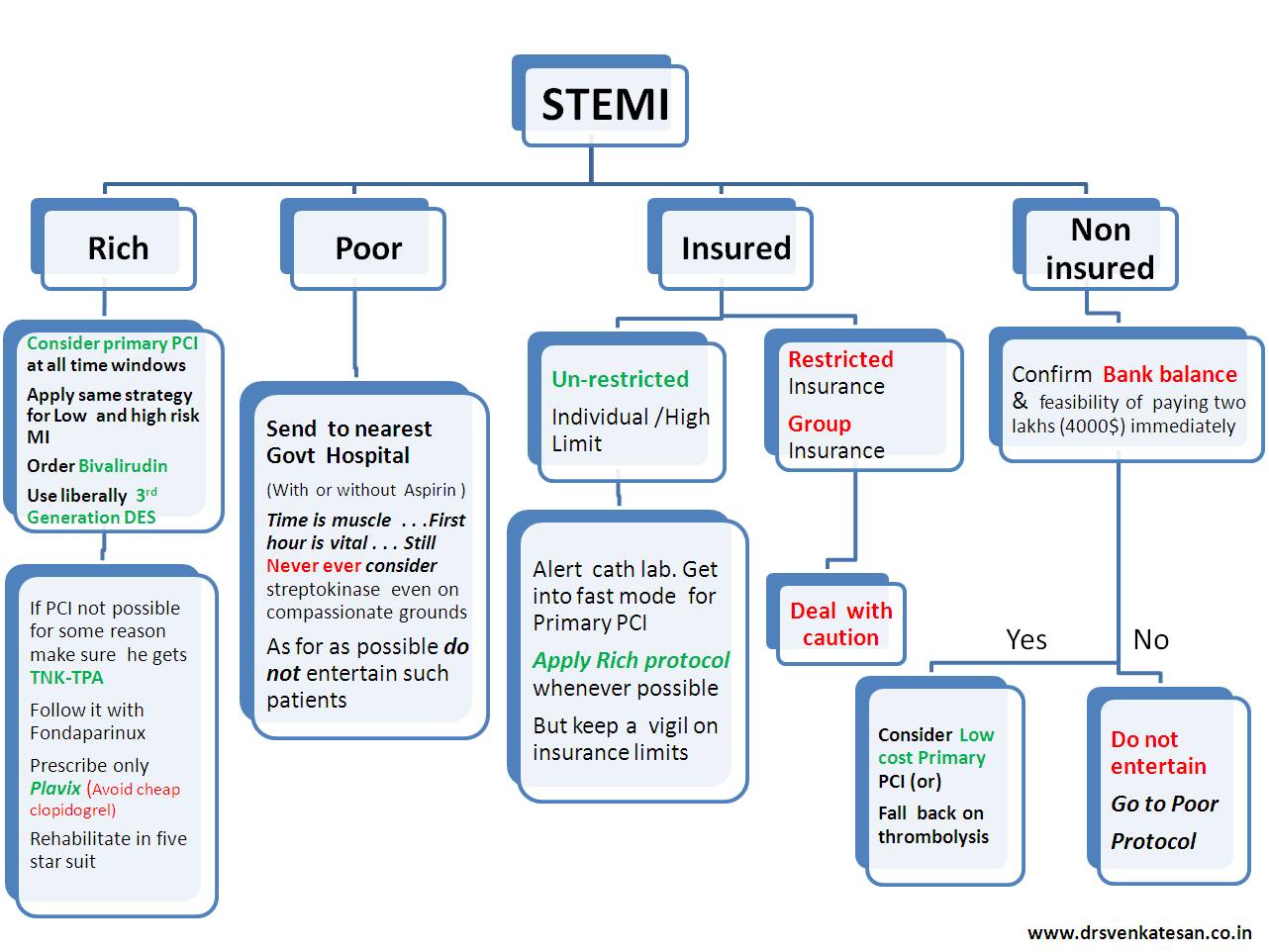
The following flow chart  is a result of my observation from close quarters  about the management strategies in corporate as well as Govt hospitals .

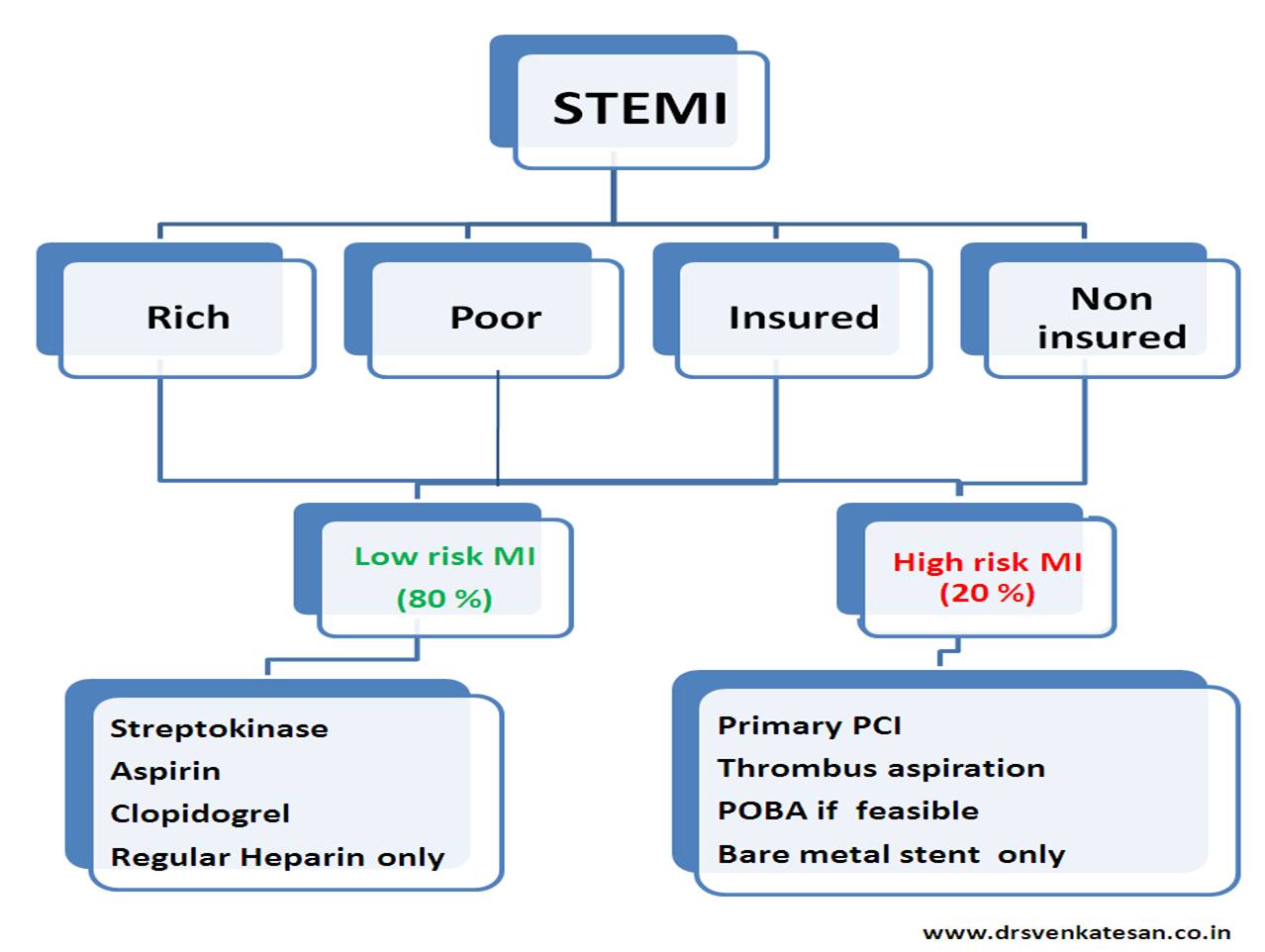
The first chart exposes the problem .The second one tries  to address the issue

Please bear with me . . .  if the  stuff  sounds  too crazy !

* Too much care is also referred to as inappropriate care

Practical and ethical guidelines for stemi management corporate

And for the solution  . . . try this

Practical and ethical guidelines for stemi management

Read Full Post »

Answer

Each of the above can be important in diseased heart .The most important component seems to be Inter- ventricular  synchrony .This is closely followed by AV synchrony .In dysfunctional  ventricles Intra-ventricular  synchrony  also becomes important .In  structurally  normal hearts  none seems to be important  (This statement can be debated  )

VVI pacemakers causes  both AV  and Inter-ventricular (VV ) dys-synchrony

DDD pacemaker  may still  induce  Inter-ventricular ( VV ) dys-synchrony  whenever  RV is paced for any reason .This may happen up to 60 % of pace making time in real world.

Some more facts

*Chronic VVI pacing may  induce adverse  remodeling of both atria and may worsen LV dilatation. In contrast isolated chronic organic LBBB is well tolerated and with paradoxical septal motion rarely worsen the LV function.

**Please note the paradoxical septal motion , which is  noted in  all LBBBs is  same as inter-ventricular  dyssynchrony .

***Inter atrial synchrony is a less discussed issue .It becomes  important in diseased atria which manifest gross   intra atrial conduction blocks  , atrial inhomogeneity and AF .Onset and offset  of AF has a major impact in the way DDD pacing is going to fire .

Read Full Post »

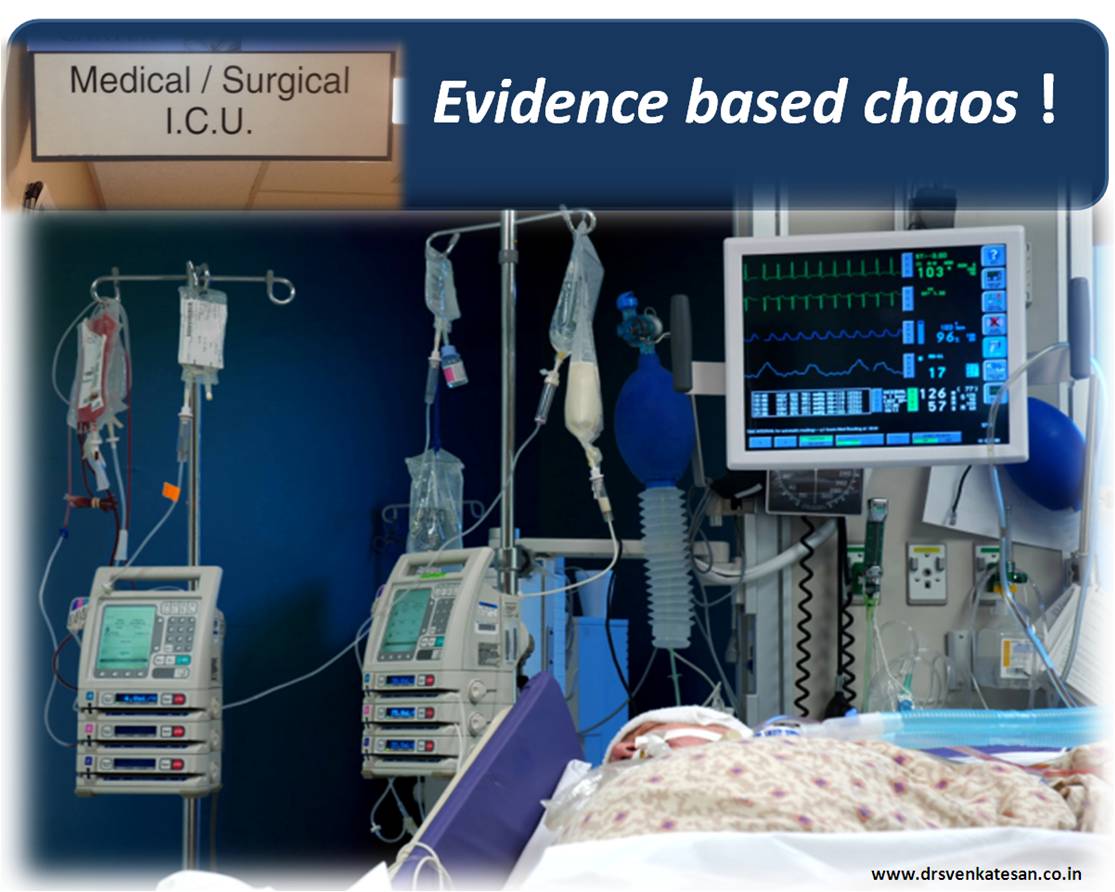
Critical  and intensive medical care is meant for supporting  an  individual organ (or multiple organs )  at times of extreme distress ,  till the  healing process  prevails over .Later , the patient  shall be shifted safely out of the unit .

Whatever be the modern technology , the single most important factor that  determines the success of ICU outcome  lies within the  patient body ( One estimate says  patient factor constitutes almost  85-90% -Dukes medical center )

Ironically , the modern gadgets, drugs , devices  threatens  . . .  rather  fights . . . with this  inherent  patient fighting  mechanism . We will  never-ever know how many cellular switches are turned on by our biological high  command ,  that compensates  and tries to restore  body  homeostasis.

critical care unit icu ccu.jpg evidecne based medicine modern medicine

Here is a  personal experience with a patient management scenario in an ICU  . The  patient is none other than my father !

He  is a 82 year old man who has  developed a acute febrile illness which rapidly degenerated into  acute respiratory failure  and  X ray  showing  infective bilateral pneumonia  and  probable ARDS  .He was on ventilator for 4 days  and subsequently weaned  off but still  heavily dependent on oxygen . His lung is wet with crackles and wheeze intermittently . His cardiac function was excellent . In one of the episodes of hypoxia he  developed  , mild shooting of blood pressure and minimal ST changes .  Alarmed  by this he was started on  beta blocker , for the first time  . It  was titrated up to maximum doses for a suspected ischemic  episode .

It is  well-known , ECG changes are extremely common in hypoxia , tachycardiac  stressed individuals .

Sympathetic  blockade  is important , only  if ,  it is an inappropriate surge  . When the body fights a disease it is the only major biological weapon available to him .How is it justified to block it ?

When this was discussed with the  team they said they have no power to deviate from  protocol and there is one article , that says  BBs are  beneficial even in COPD !

The patient  continues to be in ICU dependent on oxygen with extreme  ICU fatigue  definitely worsened by the heavy dose of adrenergic blockers which is in my opinion delaying recovery !

Different   organ specialist are prescribing  drugs  according to their level of understanding  (evidence is always available for them  . . . some where )  and radiology fellows  keep taking  snaps of  distressed  organs  in various angles  in HD quality images . Meanwhile , CT scan  seems to have revealed a chronic  interstitial  process   . . . how to diagnose a chronic lung condition  in a man who is  yet to recover from major acute inflammatory lung Injury ! I do not know ? And the current development is they are considering disseminated tuberculosis !

You may a big physician , the patient  may be a very close family member  , modern health care  system makes you watch  helplessly once you hand over  patient to a   complex care  unit .

We hope for the  best .

Final message

               Medical practice  . . . however intensive the care may be  . . .   the bottom line is  . . . it  should be based on  common sense . Modern medicine  tends  to make  this faculty of our brain  blunted .

The  specialty of Intensivist   is largely  misunderstood  . It goes more with  satisfying scientific egos  and public  perceptions  rather than true patient needs .

We need not react to every changing parameter that emanates  from the modern machines  that  keep sending out live  data from a seriously ill patient ,  on a moment  to moment  basis ! (We simply do  not need that ! If only a pilot  reacts with  jitters to every air pocket turbulence ,  he will  not reach the destination safely  ! )

From a cardiologist perspective ,  the humble  request  to all Intensivists   and critical  care physicians   is ,   avoid being  in  “fire fighting mode”   for all  those subtle ECG changes  that occur  in ICUs ,  especially with multi- system disorder (Caution : Acute coronary syndrome in CCU / post PCI  set up   is different story altogether where even a minor ST shift can be significant ! )

Heaven’s  sake  let us  rely more  in  our  brain rather than  the machines and devices !

Above story is not even a tip of an Iceberg . I come across it  every day  in  many ICUs  I visit  . The  most saddening aspect  is ,  we can not point out these mistakes  to our fellow professionals ,  as it  amounts to   hurting academic egos .They are more important  than patient care at any given point of time !

Counter point

For any system to work  , it  needs  a  strict set of guidelines ,  other wise the system of care will fail. This is a  fundamental basis on which modem medical  care works . The only issue is ,  we  should keep checking for any inadequacies in the evidence base and try to correct it. So do not blame the  EBM . It has come to stay .That is the future ! You are very pessimistic towards  modern science !

Rapid response to counter point

But the real issue is  . . . by the time next evidence base finds a major flaw  in the existing system of care ,  damages are already done . So with your clinical acumen  every learned physician is free to create  his own real world  experience .(That is also called Level 3 evidence now ) ** Protocols are not  sacred sermons . It  may  be (rather must be !)   violated if there is a need for the benefit of patient .

Disclaimer

* This is not an  attempt to disgrace the concept  of intensive  medical care . Please remember ,  finding fault  could be same as finding facts .(At least in   medical care )


Update ( February 24th, 2013  Sunday , 12.05  AM )

After 25 days of  intensive and aggressive  medical care   we lost one of the great lives

of modern times  which will be celebrated by his  sons and daughters forever !

Read Full Post »

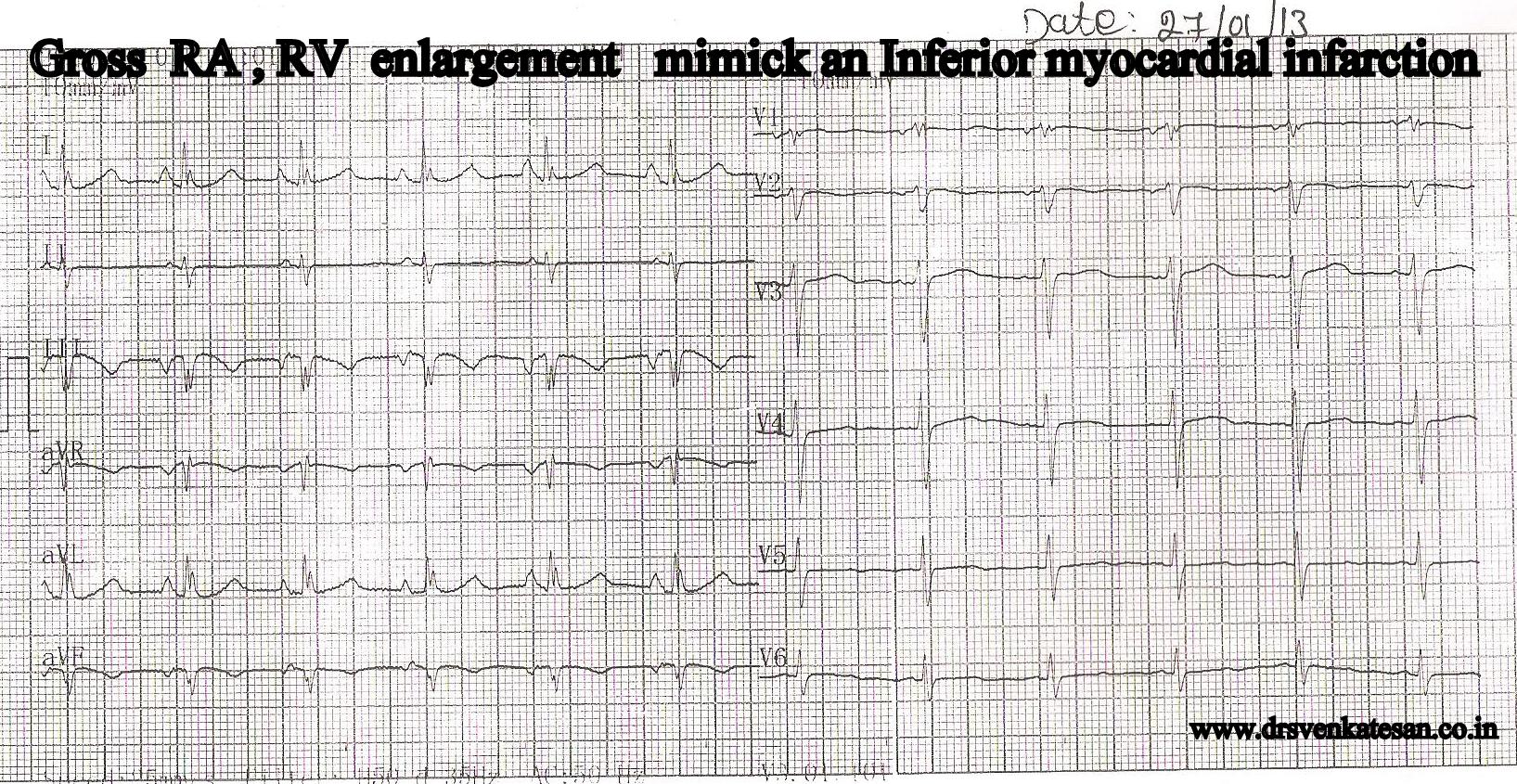
We know q waves are not synonymous with Infarct . It just represents electrical activity going away from the electrode.This is why it can occur  even in physiologically in many leads.

Non  infarct Q wave can be recorded with

  • LVH
  • Fibrosis
  • Fluid/Air in beneath  the recording lead
  • Thick chest wall/pericardium (More often Poor  R wave )

rv cavity potential in inferior leads mimicking inferior mi q in

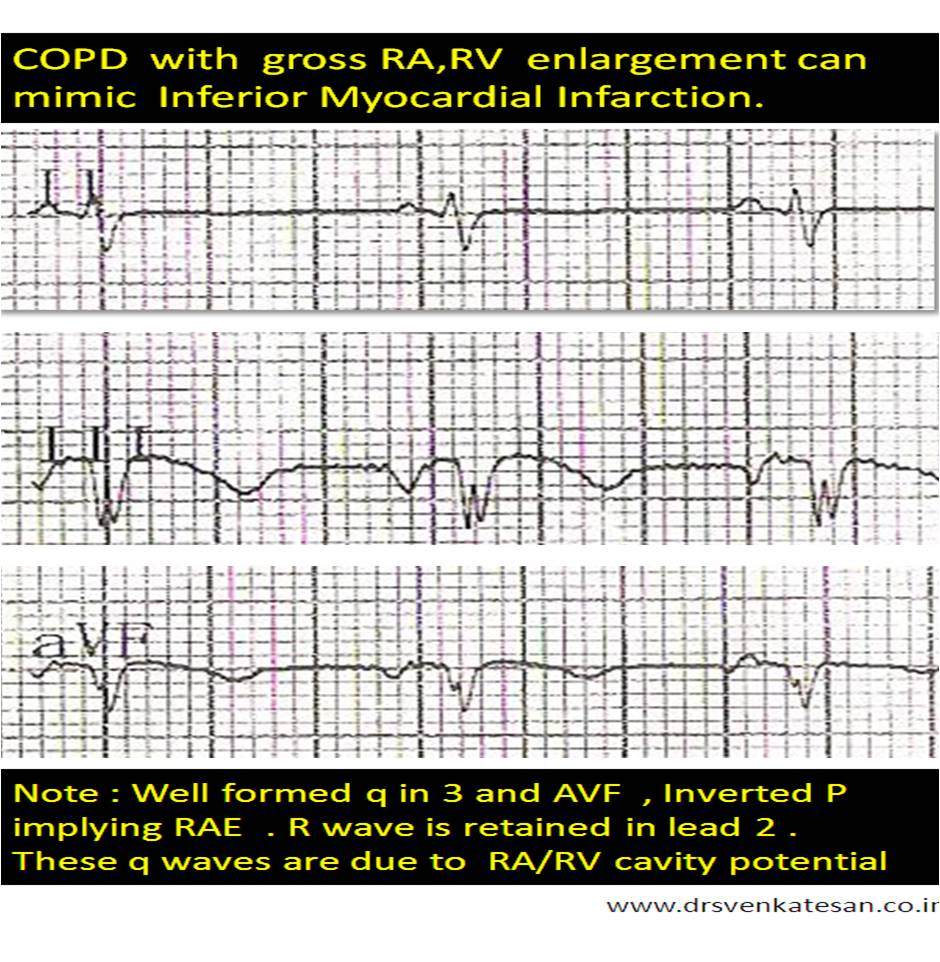
When a chamber enlarges (Any chamber )  it is  brought near the chest wall the electrode may pick up the intra cavity potential that is recorded as q waves .

(The q wave in V5-V6 in severe volume overload of LV may represent LV cavity potential )

Similarly qR complex in severe RV  enlargement  in V1 represent RA cavity potential.Right ventricle is anatomically a difficult chamber to understand. It is located anterior below the sternum  the inferior and posterior aspect of the RV  is facing the diapharagmatic  surface

copd ra rv enlargement mimic inferior mi q waves in 2 3 avf differential diagnosis

In huge RV enlargement , RV cavity potential or( even RA )  can be picked up by limb leads . While cavity potential is well picked up by unipolar pre-cadial leads , it is uncommon for limb lead  record  intracavitory  potential. However  this patient , who was diagnosed  as inferior MI by a  resident ,  turned out to be a clear case of severe  pulmonary hypertension due to  COPD .

Final  message

One  more differential diagnosis for  inferior MI in ECG  exists. A grossly dilated RA, RV due to COPD  with  severe  pulmonary hypertension.

Read Full Post »

Guidelines are meant for simplifying  cardiologist’s life  as well as  ameliorating   patient suffering  . It should also  ensure  improving overall  outcome   with  efficient  use of human resources and  economy .

acc aha guidlines stemi 2013

These guidelines  are written from sophisticated centers  mainly for consumption  in developed countries .Though core  concepts will be same , many recommendations are neither possible nor desirable  at the exact point of delivery  in  less developed countries . Please remember these guidelines are not binding on you .Physician discretion is the ultimate principle in medicine.

So ,  let us read these guidelines apply our mind and try to  indigenise . Get maximum out of it  for the respective population .

Some  of the highlights in this 2013  guidelines
1. Therapeutic hypothermia should be started as soon as possible in comatose patients with STEMI and out-of-hospital cardiac arrest caused by ventricular fibrillation or pulseless ventricular tachycardia, including patients who undergo primary PCI.31–33
(Level of Evidence: B)

2 . Presumed or New onset  LBBB is no longer a Indication for emergency reperfusion

3 . Indication of Primary PCI has the following modification

Primary  pci Guideline in  2013 aha guidelines

Reference

http://circ.ahajournals.org/content/early/2012/12/17/CIR.0b013e3182742cf6.full.pdf+html

Read Full Post »

« Newer Posts - Older Posts »