Feeds:
Posts
Comments

Archive for the ‘Cardiology -unresolved questions’ Category

Brugada syndrome continues to fascinate  us for two reasons.

One , it deals with mysterious sudden  deaths of young  men and women

Two , it is one of the  fine  examples  of how  advances in molecular biology , links  physical defects in ionic channels to  sudden electrical  death (Most of them  are due to inherited defects  sodium channels  of myocyte cell membrane )

While high risk subsets of Brugada are easily managed , it is  the asymptomatic  ones  that bother us.

The following are some of the  difficult  questions ,   a  cardiologist faces when dealing with   patients , who exhibit  only Brugada pattern in ECG .

  1. Should I go for an EP study Doctor  ?
  2. Will  I  require an ICD  Doc ?
  3. Do I carry a significant risk of  dying  suddenly  ?
  4. Do  I need a genetic test for sodium channel mutation ?

Fortunately,  we can answer  all these questions with much  courage than before.

(Thanks  to the European Finger registry published in 2010  !)

“No” is the  clear  answer for all of them !

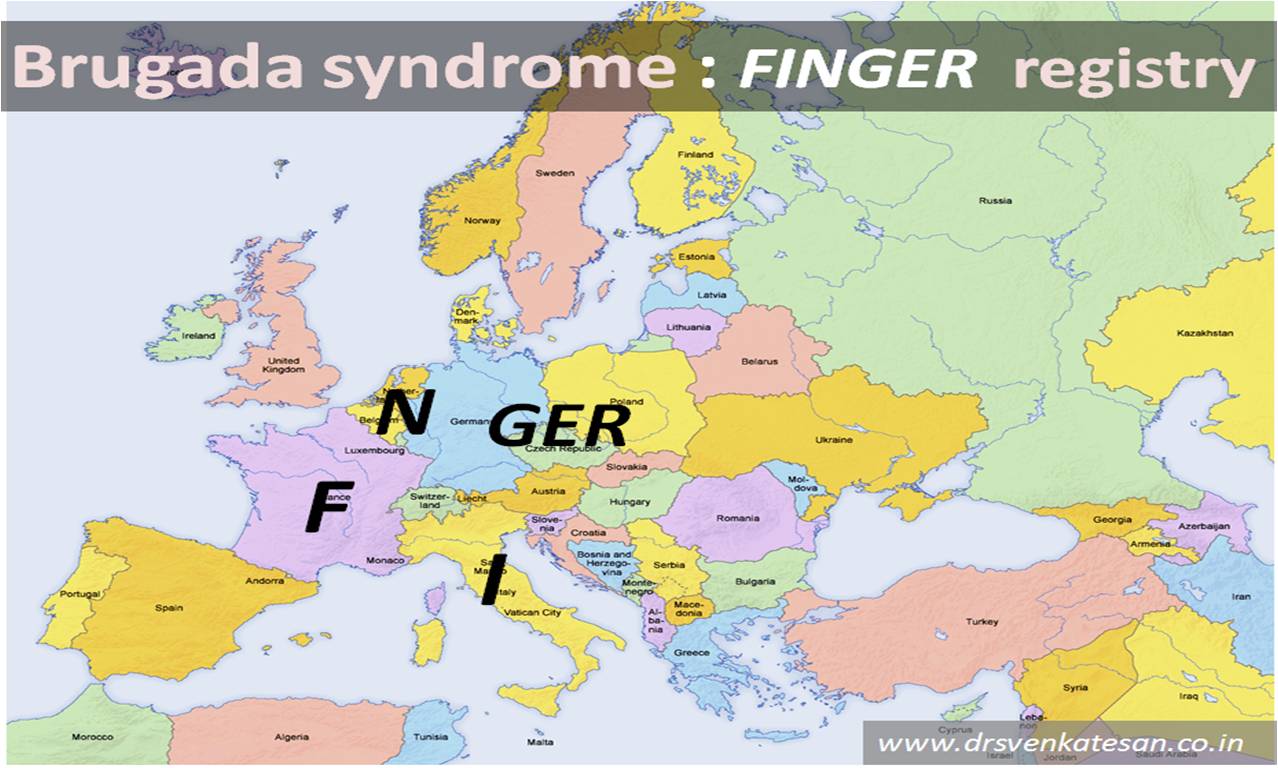
Summary from the FINGER registry. 

(France  , Italy, Netherlands, GERmany)

The registry included 1029 consecutive individuals

(1) Aborted SCD (6%);

(2) Syncope otherwise unexplained (30%);

(3) Asymptomatic patients (64%).

In the  follow-up of 31.9 (14 to 54.4) months . A total of  7 death occurred .

The cardiac event rates per  year was 

  • 7.7% in patients with Aborted SCD,

  • 1.9% in patients with syncope

  • 0.5% in Asymptomatic patients.

Predictors of cardiac  event

  1. Previous syncope
  2. Spontaneous type 1 ECG

Non predictors ( Surprisingly there were more non predictors ! )

  1. Gender has no predictive role
  2. Familial history of SCD,
  3. Inducibility of ventricular  tachy-arrhythmias during  EP study,
  4. Presence of an SCN5A mutation


Follow up

PRELUDE study  almost reaffirms  Finger data

(PRogrammed ELectrical stimUlation preDictive valuE)

Just publicized in JACC 2012 from the pioneer of   Brugada Silvia  Priori of   university of Pavia  Italy

Reference

http://circ.ahajournals.org/content/121/5/635.full.pdf+html

http://content.onlinejacc.org/cgi/content/abstract/59/1/37

Read Full Post »

Time and again cardiologists are called to opine  in critically ill ICU patients with  hypotension.  The circulatory shock of septic shock  is often refractory  . Many  times it  degenerates  into multi -organ failure . The mortality remains high in- spite modern treatment .Even in those patients who recover , they require prolonged  inotropic support  (for days or even weeks)

Here is a  recent call I attended to .

A 44 year old   febrile   , ventilated patient  (With a pneumonitic patch , PEEP of  6 , near ARDS )  ,  precarious renal function and altered sensorium , maintaining a blood pressure of 100/70mmhg with high dose dopamine and nor- adrenaline  , monitor showing a heart rate of 125 /mt sinus  .This status -quo  has continued for more than 72 hours. To my surprise,  the ICU physician told  me there is  in-fact a  minor improvement in general condition than before  . After blinking  at the patient’s  file for few  minutes  , I did a customary bed side echocardiogram .The only positive finding  I  found was  his  heart was  structurally normal  and EF was  64 %  , still the right heart chambers were struggling  to do it’s job   fighting with the PEEP.

The physician had  a very  specific query  from the cardiologist . How to wean the inotropic support and shift him off  ICU ?

(The poor patient  has no  insurance  , and has to shell  Rs 10000 everyday  which is equal to his monthly income ! )

A very  valid question indeed   !   After all  , cardiologists  claim to  have special  knowledge  and wisdom about disorders of  vascular system .

Heart being normal , the crux of the problem is loss of vascular tone. (Autonomic dysfunction ) .How to improve it ? I  discussed the following suggestions.

  • Early passive muscle exercise (Augmenting  muscle tone and transforming it to  into arteriolar and venous tone )
  • Venous support ,stockings etc.
  • Ensure adequate intra-vascular  fluids
  • Sodium supplements
  • Corticosteroids.
  • Fludro-cortisone , the mineralo-corticoid may have a specific advantage as it could retain sodium in vessel wall that can be exchanged with smooth muscle calcium and improve vascular tone .
  • ECMO is  often a pre terminal intervention .
  • Will power . We know vascular  tone is in fact neurogenic in origin .The tone flows from brain stem .Administering  will power could be a useful intervention . (parental infusion of fighting spirit !)It can be done through pep talks from  close family  members   in   conscious patients .(One controversial advice is to allow  near and dear  into bedside , ICU phobia may delay recovery of vascular tone !)
  • Finally  I suggested , a  vascular consult from the GOD  . Organised prayer .  There is some evidence ,  even  proxy prayers do exert benefits in unconscious patients .

After a 15 minutes stay in the ICU , for doing nothing  I  received a significant consultation fee  , and I left the  place  sheepishly  with a  definite dose of guilt !

Reference for role of Hydrocortisone in septic shock

The CORTICUS study

It has no overall impact but hastens recovery from septic shock . Even though the study appears to denote a negative connotation

it has the role in selected individuals .http://www.nejm.org/doi/full/10.1056/NEJMoa071366

Read Full Post »

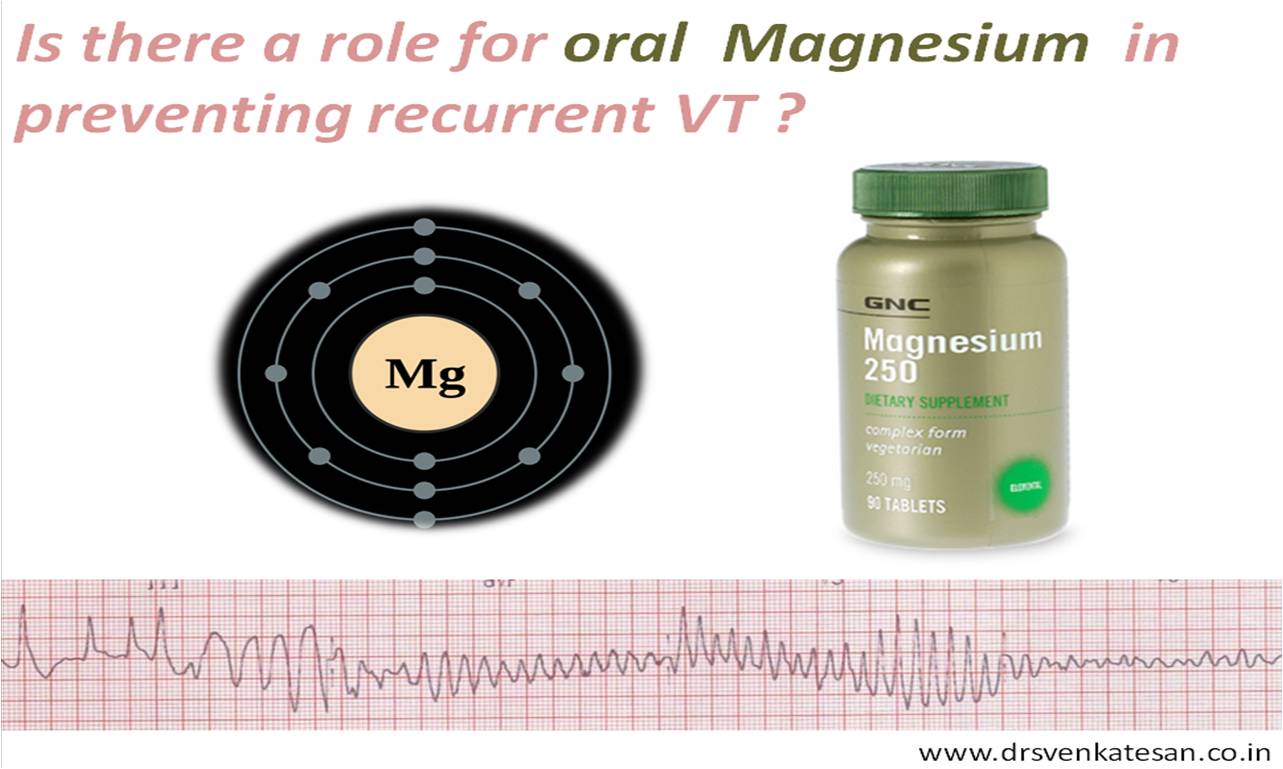
Magnesium   is a powerful anti-arrhythmic drug . It has a well  established role in controlling VT when administered  Intravenously   especially in polymorphic VT .

Mechanism of action

  • It acts at the cell membrane.
  • It has a unique action of blocking calcium channels  that reduces the number of oscillations of  both  early and late  after potentials

Link for more  on mechanism  of action

https://drsvenkatesan.wordpress.com/2010/01/13/how-does-magnesium-acts-as-an-antiarrhythmic-drug/

How often cardiologists administer oral magnesium for long-term control of VT ?

As for as I know ,  no one uses it ! but dietary  supplements are used for general well  being .

Why ? Is it because

  1. Magnesium does not get absorbed in the gut
  2. Magnesium levels are un- predictable in plasma if administered orally

Answer : No one has really tried  it as a  chronic therapy in VT  yet  !

Final Message

Tablet Magnesium can give a tough fight to Amiodarone and Flecanaide in refractory VT at a fraction of the cost !

Who has the audacity  to  compare Magnesium  with Amiodarone head on ?

Reference

Magnesium as health supplement . 

Magnesium is available  in tablet form as  Malate , Stearate, Taurate and Aspartate  along with calcium and Zinc etc .

Read Full Post »

Irregular  wide qrs tachycardia is a fairly common clinical entity in any cardiac emergency room. The moment you ask about  such tachycardia ,  9/10  fellows will  come out with a  prompt answer   ” AF with WPW syndrome” even before you complete the question !  It is not that common  as we perceive .The problem is with  our traditional teaching methods and the attraction of human brains to  rare and exotic disorders.

traditionally   SVT with aberrancy  is   diagnosed  mainly  in the setting of regular tachycardia .

We often  forget  “AF with aberrancy”  is equally common  , and  it presents   with a  irregular  wide qrs tachycardia . 

I  wonder whether  this phenomenon  can be termed as  orthodromic aberrancy .This can directly compete  in the differential diagnosis  of  antidromic AF  with  WPW !

It should also be mentioned antidromic  AF can run into very high rates  as accessory pathways do not check the incoming signals while orthodromic aberrancy the ventricular rates can not exceed 220 or so at least theoretically . (This simple clue can clinch the issue in favor of  WPW )

There is no proper  published data available for the true  incidence of AF with orthodromic aberrancy in general population

In fact , there are  many  electrical  environments for AF  to  become a  wide qrs AF

1. AF  with  Antidromic conduction through accessory WPW pathway.

2. AF with Orthodromic aberrancy ( Non WPW – Similar to  any SVT with aberrancy )

3. AF with pre existing LBBB

4. AF  with Amiodarone effect. (Especially with DCM and cumulative load of Amiodarone )

5. AF with electrolytic /  especially excess  intra-cellualr  potassium

6. Finally , even  Atrial based pacing (DDD)  can cause wide qrs irregular tachycardia when  mode switching  fails .Here the  ventricles  may track the  atrial irregularity  and respond with a  wide qrs  bizarre tachycardia .

Final message

There are many causes for  wide qrs tachycardias  in  Atrial fibrillation . WPW with anti-dromic conduction is just  one of them .We need to approach the issue with an open mind .Please  be reminded , once contemplated  WPW syndrome  can be a powerful thought blocker  !

Note : *We are not including   polymorphic ventricular tachycardia here .It is an  important subset of  wide qrs irregular  tachycardia.

** VT can co-exist with AF .This is not   surprising  as  many of the diffuse cardiomyopathies  involve  both atria and ventricle  with extensive scarring and fibrosis  a perfect trigger for  both atrial and ventricular arrhythmias .

Read Full Post »

RR interval in Atrial fibrillation is irregular because . . .

  1. The Atria  fires irregularly
  2. AV node conducts irregularly
  3. Atria confuses the AV node  with  its random firing  and varying penetration *
  4. The ventricle just reflects  irregular  response of atria .

The answer is all of the above. Response 3  explains  best.

*Please note , the AV nodal property is predominantly  responsible for the irregular RR interval in AF  . Atria confuses the AV node  with its random firing .The varying penetration into different depths of AV nodal structure and  the resultant concealed conduction make the   the AV nodal refractory period into continuous oscillation .This  random delays in AV node  is reflected in RR interval as irregularity   )

The response we get in ventricles  in AF  can be summed up as  “A filtered atrial rhythm”

Paradoxically,  amidst the chaos in atria  the rate  is fairly constant within the atria (Fibrillatory   wave firing  at up-to 600/mt )  Of course  , the FF interval in the atria will also be varying  .  At a rate of 450-600 this is difficult to quantitate  especially in fine AF.

When does RR interval becomes regular in AF ?

  • When the patient develops complete heart  block.
  • Digoxin toxicity
  • Associated Sinus node dysfunction

For advanced readers in EP : A mystery explanation for irregular  rhythm in AF  in the offing ?

AV node is a physiological and electrical sink .

When atria fires at 600/mt it absorbs about 60-70  % of the atrial response .Whether it releases the original impulse or initiate a new rhythm in the junction  is not clear.

There is some evidence to suggest the rhythm that control the ventricle in AF may not be  filtered original rhythm from the atria .Instead it could be a fast junctional  escape rhythm (Is that a junctional fibrillation ?)


Read Full Post »

What will be the  pulmonary capillary wedge pressure ( PCWP ) in grade 1 LV diastolic dysfunction ?

  1. Significantly elevated
  2. Marginally elevated
  3. Usually Normal
  4. It depends upon  age, LA size and LV  function.

Answer is 3 . (Of course  it depends on  4 )  Normal PCWP  is  4-12mmhg

Are these patients with grade  1 LV diastolic dysfunction  are at  risk for  acute pulmonary congestion at times of stress ?

Probably not ( in  most )*

                                             The grade 1  LV diastolic dysfunction or defect is the most used (abused ! )  echo terminology .The diagnostic simplicity of this condition namely  a simple documentation of “a”velocity more than “e” , has made it  as an epidemic in echo labs  world wide. After all  , it reflects a simple  fact that  left ventricle  has  summoned   the atria  for assistance   (Which is  all the more  physiological   at times  of stress   !)

When does this physiology becomes pathology ?

As long as  the atria is  doing its job of assisting the LV without any fuss  ,  the mean pressure of LA(PCWP) is maintained  within  normal level . Only if the atrial function is stretched  beyond the limits ,  PCWP begins to raise.  It can happen  in a variety of  ways . Most commonly it happens   elderly hypertensive /Diabetics  especially with LVH .

It can also occur in healthy individuals when they become physically deconditioned. (Left ventricle   goes  for  disuse and find it difficult to relax)

Final  message

Isolated  grade 1 LV diastolic dysfunction in people  > 40 years   generally do  not indicate a serious  abnormality.

Only if they have DM/HT and myocardial  disease they need to be evaluated further.

One practical clue is ,  if LA size is normal one can rule out  significant  diastolic dysfunction.

Caution

* In elderly population ,   when they undergo any major  surgery ,  presence of even grade 1 LV diastolic dysfunction can be a marker for peri -operative LVF and  lung congestion .

Read Full Post »

Clinical sense

  • First and fore most  dictum  is  not  every  prosthetic valve obstruction  is  thrombotic (Most cardiologists are tuned to think that way )
  • Pannus, Mechanical failure  and  vegetations can increase the gradient across prosthetic valve.
  • If the clinical presentation is acute (< 48 hours ) it is  more likely to be a thrombotic event .
  • History of  recent discontinuation of oral anticoagulants /sub optimal INR will favor thrombosis.

A meticulous Echocardiography is vital (TEE though gives more information in an emergency TEE is suffice )

  • Thrombolysis is to be considered in all .
  • For right sided prosthetic obstruction thrombolysis is the  initial modality of choice.
  • For left sided valve thrombosis   surgery is the preferred option .However a trial of  thrombolysis for 24 hours may be tried .
  • For a high risk mobile thrombus , thromolysis is contrandicated.

The success rate is less with Mitral than Aortic valve  . Success depend upon more on the  location / Freshness of thrombus than the type of the lytic agent used.

Is there a time window for prosthetic valve thrombolysis ?

Thrombus organisation takes 2 weeks at- least.Hence , it better not to attempt thrombolysis in documented late prosthetic valve thrombosis.

Thrombolysis of left-sided valves has inherent risk of  stroke .

Heparin controversy

Simultaneous usage of heparin along with streptokinase or TPA is  perceived as risky (No good evidence for this perception )It is logical to expect even as the thrombus  lyses the clot lots of pro-coagulant debri  are released . Concomitant usage of heparin  will definitely help accelerate thrombus dissolution. (I am glad  Joseph S   Alpert also feels the same ! )

Assessing successful  thrombolysis

  • Can be a tough task .
  • Relying purely on gradient is vested with risk of huge error.
  • In a patient with shock or LV dysfunction gradients are not reliable as low flow status masks the gradient.
  • A accelerated thrombolytic  protocol 15lakhs streptokinsae in 60 minute may be tries in unstable patient .
  • It is wiser to rapidly asses for clinical improvement in high risk subsets  and refer the  patient for early surgery .

Surgery

Prohibitive mortality reported in many centres.

It need to be remembered no surgeon will operate on a  sick patient in  shock  exposed to  cocktail of heparin and streptokinase.

Valve replacement is required in most case. Simple valve debridement  (servicing the  valve ) and releasing  discs  from the  sticky thrombus is  also possible in an occasional patient.( Do not ask reference for this !)

Reference (Surprisingly most of the good papers in the topic appeared  in JACC)

http://content.onlinejacc.org/cgi/reprint/41/4/653.pdf

http://content.onlinejacc.org/cgi/reprint/41/4/659.pdf

http://content.onlinejacc.org/cgi/reprint/35/7/1881.pdf

http://content.onlinejacc.org/cgi/reprint/35/7/1874.pdf

After thought

I have not seen a single case of acute prothetic valve thrombosis involving Starr Edwards valve  in the  last  20 years of  of clinical cardiology practice.

Is it true   . . . the new age valves  with more mechanical stress points  are proving more injurious to our patients. Our  pursuit  towards a  perfect artificial  valve need some introspection .

Read a related article in my site :  Who killed Starr Edwards valve ?

Read Full Post »

Pulmonary  arterial hypertension (PAH ) is  an uncommon manifestation of dilated cardiomyopathy .While pulmonary venous hypertension of some degree is expected in most patients with DCM,  it is rare for these patients to go for severe arterial hypertension.

The reason for this may be the  natural history of DCM do not allow these patients to live that longer to manifest severe PAH.  Still ,  we encounter this problem  atleast in tertiary hospitals. Presence of moderate to severe PAH (> 50mm peak PAP) is a sinister sign in  DCM. They not only do badly , they also make  the transplant outcome dismal .

What causes this severe   PAH in DCM ?  The following observations are made in our institute .

Now we know , isolated  systolic dysfunction is  rarely associated with PAH  .It is the presence of  LV diastolic dysfunction (Often restrictive )  that raises the pulmonary pressures.  PAH of DCM is rarely progressive.

One important suggestion is the DCMs  which are associated with  severe  PAH may indeed represent  late stages of RCM , when the LV begin to dilate.

Associated mitral regurgitation   contributes  to PAH

Atrial fibrillation has a significant impact on elevating  pulmonary  venous and arterial  pressures in DCM.

Hypoxic PAH can occur in any medical situation  in susceptible population . DCM is no exception

For some reason  idiopathic DCM is more often result in PAH than ischemic DCM . (Is that possibel , some form of  idiopathic   PAH and DCM are etiologically  related ?)

Further , the positive inotropic agents when liberally used will worsen the diastolic  properties of LV.

Finally involvement of  right ventricle  in the cardiomyopathy  process can have an ameliorating effect on PAH.  A good RV function is essential to lift the PA systolic pressure. If RV failure is causing a low PAP , do not be happy .It simply means RV is going to  say  good bye  . . .  for the final  time !

How to manage PAH in DCM ?

There is no specific management strategy .

We do not know yet  whether Sildenafil ,  Bosentan, and Epoprostenol  have any role in this  form of  PAH. These are all basically vasodilators. It’s use in DCM is vested with a risk of  catastrophic hypotension . Of course ,  we do have a role for balanced vasodilators in cardiac failure .(As most of these patients would be already on adequate ACEI )

Presence of PAH should be considered as an independent indication for anticoagulants as in situ  pulmonary thrombus is common.

The effect of  cardiac resynchronisation therapy in reducing the PAH of DCM is not convincing.

Final message

PAH  in DCM is an unwelcome development. It makes the situation  tough .  The mechanisms are diverse  .Understanding the mechanism would help us deal  this problem better .  Conventional anti failure treatment may help  ,but  it is wiser to try  reserve drugs.

Read Full Post »

Clinical cardiac  problems can be very demanding at  times. Here  is a  situation even the toughest will struggle.

A 52 year old man comes with a wide qrs tachycardia  with a blood pressure of 90 /70 with class 4 dyspnea .He was restless , trying to sit up because of  orthopnea. The ECG showed  a definitive ventricular tachycardia  with LBBB morphology.The patient was   connected  the   oxygen line ,  cardiac monitor, oximetery, etc

The consultant  on call instructed   immediate DC shock   and  he  warned  about  impending ventricular fibrillation .He  casually told the fellow to  do a echocardiogram also and rule out any structural heart disease. Even as  the staff was  arranging the defibrillator , the fellow did   a  rapid bed side echocardiogram . He was  shocked to find a  large mobile LV clot   with a  dilated ,  severely dysfunctional left ventricle  having an  EF  of  25 % .

Now comes  the critical time . Should we shock this man with VT and LV clot?

What will be your option now ?

  1. I will not mind the LV clot  ,  will go ahead with DC  Shock . Let him dislodge his LV clot . If It is his fate  let it be !
  2. Defer the   DC shock . Fall back on medical cardioversion like  Bretyllium, Amiodarone or magnesium  . After all . . .  it is not a pulse less VT. He is not in cardiac arrest . He can afford to wait .We can’t risk a stroke .
  3. Give a low energy  shock  25 joules  with paddles  avoiding the LV apex.  .It may not dislodge the apical clot , still  VT may be terminated.
  4. Try overdrive  pacing instead of DC shock
  5. Refer the patient for emergency surgical removal of LV clot
  6.  Suck out the LV clot with a   LV suction catheter and plan elective DC version*
  7. Insert a temporary Aortic filter and shock the patient **

*  Such catheters are in preliminary stage of development . Is  that true ?  ( If  no I  should get the royalty for the idea  ! )

(Read the related article in my blog )

** A loud imagination . Such filters do not exist.( If  IVC  can be filtered   why not  Aorta ? )

What was finally done ?

After analysing each  of the above  , we decided   option one “Prey the  God  and shock the heart” ) After all if it is  a VF ,  this  issue becomes null and void !  . Luckily God was with us.  The  patient  was  reverted to sinus  rhythm with 50joules   and  had  no  untoward events . He was subsequently anti-coagulated .  He is being planned for CRT/ICD therapy

Final message

Critical care  medicine is all about risk taking .Many times , therapeutic maneuvers  confer a  significant   risk  to life  comparable  to the   index problem.  But that  should not be a deterrent .  A careful learned decision  is warranted.

Read Full Post »

Angina occurring at night is relatively uncommon . It is  still  more rare  for angina to occur exclusively at night (With a possible exclusion of  syphilitic aortits with AR !) The underlying conditions and mechanism  of nocturnal angina  are largely unexplored. In most clinical situations nocturnal angina  is  associated with day time angina as well .

Various mechanisms are proposed

  • It is primarily due to  increased demand  (Holter monitoring has documented  brief bursts  of  HR acceleration  just before  nocturnal angina with  manifest  ST depression )
  • Increased demand  during  REM sleep .
  • Dreams  related adrenergic surge has been implicated.
  • Rarely it is due to supply side defect .
  • Coronary vaso-spasm ( Mostly  in a pre-exisiting lesion )
  • It could  simply  represent  paroxysmal nocturnal dyspnea (pnd)
  • Sleep apnea can precipitate angina  ( Ironically angina occur during   re-breathing  phase )
  • Altered hemo-rheology
  • Nocturnal gap in anti anginal medication *

* May be more  common than we realise.

Cardio vascular hemo-dynamics  at night

If we  believe , sleep is  the great relaxation , and the heart   would enjoy the   “night time”   we  are absolutely wrong . Even in sleep ,  heart has to pump the same 250 ml of blood every minute. Of course , the sleeping heart rate slows down considerably , still  it is interspersed with spikes of activity.  When the heart  rate  slows down  , diastole is prolonged , coronary blood flow  is expected to be copious  unless there is critical CAD.

                                      We  know , sleep is not a passive process  , even as the  autonomic nervous system takes complete control over the  somatic  system .The true colors of  our delicate autonomic system will come to light only during sleep.The muscle tone ,  the sympathetic drive fluctuates according  a pre-set degree . Dreams and REM sleep disturbance can have considerable impact on the sympathetic nerve terminals which ooze  catecholanines  .

Sudden awakening  from  early sleep  is vested with a risk of dangerous   spikes of adrenaline release  .This becomes especially  important in compromised coronary circulation .In fact , this is commonest  sleep -awake  sequence  in patients with nocturnal angina.

Silent ischemia at night

It is curious to note 24 hour Holter  monitoring  reveals  most episodes of ST depression at night are silent. There must be a  specific pain threshold above which a patient awakens  with angina.   The  available  studies   do not  answer this issue   and are not perfect  . We have no way to find  true   silent ischemia  during  sleep.(PET scan in thalamus ?)

Nocturnal angina  in  Aortic regurgitation

Aortic regurgitation  has special relationship with dusk  .For angina to occur AR must be severe and usually isolated .

  • Prolonged diastole at night   -Regurgitation time is prolonged .
  • Dilated LV . Increased  LV mass .Increased demand.
  • Raised LVEDP due high wall stress.
  • Diastolic coronary stealing . Venturi  effect of AR jet

Nocturnal Angina : Is it stable or unstable ?

Most  consider it   as a type of stable angina .Now ,we have reasons to suspect  it could a  marker of unstable angina as it is an  expression of rest angina .

Nocturnal angina vs nocturnal STEMI

How often an episode of nocturnal angina end up in STEMI ?

STEMI is more  common in the early hours of the day and is more related to the hemo-rheological factors  . Please  note ,  STEMI is  a supply side defect  while most episodes of nocturnal angina is due to  demand ischemia . However  it is possible   nocturnal angina episode can precipitate STEMI if  vasospasm is  the underlying mechanism  and if  it is prolonged can trigger thrombosis.

We do not know the answer as yet.

Nocturnal  Angina : Can  it  be PND equivalent ?

Paroxysmal nocturnal dyspnea (PND)  is a classic manifestation of  episodic LVF.  We  know dyspnea can be an anginal  equivalent.  What prevents angina  to  become a  dyspnea  equivalent ! ( Especially the nocturnal ones ,   since the  mechanism  of generation of PND   are very similar  to the  genesis of  angina ). It is distinctly possible  one  may  be mistaken for the  other .  Both occur when  sudden hyper-adrenergic  state  is evoked  which demands   high MVO2 .  An  ischemic heart has every reason to  respond with  angina  .

It is well known  ischemia can result in transient diastolic dysfunction and  elevate the PCWP simultaneously  and PND  would be  the sequel .  When we analysed the  nocturnal calls (  Our fellows ,  do get lots of  such calls from   general wards  at night ),  many  patients with LV dysfunction  who complained  of  classic  chest pain  had  some degree of  dyspnea  and few crackles over lung base as well  .

Nocturnal angina and obstructive sleep apnea

The incidence of nocturnal angina is more common in obese population with obstructive sleep apnea.

The reason is two-fold

1 .Hypoxia mediated

2. Inappropriate tachycardia during recovery phase

Is there any  specific management strategies  to control nocturnal  angina ?

  • General  principles apply .
  • The timing of  anti anginal medication can be adjusted . Long acting preparations taken  in  morning hours to be avoided as they do not cover night time.
  • A calcium   channel blocker   (with optional  beta blocker )  at night may be the best bet to prevent nocturnal ischemia.
  • Dinner to sleep time to be widened.
  • Heavy diet at night to be avoided.
  • Sedatives role is not clear. (Can Diazepam suppress nocturnal angina ?  If so . . .  we  can call it as anti anginal drug  . . .  is isn’t )

References
http://www.thelancet.com/journals/lancet/article/PIIS0140-6736%2884%2991693-3/abstract

http://www.ncbi.nlm.nih.gov/pubmed/8419815
http://www.nejm.org/doi/pdf/10.1056/NEJM199302043280502
  Obstructive Sleep apnea  and  Angina 1  : http://www.ncbi.nlm.nih.gov/pubmed/7715342

 Obstructive sleep apnea and Angina 2 http://content.onlinejacc.org/cgi/reprint/34/6/1744.pdf

Read Full Post »
« Newer Posts - Older Posts »