Feeds:
Posts
Comments

Archive for the ‘Uncategorized’ Category

The major mechanism of exertional dyspnea in HOCM is due to

  1. Hypercontractile LV
  2. LVOT obstruction
  3. Diastolic dysfunction
  4. Mitral regurgitation
  5. Unrelated to HOCM

Answer : 3*

*This has been proven by a simple fact , dyspnea continues to be  a prime symptom in both obstructive as well as non obstructive HCM

Though LVOT obstruction appears to be the core issue , the myocardial disarray is a global one and lies scattered .That is why , myomectomy , septal reduction , may not reduce the symptoms  grossly as one would expect.

Paradoxically , preload reduction with diuretics  (That works well  for most  dyspnea with  raised LVEDP) ,  is vested with the risk of worsening the symptoms in HOCM . Diuretics underfill the  LV and tend to aggravate dynamic LVOT obstruction.

Probably ,the best way to reduce  symptom of dyspnea is to keep the heart rate low with betablocker.Further, betablockers smoothen the LV wall stress and calm down the LV baroreceptors which  indirectly suppress the  afferent input in  the brainstem dyspnea circuit.

Read Full Post »

Hi ,

It all started in 2008 with two posts and about a handful of visitors.It gladdens me to note it’s helping  so many  followers. Iam  posting  herewith the official annual report of my blog  for the year 2014.

Wishing you all a Happy , Healthy and energetic New year !

Thank you  once again.

Dr S.Venkatesan

Chennai,India.


The WordPress.com stats has  prepared a 2014 annual report for this blog.

Here’s an excerpt:

The Louvre Museum has 8.5 million visitors per year. This blog was viewed about 520,000 times in 2014. If it were an exhibit at the Louvre Museum, it would take about 22 days for that many people to see it.

Click here to see the complete report.

Read Full Post »

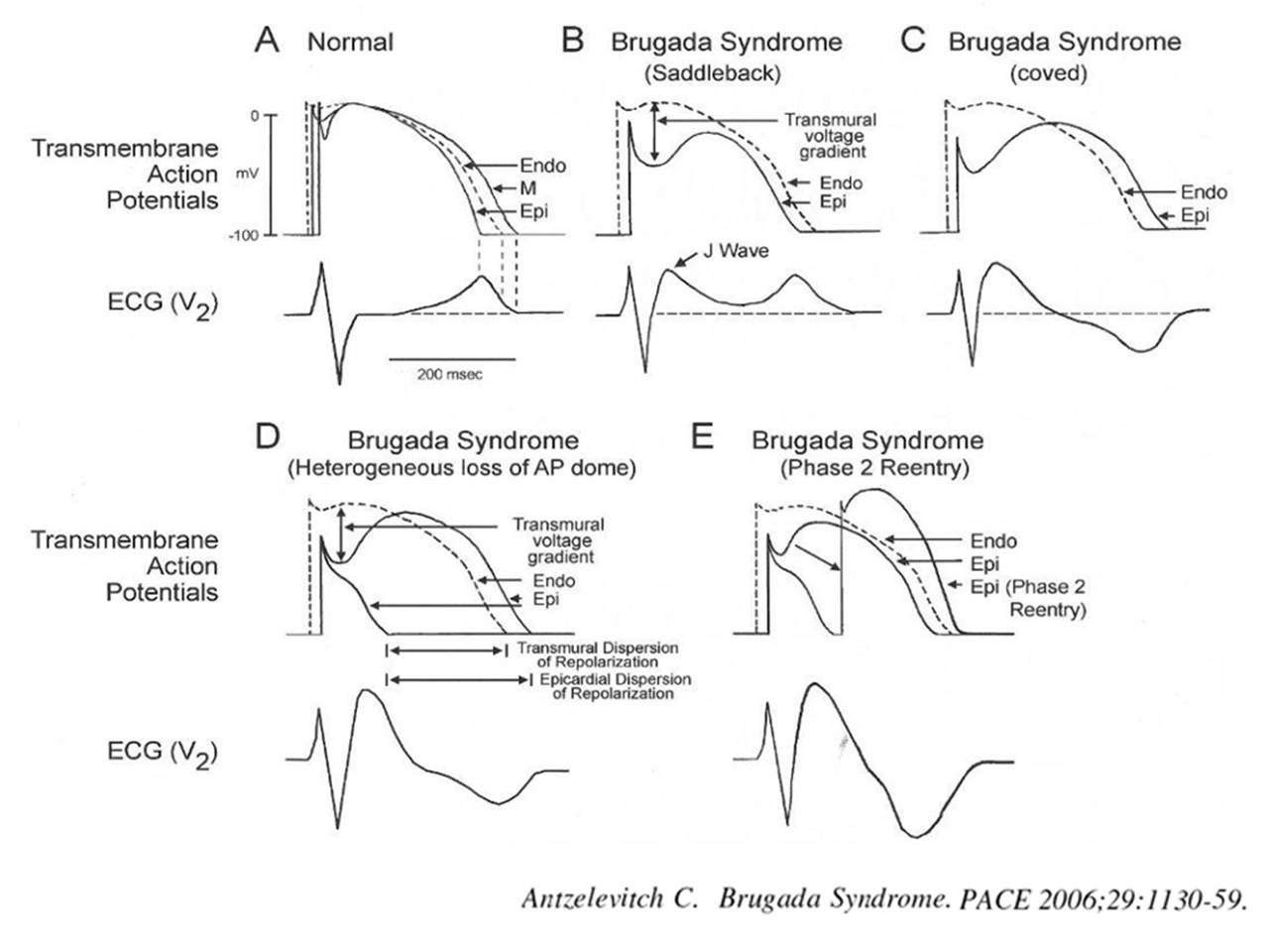
Brugada syndrome is due to a genetically  impaired  sodium channel activity  ( SCN5A)  in phase o, of action potential .This results in phase 1 (Ito channel) failing to inscribe the transition between phase 0 and  1 that result in loss of  dome .This loss of dome is dominant in epicardial cells compared to endocardial cells.This result in  electrical heterogeneity and a hence a voltage gradient in repolarisation phase  that can trigger a Phase 2  reentry mediated  VT /VF.The above said defects are either dormant, manifest, self extinguishing , dynamic  subjected to autonomic tone , ambient myocardial temperature (Febrile VTs) making this a complex entity.

There are three distinct types according to surface ECG.It can be either spontaneous or induced. The arrhythmic events and prognosis and hence management differs according to the types.

mechanism of brugada syndrome three types of ecg 2All types carry  a minimal risk of SCD , variable though . Of course  syncope  has to be  much more  common. Curiously every episode of syncope is seen as naturally aborted SCD by physicians ! (No one  to be blamed for this .The definition of syncope is like that !If the patient doesn’t wake from syncope it becomes death !).

When a patient with Brugada  has a  syncope , it  doesn’t  imply  he  experienced a dreaded VT or VF.While SCD is invariably due to ventricular fibrillation , a spontaneously terminating VF  as a cause for syncope is rare in Brugada . (Ref 2 : ILRs have documented though in few)

So what exactly is the cause for syncope in Brugada ? The issue is  real  and critical in clinical decision-making. We are beginning to document variety of mechanisms. Following are the possible causes

  1. Sustained  VT or NSVT with
  2. Non sustained self terminating  VF
  3. Extreme bradycardias (Vaso vagal )
  4. AV blocks
  5. Unrelated neurogenic

Final message

It is to be strongly emphasised a significant subset of Brugada patients especially in Type 1   Brugada (spontaneous or drug induced )  the mechanism of syncope is often not related to the dreaded VT/VF. It can simply represent high vagal tone and unexplained dynamism of autonomic activity .ICD is not a default indication for all those with syncope in Brugada syndrome.Think , pause and decide when you deal with such patients. ICDs are true revolutionary devices  . . . no two thoughts about it,but it can make a hell out of heaven if used in an inappropriate situation !

Reference

Read Full Post »

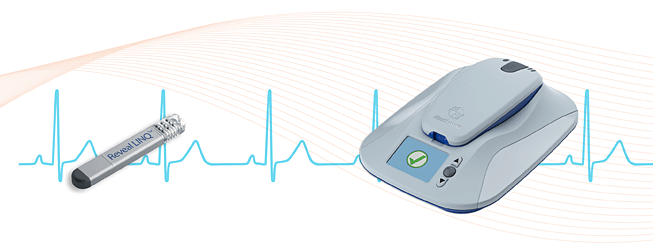
In this wireless networked world nothing is personal, not even your heart beat.Modern pacemakers and ICDs have wireless connectivity with the manufacturers.This is value added service for regular monitoring and solving  any technical issues.

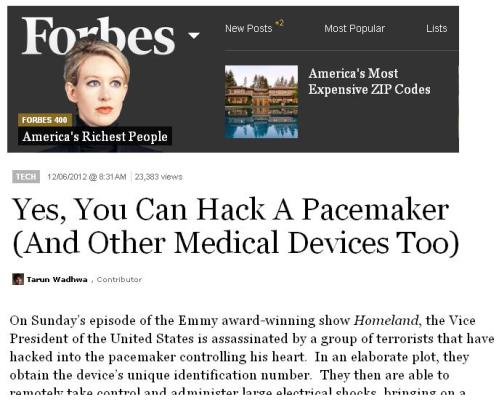
assets_174815Hacking  a device like pacemaker and ICD  and instant deactivation or triggering a new event   is a distinct possibility .It was shown in a fictional TV series “Home land” that prompted the  ex American wise president Dick Cheny to switch off all wireless function in his ICD. Now ,the US homeland security  cyber emergency  response team has decided to probe the issue .

pacemaker hacking icd

Perils of technology is taking us to new uncharted territories , while your  SA   AV node are at risk of being  remote controlled !

Meanwhile Medtronic has clarified they have increased the security features and pacemaker /ICD hacking is not an issue to be worried . But the threat is genuine !

Reference

1. Frenger P Hacking medical devices a review – Biomed Sci Instrum.  biomed 2013.2013;49:40-7

3.Fox news

Read Full Post »

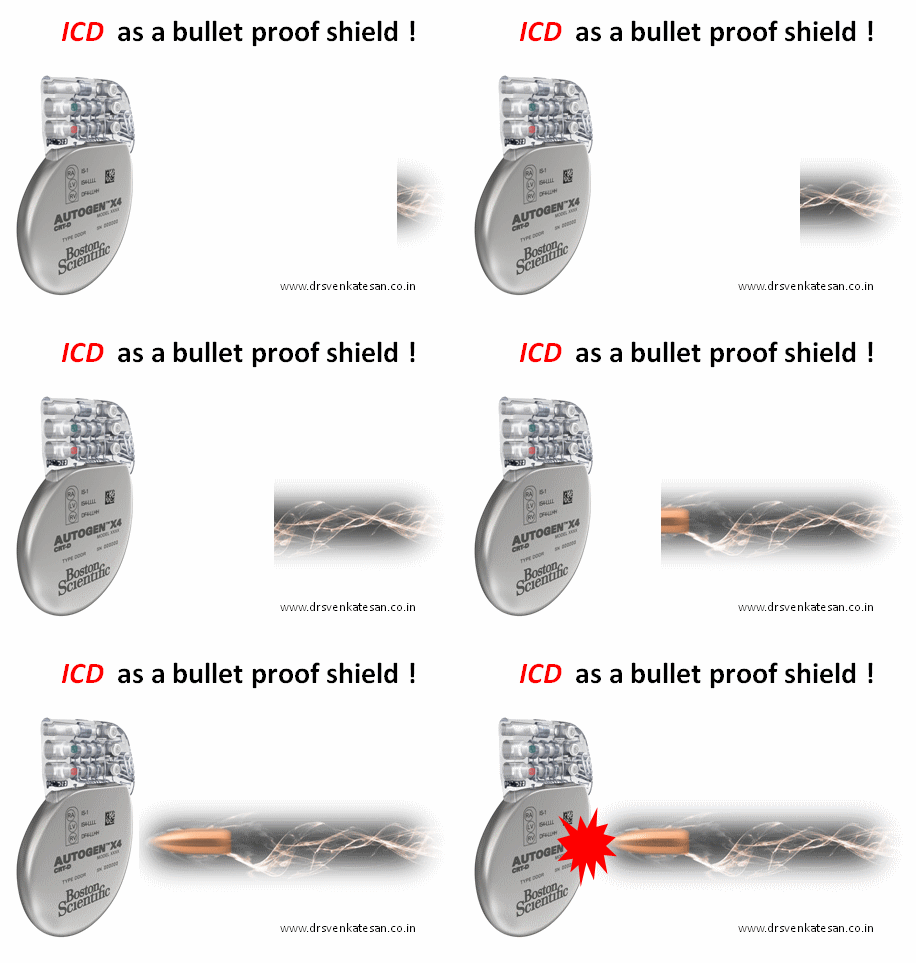
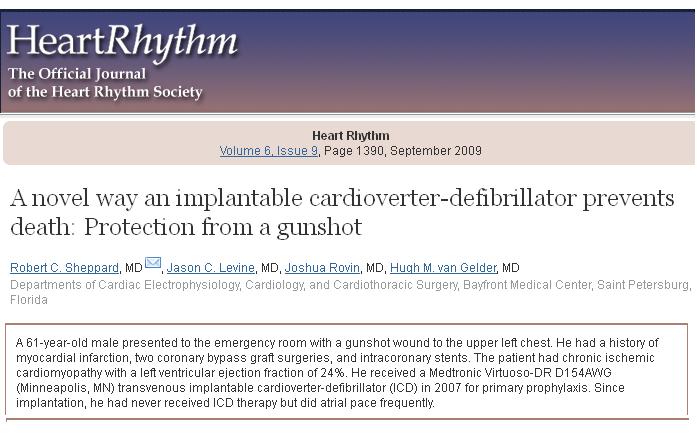
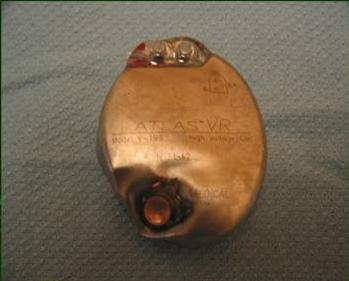
We live in curious times .As we  advance in our intellect and wisdom ,bullet firings (either cross or straight !) have become an important cause  for sudden cardiac death.Sometimes a life is saved by unexpected way in extraordinary circumstances. Here is a man  from Florida , whose life was saved by  an ICD not by shocking a VF . . . but by blocking a bullet

ICD acts like a bullet proof jacket


A case report from Heart Rhythm


Bullet proof ICD jacket saves life

Complete Heart  Bullet Block : The Aftermath

ICD_Shot_Bullet

It seems ICD is strong enough to stop a bullet !

Read Full Post »

When  a life leaves the body  silently in CCU , an  undulating  flat line in the monitor has a hidden scientific tale  to tell !


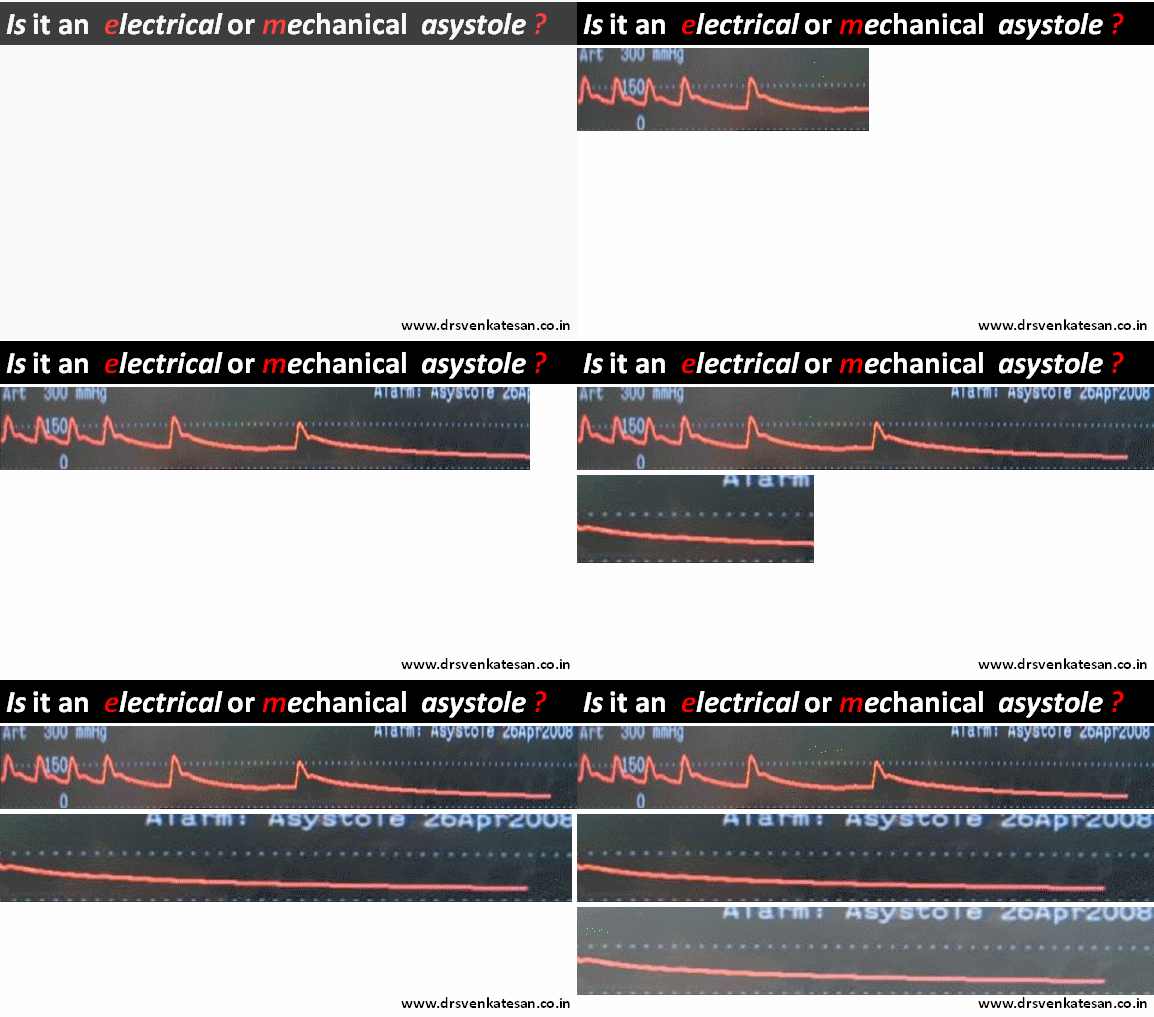
A  56 year old obese women died a instant death immediately after engaging the Left main ostium  after first injection of 5cc dye. The monitor showed only  a short pause, few sinus beats , a long pause , asystole and death . In the last 2 minutes of survival she threw a random wave forms of suggesting EMD . At any point of time she never showed any evidence for ventricular fibrillation . 1o minutes of intense resuscitation failed that included temporary pacing , repeated shocks  and ventilation.(ECMO /LV assist excluded)

asystole_bad_day_in_the_cath_lab_tshirt-p235709389664476041uye8_400

What is the mechanism of death ?

  • Is it electrical or mechanical ?
  • Acute mechanical stunning / the stone heart ?
  • Is it a primary electrical asystole ? (Acute sinus arrest or AV block )

Post hoc analysis of CAG did not show any significant clues except a tight distal left main.Apparently the catheter has triggered the event .( Or is it the  dye ? as some body suggested it as anaphylaxis  ?)

Even though we conveyed the message to the relatives,  it’s was an unexpected massive heart attack , obviously we were not convinced with our  uttering  ! Mind you , she had  normal LV function but had recurrent angina prior.

asystole ecg 004

Image courtesy modified from http://www.ijaweb.org 2012 for representation purpose only.

We know if cardiac arrest is due to VF, it tends to give us  at-least some time and sense. Further,the VF protocols are more clear and success rate is more .

There is always an issue of  fine VF vs  asystole.If the flat line is indeed VF , there is more chance of revival as we try to pump adrenaline to make the fine VF  into coarse one  and shock again .The sequence can continue few times.

It is well known  asystole has a  dismal outcome .Even among the asystole there is some hope* if asystole is purely   electrical . (Like Stokes Adams in CHB or electrolytic asystole like hyperkalemia etc ) .But if asystole is due  mechanical cause , death ensues in spite of prompt temporary pacing .

* Important note : We have this  common  form of  treatable  mechanical asystole .It is called cardiac tamponade .It always present  with extreme bardycardia and asystole. It is extremely  rare to see a tamponade to present with VF. A prompt needle tap will do the job .It is vital  to recognise this in cath lab as our efforts are rewarding .

I would recommend a hand held echo machine , to hang like a catheter in every cath lab , ready to screen unexplained cardiac arrests with zero delay !

Why some hearts respond with VF  , while others go for asystole  with acute coronary insult ?

  • A million Rupee question ! We are yet to find a legible answer .What is probable is  the the heart doesn’t  even have energy to fibrillate !
  • The underlying disease need to be so intense .In this case it was left main stenosis supplying a truncated LAD and LCX. We could also see it supplying twigs to RCA  suggesting it to be a total occlusion .
  • So ,when a  “physiologically single” coronary artery that precariously  supply the entire heart is suddenly insulted the heart behaves violently with runs of VT/VF. Our ignorance is complete when we realise  the heart  can do the opposite as well .It does not react at all , goes for a deep slumber and result in electro-mechanical sudden death.
  • It is expected , in acute mechanical  deaths one may encounter flash pulmonary edema if the LV alone gets stunned. However , if both right and Left ventricle come to standstill in a synchronised sudden fashion , lungs will be as silent as deep sea . We believe this is what happened in our patient and it can be logically correlated  as  the critically narrowed left main was supporting the  RCA  as well.

Final message

Sudden cardiac deaths  9 out of 10 times is electrical . Majority  of them is  due to fibrillation. Next comes the electrical asystole ,Rarely (is that really rare ?) an ultra fast  sudden death due to mechanical asystole (Non -Tamponade ) is  possible , as experienced in our patient .

These mechanical asystole  are yet to be decoded.Whether it is a form  of Acute stunning , electro -mechanical uncoupling or mechano electrical standstill is not clear.


Read Full Post »

Inserting an ICD  for  DCM  may a be great therapeutic success  for the physician  as well as the patient . But there is one big truth hidden behind the statistical screen.

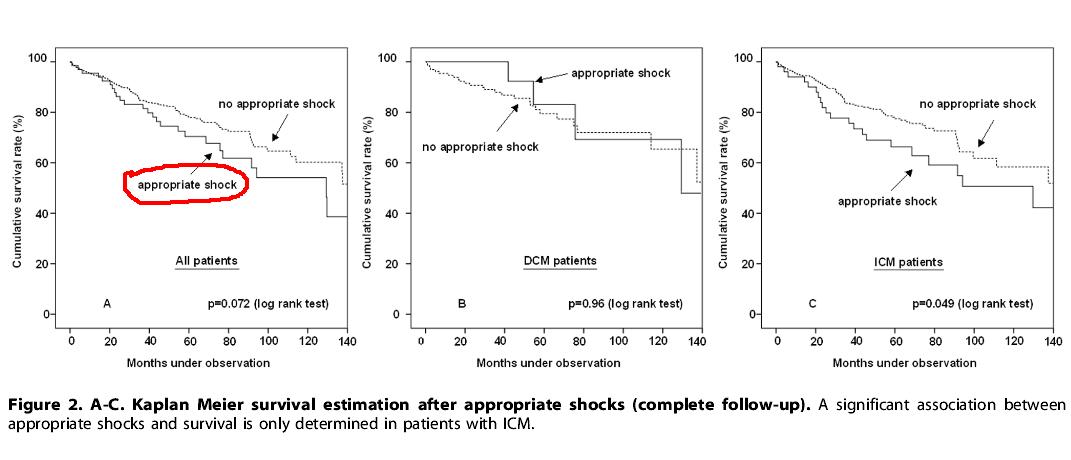
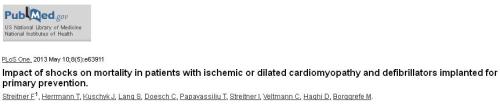
Following  study  provides dramatic data from Maanhiem in Germany in about 561 patients who had ICD .The long term patient outcome after appropriate shocks were much worse  than those without    shocks .This was more pronounced in Ischemic DCM .

appropriate and inappropriate shocks ICD

Source : Streitner et al ,University Medical Centre Mannheim, Mannheim, Germany PLoS One. 2013 May 10;8(5):e6391

The fact that these patients continue to throw VT , some thing is wrong in the cellular  milieu or a fresh scar / fibrosis / ischemia is progressing .Further , the VTs and the  subsequent  shocks  set in temporary  hemodynamic instability .We have evidence , EF can be depressed for days  worsening the long-term out come.

While it is easy  to blame it on natural course of DCM , there are  solid reasons to believe  , shock induced myocardial damage is definitely contributing to this  excess mortality.

One important  clinical tip is to screen  all  these so called Idiopathic DCM  patients  who  had appropriate shocks.  They should be monitored for fresh signs of any systemic illness  , like a  connective tissue disorder , chronic granulomatous lesions  like sarcoid etc .To our surprise  some specific  myocardial disease may unmask themselves in the natural history. Identifying them may offer a dramatic cure .

Final message

Some where along our EP mind-set  we are conditioned to think  , as along as there is an ICD in situ and it appropriately  shocks, every thing is bliss ! Blame it  on semantics . The  word “appropriate”  inappropriately  soothes  our nerves.

The fact of the mater is , every appropriate shock is a  grim reminder  that the heart  in question  is restless electrically and VT continue to emanate  from diseased  myocardium  . It could  mean either the LV   is destabilising  , or the original  disease  is   progressing  or a new disease  is evolving .

Mean while, paradoxically , inappropriate shocks give us a quixotic comfort , since the  heart is not really  throwing any dangerous arrhythmia, after all it is  the device related  false alarm   that  could be easily  reprogrammed!

Reference

ICD appropriate and inappropriate shocks

Read Full Post »

Current guidelines advice us to wait for 40 days following STEMI to implant ICD in most high risk patients.

Why this  cool off period.? *

  • Essentially  we are waiting for the Infarct healing process to be completed.
  • By this time electrical stability may be restored. The  risk of VT/VF  declines per naturalis.
  • LV function recovery  is possible. As stunned and hibernating myocardium resumes its mechanical function and patient might  jump out of the MADIT-2  cutoff point. (EF< 30%)
  • Introducing  ICD very early  after STEMI may be a myocardial irritant and that it self can generate  arrhythmias.
  • There is a possible interference by the leads in the physiological remodeling  process.

Final message

So the cool off period is  not only to reduce  the unnecessary  ICD implantation  but also to  avoid lead related issues .

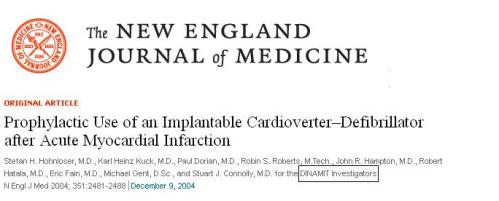
*  This 40 day rule is based on one  large study from Germany. (DINAMIT, 2004  ) . However  few believe  the rule is not absolute. There can be individual   exceptions in high risk patients with critical LV dysfunction .

Other  wise   . . . How do you digest  a death occurring on  35th day  in a patient  who is waiting for an ICD scheduled one week later ?

Reference

DINAMIT trial ICD nejm

Link to  ACC/AHA  Guidelines for ICD Implantation 2013

New development

How to bridge the 40 day gap in really high risk post MI patient ?

We can’t keep him in CCU. Here comes the role of WCD (Wearable cardiovertor defibrillator.) Life vest is  from Zoll . WCD can act like a bridge till the 40 days when the patient becomes eligible for ICD.

http://lifevest.zoll.com/


Read Full Post »

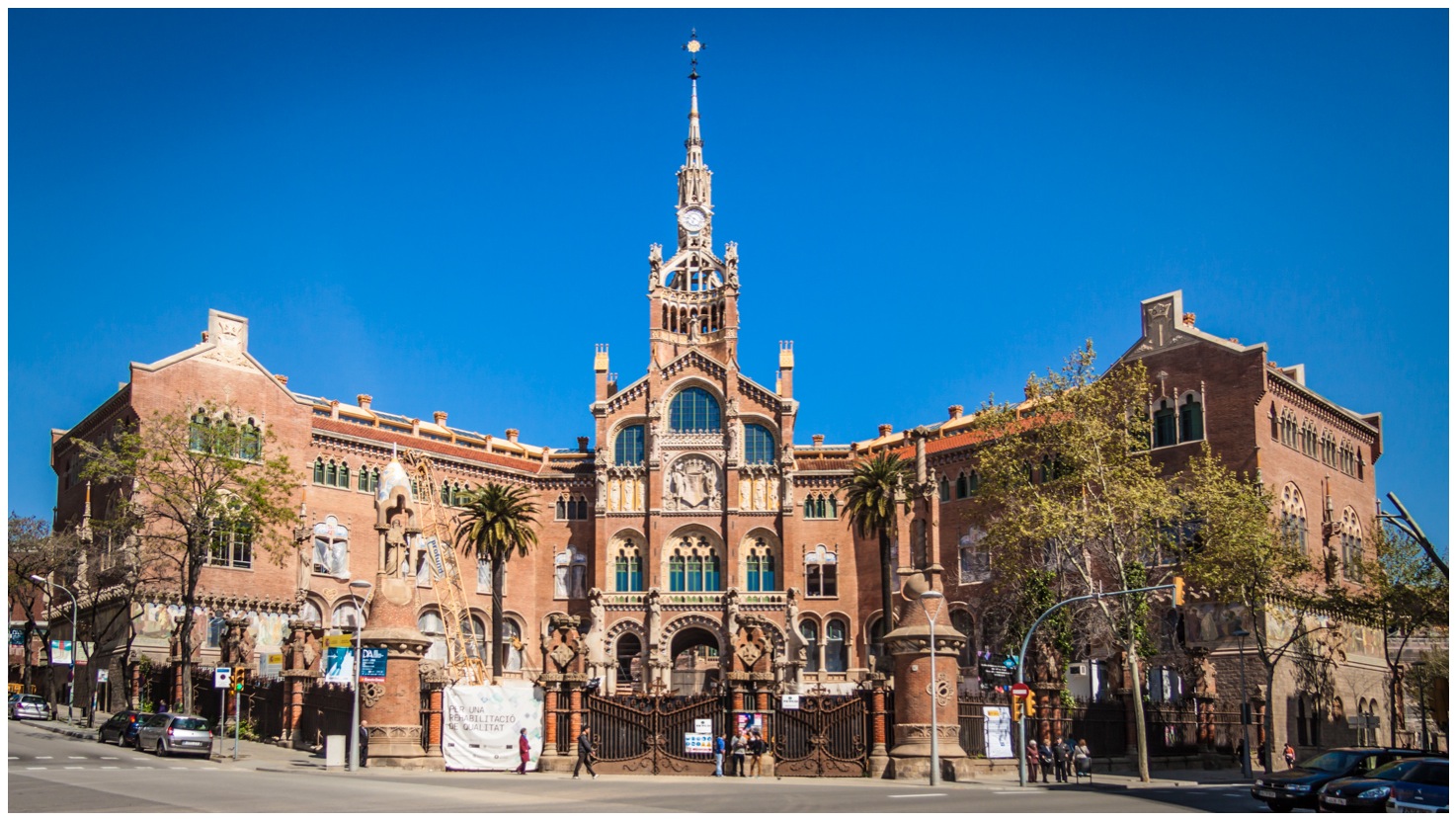
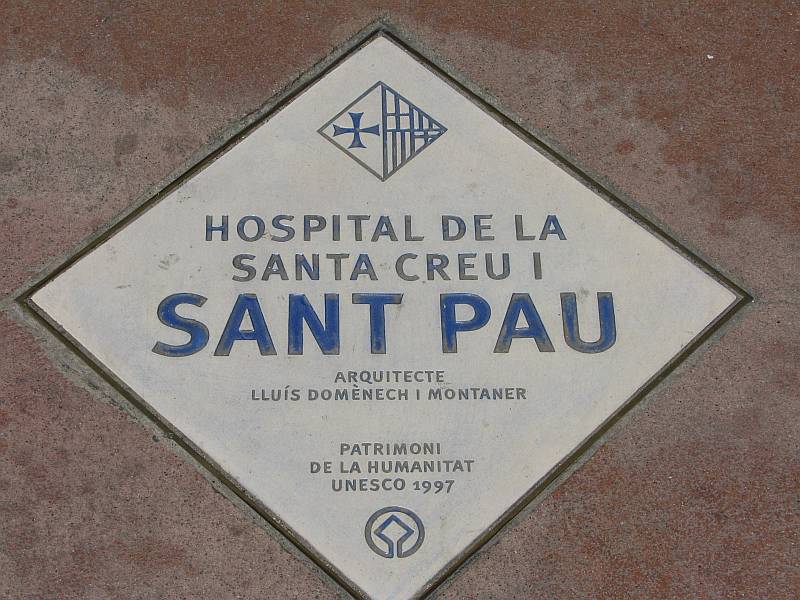
One of oldest hospital  in the world , is now an  UNICEF heritage site. Santa Creu , Sant Pau original hospital built in 1400 AD rebuilt in 1900 by Catalonian modern architect Montaner.

sant pau hospital barcelona unicef

Architecture by Lluís Domènech i Montaner

sant pau hospital barcelona

inside-hospital-sant-pau-in-barcelona

sant pau hospital unicefReference

Hospital de Sant Pau

Read Full Post »

One of  the hottest debate in  the recent  world  cardiology forum in Barcelona WSC 2014 , was  about  how to tackle incidentally detected non IRA lesions  during primary PCI.

So far , the dictum is , one should not meddle  the non culprit lesions unless demanded by hemodynamic instabilty .The next option is to do a staged PCI for these  lesions. (Few days later). or just forget about these lesions unless they are critical.

Now new studies are appearing that suggest  doing all  “do-able” lesions must  be stented  in one go ! This is obviously inviting trouble .The worry is not  in the concept but with the  dubious  track record , fragile guidelines and potential  ethical debacle of the cardiology community !

Stent “As you want and as you please”  has  already  invaded our mindset in  the chronic coronary  scenario. Now in 2014 , we want more freedom  in acute coronary  syndrome as well ! We  can’t ask for a  referee less game of soccer !

We clearly know coronary  arteries  are to be respected and do not deserve indiscriminate stenting  especially  in ACS  where  the early hazard is  more.

A recent story  which I heard  was a  height of  futility . A semi experienced cardiologist in the suburbs of a big southern Indian city , opened  successfully a LAD  which was the IRA  and  subsequently caused  acute  LCX  STEMI , while trying  to tackle an insignificant  non culprit lesion due to procedural mishap ! (Some suggested migration of LAD thrombus !)

What a pity , when we are supposed to  arrest the culprit, in reality it is simply  chased  down to another territory !

 Here comes  unique  advantage of thrombolysis , you need not locate  the culprit  artery the drug chases it wherever it is , even if they are  multiple ! Read in this link :

 Final message

We call it as fate when  thrombus suddenly occlude  a coronary artery  and the IRA becomes  a  culprit . We  need not compete with fate and end up creating  potential new culprits.Let the  sixth sense prevail over the five .Use judicious discretion when trying to stent muti-vessel  CAD  during PCI. Please  realise ,the concept  of  multivessel stenting during pPCI is not wrong .  How we interpret is the issue !

There is no excuse  to indulge as you like  , simply because your intentions are good !


Read Full Post »

« Newer Posts - Older Posts »