Feeds:
Posts
Comments

Archive for the ‘Uncategorized’ Category

A Cardiologist will never accept  the diagnosis ,  if a technician reports   a  ECG as normal in a  patient with chest  pain   . . .

While , the same cardiologist  gleefully  accepts  an  echocardiogram   done by a technician  and  treats  the patient without  verifying the veracity of the finding !

Why ?

Some where along the cardiology training  , we have been made to believe Interpreting  Echo Images does not require serious medical knowledge . . . but we strongly believe  ECG  cannot be read by technicians however well they are trained .(In-spite of the fact , Echo images are highly dependent on the person who does it , while ECG wave forms are  totally independent of the person who record it ! )

ECG, still has a  prestigious place  in cardiologist’s mind ,  while Echo is often considered  an inferior  Investigation.  Many of us consider ECG interpretation  as a  brainy work while Echo image acquisition and  interpretation is perceived a dumb job* !

Lastly , probably most importantly ,  performing  Echo  is   a time intensive process for the  present day cardiologist  who’s hands are tied with  catheters and  guide-wires  .He has little time for  the meanly echo . .  . hence  ready to compromise on the quality .

* With due respects to all non invasive cardiologists (That includes the author !)

Final  message

I would think it is  fundamentally inappropriate  for technician  to  report Echocardiogram (Of-course they may record it  ) . Unfortunately , for some reason this practice is continued  in many  parts of world .

Read Full Post »

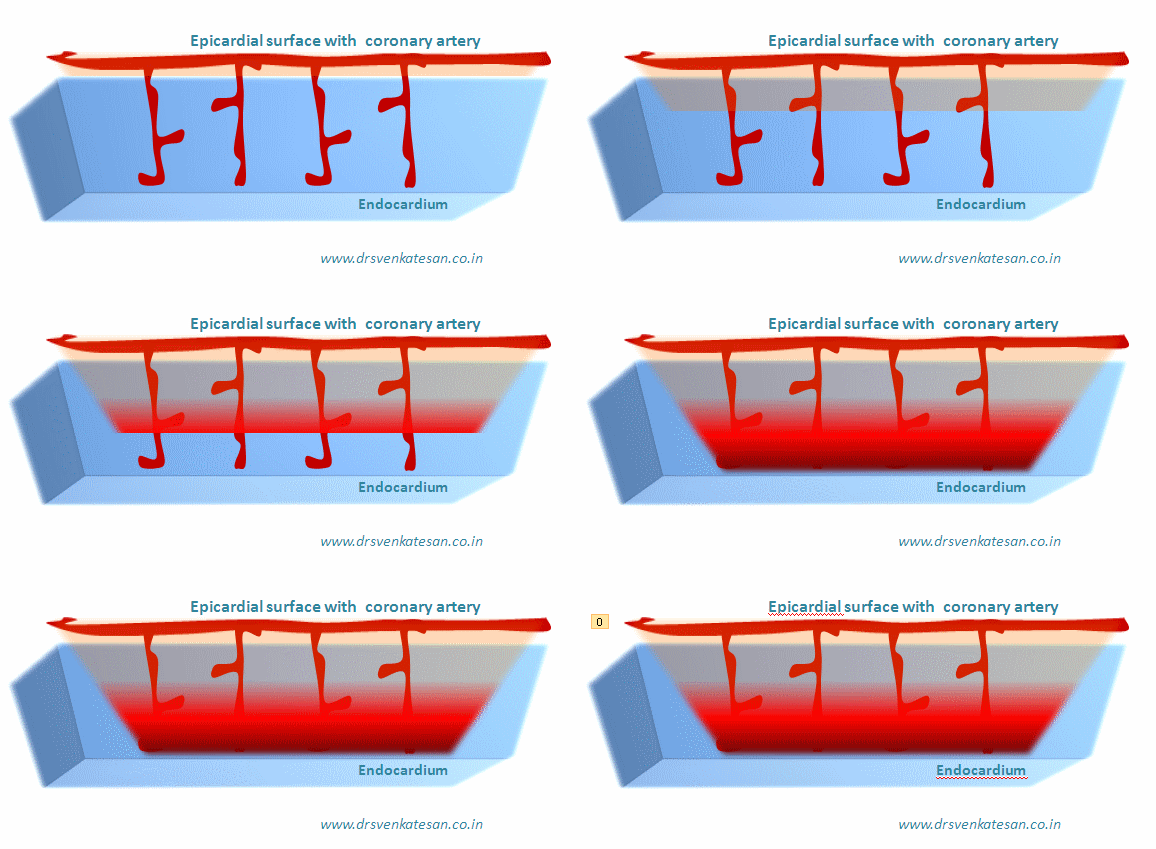
Even though multiple mechanisms operate  the major mechanism is due to augmentation and  diversion of blood flow towards sub endocardial region* which is  main area of ischemia in most patients with Angina .
subendocardial-blood-flow
*Beta blockers  does this by smoothing   the  myocardial contractility there by  reducing  trans-myocardial gradient. The coronary arterial perforators which traverse from epicardium to endocardium gets less squeezed and promotes sub endocardial perfusion. 
Link to  a related article from this site

Read Full Post »

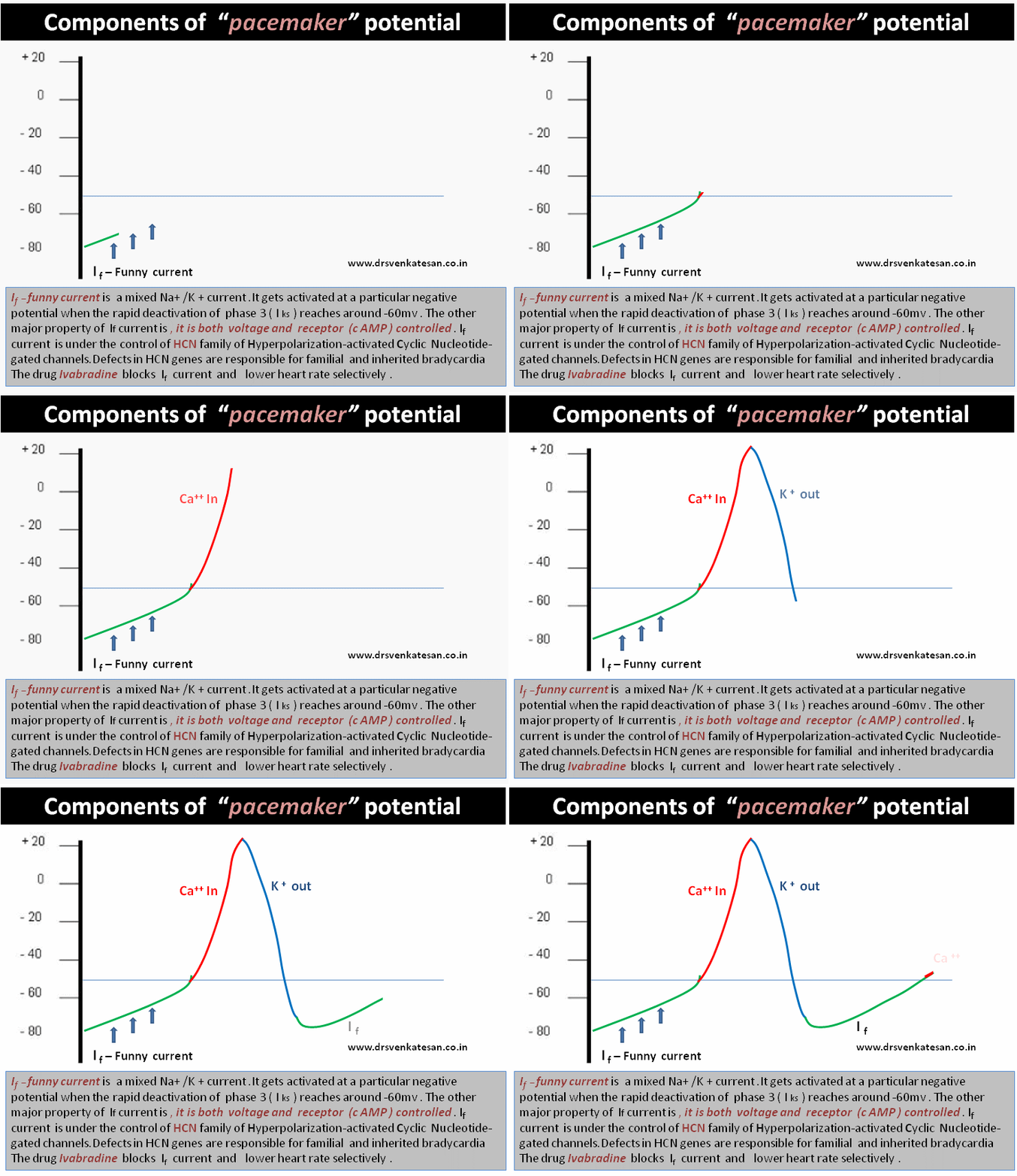
Pacemaker current is   strangely  referred  by physiologists  as  funny current (I f ) . I am yet to find the exact reason .  This is the current  that  sustain  our life right from the day 22  of  embryonic life when the  cardiac jelly beats for the first time.   SA node  solemnly  follow our  entire life  before  making  a  bid-adieu !

pacemaker  potential sa node 5


pacemaker current if funny current poential 002

pacemaker current if funny current poential 003

What is contribution of  If  current in the overall Pace-making  activity ?
This  has not been quantified . The fact that ,  Ivabradine induced  If  current  blockade does not result in serious bradycardia indicate  , SA node has alternate reserve currents as well . ( SA node  is a such a mystery  structure , it would never be a  surprise , if we  find many more  “not so funny”  currents !)

Read Full Post »

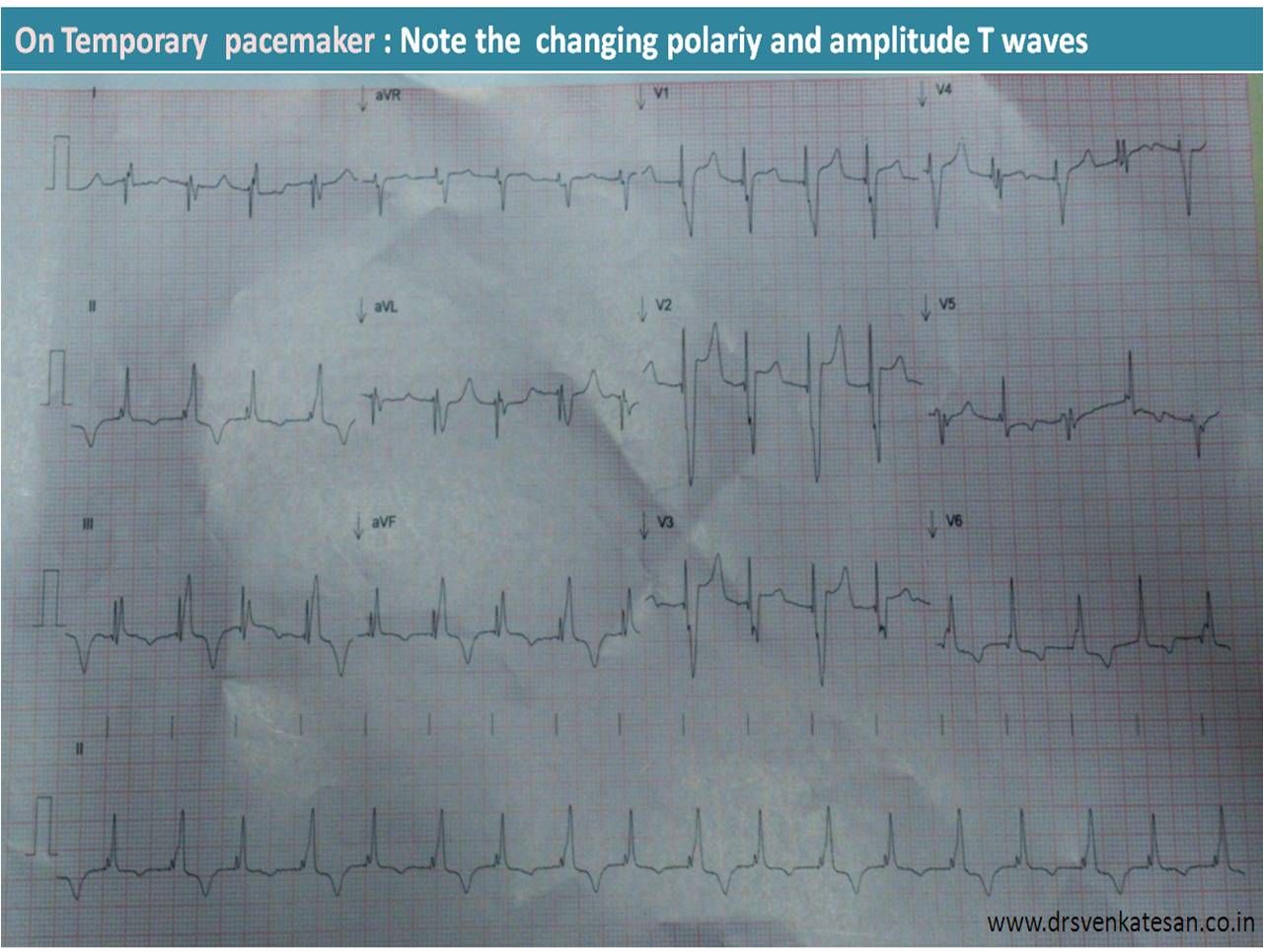
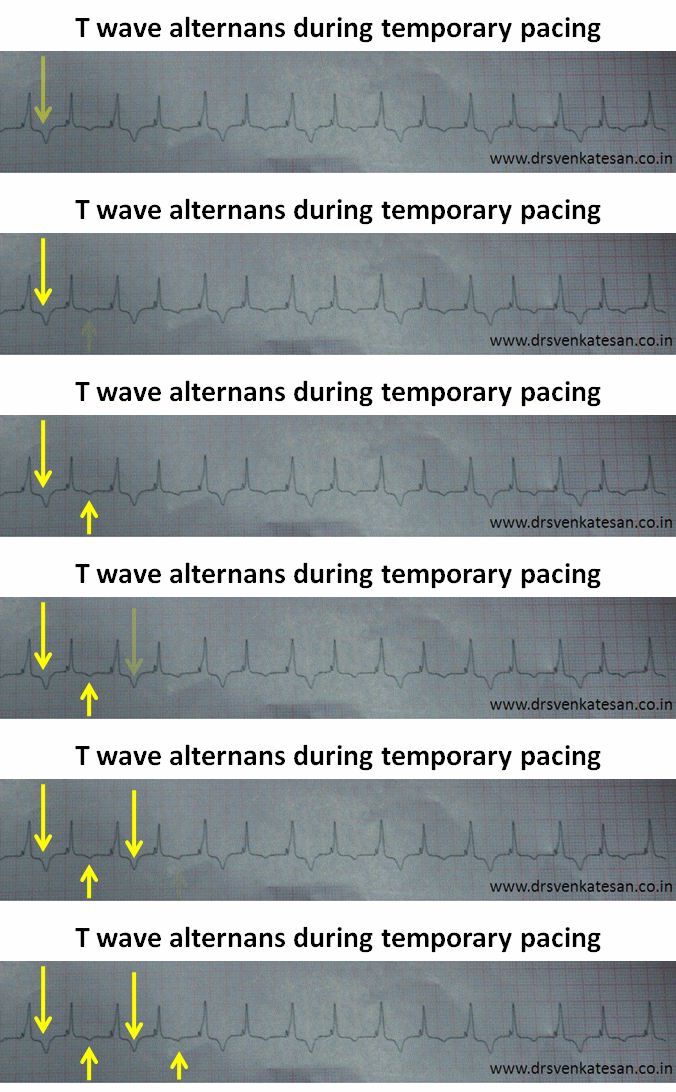
It is believed  T wave alternans  is a marker of impending ventricular fibrillation. Though it is not applicable in every clinical setting it is indeed true if we observe T wave alternans in an acute ischemic setting .Here is a patient with  ACS and inferior MI who developed T wave alternans after temporary pacing.

T waves alternans torades de pointes 3

t wave alternans

T waves alternans torades de pointes

went in  for a chaotic  T wave rhtythm  and ended up in VF that  required s shock.T wave  alternans is other wise known as repolarisation alternans .

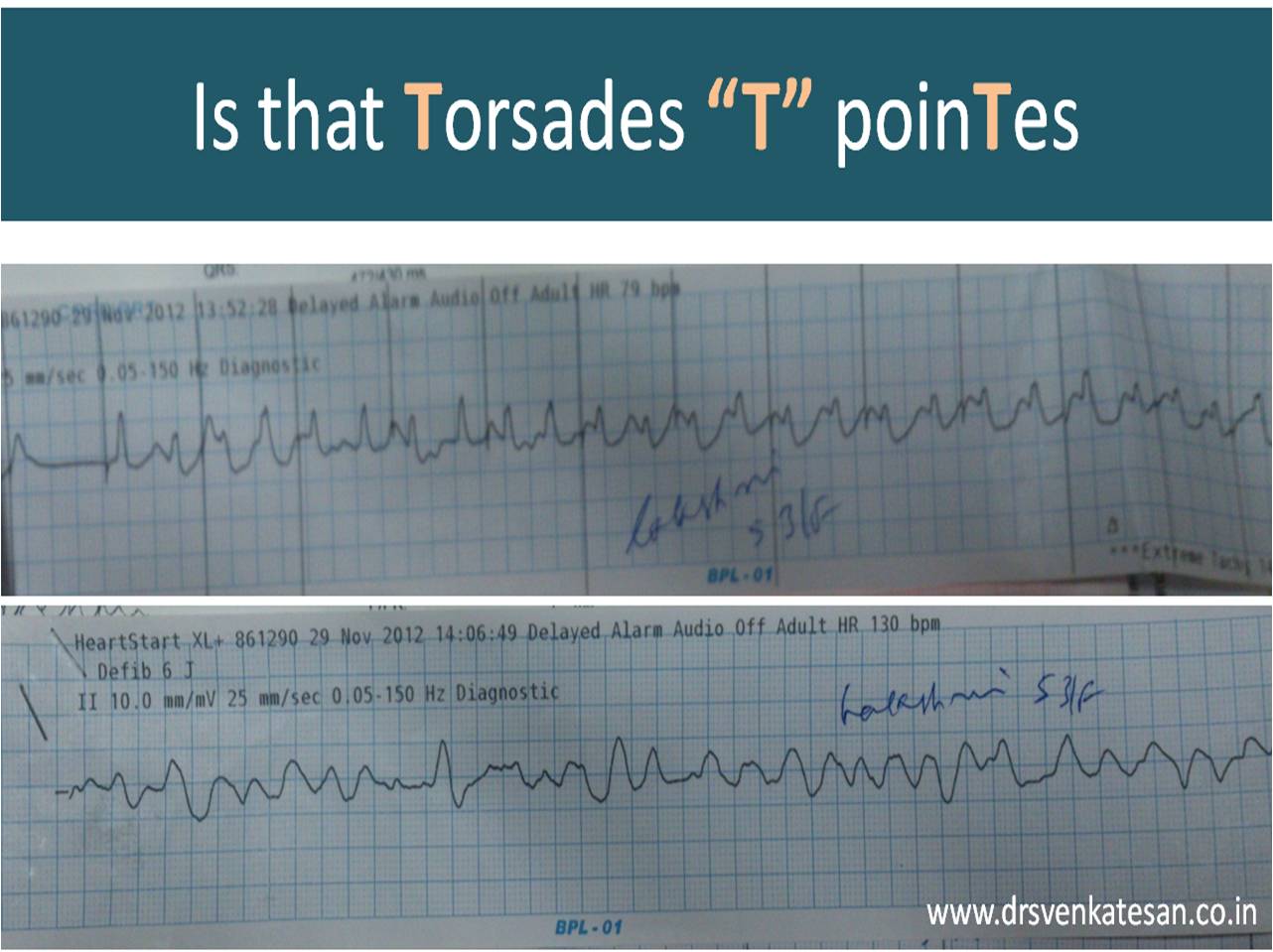
Twist dance of Heart

Torsedes is twist around it’s axis.   Any   ECG wave  can twist in it’s axis .If T wave alternans  becomes gross it will twist 180 degrees   .Once this happens the heart can go for  fibrillation any moment !

Final message

Extreme form of T wave alternans would result in  complete twisting of repolarization vector which is a  harbinger of ventricular fibrillation

I wish  this can be referred to as Torsades  “T” pointes instead of  Torseades “de” pointes


Read Full Post »

Ventricular tachycardia is a common cardiac arrhythmia. The significance of which can be very dangerous to relatively benign  depending upon the etiology and underlying heart disease . The ECG during VT is rarely useful to identify the etiology .Often times  ECG after reversal will  throw more light .

What are the ECG clues one should look for once VT is  reverted ?

  • Any evidence for old MI
  • Low voltage QRS/ LBBB/RBBB may indicate DCM
  • LVH -HOCM features
  • VPDs – Multiple , LBBB morphology / suggest  RVOT  VT
  • QRS slur or notching  indicating scars
  • Epsilon waves indicate  ARVD
  • RBBB pattern would  suggest  Brugada
  • Prolonged QT interval
  • Tall  T waves/ U waves /  Inverted  T -and other electrolytic abnormality.
  • Delta waves would indicate anti-dromic tachycardia.

Read Full Post »

We are taught in  medical schools  early in our career ,   ventricular premature  depolarization (VPD ) takes  LBBB morphology if it arise from right ventricle , and  RBBB morphology if it arise from left ventricle .This is a rough rule of thumb.

Why this rule is  unreliable ?

VPDs have a focus of origin—–a short circuit——and an epicardial  breakthrough . All these together influence the morphology. Within  the left ventricle , a deep endocardial focus  can  behave  vastly different  from superficial epicardial focus  . The  course of VPD is influenced by the myocardial status ( scars etc ) . Further,  the electrical  properties of  interventricular septum is shared  by both ventricles .

  • Generally – LBBB morphology  has  more localizing value .
  • Most RV focus have LBBB morphology (but not vice versa!)
  • LV focus can either have LBBB or RBBB

What happens to  a VPD  arising from  interventricular septum ?

IVS is  not only shared by both ventricles , it does  not have  true  epicardial  surface  (Both side  bordered by endocardium ) In most septal VPDs , breakthrough occur on either side of the ventricle  . However , It  keeps trying  to break through  epicardial surface  !  .  Hence , septal VPD  is like cat on wall situation .So the morphology varies quiet frequently.Further , the VPD can capture  the specialised conduction tissue occurs  more commonly with septal VPDs. This can alter both the width and morphology of QRS.

Read Full Post »

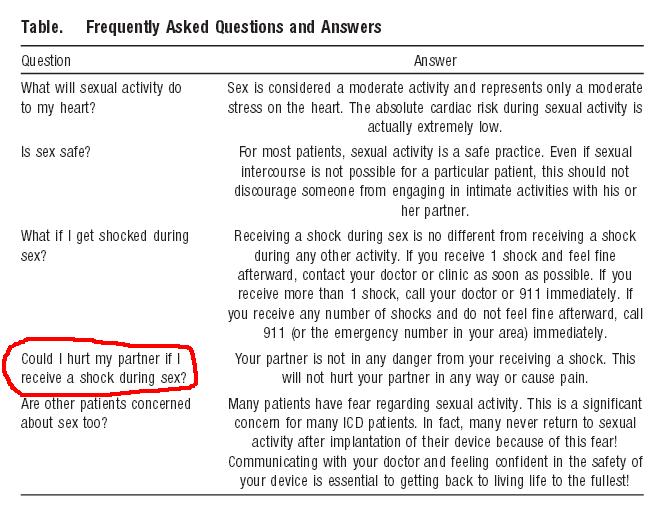
Modern human life is driven by technology  . We are gradually taken over by gadgets .Heart is not an exception . Implantable cardiovertor defibrillator (ICD )  is major innovation  where in , an  electrically  wayward heart  is brought under control  by series of automatic shocks . One of my patients with old MI and significant LV  dysfunction for whom ICD was an option  taught me a lesson in physics  . During  counseling ,  he was asking me about  the quality of life issues etc .
ICD  shocks  during sex 2
First,   he wanted to know  how  stressful  the  sexual acts  are ?  . . .Then he  surprised me with this  question .  He wanted to know ,  the  risk of  developing a VT/VF  during the act and  will the ICD  shock  his spouse as  well ?  That was a real  cracker of  a  question  I thought .   I had to do  a mini  research   and found that  these are  low energy shocks (30 Joules)  and transmitted electrical injury is a non issue  .
I realised   then  . . .  we live in a era  where   physicians often get educated from their patients !
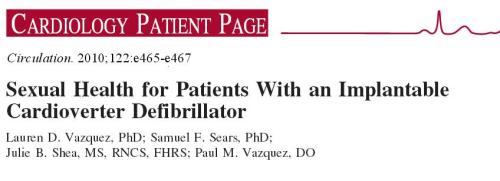
Here is the  FAQs on ICD from the patient pages of circulation . With  due courtesy I  reproduce it here.
ICD  shocks  during sex
Final message
ICD shocks are  low energy shocks delivered  Intra cardiac ,  and  rarely  reach the surface  ,  hence has little risk for electrical injury  for those in contact.
References
1. Vazquez LD, Sears SF, Shea JB, Vazquez PM. Sexual health for patients with an implantable cardioverter defibrillator.

2.Steinke EE. Sexual concerns of patients and partners after an implantable cardioverter defibrillator.
Dimens Crit Care Nurs. 2003;22:89–96
3. A  review article on the  broad issue.
sexual activity in cardiovascular disease  circulation 2012

Read Full Post »

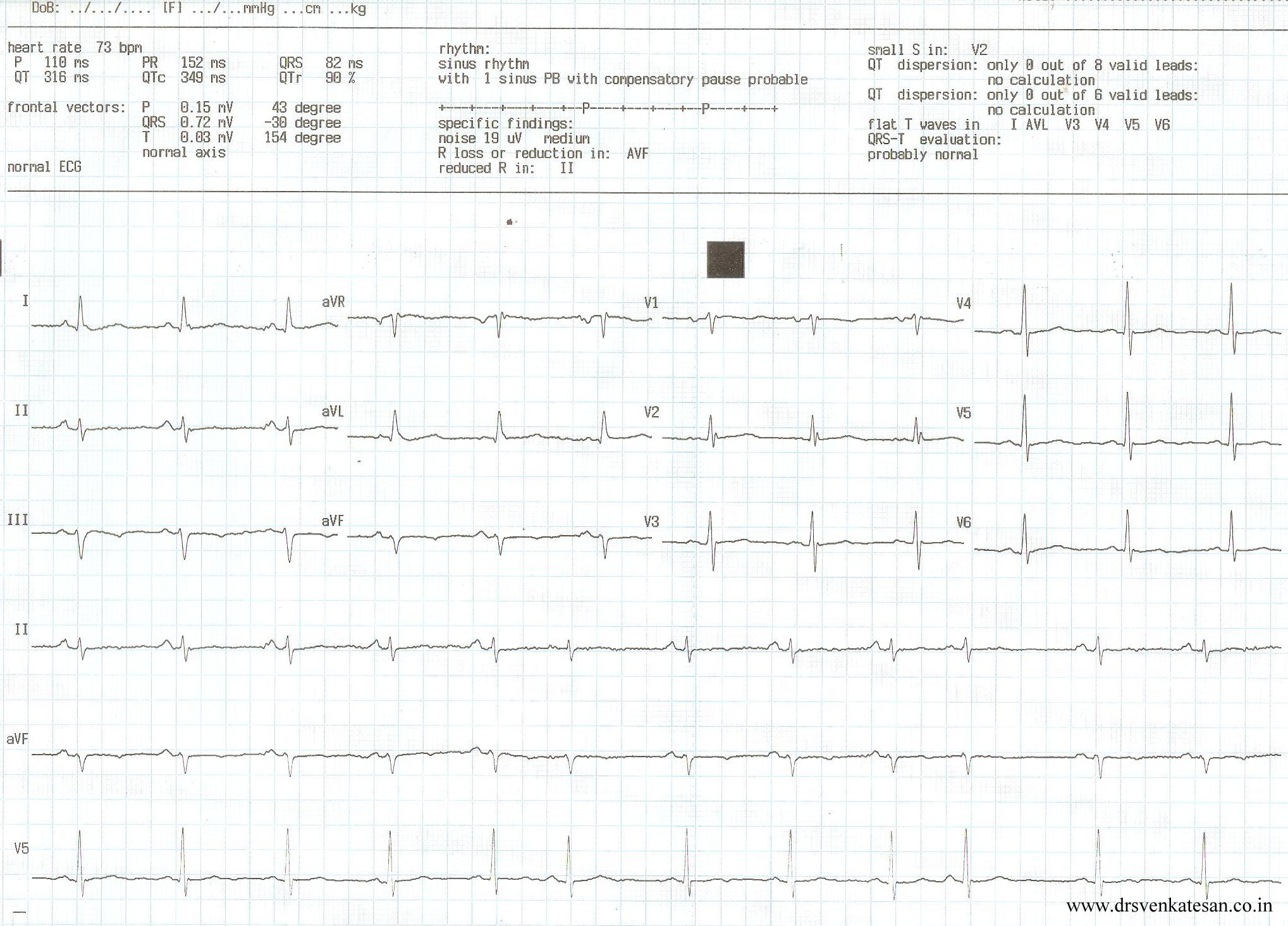
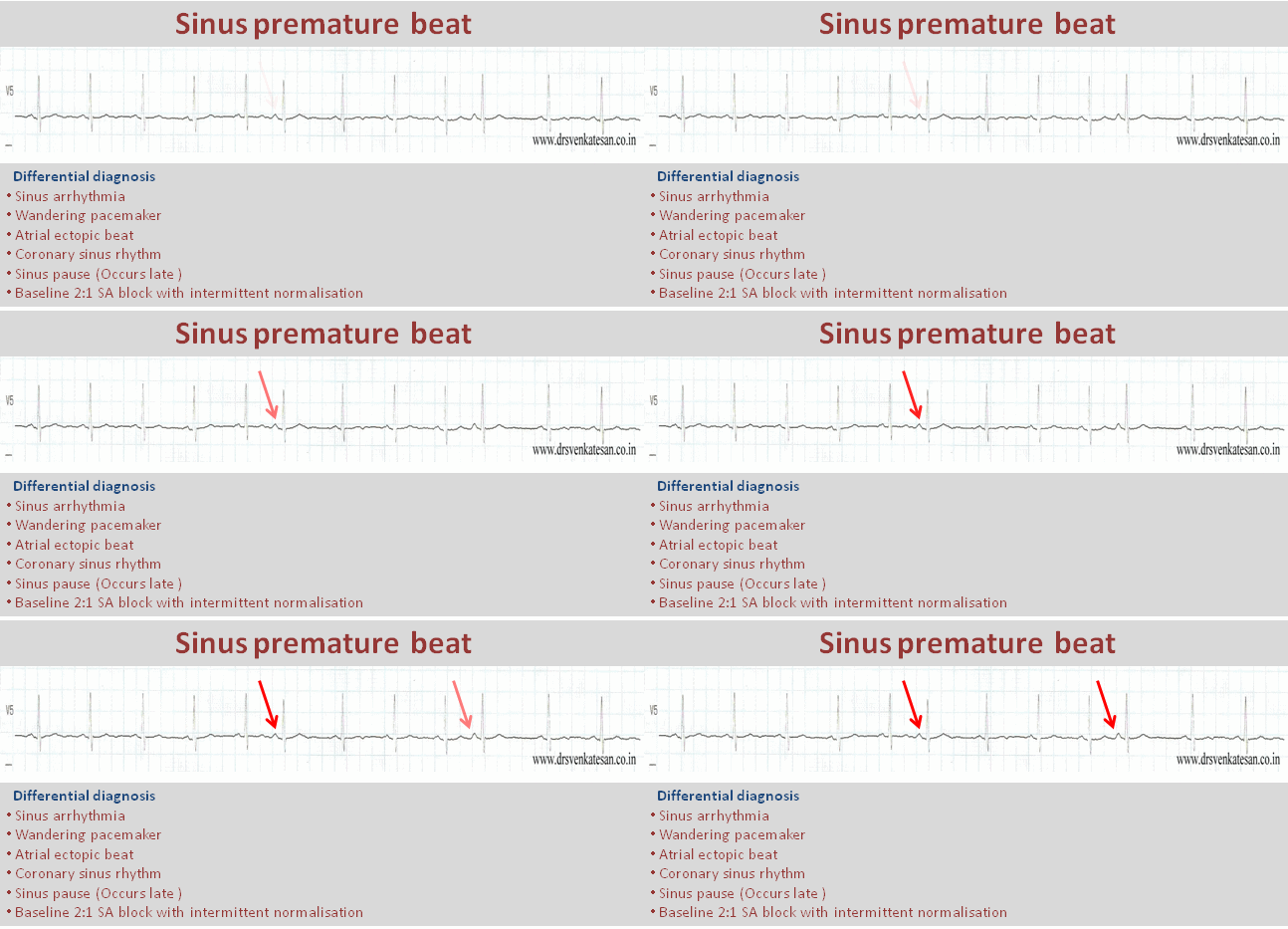
This is an  ECG which  I reported  yesterday in my clinic . I thought it was a  near perfect example for sinus node premature beat .

sinus premature beat spb 2

(Of course I need to explain  why the  P morphology  slightly  differs )

A  sudden unexpected  QRS  complex is often called as  ectopic beat . If it occurs prematurely (ie earlier than anticipated )  it is called as premature beat. If it occurs late it is refereed  to as escape beat .Please note the difference is not absolute .

Sinus node is a dramatic bundle of energy with divine powers that  drives rhythm of life !

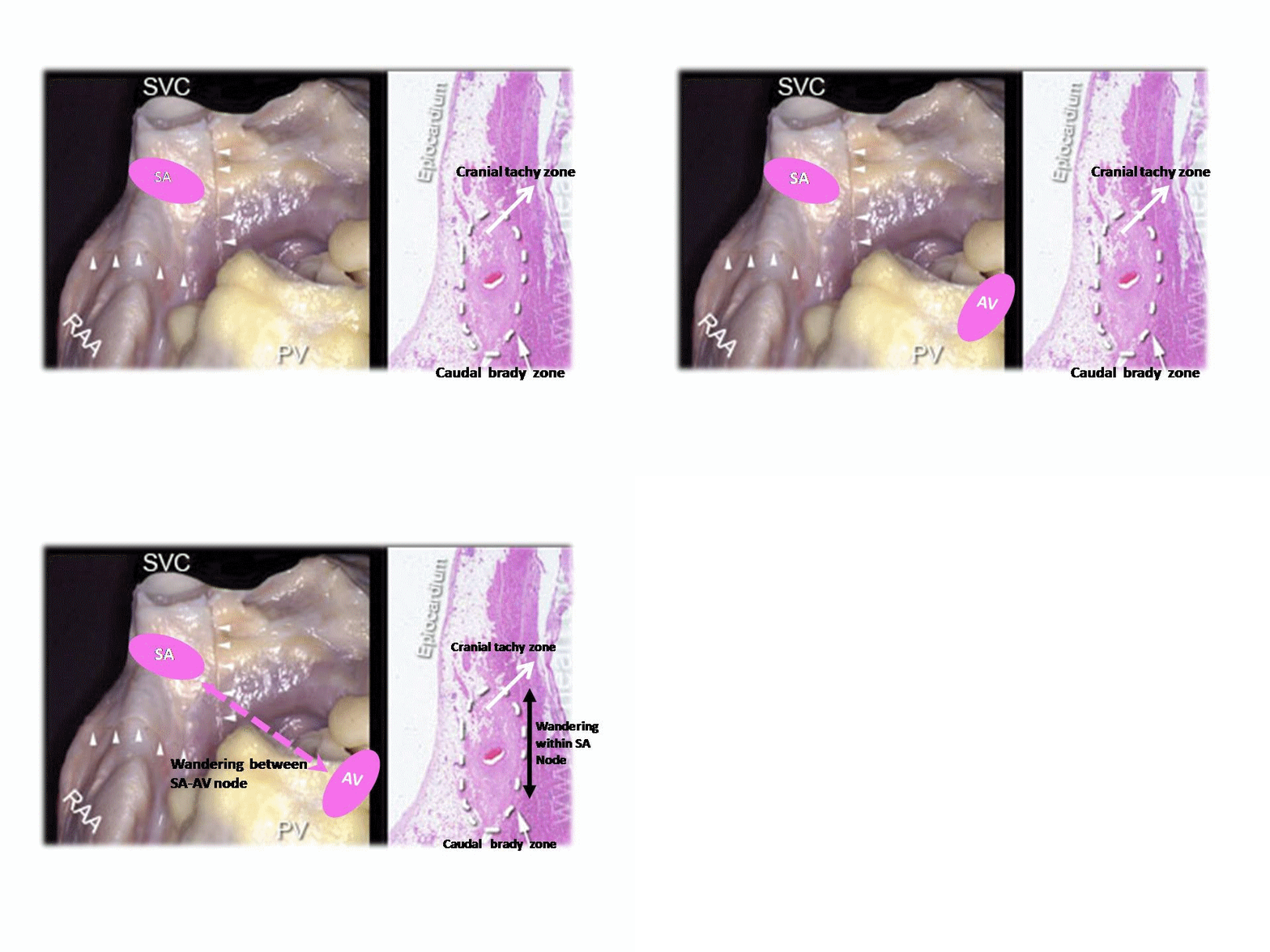
The pacemaker cells are arranged in a compact fashion with  differential properties from cranial cells firing fast and caudal cells little slower. The neural control is under constant Neuro/electro/humoral  servo control mechanism.It is well known the pacemaker shifts it’s firing location within the SA node in fairly regular fashion .The entire SA node has rich adrenergic and  cholinergic  innervation , with  a dominant control by the later . (This is  why the intrinsic heart rate is  in the tachycardia  range (around 116 )  when SA node is denerved  pharmacologically )

wandering-pacemaker

sinus premature systole spd sinus node ectopics002

SA node ,  being  a complex structure ,  it is not surprising to note  few beats to fire  slightly late  or  prematurely.If it occurs late it is called sinus pause ,  if it occurs early it is sinus premature beat , if  both occurs  interchangeably  we refer it as  sinus arhhytmia. (Read  about sinus pause here)

What is the clinical significance  of   SPD ? (Sinus premature depolarisation )

It is a  very benign entity that it is  merely an  academic fascination . By  stretching my  imagination  I  can  correlate  it  with few possible  clinical issues.

  • May be it has potenital to trigger a  SA nodal reentry tachycardia  or In appropriate sinus tachycardia/bradycardia.
  • It may be imporatnt in sinus node modification process.
  • However ,the main issue is  thee  cardiac physicians  in their enthusiasm should not mistake it for some serious  cardiac arrhythmia !

Related article

https://drsvenkatesan.wordpress.com/2009/04/14/can-premature-ectopic-beats-occur-in-sa-node/

Read Full Post »

Q waves are  neither  sacred  nor sinister waves . It represents   either of the  following .

  1. Electrical activity that goes away from the recording electrode.
  2. Or whenever there is a  electrical insulation or hurdle that interrupts the flow  of current  towards the electrode ( and if it is sustained )  it  can result in q waves (Minor interruption produces  a notch or  slurs . Please note a major slur becomes a q wave equivalent  )

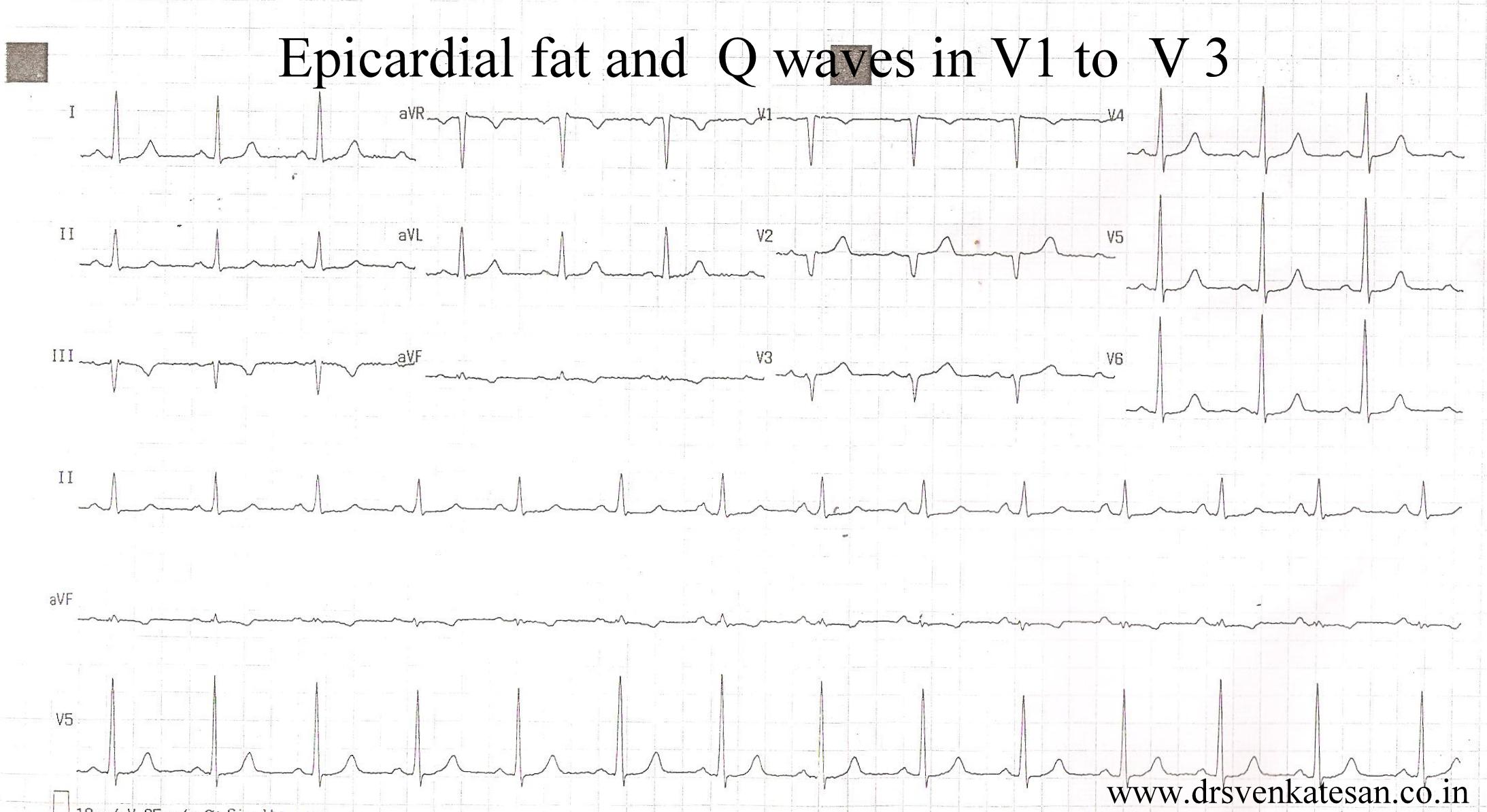
Here is young women of 42 years with  a diagnosis of  old  anterior MI for   over 5 years ( Getting a dedicated care from a cardiologist!  The prescription included Imdur/Betaloc/ Statin/Clopidogrel and Aspirin )

This was the ECG . It was very convincing for  old ASMI.
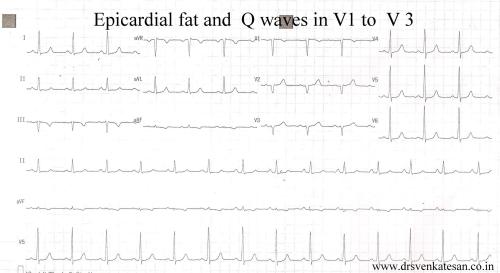
epicardial fat and poor r wave in v 1 v 2 v3 q  waves

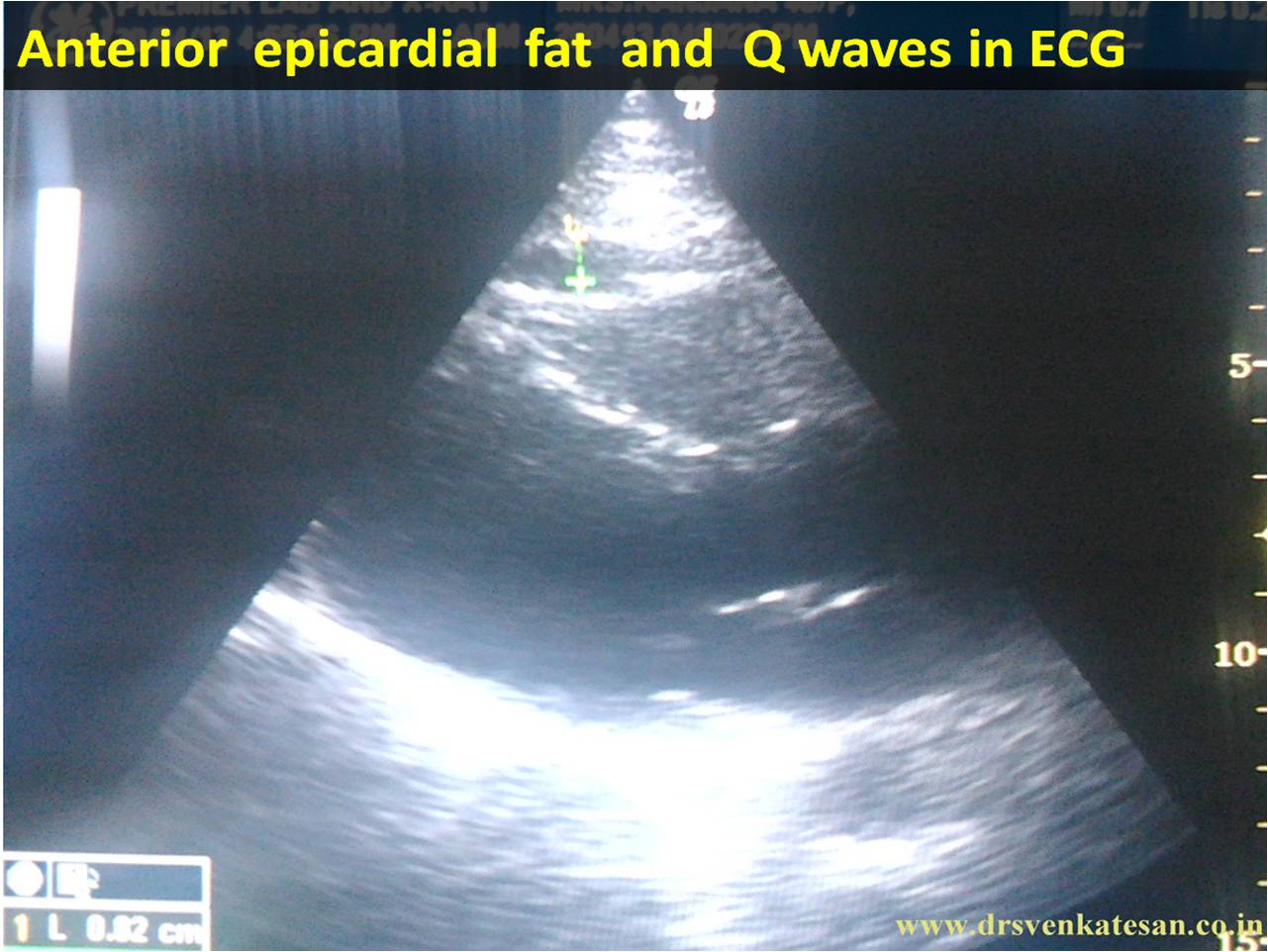
It  happened ,  I did an echo for her .
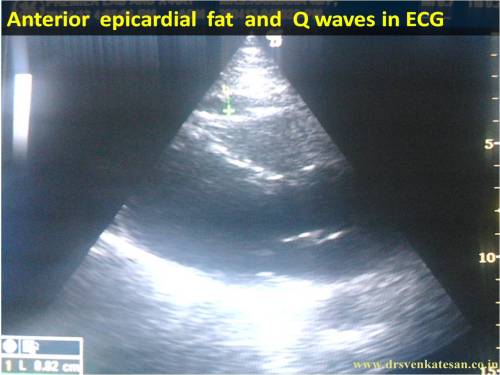
epicardial fat and q waves in ecg pesudo infarct non infarct 2  q

She lacked wall motion defects even after a meticulous search .  Instead   she had a   good layer of epicardial fat measuring 9 mm .That was more localised in  anterior wall extending little to LV apex.Her EF 65 % .

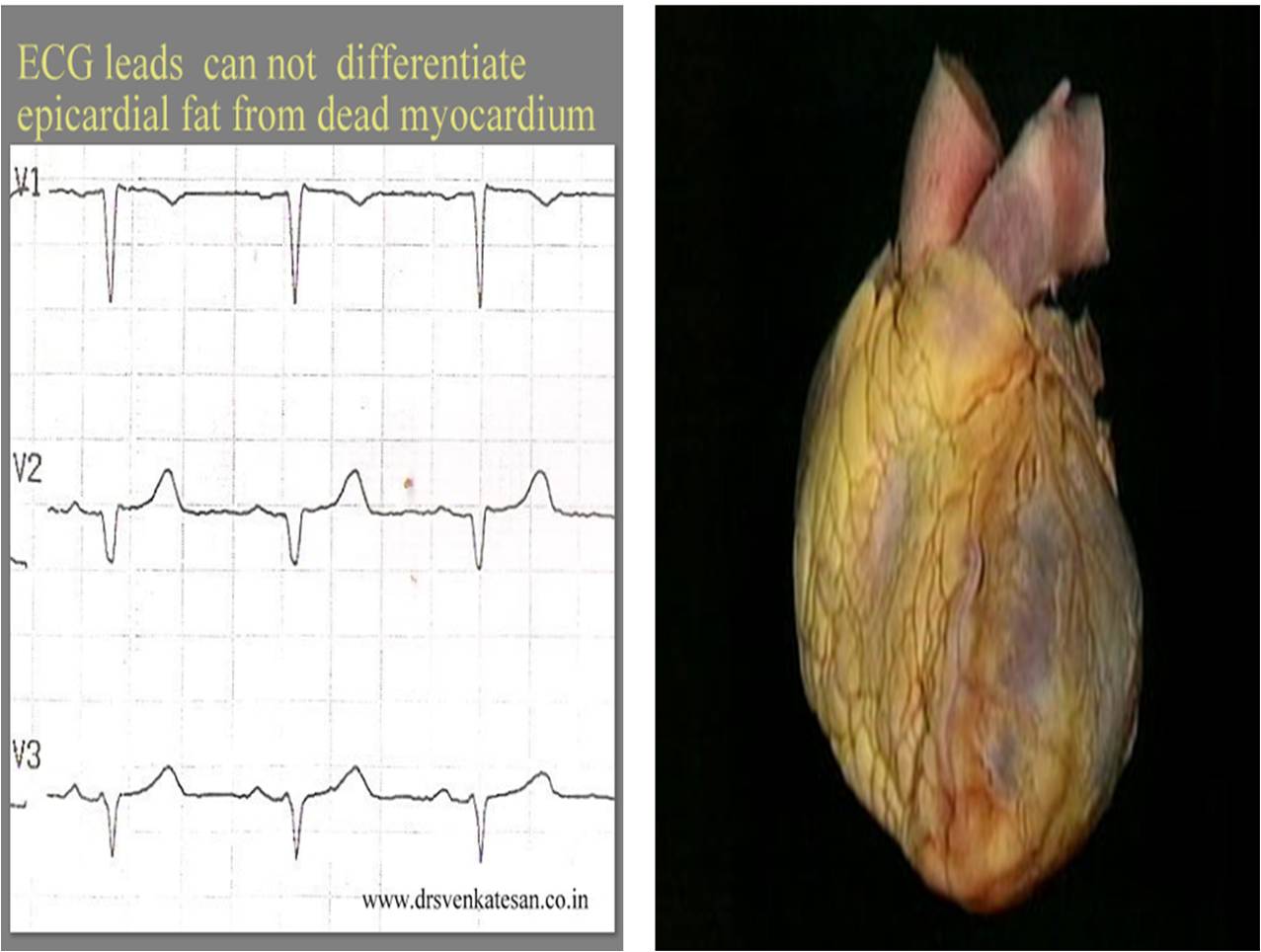
*She was a  fairly obese (not gross )  individual with a BMI of 34 .The fat pad thickness was not that huge  , I thought , still it was producing the q waves . I  have seen much thicker fat pads with good R waves in ECG . I  wonder ,  is it the type of fat that adds up to electrical insulation ?

This patient was sent back to me  again  for ruling out ASMI .  Echo was  done  two weeks  later . No evidence for  ASMI  could be detected.
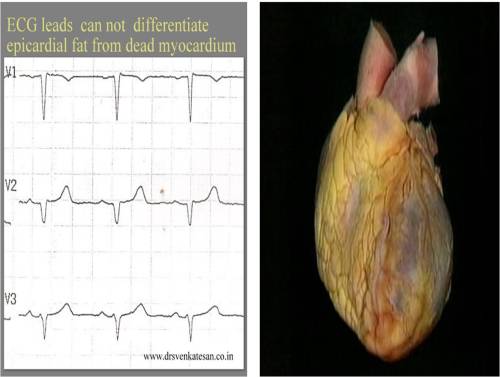
epicardial fat and q waves in ecg pesudo infarct non infarct fat 2  q

What is the normal thickness of epicardial fat pad ?

It is less than few mm . Exact normality is not known .(Empirically < 5mm ) it is very rare for fat deposition  in infero posterior aspect , except in morbid obesity.

What is the function of epicardial fat ?

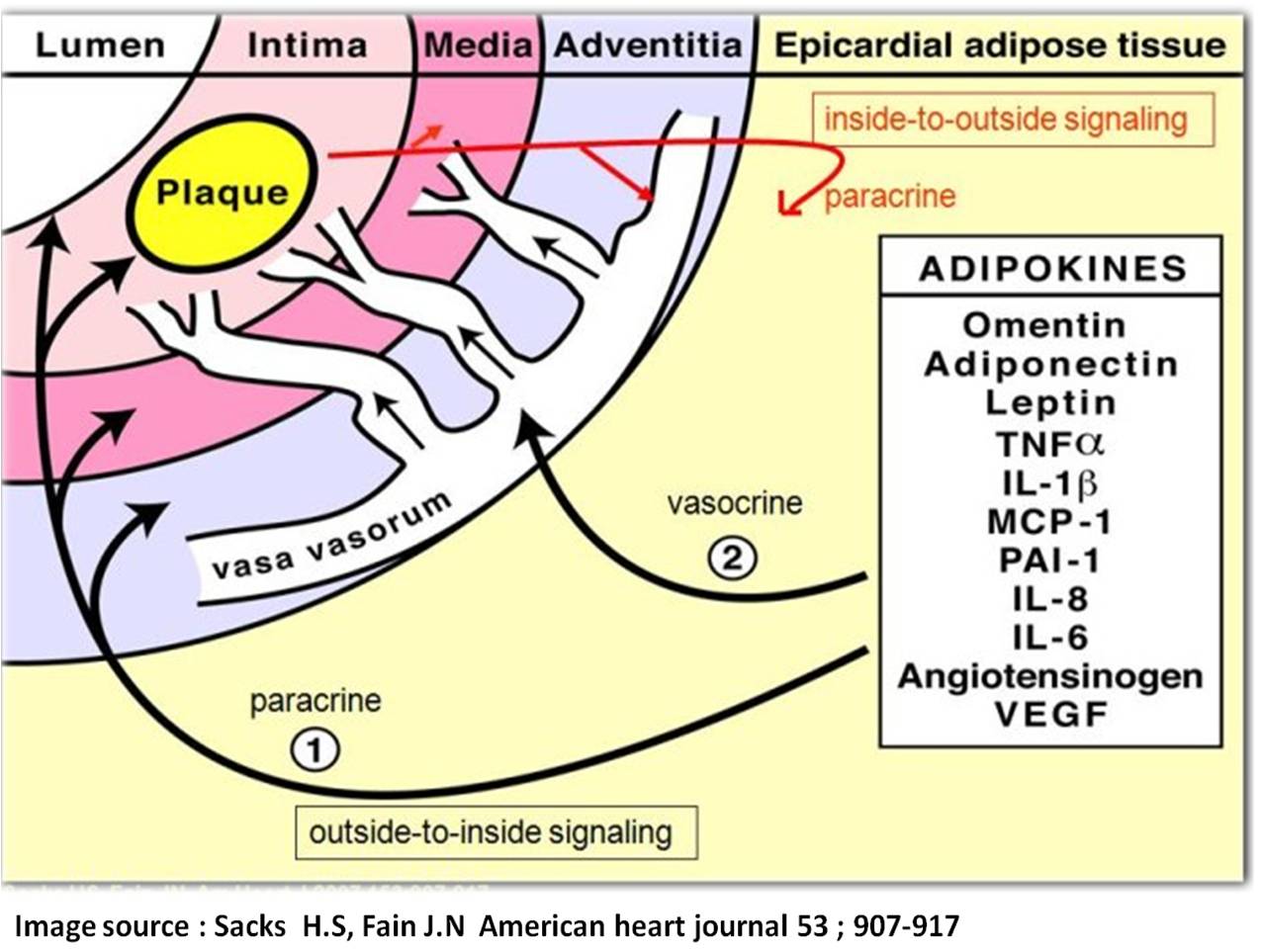
  • Long considered inert . Now , found to be a metabolically  active lipid pool.
  • We also know  heart  consumes more fatty acid than an other organs for moment to moment energy consumption .
  • Inflammatory mediator in atherosclerosis ?
  • It may also act as a mechanical cushion effect along with pericardium
  • Rarely fat infiltration can compress the heart and may result in restrictive  AV filling defects in doppler  .(May explain the unexpanded dyspnea  in many obese patients )
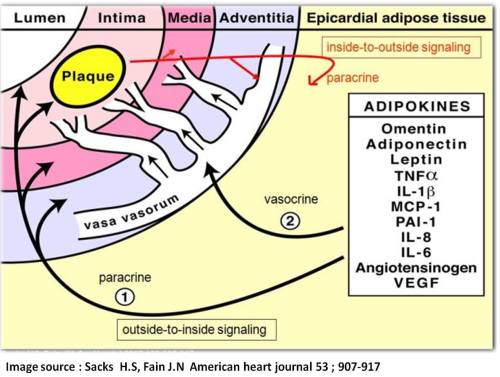
epicardial fat a dynamic depot athreosclerosis

Role of epicardial fat depot in the genesis of atherosclerosis

Subcutaneous vs  Epicardial fat.

We know thick chest wall can also interfere with ECG. Epicardial fat is more likely to record  q waves than  sub cutaneous fat ,  as the insulation is more closer to heart in epicardial fat . In thick chest wall current leaks from heart and  well scattered  hence  poor R wave is more common in such situations rather than q waves !

Following things can generate  q waves (Other than Infarct  )

  1. Fibrosis-Myocardial /Interstitial
  2. LVH
  3. Thickened pericardium
  4. Thick chest wall/ Epicardial fat
  5. Air/Fluid in pericardial space

Final message

In obese men and women  anterior Q wave can be  misleading .Such  medical errors can be so convincing .

After thought

If epicardial fat can  extinguish   R waves  and  replace it with  q waves  , these  innocuous  looking fat pads has every reason to  influence the ST segment shifts during  an episode  of ACS  as well !  .  Isn’t ?  . If so  . . . how reliable is  our ECG criterias  to diagnose  acute coronary syndromes  in grossly obese men and women ?

Read Full Post »
VPDs are such a common cardiac arrhythmia . We also know most are benign .Still modern science demands to rule out structural heart disease in any patient with multiple VPDs.

When ventricles get irritated it reacts with VPDs . ( The irritants  can be anatomical , physiological or primary electrical)

Echo can detect only anatomical irritants .We are recognising  more such focus for VPDs . Hence idiopathic VPDs  may simply reflect our ignorance !  A focused  echocardiogram is  required .

The following conditions are often observed in patients  with recurrent VPDs

  1. Posterior Mitral annular calcification (Especially in women ) –Annular VPDs
  2. Aortic valve degeneration /Bicuspid aortic valve with calcification – Cuspal VPDs
  3. Mitral valve prolapse in young -Stretch induced  Pap muscle VPDs
  4. Minimal  pericardial effusions with adherent epicarditis
  5. LV false tendons-Stretch VPDs
  6. RVOT lipid focus -Subclinical ARVD
  7. LVH and Hypertension –Fibrotic VPDs    
  8. Asymmetric septal hypertrophy
  9. Scars in MI/ DCMs
  10. infiltrations in RCMs (Any Interstitial heart disease )

(Conditions 7 and 8 are  common disorders myocardium  just included to  complete the list )

**Please note ,above mentioned entites are anatomical irritants .There is a whole lot of physiological  irritants

that can induce VPDs .  ( Hypoxia, Excess catecholamines ,  K + fluxes ,  acidotic milieu etc ) .

*** Another group is primary electrical diseases inherited channel disease can induce VPDs

Also read

A crash course on ventricular ectopics


Read Full Post »

« Newer Posts - Older Posts »