Feeds:
Posts
Comments

Archive for the ‘Uncategorized’ Category

Brugada syndrome continues to fascinate  us for two reasons.

One , it deals with mysterious sudden  deaths of young  men and women

Two , it is one of the  fine  examples  of how  advances in molecular biology , links  physical defects in ionic channels to  sudden electrical  death (Most of them  are due to inherited defects  sodium channels  of myocyte cell membrane )

While high risk subsets of Brugada are easily managed , it is  the asymptomatic  ones  that bother us.

The following are some of the  difficult  questions ,   a  cardiologist faces when dealing with   patients , who exhibit  only Brugada pattern in ECG .

  1. Should I go for an EP study Doctor  ?
  2. Will  I  require an ICD  Doc ?
  3. Do I carry a significant risk of  dying  suddenly  ?
  4. Do  I need a genetic test for sodium channel mutation ?

Fortunately,  we can answer  all these questions with much  courage than before.

(Thanks  to the European Finger registry published in 2010  !)

“No” is the  clear  answer for all of them !

Summary from the FINGER registry. 

(France  , Italy, Netherlands, GERmany)
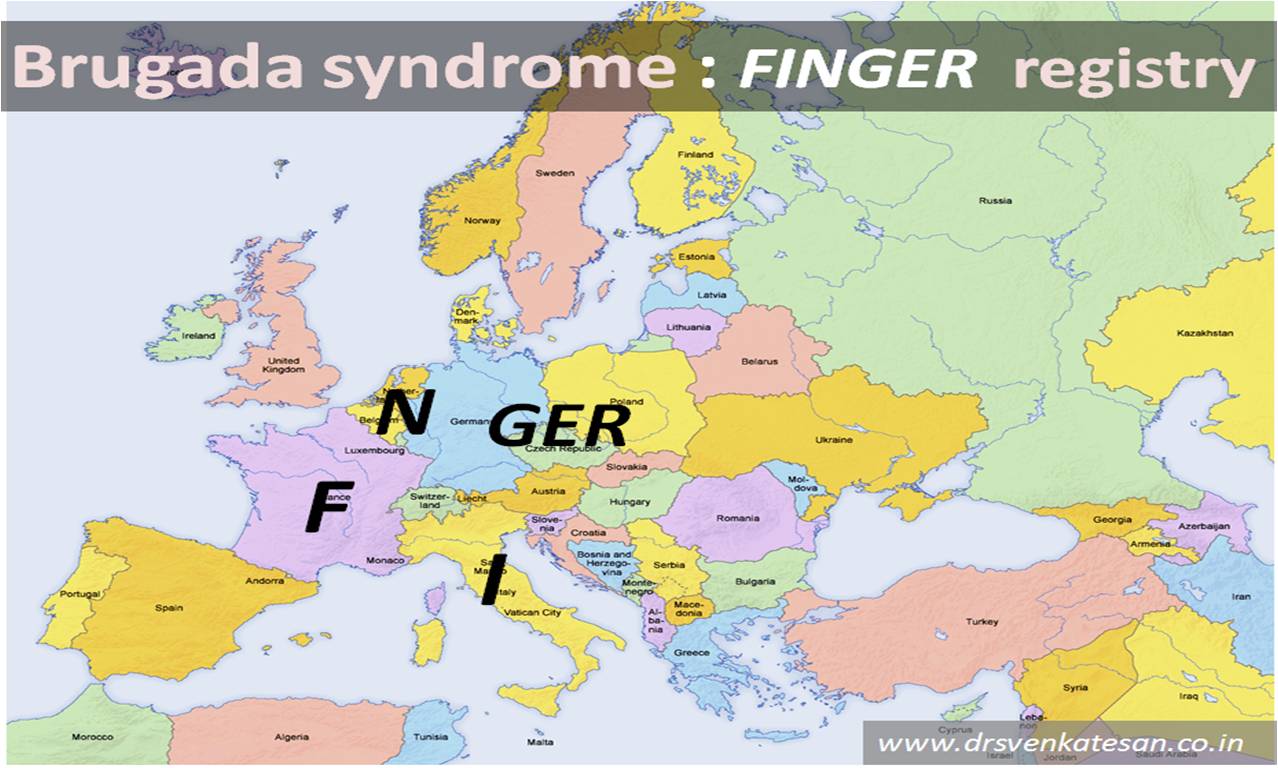
The registry included 1029 consecutive individuals

(1) Aborted SCD (6%);

(2) Syncope otherwise unexplained (30%);

(3) Asymptomatic patients (64%).

In the  follow-up of 31.9 (14 to 54.4) months . A total of  7 death occurred .

The cardiac event rates per  year was 

  • 7.7% in patients with Aborted SCD,

  • 1.9% in patients with syncope

  • 0.5% in Asymptomatic patients.

Predictors of cardiac  event

  1. Previous syncope
  2. Spontaneous type 1 ECG

Non predictors ( Surprisingly there were more non predictors ! )

  1. Gender has no predictive role
  2. Familial history of SCD,
  3. Inducibility of ventricular  tachy-arrhythmias during  EP study,
  4. Presence of an SCN5A mutation


Follow up

PRELUDE study  almost reaffirms  Finger data

(PRogrammed ELectrical stimUlation preDictive valuE)

Just publicized in JACC 2012 from the pioneer of   Brugada Silvia  Priori of   university of Pavia  Italy

Reference

http://circ.ahajournals.org/content/121/5/635.full.pdf+html
http://content.onlinejacc.org/cgi/content/abstract/59/1/37

Read Full Post »

Hypoxia is most important feature of acute pulmonary embolism.

It occurs due to variety of mechanisms

  1. Ventilation perfusion mismatch is the major  mechanism  ( Normal ventilation /Reduced perfusion)
  2. Atelectasis of lung  ( Left to right shunt)
  3. Loss of lung volume due to pulmonary infarct  contribute later
  4. Low mixed venous Oxygen saturation  (Tissue hypoxia -more extraction )
  5. One more important cause is right to left shunting  across PFO  due to sudden elevation of right atrial mean pressure reflected from RVEDP .

Can  acute pulmonary embolism be diagnosed  with out Hypoxia ?

Surprisingly many standard text books mention hypoxia is a soft sign . In fact , Braunwald’s  text book of cardiology  do mention about it .

Significant acute pulmonary embolism can not occur without affecting o2 saturation .

However , it is possible sub acute  pulmonary embolism could occur with normal oxygen saturation.

Final message

Hypoxia is indeed a hard sign  for most events  of major pulmonary embolism . It can even be termed as an essential criteria .A hypoxic , tachypenic patient in  sinus tachycardia with echo evidence of  new onset RA or RV dilatation is almost 100 % specific for acute pulmonary embolism . ( This becomes 200 % if he or she has DVT as well !)

Read Full Post »

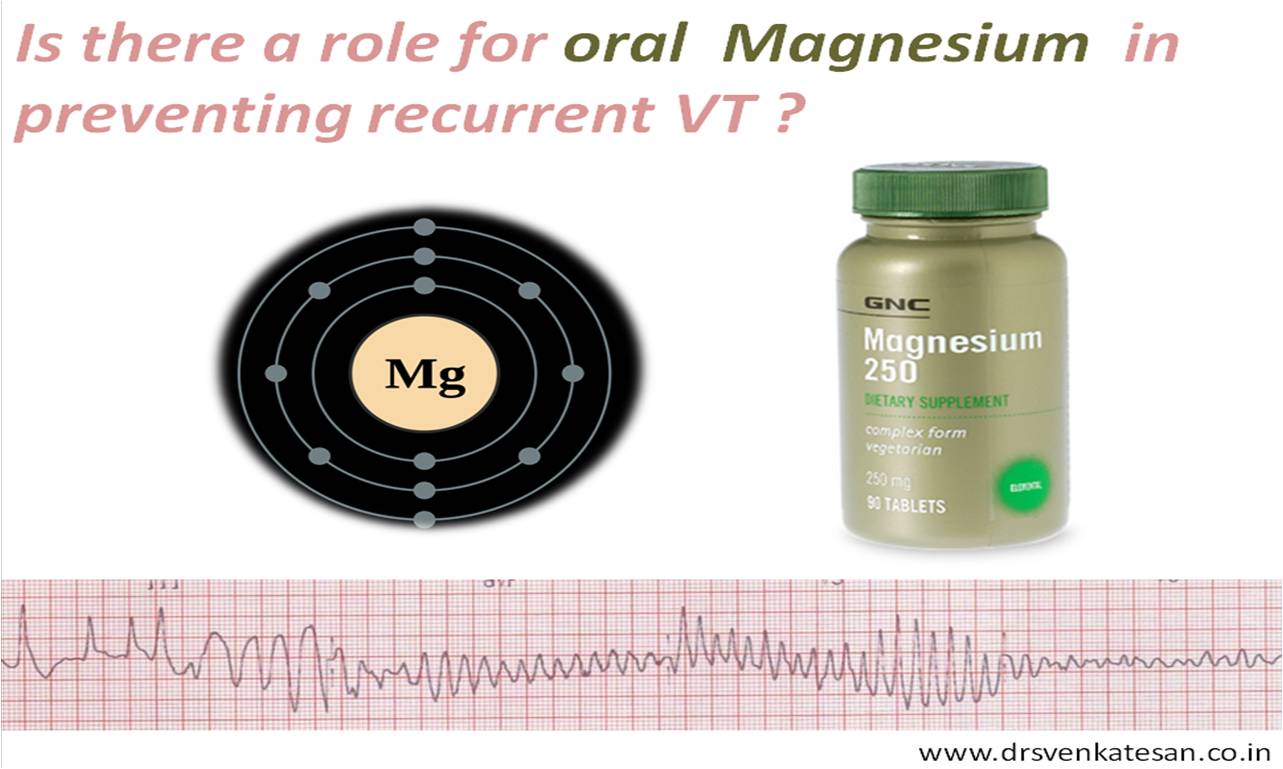
Magnesium   is a powerful anti-arrhythmic drug . It has a well  established role in controlling VT when administered  Intravenously   especially in polymorphic VT .

Mechanism of action

  • It acts at the cell membrane.
  • It has a unique action of blocking calcium channels  that reduces the number of oscillations of  both  early and late  after potentials

Link for more  on mechanism  of action

https://drsvenkatesan.wordpress.com/2010/01/13/how-does-magnesium-acts-as-an-antiarrhythmic-drug/

How often cardiologists administer oral magnesium for long-term control of VT ?

As for as I know ,  no one uses it ! but dietary  supplements are used for general well  being .

Why ? Is it because

  1. Magnesium does not get absorbed in the gut
  2. Magnesium levels are un- predictable in plasma if administered orally

Answer : No one has really tried  it as a  chronic therapy in VT  yet  !

Final Message

Tablet Magnesium can give a tough fight to Amiodarone and Flecanaide in refractory VT at a fraction of the cost !

Who has the audacity  to  compare Magnesium  with Amiodarone head on ?

Reference

Magnesium as health supplement . 

Magnesium is available  in tablet form as  Malate , Stearate, Taurate and Aspartate  along with calcium and Zinc etc .

Read Full Post »

Irregular  wide qrs tachycardia is a fairly common clinical entity in any cardiac emergency room. The moment you ask about  such tachycardia ,  9/10  fellows will  come out with a  prompt answer   ” AF with WPW syndrome” even before you complete the question !  It is not that common  as we perceive .The problem is with  our traditional teaching methods and the attraction of human brains to  rare and exotic disorders.

traditionally   SVT with aberrancy  is   diagnosed  mainly  in the setting of regular tachycardia .

We often  forget  “AF with aberrancy”  is equally common  , and  it presents   with a  irregular  wide qrs tachycardia . 

I  wonder whether  this phenomenon  can be termed as  orthodromic aberrancy .This can directly compete  in the differential diagnosis  of  antidromic AF  with  WPW !

It should also be mentioned antidromic  AF can run into very high rates  as accessory pathways do not check the incoming signals while orthodromic aberrancy the ventricular rates can not exceed 220 or so at least theoretically . (This simple clue can clinch the issue in favor of  WPW )

There is no proper  published data available for the true  incidence of AF with orthodromic aberrancy in general population

In fact , there are  many  electrical  environments for AF  to  become a  wide qrs AF

1. AF  with  Antidromic conduction through accessory WPW pathway.

2. AF with Orthodromic aberrancy ( Non WPW – Similar to  any SVT with aberrancy )

3. AF with pre existing LBBB

4. AF  with Amiodarone effect. (Especially with DCM and cumulative load of Amiodarone )

5. AF with electrolytic /  especially excess  intra-cellualr  potassium

6. Finally , even  Atrial based pacing (DDD)  can cause wide qrs irregular tachycardia when  mode switching  fails .Here the  ventricles  may track the  atrial irregularity  and respond with a  wide qrs  bizarre tachycardia .

Final message

There are many causes for  wide qrs tachycardias  in  Atrial fibrillation . WPW with anti-dromic conduction is just  one of them .We need to approach the issue with an open mind .Please  be reminded , once contemplated  WPW syndrome  can be a powerful thought blocker  !

Note : *We are not including   polymorphic ventricular tachycardia here .It is an  important subset of  wide qrs irregular  tachycardia.

** VT can co-exist with AF .This is not   surprising  as  many of the diffuse cardiomyopathies  involve  both atria and ventricle  with extensive scarring and fibrosis  a perfect trigger for  both atrial and ventricular arrhythmias .

Read Full Post »

Interventions in Eisenmenger  syndrome  or severe PAH in  left to right shunt continues to be a major diagnostic issue.The challenge lies   not only in  assessing whether the progression of PAH can be prevented by  blocking the left  to right shunt , but also  to assess  it’s impact  on  survival.

The factors  involved are

  1. Pulmonary artery pressures
  2. Pulmonary blood flow
  3. Pulmonary vascular  resistance
  4. RV function
  5. Co-morbid /general condition of the patient

While cardiologists worry more about LV , surgeons have different issue .  In left to right  shunts with PAH  RV function bothers them more , as the high pulmonary artery pressure may never allow the surgeons to come off the pump , once the decompression provided by ASD/ VSD  is removed

How relevant is Ohm’s Law in complex shunt with leaky valves and bidirectional shunting ?

The fundamental hemodynamic equation  is derived from  Ohm’s law .How relevant  is  Ohm’s law in Eisenmenger  is not clear.  For decades we have been using complicated calculations with many presumed  and assumed parameters.  The calculation of effective pulmonary blood flow in bidirectional shunt may be most complex equation in clinical  cardiology. One can only imagine how one error could amplifies the other.

The hemodynamic equivalent of  Ohm’s law states

R = Pressure / Flow .The current thinking is  If the PVR is between 6-8 it is operable .

Is it really that simple ?

We know pressures  can be measured with a fair degree of accuracy . Flow  and resistance are  subjected to change in a  moment  to moment basis  .They are  determined by a gamut of  neural and humoral factors.

Ironically , we are not yet clear , whether flow determines  the pressure or pressure determine  the flow .

The right heart blood flow can get complicated by not only bi-directional shunt but also  by pulmonary  and tricuspid regurgitation ,

There is a huge perception problem here .  We are tuned  to think ,  reversibilty of PAH is  same as operability  of shunt lesion . Definitively not !  This is the reason why there is  a vast difference in  ultimate outcome  with  little correlation with PVR !

In  Eisenmenger   physiology  , critical decisions  regarding surgery  are made outside  the cath lab 

  • Good clinical  acumen,
  • A meticulous echocardiography
  • Hard parameters  like  pulmonary  artery diastolic pressure and pulse pressure
  • Above all a  harmonious  Cardiologist – Cardiac surgeon team is vital to plan  this  complex surgery

So, now it would seem  cath studies  are  primarily done for  academic pursuit ,  and  it  rarely helps  in genuine decision-making process.

The following table  synthesized in our hospital (Mainly with  clinical data ) can be a useful tool.

Reference: Learnt in the bedside from poor children of India

We had a situation like this   . A patient was  in class 3 or 4  and calculated PVR was less than 6 Wood units what will you do ?

Never give importance to numbers .  These  patients  will 99% of times won’t survive a shunt closure surgery.

Future development

With  the availability of modern drugs like Nitric oxide, prostocyclins, Sildenafil  analogues  medical management has a potential to improve upon surgical results. Unfortunately large studies are not possible in these population . In the surgical front, fenestrated  VSD closures peri-operative intensive nitric oxide   show some promise.

 Final message

I think  we are about to say a  final   good-bye* to oxymetry  ( or even cath study )  in  the  work up of  PAH  due to shunts.

*Still, pressures of  right heart chambers and pulmonary artery  is vital .Echo can not be expected to provide accurate measure of PA pressure .(Even though there some echo studies  available to calculate  qp/qs and PVR non invasive)

Reference

Pulmonary artery pulse pressure : A simple parameter to assess reversibility  of PAH

Read Full Post »

Sons  are too glad to  inherit wealth from their father .  But destiny  maintains  a fine  balance . It makes sure  they do  inherit adverse  biological events as well .

A 68 year old man who had a TIA and was completely evaluated . Except for a mild elevation of systolic bl0od pressure and   dyslipidemia (Hgh TGL)  other  parameters were normal. Carotid vertebral  Doppler study  were normal even though the  Intimal-medial  thickness was  borderline.  His  CRP was normal . His neurologists warned him about possibility of  recurrent  TIA or cardiac events and prescribed  statins /Amlodipine .

Even as every one was worried about their  father  his eldest  son aged 44 developed a full fledged stroke just a month later !

What is the inference and final message ?

The vascular risk is a continuum .The risk  is transmitted vertically to the family members.  After all , the father and son share at least 30 % of vascular endothelium by means of structural and genetic blue print.

 “Father’s  Aorta  could continue as   son’s carotid artery !  (What   a  crazy  statement ! )

So ,  whenever you have an elderly man with a vascular  event ,  screen  entire family and preferably start  vascular prophylaxis. The problem with vascular inheritance is  ,  the children  may be conferred  more  or less  risk . The exact   quantum can not be predicted.

Final message

Beware , children  can  inherit  diseases form their  parents  even before  the parent manifest the  full expression of the index disease.It  was  an  example of  instantaneous inheritance here  .

The irony is complete  as the father develops   warning shots (TIA)  and the son suffers permanent damage (Stroke )

We can’t  expect genes to behave in rational way .  More   importantly   genes do get modified with environment in a significant fashion. What is preventing two  biological system created by same  genes one goes for full-blown vascular event other escapes  with a minor event .  One simple  explanation is  , while vascular aging is physiological  , the younger vascular system faces much more stress and strain due to altered  living  conditions.

Read Full Post »

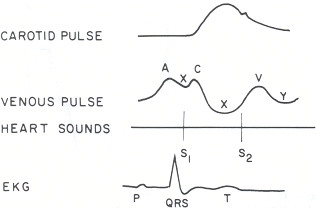
Jugular vein is a natural non invasive right heart catheter inserted permanently in the right atrium . It faithfully reflects the right heart hemo-dynamics  during  every heart beat.

The information you gather is dependent upon the time you spend and mind you you apply on this biological catheter.Wenke back did so nicely he was able to identify progressive a and c interval and a drop of c wave  before even the ECG machine was invented.

The following table  illustrates  the difference

Read Full Post »

Acute rheumatic fever classically involves large   joints of lower or upper limbs  referred to as  fleeting migratory polyarthritis .But this pattern is  not  exclusive.  In fact   acute rheumatic  fever commonly  present with atypical features .The incidence can be up to 25 % in various series .The most surprising thing is ,  it can involve spinal as well as hip joints . Mono arthritis is also possible.

The only contention is , atypical features are  frequently  labelled by  some  as post streptococal reactive arthritis instead of rheumatic fever .

It is  pure  semantics at play . Whether you agree with the terminology or not  ,  never hesitate to diagnose rheumatic fever when the  joint involvement is  atypical . If  you ignore this  you are bound to  be guilty  for damaging few hearts  later.

What are the unusual joint involvement in acute rheumatic fever  ?

  • Small joints of the feet
  • Small joints of the hands
  • Cervical spine
  • Wrist
  • Elbow
  • Shoulder
  • Hip
  • Thoracic  spine
  • Calcaneus
  • Lumbar spine

The involvement of above joint can be up  to 25%

Here is an excellent paper from Brazil about the huge variation in the pattern of joint involvement in acute rheumatic fever.

http://www.jped.com.br/conteudo/00-76-01-49/ing.pdf

Read Full Post »

Amiodarone acts  by

  1. Correcting the  rhythm  to sinus .
  2. Controls  ventricular rate  alone
  3. Does both ?

Answer is 3

How can it correct the rhythm alone ?  If  the rhythm is corrected ,  rate will automatically be controlled,  unless Amiodarone converts AF into Sinus tachycardia  which is very unlikely !

Of course  Amidarone  is not a  magic drug .The success rate of  Amiodarone  restoring  sinus rhythm is far . . . far less . . . than our expectations ! . It fails to  convert to sinus rhythm in a significant chunk *. Interestingly ,   it may still  control the  ventricular response  by its beta blocking action .

*Our estimate is , the failure rate Amiodarone  is  between  30-40%  or even higher ,  as   bulk of AF we witness   is due to Rheumatic heart disease.

Read Full Post »

Which is the best drug  for  “ventricular rate  control” in atrial fibrillation  ?

  1. Digoxin alone
  2. Diltiazem alone
  3. Atenolol alone
  4. Digoxin +Atenolol
  5. Digoxin + Diltiazem

The answer is 4.

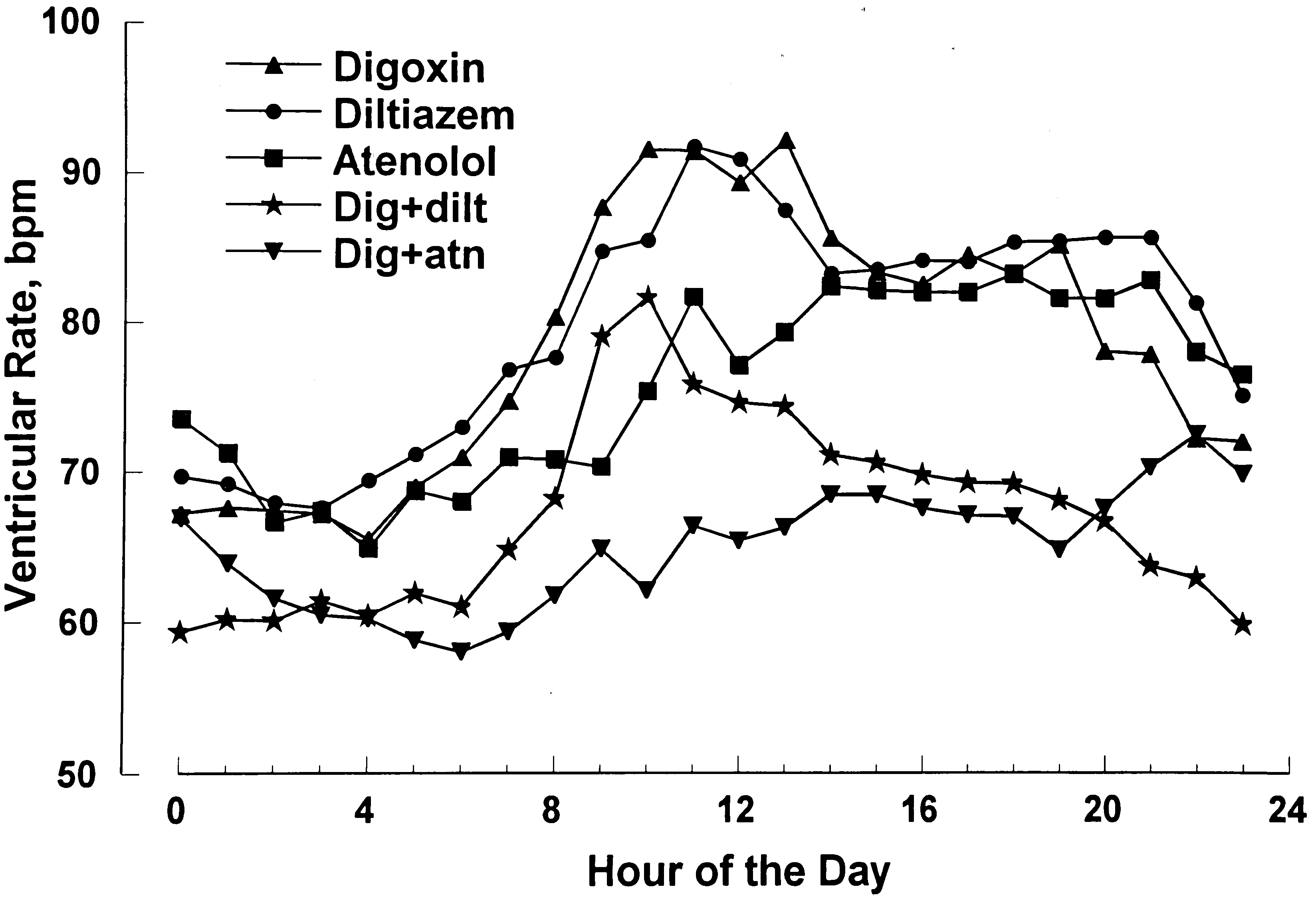
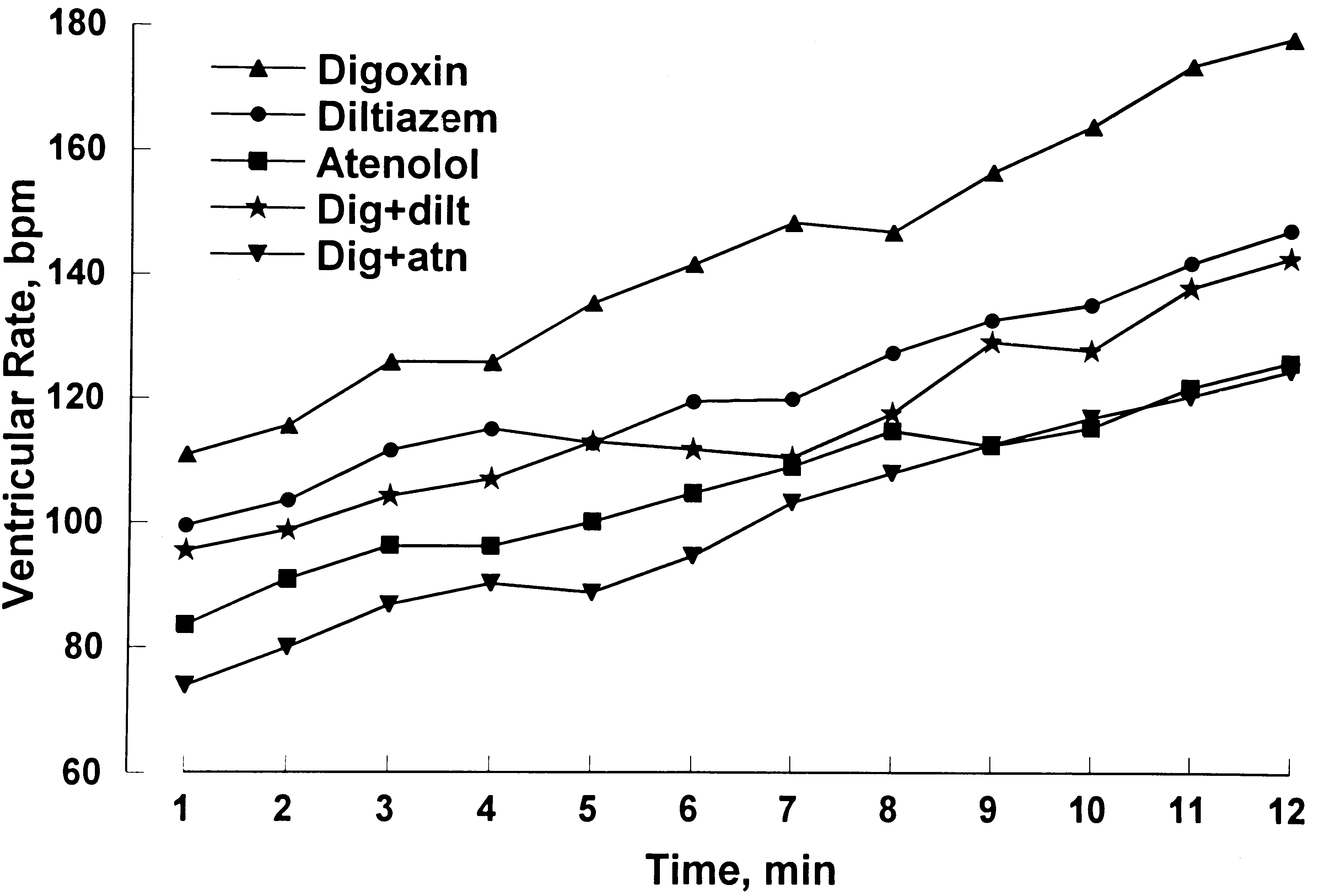
This is based on a study  done by Bramh N  Singh  and his team  from California published in 1999 . (http://content.onlinejacc.org/cgi/reprint/33/2/304.pdf  )It  was  a wonderful study   involving  just  12 patients ,  still good enough to prove a  point . It was a sequential cross over study a rare theme in medical trials !  where same patients act as control .Hence bias and host variations are  nil. Few excerpts from the study .

It is very clear, for optimal rate control we need a combination regimen , Digoxin must be one of them .Atenolol combined well with Digoxin , even as though Diltiazem resulted in maximum dip in nocturnal heart rate.

Digoxin + Atenolol is clear winner in rate control during exertion as well ! Note Digoxin has absoutely no control over the heart rate at times of exercise !

Few thoughts about this study

This study has clearly documented superiority of combined drug regimen for rate control in AF .

Still it leaves a  lingering question !  Why verapamil was not used as an agent in this study  ?

If only ,  verapamil was used (As we do in our hospital )   Digoxin -Atenolol  combination would have  faced a  really  tough competiton.

Another  curiosity is  ,  what would  have  been the power of a unique combination   of Atenolol  and Diltiazem  in controlling  ventricular  rate in AF ?

Any way , it was a wonderful cross over study  . Such studies are a rare breed ,  always welcome in this world  of  funny  pharma trials  wherein  a new drug is  compared with a dud drug called placebo !

Now  . . . Try this  one

Amiodarone

  1. Corrects  rhythm
  2. Controls  ventricular rate
  3. Does both ?

How can it correct the rhythm alone ? If rhythm is corrected ,  rate will automatically be controlled unless Amiodarone converts AF into Sinus tachyardia !

Of course  Amidarone  fais to  convert to sinus rhthm in many , still it may control the rate  by its beta blocking action.

Reference

http://content.onlinejacc.org/cgi/reprint/33/2/304.pdf

Read Full Post »

« Newer Posts - Older Posts »