Feeds:
Posts
Comments

Archive for the ‘Uncategorized’ Category

RVH is  traditionally  categorized into three types . With  the  advent of echocardiography  diagnosing  RVH by ECG would  appear  redundant. Still , it gives vital information about the electro-physiologcal basis  of RVH. Knowing different mechanisms of RVH helps us decode  regional variations in RVH.

Type A , Type B  are easy to diagnose as they fulfill the conventional criteria of tall R in lead V1

Type A  RVH occur in severe  pulmonary hypertension and critical valvular pulmonary stenosis.

Type B  RVH occur in  volume overload states like ASD and moderate  forms of mitral stenosis.

( Severe  MS may cause Type A pattern  if RV pressure exceed systemic pressure)

Type C  RVH    has  no classical signs of RVH. Here  RVH  is diagnosed by proxy . Look for RAE  and a  vertical QRS axis . ( For all practical purposes RAE will indicate  RVH  except in isolated tricuspid stenosis.

Type C RVH occurs classically in COPD and in some cases  of acute pulmonary embolism .In other- words type C  RVH  reflects  predominantly  RV dilatation rather than  hypertrophy.

Why Type C  RVH is important ?

It is important  for two  reasons

  • It  is  basically a  masked   RVH .
  • It mimics Anterior MI

Missing the first  one and erring  in  later  both  can have major  implications  in clinical cardiology  especially during emergencies.
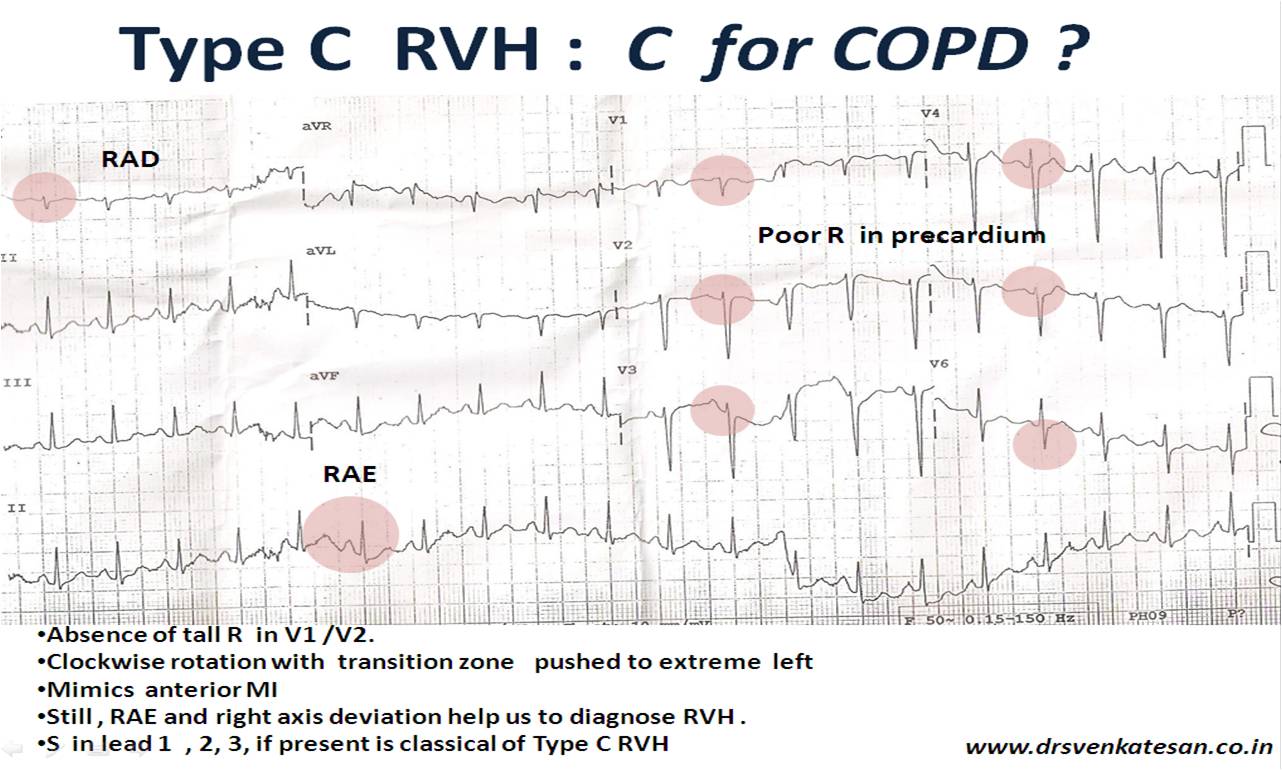
What is  the mechanism of poor  R wave in precardial leads in  Type C RVH of COPD ?

The fact that  poor  R wave  in precardial  leads occur in  most  cases of  COPD  (whether or not RVH is present or not)   convey an important message.

The  lack of  R wave  progression   is probably  less to  do  with   rotation of  RV  than  the insulation effect  lung  . Further, the  elongated lungs   drags   the heart down , and  make it more vertical and in spite of RVH tall  R  is not picked up by v1 v2 .

Unlike primary PAH and critical MS where the RVH  can dominate the LV  ,  the  quantum of  RVH is never huge in pure COPD . However , presence of RBBB  could  alter  the R wave amplitude .

ECG in acute pulmonary embolism

This resembles the type  C  RVH . The  R  waves in V 1  and  V 2 can not gain the voltage acutely.

The S 1 . Q 3 , T 3  pattern if present indicate the  acute RV strain and  the resultant  RV wall motion defect.

.

Clinical scenario : Practical utility of  decoding    RVH   by ECG ?

A  middle aged female came  to our CCU  with acute  dyspnea with tachycardia .

Echo revealed a dilated  RA and RV . She had  mild TR and moderate to severe PAH (The TR jet measured 3.8m/sec)

The MPA showed a hazy shadow suspicious of thrombus . The patient  had no evidence for DVT .

The fellows  arrived at  a conclusion about a  severe  PAH  but , the etiology was debated.

One is chronic thrombo-embolic PAH . Other groups argued for acute massive pulmonary embolism and resultant PAH.

This raised an  important    therapeutic   issue  as one of them wanted to lyse the thrombus  ,  the  other argued for simple heparin .The  argument continued as the first fellow reminded ,  presence of RA, RV dilatation is a sign of acute RV strain  . The other countered the  same  as  it could be  a  chronic response  to pre existing PAH.

How do you know  in an emergency ,  whether the RA, RV dilatation is new onset  or a chronic one ?

In spite of  good   echocardiogram  we were confused .  Then it struck  to us ,  ECG would solve our problem . It indeed helped us. She had a tall  monophasic  R  in  V1  indicating   Type A RVH , which suggested chronic PAH   and  the thrombus in MPA  in all likely hood  was a sequel  to PAH  and  not vice versa . A type C RVH  would have voted  in favor of  acute pulmonary embolism.

Meanwhile a  CT pulmonary angiogram  report was available   . It showed a small  thrombus in MPA and LPA with no clearcut perfusion defects ruling out acute pulmoanry embolism . The thrombus was probably  de-nova in- situ thrombus due to PAH.


Final message

It may  appear  funny for the  present day cardiologists to waste so much time  to analyze  the  RVH  by surface ECG . But please remember ECG remain the only simple and cheap  investigation that transmit live data from the heart instantly  .Most importantly unlike other imaging  modalities  ECG data do not vary with person who records it !

Reference

A very good referen from   Basic and Bedside Electrocardiography   By Romulo F. Baltazar

Read Full Post »

AV dissociation is  the most specific diagnostic clue in VT.But this is not a constant finding. In fact one  would be  lucky to spot a fusion beat  which denotes AV dissociation . It occurs in less than 30% of patients with VT .

Technically ,  for AV dissociation to occur atria and ventricle should  not be related in either direction .

If there is  a retrograde VA association ante grade AV conduction   is not possible  and hence one can not get a  fusion beat or so.

What happens to p waves during VT ? How does atria depolarise during VT ?

Atrial chambers can not sit idle during  VT .It has to somehow get depolarized  and contract   but  the  timing    may not be appropriate .

P waves  during VT can either be antegrade or retrograde .

Theoretically both can be present   but most times  it is   the  retrograde  p waves we see.

The occurrence and timing of p waves  is related  to the VA conduction .

If there is  1 :1  VA conduction during VT there can not be AV dissociation  for the simple reason  we have VA association.In fact there is constant vigil to depolarise the ventricle  through the normal AV node and his purkinje  in spite of the VT .SA  node is aware of this fact ,  how difficult it is going to be  confront the upcoming  rapid ventricular impulse . Usually the ventricular impulse   prevails  over the atrial impulse and much part atria is controlled by the VT . In fact  the VT reaches  all the way to SA node and simply  overdrive it . At these fast heart rates  retrograde p waves are not visible. ( But surprisingly one may see a regular  cannon wave in the neck with 1: 1   VA conduction.

Mean while ,  the SA  is always under look out for a opportunity to sneak into the ventricles thorough AV node. This happens  when the VT focus slightly slows down or shifts to a new site . this sis the time  we are able to  witness the AV dissociation . When the atrial impulse capture fully or partially the ventricle fusion beats occur confirming  AV dissociation .

Final message

AV dissociation is present in  less than 30% of VT because in  70%  there is a VA  association.(Retrograde  VA conduction ) . When V is associated with A there can not be AV dissociation.

Read Full Post »

There are many  organic causes of mitral regurgitation. ( Ischemic , degenerative , valvular , cardiomyopathy etc.) It is not  rare for  pure  electrical events to result in valvular regurgitation.   A 70year old  man  with SHT   presented  with palpitation  and exertional dyspnea  .He was  later referred  for  Echocardiography.  Echo revealed LVH with intermittent MR and moderate LV dysfunction.

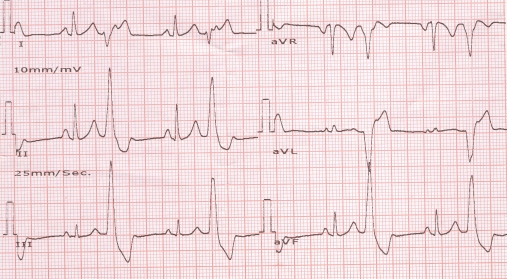
His ECG looked like

Ventricular ectopic recorded in bi-geminal rhythm

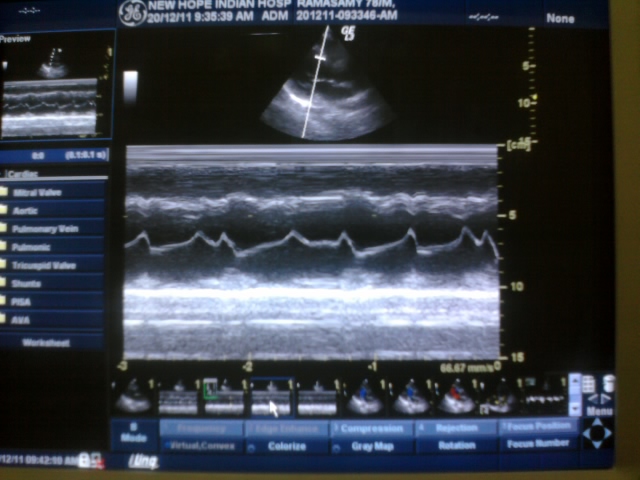
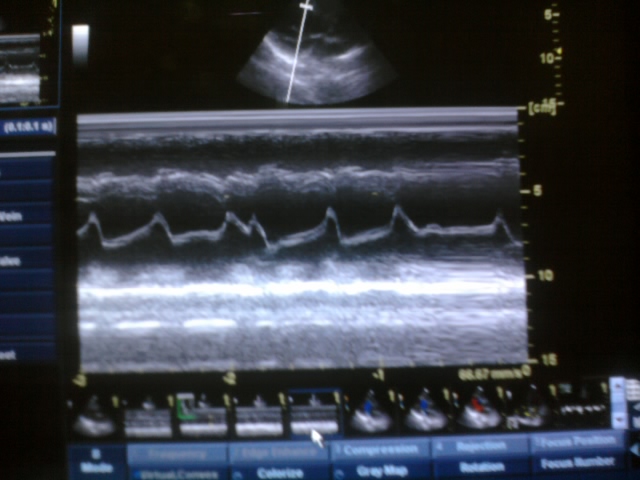
His  echocardiogram showed


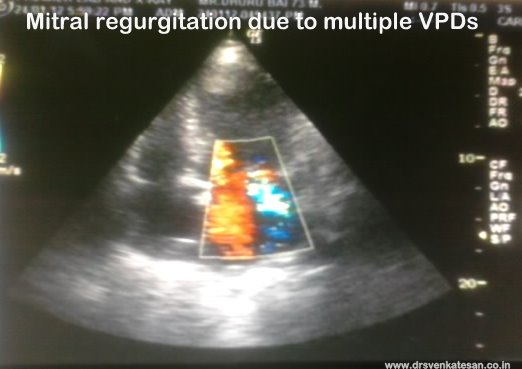
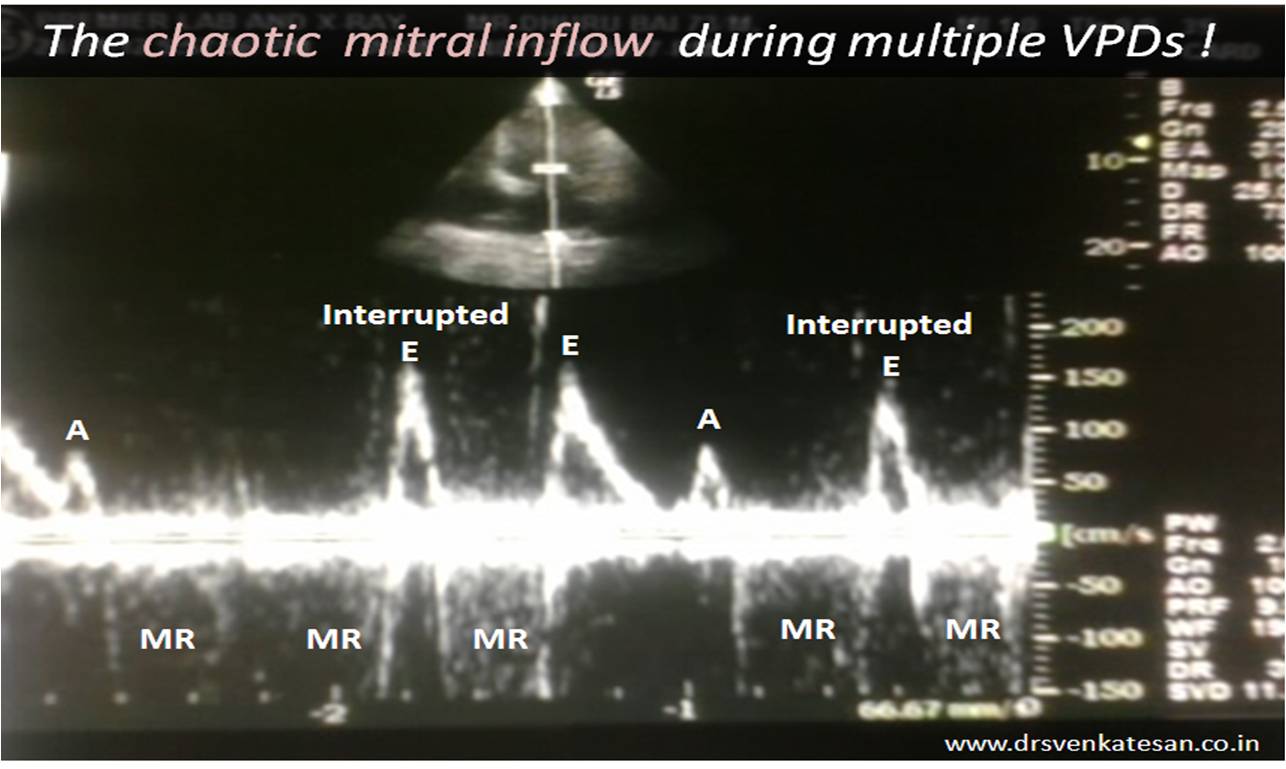
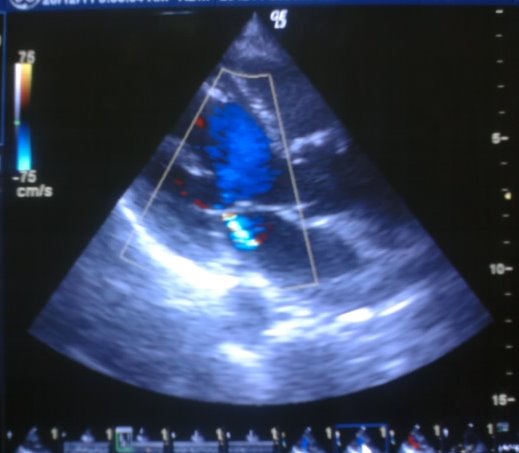
His echo showed randomly timed mitral regurgitation was detected .See the Doppler MR jets below.

We know ventricles are integral  part of mitral valve apparatus  .Hence  it  wouldn’t  be a surprise to note  abnormally timed ventricular contraction  can  have a major impact  on mitral valve function.

When ventricles  prematurely begin  to contract  ( As  during  VPDs) it  interferes with  opening of mitral valve. In other words every VPD  technically imparts a  sort of  diastolic dysfunction !

VPDs occur in which part of cardiac cycle ?

VPDs  occur  either in early   or mid  diastole . Thank fully VPDs can not occur in systole . (Refractory period )

What would be the status of mitral valve at times of  VPDs?

Though it depends upon the timing of VPD ,  generally it interrupts the rapid inflow period of diastole .

In fact ,  it converts the cardiac  cycle from diastole to a partial systole or  a combination( fusion ) of diastole   and systole ! *

More MR jets are visualised than LV filling waves . Note the some of the E waves are sandwiched between two MR jets. ECG gating should have made this image more interesting .Any way , we have good MR jets to time systole nicely

* Is that a funny  imagination  ?

During   diastole ,  if  LV suddenly  begins  to contract   instead of  receiving the blood  ,  what will happen ?

VPDs are such a common arrhythmia , we  rarely  wondered  ,  it can have a dramatic  consequence  in a any  given cardiac cycle .While   the cardiologists think too  technically  their  patients observe with  shrewd  sense and tell us clearly  what  they feel  is  actually a   missed beat !

(Yeh  . . .  how simple  they describe the complex  hemo-dynamics  of  missing  diastole !)  .They also tell  us ,  next systole is felt as big thump as palpitation . (Post VPD potentiation )

Just imagine ,  if a patient  has  multiple VPDs  with  different  coupling intervals   that fall in different location of diastole  also  interspersed with sinus beats ,   how chaotic  would be the  the  mitral   filling .

This is what  is recorded in the above patient with multiple random MR jets .

Why all VPDs do  not cause MR ?

The timing is critical .We know all VPDs do  not generate a powerful contraction to cause MR. Atrial fibrillation, Prolonged PR intervals , heart blocks , critically raised LVEDP all can influence the trans mitral gradient . In fact these situation can result in  an  entity called diastolic MR that would be discussed later.

Can  VPD induced MR be  referred to  as diastolic MR ?

When VPDs  occur  in  diastole  , it  interrupts the diastole  and a new systole begins. In any  particular point of time there will be  leak into the LA  if the mitral valve is open .This is technically a new systole but in true sense it is the diastole of  the  previous beat . I wonder , whether   VPD induced MR  may be referred  to as one  form of  diastolic MR.  Of course ,  this MR can spill over to true  systole as well .

This also  makes  sense (Non !) as many of the VPDs do not open the  aortic valve ,   hence technically we can’t call the phase reset  by  all  VPDS   as a true systole !

What is the effect of VPDs  on pulmonary venous flow ?

Left atrial  cannon waves can occur that can elevate PCWP .This is the prime reason for resting or  exertional  dyspnea in these patients. Some may get a paradoxical relief  during exertion   as  exercise  suppress VPDs which are frequent at rest.

If VPDs can seriously interfere with mitral valve function , why  they are  often  considered benign  ?

VPDs are well tolerated* as long as  the  LV function is intact.  If VPDs are associated with  LV dysfunction  it  can initiate a vicious cycle of   hemodynamic deterioration .  Multiple VPDs  if left untreated can lead to progressive LV dilatation  in a  significant population .  Hence patients with  recurrent VPDS need some sort of  follow up. It  makes good medical sense to suppress VPDs in the long run. (Of course the  available anti VPD  drugs  are not very safe  !  The search for non toxic ,  ideal drug should go on !)

*”Well tolerated VPDs”   in no way  means  normal physiology.  Read a related article in my site.  “3 minutes crash course on VPDs”

Final message

VPDs  though considered  largely benign , can lead to dramatic  alterations in the  functions  of mitral valve , especially in diseased hearts.

We  must  realise  when ventricular  ectopic beats occur frequently  , it  interfere with the  both opening and closing of mitral valve.

It is really surprising  ,  the literature is  devoid of  major studies  about the  impact of  VPDs on  mitral valve  physiology . . . rather pathology !

Read Full Post »

RVOT obstruction is the  sine qua non of TOF. It is  traditional to believe the obstruction  in TOF   is dynamic and is located in the infundibulum. It may be true in a broad sense .But  in reality  the  blood flow faces  too many hurdles within the RV before it reaches the pulmonary artery  and lungs  there after.

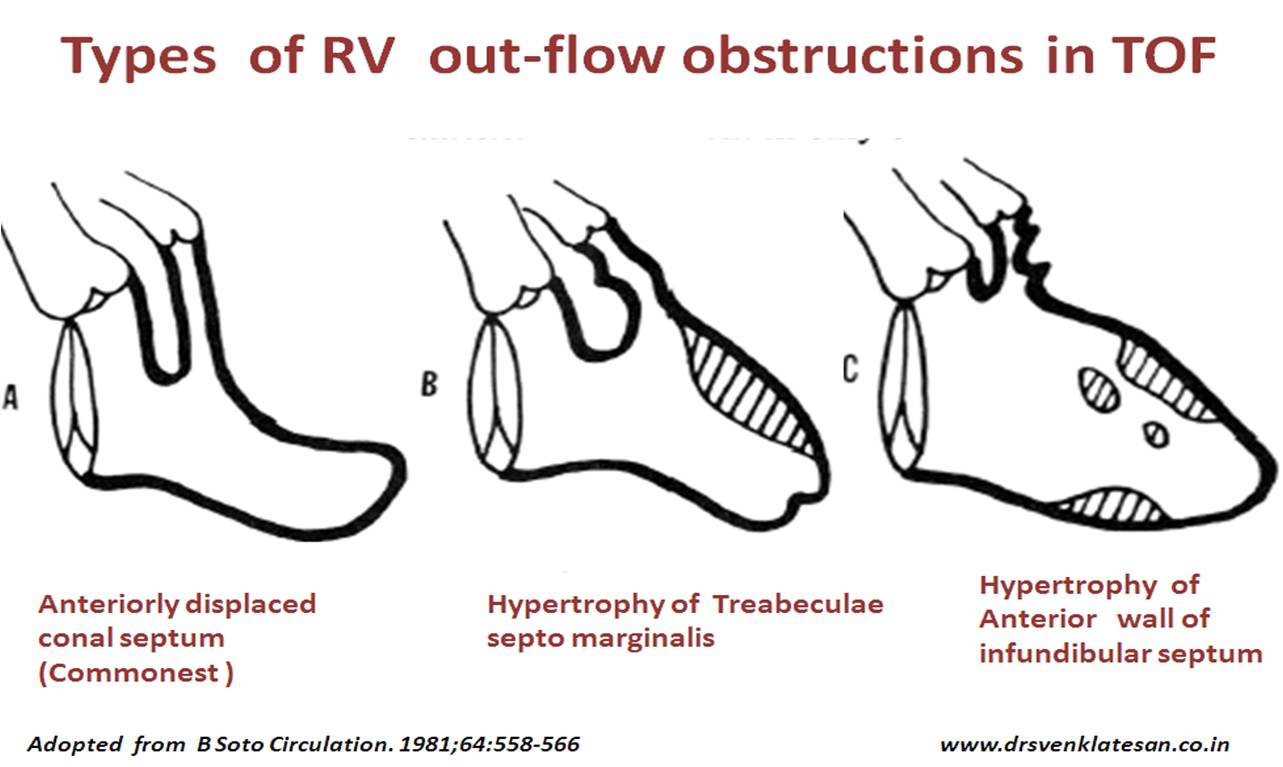
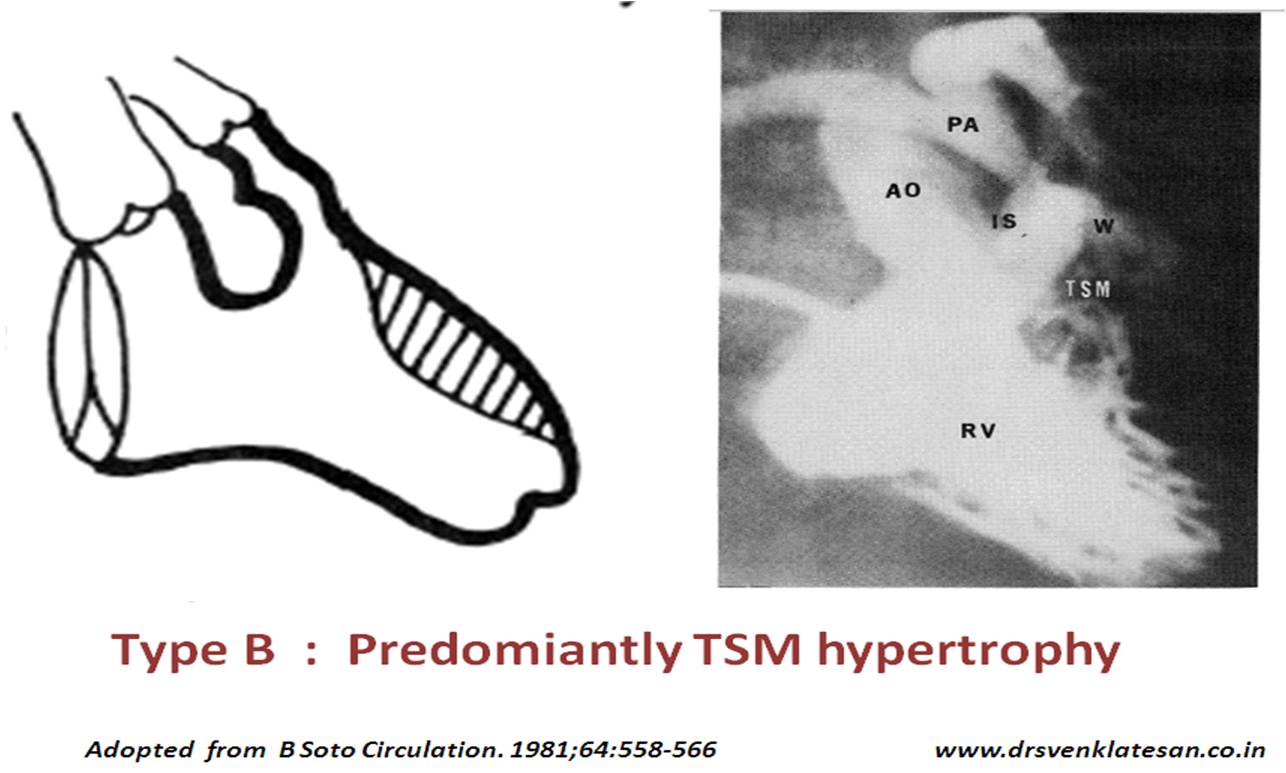
The commonest and most important one being the mal-aligned conal septum encroaching the infundibulum .(This anterior migration of conal septum is responsible for the aortic  over ride and  VSD as well) .It is erroneous to  think  the RVH in  TOF is simply an after effect of RVOT obstruction .There  can be  intrinsic defects in the RV trabecuale  that hypertrophies and  traverses the RV cavity  in  randon fashion.

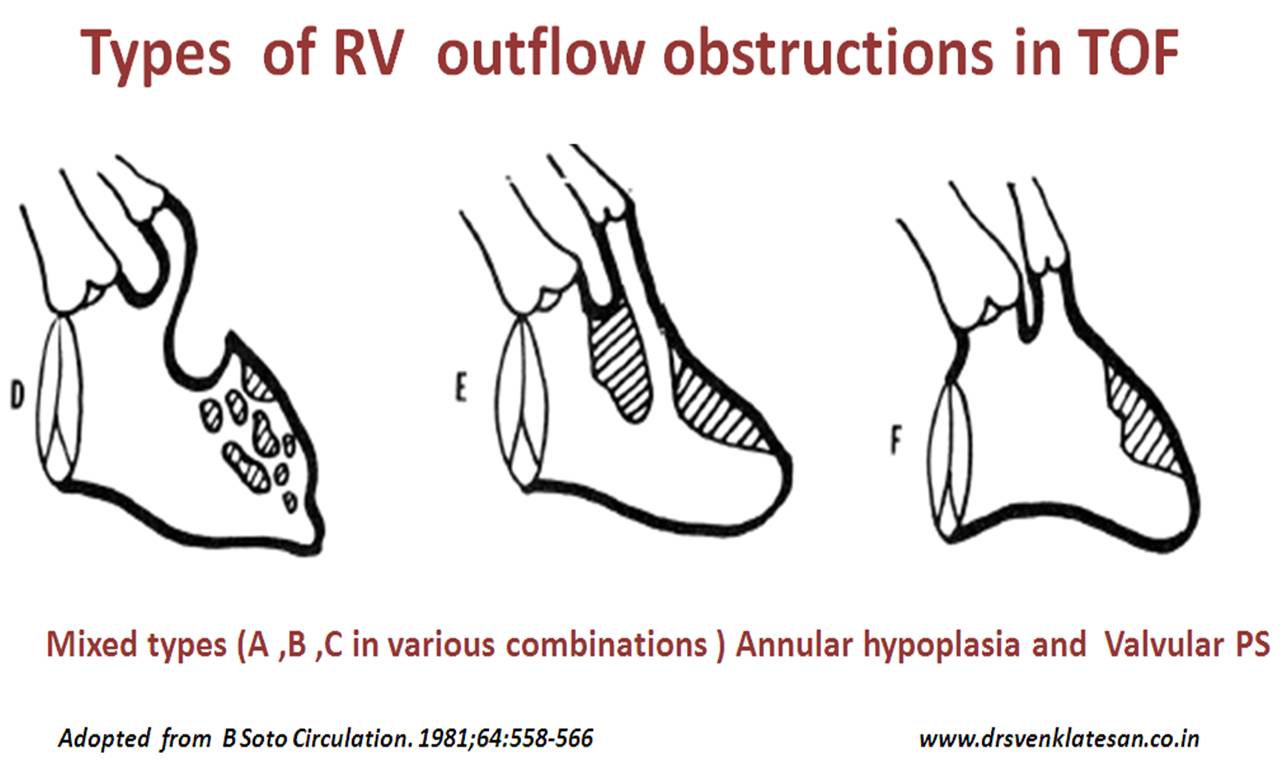
Soto described 6 types of obstruction in TOF in elegant anatomic and pathologic study in 1981. Every cardiology fellow must read this original article before going to the Board examination. http://circ.ahajournals.org/content/64/3/558.full.pdf+html

For some reason  God  has  not  arranged  the   RV inflow , body  and out flow  in a linear  fashion . ( ? Meant  for haemic  acceleration in the low pressure venous circuit  )  .In  TOF this becomes important.  It is curious to note even minor  muscle bundles that  criss cross the RV body  act  as a speed breaker and alter the stream and direction of blood flow  .This  is why ,  TOF  can generate   systolic murmurs in various shapes and  time  over the left para-sternal area .(In TOF one can get a murmur right from left  2nd space to well down the lower sternal area )

What are the fixed obstruction in TOF ?

The  resistance  to  blood flow  within the RV  is often multiple ,  extend  from RV body to  pulmonary arterial branch points. It is important to realise few of the obstructions are fixed in nature.  Differentiation of dynamic vs static obstruction  is important in therapeutic aspect also. The efficacy of beta blockers is directly related to the ratio of dynamic vs fixed resistance .

Hypertrophied  trabecuale sept0 margianlis (TSM) usually offers fixed resistance. The infundiubulm is the only place where one can expect a dynamic component . If the annulus and valvualr PS  caused more of a  fixed obstruction

Final message

So,  fellows beware if some one asks this  question “Where is the site of obstruction in TOF ”  .Be ready with an elaborate answer . It is better to classify according to sites  of obstruction   with specific  reference to  dynamic or static nature .

http://circ.ahajournals.org/content/64/3/558.full.pdf+html

Read Full Post »

How to manage multi -vessel CAD in STEMI ?

In this era of explosive information  , we rarely get clear-cut answers to  our  problems.

There are rare  exceptions . Here is an wonderful  review article on the issue of multi-vessel CAD  during STEMI. (http://www.ncbi.nlm.nih.gov/pmc/articles)   Especially  heartening ,   is the way the article concludes . It can not be more crisp than this !

Conclusion (Reproduced from the above article )


  •  Single-vessel acute PCI should be the default strategy (to treat only the IRA during the acute phase of STEMI).
  • Acute multi-vessel PCI can be justified only in haemo-dynamically  unstable patients with multiple truly critical (90%) lesions.
  • Significant lesions of the non-culprit arteries should be treated either medically or by staged revascularization procedures— both options are currently acceptable.

In-spite of the clearest possible guidelines   there  are frequent   debates  going on  for aggressive approach  to non IRA  lesions in hemo-dynamically  stable patients  as well  !  Many of the  learned cardiologists are calling for a  a  “legal violation”  of above guidelines !

The term staged primary PCI (Non IRA)  is often misused  . One such strategy is  rescheduling the non IRA PCI by 24 to 48 hours  later  than  the primary  ira PCI.  This  enables  us to violate the guidelines silently   . Please mind , the excess morbidity of non IRA PCI is due to the altered hemo -rheology which is expected to persist for at least few weeks !

I have recently come across a  cardiologist performing RCA PCI on Monday and LAD PCI (A 70 % lesion )  on Wednesday in a hemo-dynamically stable inferior STEMI ( Incidentally , he  felt  no guilt  , as  he was   ignorant about  existence of such  guidelines . In fact ,  he wanted to finish both angioplasties  on the same sitting  . It seems  he had to defer  the LAD  PCI   to Wednesday as the initial insurance  limit was exceeded   .

I do not want to dwell into another  unfortunate story  , as  this   patient had  to borrow  Rs 1.25lakh for  his life saving second stent  !

Final message

Come on   . . . let us violate the primary PCI guidelines . . . after all , our patients do not know the reality !


Reference:

Read Full Post »

A middle-aged man was rushed to cath lab with  extensive antero- lateral STEMI   . Primary angioplasty  was planned.The coronary angiogram  showed a critical LAD and a  total LCX lesion just beyond the bifurcation . Both lesions looked irregular and hazy . RCA had insignificant lesions . Patient was  stable hemo-dynamicaly .

The moment  we  saw the angiogram,   we knew ,  we had a real problem on hand !  . First of all ,  It looked a complex lesion for  a pPCI .(A brief  thought about an emergency CABG  creeped in,  but was dropped  with   enthusiastic residents voted unequivocally in favor of  PCI . Of course , to be frank  we didn’t have a  CABG team ready either ! )

So the plan  was : To open the IRA  . . .  &   forget the non IRA (  for the time being )  which  is the current management mantra as on 2012 !

Trouble from unusual  quarters !  By the way   . . . which is the IRA  ?

Even as the consultant  was  initiating  the rituals with wires and balloons  to tackle the LCX , some one behind the consultant  mumbled  “why can’t the LAD be  the IRA ”  After all  , it  also has  a critical lesion  and  mind you  we are dealing a case of   anterior MI  !) . That mumble  was  loud enough to create buzz of confusion in cath lab .

Now everyone quipped  , ” IRA is  what ?

Is that  the critical mid LAD lesion ?

(or ) Is it the total LCX   (or ) Both ?

Logic would suggest in the setting of STEMI   any  total occlusion should be considered as IRA  . Of course  , one can not be dogmatic about it.  When a patient is having   anterolateal MI  both LAD  and  LCX can contribute to the MI .

What about  proposing a new  concept  of  “Double IRA” ?

When  multiple  plaques  are  activated suddenly in unstable angina ,  it is  possible  for multiple IRAs  to occur  in STEMI as well . But this issue is rarely discussed in literature .

Other  possibilities

The 100 %  lesion  in LCX  could  still be the primary culprit  and  a  thrombus migration into LAD   might have  resulted  in  infarct  extension into anterior wall .

Further ,  confounding may occur if a patient with chronic total occlusion  develop a  SEMI  . It  makes it really difficult to identify the  IRA.

When  the supposedly gold standard coronary angiogram   fails to identify the IRA ,  what shall  we do ?

Go to the basics . The good old ECG might help .

(Please beware in a patient  with pre- existing  multi-vesel CAD  , none of  the ECG algorithms work  to localise  IRA !(Especially   the famous Wellen’s miserably fails ! )

Still unclear ?  Look for the wall  motion defects  in echo . An echo cardiogram (Need to be meticulous )   will help match the  dysfunctional segment with IRA.

Wall  motion defects are notoriously  error prone in ACS  for  two reasons.

  • We do not have easy and accurate  methods to differentiate ischemic wall motion defect from infarct related wall motion defects.
  • Tethering artifacts  ,  differential behavior  epicardial  vs endocardial ischema on contractility   will confound  the issue .

So what is left ?

One  need to  go back  to the CAG again  . Have  a critical  look  at the lesion once more. Look for thrombus or eccentric /unstable lesions . If  present it is  going  to be the IRA in 90 % of times. Let it be a  wild guess in the remaining 10 % .

There is also a  practical solution . Poke the lesions  with your favorite  guidewire ! . The one that  gives way easily  is likely to be the  IRA !

Finally,  if the confusion still prevails ,

Stent both the  lesions. That’s what , was  done to this patient . Many would have thought ,  this should  have been the default approach instead of scratching  our heads to identify the IRA ,  wasting crucial minutes !

Final message  : 

Current  guidelines do not recommend  pPCI for non -IRA   at the same sitting  of  IRA pPCI . However the issue  of  IRA  “too close to call is  rarely addressed.I do not know  how commonly  this issue is encountered  in angiographic  core labs that deal  huge loads  of pPCI world wide .

Our  early  experience  suggest  the problem is   real ,  unique and  definitely not rare  .

What is your take ?  We argue guidelines committee   to  specifically  address  the issue of  uncertain IRA as a  branch point in the pPCI decision making  tree !

Read Full Post »

How to rapidly  diagnose  significant LV dysfunction  at the bed side ?

Look for

  1. Tachycardia*
  2. Exertional LV  S3
  3. Muffled S1
  4. Weak carotids
  5. Often inconspicuous apical  impulse

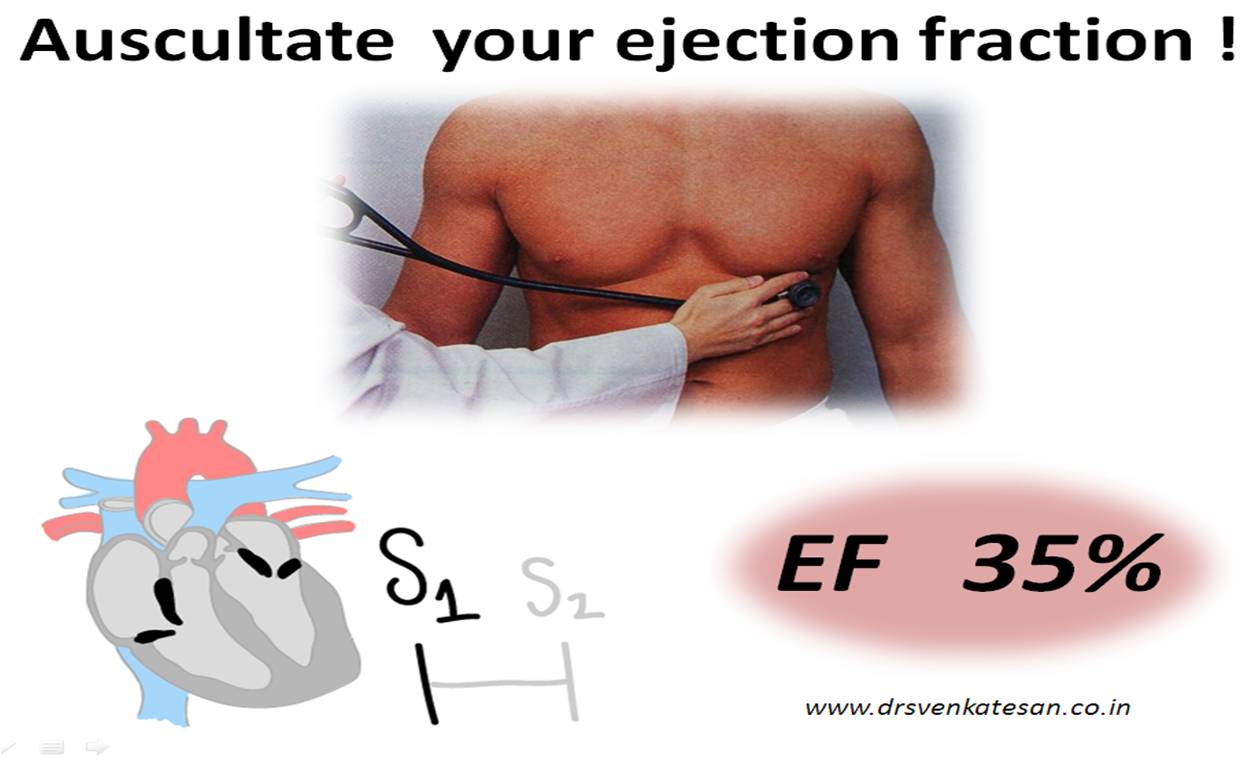
If all these signs are present EF is likely to be less than 35 % with 90 % specificity . If this is accompanied by  true cardio-megaly in X-ray chest,  LV dysfunction can be diagnosed with a  precision  reaching almost  100% .

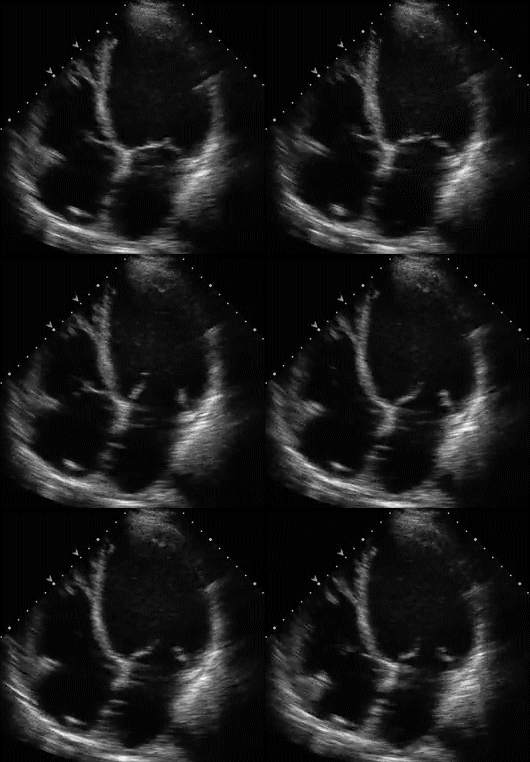
Note the sluggish motion of mitral leaflets and how closely the LV contractility is related to AML movement.This man had a soft S1 and his EF was 30 %

* Tachycardia may be  a non specific finding . Further ,base line tachycardia may  not be present  in all cases of LV dysfunction . When there is a  sudden surge in HR  even with minimal exertion , it  suggests   severe  LV dysfunction.

** The above clues  may not apply  in  valvular heart disease  , and isolated right heart disease  as multiple factors may impact S1 intensity .

*** LV failure must be distinguished from LV dysfunction (Vide infra)

Similarly , a  patient can not have significant  LV  dysfunction if  one  detects any of the following.

  • If the first heart sound is loud
  • If he feels chest thumping as palpitation.(A fluttering and audible   mitral  AML has 100 %  predictive value for normal LV function )
  • If you here an aortic ejection sound (Vascular clicks ) . Ejection clicks need significant force for it’s generation.

Final message

The most mobile structure of the heart is  anterior mitral leaflet . Fortunately it’s closure is  well heard as   S1 . Mind you, the most important determinant of  S1 intensity is  LV  contractility.  If your ear is sharp , and if you are able to  rule out other  reasons for soft S1  (Like obesity, pericardial effusion )  we are fairly  justified in suspecting significant Left ventricular dysfunction.

Further reading :

***What is the difference between LV dysfunction and  LV failure ?

Both these terms are  often  perceived  to convey the same meaning . But it  can  never be used synonymously .Cardiac failure is a clinical entity while LV dysfunction  is  a  derived  technical parameter  by and large an echocardiographic entity. Cardiac failure   is defined classically as a clinical syndrome .(elevated jvp, edema * S 3 rales etc)  Neuro hormonal activation  can occur with both.

A patient with   LV dysfunction    when destabilsed  develops   LV  failure and after stabilisation of   LV failure he is brought  back to  the baseline  LV dysfunction.

Read Full Post »

Most  cardiologists  are familiar with  “Circulation” . We know  it  is a top  cardiology  journal with highest impact factor.  Few of us are  aware  of  a journal called  “Circulation  research” ( I wonder  why it is named  like that ,  as if  the regular   circulation journal  does  not carry research stuff  !)

It is one of the  path breaking   journals that regularly  churn out state  of  the art , often  mind  boggling research stuff.  Once in while we should get a feel of  basic science  research  as it  happens.

How else we are going to know an  atrial cell is to be bio engineered  shortly to behave like a  SA node  in patients with sinus node dysfunction. (Biological pacing )

This team from academic  medical  centre Amsterdam   should be credited   for  publishing   this gem of  an  article   from  a  study  involving the  measly mice !

It  deals elaborately  about the embryonic basis of AV nodal  disorders  . Specifically it  explains  the genesis of  WPW syndrome and how AV rings get muscularised  .

(It  is  due to   error in  bio-genetic forces ,which  affect the    incorporation  of AV nodal tissue  in the  fibrous  skeleton .This   results  in ectopic  junctional  tissues appear   any where along  the AV ring . This is the basis of  accessory AV pathway and   clinical  re-excitation.)

Final message

Once in a while  we should develop the habit of reading  tough  journals  like circulation research . After all ,   if a cardiologist  is not reading   these stuff who else  . . . will  ?

Reference

http://circres.ahajournals.org/content/107/6/728.full.pdf+html

Read Full Post »

VPDs are the most common arrhythmia  that  confront  us  in  cardiology clinics .While  it can be a totally  benign   manifestation in some  ,  it may signify a sinister condition in others. ECG  is the easiest  and surest way to identify VPD.However  a shrewd echocardiographer can detect the VPDs while imaging the heart.It is often missed if one do not concentrate on the mitral valve motion.

Note :The VPD convert the typical M pattern into a inverted U pattern in mitral valve.

One of the important hemodynamic side-effect of VPD is intermittent mitral regurgitation.

Effect of VPD on mitral valve opening .

By  conventional thinking   VPDs  are expected   to impact  more on the  mitral  valve closure than it’s  opening .In reality it has indirect influence on mitral valve  opening as well. The retrograde  conduction(VA conduction) of the VPD determine the timing of atrial contraction and hence the   mitral valve opening. If the VPD gets blocked retrogradely  within AV node , the normal sinus impulse will activate the atria in an antegrade fashion .Note ,  he atrial activity  occur randomly when multiple VPDs occur.This makes the cardiac cycle too complex to assess especially the diastole. (In fact true  physiological diastole  may  not occur here !)

If  the mitral valve opening  is interfered by a   VPD  (Early diastole is  the  favorite time  for VPDs to  appear  !  )   .When it occurs the AML is    suddenly pushed  upon superiorly  by the premature ventricular activity and hence resets the  mechanical diastole. Please note electrical resetting of atrium is different from mechanical resetting.

It is also possible atria and ventricle contract simultaneously .This is the time , a cannon wave  may occur inside LA .VPDs can result in pulmonary venous canons and may even elevate pulmonary venous pressure   if  this  occurs repetitively .

Another possibility  is ,  VPDs  may not initiate a ventricular  contraction at all .It may be  simply  be an electrical event. That’s why  we changed the name of extra systole  and premature contraction into just   premature depolarisations.

Why is it important to know about M Mode motion of VPDs

Cardiologists  continue to  engage wide qrs  tachycardias   in the  wrong side  of their   brain for many  decades .The ECG debate about wide qrs tachycardia  is expected to  continue  for generations . !  Few smart cardiologists would  rapidly put  the echo probe  over the mitral valve and able to  differentiate  instantly a VT form SVT   with fair  degree of accuracy.

Detection  of regular M shaped mitral AML  will exclude a VT with a high degree of precision .(AV dissociation by echo )*

Even  presence of trivial  MR*  (More often diastolic )   which occur  irregularly  will  definitely indicate it is VT . SVT  hemodynamically   can not result in this  MR is gives us evidence for AV dissociation

* No reference for these observed indices in our lab. (Class 1 Level C expert opinion(  No one calls me as expert though ! )

What is the mechanism  of VPD induced  mitral regurgitation ?

It is well-known VPDs can cause   mitral regurgitation .Not every VPD cause MR.

  • The timing is important .
  • It can be  either systolic or diastolic MR .
  • If VPD occur in early diastole (After the T wave , the MR jet  will collide with  diastolic mitral flow. )
  • Paradoxical septal motion induced by VPDs can alter the pap muscle alignment transiently and result in MR
  • We dot not know how a LV apical VPD  differ from RVOT  VPD in the genesis of MR.
  • Logic would suggest RVOT  VPDs are unlikely to result in MR as there is  a time lag for the impulse to reach the LV base

What is  the effect of  VPD and Aortic valve opening ?

While  every VPD promptly  hits the mitral valve ,  aortic valve may or may not open with VPDs .Again timing and focus of VPD could be  important.This is the reason during  multiple  VPDs  only few open the aortic valve , that  explains  pulse deficit. (The so called missed beat )

Final message

Anterior mitral leaflet (AML) is the most mobile structure  of  the heart . Hence ,  it is not surprising to note  sudden unexpected ventricular contraction will  have maximum impact on this valve .

When VPDs occur in clusters or at random it has a complex effect on the mitral valve motion. This is responsible for  palpitation , minimal mitral regurgitation and rarely trouble some pulmonary venous cannons and raise in pulmonary venous pressure .

Careful analysis of  AML motion can give us useful clues to differentiate VT from SVT during wide  qrs tachycardia

Read Full Post »

Though heart is  primarily  known  as a  mechanical  organ , in reality   it is a vital  electrical organ as well . The entire mesh of electrical  pathway  from SA node to  Purkinje  fiber  would easily cross  a mile or two .Maintaining and protecting  such a  delicately  woven network  needs lots of  electrical sense  .  It is not surprising to note  , VT or VF  can be induced  virtually  in  every human heart  if stimulated rapidly. Electrocution  induced  by VF is  the typical example.Cardiac surgeons  do it regularly  before  surgery .

So , inducible  VT  in the EP  lab need to be  defined in a strict manner .

  •       VT must be triggered  by a  single stimuli  (or  two )
  •       Multiple sites should not be stimulated(ideally  single site , at most two )
  •       It should be sustained.
  •       Only mono-morphic VT has  significance
  •       Induced  p0lymorphic VT  has no clinical value.
  •       Pharmacological  stimulus  such as isoprenaline   can be used but reduces specificity.

*If a VT  rapidly degenerate  into VF  it  usually  means a polymorphic VT  while   unstable irregular  polymorphic VT   could be  same as   VF )

How do you make sure  what we induce in  EP lab is same as the clinical VT ?

This is the most difficult task for electro -physiologists. In real life setting VT is  often induced by ischemia hypoxia , local  acidosis and electrolytic imbalance. However  rarely mind this issue . In EP lab we induce  it  with  artificial electrodes  . Does it make sense to compare  these two totally different  set of triggers  in real life and a virtual EP life . Ideally  to confirm ischemic  VT  one has to induce ischemia  in EP lab and look for  VT . (Adenosine  stress ? )  Further ,  only re -entrant VTs  can be induced in EP lab by programmed stimulation . Automatic VTs can not be induced by stimulation .

The chances of inducing a VT in EP lab is  directily proportional to the aggression of the electro physiologists and patience  of  the  patient ! One can afford to use  more aggressive  protocols only   if a clinical VT was  recently the   documented .

 Electrical stress testing of heart

It may be tempting  to refer    induction of VT  in EP lab  as  electrical stress testing  for the heart. But fundamentally there is a difference  between this and  the conventional EST . Unlike exercise stress  test the  inducibility of VT highly unpredictable . It has far too many variables . (The surface area of contact , number , Intensity ,  site of stimuli , scar location , irritability of viable myocardium  ,  inertness of scarred myocardium ,  and finally the cellular milieu etc  )

Thoughts to ponder over Is it not  “a fundamentally a wrong concept”  to give importance  to inducible VT  ?

Why should we  treat a clinically non relevant inducible VT ? We do not know yet whether inducible VT in other wise normal LV function  has any long-term significance . Currently it makes   no sense   to intervene in VT  if the LV function is good and the episodes  are not clinical but only inducible.

Note: If there is severe LV dysfunction (EF < 30 % ) one can implant an  ICD without   an  EP study . ( Of course   to state more dramatically   without even single documented VT  !) MADIT 2

Final message .

A VT which is inducible in EP lab has no meaning ,  if the LV function is normal , while  even a  non-existent  (potential  )VT  in the setting of severe LV dysfunction is vitally important !

Though  we  differentiate cardiac function  into mechanical and electrical for academic purposes , it is astonishing to note   how the heart is able to function  as a  single unit  . We know today , the ultimate  outcome of   VT  is  not  dictated  by  electrical status of the heart rather , the mechanical ability  to  with -stand  sudden dis-organized  ventricular  contractions ( A ventricle with good contractile function has inherent  capacity  to extinguish most episodes  of VT .(Myocytes with inbuilt biological ICDs ?)

It is a million dolor question why some VT remain as non- sustained while others rapidly degenerate into  fast VT and VF thereafter

Reference

The two contrasting studies

The MUSTT (1999) trial exposed the limitation of   clinical utility of inducible VT . Multicenter Unsustained Tachycardia Trial (MUSTT) Investigators

While   MADIT 2  (2002)which recommends an ICD in every patients with  severe LV dysfunction following MI without even a EP study .

Read Full Post »

« Newer Posts - Older Posts »