Feeds:
Posts
Comments

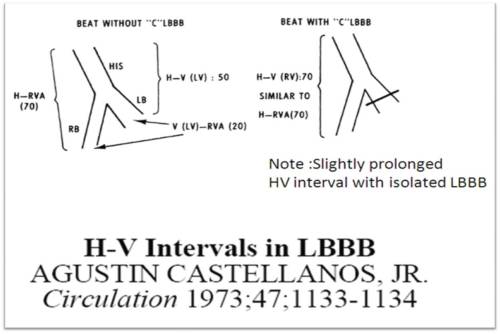
These simple questions were asked once upon a time  when cardiologists were not known as interventionists.Now many of them  have neither time  nor interest  to ask such questions .! An article   which came in Circulation 1974 addresses this question lucidly.

It is known, HV interval represents infra hisian conduction . And LBBB is  just that ! Then , why it is not prolonging it ?

The answer is ,  it does prolong  the HV interval  by 20 -40 ms , but , it is not manifested in surface ECG .  A 20 ms increment in PR interval (Say 160 to 180 ms ) is not a big issue generally.

* Then the concept of incomplete and complete LBBB is always there to confront us !

Many believe , the intraventricular conduction delay in LBBB may simply represent  the  “unmaking effect”  of   LBBB   which  re-routes  the conduction  in the slightly delayed  , circuitous   right bundle  highway   . But it is only a   assumption.Many things can happen in a  ischemic , degenerative, dysfunctional heart.

When does the HV interval prolong pathologically in LBBB ?

Acute LBBB (Note Left bundle  has two fascicles , technically  equivalent to bifasicular  block )  A 40ms  increment in HV interval (Hence in  PR interval also)   can be a dangerous delay in LBBB .

The commonest cause of syncope is the neuro-cardiogenic or vasovagal syncope .

The following is  the possible neural  circuit  of this syncope . In fact . it is a  “Neuro -vascular circuit”

The afferent* (Two components  are present  -Both trigger sympathetic signal )

  1. Sympathetic (Prodrome /Anxiety /fear )
  2. Cardiac mechano /stetch receptors  located mainly in LV .(Can be in Aorta/Carotid )

* In some cases sensors  and afferent can be same entities.

The centre – Medullary Nucleus ambiguous /Tractus solitarius

The efferent -Strong parasympathetic overshoot and sympathetic withdrawal

Parasympathetic excess lead to bradycardia primarily, while sympathetic  withdrawal lead to

hypotension

Syncope recovery

As patient recumbent posture ; LV gets filled and  LV mechanoreceptors are passified .

Final message

The exact pathophysiologic basis of this syncope  still  not elucidated.But one thing is clear , the syncope is due to sympatho- parasympatho signal mismatch( and sort of a rivalry reaction)  !In this neural game , heart’s behavior is all the more funny , it initiates the reflex  while  the brain stem  “Boomerangs” it back to heart and vascular system ,  with a vagal onslaught .

To call this  simply as vasovagal  is not proper , that is why neuro -cardiogenic syncope was used.

Ideal terminology  would be  to call it as  cardio -neuro -cardiac syncope   as the cardiac component form the afferent limb as well as the efferent (target organ )

Reference

Pericardium is a  fine  biological sensor. It   makes   noise when the kidney is in distress .

We call   this as uremic pericardial  rub .  This is not a universal phenomenon in renal failure.

Occurs in about 10% of renal failure .

Mechanism

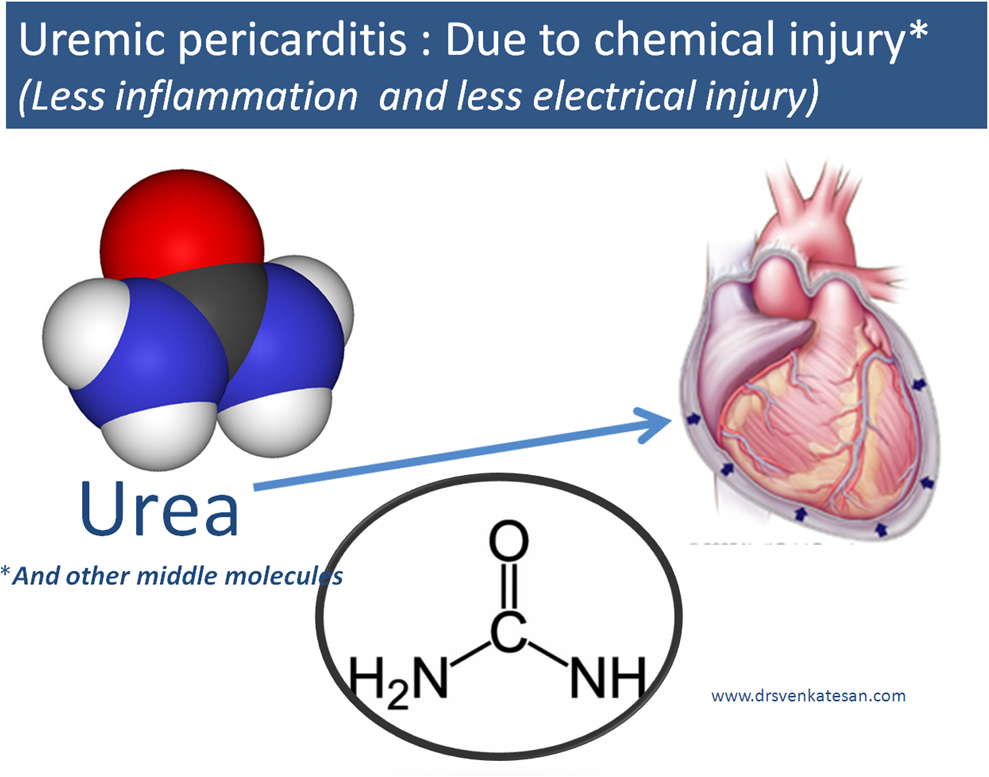
  • Chemical pericarditis . Uremic middle molecules ?
  • Dialysis related pericarditis
  • Associated infection

Two  themes can occur .

  • Pericarditis without effusion .
  • Effusion without pericarditis

The later is more common .

Is it a exudate or transudate ?

Usually a transudate. Protein accumulation may occur .

Hemorrhagic or non hemorrhagic effusion ?

Again both can occur. Platelet dysfunction is well known feature of renal failure .Bleeding into pericardial space  even a few cc of blood is suffice ,  to color the entire effusion  red  .

ECG features of uremic pericarditis , how is it different ?

The uremic pericarditis  less often results  in classical ST elevation  (concavity upwards)  instead the hyperkalemia features dominate , if present.

The reason for less conspicuous ST  elevation is due to the relative lack of  epicardial electrical injury . Further , the pericardial fluid  is enriched with  oppositely charged uremic molecules  which neutralise’s the

electrical gradient .

Relationship  of pericarditis  with acuteness of renal failure

Though it can occur in any form of uremia.It is more often observed in rapidly worsening renal failure

Relationship to dialysis

  • Presence of  pericardial rub is a classical indication for dialysis .(But not presence of effusion per se  )
  • While pericardial rub disappears in many ,  a  pericardial  rub that is  exclusively  observed  for the first time  after dialysis is well known .
  • The exact mechanism is not  clear . One explanation could be  the pericardial   surfaces gets approximated once pericardial fluid is filtered by dialysis.

Complication

Tamponade is common .Usually tolerated well till late stages as  LVH  and mild PAH are common which resists fluid compression.

Constriction can rarely occur. Tuberculosis can co exist.

Management

  • Indomethacin /Other NSAIDS
  • Steroids
  • Pericardiocenetesis
  • Surgery may be needed if recurrent pericarditis occur

Patients with pericardial rub should be dialysed heparin free .

Reference

Review article

http://emedicine.medscape.com/article/244810-overview

http://circ.ahajournals.org/cgi/content/short/53/5/896

Surgical management

http://ats.ctsnetjournals.org/cgi/content/abstract/22/6/588

Detection of  pericardial effusion was  the earliest  clinical application of echocardiography. Diagnosing  large effusions is a non issue .Assessing  minimal effusions (Systolic vs diastolic echo free space) and associated  thickened pericardium is tough even after 50 years of echocardiography.

Mainly , we are limited by the resolution power of echo. Further , lack of echocardiographic landmark for visceral  layer of pericardium (It is same as epicardium !) makes  diagnosis of  thickened pericardium a real tough exercise.It is said , normal pericardium is less than 4mm .

Where to measure it ?  how to measure is still not clear.

Why differentiating  minimal  pericardial effusion from  thickened pericardium  is important ?

  • Mild  pericardial effusion is  largely a benign finding in vast majority.
  • But , even a minimally thickened pericardium  due to active inflammation  can be significant.
  • Sticky pericardial effusion predispose to thickening and constriction.
  • Early recognition of this dreaded pericardial pathology is essential to interrupt the inflammatory process.
  • In CRF (With or without dialysis) even a  minimal pericardial  effusion can denote a dismal outcome .

Here is a link to Horowitz classification of mild  pericardial  effusion ...

http://circ.ahajournals.org/cgi/reprint/50/2/239

It could help us understand, How thickened pericardium presents in echo. Of course, CT and MRI now have increased sensitivity for diagnosing  pericardial thickening.

Cardiologists are often confronted with pregnant women in distress with heart disease. Obstetricians promptly refer them to cardiologists.

There is a tendency among cardiologists,  to make fun of obstetricians who  some times  call them for  frivolous  cardiac problem at odd hours  .(Say a VPD in the monitor or a systolic murmur of anemia etc)

Of course  , this   doesn’t mean in any way ,  cardiologists  belong to a superior  species  ! The fact  is  , many  cardiologists fare poorly in their  knowledge about the hemodynamics of pregnancy (Let them prove this wrong !)

A small quiz . . . for all cardiologists

  1. How much of  blood enter the maternal circulation after each uterine contraction during active labor ?
  2. Is the stress of normal delivery is   greater than that of  cesarean section under epidural anesthesia ?
  3. What anesthetic agent is ideal in patients with pulmonary hypertension ?
  4. How safe is  general anesthesia in a hypotensive  , heart disease patient ?
  5. What is the clinical significance of administering IV anesthetic vs inhaled anesthetic in a patient with right left shunt lesions ?

If a cardiologist is able to answer all  these 5 questions correctly without guessing , probably  they have  the right to make fun of obstetricians  or else  they have  to  quietly buy this book and read !

Final message

Every responsible cardiologist  must have good awareness about hemodynamic  stress of pregnancy and the intricacies of obstetrical anesthesia

It sounds  to be a  simple question . But, cardiology literature is sparse  on the subject.

RV mimics a three dimensional triangular chamber .The inflow, body and outflow align themselves in complex planes .This makes measurement difficult.

What  are the measurements to be made  ?

  • RV inflow tract (RVIT)
  • RV body
  • RV outflow tract (RVOT)
  • RV Free wall thickness

How to measure RV size ?

  • Inflow diameter is assessed in inflow view ( Para sternal long axis,probe  tilted down towards lower  sternal edge (cool . . .That is were tricuspid valve is located !)
  • RV body can be assessed in long axis or 4 chamber view
  • RVOT in short axis view.

What is the normal range ?

RV Body

< 3 cm in parasternal long axis view

<8 cm Long axis ( RV apex to mid point of TV )

RV inflow(RVOT)

<  3- 4cm

RV outflow (RVOT)

1.8 to 3 cm

Note :

  • All measurements are taken in end diastole .
  • The largest diameter of RV is at its inflow(it is roughly equivalent to tricuspid annulus)
  • RVOT size can vary  , generally tapers as it reaches near the pulmonary valve .

How common is the  differential RV enlargement*?

The complex shape and architecture of RV  make  the  direction , sequence  and magnitude of  RV enlargement less predictable .

  • Diastolic loading of RV generally have more uniform enlargement of RV .(Inflow, body, outflow )
  • In dilated cardiomyopathy RV enlargement  common in short axis > long axis
  • Pressure over  loading may not result in uniform enlargement as the pressure points on RV surface is not homogeneous.
  • In congenital heart disease , RV shape and size  depend more on the morphology(location of VSD, infundibular  anatomy, muscle bundles, extent of trabeculations etc)
  • In arrhythmogenic  RV dysplasia (ARVD) outflow  tract enlargement is more dominant.

* The fact that ,  RV can enlarge  in focal and localised manner make it mandatory to measure RV dimension in multiple views and in all possible diameters.

At what  pressure RV begins to enlarge ?

RV is believed to enlarge at > 60mmhg .Hypertrophy is usually precedes dilatation  .

At what volume overload RV begins to enlarge ?

Our experience with ASD indicate when the pulmonary  blood flow  is twice that of systemic blood flow RV is distinctly enlarged. May be it begins to enlarge at>  1.5: 1 shunt

RV begins to enlarge horizontally or longitudinally ?

this aspect is not studied much.  Generally volume overload causes more uniform enlargement.

How does acute RV enlargement differ from chronic RV enlargement ?

Dilatation is more conspicuous in acute RVE ( Pulmonary embolism, RV infarct ) associated wall motion defects and thinning favors acute RVE.

Normal or increased thickness is expected in chronic RV enlargement

Here is a  five-star rated  article on RV dimension

Published in 1986 , still considered a  land mark paper  . . .

Echocardiography  has  evolved over half a century . As it was pioneered by cardiologists , it is  still  believed to be an  exclusive tool of cardiologists ! In reality , it can have a wide spread clinical application  , as we recognize now.

Echocardiography can be useful in the assessment of

  • Central volume  status of a person in shock .It  can be  analysed by IVC diameter ,(IVC < 1cm hypovolemia >2cm elevated CVP ,
  • Assessing rehydration  by Tricuspid  flow velocity .
  • Acute pulmonary embolism , the first change could be  dilatation of  main pulmonary artery( later  RV )
  • ECHO can be a screening tool for any patient in shock  or acute dyspnea.
  • All neurologic emergencies -To screen  for cardiac source of embolus
  • Pericardial space assessment in  suspected tamponade.
  • It is of vital use in suspected acute aortic syndromes.
  • Even , live hemodynamic data from TEE probe  is possible in a critically ill person.

Here is  a 5 star rated website , dedicated to critical care Echocardiography

http://www.criticalecho.com/content/links

This is a 15 year old post, written in 2010 , just when, now famous TAPSE was introduced for RV function assessment.


Throughout the  history  of  echocardiography Right ventricular functional assessment  has received  less attention and suffered a  step motherly concern. There are innumerable parameters to assess LV function  , but we have  very few for RV !

LV ejection fraction continue  to reign supreme  in spite of the inaccuracies  and fallacies.RV ejection fraction by echo ,  never got into the main stream   cardiology literature as a tool for  RV function  assessment.

(The major reason for this  is ,  lack of  a “mathematical shape” for RV !)

RV is  formed by , a  horizontal inflow , an elongated and  wedged apex ,( in)conspicuous  body and an  ubiquitous RV outflow .No one  really knows , how  much  these  parts contribute  individually to the conductive  and contractile function of the low pressure venous ventricle.

(Of course, MRI and radionuclide derived RV EF can be accurate but doing these tests solely to measure  RV EF defies clinical sense !)

In this scenario,

Two parameter can be considered simple and accurate to estimate the RV function.

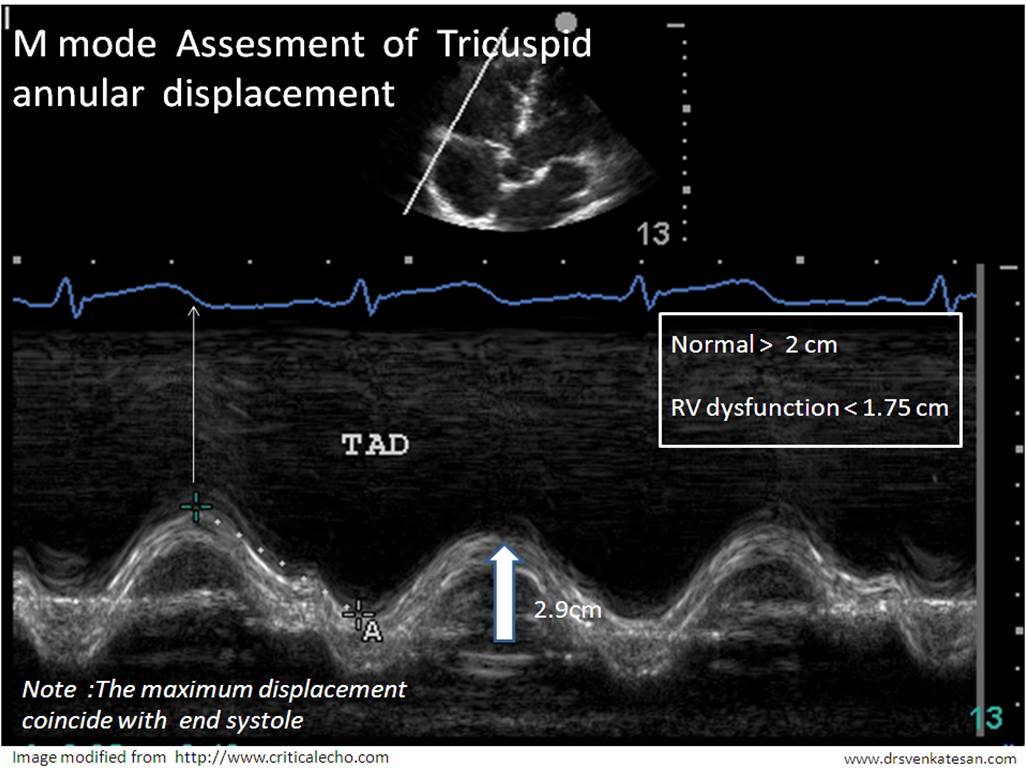
Tricuspid annular displacement (TAD)


This is a simple m-mode derived  parameter ( much ridiculed by  modern  day echo-cardiographer !)

M-mode echo in apical  4  chamber   view across lateral tricuspid annulus .

  • Normal displacement  >2 cm
  • RV dysfunction < 1.5cm
  • Borderline  RVD between    1.5 to 1.75 cm

The other parameter to measure tricuspid  motion is

Tricuspid Annulus peak Systolic velocity (TAPSV)*

  • This , in-fact linearly correlate with TAD.
  • Normal TAPSV is > 10cm/sec
  • Anything less than 8cm/sec is usually associated with RV dysfunction.

TAPSV – http://onlinelibrary.wiley.com/doi/10.1111/j.1540-8175.2006.00305.x/abstract

* One need not be  depressed if  tissue Doppler  is not availablein their  echo machine  , TVD by M mode is good enough in most situations.

Situations where RV function is impaired include

  • Severe forms of  dilated cardiomyopathy.
  • Primary (or secondary ) pulmonary hypertension
  • RV infarction
  • COPD -terminal stages
  • ARVD
  • RV dysfunction with VVI pacing
  • Following CRT

Final message

It is often  said there will  always be a simple solution for any  complex problem .  But,  it is  recognised late.

In our quest for ideal RV functional  parameter , we were entangled in the complexities for decades ,  only to realise  an obscure  M -mode  parameter in apical 4 chamber ,  could be   an  accurate way to exclude significant RV dysfunction.

Interventional cardiology is a glamorous  specialty. Everything is innovated . New devices come every day to ease the work of cardiologists.

But, the percutaneous vascular  closing devices are used for over a decade. Has it won the battle against the hand and sand ?

Still the judgment is not out regarding it’s utility.

My personal  opinion  is  . . .

And it is some what , ratified by this Meta analysis in

American Heart journal 2010 (.We expect the devices to evolve

and ultimately should prevail over the hands  )

Echocardiography is about 50 years old tool.It has evolved from simple M mode to sophisticated tissue Doppler and 4D imaging. Color Doppler imaging was a great revolution ( One  can  consider it  as big as invention of ultrasound itself  !)

Even though , we could code the pulse Doppler samples into color coded pixels (Called auto correlation computed by Fourier algorithm) the full potential of color Doppler is yet to be explored. Accurate assessment of regurgitation  lesion severity continue to trouble  us  .

The PISA concept fizzled out due it’s complexity and   inaccuracy.It  exhausted  thousands of  cardiology man  hours  and  precious  academic time ! (Not really waste . . .it stimulated our intellect !)

I wonder we have a method to predict  early  “The would be failed concepts”  in medicine !

Vena contracta* Who named it     http://en.wikipedia.org/wiki/Vena_contracta

Suddenly common sense struck us . . .  simplicity replaced complexity . The concept of vena contracta came in to vogue.

It is a  simple estimate of the  narrowest part of a regurgitant  jet.It  is good enough to assess the severity of regurgitation .The diameter is measured  in the   zoomed up view of  the  leaky valve  aided by color flow. If it is > 6mm it is severe regurgitation .(Both AR/MR)

Please note ,it is  one of the measurement  we  take in the  dimensional regurgitant  shell of (blood dome )  in the PISA method . The harrowing exercise of calculating ERO  with all those radius and velocity etc  may be fresh in many  minds !

Can’t we extend the simplicity of  the concept of vena contracta further ?

As usual ,  we assume  many things in medicine .

Here the concept of Vena contracta(VC)  requires

  • The orifice is near circular. (Very unlikely , considering the complex shape of mitral valve especially in diseased state)
  • The vena contracta applies only to single jet MR
  • Central jet (Eccenticity increase the chances altering the shape of ERO )

but, the major advantage is VC is not much  influenced by loading conditions .And the parameter used as such without amplifying the error.

Why vena contracta  is not used to  assess mitral stenosis  severity ?

I wonder why it shoudn’t ?  The same principles apply, the flow through  narrowest point of mitral  valve  will reflect the degree  of narrowing. In fact ,the inter-leaflet distance  could be   same as  vena contracta  in mitral stenosis.

If we assume !   the orifice as a circle,  then  50 %  the vena contracta is   the radius  the orifice  and ERO  can be easily arrived .

Logically yes. We need to validate the data ,comparing with a gold standard .When there is no gold standard , and what  we are testing is  better than gold standard what shall we do ?

Final message

Complex  measurements  lead to  complex errors (Lesson learnt from PISA) , with simple parameters  errors do not get amplified.

Do not ditch any investigation just because it is simple  . . .