Feeds:
Posts
Comments

It is traditionally believed  , renal blood flow is critically determined by the  luminal diameter  of  renal artery.But in reality  there are more important factors  other than renal  arterial diameter  that determine the glomerular  blood flow.  As in any vascular bed, it is the arterioles that determine the resistance and hence the flow . These arterioles  form the  critical  resistance  points and acts as   check  valves in this  “vascular  highway”  flowing across the renal terrain !

Unlike other micro-circulations ,  the kidney has a  special job to do ,  ie  filtering  the toxic  molecules.  Hence,   for the blood entering the kidneys  , even  nourishing the kidney seems ,  a less important  function !  The nephrons  of the kidneys are probably the most  “high – tech” cells in human body (Of course ,next only to brain cells ) .The vascular  tuft of glomerulus located within the bowman’s capsule  is perfused  by afferent arteriole and drained by efferent arteriole .

The entry of blood into glomerulus is regulated both by afferent and  efferent arteriolar  tone .These  two micro-circulaoty units  are under the  sensitive control of both neural  and humoral  signals. Glomerular circulation is meticulously  regulated by renal juxta glomerular apparatus.It modulates the glomerular  blood flow by secreting renin which  acts through Anigiotensin 2  on the   efferent arteriole .

The tone of the  efferent  arteriole  is thought to be the single important factor in this servo control mechanism.
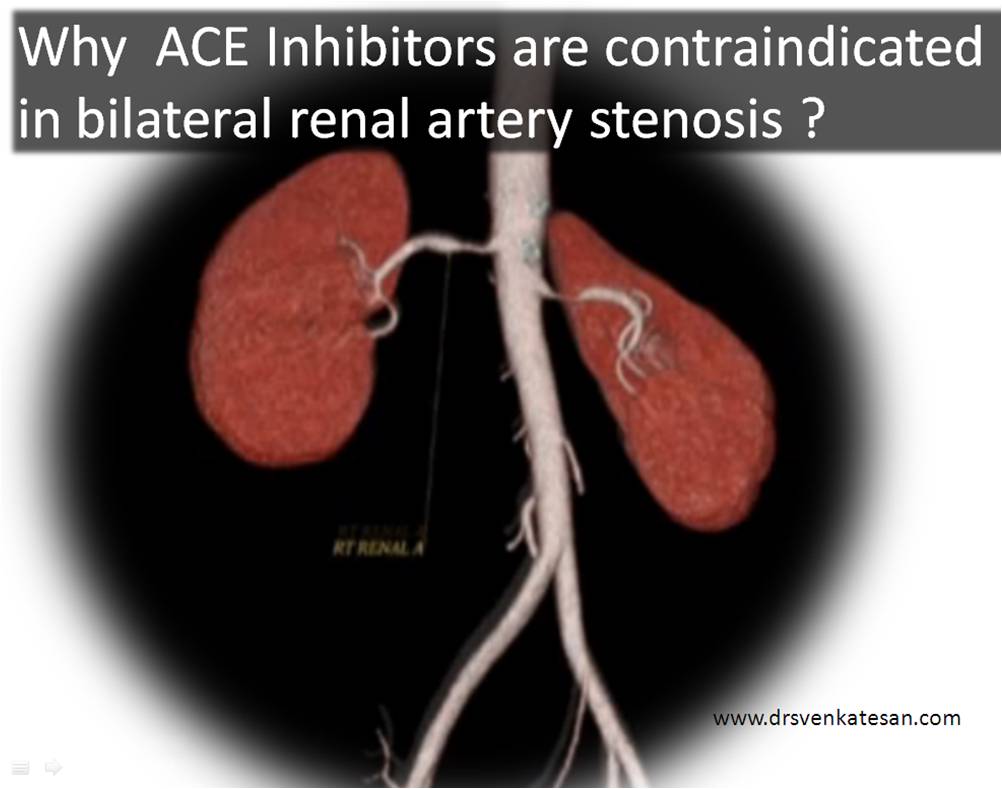
What happens in bilateral renal arterial stenosis ?

When there is bilateral renal arterial stenosis the effective renal blood flow is not  significantly reduced , but maintained at  the cost of increasing the efferent arteriolar constrictor tone. It  is  like a  check valve at  the  exit point of a dam , which is partially closed to maintain the adequate pressure head (Here , intra-glomerular  pressure head )

What happens when ACEI are introduced ?

Once ACE inhibitor  is administered , the efferent arteriolar   tone is removed , this triggers  the intra glomerular pressure to drop  suddenly and filtration pressure reduces .

Note: ACEI does  not reduce the renal  blood flow  directly  but  the glomerular  perfusion pressure drops hence precipitating acute renal function deterioration.

What is your comment about the reno-protective effects of ACEI ?

The medical science’s  most  crucial  moments  occur  , when we confront  two diagonally opposite views  are  debated  and both  suggest , there is definite benefit for the patient ! Cardiologists and nephrologists were always  made to believe  ,  ACEI are  unfriendly to kidneys . But ,we now have  evidence , ACEI is not an untouchable molecule in renal  dysfunction.

This is based on  the observations made , over the years that  excess Angiotensin 2  is  ultimately a liability for the kidneys !

Looking at a  long  term perspective  , AT 2  increases the intra -glomerular hypertension and ACEI inhibitors reduce it.This  pr0tects the  nephrons from  hyper-filtration  mode ,  that accelerates the  glomerular  injury . So , the  current thinking  is  ACEI has a definite role in arresting the progress of  renal cell injury .

This is akin to beta blocker story in CHF which was initially contraindicated in CHF later became a definite indication

The only issue for ACEI is , it should not be continued if an ARF like picture sets in .(Acute deterioration ). Otherwise ,  in CRF at any  basal level of serum creatinine  , ACEI can be continued . Some think even an  increase by few mg of creatinine  can be allowed .

So the following can be a working guideline *

  • ACEI can be started  or continued at any level of creatinine in stable CKD with or without dialysis

But ,ACEIs need to be stopped in all of the following 

  • Acute renal failures
  • Acute on chronic renal  failure
  • Accelerated elevation of  creatinine  (As in bilateral renal artery stenosis)

How much elevation of creatinine is allowed in CKD  with ACEI  ?

This is   not answered yet .

*Caution : The above conclusions on ACEI and creatinine was  derived  by me , based on  with  personal discussions with my  Nephrology colleagues. It may  be subjected to correction.

//

The much fancied criteria   “suspect secondary  HT” if the  onset of  hypertension  is   before 30 years   later than  55  years ,may be useful  .But a caution about this criteria  : It does not mean you should not hesitate to  diagnose renal HT  between 30 -55 years.  The  real onset may be   < 30years , but  the patient may report to the physician  late  in his /her  40 or 50s !

  1. Diastolic blood pressure > 120
  2. Sudden acceleration blood pressure
  3. Blood pressure which is  resistant to control with three or 4 drugs ,that shall typically include a  diuretic.
  4. An episode of left ventricular failure (Often referred to as  called flash pulmonary edema)
  5. Presence of  Hypertensive retinopathy
  6. Para umbilical bruit
  7. HT associated with significant CAD
  8. Marked LVH in echocardiography
  9. Finally , most importantly , worsening of renal function with ACE inhibitor is a  strong clue the kidney is under perfused  and  the   renal circulation  is dependent on  elevated angiotenisn 2 (Which ,if blocked worsens the GFR ).This implies every physician should take a baseline serum creatinine  and urea before starting them on ACEI.(Which is rarely followed , as far as my country is concerned !)

Is there any simple way to  differentiate  reno vascular from renal parenchymal HT ?

It is very difficult to differentiate between these two clinically. It makes things more difficult , as  combination of both occurs. Prolonged renal ischemia can result in parenchymal damage as well.

The simplest way is to do a rapid ultrasound imaging to assess kidney size and texture (Loss of cortical-medullary differentiation indicating early renal contraction phase ).Of course , our nephrology colleagues are always there to help you out .

* It need to be remembered the functional renal HT -Renal tubular acidosis,  Adrenal HT (Conn’s /chromo-pheocytomas  has to be ruled out , as these entities also occur in the same age group ).The combination of hypokalemia and mild alkalosis is a  good clue to rule out many of these  defects.

* The CT scan image used in the above illustration  courtesy

http://www.ajronline.org/cgi/content-nw/full/189/3/528/FIG21

For medical science  to  defy   logic , is a not a great  new discovery . “Diabetes is a major  risk factor for heart disease   but controlling diabetes may not  remove this risk factor” Similarly  severe mulitvessel CAD  occurs without  any symptoms and compromise on LV function . It is a natural human  instinct  to open of  any thing  that is obstructing   on  their  path . The same logic applies in   physicians when we encounter blocks in the vascular highways  .

For a moment compare  it with an express way .

We realise many  roads have a  reserve capacity . Even if the road is  half  blocked , traffic  congestion  rarely happens  as the  original road’s width is  sufficiently  large for the projected traffic . Some other roads have emergency  service lanes (Collaterals) that can take care the flow of traffic.

Another  question to ask is , Where does the road  lead to ? and why  we are  traveling ?

If it leads to a “dead  sea”  or a “bottom less cliff’  there is no purpose  to travel further . Similarly , when you find a destructed kidney with little nephron mass( or dead myocardium  ) there is absolutely no purpose  in opening the block . (Some  may  believe  the act  of  opening  block , by itself   is a success /  sorry- story !)

This is what happened in the lase decade . Interventional    radiologists , vascularologists , cardiologists started  opening  renal artery obstructions , at their whims and fancies, in  many elderly and middle-aged population .To their surprise (This surprise is due to ignorance )  they found no worthwhile benefit  either in the BP reduction or worsening renal function .

Now comes the evidence  in  2009  as   ASTRAL  trial from UK . ( As usual   the evidence came   late after ,  few lakhs  of kidneys   been injured !*

* Renal interventions are notorious for many complications , which is often not reported . Read this article to know  it better.

http://www.nejm.org/doi/pdf/10.1056/NEJMoa0905368

Final message

Common sense can  work great wonders than the much hyped RCTs . (Except ASTRAL  of course !) In this era of scarcity of  such  sense we can expect another study soon , to nullify ASTRAL  and give us further license  to pursuit the  good old  human instinct  ! Already silent noises  are made in interventional  corridors questioning the  outcome of ASTRAL.

Acute MI and ventricular tachycardia are closely related entities.In fact ,  the earliest response to ischemia could be a VT .But what  is peculiar about this VT is,  it  almost always degenerates into VF  within a minute or so.(Unlike idiopathic VTs /RVOT/LVOT VTs)

This arrhythmia in  every sense  can be called as  “primary VT which is the cause for “primary VF”

It is strongly  believed VF cannot occur without  a  brief episode of VT preceding it .Logic would also suggest  the ischemic myocardium  can not suddenly  become chaotic  “with the first  beat  “. There is little documentation available to unprove this presumption.

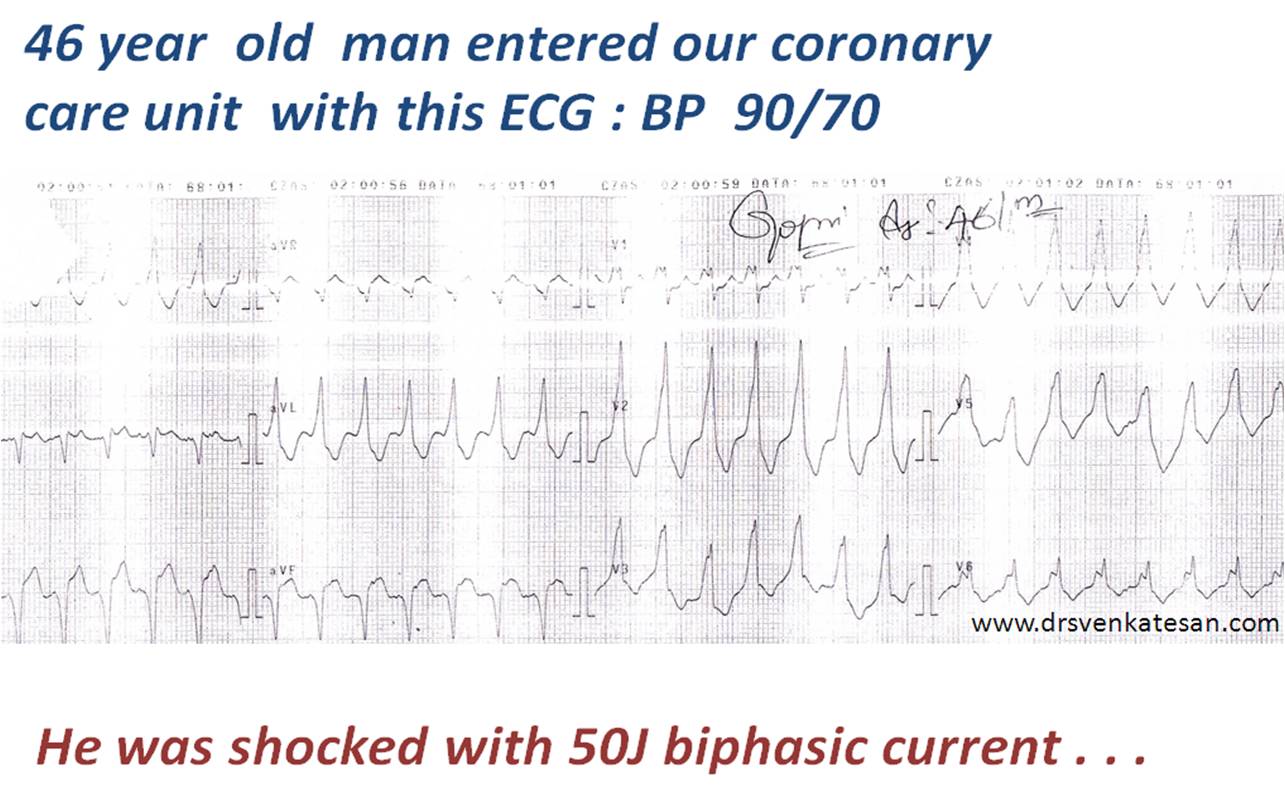
In spite of  this intimate relationship between VT and STEMI ,  it is very rare for a STEMI patient   to enter  ER with a sustained stable  ventricular tachycardia .  While  many VTs are known for it is hemodyanmic stability and immunity against degeneration   into  VF  , it is extremely rare  for  VT to remain as VT  in acute STEMI.

*Note : NSVT can be common   in  hospitalised patient in the coronary care unit . In our experience a sustained  VT in STEMI  will enter the VF mode within 60 seconds .If not , it is a highly  unusual phenomenon .

“But surprise is the other name of medicine ”

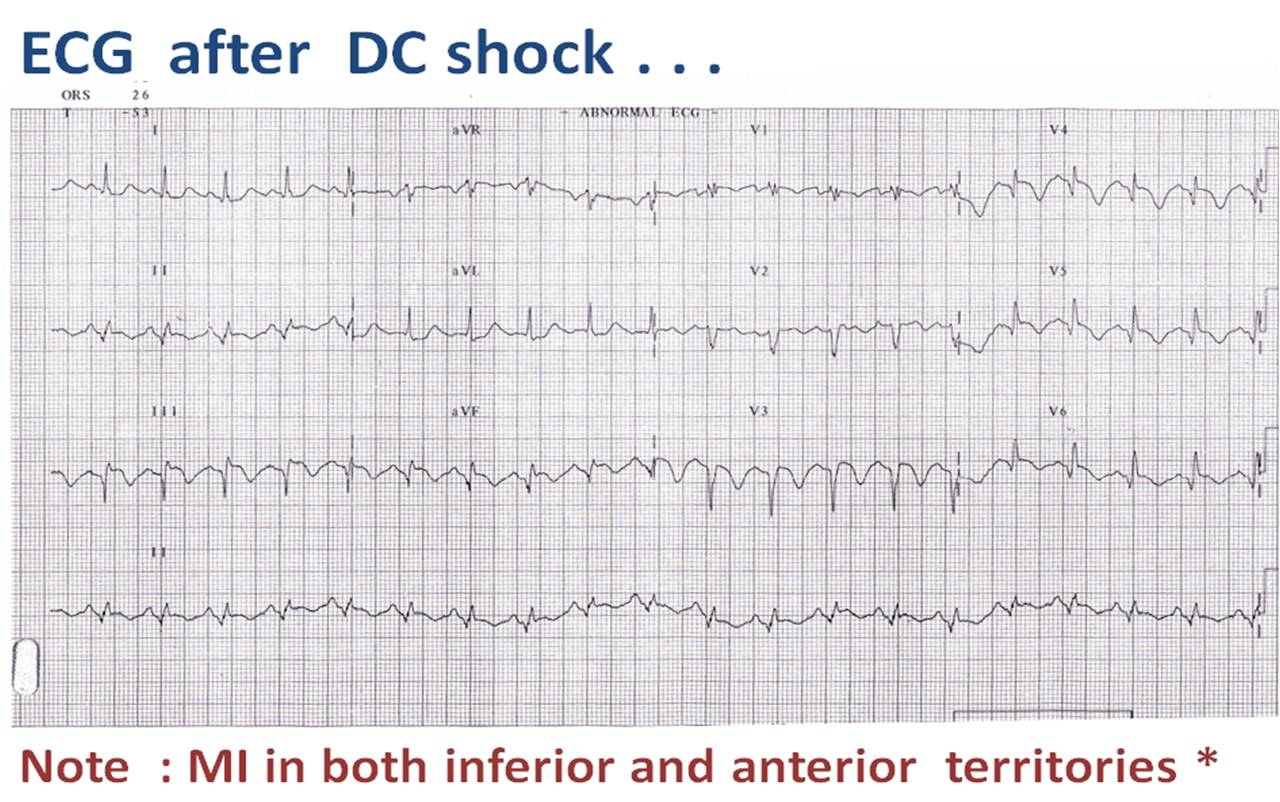
Here is  case report, a patient walked into coronary care unit with sustained( relatively stable) VT with LBBB morphology .We thought  it was   a  non- ischemic VT  (cardiomyopathy  , RVOT etc) .As we were examining him,  he became  unstable  and  was shocked 50 J biphasic .To our surprise a classical STEMI was unmasked and he was immediately  thrombolysed.

* It is possible ,  the patient had  suffered a  old MI  which got infarcted again and the VT  was scar mediated .

But it is still uncommon  for  it  not to degenerate into VF  with fresh  STEMI

Final message

Nearly all episodes of  ventricular tachycardia , that occur in the early minutes/ hours of  STEMI would degenerate into VF.This includes  VTs  that  occur within the CCU . Most  of the times , the CCU physicians and staffs  revert this VT  promptly and deny the  ventricles  from performing the dance of death !

It is extremely rare for an acute ischemic VT associated with STEMI to walk in to the hospital,  which our patient did !

Further reading and unanswered questions

  • What determines a VT to degenerate into VF ?
  • Why macro-reentrant , scar dependent VTs  often  are well tolerated ? ( In spite of LV dysfunction !)

We have read extensively  about LV pressure volume loops . What about Left atrial pressure volume relationship ?

This could be vitally important to  understand left atrial failure . While, it is often taught that , LA comes to the rescue of  left ventricle  at time of stress , we rarely talk about left  atrial failure !

Where  will the LA look  for help  when it is stressed ?

Pulmonary veins ?  , No , the LA  simply succumb and patient deteriorates.The only way it can react  is by a  panic response and starts fibrillating !. This is what happens in many  cases of dilated cardiomyopathy  and late stages of aortic valve disease . This AF is very poorly tolerated . ( Of course , we do not understand fully ,  why AF is relatively well  tolerated in severe  mitral stenosis  , inspite of very high  LA pressures Often >40mmHg?)

The  importance of left atrium as a mechanical chamber   is well  recognised .It is supposed to empty the blood  it receives  from pulmonary veins  within a narrow  pressure zone of  8-12mmhg within a  fraction of a second. Even a slight increase in LA pressure may result in pulmonary venous regurgitation and  the incoming venous tides are reversed(“a” reversal in pulmonary vein echo )  that results in the so called pulmonary congestion /Pulmonary venous hypertension.

If only god has created  additional pulmonary venous  valves** at it’s  entry , LA can perhaps a  relax a little bit  . But it is not the case  . So,  LA function becomes as  vital  as LV.

(**Can we create pulmonary venous check valves  ?  . . . will it be  an answer for preventing recurrent LVF in cardiomyopathies etc)

Here is an  article from European heart journal , which gives  great insight into Left atrial function.

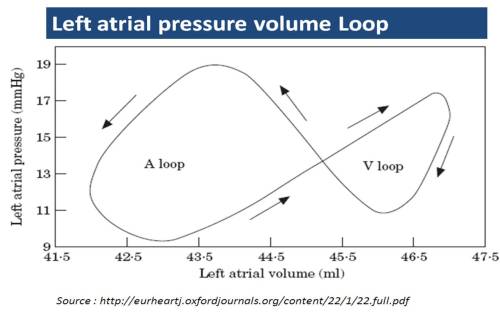
The one that has fascinated me is the  LA  pressure volume loop.

The two pressure waves in left atrium reflect distinct  properties . “v” wave  is a  volume dependent wave and  “a” wave a pressure generated wave . Surprisingly the volume dependent wave generates more pressure than the atrial contraction wave.(Note in LA  v > a while in RA a>v)

http://eurheartj.oxfordjournals.org/content/22/1/22.full.pdf

Ascites precox

Fluid retention is  a classical sign  of  cardiac failure . (Elevated JVP, hepatomegaly , edema legs ) The mechanism of fluid retention are many .But, traditionally we have given importance to   venous back pressure  (Hydrostatic pressure)  . Equally important (if not more !) is the renal sodium  and  fluid  conservation  in response to reduced effective renal blood flow.

How common is ascites in cardiac failure ?

While we see hydrothorax  little  more frequently  it is rare to  get ascites in cardiac failure .However ascites often manifests late  in the pre terminal phase of cardiac failure *. This is due to congestive hepatomegaly, secondary hyperaldosteronism and renal dysfunction .

When does ascites come early before edema of extremities in cardiac failure ?

It is  classically  reported in  constrictive pericarditis. The reason why ascites precedes edema legs is  long  been speculative . Now we have evidence , the pericardial pathology , has a direct effect on the hepatic venous morphology. There can be a  selective  , partial constrictor effect on at least one of the hepatic vein as it enters the right atrium .In fact , the entry point of hepatic vein is  delicately  close to IVC/RA junction.

*It should be remembered in the current era we are expected to diagnose cardiac  failure even before  the onset of edema !

Anatomical   constriction has a mechanical effect on the hepatic venous drainage  and subsequently alters the hepatic function . Segmental hepatic dysfunction is thought to  ooze out the   ascitic fluid  from the surface of liver .Ultimately severe raise of hepatic venous pressure results in congestive hepatomegaly and could result in now obsolete , cardiac cirrhosis.

Other mechanisms of ascites  in constrictive pericarditis , include

  • Hypoprotenimia
  • Common infection of  peritoneum and pericardium( like tueberculosis)

Is ascites precox an exclusive feature of constrictive pericarditis ?

Not necessarily so  . Even though , it was first described in this condition ,clinical experience  suggest, any  congestive cardiac failure with predominate right sided  pathology like organic tricuspid valve stenosis or regurgitation, right ventricular  endomyocardial  fibrosis  , all can result in significant ascites which may precede edema  legs.

What is  effect of  of severe TR on hepatic venous  hydrodynamics ?

TR like MR  can be eccentric and some times hits upon  the hepatic veins directly

and result in disproportionate elevation of hepatic venaous presure than even IVC pressure

which  may contribute to early ascites in organic tricuspid valve disease.

A related article in this blog

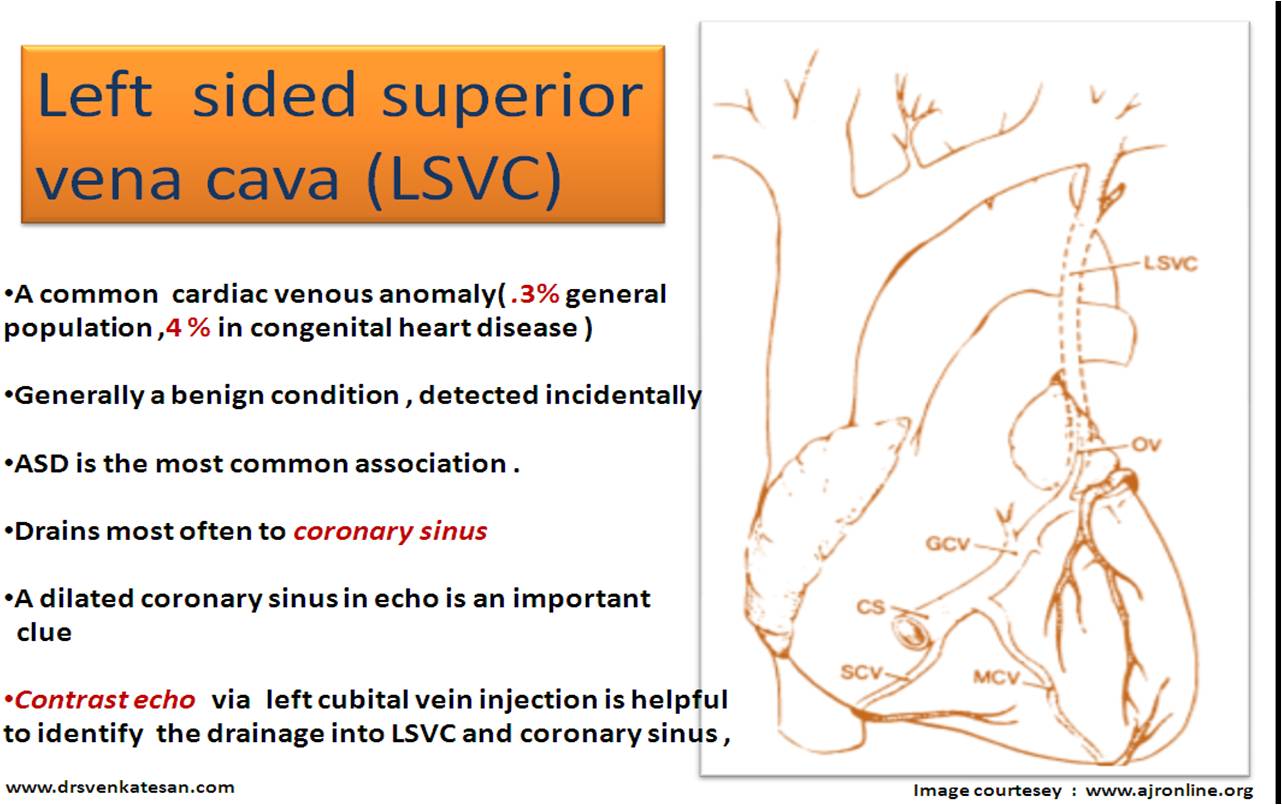
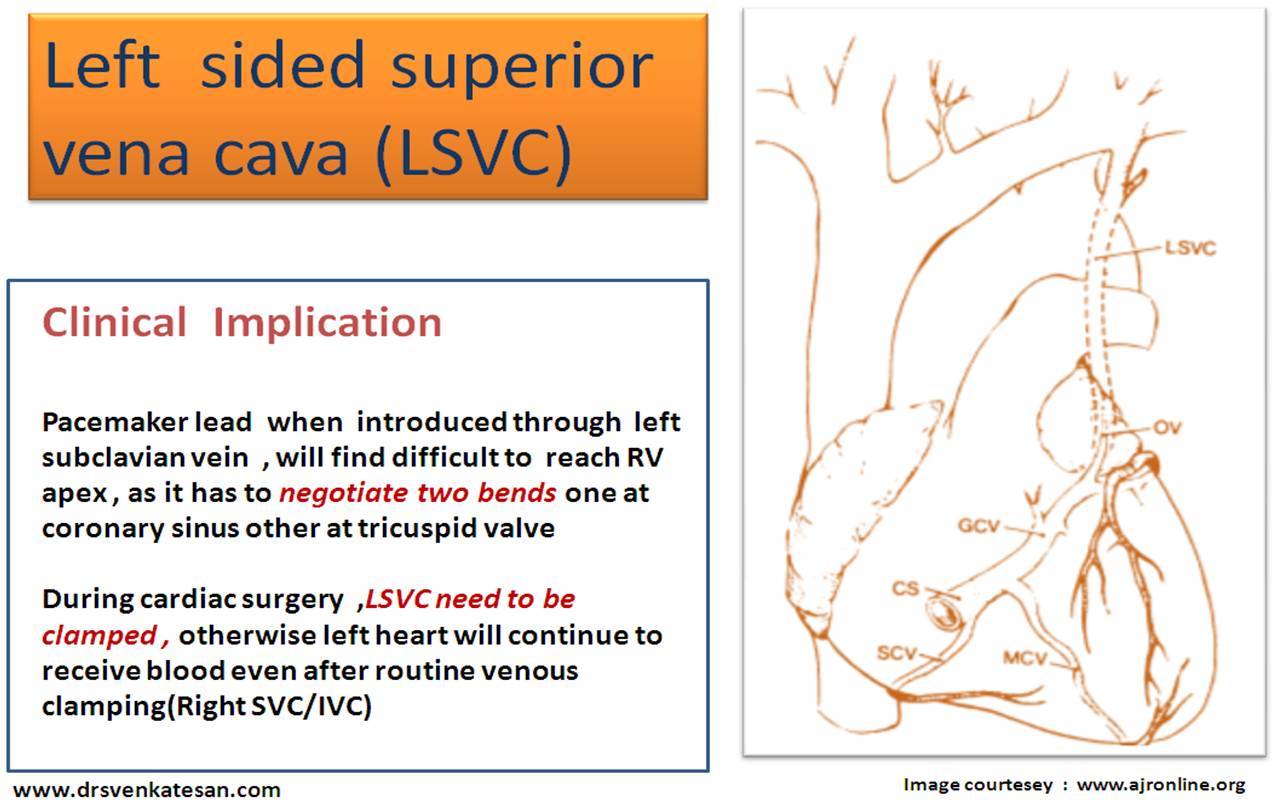
Un-roofed coronary sinus

Further reading :

A rare comprehensive review article on Thoracic venous anomalies

Fr0m American journal of  Roentgenology


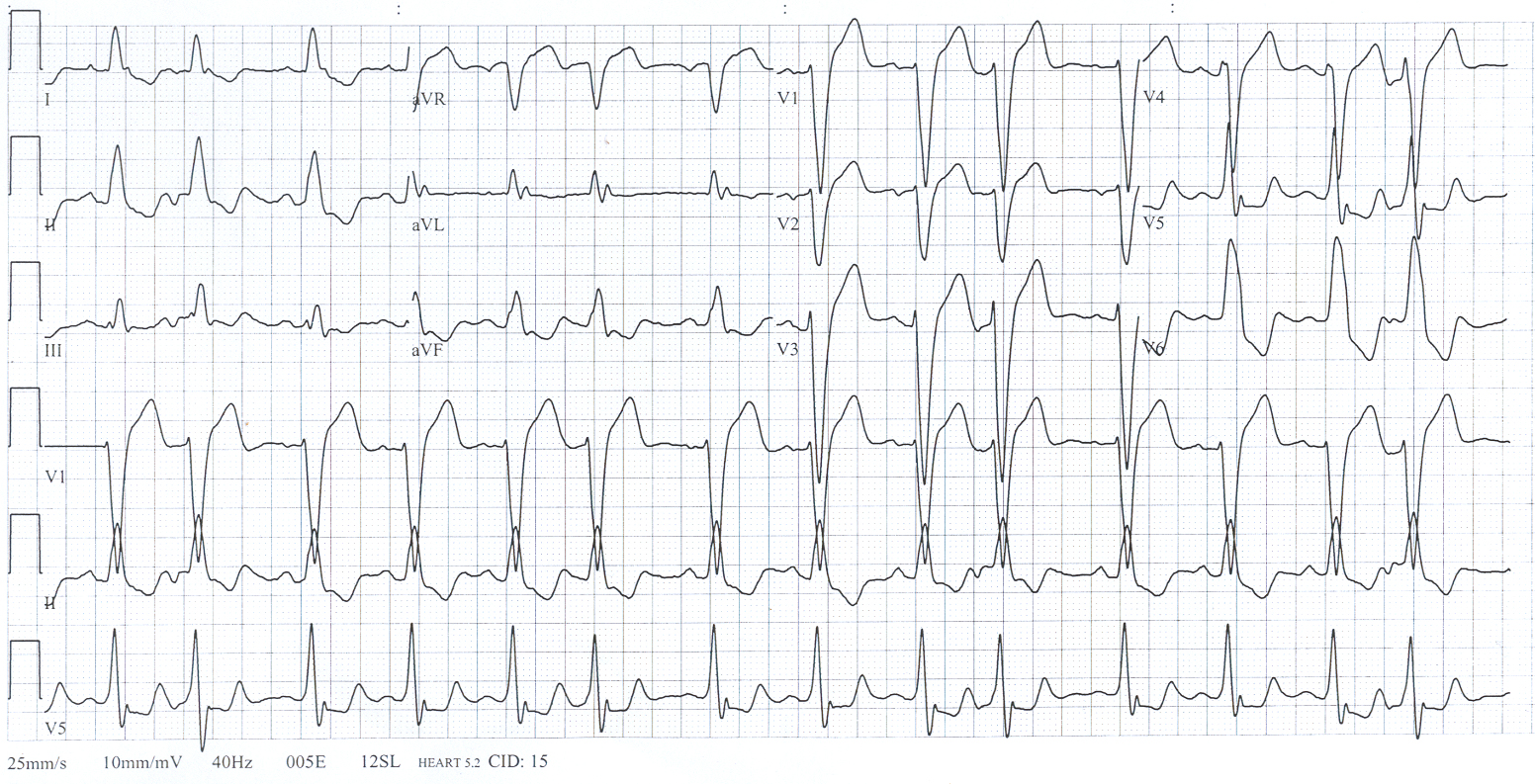
Why the qrs complex becomes wide and tall in LBBB ?

The qrs  complex is  wide , due to delayed conduction over non specialized fibres .The qrs  becomes are  tall due to temporal dissociation of RV  and  LV forces ,  which  leaves  the LV forces  unopposed , thus  a tall qrs  is inscribed  , without the neutralizing effect of RV forces.

Is muscle to muscle  conduction a hall mark of LBBB ?

No , it is not . Even though the left bundle is blocked , much of the conduction tend to occur in

specialized  conduction  system  . It depends upon the level of block of LBBB.

What is the mechanism and clinical significance of left axis deviation in isolated LBBB?

The mean qrs axis is surprisingly  not  altered greatly ,  in LBBB . If there is a significant left ward shift  it may imply associated organic LV pathology or involve ment of predominately  left anterior fascicle

What is  the impact of IVS contraction and timing in LBBB ?

In isolated LBBB, it is expected an abnormal septal motion due to altered sequence of septal activation. This results in an abnormal appearance of  septal motion in Mode (Septal beak immediately following qrs complex) .In fact , this sharp downward movement indicate good LV  function  .Absence  of which  is a  good clue  for a pathological LBBB due to structural heart disease

Why does the abnormal  septal motion in LBBB  ,  do not  desynchronize  the normal LV ?

CRT is the much fancied  treatment in patients with LBBB and cardiac failure. In normal ventricles LBBB do not destabilize LV function in spite of septal /free wall desynchronisation  .This is still a mystery how IVS is cope up with the totally unexpected  insult of asking to work in head over heal situation !In spite of  this the ventricle gets used to the altered conduction pattern and the contractile pattern.(Nature’s  at it’s best !)

What are the mechanical disadvantage of LBBB

  • Septal contraction is  ill-timed
  • Mitral  regurgitation

Most isolated chronic LBBBs  do not  confer  any hemodynamic  disadvantage  to LV  – why ?

LBBBs are dangerous looking ECG , but in most patients it is benign , in the absence  0f structural heart disease like valvular , myocardial or ischemic  disease.

Can there be a small r wave in V1 and V2 in LBBB ?

Yes . Though we expect the  reversal of septal depolarization  extinguish  the initial r in v1 to v3 .It is  noted in many. Hence presence of small r in v1 to   v3 does not rule out LBBB. 

  1. The commonest explanation given is un-masking of RV free wall forces which is   normally  masked by early LV forces .
  2. Another possibility is the   orientation of septum  in pathological states.
  3. Third possibility is  “r” may  actually represent  the  septal q waves as in LVH or old AWMI  .(Counterpart of small  q in lateral leads )

How do we explain concordant  pattern  of QRS  v1 to v6  in LBBB ?

We expect the qrs to  transit from QS  complex  to RS ,  at-least by lead  v5/v6 .Some times even V6  shows a RS complex.This is usually due to faulty lead  position or a grossly enlarged  LV,  ie  if we  record V 7 or V8 we will be able to pick up the qs complex.

What will be the morphology of a VPD that is arising  from LV in the presence of  LBBB ?

A premature beat arising  from a  ventricle which is having  a bundle block  is  sort of  electrical blessing !The VPD often bye  passes the block and makes  the conduction near normal  and a normal  qrs may be  recorded. So , when a patient with LBBB suddenly develops a normal qrs beat or  normal qrs tachycardia  one  should consider a VT arising from the  Left ventricle .

And a studious electro physiology fellow  should  be able to answer the following !

What will be the morphology of  VPD if it arises from RV and septum in the presence of  LBBB ?

Kindwall has tried answer  this question

What is the effect of  LBBB on S1 and  S 2 ?

The classical  description in LBBB   is

  • Paradoxical split of S2
  • Wide split of S1

You are supposed to hear  4 components in complete LBBB  !  In reality this does not happen . At best you can hear the reversed  split of  S2 with difficulty .

One  more reason  for the  non manifestation of these splits is  confounding factors like LV dysfunction , MR , PR interval etc .(Each one tend to pull or push  S1 and S 2 in different directions )

Do  patients with LBBB  , are at increased risk for developing  complete heart block   when

beta blockers , calcium blockers etc  are administered ?

Common sense would say yes. Scientific  sense has  no answer .

We know, ventricles are innervated by two bundles  .When only one bundle  is  functional, it means the ventricles  are experiencing  50 % power shutdown .   In CAD  , single vessel blood supply due to a CTO  is considered  dangerous but in electrical  flow it is not so !  In spite of the fact  that  ventricle has numerous  cell cell electromotive conduction   it is  always better to exercise caution  when administering  beta blockers, calcium blockers and digoxin in patients with LBBB . If it is a must periodic  monitoring is advised .(HV interval in isolated LBBB is slightly prolonged ) Never administer beat blocker in a patient with recent onset LBBB and ACS

Also read the related article  in this blog  Incomplete LBBB

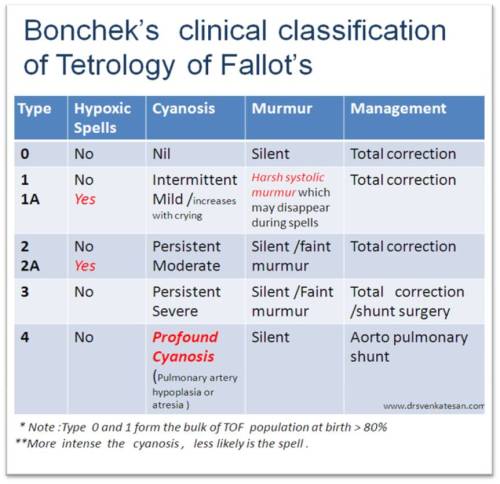
Tetrology of Fallot is the commonest cyanotic heart disease . In 1973 , working at Portland,  Oregon , Bonchek  and colleagues created this classic with intense clinical acumen , that defined the way   how we understood TOF   in infancy  . Such studies  have  become extinct in this fast paced cardiology academia !

With due tributes , here is a slightly modified version of Bonchek classification of  TOF in infancy .

Every cardiologist must read every line of this article  which came 37 years ago  !

Welcome to the new era of “medical avatar “

Cardiologist’s ultimate dream  of  monitoring  their patients

Live ECG feed in your cell phone  !

Thanks to the American “scientific  pursuit” and the mankind  will be  the beneficiary !

Courtesy :

Airstrip technologies

What’s next ?

Remote DC shock and pacing  .

Watch out  . . . it is going to happen in next 5-10 years !