Feeds:
Posts
Comments

LBBB is probably the most important  conduction defect of the heart .When we say LBBB , we visualize a  strikingly  wide bizarre qrs complex .

Left bundle even though is considered  a discrete structure , the fascicles  make it a diffusely spread structure. Many varieties of LBBB with various degrees of involvement occur.

Talking about the basics of  LBBB  electrophysiology  is out of place for the current generation cardiologists,  who  have little spare time as  they sweat it out inside the cathlabs.

In early 1960s and 70s great articles came from pioneers regarding these defects. If we want get a good insight  read  this  articles from  Sodi palleres .Who  says LBBB is a dynamic process, where it can occur from mild functional  delay to a total block .

The conduction  properties of left bundle is very much influenced by heart rate.

Law of statistics would  suggest  for every complete LBBB  at least three to 4 times incidence of incomplete  LBBB

Then . . .

Why we are not diagnosing ILBBB often ?

  • We miss it
  • Mistake it with LVH
  • We know it  is there , but we do not  want  to diagnose it .

How to diagnose ILBBB?

See  Sodi palleres criteria*

What is the relationship between qrs width and completeness of LBBB ?

Surprisingly and contrary to the belief , the width of the qrs has no linear correlation between severity of LBBB. In fact incomplete  LBBB can occur with even 150ms qrs !

Then ,  what  exactly determine the completeness of LBBB ?

What  matters is , whether the down coming impulse gets blocked  and split in the  left side of the IVS or not ? This causes the  the septal vector to  change  it’s direction ( ie  right to left instead of the normal left to right) It  removes the initial small r wave in v1  and q in v6  in complete LBBB. In  incomplete LBBB these  r and q are  often retained .

What is the differential diagnosis of ILBBB ?

Type B WPW may mimic LBBB and vice versa.

LV hypertrophy .

Differences : See table in  the Barold’s article  linked above .

Unanswered questions

  1. How common is ILBBB in STEMI ?
  2. How often ILBBB progress to LBBB ?
  3. ILBBB in dilated cardiomyopathy : Is desynchrony an issue ? (Normal QRS CHF !)
  4. Is functional  rate dependent  LBBB in cornary care units  same as transient  ischemic LBBB ?
  5. Intermittent LBBB and Incomplete LBBB  aren’t they  synonymous ?

Final message

ILBBB is not that uncommon as one would  tend to perceive.

Reference

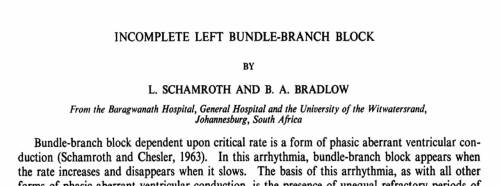
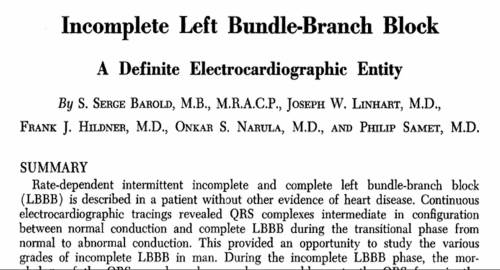
My humble tributes to  Barold, Sodi -palleres , and Leo  Schamroth . Probably  one of the best  article on ILBBB is linked below. Reviewed    in 1963 !  Not much data has been added  in the next 47 years as on 2010

ERS -Early repolarisation syndrome  is known as a   benign ECG finding  for  many decades  .Now it  is beginning to look dangerous as evidence is accumulating  it may have a link with ventricular arrhythmias.

ERS represents complex changes in  ionic movements during  cardiac repolarisation . (To be specific , it is due to a functional gain of  K + ionic channels during phase 3 of action potential).Generally this is a very benign condition. But , what concern us is ,  it can predispose to ventricular arrhythmias when these patients are confronted with ischemia .

When repolarisation occur early it indirectly shorts the QT interval .We know QT interval is a notorious period in human ECG as both a short and long (<320ms, > 460ms)  can be dangerous.

Is ERS a marker for potential cause for primary VF ?

Read this article from NEJM 2009

There are thousands of medical journal published worldover. Dozens are available in the field of cardiology .Only a few  are dedicated for pediatric cardiology.  Annals of pediatric cardiology is one .

It is all the more  creditable , as it comes from India , A country which is lesser known for scientific infrastructure  .  Full credit to the  pediatric cardiologist associataion of India and the medknow publishers for  bringing  this  highly specialised scientific content in this part of the world .

Association of pediatrics of India  has done a wonderful job .This may the first of it’s kind to formulate a excellent guidelines for managing CHD in India . This was made possible by the consensus conference on CHD held in AIIMS in 2007.

A must read for every physician, pediatrician and  cardiologist

It is recommended , this  guideline should be incorporated in every undergraduate curriculum of  medicine .This article which was published three years ago ,  should  have been published in the Indian  heart journal also.

Thanks to Indian association of pediatrics for providing this article  free

Link to article.2007 consenus conference on CHD Newdelhi

Thrombolytic therapy  is the specific  therapy  for Ischemic stroke ,  when administered in less than 3 hours ( Now 6 h ?)  and has proven to  save lives and brain .The only issue is , we need a 100% exclusion of hemorrhagic  stroke by a CT/MRI. The mechanism of action of thrombolytic agent is simple .It lyses cerebral thrombosis and makes way for sustained reperfusion and arrest or even  reverse  the  ischemic damage to  neurones .

And now ,   let us see ,  how we perceive the same therapy in a patient  with a  history of  recent ischemic stroke  with an  acute STEMI .

The issue is two fold.

  • He needs urgent myocardial salvage in the form of thrombolysis or PCI .
  • The thrombolysis or PCI should not worsen the  cerebral infarct.

According to  most standard literature thrombolytic therapy is an absolute contraindication in a patient with STEMI and recent history of ischemic stroke (<3 months )

The  term absolute means ‘it is medical  crime” to give TPA or Streptokinase.
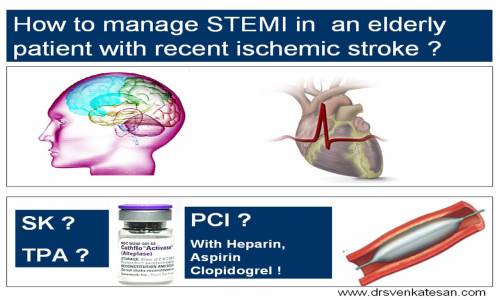
How  is it possible when the same drug  is  projected a savior in acute ischemic   neurological  emergencies  and  be dangerous when administered  few months later in an evolved ischemic stroke ?

The major  reasoning  against thrombolysis in recent stroke is  the  potential concern for  converting an  indolent ischemic  infarct into hemorrhagic  infarct in  a  patient who may start  bleeding  into brain.

This is  highly conjectural  , as  a previous history of  ischemic   stroke in no way increases the bleeding risk .Conversion of ischemic to hemorrhagic   infarct tend to  occur  in the very early  hours  of acute stroke (not weeks later) .This could be part of calcium induced  reperfusion injury .

Unanswered questions

The issue become further  complicated with our  skewed  thinking pattern.

If thrombolysis  is contraindicated  in STEMI , does  it any way imply a automatic indication for  primary PCI ?

It seems so , for most of us !

How safe is PCI in a patient  with a previous  history of ischemic stroke ?

  • An emergency PCI in a patient  who is expected to have   widespread  cerebral  carotid , and peripheral vascular  disease  is fraught with added hazard.
  • Aortic arch manipulation  and aortic  valve  atherosclerotic  changes  might  increase a risk  of another stroke.
  • The drug we administer  during PCI  are  not innocuous ones  . Aspirin ,  Heparin, clopidogrel (sometimes  even 2b 3a!) will  keep the  risk  of converting the ischemic infarct into  hemorrhagic infarct remain  at  dangerous  levels . This ridicules  the  very  logic  of   PCI being preferred over thrombolysis in such situations .
  • So it is not an  easy decision to do  primary  PCI in an elderly  patient  with STEMI and a recent CVA. It is only a mirage of  medical  intellectualism  and  the blind following  of unscrutinized  scientific  literature   that   determine  many of the decision  making  in cardiology .

The argument here is ,  in a patient  with evolved ,  uncomplicated ischemic  stroke thrombolysis can safely be administered  irrespective of the age of stroke.  .This is contrary to the published literature.Let us not make unethical practice against scientific literature  but let us also understand   it is unethical  not to realise  many of the so-called scientific  evidence  are  merely speculative.I  request  the  neurologists  and cardiologists give their   input on  the issue

As far as  I have searched  the superiority or inferiority  of thrombolysis   vs PCI in  recent  ischemic CVA has never been compared one to one. The fact may be ,  such a study is never possible in the future .But  it seems PCI has won the   trial  without  a trial .

Unanswered  questions

How  many deaths have happened due to worsening of stroke after thrombolysis ?

How safe is a  combination of aspirin, heparin and clopidogrel in a patient with recent stroke ?

How shall we decide about thrombolysis  in these situations  of STEMI and recent CVA) depending upon the

  • Age of  CVA
  • Location of cerebral infarct
  • Size of the infarct
  • Residual neurological deficit

It may be prudent to redefine  the indication for thrombolysis and PCI in a patient  with history of recent or remote stroke.

  • It is logical to assess the potential   risk of   converting the ischemic cerebral infarct   into hemorrhagic infarct.
  • It is expected only large infarct in vital locations need to be feared upon for this complication
  • All small healed cerebral infarct need not be worried about reactivation.

How to asses the healing of cerebral  infarct?

The healing  and gliosis  is highly dependent  on individual response to inflammation. Some heal  within weeks. Neo vascularisation within the necrtoic area may get hyperpermiable .These are very speculative concerns. In all probability   the risk of converting an ischemic necrosis into hemorrhagic  necrosis  is less than a  percentage .The 3 months time for  fixed for infarct healing  is an arbitrary one

How good is MRI to predict a healed infarct from nonhealed infarct ?

As of now,  we have no good tools to identify the  safe infarcts that can withstand intensive  anticoagulation or even thrombolysis .If the imaging techniques improve we may able to predict complete gliosis and the vascularisation  of cerebral scars.

Post blog query

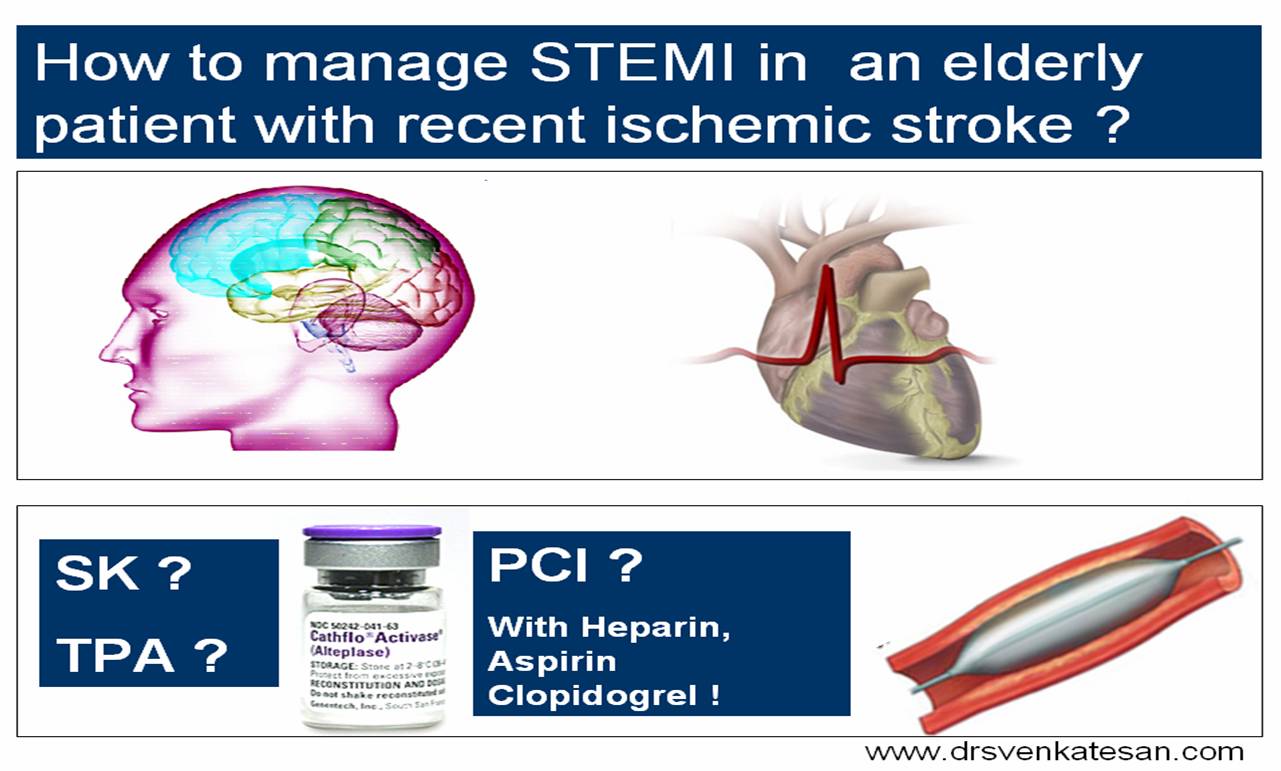
How to manage an elderly man with STEMI in a patient with recent ischemic stroke ?

A.Take him to cath lab and do primary PCI
B.Thrombolyse with TPA or Streptokinase
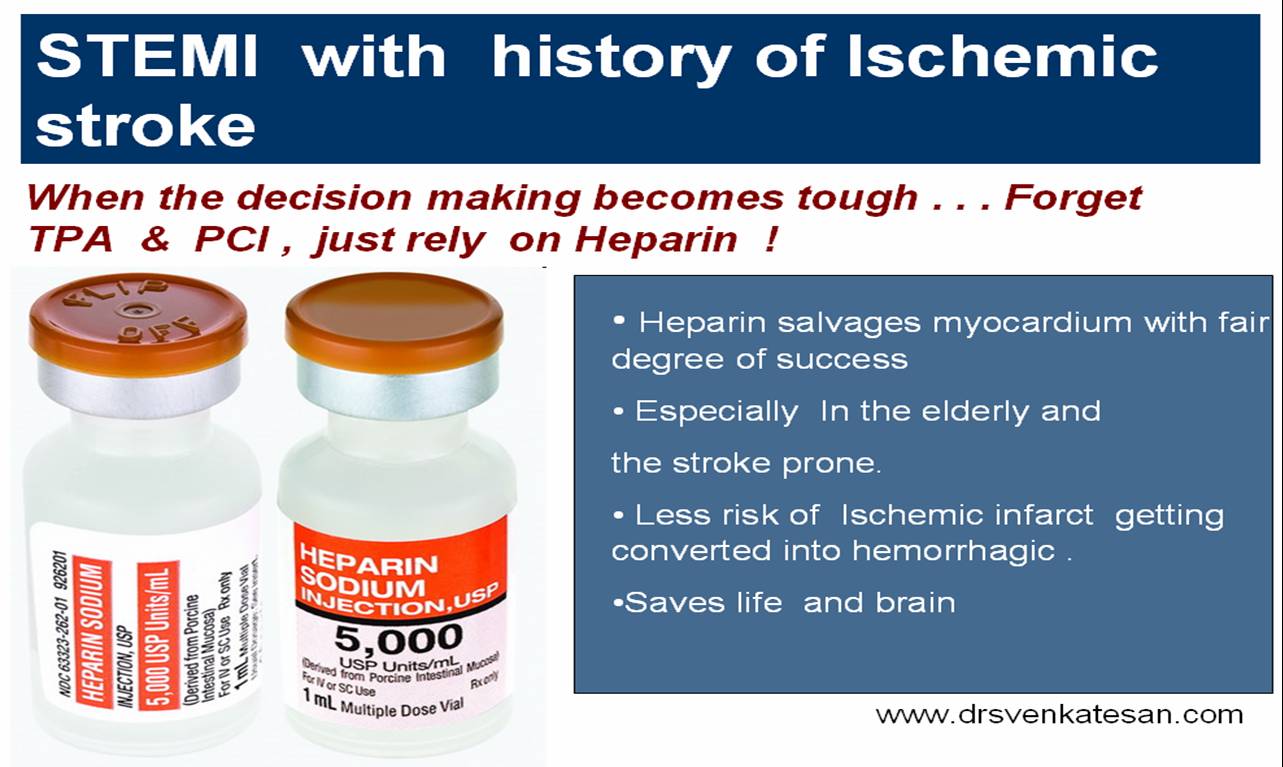
C.Just observe and  manage  with Heparin*

Answer : Any of the above can be correct answer .

If  we  still think  the answer is only   “A”  great reforms need to be done in  medical science  . . .

*Another important option for STEMI and recent stroke (Perceived  as inferior form of management of STEMI !)
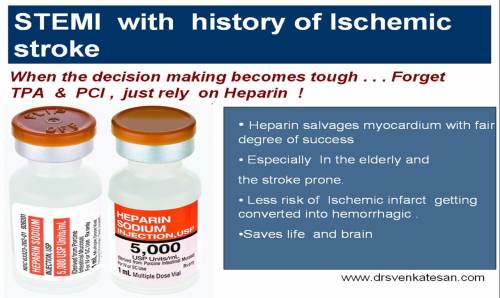

An important option is ,  neither thrombolysis nor PCI just simple heparin for STEMI in these high risk individuals .This simple treatment has saved many lives .

See A Related video  from you tube : Forgotten hero  in cardiology

Final message

In this world of gross approximation  and perceived fears ,  it may be reasonable to  shift  the  indication of   thrombolysis for STEMI( with h/o recent stroke ) from absolute to relative contraindication.

Many of the  junior  physicians  in the learning curve may take it as granted  in the management of STEMI  “If thrombolysis is contraindicated  , then primary PCI must be indicated ” This again  is absolutely not true  !

//
Thrombus formation  and subsequent lysis  either spontaneous or pharmacological is the key events in acute vascular emergencies .We know both STEMI and acute strokes can get aborted  naturally.

The thrombus which initially forms , triggers a natural lytic mechanism and this fights vigorously against the clotting process , and tries to get rid  of the intravascular clot.

The early  minutes are vital. (Like the T 20 cricket )  the win or loss is decided in the first few overs . The mantra is unrelented attack of the ball . . .ie thrombus !  In some patients  the clot  can never grow big to fill the lumen.These are lucky few .The mechanisms are common in both cerebral and coronary circulation. Here is were comes the role of antiplatelet agesnt .An aspirin or clopidogrel administered within minutes can prevent the genesis of  central core of the thrombus .(This is the  secret of aspirin scoring over stretokinase in STEMI in ISIS2 study done three deaceds ago !)

It should be realised,  our understanding about spontaneous lysis is very little considering explosive growth of other aspects of cardiology. It is mediated by circulating  TPA and antithrombin 3  .  Remember  every humans have it in their  blood .But how much ? How to augment it ‘s power at times of thrombotic crises ?

What could be the clinical correlates of spontaneous thrombolysis ?

  1. In brain classically it is TIA .
  2. In heart do we have TIA equivalents ?  .Yes it transient rest angina

Link to video on TIA of the heart

Read this article to get a glimpse of  natural cerebral thrombolysis  and shall we   extrapolate it to coronary spontaneous thrombolysis  .Why not ?

Arch Neurol — Nonocclusion and Spontaneous Recanalization Rates in Acute Ischemic Stroke: A Review of Cerebral Angiography Studies, December 2002, Kassem-Moussa and Graffagnino 59 (12): 1870

The greatest  adverse effect of modern medical science is the  notorious phenomenon  of  amplifying  medical trivia .We rarely realise how much of anxiety this causes to our patients. We can’t complain either, as many of the medical professionals make a living out this.

For  cardiologists and echocardiologists , there is  often an  issue  in  reporting  some of their findings .Doppler is a great tool , especially the  color Doppler  which can pickup even few clusters  of RBCs that leak into atria  every time the AV valves closes. Ideally this  has to be  labeled as physiological MR or TR .If the arotic root is obliquely aligned with it’s leaflets one  may even  get a physiological AR .

While  it is better to ignore these lesions , some call it as Trivial MR / TR/AR .

This can be detected up to 40 % of individuals.

What does trivial regurgitation  mean to a doctor ?

It means nothing . Few may  use  it as  a weapon to advice further visits to their  clinic and do serial meaningless  follow up scans .The irony is   some of these  patients  enjoy this  . . . and it  becomes a different matter altogether.

What does it mean to the patient?

Anxiety for the majority  ,   for the modern net educated public. No issue ,  for the ignorant and the take  it easy men !  We have seen number of patients getting cardiac symptoms after reporting the physiological MR or TR.

So, should we report physiological events in routine echocardiogrpahy?

We need not . But we do it often .Why ?

There are few  reasons for this phenomenon ( Which  I believe are true  , after observing as many echocardiography centers for more than few decades)

  • Doctors and Imageologist are often self suspicious and worried about missing something and getting exposed among their peers and public. They do not want to miss any abnormality. So even a trival abnormality of negligible importance is also reported.
  • In the prevailing  Geo commercial medical world there are issues other than  academic  creeping in..
  • Many get bored to  report normal reports  as they  want to add spice to their report hence they fill it up all fancy terminologies . This sort of spice reporting adds self esteem the medical  professionals .It makes some sense to report and reveal what they know to the non specialists.
  • Finally, the present day high IQ patients also do not expect a bland ( normal ) report.They often relish  some scribblings in their master health check reports. They tend to  question the authenticity  if we simply say  everything is normal.

The following can be termed as Echo trivia in otherwise healthy individual

  • Mild LVH
  • Age related impaired relaxation of LV without LA enlargement.
  • Mitral valve prolapse without MR
  • Minimal pericardial effusion
  • Patent foramen ovale  without any shunting

When does a trivial lesions can be important ?

In a patient with established heart disease  , a trivial valve leak could become important. For example  in dilated cardiomyopathy, COPD, MVPS dilated aortic root etc .Here regular  follow ups may be necessary.

Aortic and mitral valve degeneration with calcification in the elderly is now implicated in many of the unexplained strokes .Hence  even though it is  age related physiology it need to be given importance.

Can trivial regurgitant lesions be a risk for infective endocarditis.?

No one knows. Logic would  imply a risk ,  as micro jets are  the norm here . But the potential for it to cause a endothelial damage is negligible. Some sinister thinking cardiologists    Many of the native valve endocarditis in otherwise normal hearts may be attributed to this physiological MR/TR .(Evidence less cardiology !)

Clinical use of physiological TR and MR ?

The physiological TR,MR jet helps us to estimate pulmonary arterial pressure and LA mean pressure. Systemic cuff pressure minus MR jet pressure give us LAP.TR jet plus RA pressure give an estimate of PA pressure .

Chest pain as a symptom in  acute MI is vitally important as it only  brings the patient  to the ER. (Realise ,silent MIs  can never reach the hospital in time ! ). Heart is  located  few  centimeters beneath the chest wall and extend up to  15 cm posteriorly.The location heart within the chest wall  , make it a  three dimensional structure .Theoretically  pain can initiate in one focus and radiate to any direction. Traditionally , when we say  chest   pain , we mean the anterior chest wall on either side .Technically , chest contains a lateral  and a posterior wall .The posterior  surface of the chest is called back of chest , or some times simply the  back .

We know , chest pain can radiate to many sites , of course the  much hyped  (May not be common yet !) being  the radiation to left shoulder , and arm.

The ischemic chest pain , even though described  as classical angina over a century ago . It applies mainly to stable exertional  angina .In    STEMI  or  unstable angina  these rules are   can not be expected to be followed  strictly.

We often think the pain of MI comes only from the myocardium ,  but there are many potential sources

  • The adjacent pericardium
  • coronary artery dissection, plaque fissures
  • Neuralgic pain from the  ischemic  nerve terminals
  • Finally dermatomal  reference pain

What is the quantum of pain signals  arise from each of these  components ?   Obviously ,  myocardial pain should be the dominant one .Here again ,  there is a dichotomy .Whether   the infarct segment elicits more  pain or the surrounding  ischemic   segment is also not clear. The  is an important difference the character of pain infarct pain is a  severe continuous  dull  aching .Some believe in   a fully infarcted segment where the nerve terminals are dead can not carry  pain  signals and pain is absent, while partially dead muscle produce maximum pain.

The somatic nervous system , that mirrors the visceral pain  into the dermatomes that the patient  feels as if the pain is originating from these sites. Heart is a huge middle mediastinal structure , primarily reflects the pain to the anterior chest wall , but  no surprise if it deflects  the pain signals posteriorly  also. Of course , the spine and the thick posterior chest muscle walls tend to  block this transmission.

But , on many occasions  patient who are admitted with ACS in CCU complain pain in the   back of chest

the following things has been observed.

  • Severe back pain in  a patient with large STEMI invariably indicate a myocardial tear .
  • Mesentric and coeliac artery occlusion
  • Aortic dissection

Back pain only STEMI

Every cardiologists would have seen atleast   few cases of STEMI presenting only as back pain.The problem here is they land up in varied departments .We have on instance of  a STEMI landing to a ortho surgeon .He was good enough to suggest an ECG and that showed an extensive infero posterior MI and later shifted to coronary care unit.

Back pain as marker of impending rupture

Severe back pain in an established STEMI is a ominous  sign as it is often a  marker of impending rupture. Here the patient is in extreme distress, and may become violent and restless .(Hypoxia adds to woes!)

Does posterior  MI  more likely to produce back  pain or posterior chest pain ?

Not proven  but distinctly possible.  ( posterior MI -Posterior pericarditis- Back  pain .)We emphasize  posterior  chest leads  in  ECG V7  to V10 in inferoposterior MI .  We  expect  the injury current to  flow to  the back , is it not logical  some of the neural signals would  also  reach the back.

Final message

Never underestimate back pain. We are tuned to think chest  has only one surface that is anterior .This is a gross missense .After all , there is a huge area(> 30X 30 cm )  of chest wall located behind us .

Take an ECG in all patients with  acute  pain  in the back of the chest . Even though this may look a  funny advice   . . . it is  an  important clinical tip   for all those  budding physicians  of this world. If  one life   is  saved per 100 innocent back pain cases ,  this article  acheives it’s purpose !

Drug eluting stents are liberally used  worldover .

It is very unfortunate ,while the jury is still confused about the role of DES  “even”  in chronic coronary syndrome ,

There has been widespread use of DES in  the   potentially hazardous    thrombotic milieu  of STEMI  . It is well known  the DES ( polymer and drug)   has a dangerous liaison  with the thrombus.

Even as the evidence base was about to accumulate against the DES in STEMI , there was  an undue haste in the use of  this stent in STEMI .

Now in 2010 the results are out the DEDICATION trial

  • The culprit is out
  • The truth exposed
  • DES kills more life than bare metal stents   during primary PCI

Read this article  ,just released in Atlanta 2010

http://www.cardiosource.com/clinicaltrials/trial.asp?trialID=1618

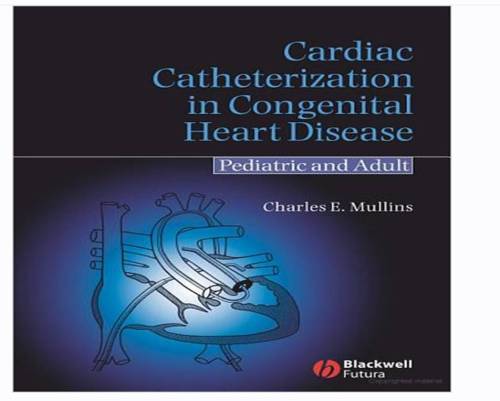
Here is one of   the  very good resource   for  all those basic questions we often ask  in pediatric cardiac catheterisation. Mind you ,  great books do not come free of cost .

Have a preview . Thanks to Google books

Click on the book to enter  , if  you are lucky you will get the  information you need   free  . . .