Feeds:
Posts
Comments

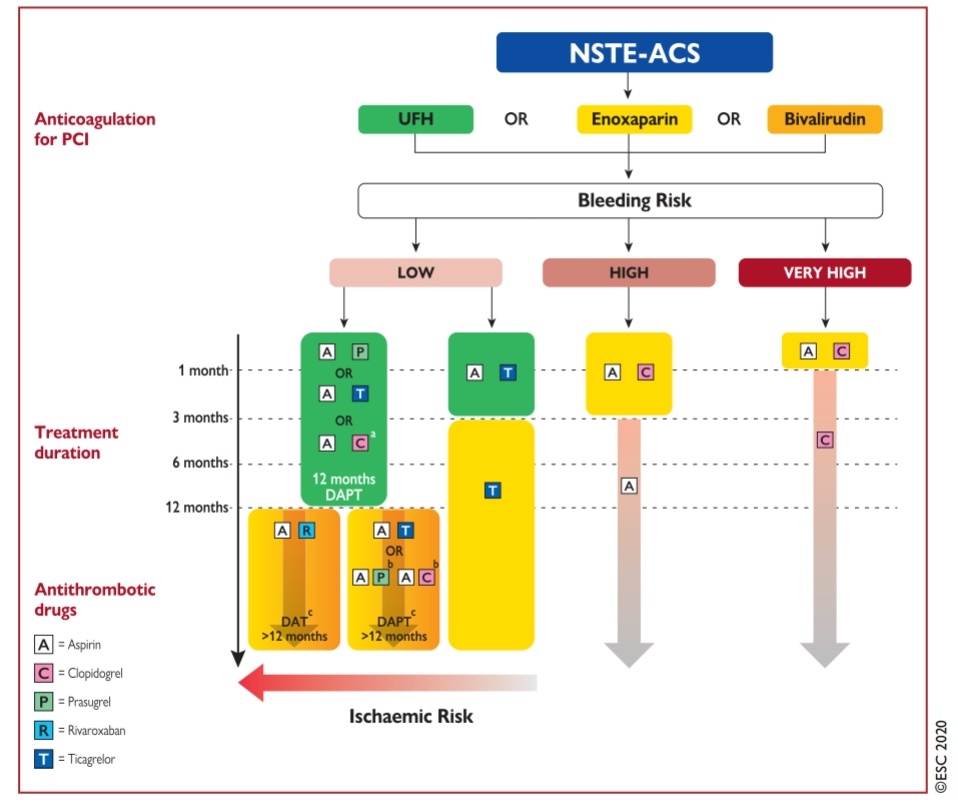
Anti-platelet drugs find a place virtually in every prescription written by a cardiologist for CAD.No doubt, it sits right on top among the highest prescribed medication in the world. They are used in all forms of CAD/ ACS. It becomes  mandatory in  post PCI as a stent maintenance protocol. 

Cardiologists (at least me) are exhausted with so many studies with these drugs. When we thought we are relaxing for a while, the current issue of circulation release a big meta-analysis with 50,000 patient data.It tries to draw fresh battle lines between the three friendly  P2Y12 inhibitors.


  • The findings, from the meta-analysis, directly confront the famed study ISAR React 5 (NEJM 2019)which apparently crowned Ticagrelor the superiority cap over prasugrel  
  • It says Ticagrelor is as good as Prasugrel in any ACS patients. 
  • I guess this meta-analysis is meant to remove the huge faith cardiologists show towards Prasugrel (Still as on date, Prasu is probably  best for stent thrombosis prevention in complex PCIs)
  • While the humbled and knocked out clopidogrel still manages to woo, with its low bleeding risk and cost .(Comorbid patients) 
  • As expected Aspirin, is not even in the fighting ring, just chucked out by the referee for being too smart and threatening the famed heavyweights.(THEMIS brings Ticagrelor even for primary prevention 2020 FDA approved)

What should you believe in? 

This meta-analysis or the ISAR React 5? Don’t believe either,  Then what shall I do? Maybe, go with your Intuition. (Considering the fact, P2Y12 receptors are more attracted to unidentified wall street ligands, than Adenosine diphosphates)

Final message 

Let us hope true breakthroughs happen in antiplatelet drugs so that we no longer need to see these boring  fights between the same old drugs.


I stumbled upon this unique historical info about my college. *According to Prof. Emeritus M.G. Sahadevan., F.R.C.P. (London), the first medical college of Kerala was started at Calicut, in 1942-43, during the Second World War. Due to a shortage of doctors to serve the military, the British Government decided to open a branch of Madras Medical College in Malabar, which was under Madras Presidency then. The Medical School was started close to the then district hospital at Kottaparamba ( now Women and Children’s Hospital).

The war was over before the medical students completed their course. After the war, the medical school at Calicut was closed and the students continued their studies at Madras Medical College. Captain A.B. Das,(late) a veteran doctor who practiced in Calicut belonged to that batch. Nothing much is known about other students who might have served in the British military. Until recently the building which housed the medical school was the R.D.O office. The building next to that is the public health laboratory even now and the buildings beyond those are the doctor’s quarters of W & C Hospital even now.


Those of you, who have any further information on this historical fact are welcome to share it here.

http://calmedcollege.freeservers.com/cmchistory.html


The antiviral properties of hydroxychloroquine are well known. The doubt is whether this property works against the pandemic Coronavirus.

Mechanism of HCQ’s antiviral action. HCQ primarily gets concentrated intracellular endosomes, that’s where the virus resides and multiply.

The study, all of us were expecting has come out. It concludes,   

While, many of us might think, its end of the controversy, but definitely not.

Why the top medical journal uses a term “unable to confirm” the benefits of HCQ on covid. Why it hasn’t concluded as “No benefit”  This is because , they know their limitations. They really believe their statistical Interpretation is still tentative, and the truth is yet to come out,  right ?

The main thrust for the negative results of this study is related to the loosely defined term ventricular arrhythmias. (Few asymptomatic  NSVT? Three VPDs enough? we don’t know ). Of course, combining two drugs that are known to prolong the QT interval is to be avoided. Further, it is a well known statistical principle that analysis from registries is not a good tool to assess the efficacy of a drug as they are retrospective. (Read the CSIR review of this  paper in the reference )

Final message

Chloroquine is not useful for Corona declares this Important study from Lancet,… but we also realize, this study may end up as neither landmark nor important. (The authors themselves are ready to accept this possibility) 

As I finish this topic, I got to see the following response to this study from official  Indian authorities. 

Council of Scientific and Industrial Research (CSIR) , Institute of Genomics and Integrative Biology (IGIB) Delhi .Chennai Mathematical Institute (CMI)


Now Lancet study in more trouble: Suspicious data

From a major journal Science. Lancet has already reported a clarification and concern. Let us wait, there is more dram to follow.

Postamble

When coming to drug trials, why registries, meta-analysis, systematic reviews, even high-quality RCTs are bringing more controversy than clarity?

I leave the answer to our conscience. Post Corona, I wish we learn some harsh, new lessons, in contemporary scientific research & how it shall be conducted, interpreted, and reported without bias. The definition of “bias” itself needs some overhaul. (I will be called biased if I say the bulk of the published EBM is intrinsically biased! I guess there is good bias, if it leans towards truth.)

It’s all happening. FDA approves Ticagrelor for high-risk cad primary prevention and stroke. I am sure, even Astra Zenica wouldn’t have expected this. At best, the evidence from THEMIS for this Indication, can be called as a statistical extrapolation of comical proportion.  

Meanwhile, Ticagrelor thanks Aspirin for its extreme kindness for agreeing to co-live with it. 


The twitter reacts. This one is fromDr. Davide Capodanno , current Editor In chief , of  EuroIntervention, the journal with one of the top Impact factor with a huge following. 

After decades into the field of medicine, I am unable to come to terms with one of the most fundamental questions in our profession.

What does the term Public health means?

Have we erred, by defining health in terms of its delivery rather than a comprehensive biological definition? How do you compare a guy, who gets pride with glittering five-star care in a private hospital , with that of man who humbly accepts the same in a crowded public health facility?

“It’s 1 .30 AM past midnight. I am part of the  COVID supervisory team on rounds. I could see a tired-looking corporation worker wheeling out an elderly man who had just expired in ward R-3, in one of the biggest Corona care hospitals that house 350 COVID patients. In the background, haunting sirens break the eerie silence of Chennai midnight. In the far end, I see a stream of ambulances wait in a queue to drop patients, which, they have ferried across from various private hospitals. Chilling thoughts of this grand old hospital might crumble looked real for a moment”. (This is exactly the time, I got the urge to write this piece) 

When calamity strikes, the true colors of the capitalistic mindset are being exposed. It looked shamelessly obvious, that the responsibility of guarding even private health has been shrugged off and has become a public responsibility. 

It’s a  politico -Intellectual tragedy, that the private sector enjoys a right to ignore public health ,.. for the public hospitals, it’s a crime to ignore private health . 


A 24/7 hour COVID control room in our hospital with  an untiring, committed workforce 

Few days later, the Times of India reports this.I wonder, what I am supposed to feel ?

The report  is a shocking revelation.I wish its wrong.

When the sun shines, someone tends to thrive pathologically on public health. At times of natural crisis, they want a bailout from the public (state) sources. Why not we reverse the deal in normal times?  Should the Government take over all private health providers and make it accessible to the public at all times?

We have a directorate of public health in every state of India, which has zero control over private health care in normal times. How can they get control over them only during pandemics and calamities?  Wonder, should we consider a separate cadre of  “Director of Private health” 

Final message 

So, after spending substantial time trying to find what is public health, I must say,  I lost track. I don’t think any medical school has ever taught us, to differentiate two biological systems in the human body, one for the public and other for private.

The stigma associated with the word public should be erased once for all. It may sound strange, let us dismantle the term public health (How about  Unified human health ?)  . All private and public hospitals to be administered, regulated, and audited by WHO. I believe it may restore some sense in global health. United Nations and the World health assembly should work on this and usurp the required power

We should also ensure, the more powerful vectors of human disease, like climate change, air pollution, poverty,  inequality, war, violence, all should enter first-year medical school along with Anatomy, physiology, and biochemistry to bring up a generational change. (I know very well, this crazy and cranky thoughts, is as good as a faded dream  )   


The mainstream (& the sidestream) medical media have already named one culprit ie hypertension (HT) as a significant comorbid entity in the current Corona pandemic. But, If we ask one direct question, how Corona and HT are linked ? , the answer is not forthcoming fluently.

.

Some of the thought process about the Issue.

1. Does Coronavirus relish high blood pressure on its journey to attack lungs ?

Funny question you may think. The virus primarily lives and tracts through the respiratory tract to reach lungs. Viral load in the bloodstream is nil or minuscule till late stages. BP is nothing to do with what is happening in pulmonocytes . BP doesn’t influence the viremia in any significant way.

2. Does HT related pulmonary endothelial dysfunction facilitate and accelerate viral injury?

We don’t know. If at all,  this is true,  we have to worry about pulmonary hypertension (PH) and not SHT . PAH and SHT have absolutely no relation as far as I know.

3. Is concomitant anti-HT drugs cause relative hypotension and cause morbidity?

Maybe. We don’t know. Hypotension should be avoided at all costs.

4. Is there a conflict between Antihypertemive agents and Corona?  

We don’t know.(Much has been written about the ACEI genetic susceptibility Here is a current reference South, A.M., Tomlinson, L., Edmonston, D. et al. Controversies of renin–angiotensin system inhibition during the COVID-19 pandemic. Nat Rev Nephrol 16, 305–307 (2020).)

5. Does Corona precipitate  LV dysfunction in patients with corona infection?

Possible. Very rare (We haven’t seen much of uncontrollable HT causing afterload mismatch in corona setting as of now)

6. Do silent or manifest Coronary artery disease (CAD) and diabetes (The close buddy of HT) add up the risk?

Yes.definitely is possible. (No doubt, DM confers definite additional risk in Corona) 

7. Is preexisting HT cause CKD and argument the morbidity?

Yes. This happens only if HT has damaged the target organs sufficiently. Here the outcome of Corona infection might have an aggressive course.

Final message

So what exactly is the relationship between HT and Corona?

(Actually, this question was asked not in a cardiology academic meet. It was a casual query from one of my studious patients. I think nowadays we learn cardiology more from them than textbooks)

I guess, there is no direct, meaningful link in most people who just have isolated  HT without any target organ damage. It is more of perceived risk, and views are speculative and conjectural (Including what is written here) Corona affects the elderly and HT is also common in the elderly (30% of all elders) that’s it. 

The estimated 300 million people who are labeled as hypertension around the globe need not panic. Just because you are having high BP, corona doesn’t have any special attraction to you.   

We know, LV dysfunction of any etiology can cause VPDs.This must be differentiated from VPD induced LV dysfunction. Mind you, this is not an easy job at all.

When do you suspect excess VPDs are the cause (or might cause) of LV dysfunction?

  • In young, otherwise healthy persons with “VPDs and LV dysfunction”  would suggest chronic abnormal electrical activity is the cause for subsequent LV dysfunction. (An expression of electromechanical remodeling)
  • Monomorphic VPDs more often suggest primary electrical pathology(Like OTVT, Fascicular VT)
  • VPD count more than >10000 in 24 hrs in Holter will probably Indicate an electrical defect that requires  Intervention.
  • VPD burden (>10% and usually >20%),
  • Frequent NSVT,
  • Retrograde P-wave after the PVCs,(Chronic AV desynchrony)
  • Lastly one may argue its myth as well. VVI (& mode switched DDD) is a perfect example of how our heart tackles undesired VPDS. (We see hearts living comfortably with only with VPDs from the right ventricle (Pacemaker rhythm) without any troubling LVD.

Ref 

1.Baman TS, Lange DC, Ilg KJ, et al. Relationship between burden of premature ventricular complexes and left ventricular function. Heart
Rhythm. 2010;7:865–9.
2.Ban JE, Park HC, Park JS, et al. Electrocardiographic and electrophysiological characteristics of premature ventricular complexes associated with left ventricular dysfunction in patients without structural heart disease. Europace. 2013;15:735–41

When do you suspect VPDs are because of LV dysfunction?

  • History , clinical examination is the key. If there is a known cause for myocardial pathology.

  • Here, the VPDs are more often multifocal (Rarely monomorphic)
  • QRS complex other than VPDs may show slurring or fractured abnormality 
  • More severe forms of LV dysfunction  
  • Severely scarred ventricle obviously would Indicate primary structural disease that causes VPDs

Clinical implication

  • If VPDs are the cause of LV dysfunction we may try to suppress or abolish it.
  • No point in ablating otherwise asymptomatic VPDs in cardiomyopathy. Here we have to identify the cause for LV dysfunction(CAD, Myopathy etc) 
  • Beta-blockers can be useful in both subsets.
  • The over-enthusiasm of ablating all forms of VPDs in any structurally abnormal heart is to be restricted. (Of course, Indication for RF ablation/ ICD may be appropriate in malignant forms )
  • The beenifits of CRT therapy can be negated with frequent VPDs
  • The relationship between the risk of SCD with the number of VPDs,  is never found to be linear. (We have learnt in a hard way, that It is the degree of LV dysfunction that writes the script for SCD in a given patient)

What is the mechanism of VPD induced LV dysfunction?

VPDs alter the way ventricle contracts by inducing wall motion defect. In fact, it is intermittent cardiac desynchrony. Generally, LV tolerates this well. When the number exceeds a critical level LV size, shape and contractility is affected.

We need to differentiate chronic tachycardia mediated LV dysfunction (Tachycardic cardiomyopathy) with VPDs per se. This differentiation we can only guess. 

* Some how cardiologists have not,  implicated RV dysfunction induced VPDS. My guess is, it is equally important. Logically,at least 30% of VPD in end-stage DCM must be attributable( and arise from) RV dysfunction.

How to confirm is it a cause or bcoz ?

The only way is to prove LV function improves to normal or near-normal with ablation of VPDs .This can happen only with primary electrical disorders.

Final message 

The link between VPDs and LV dysfunction is stuck in a complex two-way affair. Though a cause and effect component might be quantified to a certain extent, both can be coupled sequentially . “VPD promoting  LVD” &  “LVD begetting VPD”  is always a possibility. This is the reason, we are tempted to take on any VPDs,  which of course, is definitely not warranted.

  Two resources 

The HRS guidelines must-read for all fellows


This is a real state of the art lecture on VPDs straight from a world-renowned Dr Gacia  Courtesy : Methodist, Houston 

Surprised to see many of my colleagues, physicians and fellows are beaming with new pride even in this troubled corona times. Paradoxically, could see some fresh clinical sense in their approach to problems as well.

Each one of them has a story to tell

  • Sir, I could suddenly diagnose heart failure for the first time with my eyes and ears without NT- Pro BNP or E/E’ . I agree with you sir, textbooks seem to be right. There was indeed basal rales and JVP was elevated. I was astonished I could diagnose CHF clinically!
  • I feel proud, that I have acquired the rare expertise of giving fitness to an emergency appendectomy just by ECG.Its unbelievable, I had the courage of not asking for a pre-op echocardiogram.
  • Oh yes, it was a real flash of bedside brilliance. I could rule out Infective endocarditis, in a patient with prolonged fever, without caring to call for a bed side screening echo for vegetation. I am really proud of my acumen! I realised, Duke criteria is far more deep than our urge to have a glimpse on vegetation.
  • I can’t believe myself, yesterday, I was able to Ignore a 90% LAD lesion, first time in my life, by clinical means without FFR and QFR stuff.
  • This one is again from the echo lab. I refered a patient with aortic stenosis, for AVR, without bothering about all those low flow and high gradient conundrum. I was sure it was severe AS. The dense calcium and LVH were good enough to tell the complete story.

Finally, one of my senior colleagues, who lives half his awake time in cath lab, confessed to me. “Yes,Venkat, it’s all happening right in front of my eyes. Miracles based on absolute truths . I have since learnt the ultimate lesson in cardiology. How to treat, many of my CAD patients, without knowing coronary anatomy, that too without any major adversaries”

Postamble

After listening to these sobering stories , I got into a mid-afternoon nap, wherein, my good old professor came in my dream. He blessed me with his famous smile and hug for practicing and propagating clinical cardiology, as he taught to me.

But sir, I blinked, sorry sir, I don’t deserve your compliments. This newfound sense is going to vanish along with this dream. Blame it on the terrible corona times, which has forced us to deliver this low-quality care based on the antique clinical methods.

My mentor’s happiness was short-lived, as he realised these guys will soon be consumed again, by the glamor machines that runs medical science. He left silently, still pleading us to try our best.

This post was originally written in 2013.

A middle-aged man with STEMI  came to our CCU.  It is just another case of STEMI and asked my fellow to lyse.

Anterior STEM ecg

But it was not the case . He, told me, Sir, the patient had a syncope following chest pain and he has injured his face and Jaw. He was actively bleeding. When I saw this face, it was indeed  frightening.Strptokinase induced bleeding

What shall we do ? When a patient  with STEMI presents with bleeding facial Injury

  1. Rush for Immediate PCI (Which was  of course not possible in our place as it happened out of office hours! )
  2. Take that ultimate risk and thrombolysis
  3. Give only heparin ( Many times it is as good as  lysis )

We took a (bold ? ) decision to thrombolyse with streptokinase.(After  a CT scan which ruled out any Intracranial bleed like hematoma etc) Clopidogrel was also given.

absolute contrindication for thrombolysis facial trauma

Patient continued to bleed in the initial 3 hours and was oozing in the next 12 hours. Blood transfusion was contemplated, but it was not required. Dental surgeon opinion was sought, his teeth were pulled and a compressive bandage was applied.It arrested the bleeding.The ECG settled down.LV function was almost normal with minimal wall motion defect. He is posted for a coronary angiogram later.

Final message

 There may not be anything called “Absolute contraindication” everything appears relative

I presented this in the weekly clinical meet,  with a tag line of  How to save a patient, apparently by violating a standard guideline. Not surprisingly, It evoked laughter amusement from learned physicians. I wasn’t. Guidelines are meant to guide us agreed.They can not command us. They are not legally binding documents as well! Many lives can be saved if only we have the courage to overrule when it’s required.

Afterthought

Had this patient has bled to death during lysis what would have happened to the treating doctor? (or )If the patient has died due to MI, because of deferred thrombolysis, what would be the line of argument?

2020 update.

This case scenario is a non-issue as of today. With so much experience, we straight away do PCI . Just manage the oral bleeding if any.


What is the incidence of Isolated systolic pulmonary arterial hypertension (ISPAH) and its Implication? We attempted to answer this question and found some interesting answers. It was published in the Indian heart journal  December 2007 Abstract issue. More than a decade gone. I think this issue is still largely misunderstood. Fellows may pursue this. One more parameter that can be explored is pulmonary artery pulse pressure and effect on progressive pulmonary vascular disease and PVR. Mean while  PAH definition and classification has changed many times, ISPAH definitely requires a place in the new scheme of things.

The abstract

ISOLATED SYSTOLIC PULMONARY ARTERIAL HYPERTENSION
S.Venkatesan ,G.Gnanavelu,V.Jaganathan , Madras Medical College. Chennai

Pulmonary circulation is a classical example of a low-pressure low impedance circulation. It is generally presumed high output states generally do not increase the systolic blood pressure in the pulmonary circulation. In systemic circulation, there can be divergence of systolic and diastolic blood pressure depending upon the cardiac output and peripheral vascular resistance. This has resulted in separate clinical entity -Isolated systolic hypertension.(ISH). It has been our observation many of the patients with PAH during echocardiographic and cath study were found to have an elevation of systolic pulmonary artery pressure(PAP) with normal diastolic PAP . In this context, this study was undertaken to specifically identify whether there is an entity of Isolated systolic PAH
( ISPAH ) and it’s the incidence in various clinical situations.
We analyzed the echocardiographic data of patients who were referred to our echo lab retrospectively. A total of 4000 echocardiograms over a period of 6 months were reviewed. Majority of these patients were referred for routine screening echo from our OPD. Data from patients who were assessed to have PAH were thoroughly scrutinised. They constituted shunt lesions, RHD,PPH, COPD, pregnancy, and patients with unexplained dyspnea for evaluation Those Patients who had both TR and PR jet were only considered for analysis .The Systolic PAP was estimated with TR jet and diastolic PAP with End diastolic PR Jet. ISPAH was diagnosed when the calculated systolic PAP was more than 30mmhg. And the diastolic PAP was less than 16mmhg  Antenatal women formed 2 % of the study population. A total 72 patients fulfilled the criteria of ISPAH Among the shunt lesions it was most common in large VSD( 4/10), followed by ASD(14/35) and PDA( 1/3) . In patients with RHD it was observed in 12%(15/110) , COPD 10%(15/150), in pregnancy and general population it was 5%(23/450). None of the patient with PPH had ISPAH.The mean Systolic PAP was 38mmhg(R 32- 74) The mean diastolic PAP was 14mmhg(R 8-15).The highest systolic PAP was 74mmhg recorded in patient with large VSD.
It is often presumed hyperkinetic states elevate systolic PAP and reactive elevates diastolic PAP .But it is clear from our study the rule is not that simple. Surprisingly many of the RHD patients had only the systolic PAP raised.It is important to recognize systolic PAP was very high in some of the shunt lesions. Taking this alone as an index of severe PAH is fraught with the risk of declining corrective surgeries in these patients.
Perhaps the most important observation from the study is the incidence of PAH in apparently healthy individuals, which is very significant as it could be the marker of continuously increasing chronic lung disorders due to the worsening environment of the 21st century.


A PowerPoint presentation of the paper is available with the author and may be requested.