Feeds:
Posts
Comments

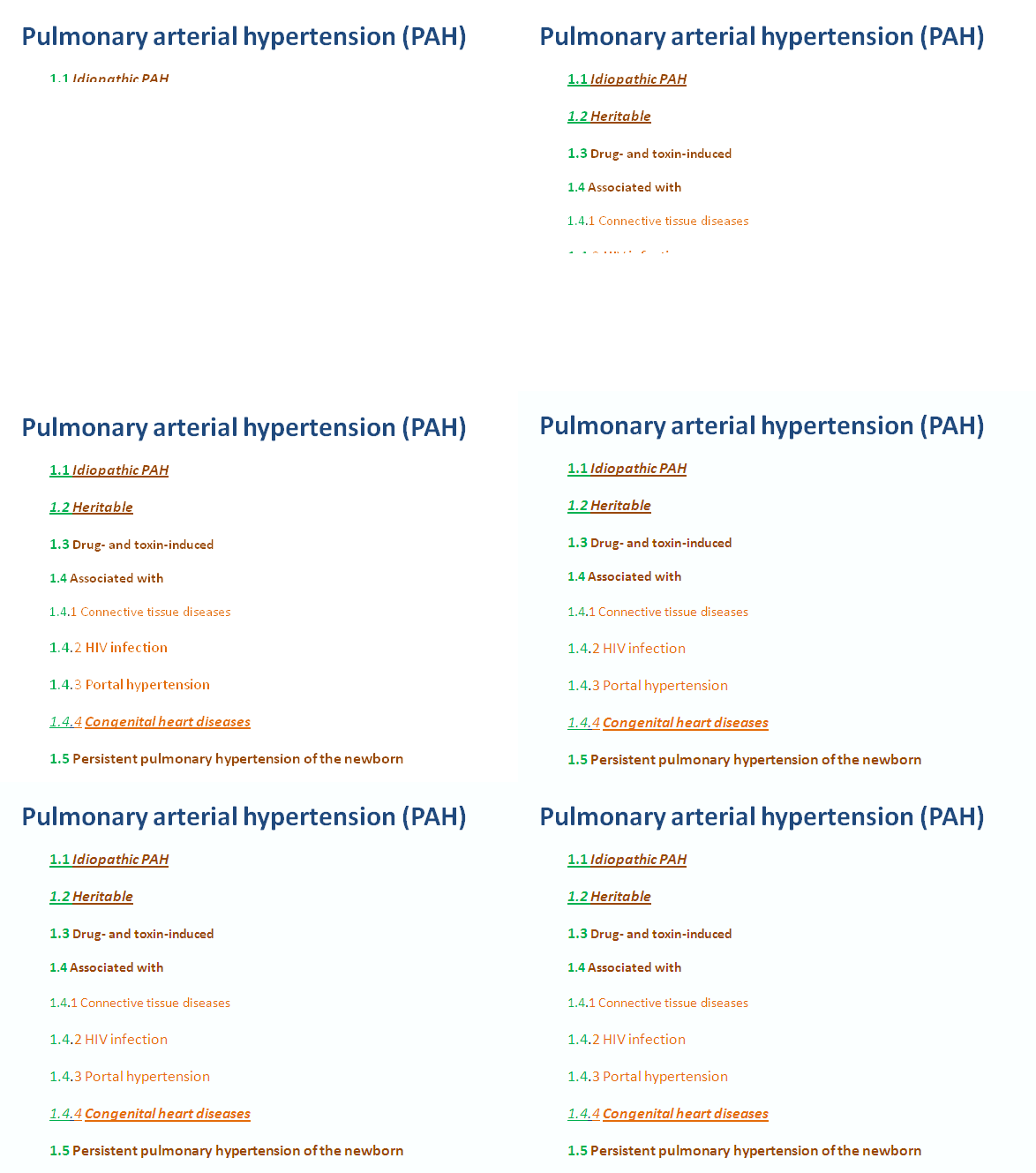
Pulmonary hypertension (PH)is a very common clinical problem in cardiology.The classification of PH  has been little complex. Now we have a fairly clear scheme formulated in 2008 in a small beach side county of  California called Dana point .

I have tried to simplify it without affecting the core

Click on the image if  slide is not displaying

Category 1 is again divided into 5 categories

1.1 /1.2/1.3/1.4/1.5

Other categories( Category 2 to 5)

* Note there is a special category called 1 ‘ for pulmonary veno-occlusive disease .This should be distinguished from CTEPH

Summary

Remember  99 %  all  pulmonary hypertension will be constituted by the following  seven entities .

Idiopathic PAH  1.1

Familial PAH       1.2

Connective tissue disease 1.4.1

Congenital heart disease  1.4.4

Left sided valvular /Myocardial heart disease 2.3.3

Secondary to  COPD  3.1

CTEPH   4

In India  (probably worldwide ) the commonest  cause for  PH is  2.3.3

The updated pulmonary hypertension  classification is available here

Before answering the above question ,  there need to be a correction to the question itself . PDA is persistence of ductus arteriosus . In pulmonary atresia ductus itself is not formed .So  the question should  ideally be  Why  ductus  is absent in pulmonary atresia  with VSD  !

Ductus  is formed from the dorsal portion of left 6th arch  .The sixth arch also gives raise to  right and left pulmonary artery.This can happen only if everything from aortic arch and pulmonary artery development is normal

Ductus  has to connect aorta with left pulmonary artery  , when pulmonary artery itself is  poorly developed or not developed   how can the  ductus  connect to  LPA ?

Pulmonary atresia is essentially a defect in the development of pulmonary arterial tree (Please note pulmonary valve and  MPA  is formed  from different  structures in different times and it  would  get  docked  with developing LPA,RPA  and  subsequently to the rest of the  pulmonary tree .)

In fact , one of the terminologies used for pulmonary atresia with VSD  is ,  total anomalous pulmonary arterial connection(TAPAC)  .In fetal    life,   blood flow in ductus is from RV  to  pulmonary artery  and then to  descending aorta  through the  ductus . When RV is disconnected with pulmonary artery( Rather there is no pulmonary artery )  ductus can not be  formed  for  both anatomical and physiological reasons . Some consider the  left 6th arch  in these patients  would become  a poorly   identifiable  minor Aorto pulmonary channel .

A Link to  3D vedio  of aortopulmonary collateral

Embryology of major aorto pulmonary collaterals.

  • The lung perfusion in patients with pulmonary atresia is important only after birth,  as fetal  lung is largely non functional.
  • In patients with pulmonary atresia with  intact IVS this becomes  critical and  usually death ensues unless intervened.
  • If VSD is present it allows the baby to survive as the  lung gets perfused by major or minor aortopulmonary collaterals.
  • These collaterals can range between extensive and   sparse.  Hence the  symptoms can  also vary from volume overload  /cardiac failure to  severe oiligemia  and recurrent  hypoxic spells.*

MAPCOS ,  if present can connect directly the aorta  to  hilar pulmonary artery or indirectly  from the branches of  aorta (subclavian /LIMA/RIMA etc) . These arteries  supply  with or without  a central confluence . It may enter the lung through the hilum or  away from hilum .The MAPCOS can be located anywhere from the arch of aorta to descending thoracic aorta.It is very rare in the ascending Aorta .

There is also  strong argument for MAPCOS are  nothing but dilated bronchial arteries.(Link to Full text )

*The  natural history  directly depends  on  extent of aorto pulmonary collaterals and its anatomical patency .

Final message

Embryologically   both  the  major  arteries of thorax  Aorta and Pulmonary artery have  the  same parent structure namely the dorsal aorta and its six  arches.Hence there  is no surprise  ,  when these embryological  divisions and fusions   goes awry ,   pulmonary artery fails to get  carved out from  the dorsal aorta  in the normal fashion .The randomly formed pulmonary  arteries continue  to have link  with   the parent -dorsal aorta .These are manifested in various ways as major aorto pulmonary collaterals .

(It is to be noted  in pulmonary atresia  , VSD is an offshoot developmental defect  . Embryologically  VSD   is not linked to the primary defect of pulmonary artery development . This is the reason many would consider   PA with VSD as a  distinct entity with that of TOF (Which is a cono truncal anomaly) This also explains the lack of MAPCOS in true TOF .

When know   statins have  revolutionised  the management of  coronary artery disease , why  we  hesitate  to  say   the same thing    for  cerebro vascular disease ?

Is it because

       Atherosclerosis is different in  cerebrovascular disease   than coronary artery  disease

 or  Blood pressure control  becomes more important in preventing stroke than lipids?

Unlike  MI ,  Cerebro vascular system   have   variety of insults.

  • Embolic stroke
  • Thrombotic stroke
  • Ischemic stroke
  • Hemorrhagic stroke
  • Low flow – Water shed infarcts

Hemorrhagic , embolic and low flow mediated  myocardial infarction are very rare and  denova hemorrhagic MI is non existent.This is due  to  the fact ,  coronary autoregulation is  vastly different from cerebral vessels. Carotid plaque stabilisation  is a  major mechanism by which statins can prevent stroke . Still , statin  therapy( however aggressive)  has less impact  in the incidence  of stroke than MI.

This meta analysis claims statin to be very  effective  in prevention of ischemic stroke.

We have observed  ,simple statin administration without concomitant BP reduction has absolutely no effect on stroke prevention,   while  in  coronary  prevention even if the blood pressure optimisation is less than the desired levels,  significant number of  MI are still  prevented.

http://www.ncbi.nlm.nih.gov/pubmed/18187070

 The  SPARCL  trial  was big boost  for   statin   industry  in widening the Indication  for stroke prevention


Final message

Does statins remain a suspect in stroke prevention ?

If we  accept the  saying   ” Data won’t lie ” . .  . the suspicion  about  statins  is  a myth.

High dose Atorvastatin 80mg /day should be prescribed for every one with at high risk for ischemic stroke .

A patient with  chest pain   is being rushed   into the ER  of  a medium sized cardiac facility in an urban county of India .The fellow briefs the senior consultant cardiologist about the arrival of  this  extensive anterior  STEMI  over phone.  The  consultant  enquires  about the “symptom to door time” and  was little concerned  when the fellow said ” it is only  2 hours sir”  .The fellow was amused with the consultant’s  reaction.

The consultant arrived in 15 minutes  and  began  the all important  discussion with the  patient  and his spouse  .(Meanwhile tablet clopidogrel and Aspirin was  loaded  per orally . Note : Heparin is not given yet )

Cardiologist : It is a  massive heart attack . One of your coronary artery  got  blocked suddenly , I have to remove the block at the earliest . There are  two ways of doing it .  One is fibrinolysis which lyses the clot .It can open up  your vessel  , though incompletely but would prevent myocardial damage  at the earliest .

The other one is PCI ,  which if performed rapidly  will completely  open up the vessel in question , what  we call TIMI 3 flow ,  But it has to be done within one hour.

Patient : Which is better doctor for me ?

Cardiologist : My cath lab  logistics  does not allow me to do a  PCI within the stipulated  time ,   still  I wish  to perform   a primary angioplasty  as i am not a believer  in thrombolysis !

So , even though you are  eligible for both modes of re- perfusion, in the strict sense doing a  PCI  which will  ultimately be  delayed  beyond the recommended time window  is technically contraindicated “

(Please  be notified : Currently , if the delay is during the procedure due to some technical issues after starting the procedure  or if the delay is at  the patient   level in arranging the required finance or insurance clearance it can be condoned without any ethical issues )

Patients spouse : Doctor please save my  husband . You  start  the fibrinolysis  every minute is risky isn’t doctor , and do the PCI once its ready doctor .

No . . . Fibrinolysis  does not combine well with PCI  in fact it will worsen the situation .   Thats what FINNESSE  study says . We can do only one of them . . . not both .

The patient and spouse (Terribly confused  by now )

Cardiologist:  By the way , what is  your insurance limit  sir ?

Patients spouse : Its 4 lakhs

Cardiologist : OK , that should be suffice  90 out of 100 times . Any way keep another lakh ready in case I need IABP.
Patient : My pain is worsening doctor at least relieve  my pain till this debate  is over !

(A patient’s relative  browses his  i phone  and argues  the  cardiologist   to administer streptokinase at the earliest . Suddenly  the patient family lobbies for fibrinolytic mode  empowered by the i phone guy )

One of them shouts “Please doctor you do something either take him inside cath lab or  start a fibrinolyitc therapy ”

How did the cardiologist  fight his way through ? ( He gulps a cup of coffee and  starts a fresh discussion)


Cardiologist : 
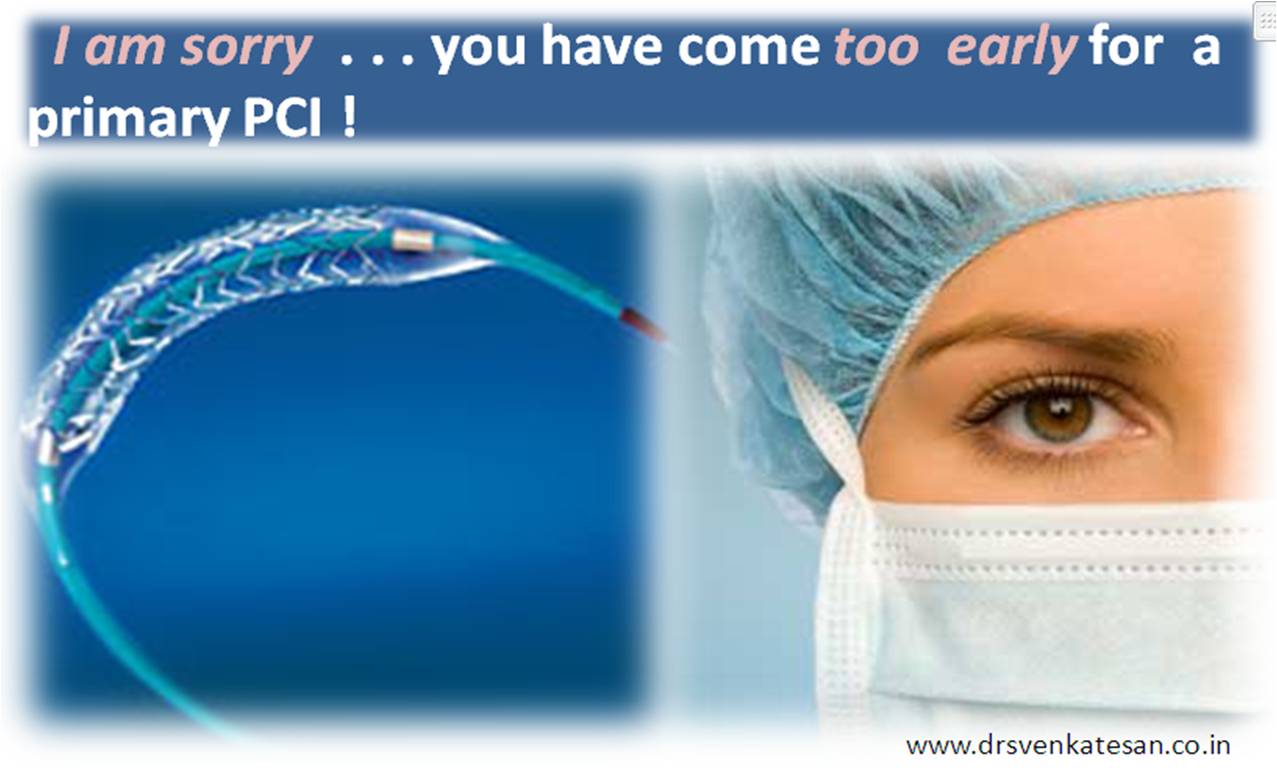
I am sorry , you have come too early  for PCI .  Guidelines do not allow me to choose PCI in the first hour  as our  anticipated delay for PCI is more than 3 hours . I wish you arrived after  the 3 hour window .

“Of course you are on time for thrombolysis”  which  unfortunately I am against !

Now, I am going to wait ( You may think it is a waste of time i call it as patient preparation time )  .This waiting period incidentally  allows us to cross  three  hour  time  window ,  then the issue of not lysing  does n’t creep in at all . A PCI done after 3 hours is not a race against time , while a PCI done early is like  a power play in cricket .

I do not know whether this delay which is happening  right now –  Intentional /Unintentional,  Scientific / unscientific reasons  would  damage your heart or not !

Since you have an extensive MI , I earnestly believe  with all my wisdom and knowledge, you will do well with primary PCI  even if  i do it  little late .  Please allow me to violate the standard criteria in the interest of your heart .
Cardiologist : I wonder , if you had arrived little late we wouldn’t be discussing this terrible conversation at all .Your myocardium  will also feel thrilled for getting a better mode of re-perfusion. You put me in an awkward situation by coming early !

Patient : But  . . . doctor every one  tells me ,  one should reach the hospital  after a heart attack  at the earliest  is it not ?   Please believe me doctor ,  I  made  extraordinary  efforts to  arrive early to your hospital , but you have put me on hold doctor !

Cardiologist :I agree  . . . but you won’t understand the modern jargons  in  interventional  cardiology ,  some times (Or is  it many times !) we will be doing the diagonally opposite to what  is   preached  in text books  .  Both intentional and unintentional delays are common  in the emergency cardiac  care . Do not bother about it   . . . science will take care of it !

Patient : You mean  . . . you are going to waste the golden hour in STEMI by simply arranging for cath lab staffs and machinery .

Cardiologist : You got the point right ! Just sit back enjoy the  flight !

Patient : Your wish is my wish doctor . Please handle with care doc !

* Please note this is an imaginary conversation ( Most often happens in silent mode !) in many of the cath labs which do not have 24 hour service. In a country  with  100 crore population like India ,  less than a dozen cathlabs  work round the clock . Guess  how often such a  situation would come in day to  day cardiology practice.


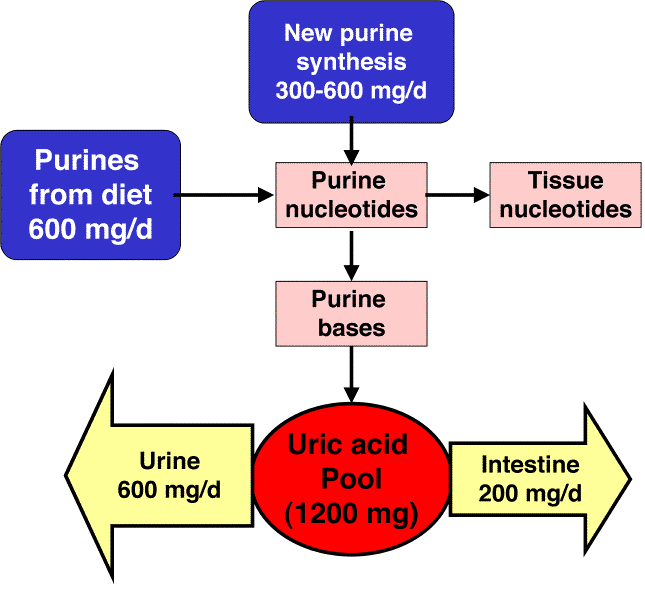
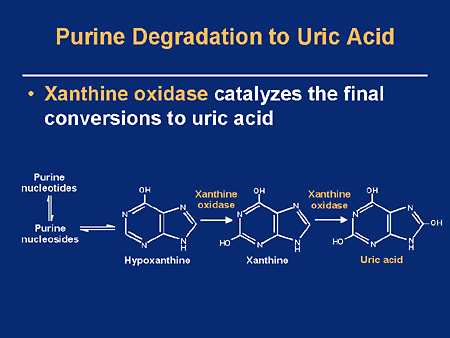
Uric acid is a  metabolite of purine metabolism.Purine is dynamically present in  every  active multiplying cell .Uric acid is formed when Xanthine oxidase  acts on   Xanthine and hypoxanthine  which are products of purine . The estimation of serum uric acid level can give us a rough estimate of cell metabolism and turn over. We need to  understand there is a dietary source for purines as well.

UA is mainly  excreted in urine . Normal levels of UA is   3-6mg in women and can be 1 mg higher  in men

Biological actions of uric acid

UA is a physiological molecule . It is more of an byproduct  and  devoid of any unique  action. Hence , most physicians still   believe it to be an unwanted  dangerous toxic molecule. What we fail to realise is ,  uric acid is a strong natural reducing agent .Hence it acts as an antioxidant .(Comparable to Ascorbic acid Vit C !)

Some believe excess uric acid is  a natural metabolic weapon against cellular degeneration . In fact , hypo- urecemia has a well known  association with multiple sclerosis and augmenting UA  is known to improve multiple sclerosis.

However, the problem with this  physiological molecule  is ,  we do not know yet,  when the  levels become pathological .We know uric acid in excess can lead to  urate stones  in kidney and Gout in joint . Does these crystals have any effect on coronary and cerebral circulation ?

Is uric acid a marker of inflammation and cell turn over ?

Yes it is.  What ESR  means to  inflammation , uric acid means for cell turnover . Since Inflammation induces white cell turnover  uric acid  level  becomes   a marker of inflammation as well .

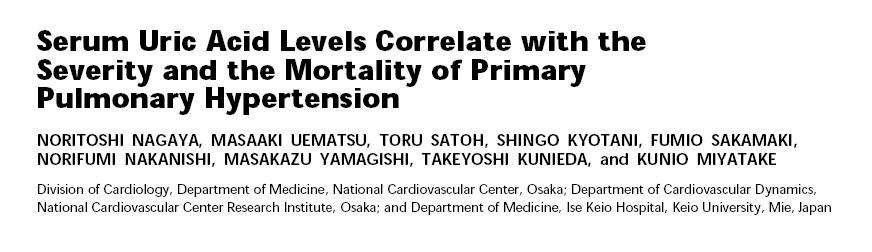
Uric acid in  excess  is a  marker of vascular  damage as  atherosclerosis  is an inflammatory process  , especially  with  pulmonary endothelial damage. So , in patients  with primary pulmonary  vascular diseases  like PPH , uric acid levels   may indicate  the progression or regression of PAH.

Some studies have correlated right atrial pressure with uric acid levels.

Uric acid and hypoxic states

Uric acid formation is more in hypoxic states as hypoxia depletes ATP and adenine metabolism is promoted and more inosine and  Xanthines  are produced . Uric acid can be a simple  marker  of increased oxidation stress of human biological system.

No surprise  to note   pulmonary hypertension  an important hypoxic state  increase uric acid levels .

Why uric acid is rarely considered as a useful diagnostic marker in cardiology  ?

  • The major  reason is it is an old molecule and has  lost its  flavor .
  • The name is not exotic (Like BNP, Di dimer etc)
  • Finally it is  a  cheap investigation and hence  lacks the required glamor.

Technical limitations

  • Uric acid levels are non specific (Like any other  modern  molecules  Tropinin , CRP etc! ) No one  would like  to compare uric acid vs hs CRP one to one as a marker of inflammation in vascular  disease.
  • UA  levels depend on kidney function .
  • Dietary influence can be significant (Especially meat, Liver Beans, Cauliflower etc)

Knowing the  basal level of uric acid  in a given patient ,   help us  monitor the net cell turnover during medical   management of chronic illness.

UA’s Clinical utility in cardiology practice

Importance of UA in PAH   is well recognised now  . Most studies on PAH  use it as a marker  or even  to define a therapeutic endpoint  But , please remember  elevated uric acid is a  simple  index of elevated  cell turnover and oxidative stress and it mainly represent  the effect of  pathology rather than a pathology itself.

So , attempting to reduce uric acid levels   with drugs like  Allopurinol may not  improve the  vascular function as one would wish ! The only indication for  reducing uric acid level   is  when the levels   become  too much and it starts depositing   in body.

Final message

Uric acid is a useful bio marker for  vascular function. It can indicate  the  quantum of  inflammatory , metabolic  and cell turnover of any progressive vascular  disease. With serial measurements  it definitely helps us in monitoring   cardiovascular disease  especially pulmonary hypertension  as  lung tissue is major source of this molecule . Now , uric acid  is used  for prognosticating  cardiac failure also.

Reference

http://qjmed.oxfordjournals.org/content/93/11/707.full.pdf+html


http://ajrccm.atsjournals.org/cgi/reprint/160/2/487?ijkey=dc24281a22fcf54ed27ac4466393abd691047408

http://cel.webofknowledge.com

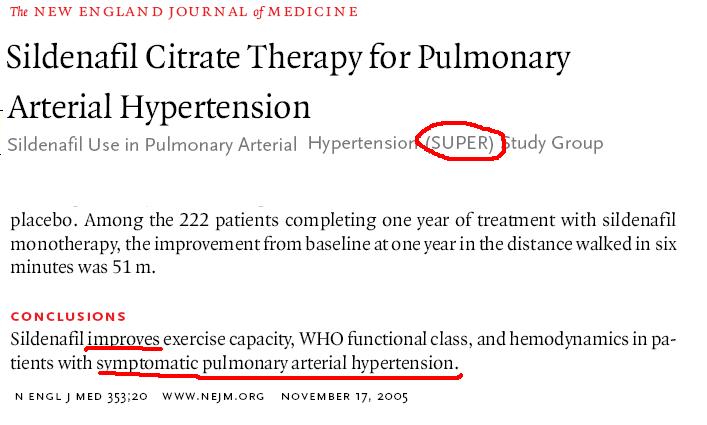
Sildenafil was first approved for pulmonary hypertension  in 2006  after a much hyped study called “SUPER” published in New  England journal of medicine.

This study population  included only  idiopathic pulmonary  hypertension and secondary  pulmonary hypertension due to pulmonary vascular disease like scleroderma  etc .The exclusion criteria were not clearly described in this paper ,  but it was clear PAH due to COPD was not included.

Please note , the title and conclusion are misleading .The real conclusion should be read as sildenefail may be useful some of the patients with in idiopathic PAH and secondary PAH sue to connective tissue disorders.

Further ,  the conclusion  of  SUPER study gave considerable  room for   misinterpretation (Intentional ? ) .The term PAH was used in too casual and generalised  manner. Many of the physicians  started  using sildenafil for every case of PAH including COPD.                 

COPD is a disorder of  airway , while sildenafil is a drug which acts on  the vascular  system (Vascular smooth muscle )  Apply your own logic  ,how  effective sildenafil  would be in  COPD patients .

As on today there is no good  evidence to suggest sildenafil will be useful in COPD. (Few studies  suggested it may be useful in fibrosed  lung)

Still , no body can prevent a physician  from testing this drug in otherwise refractory COPD as  we have a convenient   semantics called  ” off label  indication ”

So, the answer to the title  question still  eludes the majority    . . . even though many of us  know  the answer !

Ans : You   can use it  . . . but your patient   may not  really benefit ,  of course it satisfies  the physician and the drug company.

Reference

An editorial from Indian journal of chest diseases debates the issue

http://medind.nic.in/iae/t08/i4/iaet08i4p317.pdf

http://www.nejm.org/doi/pdf/10.1056/NEJMoa050010

http://www.nejm.org/doi/pdf/10.1056/NEJMc053442

The prosthetic cardiac valve which saved so many lives  in the later half of 20th century is no more. A valve which is not only  known for its excellent durability  but also  devoid  of sudden  mechanical  occlusion , unfairly  lost its place  by the rival  mechanical  bileaft valves. (Supposedly superior hemodynamics !)

Here is a nice video  from Indian surgeon  which  describes the hardware of  Starr Edwards valve .

Please read a related article from my site

Who killed Starr Edwards valve ?

Heart is a dynamic organ . It can alter  its force of contraction with every beat  according to the needs.Generally it responds to  length  of  previous  diastole.This is famously called frank starling law , ie the force of contraction is directly proportional to the end diastolic fiber length. So changing diastolic  duration as in atria fibrillation classically result in varying amplitude of LV contraction and pulse volume.

However , the commonest cause for  pulsus alternans  is  due to  severe left ventricular systolic dysfunction .There has  always been a suspicion about the existance of  beat to beat variation in  diastolic function as  well.  We have recently observed a  new* explanation for pulsus alternans .We know AV inflow is subjected to respiratory swings . Non  respiratory swings in mitral and tricuspid valves are rarely described. This pattern is now increasingly recognised.

These  non respiratory swings in the mitral inflow doppler pattern  is seen in  some of the  patients with hypertension and LVH.This  probably confirms the existence of  beat to beat variability of diastolic function . This phenomenon is relatively a new observation . Such pattern are common in patients who have had a recent hypertensive failure .


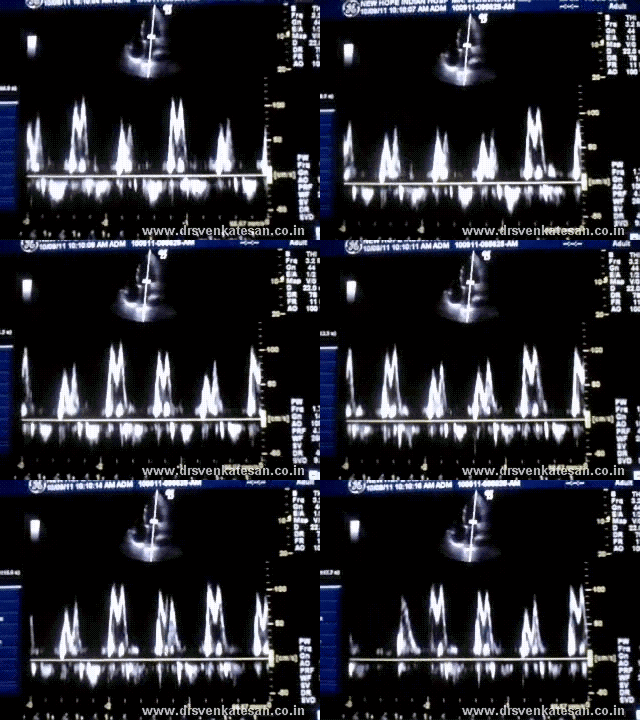
Here is a doppler of mitral inflow recorded from a patient with hypertension with LVH .

This is the doppler mitral inflow profile of a patient with Hypertension, LVH and class 2 dyspnea .Note the non respiratory swings in both "e" and "a" velocity

It is proposed  to  define  a new class of diastolic dysfunction that can be referred to as diastolic  mitral inflow  alternans .This phenomenon probably indicates a more severe grade of diastolic dysfunction.At the molecular level this is related to  undulating flux  in the calcium uptake from cytoplasm into SERCA .There is one more possible explanation for diastolic alternans  -Left atrial  dysfunction .

Occasionally one can visualise  a chaotic pattern of  diastolic filling waves  (e=a e>a a> e )  Such patterns are thought  to be markers of impending acute diastolic shutdown .

Further  analysis of  this  mitral doppler inflow pattern will be reported  later.

Reference

* Though we observed this for the first time , this is not a new phenomenon .There are few reports available in the literature.

http://www.sciencedirect.com/science/article/pii/S0735109785800358


http://www.sciencedirect.com/science/article/pii/S0894731706012818

Bicuspid aortic valve (BCAV) is  one of the common  congenital abnormality of heart . Incidence can be 1-2% of population . It can result in premature aortic degeneration with Aortic stenosis/Aortic regurgitation or both .

The normal development and arrangement of three cusps is altered ( rather interrupted )  during fetal life.

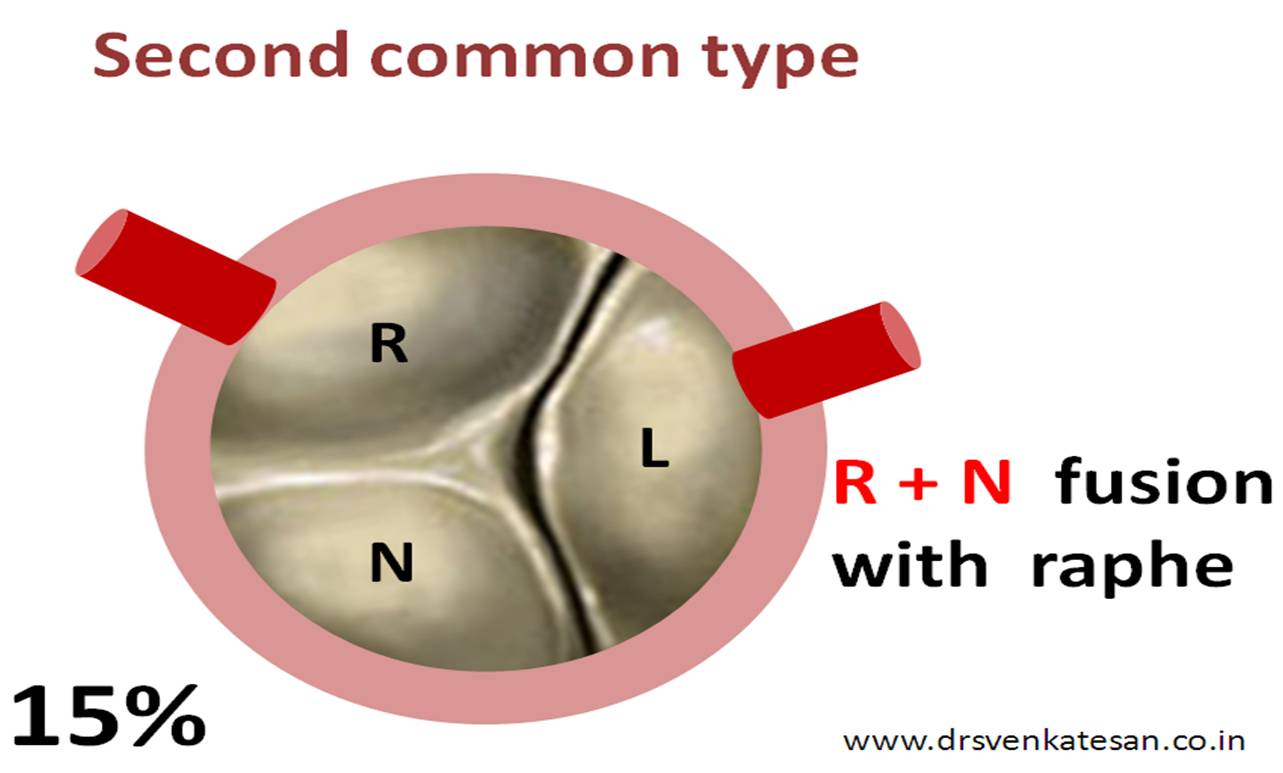
There can be two ways BCAV can occur. One is due to the   fusion* of two leaflets to covert a  tricuspid  valve into  bicuspid  ,  and the other is    two cusps develop de novo .The former has a raphe , while the later has no raphe.

The  fusion* occurs between  either

  • Right and left (R +L)
  • Right and  non coronary cusp  (R +N )
  • or Left and Non coronary cusp (L +N)

(* The fusion is embryological , not acquired )

Most often the  fusion is due to lack of division in the valve  analgen .Hence a raphe (A conjoint remnant) is noticed .

90% of BCAV has raphe  ,only 10 % lack raphe . Aortic root is also structurally abnormal in many .(Little clinical sequale though !)

Coronary artery origin anomalies  are more common with  BCAV. We also know co-arctation of aorta has a embryological link with BCAV.

The commonest type of BCAV is

The most hemodyanmic stressed BCAV is R +N type fortunately it is rare

R + N fusion is a high risk BCAV as degeneration occur fast

The least common type is

The coronary artery origin anomalies are common

BCAV in the absence of raphe is classified separately (This constitutes 10 % of all BCAV)

The nomenclature  is

  • Antero posterior (Common type ) AP
  • Lateral (L )

What is  the pathological significance of raphe ?

Many  believe presence of raphe accelerates degeneration as leaflets have  rough surfaces . Still , BCAV with raphe has less coronary anomalies and aortic root pathology .

Presence of raphe  indicate relatively  a minor embryological defect  , as the fault is in the failure to divide after the formation of analgen , while BCAV without raphe  imply  lack of development of analgen itself . This is expressed in the coronary sinus anatomy and aortic root dimension and orientation .

So currently it is  welcome  to spot  a raphe in the patient point of view  .Echo cardiogram is notoriously  unreliable to diagnose raphe. Once degeneration process sets  in ,  it is almost impossible to recognize  the  presence or absence of raphe .

* Please note ,tricsupid aortic valve with eccentric leaflet closure  shares  a close pathological relationship with BCAV. Premature degeneration ,  (AR more common than AS here ) .This entity will be discussed separately later.


Image courtesey

Part of the Image (The valve) is adopted from Yale university Image Bank .

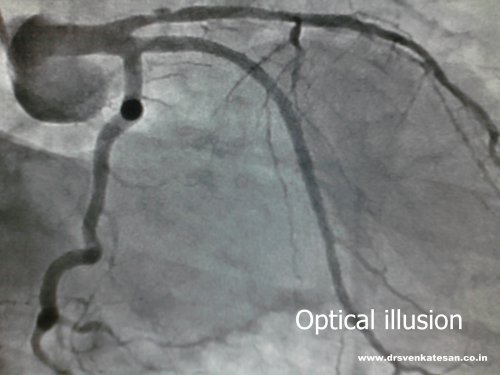
Coronary angiogram is  a videographic snap shot of  moving targets. Coronary arteries are dynamic  , tortuous  vessels of varying dimensions .Normal vessels  sometimes appear as an  illusion of lesions and tight lesions may appear innocuous at times. So the  rule is never rely on a single view before reporting.

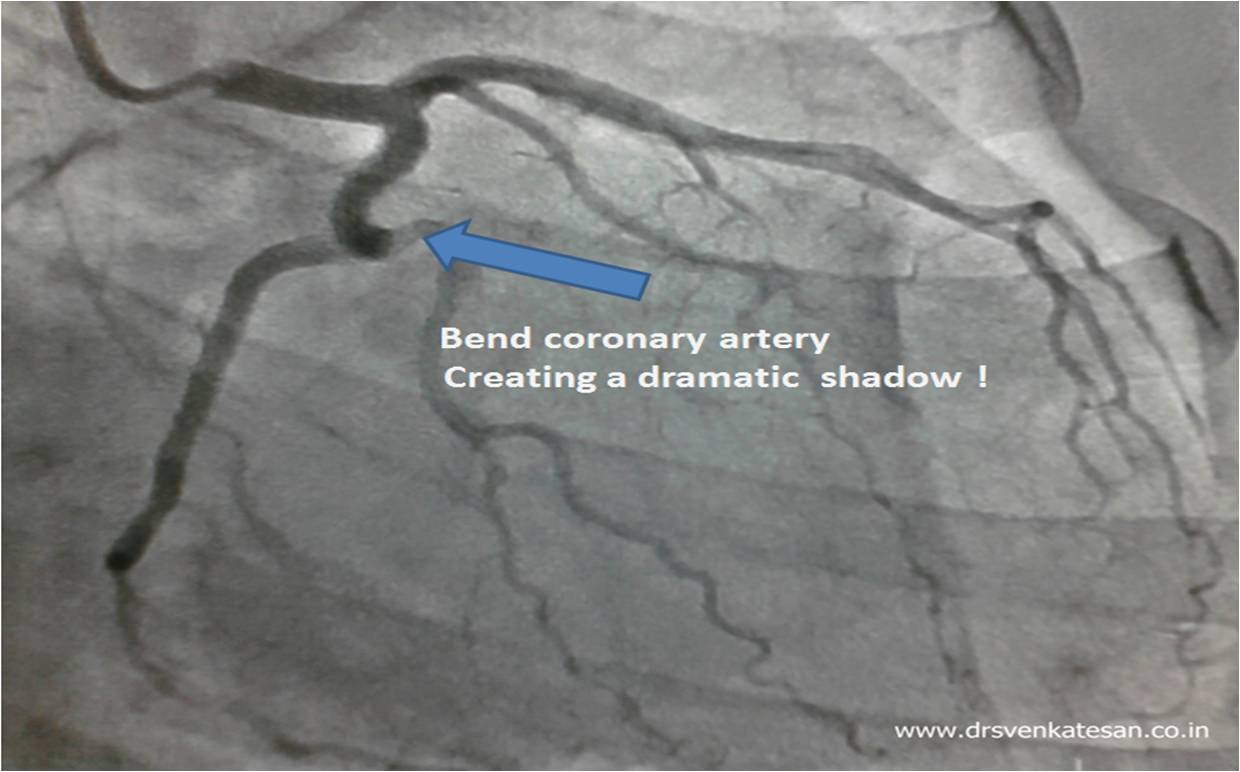
This is an  angiogram of a patient , which  one of my fellows referred to as  “a black pearl  inside the LCX !

The same patient,s angiogram showing  origin of OM1

Final message

Beware of radiological artifacts in various angiograms. It can lead to erroneous interpretation and interventions !