Feeds:
Posts
Comments
Every time , patients ask me  what diet he or she  should follow , Iam sort of  amused , as my understanding of diet and cardio vascular disease is at best primitive.I used  go with a standard single phrase  advice “Anything in moderate should be okay  “
What about going for a saturday night party doctor? One of  my shrewd looking  patient who was recently double stented with DES , asked.
Human body is a biological marvel.While medical professional divide it  into various systems  for our convenience. God doesn’t  think that way .He has no systems in mind when the body was designed . There is no wonder , the alimentary system and hematological system has to interact on a daily basis  with the help of circulatory system  to keep the  body alive. Platelets are unique blood cells that exist primarily to plug physiological bleeding if any  or for self-healing at sites of tissue injury.
 platelet lipid ldl tgl triglyceride ineraction 002
With human vascular system increasingly invaded by various metals and wires , platelet are a confused lot since their original biological functions are altered. They simply don’t know whether  fight these foreign body , aggregate over it , flush or simply pass over these .Adding to this  the powerful anti-platelet drugs targeting critical functional pathways .No wonder every other cardiovascular  patient  consumes at least one anti-platelet drug.
It seems diet  can have direct influence of platelet function
With human beings desire to add style to food consumption and eating habits  competing with  top slot of purpose of living , we often forget it is same prevent us from living a good life.
There has been numerous anecdotal and study population and experience  acute coronary events are more common after a heavy meal especially a fatty one .The immediate suspect has been high triglyceride and chilomicrons in blood stream shunted  intestines .
It is logical to expect , these high TGLs some how act a s trigger for pro-coagulant trigger .With the core thrombus  rich platelets it is assumed platelet stickiness is augmented and  maintained  by transient raise in triglyceride formation(Reference 1,4,5)
Glycerol component of  TGL is know for  its sickness and  making the companions wet.
The million dolor question is , at what level of TGL and which forms of TGL make the platelet cry and attract each other ?
Diet, anti platelet drug efficacy  ?
 Now , patients with coronary stents has to live at the mercy of these anti-platelet drugs. The drug resistance(Clopidgrel) is  threatening to be major issue.Like warfarin do we have real issue of dietary binge and acute neutralisation  of anti-platelet drug efficacy that can trigger acute stent thrombosis . This is potentially  important  area of study .
Final message
So does a fatty meal  a new trigger for ACS ? It may sound an alarmist statement .but as of now , its difficult to ignore this.So my advice for that  the that smart young man with soluble stent  was to avoid binge dinners that carries a definite risk of interfering with  stent maintenance .
Reference

What are the mechanisms of cyanosis in  cyanotic heart disease ?

Most of my fellows have difficulty in answering this question. (It is not the lack of knowledge though !)  In my view ,cyanosis can occur , by six  different  modes

  1. Reduced pulmonary blood flow  with some form of anatomical obstruction in RVOT with a communication between ventricles  (TOF physiology  ) , atria or both
  2. Reduced pulmonary flow with obstructive pulmonary vasculature (Eisenmenger physiology )
  3. Wrong way origin ( RV to Aorta/LV to Pulmonary artery ) : Transposition physiology
  4. Simple mixing of arterial  and venous  blood channels within the atria  ,ventricle or great vessel  without RVOT obstruction .This, in fact can causes increased  pulmonary blood flow (Technically left to right shunt ) and still there is cyanosis (These are called as Admixture lesions ) It is  also to be noted some of the admixture lesions  (Truncus, DORV,etc ) the mixing takes place only during systole  , while TAPVC,Common atrium, Tricuspid atresia*  admixture is more complete as it happens during  entire cardiac cycle.
  5. Isolated Right to left  shunt are  very rare ( Pulmonary AV fistula , SVC to LA )
  6. Complex combination of first 4 (Like bi-directional shunting , TGA combines ,  AV canal defect , with varying degree of pulmonary obstructive disease) Note : TOF and Eisenmenger are physiologically mimic each other , the  only difference is site of resistance to pulmonary flow. RVOT vs Lung vasculature )

* Essentially Atrial admixture is more complete than when it happens at ventricular or great vessel level

For advanced readers only

Now, is it possible for “Net” left to right shunt to  result in cyanosis ?

Yes*.Very much possible. The bulk of this group is referred to as admixture lesions with certain caveats.There should be an obligatory mixing without contribution from RVOT obstruction or raised PVR( *Please note theoretically  admixture can either be right to left  or  left to right shunt )

All pure admixture lesions are in fact net left to right shunts. (TAPVC, Single ventricle , Common atrium , Common AV canal ,Truncus, ) This is the group we have been traditionally calling cyanosis with increased pulmonary flow.

Its may also to be noted with  surprise some admixture lesions often  has less intense cyanosis than other forms as long as pulmonary blood flow is normal and the lung does its job perfectly .

*Please note Isolated classical left to right shunts , ASD, VSD, PDA can never cause significant cyanosis unless there is reversal of flow .However ,many Eisenmenger physiology  show net Left to right shunting only ( 1.2-1.5 : 1 or so ) but with a definite right to left component .What we call as typically bi-directional shunt .

How can cyanosis be minimal even in some cases of single ventricle ?

  • Even though there is single ventricle , there can be preferential (favorable)  streaming of right heart blood flow without gross mixing .
  • As discussed before good uninterrupted pulmonary blood flow will make the cyanosis less intense .

Is single ventricle with PS  admixture lesion or TOF physiology ?

Though single ventricle in isolation is an admixture lesion, when it has associated RVOT obstruction it ceases  to be admixture by definition  as mixing is augmented by the obstruction rather than by simple mixing.The complexity could be understood in certain situations  where admixture lesions  like common AV canal  go for raised PVR .Here the various quantum of contribution to cyanosis is mind boggling. (Original admixture, augmented by RVOT resistance, differential mixing at atrial and ventricular level  , hypoxia  at lung level due micro pulmonary AV fistulas in grade 4 heath Edwards etc )

Role of streaming in Admixture lesions

Streaming is selective flow of  venous blood into PA and arterial blood into Aorta even in the presence of  large septal defects. Favorable streaming implies good systemic saturation. Unfavorable streaming would mean PA saturation more than aorta.(It should be noted streaming and good admixture don’t go together. If good admixture has happened there can’t be any streaming and vice versa)

Streaming is common in which situations?

Inspite of absence of IVS, streaming has been noted in some cases of single ventricle with minimal cyanosis with good saturation in Aorta.

Streaming in TAPVC has some unique features.

Fetal circulation has certain preformed pathways. IVC blood deflects to LA through ASD/PFO .SVC blood preferentially enter RV-PA. In Infradiaphragmatic TAPVC where it  drains into IVC  highly saturated PV blood may stream  into LA  thorough ASD and reach LV nd result in  higher Aortic saturation.(This is in contrast the  classical type of TAPVC draining into RA  with little favorable streaming and hence  O2 saturation equilibrates between PA/Aorta.)

In Supra cardiac TAPVC that drains into SVC or coronary sinus  the streaming is unfavorable as it may preferentially cross tricuspid valve and enter PA making the saturation  higher than Aorta.

Streaming is less common in which lesions ?

In common atrium and TAPVC draining into  RA  streaming is less common.In tricuspid atresia streaming is almost impossible as TV is non existent and this ensures complete mixing in the atria and hence cyanosis is likely to be severe.

Can TOF behave  like an admixture lesions ?

Technically yes.If the RVOT obstruction is minimal ,(What was called then as pink Fallot ) We haven’t  understood this entity properly for so long. Atleast  I was baffled to read when J.K Perloff mentioned in his book  during my DM fellowship days, that TOF can manifest  with predominant left to right shunt with little or absent cyanosis.

The  aortic override in TOF facilitated by large malaligned VSD make it a sort of admixture  situation as  RVOT resistance is too little to offer any resistance, (rather it welcomes more blood from left side ! ) So , should we call it simple VSD physiology , admixture physiology or  just acyanotic forms of TOF ?)

Key points

Though admixure lesions are discussed separately , bulk of them  actually represent cyanosis with increased pulmonary blood flow situations.

The  net pulmonary blood flow is much more important than the quantum  of admixture in determining the degree cyanosis

Finally , one should appreciate  there can be combination admixture lesions with obstructive RVOT components . (Tricupid atresia+Pulmonary stenois )

Further reading

An excellent review article on this rare topic of  admixture physiology

  1. Jaganmohan A Tharakan Admixture lesions in congenital cyanotic heart disease Ann Pediatr Cardiol. 2011 Jan-Jun; 4(1): 53–59.


On this special day , wishing all the readers and followers of this blog  an energetic, creative , insightful and  of-course a happy new year 2016 !

Just wanted to share the 2015 annual report of this site with the readers.

wordpress annual report dr venkatesan

Metformin is one of most commonly used oral hypoglycemic drug listed by WHO as an essential anti diabetic drug. .It is a biguanide  which  blocks the hepatic gluoneogenesis . Since lactate is the major substrate for the process of gluco-neogenesis , excess of which  spills into blood .Lactate is swiftly cleared by the normally functioning  kidneys .Metformin is completely excreted by the kidney. Hence in patients  with compromised renal function (or when  contrast agents compete with Metformin in renal excretion ) high levels would not only cause lactic acidosis (> 5meq), it can also aggravate contrast induced renal injury resulting in a downward hepato -reno-metabolic spiral.

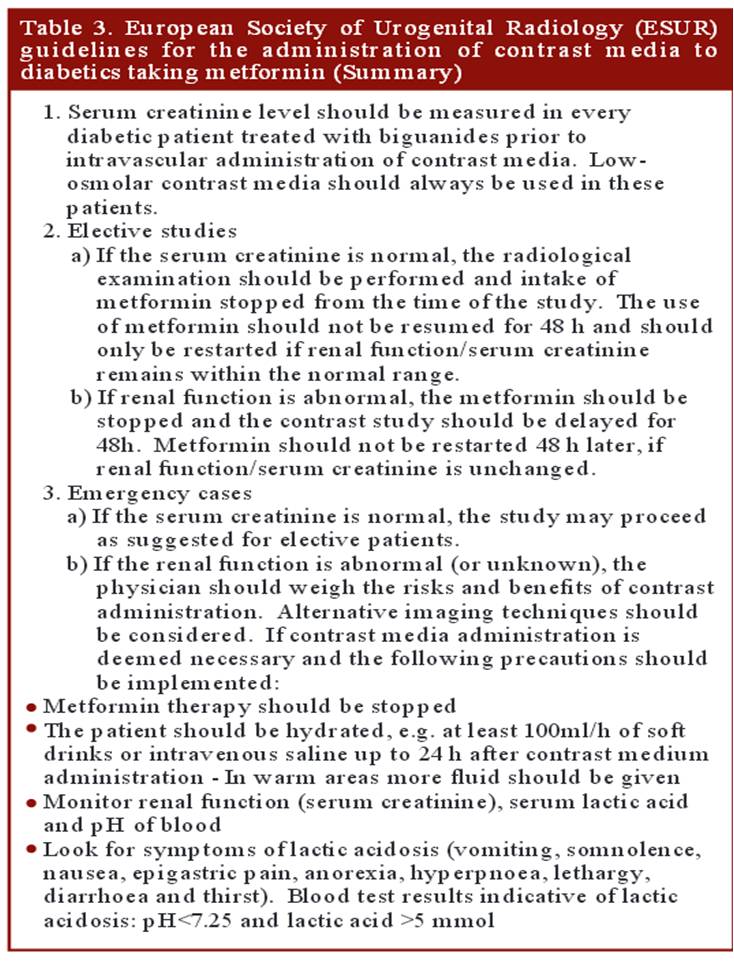
Though the incidence of Metformin induced Lactic acidoss  is low , the outcome can be bad , hence the concern. The European society of urogenital radiology  has provided clear cut guidelines regarding Metformin usage when contrast agents are being used.

metformin and contrast induced nephropathy guidelines cin european

What can be done in emergency situations 

  • Since the risk  of  lactic acidosis is very low , in case of emergency situations Metformin need not be discontinued prior to contrast usage.However it need to be stopped for 48 hours from the index procedure. (Fortunately Metformin is a dialysible drug that can be removed in case of toxic accumulation.)
  • Consider alternate mode of Imaging if renal function is really concerning


Reference

1.Pre admission metformin use and mortality among intensive care patients with diabetes: a cohort study.Christiansen C, Johansen M, Christensen SCrit Care. 2013 Sep 9;17(5):R192. doi: 10.1186/cc12886

2. http://ccforum.com/content/pdf/cc12886.pdf

contrast nephropathy

A good  article  from drug review Contrast induced nephropathy and metformin


Wall motion defect , in patients after CABG is fairly common.These  defects are difficult  to interpret  as the mechanisms can be multiple.Though the commonest wall motion defect appears to  involve the interventricular septum. it can occur anywhere in antero-lateral zone.

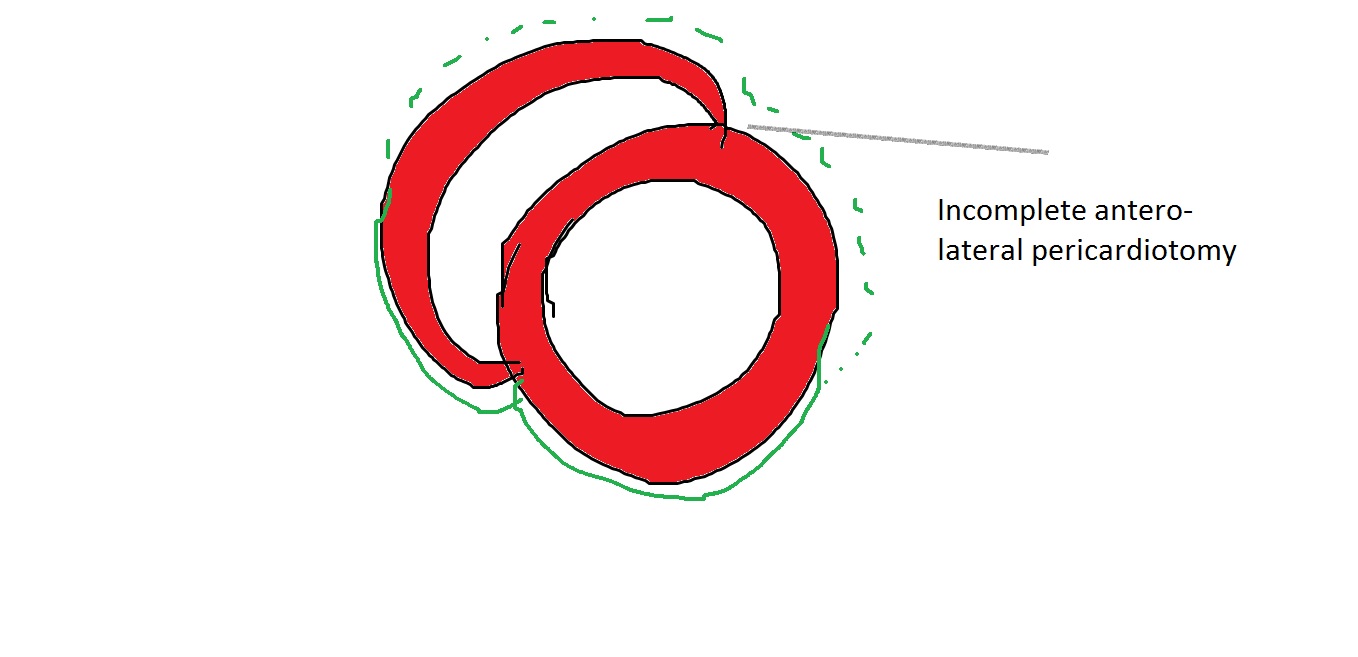
The mechanism attributed is  the effect of pericardiotomy , which surgeons as we understand leave it open after grafting  .This can cause lack of localised ventricular interdependence and results in a a brisk septal movement (bounce )It is an indirect effect .

post cabg wall motion defect

Note the, wall motion defects are confined to the exposed areas of the heart during cardiac surgery .In short axis echocardiography it correlates anywhere between 9 to 3 O clock position. Though interventricular septum is not covered by pericardium in the true sense , there is a indirect bounce effect over IVS due to interference with anterior ventricular interdependence .

More commonly a direct wall motion defect in the 12 to 3 O clock position in short axis is seen .This can closely mimic true wall motion defect as pericardial adhesions can tether these segments. Careful observation is warranted.Myocardial thickening is the key differentiating feature.

What is the physiological impact of these wall motion defects ?

It is generally considered benign (It is !) .Though in echo it looks awkward and suggest desynchrony. The real issue is , it can  mislead the echocardiographer to errors in calculation of that universally  sacred parameter called EF %

Importance of  knowing pre existing wall motion defect.

This has to be reviewed with old reports as it can wrongly create a new wall motion defect de-crediting the surgeons.

New pathological wall motion defect.

Of course it can happen due to peri-operative ischemic insult or infarct . However , It need to emphasised transient wall motion defects are common post CABG due to apparent hypoxia.This seems to be more pronounced with on pump surgeries than off pump .(Expected though) In my opinion, 2-4 weeks cooling off period is required before  a meaningful assessment of  wall motion post CABG.

Late pericardial reactions and localised constrictive features has been reported.

Disappearance of wall motion defect : How  common ?

Any disappearance of WMA is welcome . It happens rarely though . Some of the post ACS population (Both STEMI and UA/NSTEMI) can experience this ,  as they could harbor  zones of myocardial segments afflicted by  ischemic stunning rather than true  necrosis , that might  disappear.


Inferior STEMI is as  common as Anterior  STEMI .Unlike the anterior  STMI  which  auto localises  to LAD , inferior STEMI has to be fixed either RCA or LCX.

Following ECG features help localize Inferior STEMI  .

  • ST elevation in lead 3 > lead 2  suggest RCA (Not always true )
  • ST depression in lead V1,V2,V3 strongly suggest LCX. (More objectively the sum of  ST depression in V1, 2 , 3 divided by sum ST elevation in 2,3, AVF ,  if less than 1 indicate LCX.   Or simply ST depression  V3 > Lead 3 indicate LCX.)
  • ST depression in lead 1 indicate RCA
  • ST elevation in lead V6 strongly suggest LCX

Finally , and most importantly RV infarction as documented  by  ST elevation in V4R almost always localises the lesion in proximal RCA.

Role of Echo

If ECG  features  are not clear , a rapid bed side echo has a very good  localizing value. To fix RCA  look specifically for wall motion defect between “6 to  8”  O-clock position .It corresponds to  infero basal septum  that is invariably  supplied by RCA. For LCX involvement concentrate  on “3 to 6” o clock position.

stemi localisation by echo inferior rca lcx

Image source and courtesy http://www.aseuniversity.org

Which has better  outcome RCA or LCX STEMI ?

  • Though RV infarction  does not occur with  LCX , incidence  of MR is more with LCX and  can be truly troublesome. This probably negates the potential advantage of  “protected RV”  in  LCX  STEMI.
  • Since LV lateral free wall involvement  is extremely rare with RCA STEMI , it  has a lesser  impact on LV function while LCX STEMI can  give a double blow to LV   (MR and LV dysfunction)
  • On the down side ,coronary artery spasm and thrombus load are more with RCA .

Interventions in RCA is fairly straightforward ,while acute LCX PCI  has some  issues . Apart from technicalities of  intubating  the posteriorly  curving LCX ,realistically it involves fishing in troubled waters , as we need to cross the left main , likely physical contacts with LAD ostium , which is the sole supply chain for the injured and ischemic LV myocardium . Meanwhile ,  If RCA  is the culprit  , its a well cordoned crime scene where one can spend time liberally and fix the lesion.

Final message 

It is easier to localisethe culprit artery in inferior STEMI ,but its a tricky  to  predict outcome .Both can be troublesome .It depends on  dominance of the RCA/LCX ,proximal nature of lesion, the number and caliber of OMs, and PLVs and RV branch .However, it remains a fact  LCX STEMI has a  overall turbulent course.

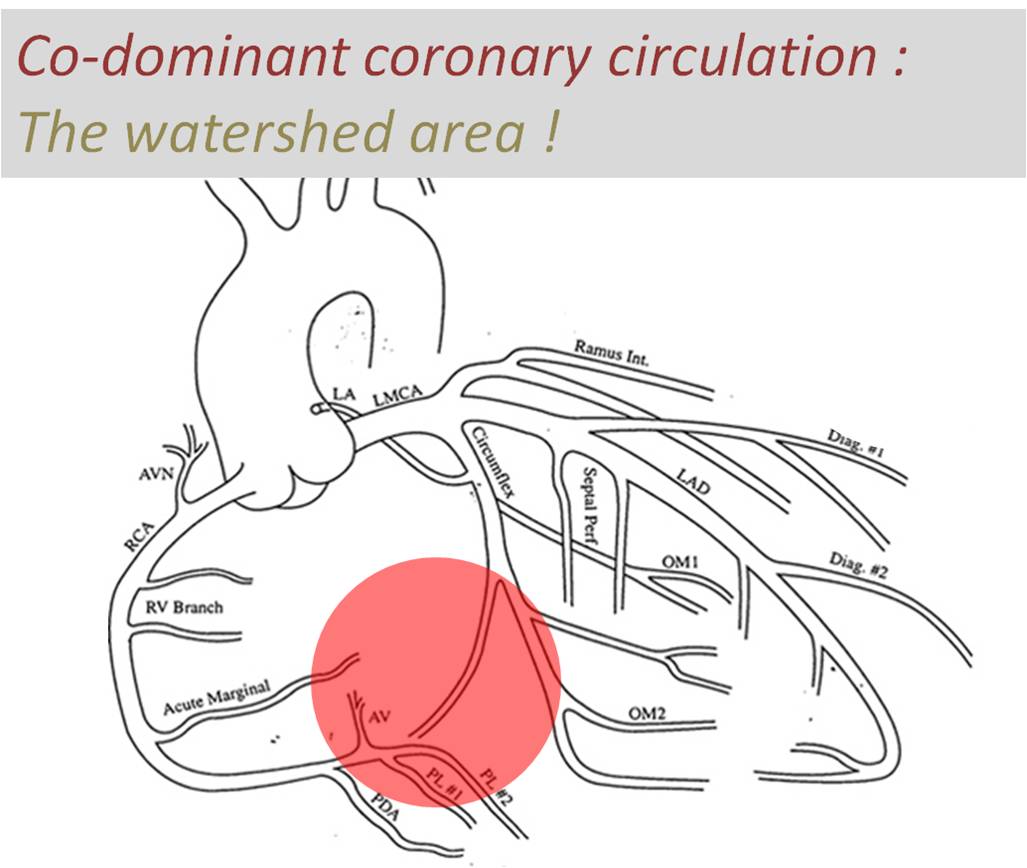
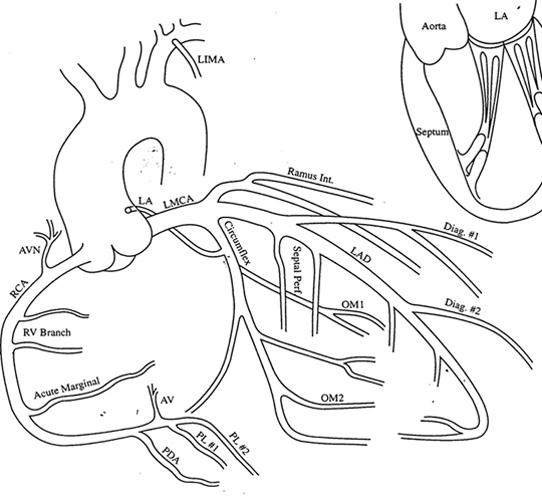
Co-dominant coronary  circulation is defined as , when  posterior crux of the heart receives twigs from both right and left system making this water shed area with advantage of twin innervation.They essentially supply  inferior and posterior aspect of both left and right ventricle including the posterior aspect of interventricular septum.

Traditionally inferior and basal aspects of heart are perceived (wrong tough !) as less important  than anterior  surface of heart.Infero posterior MI can be extensive and cause significant LV dysfunction and poor outcome. Longitudinal function (AV grooval velocity) and Mitral valve function  is critically  dependent on  posterior circulation.

Is there an advantage for co-dominant circulation  with reference to ischemic mitral regurgitation ?

Obviously ,one would expect there is some advantage in co-dominant circulation when ACS occurs  either LCX or RCA.It could theoretically  protect against development of MR as posterior  papillary muscles could receive supportive twigs from its companion.

However , there is a caveat .The antero-lateral papillary muscle normally has twin blood  supply from LAD(Diagonal ) and LCX (OM) . But in co-dominant circulation this pap muscle is  at risk of becoming single blood supply as the dominant RCA has a trade off with OM with its large PLV branch. It is likely in   co-dominant circulations if LAD is the culprit outcomes are likely to be worse.

Final message

A rare  study involving  more than 200,000 patients which specifically addressed this issue  of dominance and outcome , threw some surprising  findings. In concluded  PCI outcomes  with left or co-dominance has a worse outcome than Right dominant system.

Reference

1.Left and Codominant Coronary Artery Circulations Are Associated With Higher In-Hospital Mortality Among Patients Undergoing Percutaneous Coronary Intervention for Acute Coronary Syndromes . Report From the National Cardiovascular Database Cath Percutaneous Coronary Intervention (CathPCI) Registry  Nisha I. ParikhEmily F. HoneycuttMatthew T. Roe, Circulation: Cardiovascular Quality and Outcomes. 2012; 5: 775-782  2012; 5: 775-782

2.Papillary Muscle Perfusion Pattern A Hypothesis for Ischemic Papillary Muscle DysfunctioPaolo Voci, Federico Bilotta, Quintilio Caretta,Circulation. 1995; 91: 1714-1718


Verdict ?

Only complicated or high risk  STEMI,  would require immediate anatomy based management. Please note, this population at worst is never beyond 20 % of all STEMI. Hence more than majority of  patients  can be managed effectively without CAG.

My reasoning tells me,though knowing the  coronary anatomy appear vital  , it is rather the physiological impact of those  anatomical lesions  that will determine the outcome. So,post STEMI, if at all , we need to investigate, it should be about the  adequacy of the over all blood supply to left ventricle.This is done by a pre or post discharge sub maximal stress /nuclear test .If it’s negative with a good exercise tolerance  CAG will never be required as any critical flow limiting lesion ( that would require intervention  )is excluded with near 100% surety.

Postamble :Try asking  any neurologist , how often they demand to know cerebral arterial  anatomy for managing stroke  ? You will get a real surprise answer !

Holter monitoring is the Initial test for all those with documented  syncope (or Pre syncope ) with suspected cardiac arrhythmia .It is a 24 hour ambulatory  ECG monitoring , expected to pick up any electrical abnormality and its correlation with the resultant symptom if any. Though the test looks  attractive , the diagnostic yield is far less. (About 10%) .The reason being the episodes can be rare  to be  missed by 24hr sample time. We have extended Holter (48hr) , Event monitors , Loop recorders and implantable devices that can record ECG for extended periods.(18 Months ,Reveal Plus Medtronic)  that improve the yield  up to 45%.

One common issue that often confuse us  while reporting  Holter is, the  pauses that occur during day / night .

What is the significance of these pauses * ?  Nocturnal vs Daytime

Pauses are obviously significant when the patient is awake . It is generally accepted pauses more than 3 seconds during day time  (ie Heart rate of < 20/mt ) is significant . This is logical , as pauses more than that,  is expected to cause syncope ( or atleast pre-syncope ).The problem comes when you document pauses more than 3 seconds without any symptoms . Then this  difficult  question comes up ,At what degree of pause syncope occurs ? How is that some persons mange  even prolonged pauses with just giddiness.(Good overall vascular integrity and tone ! )

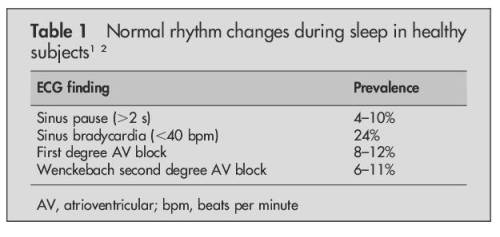
We know such pauses are  especially  common during sleep. How does the brain react when pauses occur  during sleep ? as there is no question of fall as such and loss of muscle tone is non existing.

*Please note ,when we say pause we mean only Sinus pause , Pauses due to AV blocks are very significant

nocturnal pauses during sleep holter

Source : Brodsky M, Wu D, Denes P,et al.Am J Cardiol 1977; .

Dramatic  pauses during sleep do occur

There has been prolonged pauses reported  during sleep without fatality . A 35 second nocturnal pause resulting in seizures has been documented by implantable  recorders.(Mairesse 2003)

Causes for prolonged pauses

  • Sinus node dysfunction
  • Obstructive sleep apnea
  • High dose beta blockers therapy

Final message

 Most bradycardic episodes during sleep are benign.This is due to depressed autonomic control during sleep. Holter interpretation is primarily done with  awake rhythm data in most individuals .So, empirically shall we fix a  5 second pause as significant during sleep ? We don’t know.While this may seem applicable even with structural heart disease , one may be vigilant while interpreting the nocturnal pauses in this population .

Caution

** Please note,  all these rhythm monitoring extravaganza is meant for people  with equivocal symptoms .Patients  with well documented syncope with ECG features suggestive of  cardiac rhythm disorders would never require these tests and go for pacemaker straightaway.

Reference

4.Arrhythmias documented by 24 hour continuous electrocardiographic monitoring in 50 male medical students without apparent heart disease. Brodsky M, Wu D, Denes P,et al.Am J Cardiol 1977;39:390–5.
For Advanced readers
guidelines for syncope nocturnal pause holter

What are the determinants of  dissecting  path   in Aortic dissection ?


Aortic dissection stanford002

Aortic dissection is  taught to us as a dramatic cardiac emergency where the blood  enters one of the planes of aortic wall and travels  in a random way . The wrong way blood instead of flowing within the lumen invades the vessel wall .(Vascular Tsunami ?) It may (or may not) leave the aorta at a distance resulting in various combinations of true and false lumen. Much like a tsumani  its also triggered by an energy releasing  blood pressure spikes hitting on the weakened  aortic wall rupturing the Intima. While acute dissection are often dramatic chronic dissection can be more subtle clinically.

Apart from the site of entry , blood pressure , condition of aortic vessel wall , there seems to be an invisible force that direct the dissecting tract.How it spares or compromises the arch vessels in selected few , as it travels down remain a mystery . If we can predict and track the plane of dissection by any means with computational  hemodynamic models , that will help us plan strategies. Beta blockers are used to reduce the shearing pressure , and emergency surgery is required in many type A dissections.


aortic dissection animation stanford a b classification 002

Do we see a “mini” Interventional opportunity here  ? To arrest or direct the dissecting tracts  into less benign zone. Shall we deploy an emergency  metal ring barrier  just proximal to aortic arch in Type A or  just above renal arteries in type B to prevent vital organ compromise ? This procedure can  be done fast , instead  planning a  elaborate endovascular intervention which is logistically difficult in  arch vessel dissection .This could also act as a bridge to definitive surgery. (Can we compare this with  bush fire fighting which are tamed by c0ntroled artificial fire lines and thus  avoiding spread to residential areas ! )