Feeds:
Posts
Comments

Ventricular ectopic beats are the most common cardiac electrical abnormality for which cardiologist’s consultation is sought.VPDs are one of most benign observations in ECG and  and almost every  heart experiences it. In 24 hour holter recordings it was reported up to 25% of healthy  individuals .

In spite of this ,  the fear of  noting a VPD in a given tracing of ECG is genuine both for the patient and his physician.This is because  VPDs  can be  a forerunner of dangerous ventricular arrhythmias.

  • VPDs are often graded according to the count and morphology and frequency.(Lown’s ,Bigger’s grading)
  • VPDs that occur in single are less fearsome.( It may not be so . . .)
  • VPDs in couplets and  triplets raise considerable anxiety.( Again it need not be . . .)
  • A series of VPD lasting for 30 seconds is called non sustained ventricular tachycardia(NSVT)
  • If it exceeds 30second it called sustained VT.
  • VT may remain as VT in many.
  • VT may degenerate into VF  ventricular fibrillation in minority( ie cardiac arrest)

The importance of VPDs do not lie  in the number ,  morphology or frequency  but most importantly  in  the underlying etiology. If it occurs in a structurally normal heart it is largely benign.

New onset VPDs should be investigated thoroughly. The commonest symptom is palpitation.

vpd ectopic

Friendly VPDs : Some of  situations where VPDs are  commonly observed and has little significance are.

  • Exercise induced VPDs
  • Pregnancy induced VPDs  (PIH /Peripartum DCM are  rare possibilities)
  • Thyroid associated VPDs
  • Alcohol /Smoke related

What are the VPDs that could be clinically  important ?

VPDs with chest pain(Ischemic etiology )

VPDs in patients with dyspnea.(CHF , COPD)

Drug induced VPDs(Digoxin etc)

Renal failure associated VPDs

VPDs due to hypoxia/Hypokalemia

In patients with pre existing heart disease.(Congenital, valvular, myocardial disease)

What prevents a non sustained VT from becoming sustained ?

No one really knows the answer.Most of the NSVT self terminates.A healthy heart some how gets the capacity to self terminate the arrhythmia.The normal  LV  fails to sustain the abnormal electrical circuit . A diseased heart may not be able to do so . Further if there is electrolyte abnormality (low potassium), or lack of oxygen it may maintain a VT.

What are the most dangerous forms of VPDs ?

  • VPDs that occur during  acute coronary syndrome.
  • VPDs associated with cardiomyopathy( Ischemic , nonischmic,)
  • Some forms of primary electrical disorders of heart( Brugada syndrome, ARVD , CMVT etc)

How do you investigate patients with VPDs?

General medical work up in all.

Echocardiogram is usually necessary in most.

Holter monitoring in occasionally.

Coroanry angiogram rarely

Electrophysiological study in high risk category

How do you manage  patients with VPDs?

  1. Generally do not require any specific drugs in vast majority of individuals .
  2. Reassurance is the key
  3. Ask them to avoid potential triggers like smoke, alcohol, coffee, tea and related bevarages.
  4. If palpitation is troublesome beta blockers( Propronolol, Atenolol, metoprolol can be used.)
  5. Anxiolytic may also be given.

*If the patient has  systemic disorder like hyperthyroidsm , anemia  or underlying heart disease he has to get the specific treatment.

Caution:It has become fashionable for the physicians  to use powerful antiarrhythmic drugs like amiodarone (Cordarone) liberally in patients with asymptomatic VPDs with structurally normal hearts.this practice must be absolutely avoided as amiodarone is one of most toxic  cardiac drugs known  with great pro arrhythmic activity.

When to refer a patient with VPD to a electrophysiologist ?

Physicians   can  treat   most of these patients. But the following will require EP consultations

  • Patients with syncope
  • Patient who have LV dysfunction(Low ejection fraction EF%)
  • Has had an episode of ventricular tachycardia
  • Cardiac arrest

What will the Electrophysiologist  do ?

These patients will be evaluated for inducibility of VT/VF and if the LV function is poor (EF<30%  MADIT 2 criteria ) many would receive implantable cardivertor defibrillator(ICD) or life long anti arrhythmic  drugs.

Some times radiofrequency (RF ablation)  waves are used to ablate the focus of VT.This is possible only if it occurs close to endocardium as  intracardiac catheters do not have access to epicardial  focus. Among  ICD and RF ablation later could be preferred whenever feasible as it eliminates the arrhythmia , while  the former only tackles it only after it occurs .( Hence ICDs  , even though a technological marvel can not be labelled as curative ! )

Final message

VPDs are the   most common cardiac arrhythmia .Most of them are benign. Few of them require extensive investigation.
How will you refer to a ventricle which is not dilated but still has severe global contractile dysfunction ?

Traditionally cardiomyopathy is classified as

  • Dilated (DCM)
  • Hypertrophic(HCM)
  • Restrictive (RCM)

But there is large group of pateints who do not show any of the above features and still have global hypokinesia  contractile dysfunction. this group has been largely ignored .It could constitute up to 25%of all cardiomyopathy.there can be some overlap between non dialted cardiomyopathy and RCM.

We report our experience here with

non dilated cardiomyopathy click to download PPT

non dilated  cardiomyopathy

Infective endocarditis (IE) continues to be a dreaded  medical problem. The clinical outcome has not improved much , in spite of  availability of powerful antibiotics. Early surgery in eligible patients  could provide the best possible results.

One of the major determinants of morbidity and mortality  in IE  is the renal involvement.

Kidney gets affected in almost all the patients  with IE.  As IE is a  a systemic illness and  immunological activation is  the  norm ,  some degree of renal involvement is universal. Microscopic hematuria confirms this. This is due to clogging and  globulin mediated  damage to glomerular membranes. There is a linear co relation between  the size of the vegetation and degree of renal involvement.

The following  mechanisms are attributed   for  rapid deterioration of renal function in patients with IE .

  1. Renal arterial emboli-occlusion-renal infarct
  2. Immune complex mediated  focal nephritis .
  3. Diffuse ,  rapidly progressive glomerulonephritis
  4. Drug induced renal dysfunction, especially with  aminoglycosides, vancomycin etc
  5. Finally &  most importantly , the underlying cardiac condition, which result in refractory cardiac failure  may either be primarily responsible for the renal compromise or aggravate the situation.
  6. Combination of each of the above can occur

How to manage renal failure and IE ?

This forms a deadly combination.  Aggressive  planning  & implementation  is  required. Cardiologists, cardiothoracic surgeons, nephrologists  should  discuss the strategies  together.  A microbiologist  is also welcome !

  • If it is purely a pre -renal failure due to CHF, there is no major worry.The  patient should  do well with cardiac failure management.
  • The role of CT surgeon is always vital, since 75% of times , IE patients require  valve replacement or vegetation/abscess  removal  in  an  emergency or semi emergency basis.
  • Pre operative and peri-operative dialysis will  improve the results.
  • Renal replacement therapy , combined with valve  replacement may be the ultimate therapy .It  could be the most heroic way to save a patient but carries near death mortality.

If ,  there is strong  evidence  to suggest  immune activation ,there could be a role for steroid administration. Literature  does not address this issue . Long term follow up of renal function is required in these patients .

Final message

Renal failure in IE is common and the underlying mechanisms are often complex.Early intervention is the key as there is  almost  “no  option” for   conservative management in this situation.

Aortic stenosis is one of the commonest valvular heart disease.Degenerative, calcific aortic valve is the underlying pathology . Many of the degenerative aortic valve is thought to be  a sequel to bicuspid aortic valve .The exact incidence of BCAV  contributing to degenerative aortic  stenosis is difficult to determine as many of these leaflets  lose  it’s  identity  . Rheumatic aortic stenosis continues to be a problem in developing world.Though ,primary aortic stenosis  is the  dominant theme , some amount of aortic regurgitation is commonly observed in all these conditions.

Apart from the severity of aortic stenosis  there are two  other important factors that determine the long term outcome.

  • LV function
  • Associated CAD.
  • Timing of surgery

Left ventricular dysfunction is a common  companion in severe aortic stenosis .Once the LV dysfunction sets in , there is a rapid decline in the clinical outcome.Some  of these patients have very severe LV dysfunction (EF< 30%) .

LV dysfunction  ,  underestimates  the true gradient across LV .  Cardiologists are  often  preoccupied with assessment of  true severity  aortic stenosis  in the presence of LV dysfunction .Sophisticated dobutamine stress echo, is supposed to help us.

Unfortunately cardiology literature has  little to offer  regarding the mechanism of  LV dysfunction in critical aortic stenosis

Some of the possibilities are

  1. Sub endocardial  contractile dysfunction   due to long standing high wall stress.
  2. Diffuse myocardial fibrosis , scarring , apoptosis.
  3. Associated CAD and ischemic cardiomyopathy
  4. Finally it could be a “Pseudo LV dysfucntion”  ie , simple mechanical stunning due to high afterload.This is a distinct possibility as some of  these   patients with  worst   LV function  recover fully following AVR.
  5. Combination of the above mechanisms  can occur

How will you determine  whether , the LV dysfunction of aortic stenosis is reversible or irreversible ?  Is viability an issue in LV dysfunction associated with aortic stenosis ?

Even though it is logical to think  LV dysfunction of CAD and LV dysfunction of aortic stenosis  are similar it  may  not be so ! ( Unless the LV dysfuntion  due to obstructive coronary  disease coexists)

Following rules need to be applied in patients with AS and severe LV dysfunction.

  • Every patient with critical aortic stenosis should undergo CAG.
  • The question of reversible vs irreversible LV dysfunction generally need  not arise.
  • There is no better way to predict the recovery of LV function other than the trial of relieving the obstruction.
  • So ,all patients* irrespective of  any degree of LV dysfunction shall undergo AVR
  • If there is obstructive CAD they need to be taken for AVR with CABG

*AVR  is  probably contraindicated , in  systemically ill &  co morbid patients , with grossly  dilated  ventricles. Here balloon aortic valvotomy  and  possibly PVR(Percutaneous valve replacement)  could be an answer.

Final message .

LV dysfunction of aortic stenosis is a poorly understood phenomenon. Since it is very difficult  to predict whether it’s reversible or irreversible , real world clinical experience  would suggest there is no need to predict it at all !  and every one should have AVR  irrespective of their LV function.

It is the  embryological remnant within right atrium  often observed as , mobile strands within RA extending fromIVC orifice to IAS. Some  times  it is difficult  to differentiate from eustachian valve  of IVC.The network is formed by collagenous material  and mimic valvular tissue

chiary network echo

Incidence

2% of general population . ( Means 10 crore persons  in our world ! )

What is considered  a benign echocardiographic observation for long  ,  may not be innocuous  . It  can predispose to certain clinical events , although rare.

  1. Mistaken for right atrial mass
  2. May produce  innocent murmur
  3. Catheter entrapment within RA
  4. Infective endocarditis of the network , and tricuspid valve
  5. Abnormal P waves and trigger for  atrial tachycardia
  6. Disrupted chiary network  prolapsing into RV
  7. Associated  foramen ovale  may induce  streaming  .This maintains  an embryonic right atrial flow pattern into adult life and directing the blood from the inferior vena  cava preferentially toward the interatrial septum

Reference

http://content.onlinejacc.org/cgi/content/abstract/26/1/203

http://ats.ctsnetjournals.org/cgi/content/abstract/76/4/1303

http://content.karger.com/ProdukteDB/produkte.asp?doi=10.1159/000096780

The right ventricle  is a unique  chamber of the heart . It is the anterior most chamber and  triangular in shape.  Even though  the walls of RV are  not  clearly demarcated ,   it does  have  anterior ,  posterior, and lateral free surfaces   . Anatomically it has a inflow  body, apex and outflow portions . The apex of right ventricle , blends with the lower IVS at an acute angle.

How does RVH occur anatomically ?

The anatomy of RV is such that  it does not allow  it  a concentric  RVH ( like LVH ) . In fact , there is a  disproportionate free wall , anterior  wall   hypertrophy  many  situations  like  PHT/Pulmonary stenosis. The  infero posterior aspect of RV rarely show hypertrophy.

Since RV is the anterior most chamber, located just beneath the left border of sternum   RVH brings the RV  further closer to chest wall .This makes the V1 lead to show  tall R in V1.

What happens in RVMI ?

Unfortunately, when we  refer to RVMI , we generally do not make any efforts to locate or estimate it’s  size.  Since RV has , anterior , lateral and posterior surface  , the site  and  the  extent of the  mI will have a major impact  on the  ECG  features .

Most often  the RVMI occur as a  part of infero posterior MI  .Hence ,  it is uncommon for the anterior surface of RV to get involved.  But ,  it can be involved if  RCA gives of a   large RV branch  that reach the anterior surface of RV.

Anterior RVMI can occur as a part  of LAD MI  , if a large conal branch cross the RV surface.

What prevents the lead V1 from showing the  ST elevation of RVMI ?

  • Most of the RVMI do not involve the anterior surface of the RV so , less chances for ST elevation
  • Further , if a true posterior wall  MI  occur as a part of  RVMI (Which is often the case !)  V1 can never  show ST elevation  as the  posterior MI  tend to have a ST depressing effect in the V1, V2 leads.
  • Extensive IWMI , can have reciprocal ST depression in V1-V2.This again , prevents V1 lead to show the ST elevation

So many times , even though V1 lead is just sitting over the chamber RV it fails  to  pick  the  ST elevation forces of RVMI

Advantage of V4 R ?

V4R records remote RV forces , as these  signals are not contaminated by the inferio posterior ST forces. Hence  a  1mm ST elevation in right sided chest leads have good sensitivity  and specificity to diagnose RVMI .

When can V1 show ST elevation in RVMI ?

If the RV anterior wall is predominantly involved (Ie Anterior RVMI ) ST elevation can occur in V 1 like a anteroseptal MI.

rvmi ecg

Rarely a q RBB can occur in V1 in isolated RVMI.

Final message

V1 lead , though anatomically proximal to RV has less value in diagnosing RVMI since this lead picks up  Infero posterior  negative ST forces  and  the anterior  forces of RVMI get neutralised . So relying on lead V1 to diagnose RVMI is not adviced , except when  the anterior surface of RV is predominatly  involved.

NSTEMI constitutes an important sub group of ACS. In fact it  forms the major  group. Real world data would indicate it   UA/NSTEMI could form up to 75% of all admissions for ACS in any cardiac emergency units. Risk stratification of NSTEMI is important and  is available. It is  one primarily with clinical features , ECG and troponin positivity. Classifying NSTEMI   with reference to underlying patho anatomy is not available.

Classifying  NSTEMI based on the following is  is suggested .

A.Based on the  extent  of infarct.( For example there is no entity called extensive NSTEMI  unlike STEMI)

B.Based on the Location of NSTEMI .

Currently , NSTEMI simply means there is an infarct some where in the heart ? Should we not localise it ? Is it not surprising , we have not attempted to localise  NSTEMI  so far ?

C.Based on the coronary anatomy : RCA NSTEMI vs LAD vs LCX NSTEMI.

The reason is two fold.

1.NSTEMI is often patchy , subendocardial . Some times  only islands of infarct can occur.But , .How common is segmental NSTEMI ? May not be common, still if wall motion defect occur it must be an segmental MI.Some estimate wall motion defect in NSTEMI is around 25%.

2.Is  there any clinical purpose for localising NSTEMI ?

Some would  think there is no real  purpose. That does not  mean ,  we should not attempt to do it. In fact there is an  important reason ,  we  need to  localise  NSTEMI. Triple vessel disease ,  is the common pathology underlying NSTEMI. They often have  multiple critical lesions as well. Identifying the  the  culprit lesion is not an easy task. If we know the site of infarct ,  however small it may be , it  helps us fix  the coronary artery.

A real dilemma could occur in patients  with NSTEMI , who has a  90 % lesion  in  RCA and  50 % proximal LAD lesion  . We ( tend to !)  take it as granted  ,  RCA  lesion is likely to be responsible for the NSTEMI. But  the real culprit  could be  the  recannalised LAD .  If it is so ,   the 50%  LAD lesion  could   be  more important and if you leave it free there is a strong  likely hood of recurrent UA. If we could some how located  the NSTEMI in the LAD region in this patient  , he could  get a PCI for LAD as well.

Of course , there is  an   universal approach available “Doing PCI for all suspected culprit lesion however mild it may be ”  . Unfortunately , it  increases the metal load for the  patient, which is an independent risk factor for a future ACS.

How to locate NSTEMI ?

So , it is often helpful to locate NSTEMI  . Of course ,  it needs little more efforts. A very meticulous echoc cardiography can aid in locating  the subtle  wall motion defects in NSTEMI . Perfusion studies/PET studies may be indicated in occasional patients.Myocardial contrast echo can be useful.

Coming soon

Difference between Anterior NSTEMI and inferior NSTEMEI

When  a doctor is confronted by serious  doubt  ,  what will be the outcome for the patient  ?

Can  doubting  be beneficial for a patient ?  . It seems so ,  according to  EBM which  stresses   about statistical outcome at every turn of events in a  patient who  is critically  ill .

Is  something ,  always  better than  nothing   ?   Our  limbic  system tends to think so .  It  may not be true. But  in  dire situations ,   many  things  (Proven , unproven)  need to  be tried  however doubtful it ‘s  efficacy  may be  .This is  akin to an  emergency in an  airplane. Even here there need to be a logic.

Then ,this question  arises . How do we make  sure ,  we have a  dire situation on hand  ?

This is the key issue ,  in  the  decision making  for the   critically ill patients .  It  needs  experience ,  only experience !  Though the principle of uncertainty  is the fundamental rule in medicine ,   EBM  aims to bring some degree of certainty in medical therapeutics.

ebm evidence pci coronary

Benefits of doubting in coronary care unit.

In  a  sinking patient  with cardiogenic  shock  , try  the maximum treatment . Even if , the patient is  in severe shock  , take him to the  cath lab ,  try  open the coronary artery . Give the benefit of doubt  to him even though the chances of reviving him is less than 10%.

Risk of doubting in Coronary care unit.

A.Elderly STEMI  with SHT,(Arriving late ,  with  an unknown time  window  after an MI ) To thrombolyse or not ?  . There is  no benefit of doubt here.  Do not thrombolyse. Here , apply  the benefit of doubt against thrombolysis .

B. Chest pain with  LBBB (Thought to be new onset LBBB ) don’t ever rush to thrombolyse.  Wait for the enzyme result . Don’t try to thrombolyse your doubt , instead  thrombolyse the  confirmed thrombus !

C. Patient with persistent ST elevation following thrombolysis ,in an  otherwise asymptomatic and stable patient. Don’t  pass on  ” your doubt ” of salvaging   at least  some myocardium  by rescue PCI .Rescue  should be done before death. You can not resuscitate  dead myocytes.

Final message

The concept of   giving  the  benefits of doubt  to the patient   is a widely prevalent practice  in medicine .This concept is alive  and popular , not because it has proved effective, but because of the primitive   human perception and cognition  , namely “Something is better than nothing ” !

Common sense and logic would suggest , whenever  there is  a benefit  for doubting there would be a  equal (  or  even  more ) unmeasured  hazards and risks . This  becomes  especially  true ,  when   a   physician makes  a therapeutic move  based on doubting than on conviction .

Thrombolytic therapy ,  has been  the specific treatment  for STEMI for  many decades. Primary PCI*  is  shown to be  superior  than  thrombolysis  if   performed   early  by an experienced  team in a dedicated facility. (*Conditions apply). It is estimated ,   currently only a  a fraction  STEMI  population get primary PCI (<5%) in ideal conditions . Another fraction , get  primary PCI by inexperienced cardiologists  in low volume centres.

So , thrombolysis   remains, and  would continue to remain ,   the    primary  mode of therapy for STEMI  in the  present and near  future !

How do you assess the successful  thrombolysis ?

It should be recognised ,  there is a fundametal flaw in this  question !

The aim of thrombolytic therapy is  not  to   lyse  the thrombus  , but also  to restore the coronary blood flow to the  myocardium – also called reperfusion . One may wonder , why the term ,  thrombolysis  should ‘t be  used interchangeably with reperfusion. 

A successful thrombolysis  never guarantees  a good reperfusion , for the simple reason ,  distal blood flow in an  obstructed coronary artery  is dependent on ,  many factors  other than relief of obstruction.

Apart from the potency of drug,     other   important factors  that determine  successful  lysis &  reperfusion are  . . .

  • Timing of opening of artery , if the thrombolysis is delayed  ,  the distal myocardium is dead , and   it won’t allow blood flow to enter the mycardium.
  • Microvascular integrity is as vital as epicardial vessels.
  • Distal microvascualture  plugging by the thrombotic debri . This is called”no reflow “

So , we should  primarily assess myocardial reperfusion rather than epicardial thrombolyis ! following thrombolysis .

What are the parameters available to assess successful reperfusion /thrombolyis?

  1. Clinical : Relief from chest  pain. Angina relief  , though subjective is an indication for adequate reperfusion of ischemic myocardium.
  2. ECG-ST segment regression > 50%
  3. Cardiac enzymes: Early flushing of  intra myocytic CPK into systemic circulation and hence early peaking of CPK MB (<1ohours instead of 24h)
  4. Reperfusion arrhythmias(AIVR-Less specific) .Primary VF is now thought to be reperfusion related.
  5. Infract related artery(IRA) patency by coronary angiogram
  6. Distal TIMI flow/ myocardial blush score/ TIMI frame count

ECG ST regression ,  is a direct indicator  myocardial reperfusion   as the ST segment shifts  towards baseline ,  implies  of infarct current of injury . ST regression almost always correlate with good  recovery of LV function  in STEMI .

IRA patency , is an epicardial index , it  does not give information about myocardial blood flow . But ,  a good  distal TIMI flow generally indicates good reperfusion.This  again ,  is  not a fool proof  index,  as even many of the TIMI 3 flow patients  have severely damaged myocardium by echocardiography .

Final message

For the above reasons, one should always  make a distinction between successful lysis and successful reperfusion . Surprisingly ,  ECG  is  the gold standard for assessing successful reperfusion of myocardium ,  while CAG tell us  about epicardial patency and possibly reperfusion also.

Apart from  acute  coronary syndrome,    cardiac  failure is   the most common clinical  presentation of  CAD. Cardiac failure ,  classically present with dyspnea on rest or on exertion , while angina is the dominant presentation in ACS.  

What if  ,  both these  occur together in an acute fashion ?

Yesif it occurs  together it is called ischemic cardiac failure . Fortunately , this is quiet uncommon . It has   an adverse outcome,  especially if it occurs  as a companion of NSTEMI . Let us see how . . .(  Most of the episodes of cardiac failure  in CAD  means only  LV failure )

For cardiac failure to occur , there need to be a mechanical contractile dysfunction or defect . In CAD population , this can  occur in  one of the following way.

  • Loss of LV muscle (Acute  Myocardial infarction as in STEMI)
  • Mechanical defects (Mitral regurgitation/VSR etc)
  • An arrhythmia (Commonly VT or AF / CHB )  can precipitate  cardiac failure

Apart from these three , there is  an important mechanism of acute LVF, namely ischemic stunning of major part of LV resulting in severe mechanical dysfucntion.This is a dangerous form of cardiac failure (Pathologivcclaly it is thought to represent  contraction  band necrosis !) this occurs in global ischemic situations manifested as gross global ST depression.

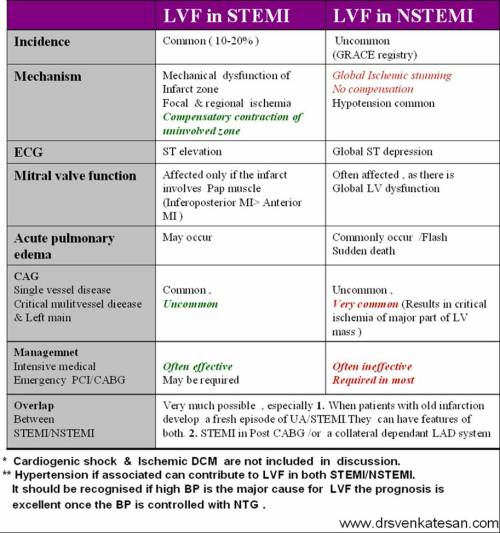
So,  there are two types of  ischemic LVF  .  STEMI   occuring due to infarct( ± ischemia ) Other  one (NSTEMI)entirely due to ischemia.

Logically ,  one  may n’t   refer  STEMI related LVF as  ischemic LVF at all  , as infarct has already occured. While , NSTEMI related LV could be the ” True ischemic LVF “


What are the differences between cardiac failure that occur in  STEMI and NSTEMI ?


lvf in nstemi stemi

Is post infarct failure  ( The commonly used terminology  , now out of vogue ! )  a type of ischemic LVF ?

In the strict sense , it is not . Here the dead myocardium , is responsible  for the   failure .To label a  LVF , as  ischemic , ongoing ischemia must  be  documented and further it  should  be shown to  contribute   for the  mechanical dysfunction .

This is of vital importance ,   if you wrongly attribute ischemia  as a cause for  the LVF , the patient may be taken up for emergency  revascularisation .It is not going to help much (Infact , it may  worsen !) as  this cardiac failure is not going to be corrected  .What we require ,  here is an  aggressive medical management  protocol .