Feeds:
Posts
Comments

The quantum of electrical energy reaching the surface of the chest wall varies widely .It depends upon myocardial mass, proximity to the chest wall  and the thickness of chest wall.

Apart from this ,  the amount of blood within the left ventricle also determine the QRS voltage of ECG.

In dilated LV due to a regurgitant lesion , the LVEDV is increased . Since  blood is a very good conductor of  electricity , it amplifies the transmural  activation front and results  in high voltage QRS complex.This is referred to as Brody’s effect.

Where else , we  can  visualise the Brody effect  ?

During excercise stress testing , when  the heart rate and   the  LV diastolic volume increases .There is  a significant increase in QRS  voltage in leads facing LV, especially V5 and V6.

This is  usually a benign response in healthy individuals. However in patients  with preexisting CAD and LV dysfunction an  increase in R wave amplitude may  be a marker of  exercise induced LV dilatation  which  could  predict an adverse outcome .

Is there  a reversed Brody effect , where Q waves get deepened on exercise ?

This has not been described in literature , but it is seen often in patients with post MI stress testing .Q gets deepened .If the q gets minimised* it could indicate presence of significant viable tissue  , as it gets recruited during the excercise induced positive inotrpism mediated by   catecholamine .Lengthening or deepening of Q indicate less viable tissue.

*Study in progress : Will  be referenced shortly .

Brody effect is a complex phenomenon.

Advanced readers follow the link for illustration on Brody effect

http://www.bem.fi/book/18/18.htm

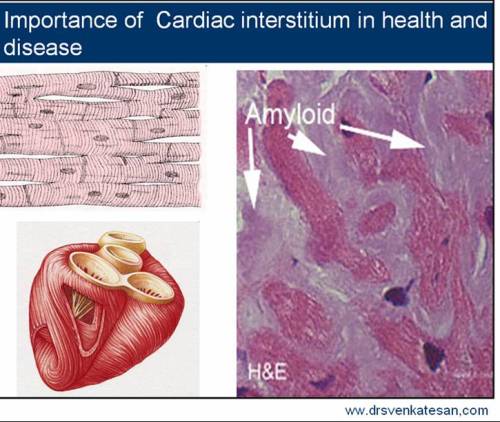
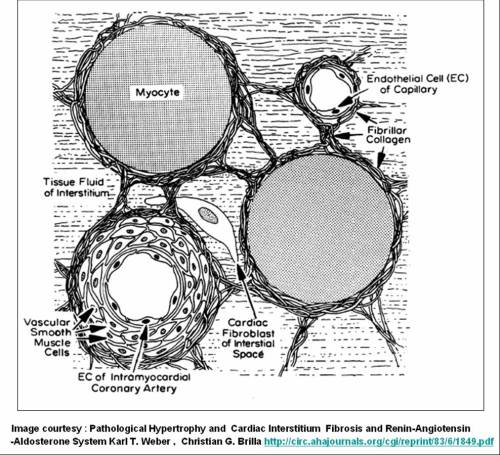
Human body is made up of trillions of cells. Some of these cells are specialised and connected together to form various organs.The cells that connect each other  provides the   structural  support  and   maintain the organ   shape  and function.  Traditionally  these supporting cells were  thought  to have little functional role. Now it is well recognised these cells   could be as  important as  the myocytes or   hepatocyte . God  has  never created any of the human cells with  out any purpose . They may  have  important paracrine function.  Healthiness  of these interstitial cells are vital for the intercellular communication, cell nutrition  and it’s  proper function . These cells are called by  various names , the old  terminology could be the connective tissue -the tissue that connects  cells. Many times  fibroblasts is the common name given to all interstitial cells . Interstitium is not only filled with some bizarre mesenchymal cells it is also a  depot of  sticky molecules.  Now we have  deeper knowledge about these  , and identified various intercellular adhesion molecules, matrix metallo proteins   , vitronectins, etc.

cardiac interstitum intersitial fibrosis amyloidosis

It is  a great  medical paradox   the specialised the myocytes, hepatocytesaxonal cells are given  due respect,  while the role of  cells and molecules that bind them together is least  appreciated . In fact in any given organ the functional cells constitute  only one third  of it’s weight.In the heart myocytes form only 30% of it’s weight. It is a clear cut case of discriminating the majority !

Interstitial disorders and  diseases

In the lung Interstitium becomes very much important because the gas exchange has to  traverse the interstitium and enter the alveloar cells. So any abnormality  here  is immediate and profound.The diffusion capacity reduces  .Patients  develop  progressive COPD.

In the kidneysinterstitium has a functional component as the absorbed fluid and electrolytes  has to reach the blood circulation .Hence  acute and chronic interstitial  nephritis are distinct clinical  entities .

In the brain dysfunctional  inter neuronal cells can interfere  with various CNS  functions dementia the major  disorder  id thought mainly contributed by the interstitial fibrosis.

cardiac interstitum interstitial fibrosis myocardial

So when each of the vital organ has a potential  to suffer from  interstitial    pathology How can heart  alone escape ?

No, it does not . The  currently popular entity   , heart failure with normal ejection fraction   could be nothing but   chronic  interstitial  carditis. or chronic progressive interstitial  fibrosis.  Hypertensive heart disease is a major cause . CAD can also contribute .

The interstitial  fibrosis  is also a feature of  dilated and restrictive cardiomyopathies. (Classical amyloid heart disease ) .Initially  these fibrosis do not affect the  contractile  function of  myocyte .In later stages it encroach  upon the contractile  cells and impair the EF. This explains  the natural  history of many of the RCMs which   go for dilatation and contractile dysfucntion in terminal state.

What is the difference  between myocyte relaxtion and  cardiac  relaxation ?

  • It is now recognised , cardiac  interstitium has a big  role in relaxation .
  • Cardiac relaxation is not synonymous with myocardial or myocyte relaxation .
  • For  myocyte to  relax ,  it has to eject back the calcium from the actin myosin complex  into the  sarcoplasmic reticulum where the calcium uptake protein   phospholamban holds it till the next systole.
  • As the myocyte relaxes  it has the additional  burden of stretching &  relaxing the adjoining  non myocytic cells  , unfortunately this   weighs 70% more than it’s own weight .One can imagine how much the heart is stressed during  even diastole ! So as  the sheets of myocytes feel the diastolic interstial stress the whole LV struggles to relax and LVED raises and diastolic dysfunction begins to set in.
  • The interstitial l plasticity and elasticity is vital for cardiac chamber to  reach it’s pre contractile  state . It is now recognised the rate of LV relaxation  (Negative dp/dt )  is directly proportional  to the interstitial  agility and turgor .

How to overcome interstitial  fibrosis and stiffness ? Anti fibrotic drugs ? .

We are in search for such a universal anitifibrotic drug that can work in liver fibrosis ( Cirrhosis ) lung  and myocardial fibrois. D penicillamine has  showed some promise. How to make the interstitial interface more flexible ? Collagenolytic agents , elastase MMP inhibitors etc may become the   future targets.  A much established  way to regress myocardial fibrotic process is ,  with ACEI and aldosternoe antogonists. (EPESUS, RALES study) .Some of the   anti myocardial remodelling  action of  ACEI is attributable to it’s  anti  growth factor properties and can  the resultant regression of  interstitial fibrosis.

Apart from the look out for sophisticated drugs ,  applying common sense can do  a “great deal of good “for the myocardium in  diastolic cardiac failure  . A stiff  skeletal muscle need physiotherapy. A stiff cardiac muscle will also   need exactly this. For  cardiac muscle physiotherpy can not be administered by a therapist  ! , we have to do it  , regular  exercises   to make it contract  and   relax  fast . So ,  it is important to recognise  exercise   prescription and training  could be the  most  important modality  for preventing progression of diastolic heart failure.

Clinical situations  where   cardiac interstitial pathology is  relevant

  1. All forms of cardiac failure
  2. Some forms  of myocarditis
  3. Myocardial interstitial  edema ,Post MI/Reperusion
  4. Myocardial interstitial edema mediated no reflow following primary PCI
  5. Acute and cardiac transplant rejection
  6. Drug induced adrimycin carditis .
  7. Cardiac interstitium arrhythmias : Many of the cardiac arrhythmias are due to re entry circuits mediated by cardiac interstitial fibrotic substrates.
  • Atrial fibrillation
  • Post MI ventricular  tachycardias

Final messge

Deep dissections  of  pathological hearts   in pursuit of   culprit cells has surprisingly ,  lead us  not into myocytes and conducting  cells but into inter cellular spaces” . There is  big secret  world over there within the cardiac interstitum.Young scientists and students  argued to   explore and unravel the mysteries !

Reference

A landmark article in Circulation 1991

Pathological Hypertrophy and  Cardiac Interstitium  Fibrosis and Renin-Angiotensin-Aldosterone System
Karl T. Weber, MD, and Christian G. Brilla, MD, PhD

http://circ.ahajournals.org/cgi/reprint/83/6/1849.pdf

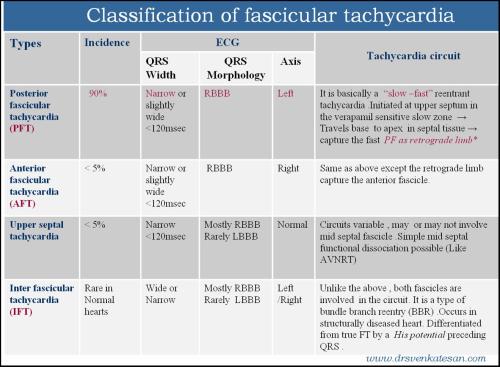
Traditionally we believed VT can originate only  from the ventricular myocardial cells . Then we realised many of the VTs shared the characteristics of SVT. When these were analysed , it was found VTs , after all ,   do not have   a big deal of   difference wth SVT s ! especially when it arises from the high septum .Contary to the conventional teaching  the AV node is not a anatomically distinct and discrete  structure  .Instead it is made up of  thousands of specialised cells located in AV junctional area .These cells ramify both superiorly and inferiorly like an octopus . Hence  , it does not require great academics to understand AV Nodal properties extend downward into the IVS for some distance . In some individuals   clusters of cells with  slow conducting  property (Which is a hall mark of AV nodal tissue )  may invade deep into the IVS .The interface of  these slow conducting tissue with that of  fast septal purkinje fibres , make it a  perfect platform for  the potential slow-fast reentry within IVS. This forms the basis of fascicular  VT.

Clinical features

  • Since it shares the  properties of SVT , the natural history is also relatively beningn
  • Occurs in young
  • Hemodynamically stable ( More physiological conduction : Superi inferior Like SVT)
  • Narrow qrs (Narrow because the VTdoes not travel by cell to cell instead  run through the normal conduting system for most part in the circuit)
  • Verapamil sensitive .(Mimic AV nodal Tach)
  • Degeneration into VF is  rare  and hence  SCD is not a big  issue
  • Tachycardic myopathy can occur.

fascicular vt ventricular tachycardia  ecg  svt avnrt avrt wpw

Note:

Fascicular tachycardia is also known in several names.

It forms the bulk of the causes for  idiopathic left ventricular VTs .Other being LVOT VT.

Described first by Cohen in 1974 , followed by Zipes , when they noticed  it was possible to reproduce atrial induction of VT.

Belhassen in 1984 found the verapamil sensitivity of this VT

Other synonyms some times used are

  • Septal VT
  • Narrrow qrs VT

Download high resolution table

Fascicular tachycardia

The term cardiomyopathy generally denotes a  progressive disease  in clinical cardiology.There was a time   diagnosis  of dilated cardiomyopathy (DCM )  was synonymous with a  delayed death sentence !  Of course , the situation has vastly improved over the years  with the availability of  new medical , interventional and surgical management. Still ,  there is no denying the  fact  ,  DCM continues to  have a grave outcome  especially when it occurs without any identifiable cause .

While we have  variety of aggressive DCMs , we also  have  patients with relatively benign forms of   dilated and dysfunctional hearts  which recover totally .

This reversible forms of DCM is observed in  the following  situations.

Hypertensive dilated cardiomyopathy . The left ventricle  in  some of the  patients with severe SHT  respond to the stress (Increased  after load) by dilatation rather than hypertrophy. This is especially common after an episode of LVF.  If we do an acute echocardiogram the LV function is severely impaired and the LV may  also be dilated. With good control of BP and fluid management the ventricle promptly return  to it’s baseline dimension. The recovery is complete in many . (The mechansim of LV dysfunction acute severe Hypertension is referred to as Pre-load /After load mismatch) Link to concept of Pre load mismatch .

* Note in the past these entities were not called as  cardiomyopathy .

Peri partum cardiomyopathy.

This is a serious disorder of cardiac muscles that occur during pregnancy  few months before  or few months after delivery  . There is correlation between PIH and this entity. Prognosis varies between very bad to excellent. Very few cardiac entities  have a  natural history like this one disease of women.Most of the pregnant women regain their original cardiac status within  year or so. It should be recalled there is high chances of recurrence in next pregnancy.

Alcoholic cardiomyopathy.

The toxic response to alcohol or the additive cobalt can result in DCM .There is overlap  between holiday heart syndrome and alcoholic DCM , where atrial fibrillation is the major problem. Wet Beri beri is the advamced form of clinical DCM that respond to vitamin B therapy.

Tachycardic cardiomyopathy.

This is also a common entity that occur during persistent sinus tachycardia or AF , thyrotoxicosis.Beta blockers are  of great use here.  Recovery is usual if the primary cause is correctable.

Toxic and drug related  reversible LV dysfunction

Adriamycin cardiomyopathy

Tako -Subot  Cardiomyopathy canbe termed as classic form of reversible  stress cardiomyopathy

Miscellaneous conditions

Diabetes and chronic kidney disorders are known to have a reversible form of cardiomyopathy

Some rare toxins  , scorpion envenomation , selenium deficiency can result in reversible DCM

**Ischemic DCM are partially  correctable in many , still  we don’t include it as cause for reversible DCM

*** Many episodes of acute myocarditis can have transient or short term LV dialtation and  dysfunction.they are classified as myocarditis .But there is little  difference (Except acadmeic . . .)  between chronic myocarditis with LV dysfucntion  and cardiomyopathy.

10.14prescriptionRXStatins are projected to be  the saviours of human race against the  killer atherosclerosis .Now we have reached a stage  soon ,  where every healthy individual may be administered this drug. There are consistent evidence for statins to reduce , retard , prevent progression of existing atheroscelorosis  and possibly prevent future atherosclerosis.

This  wonder drug acts by blocking the HMG COA enzyme a vital  enzyme that regulates the lipid metabolism within the cells. It is made to appear  as if ,  the  God has  created this enzyme  with the only purpose for human suffering , by blocking this   we  expect  all errors in lipid  metabolism is corrected.

This enzyme is  part of the house keeping  system  that is meant to service the human cellular lipid layers 24hrs a day. If it  is impaired intentionally one can imagine the consequences. That’s what modern science is all about. Luckily God is kind enough the side effects of  blocking this enzyme is seen only in minority. The myopathies that are classically described with statins are due to possible mitochondrial dysfunction .

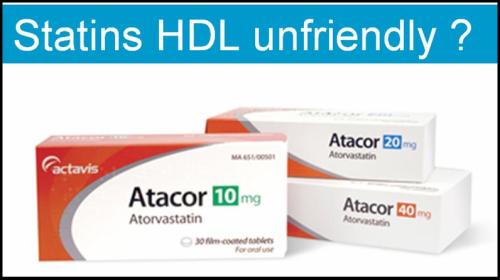
As the debate still  continues to find the   optimal bottom levels  of LDL  , we have more worries ,  real world experiences have brought us a new issue  namely  the  reduction of HDL with statins. While literature search on statins and HDL  tell  us there is marginal increase in HDL up to 10% the fact is there is marginal fall or significant  fall in many of the patients .

How can this happen ? A  huge difference between real world and trial world ?

statins hdl ldl

* Brands shown  not intentional

Readers are welcome to add their input on this question .

Reference

Visit HDL forum

http://www.hdlforum.org/

Conduction disturbance is a fairly common occurrence following  MI. Inferior STEMI is especially prone for AV blocks. This is because  the  blood supply to AV nodal  tissues and the inferoposterior surface of the heart  share the same arterial territory . AV node gets it supply  90% of time by right coronary artery(RCA )  and 10% by  LCX. Very rarely from both .

The common bradyarrhytmias that we encounter in inferior MI are

Sinus bradycardia

Sinus pauses ,SA blocks

AV blocks

Functional

Vagotonic

Organic

Ischemic

Necrotic

ECG types

1  degree AV block

2 degree  AV block – Type 1 Wenke bach

Complete heart blcok

Mechanisms

The inferior aspect of the heart has rich innervation of vagal nerve terminals (While the  sympathetic adrenergic system is concentrated in the anterior surface) . The moment infero posterior MI occur it stimualtes the vagus and a prompt bradycardic response occur .Many times the classical hypotension /bradycardia reaction is simply a reflection of heightened vagal tone.

Consequence of vagal tone on SA nodal and AV nodal conduction

As expected, vagal stimulation can result in a spectrum of arrhythmias from the  simple bradycardia to complete SA block  to  AV block. Extreme bradycardia , may release the junctional pace maker and result in junctional rhythm with a rate of around 40-50. There can be a functional AV dissociation between SA node and AV node. Careful ECG analysis is required here ,  as it can mimic organic AV block.The simple way to differentiate between organic AV block from simple AV dissociation is to look at the p waves.In AV dissociation both atrial rate and ventricular rate are nearly equal or VR  is slightly more than AR .In CHB atrial rate  exceeds ventricular  rate.

SA and AV block occur due to various mechanisms in inferior  MI

  • High vagal tone
  • Ischemia of SA/AV node
  • Necrosis of AV node
  • Drug effects -Like morphine
  • Reperfusion bradycardia*

Ischemic AV nodal arrhythmias are  some times very difficult to differentiate from vagotonia especially if occur within 24h.

Irreversible AV nodal block due to necrosis is rare.But if occur , usually  associated with extensive inferior mI/RVMI/ .AV block  that  persist beyond 48-72hours should raise the suspicion of damage to AV node.( As vagal tone is very unlikely;y to last beyond 48h)

* Some time a an episode of sudden severe  bradycardia  can be manifestation of RCA reperfusion.Flushing of SA nodal or AV nodal branch of RCA might trigger this. This has a potential  to  bring the heart to asystole.The resultant extreme bradycardia often triggers VT/VF .The reported high incidence of primary VF in infero posterior MI is attributed to this sudden RCA perfusion.

Medical management for CHB

Brady arrhythmia’s due to high vagal tone are generally benign .No specific intervention is required.Atropine will be suffice in most situations.Some times isoprenaline may be required. Aminophyline , now Ivabradine may have a role. Atropine not only corrects the HR it raises the BP also as  it counters  both cardioinhibitory and  vasodepressive  limbs of vagal stimulus mediated by  acetyl choline .

Pacing for Bradycardias in inferior MI.

  • Generally not necessary for sinus bradycardia.
  • Few with CHB require it
  • Persistent hypotension and RVMI  needs it often.(Dual chamber temporary pacing preferred as AV synchrony is vital here.)

Weaning of temporary pacing in inferior MI.

This could be a tricky issue. It can be weaned off in less than a week.A practical way is to use temporary pacing  only in back up mode at a heart rate of few beats less than the patients rhythm.Pacing for long hours  at high rates may delay the resumption of patients own rhythm and may result in false diagnosis of irreversible CHB and a subsequent PPM

How many will require permanent pacing following infero posterior MI ?

Only a fraction of patients with CHB require long term pacing . There are some centres tend to overuse PPM in this situation. Wait and watch policy may be the best.A unnecessary lead  within a  infarcted ventricle  has a potential to create problems .There have been  occasions a stable RV MI has been destabilised due to RV pacing lead triggered recurrent VF.

Tachycardias in inferior MI

It is relatively uncommon.Atrial involvement is more common with infero posterior MI and hence a greater incidence of atrial fibrillation .

RV MI can induce ventricular tachycardia arising  from the RV myocardium

micro circulation shockHuman circulatory system consists  of  the heart , the arterial  and the venous  systems . Together they constitute the  three important limbs of circulatory system namely , the  pumping, delivering and retrieval systems .In physiological conditions approximately 6 liters of  blood  has to traverse  the entire   circuit every minute . The  purpose of the  circulatory system is not simply circulating the blood within the body,  but  it has to perfuse different vital organs like brain, kidney, liver . Of course ,   the heart has to self perfuse the coronaries  by it’s own contraction.The organ perfusion is determined by local and systemic  regulatory mechanism. A gamut of intrinsic and extrinsic neuro humoral modulators take up this job. A functionally intact autonomic nervous system is an absolute necessity to maintain tissue perfusion.  The perfusion pressure is highly variable in different organs and different cells. Similarly the ability to with stand ischemia and hypoxia also varies. Shock  is a general term used to imply ,  circulation is seriously compromised.Here we will confine our self  to the intricacies of peripheral circulatory shock

Traditionally shock is  classified as

  1. Cardiogenic shock
  2. Hypovolemic shock
  3. Vasodilatory /Redistributive/Septic /Warm shock (Can be called  as  arterial shock )

The hemodynamics of the first two are straight forward and easily understood. In  cardiogenic shock , the pumping action of heart is primarily affected .In hypovolemic shock  there is no  structural defect in any of the   circulatory limbs but there is  a loading defect due to low blood  volume as in hemorhagic shock .

The term vasodilatory shock or redistributive shock is most poorly understood and most difficult to treat.

The  concept is further confounded as  combinations of   above three mechanism in a same a pateint can occur . ( More commoner than we believe !) . An example could be a septic patient  with an  internal bleed and myocardial  depression either due to preexisting LV dysfunction or circulating toxins.

Since  we have always perceived heart as  the  sole  vital  component of circulatory   system , our understanding of the role of the vascular tree which is primarily responsible for delivering the blood is largely undermined and neglected. We are always happy if the EF %  is normal.

Classical features of  circulatory failure ?

The cardiac contraction is good.This is documented by normally contracting LV by echocardiography. The pulmonary capillary wedge pressure is normal (<12mmhg).Still the patient is in  hypotension with  evidence for vital organ under perfusion like oliguria and reduced mentation.

What is vascular tone ? What sustains  the flow of blood into the tissues  ?

The entire  vascular tree could form a   few 100 kilometer length.(Capillary /arterioles /venules included). While , it is easy to  percieve heart as  a dynamic pumping organ ,  it is a less recognised fact the entire vascular tree is also  pulsating  to every beat. That is the rhythm of life. What makes the vascular tree to pulsate ? Apart from  contraction of the heart  , there is an  intrinsic tone for the large , small arteries and the arterioles and veins  .This tone is vital for pushing the bllood into various organs and return into venous circulation and subsequently back into the heart.
microcirculation shock cardiogenic septic

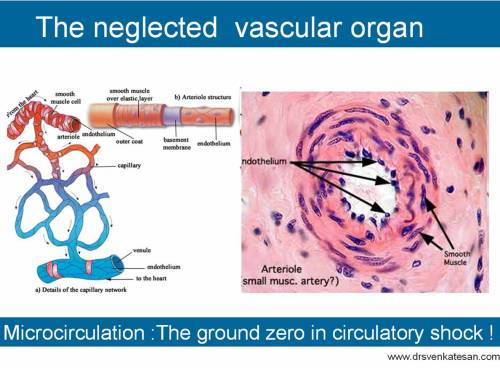
The  millions of perivascular cuffings and the artreriolar smooth muscles  can be considered as  small micro pumping stations situated along side every cell.

It is very important to emphasize here,   if  tone in these microcirculation is less than optimal , the patient’s circulatory  system can never complete the desired circuit  even if the heart has 75% EF . This exactly is happening in circulatory shock . The vascular tree fails to accept and return the pumped blood  in timely fashion.

What controls this tone ?

It is chiefly under the control of autonomic nervous system.The endogenous vasoconstrictors , the adrenergic nervous system, the endothelins , the angoitensins constrict the vascular smmoth muscles while endothelial relaxing factors ,( EDRF -nitric oxide relaxes it ). There is a delicate balance between these forces.

A cardiovascular health of a person is not simply having a healthy heart , he has to have a healthy vascular system with intact biological activity.The fact that , not every one with sepsis react with poor vascular tone indicate inherent capacity to neutralise toxic vasodilatory neuro transmitters.

Is there a invisible parameter called vascular ejection fraction  in circulatory  system?

Yes. It must be . We rarely discuss it . The vascular tree has an important role for pumping the blood into the tissues.  It needs micro manometers to assess the systolic and diastolic dimensions of small arteries and arterioles . But  what  we know is ,  it is grossly impaired in circulatory failure.The vessels especially the arteriolar smooth muscles which determine the perfusion pressure of cells go into state of permanent relaxation. The vascular smooth muscles lose control from autonomic innervation and become flabby. It is the   DCM equivalent for blood vessels. The arterioles no longer regulate blood flow and fluids get sequestrated in various viscera,( often called thrid spaces) and organ dysfucntion sets in. The resultant hypoxia aggarvates the tissue stagnation by producing still unnamed vasodialtory mediators.

What are the pharmocological approches to increase the vascular tone of a failing vascular tree ?

It is a very difficult problem even in this modern era of vascular medcine. Once set in ,  these patients invariably go downhill .The primary underlying problem  ,  often sepsis  need to be corrected. Usually these  patients need multi organ support.Vasoconstrictors like epinephrine,nor epinephrine , dopamine  can sustain vasoconstriction temporarily . As we know the vascualr smooth msucles can not be kept on this assited contrection mode for long.It is bound to fail .Patients native autonomic function has to recover fast to wean of this support.

What is normal circualtorty time .How is it altered in circualtory failure  ?

The normal circualtory time is 15-20 seconds.It is many times prolonged in circualtory failure inspite of the cardiac contraction being normal

What is effective circulatory volume ?

The body fluid compartment is divided into ICF,ECF & interstitial  spaces.At a given time , the fluid in the extracellular space  can only  take  part  in circulation. A good blood pressure does not always mean a good tissue perusion why ? This is very important to realise as blood pool has to dynamically exchange with intra cellullar compartment. At times of shock the blood can bye- pass the cells through the alternate circuits in the periphery of micro circulation. So what is circulating in the system may not be taking part in tissue perfusion .This is the concept of  effective circulatory volume.This is especially noted in hepatic shocks and in some terminally ill malignancy.

Is there a venous shock syndrome ?

Cardiologists  often show a  step motherly  attitude to venous disorders. In fact many  of the   cardiovascular  specialists   think their   job is  taking care of  heart ( Of course , a little bit of aorta and venacava !) .It is surprising  to know,  there is little  scientific data on determinants  venular and venous tone (Both small and large veins).

The power of venous system should not be under estimated  as it pumps  many litres of blood every minute  defying gravity ! For this to happen it needs a vigorous tone .Where do it get from ?  : The same  autonomic nervous system that controls the heart. Remember , in pathological states there is a  great chance for this to go out of control. So venous shock is a clinically distinct possibility. In fact inappropriate administration of nitrates which reduces the venous tone has resulted in many adverse events in RV shock.

In a patient with circulatory shock , we would  never know  how much is contributed by venous side and how much by arterial side .This is important as in circulatory shock we administer all vital drugs through veins.Now it is thought  systemic venous  dysfunction also contribute to shock state.

Clinical situations of circulatory failure or shock

Bacterial shocks

  • Gram negative sepsis
  • Staphylococcal shock

Viral shocks

Dengue/Swine flu etc

Others*

  • Dissiminated intravascular coagulation
  • ARDShypoxic shock
  • Elderly,Diabetic  autonomic neuropathy
  • Persistent post operative hypotension due to silent autonomic neuropathy.
  • Some cases of Spinal shock
  • Toxins – Scorpion etc(Intense vasoconstrictive shock )
  • Terminal shock in liver failure/Hepato pulmonary   syndrome

* Idiopathic unexplained persistent hypotension , with difficulty to wean off from vasoconstrictive agents is a commonly encountered problem in any intensive care unit.The exact mechanism is not known.When we are not clear about the mechanism  we  generally blame it on the  the autonomic nervous system !

How common is the mixed shock syndrome ?

This is more common than we realise .The classical description of multisystem failure is a direct consequence of this.

Can a cardiogenic shock transform into a peripheral circulatory shock ?

Such a scenario is  possible  .A  resuscitated cardiac arrest may end up with a recovered heart but a loss of vascular tone  possibly due to hypoxic vascular damage. .Many times cardiac patients are kept (Post PCI/CABG ) on large doses of  vasoconstrictors or IABP that can induce  tachyphylaxis. It may result in difficulty in weaning these drugs.

How can circulatory shock result compromised cardiac function ?

The common effect of any shock is  reduced organ perfusion.So even in peripheral shock , the coronary blood flow gets compromised especially if these patients have a silent coronary lesions which are otherwise not significant , becomes sites of hemodynamic hurdles during hypotension.This may result in global contractile dysfunction, or a coronary event.

What is vasoconstrictive shock ?

Epinephrine and nor epinephrine are  very potent  vasoconstrictors .If levels of these becomes excessively high , the blood vessels go in for sustained spastic state that can impair the micro circulation .Some times  this results  in a  good blood pressure in the major vessels but severely compromised tissue perfusion.This particular situation has been reported after scorpion envenomation , and in  rare cases of pheochromocytoma .

Final message

Primary circulatory failure or shock (With largely intact cardiac function without hypovolemia) is a common problem in critically ill.  The entire  macro and micro vascular tree goes for a  stunning reaction and  goes for  a sleep in a  semi dilated  state  . It can  be termed as  Arterial  or Arteriolar   shock. Contrary to  all those hi-tech   mechanical stuff for supporting a failing heart (LV assist, Impalla, Abiomed , ) the available options are very little here  . The response to vasoconstrictive agents are  also unpredictable. Correcting the multi organ failure  and targeting the primary cause  is the only hope.
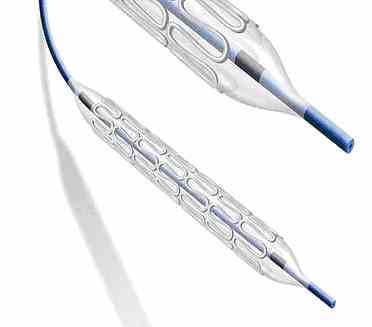
cardiologist Is he a person who puts  a   metal coil  coated with a synthetic fungus   in  a   incidentally  detected  block  inside a  small coronary artery and sends the bill to the Insurance company ?

Is he a person in a  cosmopolitan  hospital  who opens up a    chronically   closed  coronary artery , in an asymptomatic patient  and  live telecasts  his achievement trans continentally ?

Is he a person who   checks in by  the early morning flight and  puts multiple wires in  an  aged   patient   with  class 3 heart failure and  make  him walk  20 meters extra at a cost of  1000$ / Meter ?

Is he a person living in   Wall   street  ,   who   looks  for variety of holes In  the heart and trying to occlude  it  with   exotic   devicespci ptca stent

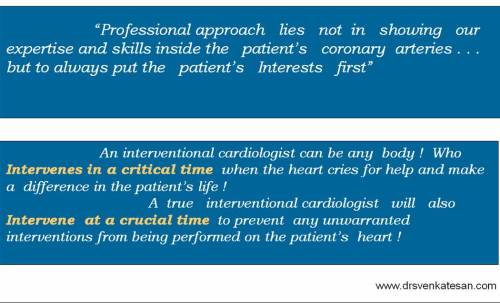
Is he the unknown   physician   who Intervenes in the natural history of Rheumatic heart disease   and arrests   immune mediated   valve damage by giving the  monthly injections  penicillin in remote parts of our country ?

Is he the person   who   Intervenes to prevent young   persons   from  smoking and help maintain  their  coronary endothelium  enriched with nitric oxide  & arrest  the coronary epidemic ?

cardiologist 2

Is he the small town doctor  who  Intervenes  to treat a breathless cardiac failure patient  with  digoxin and frusemide  and  dramatically alleviate the  symptoms and  prolong the  life of our poor country men?

Is she the village health nurse from an inaccessible health  centre  located in a  hilly terrain ,  Intervening  successfully, by   pulling out  live babies  from  severely anemic pregnant  mothers with failing hearts ?

pci ptca cardiologist coronary angiograms

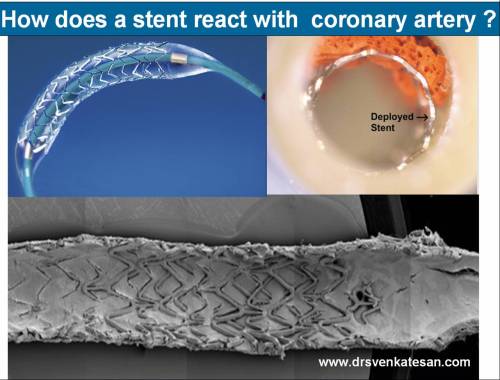
Fundamental principle  of  human biological system is to live in harmony with nature and environment.Each cell  has a unique reaction  when it comes into contact with  external  material. This reaction can be acute or chronic  ,   local or systemic. The most severe form of allergy is called anaphylaxis  that can result in instantaneous loss of life. There  is a whole gamut of disorders  that  resulted  in a  separate  speciality called allergic medicine .

Further ,the transplantation  science have   taught us  an  organ or cell can be rejected at any point of time after implantation (Hyperacute -chronic) .With advancement of science we have started implanting a variety of devices  with complex metallurgy ,inside human body, metal clips, prosthesis, valves, wires, etc .How the body handles them .The consequences can be a mild reaction to major ones occasionally.

Consider ,a local allergy due to a orthopedic prosthesis  in one of the leg bones  is far less serious than a metal within a coronary artery  irritating the intima .

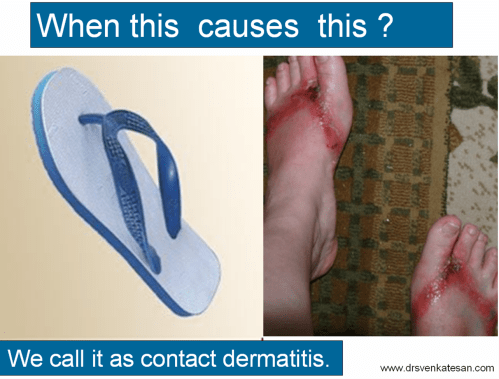
Remember hypersensitivity reactions can be severe . This lady reacted  like this to a sandal slipper -A  fiery red  infiltration

contact dermatits stent allergy pci coronary

Imagine  if a stented coronary artery react like this what would be the possible consequence ?

In susceptible  individuals  , can a metal cause

  • Intimal hyperemia
  • Intimal induration
  • Intimo-medial edema  following stent deployment

pci stent coronary angiogram thrombosis des

Why drug eluting stents are more prone for hypersensitivity ?

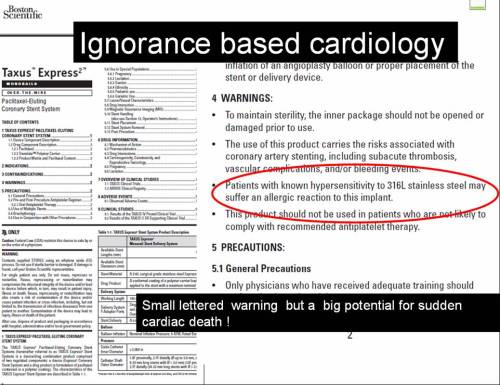
The answer is simple , while metal allergy is a comparatively rare phenomenon, the drugs we  coat and the polymers used are  many fold likely to result in hypersensitivity reaction.

While  the world is worried  more  about penicillin , sulpha allergy which occurs in 1 in 100000 ,  we tend to ignore the metal and drug  reactions within  the tender coronary arteries.

stent des rejection virmani  pci

What is  the clinical expression of  stent hypersensitivity ?

It is  often a coronary event in the acute phase and restenosis in chronic phase.

How much of acute stent thrombosis is related to stent allergy mediated reaction ?

The exact incidence  will  never be known. It could be high. Whenever a sudden unexpected early stent occlusion can be a suspect .

Is stent allergy a local reaction or systemic reaction ?

It is most often local .The drugs the stent elute can elicit a systemic reaction occasionally.

So what can be done to prevent this complication ?

Drug companies in it’s  package regularly  include the warning  message ! What does it imply to have a caution  on the covers ? .This warning simply represent about our ignorance in this issue. We presume it is a minor problem.

pci stent thrombosis stent allergy metal

Questions unanswered

  1. How does a cardiac patient knows whether he is hypersensitive to stainless steel or nickel ?
  2. Is it practical to have a stent allergic test in every patient before PCI ?
  3. Is routine administration of corticosteroids for few days after PCI an answer ?

Reference

R.Virmani , circulation 2004

http://circ.ahajournals.org/cgi/content/full/109/6/701?maxtoshow=&HITS=10&hits=10&RESULTFORMAT=&fulltext=stent+%27allergy%22+&searchid=1&FIRSTINDEX=0&resourcetype=HWCIT

Myocardial infarction (STEMI)  occurs in two distinct arterial  territories .The anterior LAD circulation and postero- inferior RCA/LCX circulation.The incidence is equally shared.

There has been some  learned and unlearned perceptions about Inferior MI.

Inferior MI is less dangerous than anterior MI.  True or false ?

Answer: Essentially true in most situations.

Reasons.

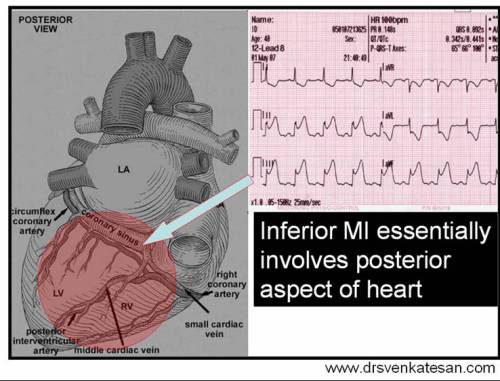
Inferior wall of the heart (strictly speaking there is no walls for heart , only surfaces , which blends with adjacent areas)  inferior wall  is formed by diaphragmatic surface and posterior surface.Inferior MI can occur by either RCA or LCX obstruction.The outcome of inferior MI is determined by mainly by  the extent  of   LV myocardial   damage it inflicts.To  quantitate this  we need to know , how much of LV is supplied by RCA , or LCX or combination of both ? This depend on the coronary dominance .It is estimated , the bulk of the LV is supplied ( up to 75%  ) by LCA. This becomes further high in left dominant circulations . In fact , it is believed LV can never get involved in non dominant RCA occlusions. This has brought in a new terminology  called “Small inferior MI”.Inferior STEMI due to PDA  occlusion or in a co -dominant circulation is not yet studied

Apart from the above  anatomical considerations the following clinical observations  have  been made regarding inferior MI.

  • When thrombolysis was introduced , many studies  suggested the the ST elevation in inferior  leads toched the isolectric levels  in most situations even without thrombolysis.Technically, this implies spontaneous , successful thrombolysis are more common in RCA. Among the thrombolysed ,persistent ST elvation is a rare phenomenon.
  • The well known difference in the conduction defect between anterior and inferior MI  is an important contibutor for better outcome in the later.(AV blocks in inferior MI , are often transient, non progressive, supra hisian location rarely require permanent pacemakers)
  • During acute phase cardiogenic shock occurs in a minority (That too , only if RV shock is included )
  • Even in the follow up the ejection fraction in inferior MI is  almost always above  40%. In many EF is not affected at all.
  • Progressive adverse remodelling of LV is rare

When can Inferior MI be dangerous ?

Anatomical factors

Inspite of the  above  factors  inferior MI can not be taken lightly . Especially when it  extend into posterior, lateral , (Rarely anterior) segments.

While  posterior extension  is often  tolerated , lateral extension is very poorly tolerated .This is probably explained as  the extension involves the vital free wall of LV and the laplace forces could precipitate LVF. Free wall rupture is also common in this situation.

Posterior extension , predominantly involves the surface of RV which is less important hemodynamically. Of course incidence of MR  due to it’s effect on posterior mitral leaflet can be trouble some.

inferior MI ECG

High risk clinical catagories.

Out of hospital STEMI  are at  equal  risk irrespective of the territories involved  .This is because,  primary VF does not differentiate , whether  ischemia comes from RCA or LAD .

  1. In elderly , dibetics and co existing medical condtions  the the established  benign   character  of  inferior MI disappear, as  any  muscle loss  in LV has equally adverse outcome.
  2. Even though  inferior MIs are immune  to cardiogenic shock  , a equally worrisome  prolonged hypotension due to high vagal tone, bradycardia, plus or minus RVMI can create trouble. Fortunately , they respond better to  treatment. Except a few with extensive transmural RVMI outcome is good.
  3. Presence of  mechanical complications of  ventricular septal rupture , ischemic MR can bring  the mortality on par with large anterior MI.

How different is the clinical outcome of infero-posterior  MI with reference  to the  site of  coronary arterial  obstruction   ?

The sequence of  outcome  From  best to worse  : Non dominant RCA* → Dominant RCA but distal to RV branch → LCX dominant with large OMs

* It is believed   an  acute proximal  obstruction of a  non dominant RCA may not be mechanically significant, but can be electrically significant as it retains the risk of primary VF and SA nodal ischemia. The ECG changes  can be very minimal or  some times simple bradycardia is the only clue. One should be able to recognise this entity (Non dominant  RCA STEMI)  as the outcome is  excellent and these patients  would never require procedure like primary  PCI

** A inferior MI due to a dominant LCX and a large OMs have comparable outcome as that of extensive anterior MI. The ECG will reveal ST elevation in both inferior and lateral leads.

***In patients with prior CAD  and collateral dependent  multivessel disease  the  inferior anterior sub classification does not make much sense as  entire coronary circulation can be mutually interdependent.

Final message

Inferior STEMI  generally lacks the vigor  to cause extensive damage to myocardium in most situations .Further they respond better to treatment. Risk stratification of STEMI based on the location of MI has not been popular among mainstream cardiologists. This issue needs some introspection as  the costly and complex treatment modalities like primary PCI  is unwarranted in most of the low risk inferior MIs.

Related posts in my blog:

1.Why thrombolysis is more effective in RCA?