Posted in Cardiology - Clinical, Infrequently asked questions in cardiology (iFAQs), tagged acs, angina, annals of internal medicine, approach to chest pain, atypical angina, atypical chest pain, bmj, cardiology, chest pain, chest wall tenderness, coronary, drsvenkatesan, ECG, emergency room, er, Heberdens, jama, lancet, myalgia, nejm, non cardaic chest pain, troponin, unstable angina on September 14, 2008|
4 Comments »
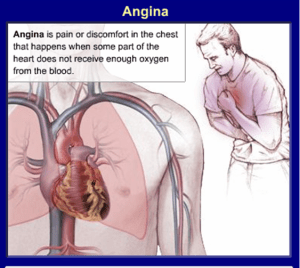
Chest pain is one of the commonest presenting symptom in any hospital both as an emergency or non emergency. Reaching an accurate diagnosis is very important. The main purpose of evaluation of chest pain is to recognise it as cardiac or non cardiac origin . Cardiac chest pain almost always means ischemic chest pain . That is called angina. (Of course there are few important causes for non ischemic cardiac chest pain which Will be discussed later).
Standard features of typical angina.
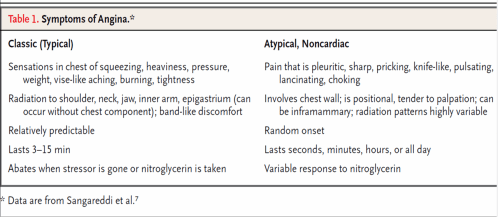
Chest pain which falls short of typical features are called atypical chest pain . Some recommend at least three typical features to label it as angina.
After the clinical examination patients should be categorised in one of the following .
- Typical angina
-
Atypical chest pain
-
Non cardiac chest pain** Non cardiac chest pain is not a diagnosis. Any physician (or a specialist) should take some effort to localise it. (Muscle, nerve , pleura , anxiety etc) . But generally once these patients are ruled out of cardiac pain they become less special and are simply referred back to their family physician, only to return back with another cardiac pseudo-emergency in a different hospital .
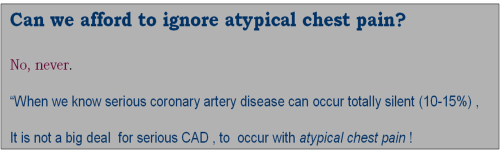
Why we are diagnosing atypical chest pain liberally ?
Currently more number of patients as well as the physicians are aware of the looming epidemic of CAD. The other major reason is the lack of application of mind during foirst clinical appraisal and examination. Many of the patients with non cardiac chest pain (Muscle, nerve , pleura ) are termed as atypical chest pain. Though some of the popular texts use atypical chest pain and non cardiac chest pain interchangeably , it is not correct to do so. For example don’t ever label a patient with chest pain with chest wall tenderness as atypical chest pain and order a cardiac work up .It is a poor model to emulate , that consumes time and resources!.Instead they should be diagnosed a confident non cardiac chest pain and dealt properly.
Once a patient is diagnosed atypical chest pain what’s next ?
They should get a complete physical examination,ECG, and undergo exercise stress test. In the screening of CAD , angina can be termed a hard sign, atypical chest pain is a soft sign, resting ECG is surprisingly a soft sign again (unless you record it during chest pain). Exercise stress testing is the ideal investigation in evaluation of chestpain.( 70-80% accuracy). This can be improved upon by Thallium, SPECT, stress echo etc. As of now coronary angiogram is considered the ultimate gold standard (Not pure gold !) to rule out CAD.
It is also worthwhile to remember non anginal chest pain can also be an emergency and life threatening
- Pulmonary embolism
- Pneumothorax
- Thoracic tumors
- Aortic aneurysm (Dissection and non dissection) The list is not exclusive
Final message
What do we really mean by atypical chest pain ?
In reality we don’t mean any thing !
When a cardiac physician is confused or rather , unable to rule out angina , at the same time he is not confident of calling it as non cardiac chest pain, he has the luxury of using this terminology . It is obvious this terminology should minimally be used. Once diagnosed these patients can’t carry on with this tag for long. They should be reinvestigated , (Right from history and clinical ex) .They should either enter the cardiac work up protocol or a non cardiac source for pain should be fixed immediately.
Read Full Post »






 Dr.S.Venkatesan MD
