Feeds:
Posts
Comments

Posts Tagged ‘aortic stenosis’

Reviewing NOTION study, the Nordic TAVI 10 year follow up has just been released (Ref 1) :

Caution :Non-academic content

This study reports the long-term outcome in low-risk individuals who required AVR. The study basically compared the blind and passive deployment of bio-prosthetic aortic valve aided by the catheter skills of new-age cardiologists with sophisticated image backup versus Open surgical replacement of the aortic valve by experienced cardiac surgeons, after meticulously removing and debriding the native leaflets and suturing the prosthetic valve permanently in the optimal target site under direct vision.

Study summary

Conclusion

The study results finds the valve deployed percutaneously under semi- blind vision, was equipoise with SAVR done under direct vision. The surprise however is, TAVI was superior to cardiac surgeons in multiple aspects .The mysterious finding is TAVI had less Structural valve dysfunction, and possibly low bio valvular failure (BVF), if Kaplan -Myer curve trend is little extrapolated. No doubt ,the Aortic interventional world is applauding and everyone is joining the party.

Now, some academic queries ?

1.Did the trial compared best practices of TAVI & SAVR ?

No. Because it was done in 2010-2013. (Which grew faster TAVI or SAVR in the last10 years ? in terms of both hardware and expertise . How it will impact now ?)

2..Was the outcome assessment blinded ?

No

3.Why there is 50 % cardio vascular and 60% all cause mortality in both groups even though they belong to low risk category ?

Don’t know. Not clear.

4.Why the gradient was high in SAVR in the follow up ?

There are two important factors. More than 98% of TAVI patients had a valve sized 26–31 mm, while 98% of SAVR patients received a size 19–25 mm . Apart from valve size aortic annular enlargement before SAVR was not done in majority, there by enhancing the gradient and valve mis-match.(Note :The TAVI begins at 26mm and SAVR ends at 25mm. For how many of you this looks odd ?)

4a. Was doppler velocity index measured in all to assess EOA in follow up ?

No. It was not mandatory.

5..Is it Ok to define structural valve dysfunction(SVD) based on gradient alone ? Did TEE/CT follow up imaging done ?

No. Flow is physiology. Sub physiological valve destruction very much possible without affecting gradient.

6.The rate of severe SVD was higher after SAVR. Is there any meaningful explanation why surgeons valve deteriorated fast ? 

No .

7.Was CAD accounted for outcome difference ?

No .CAD patients were excluded.

8.Did this study address technical issues in performing PCI with new onset CAD and its possible impact in outcome

No. TAVI induced coronary ostial encroachment not reported.

9.Why didn’t they use bi-leaflet mechanical valves in SAVR group ?

Don’t know .(*One possible reason is given in the foot notes)

10.Is this study still valid ?

Sorry,  I don’t know.

Final message

Whatever is written here, NOTION will remain a great study with a 10 year meticulous follow up . As a cardiologist, very soon we will be allowed legally to choose TAVI even in more younger , low risk cohort of Aortic stenosis without co-morbid conditions. Still, if you put patient first approach ,CAUTION should precede NOTION .

* One version of answer for question 9 , would be TAVI vs Bi-leaflet St-Judes study was in-fact proposed, but was apparently not approved for (un)ethical reasons,of comparing a short living bio-valve valve with a long lasting mechanical valve.

Reference

1.Hans Gustav Hørsted Thyregod, Troels Højsgaard Jørgensen, Nikolaj Ihlemann, Daniel Andreas Steinbrüchel, Henrik Nissen, Bo Juel Kjeldsen, Petur Petursson, Ole De Backer, Peter Skov Olsen, Lars Søndergaard, Transcatheter or surgical aortic valve implantation: 10-year outcomes of the NOTION trial, European Heart Journal, 2024;, ehae043https://doi.org/10.1093/eurheartj/ehae043

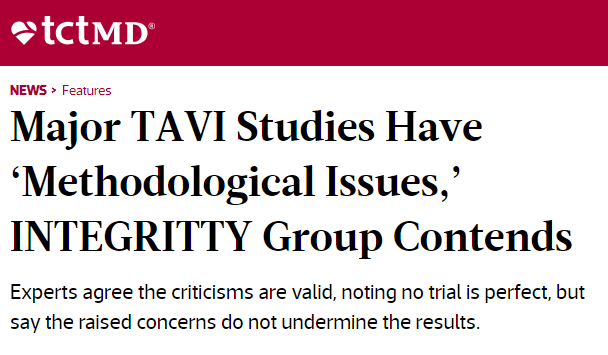
2.TCT -MD article from the INTEGRITY group / Link 2
Read Full Post »

That’s how  one of   the patient  presented  to our hospital .  An echo documented  severe aortic stenosis with a  peak aortic gradient of 80mmhg  and  a  bounding  systolic blood pressure of  180 mmhg . Is that an exception ?

I recall the early days of medical school when  we are fervently   taught  that  systolic  blood pressure is primarily determined by stroke volume and LV contractility .

The above example clearly proves this  is  explicitly wrong  .

Now , we understand  systolic blood pressure have many determinants   . Stroke volume is  just one of them .

The tone  , distensibility  of major blood vessels arising from aorta determine how a pressure wave is going to get amplified .

If you  say stroke volume is not  major determinate of systolic blood pressure   . . . .  does it  imply ,   the antique  bed side cardiac sign  Pulsus parvus  et- tardus  a myth ?

No ,  it still holds good . But it is not a hard sign .  We realise now , a patient with a well felt carotid can have a severe Aortic stenosis .

  • Pre- existing systemic hypertension is a  valid explanation.
  • The other popular explanation for  loss of systolic decapitation due to associated  aortic  regurgitation   may be  acceptable . (Not really proven though ! )

What will be the central aortic  pressure  in critical Aortic stenosis ?

It is definitely lower than brachial cuff pressure .This will explain the systolic blood pressure is actually an amplified signal .

Read Full Post »

There was a time  , even  cardiac catheterisation was contraindicated if the aortic valve  is  significantly calcified. LV angiogram was judiciously  avoided in all such patients . Why ? A significant increase in disabling strokes were witnessed .Those were the time  a sense of  fear (common sense ?)   prevailed . Every one was following this dictum with sanctity .

Now in 2010 .TAVI has  arrived with great fanfare . We not only cross the calcific valve , we literally play  a violent contact sport   in the aortic root  for over two hours with all sorts of pushes  and passes  on  a  fragile valve.And  we are happy to  claim that  stroke rate is comparable to aortic valve surgery and TAVI is not-inferior to AVR in high risk surgeries .

How is this possible ? As the times  changed ?  Is it true , our stroke  fears are just imaginations  or have we lost our  faculty of  reasoning and  sense ? (Will it be logical to  fund a research  if someone claims a  surgical  technique  to replace  aortic valve in  a beating heart without aortic cross clamping !)

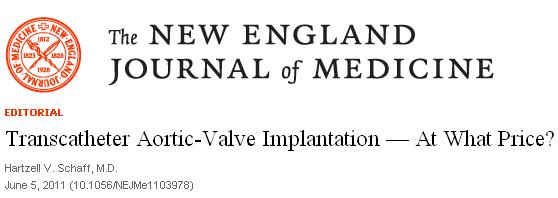
Data shows  even if  distal protection devices are  used the stroke rates  can reach to  objectionable levels .It remained  a mystery ,  at least to me how no body was  questioning this ? I was happy to find this editorial in NEJM which  just stopped  short  of   banishing  this modality in its current form.

http://www.nejm.org/doi/full/10.1056/NEJMe1103978

What price it asks ?  and leaves the readers to guess  the answer ? NEJM wants to be too decent and polite , but in science politeness is generally not required  ,  as long as  your  observations are  correct !

For all those enthusiastic  interventional cardiologists  here is  a positive message .

Nothing comes easy in science.Great  inventions do have problems  initially .  Without  major hurdles  there can be no progress ! It is  because of   you  modern cardiology is making giant strides . Remember  the early days of angioplasty , early days of pacemaker  .  But  please realise  the most important issue  is ,  whatever  we   innovate or discover it  should be shown   superior to the  best  existing modality in all aspects(Technique,  procedural  complications, long term  outcome ,costs, side effects etc  ) .It is awful  to note   new drugs or devices  are  rarely compared with  the best treatment that is currently available .

A  new  treatment that simply  complements  or proves  non-inferiority  can never be considered an invention. How can we   portray radio frequency  renal denervation (  a complex  lab procedure ) for controlling blood pressure   as a great innovation for man kind  while we  have   so many drugs and  modalities  available  at a fraction of the cost  with  little  consequence .

Reference

http://www.escardio.org/congresses/esc-2009/news/Pages/Transcatheter-Aortic-Valve-Implantation.aspx

Read Full Post »

Trans catheter  aortic valve implantation(TAVI )  is gaining acceptance  as an alternative to surgical aortic valve replacement  .It has successfully negotiated the  initial hurdles and entered the clinical domain . More and more patients receive this modality as the expertise and hardware show consistent  improvement.

Although  TAVI  is   limited to patients in high risk category for surgery , it is expected to make in roads into  intermediate  risk patients  as well  and pose a  real threat to cardiac surgeons  in the years to come .

The only  point surgeons  can rejoice is ,  it cannot be  implanted in patients with aortic regurgitation  as of now.

This video is posted  free by NEJM ,  is stunningly clear in conveying concept of TAVI !

Thank you NEJM .

And this one from  Siemens  seems to  beat the NEJM .

http://www.youtube.com/watch?v=43jGAP1qHJo&feature=related

And  now a Hybrid  imaging  creates a virtual aorta in the  cath lab

http://www.youtube.com/watch?v=OHFviHEQ_2o&feature=relmfu

Read Full Post »

Aortic stenosis is one of the commonest valvular heart disease.Degenerative, calcific aortic valve is the underlying pathology . Many of the degenerative aortic valve is thought to be  a sequel to bicuspid aortic valve .The exact incidence of BCAV  contributing to degenerative aortic  stenosis is difficult to determine as many of these leaflets  lose  it’s  identity  . Rheumatic aortic stenosis continues to be a problem in developing world.Though ,primary aortic stenosis  is the  dominant theme , some amount of aortic regurgitation is commonly observed in all these conditions.

Apart from the severity of aortic stenosis  there are two  other important factors that determine the long term outcome.

  • LV function
  • Associated CAD.
  • Timing of surgery

Left ventricular dysfunction is a common  companion in severe aortic stenosis .Once the LV dysfunction sets in , there is a rapid decline in the clinical outcome.Some  of these patients have very severe LV dysfunction (EF< 30%) .

LV dysfunction  ,  underestimates  the true gradient across LV .  Cardiologists are  often  preoccupied with assessment of  true severity  aortic stenosis  in the presence of LV dysfunction .Sophisticated dobutamine stress echo, is supposed to help us.

Unfortunately cardiology literature has  little to offer  regarding the mechanism of  LV dysfunction in critical aortic stenosis

Some of the possibilities are

  1. Sub endocardial  contractile dysfunction   due to long standing high wall stress.
  2. Diffuse myocardial fibrosis , scarring , apoptosis.
  3. Associated CAD and ischemic cardiomyopathy
  4. Finally it could be a “Pseudo LV dysfucntion”  ie , simple mechanical stunning due to high afterload.This is a distinct possibility as some of  these   patients with  worst   LV function  recover fully following AVR.
  5. Combination of the above mechanisms  can occur

How will you determine  whether , the LV dysfunction of aortic stenosis is reversible or irreversible ?  Is viability an issue in LV dysfunction associated with aortic stenosis ?

Even though it is logical to think  LV dysfunction of CAD and LV dysfunction of aortic stenosis  are similar it  may  not be so ! ( Unless the LV dysfuntion  due to obstructive coronary  disease coexists)

Following rules need to be applied in patients with AS and severe LV dysfunction.

  • Every patient with critical aortic stenosis should undergo CAG.
  • The question of reversible vs irreversible LV dysfunction generally need  not arise.
  • There is no better way to predict the recovery of LV function other than the trial of relieving the obstruction.
  • So ,all patients* irrespective of  any degree of LV dysfunction shall undergo AVR
  • If there is obstructive CAD they need to be taken for AVR with CABG

*AVR  is  probably contraindicated , in  systemically ill &  co morbid patients , with grossly  dilated  ventricles. Here balloon aortic valvotomy  and  possibly PVR(Percutaneous valve replacement)  could be an answer.

Final message .

LV dysfunction of aortic stenosis is a poorly understood phenomenon. Since it is very difficult  to predict whether it’s reversible or irreversible , real world clinical experience  would suggest there is no need to predict it at all !  and every one should have AVR  irrespective of their LV function.

Read Full Post »