Feeds:
Posts
Comments

Posts Tagged ‘apo b 100’

Eight point summary

1.PREVENT-ASCVD Equations: Replaces the older Pooled Cohort Equations with more accurate, contemporary equations for adults aged 30–79, establishing new risk thresholds to guide lipid-lowering therapy.


2.Reintroduction of Lipoprotein Goals: Returns to using absolute target goals for low-density lipoprotein cholesterol (LDL-C) and non-high-density lipoprotein cholesterol (non-HDL-C) to effectively monitor and guide treatment intensity.


3.Preferred LDL-C Estimation: Mandates the use of either the Martin/Hopkins or Sampson/NIH equations over the traditional Friedewald calculation to ensure superior accuracy across varying triglyceride levels.


4.Universal Lipoprotein(a) Screening: Recommends measuring Lp(a) concentration at least once in all adults to refine cardiovascular risk assessment, recognizing levels ≥125 nmol/L as a key risk-enhancing factor.


5.Targeted ApoB Measurement: Recommends measuring Apolipoprotein B to guide further treatment intensification once standard lipid goals are met, particularly in patients with diabetes, CKM syndrome, or elevated triglycerides.


6.CAC Score : Upgrades Coronary Artery Calcium (CAC) scoring to a Class 1 recommendation to guide decisions to withhold, postpone, or initiate therapy when primary prevention decisions remain uncertain.


7.Severe dyslipidemia : Standardizes the addition of non-statin therapies like ezetimibe, PCSK9 monoclonal antibodies, or bempedoic acid to maximally tolerated statins to reach aggressive absolute lipid goals.


8.Dietary Supplements Discouraged: Recommends against using over-the-counter dietary supplements (such as fish oil, cinnamon, garlic, or turmeric) to lower lipids due to inconsistent data and lack of proven clinical benefit.

Three questions

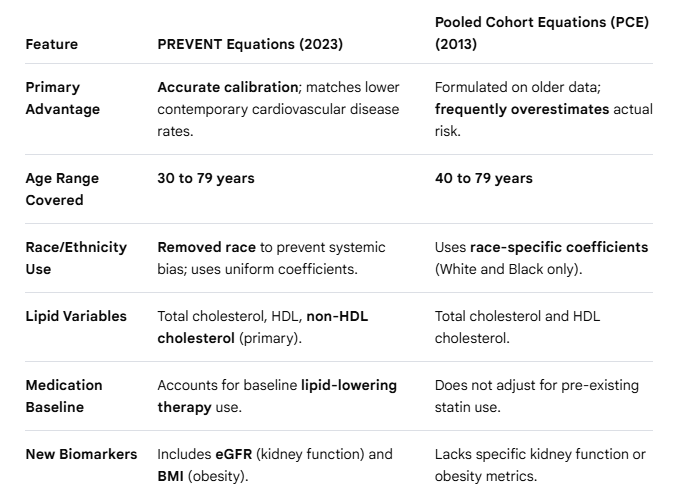
1.What are key difference between PREVENT vs PCE equations?

2.Which can be ranked as the the most important change in the new guidelines ?

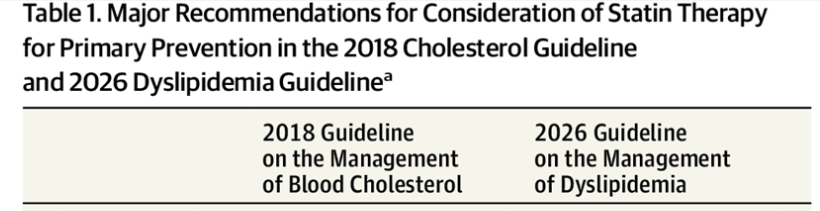
LDL reduction with statins as primary prevention in low risk individuals , is a major change
3.Which can be termed as the most questionable recommendation ?

CT calcium scoring for identifying candidates for primary prevention.A CAC score Zero only is safe . The new guidelines say even if it is 1 , a moderate-intensity statin is reasonable to achieve a ≥30% to 49% reduction in LDL-C

Reference
Blumenthal RS, Morris PB, Gaudino 2026 ACC/AHA/AACVPR/ABC/ACPM/ADA/AGS/APhA/ASPC/NLA/PCNA Guideline on the Management of Dyslipidemia: A Report of the American College of Cardiology/American Heart Association Joint Committee on Clinical Practice Guidelines. J Am Coll Cardiol. 2026 May 19;87(19):2624-2757. doi: 10.1016/j.jacc.2025.11.016. Epub 2026 Mar 13. PMID: 41824590.

Read Full Post »

From kindergarten, we cherish stories. After adolescence, we dive into fiction. Then in college , science becomes sacred , and we believe, it is an eternal truth.

What a naive notion ? Science mirrors fiction and  evolves relentlessly. Yesterday’s facts, become today’s fallacies with the stroke of a keyboard.

The myth of HDL as “good cholesterol” has been continuously propagated to the public and is etched in our (Patients & Physicians) minds. Likewise, LDL’s portrayal as the ultimate villain persists. Yet, emerging evidence flip-flops this narrative. Large, buoyant LDL particles appear harmless, even protective, while dysfunctional HDL may harbor hidden dangers.

This ignorance-based lipidology stems from oversimplified dogma, that ignores particle size, protien content, and its function. Large, fluffy LDL evades arterial infiltration, unlike small, dense variants. Meanwhile , dysfunctional HDL, oxidized or inflamed, loses its anti-atherogenic prowess and may promote oxidation and inflammation. (This may look like an exaggerated statement, but the fact that the largest popualtion at CAD risk : south asian metabolic syndrome, have a normal LDL level , tells us a chilling truth and mis- understanding about the lipid mediated CVD.

The curious paradox in dyslipdemia : It is the protien fraction that dictates the risk & benefit

In dyslipidemia, a key paradox exists. The protein fraction apolipoprotein that determine true risk and benefit, not lipid content alone.

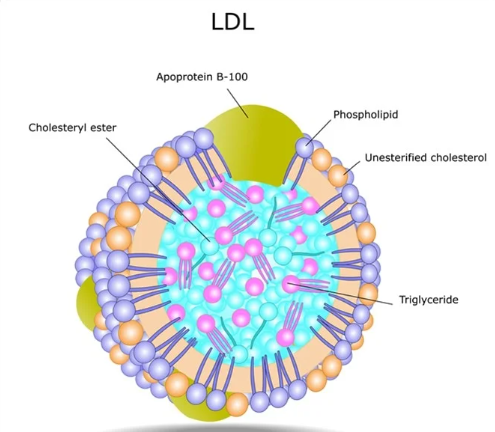
ApoB-100

Apo B100 forms the structural backbone of atherogenic LDL. There is one Apo B 100 particles one molecule of LDL. It quantifies total harmful burden.Unlike LDL-C (which measures cholesterol load), ApoB-100 directly tallies particle count for superior CVD risk prediction. In large buoyant LDL, reduced ApoB-100 atherogenicity makes these particles largely benign and non-infiltrative.

ApoA-I/ApoA-II in HDL


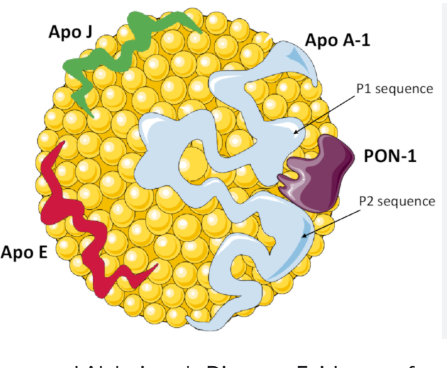
ApoA-I (70% HDL protein) activates LCAT for cholesterol esterification and drives ABCA1-mediated efflux from macrophages.
It also suppresses LDL oxidation and vascular inflammation, embodying HDL’s core anti-atherogenic shield.

HDL structure

ApoA-II stabilizes HDL size/composition but impairs ApoA-I function in dysfunctional states converint HDLto a pro-inflammatory molecule. ApoB/ApoA-I ratio is key for the proper functioning of HDL. It is also proven, that the beneficial effect of HDL is lost beyond 60mg/dl.

Final message

Whenever we discuss hyperlipidemia, we falsely blame the lipids for endothelial injury .Realistically ,it is the protein sub-fragment Apo B 100 , which acts like a knife and hides within the lipid core , and attack the intact endothelium. There is no empty or toothless LDL molecule without Apo-B. However, there is a well known phenomenon of large bloated LDL , with excess foamy cholesterol,that sort of covers sharp edges of the Apo-B* like an umbrella and reduce the risk of endothelial injury.

*No reference : A pure logical Imagination.


Next query in queue : Are we sure , the statins,Rapathas & Inclisarans always reduce only the bad LDL ? (or it may reduce good LDL as well and give us a pseudo sense of bliss)

Find your own answer

Reference

1.Austin MA, Breslow JL, Hennekens CH, Buring JE, Willett WC, Krauss RM. Low-density lipoprotein subclass patterns and risk of myocardial infarction. JAMA. 1988 Oct 7;260(13):1917-21. PMID: 3418853.

2.Cromwell WC, Otvos JD, Keyes MJ, Pencina MJ, Sullivan L, Vasan RS, Wilson PW, D’Agostino RB. LDL Particle Number and Risk of Future Cardiovascular Disease in the Framingham Offspring Study – Implications for LDL Management. J Clin Lipidol. 2007 Dec;1(6):583-92. doi: 10.1016/j.jacl.2007.10.001. PMID: 19657464; PMCID: PMC2720529.

3.Rosenson RS, Brewer HB Jr, Ansell BJ, Barter P, Chapman MJ, Heinecke JW, Kontush A, Tall AR, Webb NR. Dysfunctional HDL and atherosclerotic cardiovascular disease. Nat Rev Cardiol. 2016 Jan;13(1):48-60. doi: 10.1038/nrcardio.2015.124. Epub 2015 Sep 1. PMID: 26323267; PMCID: PMC6245940.

Read Full Post »