Feeds:
Posts
Comments

Posts Tagged ‘jama’

                              Cardioversion with DC shock  offers immediate cure in many of the dangerous ventricular and atrial tachycardias.  It is often  taught ,  any hemodynamically unstable tachycardia  refractory to  medical therapy respond to electrical cardioversion.  One should also  remember electricity is in fact be called  as a drug !  and it should be delivered in proper form and dose. Here it is the paddle size, paddle position and the axis of current flow all are important. Now we have bi phasic currents for better efficacy.

                             While it is true, most of cardiac arrhythmias respond to shock,  there are few which do not respond or respond very transiently.There are few arrhythmias  in which ,DC shock is not only ineffective but may precipitate a ventricular  fibrillation.

                            Generally arrhythmias of reentrant etiology respond well to DC shock were interuption of  electrical circuit by external current is easily possible. In arrhythmia’s of enhanced automaticity ,  and ectopic tachycardia  it is difficult  to extinguish  the tachycardia focus with DC shock .

Arrhythmias where DC shock is not going to work are

A. Mutifocal atrial tachycardia(MAT)

B. Digoxin induced arrhythmias.Patients who are on digoxin,  has  enhanced ventricular  automaticity.These patients if they  get a DC shock will unmask the  ectopic foci.

C. In elderly with atrial fibrillation and sinus node dysfunction it may be dangerous to shock them with out temporary pacing support as sinus node goes for prolonged sleep mode.

D.In electrical storm with VT ,  if more than three shocks are required within a minute,  the VT will most often going to be permanent and the  electrical therapy can be termed as a failure. These patients will require intensive pharmacological management( Including magnesium, bretyllium etc)

E. And finally , sinus tachycardia (whatever the rate)  is an absolute contraindication for DC shock.

 Verapmil is often effective in MAT  but correction of hypoxia and acidosis may be critical.For digoxin induced arrhythmias phenytoin may be tried.

What to do when the DC shock fails?

  • It will be a  tricky situation and one wonder what to do next when the so called  universal antidote for cardiac arrhythmia fails !
  • Cellular internal millieu  is altered  by hypoxia and acidosis .It may prevent the  effectiveness of cardioversion.So try to correct them .
  • Over dirve atrial  pacing  is one option for automatic tachycardia.
  • And now ablation of arrhythmic focus is possible with radio frequency waves  in some of these patients.( Diffiuclt as an emergency procedure)

Read Full Post »

                                  Indication for thrombolysis in ST elevation MI  is mainly determined by clinical and ECG features. ST elevation of more than 1mm in two consecutive leads with a clinical suspicion of acute coronary event demands immediate thrombolysis.

                                 Early repolarisation syndrome(ERS) is a  is typical mimicker of STEMI . In ERS , ST segment elevation occurs in many leads especially precardial .This entity is estimated to occur in nearly 3-5% of population where a genetic variation in the potassium channel activation is reported.

                              If they  land in ER with some sort of chest pain , chances are high for labelling  them as ACS . It is not uncommon for  CCU physicians  to  witness  an  ERS being lysed . Even in many of the land mark trials (ISIS ) there has been many inappropriate thrombolysis , recognised later on.

What can really happen if you thromolyse them inadvertently ?

Generally nothing happens . But they are exposed to the risk of thromolysis. The ECG changes persist. And troponin will be negative and  echocardiogram will not reveal any wall motion defect.

Are we legally liable if a patient  with ERS was thrombolysed and he ends up with a bleeding complication like stroke ?

                        While the physician may feel guilty , there is no reasons for him to feel so.The guidelines are kept little lineant  for  the indication for thromolysis. When we are promoting  a strategy of early  thrombolyis  on a population based approach  in STEMI ,  there is bound to have a overlap with normality .The benefits out of early thrombolysis for eligible  patients for outweigh the few inappropriate thromolysis.

When you want to catch  a   real criminal  it is unavoidable,  one gets hold of all suspected criminals before letting them free . Unfortunately  in this exercise , some of the innocent  might experience   intimidation or even a injury  at the hands of law enforcers.

                               Similarly if a patient with ERS develop a severe esophageal spasm and typical  angina like chest pain he is absolutely certain to receive thrombolysis. (Troponin, CPK come later , and the results never veto the clinical and ECG criteria ,except probably in LBBB) .Many times critical  time dependent decisions are prone for errors in CCU.   So it may be  unscientific to ask why an ERS was  thrombolysed !

 How can one prevent inadvertent thrombolysis in ERS ?

                            Always ask for the previously recorded ECGs .If it is available and  look exactly similar to the current ECG  chances are unlikely  for ACS. In ERS ST segment is generally concavity upwards . ACC/AHA  guideline for STEMI  ,is  aware of this fact , but still  advices thrombolysis for all ST elevation irrespective of the morphology of ST segment elevation. This is propably intentional,   not  to incorporate morphology cirteria of ST elevation  for thromolysis .It would potentially  make many true STEMIs  diagnosed falsely  as ERS and deny thrombolysis.


What is the latest news about ERS ?

                       Now data are coming up, ERS is not entirely benign condition.Some of them ( Even a fraction of ERS population could be a significant number) can have a overlap between Brugada syndrome and they  could be prone for dangerous ventricular arrhythmia when challanged with ischemic or other stress.

Read Full Post »

Chest pain is one  of the commonest presenting symptom  in any  hospital both as  an emergency  or non emergency. Reaching an accurate diagnosis is very important. The main  purpose of evaluation of chest pain is to recognise it as cardiac or non cardiac origin . Cardiac chest pain almost always means ischemic chest pain . That is called angina. (Of course there are few important causes for non ischemic cardiac chest pain which Will be discussed later).

Standard features of typical angina.

Chest pain which falls short of typical features are called atypical chest pain . Some recommend at least three typical features to label it as angina.
After the clinical examination patients  should be categorised in one of the following .

  • Typical angina
  • Atypical chest pain
  • Non cardiac chest pain** Non cardiac chest pain is not a diagnosis. Any physician (or a specialist)  should take some effort to localise it. (Muscle, nerve , pleura , anxiety  etc) . But  generally once these patients are ruled out of cardiac pain  they become less special and are simply referred back to their  family physician, only to return back  with  another cardiac  pseudo-emergency  in a different hospital .

    Why we are diagnosing atypical chest pain liberally ?

    Currently   more number of  patients as well as  the physicians  are   aware of the looming epidemic of CAD. The other major reason is the  lack of application of mind during  foirst clinical appraisal  and examination. Many of the patients with non cardiac chest pain  (Muscle, nerve , pleura )  are termed as atypical chest pain. Though some of the popular texts use atypical  chest pain  and non cardiac chest pain interchangeably , it is not  correct to do so. For example don’t ever label a  patient with chest pain with chest wall tenderness as atypical chest pain and order a cardiac work up .It  is a poor model to  emulate , that consumes time and resources!.Instead they should be diagnosed a confident non cardiac chest pain and dealt properly.

Once a patient is diagnosed  atypical chest pain what’s next ?

They should get a  complete physical examination,ECG, and  undergo exercise stress test.   In the  screening of CAD , angina can be termed a hard sign,  atypical chest pain is a soft sign,  resting ECG is surprisingly  a soft sign again (unless you record it during chest pain). Exercise stress testing is  the ideal  investigation in evaluation of  chestpain.( 70-80% accuracy). This can be improved upon by Thallium, SPECT, stress echo etc. As of now coronary angiogram is considered the ultimate gold standard (Not pure gold !) to rule out  CAD.

It is also worthwhile to remember non anginal  chest pain can also be an emergency and life threatening

  • Pulmonary embolism
  • Pneumothorax
  • Thoracic tumors
  • Aortic aneurysm (Dissection and non dissection)  The list is not  exclusive

Final message

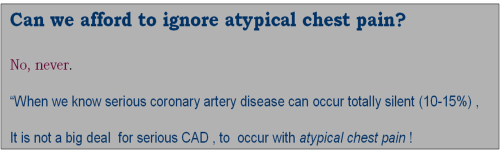
What do we really mean by  atypical chest pain ?

In reality we don’t mean any thing !

When a  cardiac  physician is confused or rather , unable to  rule out angina , at the same time he is not confident of calling it as non cardiac chest pain,  he has the luxury of using this terminology . It is obvious  this terminology  should  minimally  be used.  Once diagnosed  these patients  can’t carry on with this tag  for long. They should be reinvestigated , (Right from history  and clinical ex) .They should either enter the cardiac work up  protocol  or  a non cardiac source for pain should be fixed  immediately.

Read Full Post »

Peer review of an article even in major journals never scrutinise the “Aim of  a study ” . However big is the journal,  they seem to bother only about the authors, materials, methods, and statistical analysis.  If only they peer review an article , right from the “Aim of the study” like ,

  • Who asks the research questions?
  • Who  defines the aim of the study ?
  • Who decides which drug to be compared with which drug ?
  • Who steers the steering commitee of a trial ?

If only , we could answer these questions without bias , pharma industry and their  regulators  would have ,  far more better image than what they have now !

A typical example for , the aim of the study  to be  wrong  , is  the “ONTARGET’ study on telmisartan.

Here they ( Who ? ) raised an inappropriate  question of     “Non inferiority” of one drug with other  without any  valid reason to compare these two drugs that will benefit the man kind !

Read Full Post »

« Newer Posts