Feeds:
Posts
Comments

Posts Tagged ‘stemi vs nstemi’

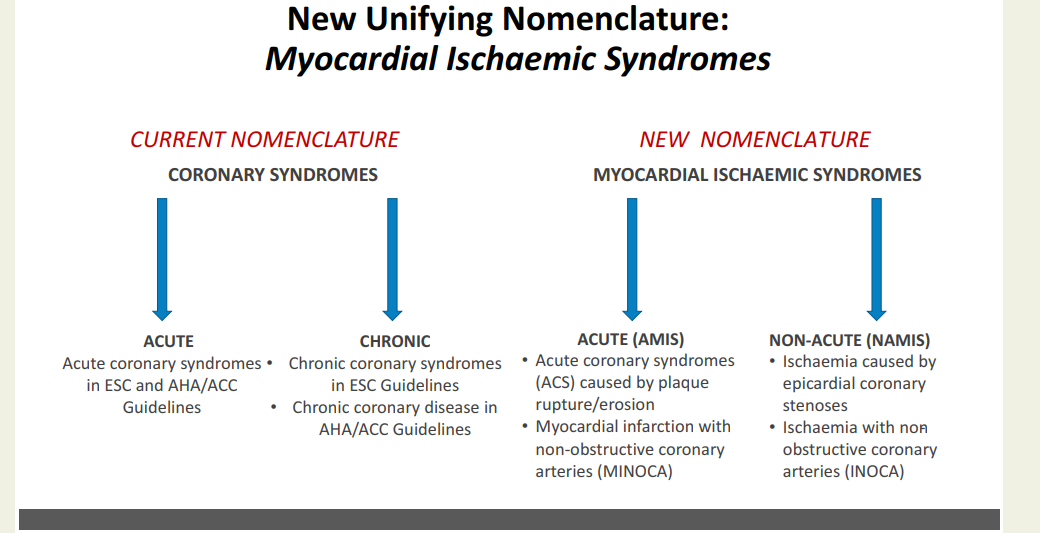
CAD : It is been called IHD, CCD, CAHD, CCS, etc. Now there is a new proposal from European Heart journal (with an Impact factor of 48 ) to change the nomenclature of chronic coronary syndrome to NAMIS : Non acute myocardial Ischemic syndrome (Ref 1)
What is the purpose & need to change the current terminology ?

The proposed AMIS and NAMIS classification shifts the clinical paradigm from coronary anatomy to myocardial function. For decades, terms like “coronary artery disease” overemphasized epicardial stenosis, neglecting the reality that ischemia frequently occurs without structural blockages. Data shows that up to 40% of symptomatic patients lack macroscopic obstructions, suffering instead from microvascular dysfunction, vasospasms, or myocardial bridges. This new term NAMIS can bring in the phenotypes like INOCA and MINOCA into the CCS without any conflict. Further, replacing vague adjectives like “stable” or “chronic” with “non-acute” reflects the high long-term residual risk of cardiac events. I also think, this new framework is meant to unify the European and American guidelines, where they use differing terminologies.

Counter Point : Do we really need this ?

Purpose of any new classification is , it should have a clear impact on patient management. But, we often find, scientific committees periodically take pride in changing the nomenclature akin to make a academic fashion statement .Within a few short years, we migrated from stable CAD to SIHD, switched to CCS , CCD etc . The fact is , for the patients it is the same angina for which they seek relief. They simply don’t bother whether doctor label their condition a syndrome or disease .

Reference
1.Boden WE, De Caterina R, Kaski JC, Bairey Merz N, Berry C, Marzilli M, Pepine CJ, Barbato E, Stefanini G, Prescott E, Steg PG, Bhatt DL, Hill JA, Crea F. Myocardial ischaemic syndromes: a new nomenclature to harmonize evolving international clinical practice guidelines. Eur Heart J. 2024 Sep 29;45(36):3701-3706. doi: 10.1093/eurheartj/ehae278. PMID: 39211956.

Read Full Post »

Your clock starts  now !


clock gif  dr s venkatesan002

Chronic stable angina : Most can be effectively managed  by  optimal /intensive medicines and life style Interventions .About 10% will require PCI/CABG.

ACS – STEMI:  Primarily  managed  with  rapid and competent  pre-hospital care with prompt thrombolysis in or out of hospital .Patients  with  large STEMI who develop complications (Again about 10 %)   require PCI and few additional  lives can be saved.

ACS-NSTEMI : This is  the group that demand  an  important role for PCI . All true high risk UA/NSTEMI patients  should receive urgent coronary  angiogram and critical lesions  should either be stented or  sent for CABG  (If the lesions are multiple and complex ) The field of interventional  cardiology  is  expected  to play a major  role in  this category of  patients for the simple reason , we  not only give dramatic  relief from angina and also prevent a  potentially a huge MI that is waiting to happen !

* It is vital to emphasise  the “Aim and  objective” in  NSTEMI  management  is critically different from other two. We know ,  in CSA   the aim is to give relief  symptoms  and improve excercise capacity . Both PCI/CABG  are  unlikely  to prevent a future MI in CSA..In STEMI it has already occurred .The aim is to salvage myocardium  and prevent  future events. While PCI can do the former , it can’t do the later . In STEMI scenerio ,we have very good  alternate  modality called thrombolysis which can easily beat the  pPCI  in , cost , availability and time  (and  hence efficiency as well  in  most  countries !)

Counter thought

The above suggestion  is too simplified ,generalized , misleading , and  unscientific, should   strongly be disagreed. For those people who disagree , I provide an alternate scheme  .It is ultra short ,comes in  5 lines .Very practical  and  scientific too  !

In any  patient , who is  suspected to have either  acute or chronic  coronary syndromes ,take them to the cath lab in an  urgent or semi urgent fashion .Do an angiogram and stent all lesions  that you feel important . If  stenting is not possible  manage  with optimal medicines and /or send them to the surgeons.

Final message

The essence of catheter based coronary care is simple.We complicate it. To understand this concept  100’s of cardiology  journals  and as many conferences and infinite  number of books are churned out every year !


Read Full Post »
