Feeds:
Posts
Comments

Archive for 2009

Pulmonary embolism is  one of the  important  causes of acute chest pain . It can mimic  acute coronary syndrome . In fact along with aortic dissection  , it forms  a  differential diagnosis for STEMI especailly if the ECG is not typical.
pulmonary embolism chest pain dvt d dimer ventilation perfusion

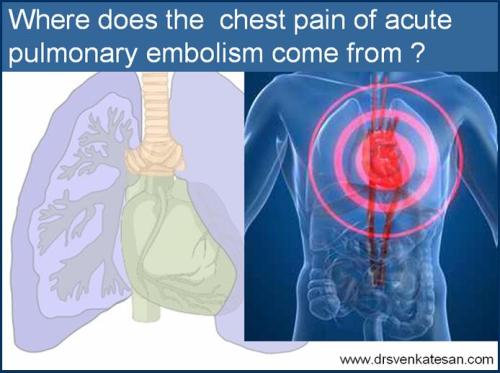
The Chest pain of acute pulmonary embolism can originate in one of the following structures  with different mechanism

  • Lung parenchyma ( Necrotic pain ?)
  • Pluritic pain in adjacent necrotic segment
  • Main Pulmonary artery and it’s branches
  • Right ventricular mechanical stretch
  • Right ventricular ischemia
  • Hypoxia induced LV ischemia with coexisting CAD.
  • Multiple contribution from any of  the above *

It should also be remembered , medicine never respects logic, as some times  an episode of pulmonary embolism can occur without any chest pain

Localisation of chest pain

One can imagine ,  how difficult for the  nervous system to zero in on the origin of this  pain as  the structures involved in acute pulmonary embolism are in different planes  and in different depths  within the chest cavity . Patients  often complain vaguely  the site of pain but  what is universal is severe resting pain deep within the chest . If the ischemic lung segment  transmit pain signals , the location and radiation depend on the  bronchpulmonary segment involved.This again adds on to the complexity in the  genesis of pain  .It can be virtually any where in the back or front of chest.

But , the central and retrosternal chest  pain are equally common as invariably the central pulmonary arteries go for a acute stretch which can be severely painful .In fact , current thinking is it could contribute maximum  for the intensity of chest pain. Similarly,  acute dilatation of RV result in mechanical pain. RV sub endocardial ischemia may   also contribute .An intact bronchial  circulation( From aorta)  can limit the  ischemic lung pain .

Final message

Analysing  the chest pain of acute pulmonary embolism can be an  interesting academic exercise . It could arise from multiple structures with different mechanisms. It may not be much significant with  reference to management . But it has a diagnostic role.  A pain which is severe , and  atypically located should raise the suspicion of acute PE especially  if the patient has associated dyspnea.
Read Full Post »

Rescue angioplasty as a concept in PCI is advocated for the past  two decades. Rescue angioplasty  continues to enjoy the  controversy over the years. A procedure which fails to shrug off the controversy for so long   inspite of multiple studies ,  would indicate there is something seriously wrong in the  procedure  or in the conceptualization.

The fundamental question   that  is often  and not answered properly is :

What is being rescued in R angioplasty ?

Is it the

  • Patient’s life ?
  • Myocardium  ?
  • Rescues ischemic myocytes
  • Infarct related  artery ?

*Or it simply rescues physician  from the legal issue arising out of  labeling his patient as  failed thrombolysis

The term rescue generally implies  tackling an  impending crisis .The threat is either  to the patient’s life or to the myocardium or both.

In STEMI when the initial reperfusion strategy fails (Usually thrombolysis)  R -angioplasty is considered. Here the aim is  to  rapidly  rescue  and salvage  myocardium . The problem  here is   , contrary to our expectation   the population of failed thrombolysis is not a homogenous one .In one end of the spectrum ,  is a patient with  persistent ST elevation ,   totally comfortable and pain free and  hemodynamically stable.The other end is , deteriorating blood pressure , tachycardia , progressive angina and impending cardiogenic shock. Considering the above situations it is very simple to guess who will  require the rescue  and  who will benefit more. In fact,  R -angioplasty  in   patients with  asymptomatic  failed thrombolysis  without ongoing  ischemia defies logic and conveys no meaning !  .This is especially true if the patient has crossed 12 hours of time since the first symptom.

In deteriorating patients R- PCI has a role where one can potentially  arrest the progression of cardiogenic shock  or even reverse it.

A third  group  among failed thrombolysis have  predominate  angina  with  hemodynamic stabilty. This group will benefit from R angioplasty  irrespective of time window , as the pain is often due to a critical non IRA lesion .Technically again we can’t call this PCI as rescue as nothing is done to salvage the myocardium . (Of course one wish to call it so ,  as the  patient is rescued from angina !)

A tricky issue is to know where does the pain come from in a post MI patient ?

It should be realised a post MI patient can have variety of source of chest pain. There has been instances where a persistent  pericardial pain has resulted in emergency  R-PCI !

The critical question that  has not  been  answered by cardiologists is

How long a STEMI pain last and when does post infarct angina begin in a  susceptible patient .


In other words how do differentiate present(Index event)  infarct angina from post infarct angina ?

Studies on pain signal transmission (medullated type c)  would suggest a dull aching retrosternal pain may occur in a substantial number of  patients  following STEMI .These pain signals come from  necrosed cells and not from  ischemic cells. This pain ceases after complete  ischemic destruction of nerve endings . The threshold , duration and central perception of this pain is highly variable.

One can imagine the importance of the above issue ,  as   there is a potential  to  misdiagnose recurrent post MI angina   for the relatively benign infarct related pain. Though experience have suggested a 12 hour cut off to define post MI angina ,  it is too empirical .

Final message

  • Rescue angioplasty remain as  disputed entity in vast majority of  post MI population .
  • It is most useful when  it is done in  impending cardiogenic shock .Note the word. Impending  . . . not established cardiogenic shock. (After prompt recognition of failed thrombolyis ,  within  overall time window < 6h*  ideally ,  but may be done  to up to 12h) There is no role for routine rescue in all failed thrombolysis patients , for the simple reason there may not be any clinical or  live myocardial  targets for rescue.

Need for seperate time window for rescue angioplasty

* Even this 6 hours is emprical . We need  seperate evidence based time window exclusive for rescue angiopalsty .I would personally believe this could  be as short as 1-2 hours .

Read Full Post »

Exercise stress test is the most commonly used non invasive  diagnostic test for CAD.

It is also useful in the functional capacity evaluation.Even though medical management of CAD is a proven and accepted  method of therapy in CAD . There  is always a   perception  even   among the  cardiologists  medical management  is an inferior form of treatment.  This is primarily due to peer group  pressure rather than based on solid scientific concepts.

What is the effect of medical  management on  the common CAD parameters ?

Relief of angina  . It is a simple , and easy parameter to assess.

Functional capacity . Increased exercise capacity  is a good marker of successful medical therapy

The effect  on stress ischemia could be most objective way to assess the success of medical therapy.

But , unfortunately this does not come in the regular scheme of things  for many  cardiologists following medical  management. If we are able to document reversal of stress  test positivity it could be the ultimate marker of success in medical revascularisation. EST is an approved method of assessment of efficacy of optimal medical  management .Still ,  in day to day cardiology practice this is rarely done for the simple reason the patient often stumbles upon an  interventionist and lands up in a PCI or CABG !

Following  things can happen over EST following medical management

  • Complete correction of inducible   ischemia
  • Delayed appearance of ST depression with increased exercise capacity
  • Duration of ST depression can be reduced
  • Convert painful  ischemia into silent ischemia*
  • No response **

* Conversion of painful episodes into silent episodes may not be a real success  in physiological terms.But in patient point of view it is .It should be  recalled  even in  CABG  pain relief  is a major clinical  outcome .

** Could be termed as failure of medical management , but there  is a  group of patients who have increased exercise  capacity but still EST is positive

Real world experience of large case studies (Individual communication : Large community based stress test in over 9000 patients ( Gnanavel et all Ganesh clinic Thiruvannamalai ,India ) strongly suggest optimal medical management would indeed reverse exercise induced ST depression.

Why can’t we call medical therapy as a revascularisation procedure ?

Human mind does not accept certain things. Simply swallowing few drugs can never make us believe ( Especially the current generation cardiologists !  )  it can be  equivalent to a PCI/CABG

While , restoration of  TIMI flow ,  %  stenosis , Net luminal gain,  are the popular   scientific parameters fro effective revascularisation , the following are  the  desired outcomes  clinical well being , relief from pain, reduction of plaque volume, plaque stabilisation, maintenance of  collaterals , microvascular patency ,  reduction of recurrent events .The irony in CAD management  is  in many points clinical endpoints can be achieved without mechanical  the above  mechanical end points !( As we learn from the OAT, COURAGE trials where we learn t arterial patency is nothing to do with major  clinical end points )

While PCI and CABG inherently convey they are revascularsation procedures , realistically looking medical  therapy also does improve the vascularisation espcially where it is needed (Micro)

In the overall interest of  CAD community , and with good scientific basis ,  it is vital  to  emphazise medical management of CAD  is  also a  form revascualrisation .It is better to call OMT(Optimal medical therapy )  as medical revascularisation .This will help us  to neutralise the unfair” semantic  advantage” the PCI and CABG enjoys as   revascularisation modalities !


Refer: 1.AVERT study :Atorvastatin equals PCI .2.Regular excercise equivalent to PCI (esc2009)

Final message

Medical management , do reverse  the positive EST in most of the patients provided the drugs are optimally used

Stability provided by  medical management   in coronary micro and macrocircualtion is  often  significant and it can either directly  or indirectly improve coronary perfusion .  attenuate ischemia ,  improve exercise capacity and relieve symptoms. To confirm this , every patient  with medical management should periodically undergo exercise stress testing.

* One may argue , without knowing coronary anatomy  it is dangerous to  assume things and every patient with positive EST should udergo CAG. Yes ,  It may be true, ischemia due to  critical lesions in proximal locations can never be corrected with drugs

Read Full Post »

Current data from TCT

TCTMD – The Source for Interventional Cardiovascular News and Education

Read Full Post »

Medical profession has  evolved over centuries with humble discoveries by genuine researchers in the past . As we  pursued  science vigorously  , we  looked  for innovations , when innovation  work ( or many times shown to work !) we jump to sky , even as  some of these  innovations fail and crash down  to earth , many times  we continue to be in the clouds . This is the fundamental problem of modern medical science . When  our expectations reached  unrealistic proportions ,   we tend to lose the common sense . Prolonging life and reducing human suffering may be the ultimate aim of the medical  profession , but  If we try to fight the death with science and money without application of mind , our current  life may become  miserable ! Thats what is happening for the majority of the population of this planet . After all ,  death is an essential and final  component of life !

Coming to the issue of CAD ,  in our country , a  rich gets a 4th generation drug eluting stent for a insignificant  asymptomatic PDA lesion , and poor fellow with left main dies without any intervention .This is  fairly acceptable   to this uneven world  , where a rich westerner  dies due to obesity related disease and a  poor African dies to malnutrition .

This article is in   response to  my  recent  experience  when  . . . I advised

Simple life style modification &   few drugs   for a patient with chronic multivessel   CAD  , I was  made to look   ordinary , inferior  and funny   by  many of the current generation cardiologists .

Further , the term optimal medical therapy(OMT)  for chronic stable angina has evoked laughter in one of the interventional cardiology  conferences  I  attended !

It is a sorry state of affairs  for the whole cardiology community , a  genuine scientific  fact , proven by  real life experience  as well,   is  being  ridiculed.

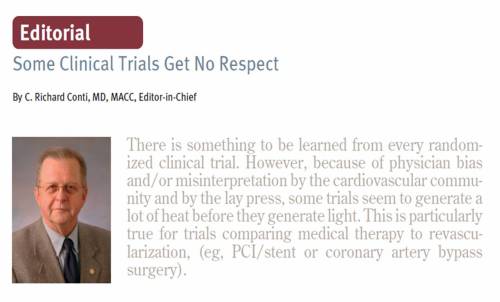
Richard  Conti tells in this excellent editorial in his journal   Clinical cardiology about the issue of medical management of CAD

“Respect in clinical trials”

Chronic stable angina pci vs cabg vs medical courage trial oat trial ethics in cardiology

Click here to reach the article  http://www3.interscience.wiley.com/cgi-bin/fulltext/122512853/PDFSTART

A similar study which  suggested  exercise  could be  better than PCI in the recent 2009 ESC is suffering the same fate !

What if regular exercise were as good as a stent for stable angina?

http://www.theheart.org/article/1000047.do

Read Full Post »

Internet has revolutionised  in sharing our knowledge . But  , the  freedom it gives  has a trade off .Identifying   genuine  knowledge  in the  vast cyberspace is like searching for lost treasure in the ocean bed.

Have a look at this site which innovates medical teaching

great medical videos top cardiology web site drsvenkatesan

Read Full Post »

Normal P waves

normal p wave ecg rae lae

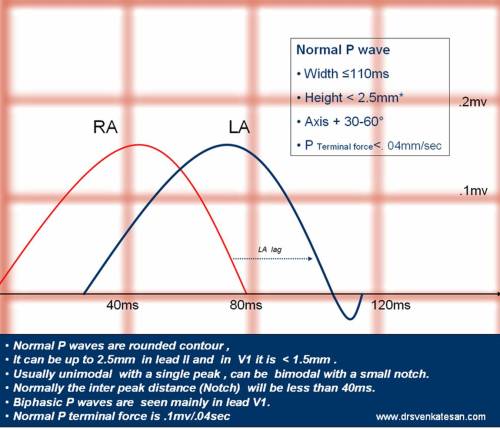
What are the components of Pwave ?

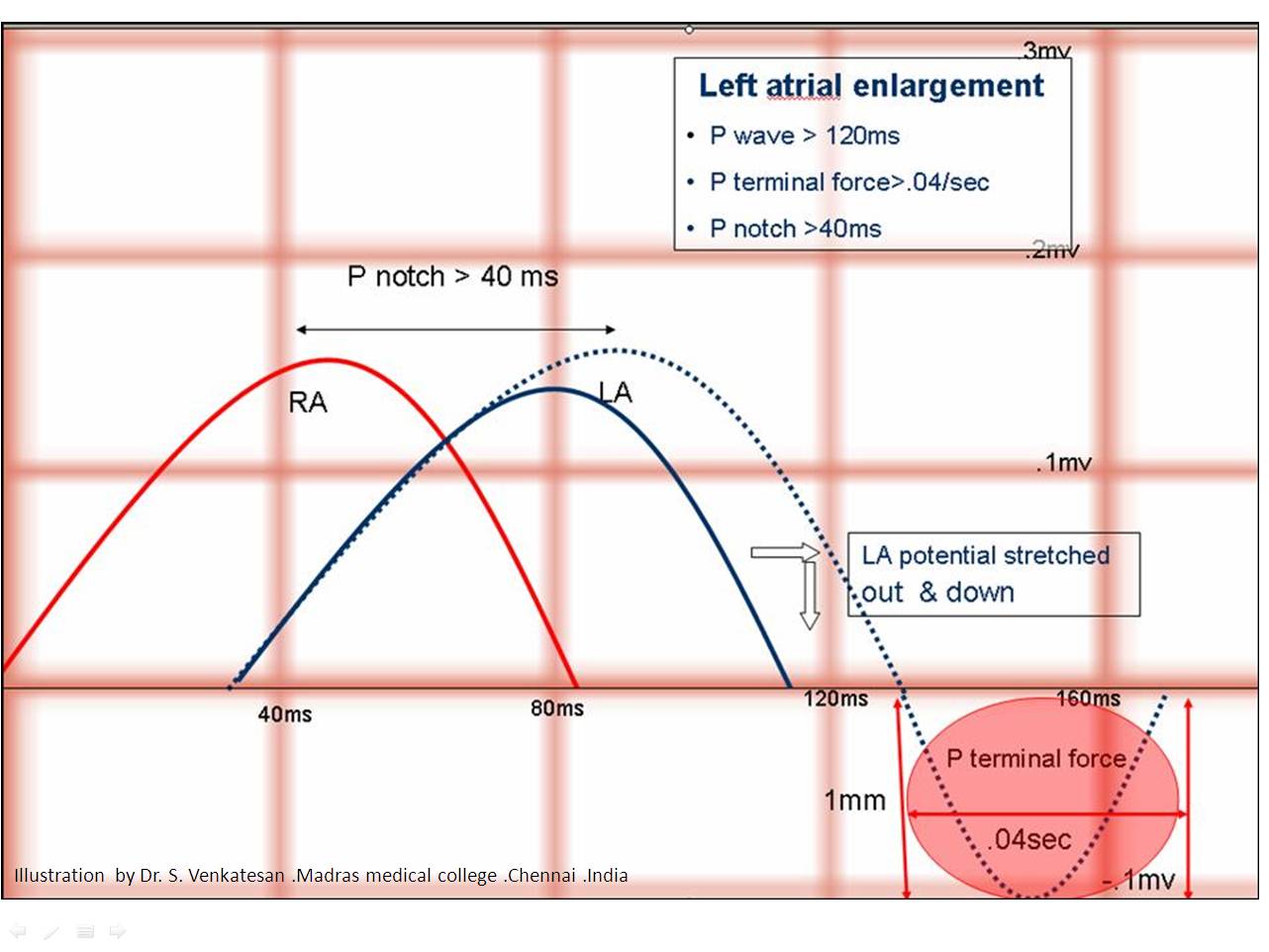
RA component : The SA node depolarises the RA first  , so the initial part of  P wave represents  RA  current .After about 40msec  the wave front reaches LA and it begins it’s depolarisation .LA component :By the time LA is maximally depolarised the RA  already starts its repolarisation.So there is  overlap and also a short time lag between these two wave forms . This is very important to recognise as , even if the RA conduction is prolonged in pathology the RA component of P Wave still falls within the LA wave .Hence it is not shown in the ECG and P wave is not widened in RA enlargement. This is in contrast to LA enlargement , when the terminal half of P vector delayed it stretches the P wave wide beyond the normal 110ms .Hence LAE widens the Pwave.

Why P wave becomes taller in RA enlargement ?

In classical P pulmonale , the P waves are  tall >2.5mm. It is easy to explain why it not getting wide than  why it is getting taller ! The atrial vector has two components .The initial RA vector  is directed  anteriorly .The main reason for tall p with RAE is  due to the anatomical proximity of RA to the chest wall Further ,the  Initial atrial  electrical dp/dt is steep . Any RA voltage increase is easily picked up by the chest leads and P wave voltage increase and becomes tall. We need to realise LA is not only left of RA its equally posterior of RA. Hence LA enlargement rarely brings (Never ?)  it closer to chest wall ,and hence high voltage tall P is almost unheard of with LA . Note , deep negative late P wave activity is typical of LAE , consistent with its posterior location as well its late depolarisation compared to RA)

rae right atrial enlargement ecg tall p p pulmonale p tricuspidaleright and left atrial enlargement how to differentiate lae rae

Why LAE can not produce tall P wave ?

The Left atrial vector which  follows RA vector  is mainly directed posteriorly and hence inscribe a  descending  limb of   P wave . This causes the P terminal force .  So  the direction of vector forces  and the anatomical locality  make a  tall & positive P  deflection highly improbable in   LAE .

*Of  course  when LAE is   huge , where a antero -supero vector from  roof of LA may inscribe a positive wave .

What happens in bi atrial enlargement ?

It can have features of both . Tall & wide P waves .

Can RA generate a Q wave ?

Yes . When RA assumes a huge  size  , especially if the RV is also at high pressure as  in severe PHT or valvular PS   a  q wave is generated in the lead V1 .This q wave is nothing but the intra cavitary potential of the enlarged RA.

What is the difference between atrial enlargement, atrial dilatation, atrial hypertrophy, intra atrial block and inter atrial  block  ?

The p wave morphology has no  specificity to identify the various entities. In any pathology of atrium the first thing that happens is a conduction delay ! It is now realised the bulk of the changes we see in atrial enlargement especially in LAE is due to intra and inter atrial  blocks or more subtly conduction delay.

It is  obvious , a wide P wave can occur either  due to LAE or simple conduction delay .In elderly  hypertensive patients atrial fibrosis is more common , one can not confirm LAE  without echocardiogram .

A notched P wave  can be a very specific sign of   inter atrial block .Which is more common in severely diseased left atrium. A notch , slurred p wave is a good marker for impending AF or atrial flutter.

//

Read Full Post »

Pharmacology is a major discipline in medicine where we learn how a drug acts in our body for various ailments . Now  in this era ,  doctors need not only how a drug acts but also how a drug company acts ! This has become vitally important   for the welfare of the mankind .

In this context one of the best books on medical pharmacology is from the

Famous Editor of New England  journal of medicine

A must read for all genuine medical professionals

ethics hippocrates ebm

Watch Marcia Angell  talk http://www.youtube.com/watch?v=ouF3ISihHLM

Full lecture of Mercia Angell  http://videos.med.wisc.edu/videoInfo.php?videoid=940

Click to buy/read the book  http://www.amazon.com/Truth-About-Drug-Companies-Deceive/dp/0375508465#reader

A Review  about the book  http://calitreview.com/176

Read Full Post »

Wide qrs tachycardia has a unique place in clinical electrocardiography .It is  a much fancied and glamorous entity for the simple reason , it continues to be the  cardiologist ever solved puzzle .For over three decades of research, clinical debates , symposiums , seminars have effectively failed to take away the uncertainties in decoding the wide  QRS  tachycardia . (Specifically ,  VT vs SVT with aberrancy)

Some wondered , should we really waste our efforts in differentiating the two . In emergencies it never matters , in fact one need  not attempt to do this often futile exercise !

Few dedicated criterias like Brugada etc have helped us .

While the difficulties in differentiating between VT and SVT with aberrancy remain over the decades .A less reported  , but more common issue is  confronting  us .

It is  the big question of  differentiating a  wide  QRS tachycardia from a narrow QRS  tachycardia

wide qrs tachycardia vt svt aberrancy

This  occurs  more often than we realise  ,because we define wide  QRS  tachycardia in a vague manner

  • Normal qrs width between Up to 80 / up to 100 ms acceptable  ?*
  • Narrow qrs tachycardia 80 ms?
  • Wide qrs tachycardia i> 120ms  ?
  • Definitely wide qrs >140msec

* The confusion is mainly because 20ms difference between limb leads and chest leads .

In reality one may not be able to all  tachycardia into narrow or wide .

There is big  overlap zone that need to be labeled a intermediate qrs tachycardia

If we can  triage the tachycardias into three instead of two it may help us arrive  fast  ,  to the  correct diagnosis

Narrow QRS tachycardia ( qrs 80ms)

  • Sinus
  • All svtS (avnrt etc)

Intermediate QRS tachycardia 90-120

  • Most of the SVT with  aberrancy  ( Except antidromic SVTs which are really to wide !)
  • Septal VTs*
  • Fascicular VTs*
  • VT in PPM and ICD /CRT patients **

*  Any VT that arise near the major conducting system of ventricle conduct  fast and hence qrs are relatively narrow.

**These are rare entities where  base line wide QRS getting narrower with the onset of VT . (Ref : http://europace.oxfordjournals.org/cgi/content/full/eun254v1)

Wide qrs tachycardia >120ms

  • Most of the genuine VT (Ischemic , myocardial origin)
  • Post MI VTs
  • SVT aberrancy especially AVRT
  • Any SVT with preexisting BBB
  • Marked electrolytic disorders

Unresolved questions

  • Which lead we should look for measuring the width of qrs ?
  • Should we take the narrowest qrs or widest qrs or should we take the average ?
  • Should we calculate how much the tachycardia has widened the qrs from the baseline  width of a given patient ?  Is it not possible , what is wide for some may be normal for another !
  • If  there is no isoelectric line  and ST segment  blends with qrs complex  how to mark end of qrs ?
  • If  limb leads show a narrow qrs and chest leads shows  wide qrs what is the significance  ?
  • In precardial leads  if one lead alone shows a narrow qrs , what is the significance ?
  • Can a narrow qrs VT conduct  with aberrancy and making it  really  wide ?

Final message

When we are  able to solve   complex electrophysiological  problems  , we must also realise  even   simple  tasks can be demanding in medicne ! It is proposed to create a  new  group “Intermediate QRS tachycardia “that can help solve the issue where we have difficulty in labeling these  tachycardias which fall  in the  greyzone .We can try &  apply the modern EP based VT criterias  to this group and find out the hidden truths !

Read Full Post »

The most popular criteria to differentiate VT from SVT aberrancy is  formulated by Brugada in 1991.

The greatness of  this  criteria is that  a single question asked  is able to confirm VT in vast majority of cases.

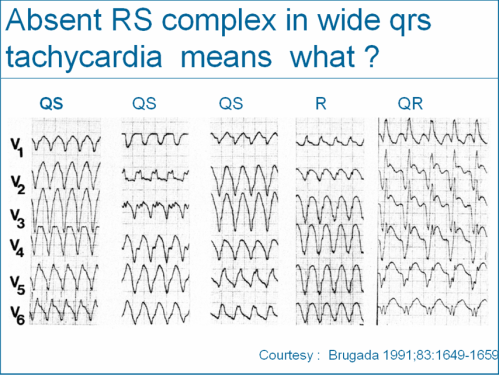
Is RS complex absent all  of the pericardial leads ? If  the answer is  yes  it is VT 100%

How is that,  we have been struggling for so long , a single question is able to solve the issue quite easily ?

wide qrs tachycardia vt svt aberrancy brugada

This is because , the term  “Absent RS complex ” actually means

Presence of  one of the  following three typical complexes Of VT.

  1. QS
  2. QR
  3. Monophasic R

Two of them  actually imply ,  q waves throughout   V 1-V6 .This  means a badly damaged ventricle and  with  little electrical activity coming towards the chest wall .This situation  almost always occur in VT.*

The third complex is Monophasic R .

A  monophasic , wide  QRS  complex  again indicate VT  as monophasic aberrancy is very rare as the supraventricular  impulse invariably conducts with  RSr’  (The right bundle  refractory period sees to that  at least a small r’ is inscribed however fast the SVT is !  )

So if there is no RS complex  it must be VT !

What  are the  difficulties  faced in applying this   first step of Brugada criteria ?

It is funny to note , in medicine criterias  often work perfectly in  text books only !

Is there a RS complex seems to be a very easy question ? There lies the catch !  .Even though this criteria may be 100% specific , differentiating RS from QS complex even by an experienced cardiologist may be difficult in a significant number of VT tracings.This  realistically ,  reduces    supposedly  100% specificity  of this criteria !

In fact we expect Brugada to develop an  another limb  to his now famous algorithm

Is there  absence  RS complex in precardial leads  ?  Yes / No / May be ,  not sure !

Read Full Post »

« Newer Posts - Older Posts »