Feeds:
Posts
Comments

Archive for August, 2012

Usually co -morbid conditions are  relative contraindication  for renal transplantation . LV Myocardial   dysfunction is a  fairly common  association  in CKD.

The uniqueness of   this  LV  dsyfunction is  , there is no primary   myocardial failure . Further  features observed are   . . .

  1. Structural damage is less
  2. LV is not much dilated
  3. Wall thinning is less common , In fact more often than not LVH is associated . (Laplace law at work to reduce LV wall stress !)
  4. The systemic Blood pressure is  well maintained (Chronic HT related ?)

Mechanism of reversible LV dysfunction in CKD

Chronic pressure overload result in After load mismatch . 

(Normally pre-load , after load , and contractility should be  sequentially matching parameters . After load mismatch is an important concept where myocardial contractility is temporarily is depressed due to  lack of adequate pre-load for a given level of after load )

Evidence for reversibility

Very often one can observe improvement of LV function significantly  24 hours after dialysis .The  concept of    uremic biochemical dysfunction is still valid .Though it can not be exactly quantified .

If significant coronary artery disease is excluded , these patients   do well ( after transplantation )  from a  cardiac point of  view !

(64 slice MDCT may be a simple screening test to rule our significant  CAD .)

Final message

How wise it is to do renal transplantation in DCM patients ? .

  • Most patients with LV dysfunction of CKD do well after transplantation .
  • Presence of severe LV dysfunction especially   with  normal  or increased wall thickness should not be a contraindication to  renal  transplantation .

Read Full Post »

AVRT is  a second commonest cause of  narrow qrs tachycardia.  While , all narrow qrs tachycardia in AVRT must be  ortho-dromic. wide qrs tachycardia in WPW  can either be ortho-dromic or anti-dromic ,

The classical one is the much popular and fancied Antidromic  AVRT . Please be reminded  AVRT can conduct  orthodromically  through AV nodal tissue  but still  become  aberrant , as it travel downwards thorough the bundles   and result in a wide qrs tachycardia .

Among the two which  is more common ?

My observation is  ortho-dromic  wide qrs  AVRT  is  more  prevalent . Do you agree ?

Final message

Not all wide qrs tachycardia  in WPW  is anti-dromic !

Read Full Post »

The fundamental difference between  accessory pathways (APs) and AV nodal tissue is the former lacks decremental properties . That is  , APs continue  to conduct whatever the  impulse   it receives. (Unlike  the AV node which has a filtering  mechanism , A heart rate sinker / Dampener) . This is what we were taught and we believe in that .

If it is true  , every episode of   atrial fibrillation should conduct with 400-600 ventricular responses . In reality it does not happen .  The usual ventricular rate in AF with WPW is  250-300 /mt .

What happens to the rest of atrial impulses ?

I am sure it must  get   blocked in APs . Of course it is possible the block need not be in a fixed ratio  .It  changes in a  dynamic   manner with  reference to the   refractory period . (Please note , blocks and increased refractory  periods  can be  used inter changeably in most  physiological situations .

Final message

All APs are not dangerous .They do have a   restrictive mechanism in place .This is evident in every patient with AF and WPW syndrome with a fairly controlled ventricular  response  . Hence  one can conclude   APs in WPW syndrome do have a physiological block in most episodes of  Antidromic AF . The cut off  for safe  refractory period is defined empirically as > 250 ms.

Coming to the title  question , Is  there a physiological  2 : 1  block  in accessory pathway  during AF and WPW syndrome  ?

Yes . It seems so !  A WPW  patient who has  just recovered from a  well tolerated AF ,  is  sort of a natural screening test which effectively rules out a future SCD .(Unless of course he has multiple APs with varying RPs  , one for AF other for VF !)

Is that a correct way of reasoning ?  Experts may provide further  input .

Read Full Post »

A 32 year old unmarried female with rheumatic heart disease   presented with class  3 dyspnea . She had severe mitral  stenosis with significant calcification , subvalvular fusion , and  a LA appendage clot . She had an aortic valve  which showed mild to moderate AR*  was  and  mild  Aortic stenosis ( Peak  Aoric gradient 30mmhg ).LV diastolic dimension was 40mm and systolic 26 mm .LA was huge 48 X 56 mm  EF was 66 % .

* The patient was having three echo reports done in various parts of the state ranging from mild  to severe  AR . I did the echo myself and I  was convinced  ,  it can at best termed as Mild AR . Let us take it as moderate AR for discussion  

To my surprise  , this patient  was   being planned for double valve replacement . (MVR  and AVR ) .

I agreed with MVR since the valve was completely  damaged and neither PTMC or mitral valve repair  is possible.

However  , I was taken aback   , how can  one  plan for a  AVR for mild aortic valve disease ? I  asked the surgeon  ?

The answer was even more a shocker to me .

Since we are  opening the chest for MVR it is better to replace Aortic valve as well . Since  repeat surgery can be avoided .

The surgeon seemed to be very much convinced about this argument .

I asked him ,   is the mortality /morbidity due to DVR is too high  to take a risk .

The LV dimension is absolutely  normal (In fact it is less than normal !)  so  the AR is definitely not significant .

The surgeon was in no mood to leave me . He argued ,  Since the mitral stenosis is severe , the AR is  probably underestimated .   ” We have quiet a few experience of AR worsening after MVR” ? he asserted !

I still fail to  understand  the reasoning of the surgeon .

How is that ,  indication for AVR could vary if it is  accompanied by  mitral valve disease . If the same patient has  isolated moderate AR  AVR is  forbidden  . Poor patient !

By the way , we have problems with our patients as well .I recall an event ,   a  disappointed  patient’s  spouse  arguing  with his the doctor for not fulfilling his Initial  promise of  replacing two valves . We are living in difficult times , I agreed with the surgeon !

Do we have  alternate solutions ?

  1. Assess on table after MVR by TEE if the AR seems worsen proceed with  AVR .
  2. Modern technology might answer .Let us dream  TAVR for rheumatic valve . . . not too far ?

*Transcutananeous Aortic vale replacement .

Final message

Cardiologists and cardiac surgeons should take extra care before finalizing a decision on DVR in any combined valve disease. It may seem  easier to replace two valves . Please spend few moments silently and think about these young men and women  . Valve replacements are  not like replacing  worn tires of your car.  Do not  burden the heart with multiple artificial valves without a real need for it !

The rate of progression of Aortic valve disease following MVR  can be slower than we think . With surgical techniques and  expertise   improving every year ,   repeat aortic surgery may be done safely in selected few ,  in case it becomes necessary !

Read Full Post »

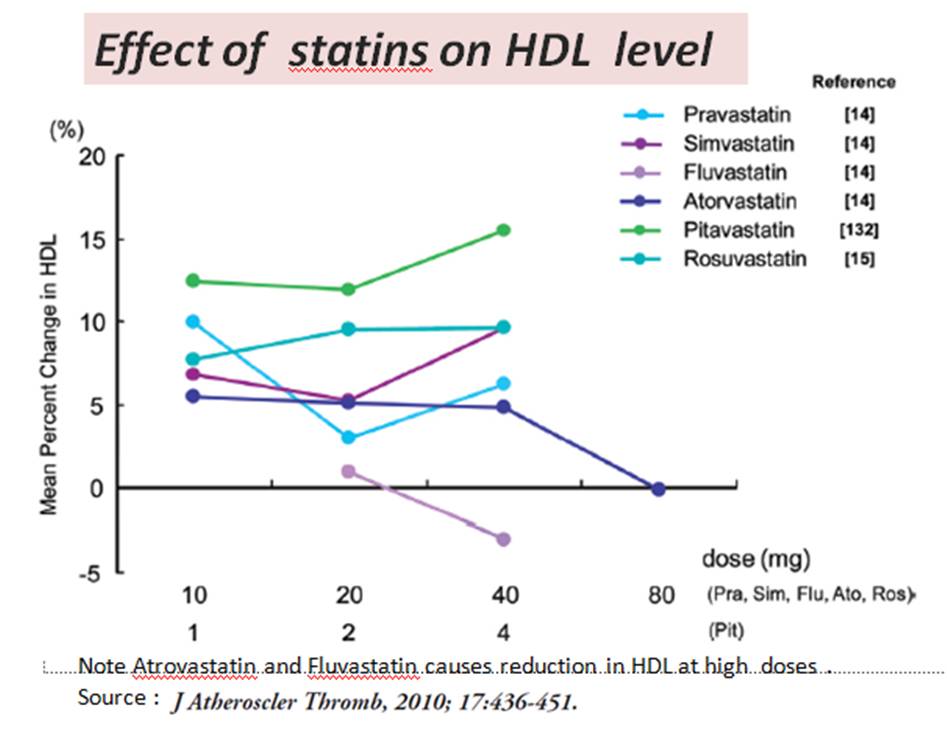
Statins have revolutionised the treatment of coronary artery disease .Intensive lipid lowering is the fundamental prerequisite in the management of both acute and chronic coronary syndromes. One question  is  always difficult to answer , ( rather reluctant to find the answer )  “The effect of statins on the HDL cholesterol”. Logic and the mechanisms of action would suggest HDL is not much affected , but in reality  I believe , in a given patient statins  do  reduce the HDL by at-least 10-20 % .This might have some significance. However ,  the marked  reduction in LDL  may nullify the adverse effects of lowering HDL.   Does this happen in all

What does the scientific evidence say ?

It says the opposite .  It seems  HDL is raised by statins that too significantly . The following paper also  suggests mechanism of  HDL  elevation by statins .It is Independent  to that of LDL reduction , I believe .

This JAMA article  adds more evidence

http://jama.jamanetwork.com/data/Journals/JAMA/5100/jpc70001_499_508.pdf

This paper  from  the  premier  Journal  of   Lipid research  agrees  to the   mechanism of  HDL reduction by statin  is a complex process  but still  it vouches for it .

http://www.ncbi.nlm.nih.gov/pmc/articles/PMC3035518/?report=printable

In spite of  all these  evidence . . .   it  remains a  huge suspect . . . from my personal point of  view ( My patients are  my evidence !  )

Coming soon

The above articles also raise an important  concept of dysfunctional HDL.  Simple raise  in HDL is not suffice . . .it should be functional as well !

Read Full Post »

« Newer Posts