Feeds:
Posts
Comments

Posts Tagged ‘lipids’

Patient No 1 :

“Doctor, you had  put  me on high dose statins since my CAC score was high. Now, my CAC is increased further. What is this ? should I not get anxious ?”

“No.Not at all . It is a good sign and it indicates your plaques are getting stabilised”

How is that possible ?

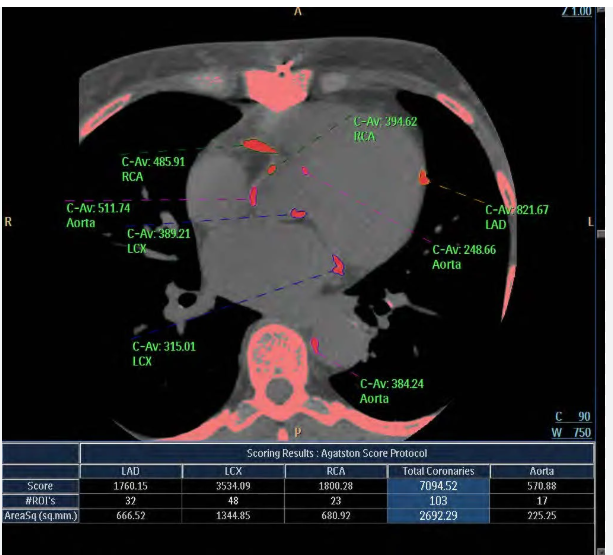
It is a therapeutic paradox. We start statins based on a CAC score in a low-risk population only to find the CAC score increase further in many people. In multiple analyses, we have seen the CAC score even increase up to 30 % . Feel happy about it, as we presume it is a sign of plaque stabilization.

That’s interesting Doctor. Now,.. Doctor, my dad already has a good CAC score of 300 , without statins he should be lucky , is it not ?

No you are wrong. “Natural CAC score is a marker of plaque burden, and we can never consider it as an index of stability, while the statin-induced high CAC score is absolute bliss &  index of pure stability

Patient no 2 : My CAC is not increasing with statins , what to do ? Is it sign of statin failure ?

May be yes. I am not sure . It may indicate a poor response to statin and  inability to convert the plaques to its logical destination ie hardening and micro calcification.

Final message

Most coronary calcification whether God or statin made , imply that plaques are stable biologically. (Except the nodular /eruptive ones or those in  the shoulder region of the plaque, which can make a plaque physically stressed . Cardiologists  hate calcium essentially because, it is a hinderance to deploy a stent)

We rarely realise , how often we formulate important concepts in cardiology based on very superficial or incomplete knowledge

Reference
1.Dykun I, Lehmann N, Kälsch H, Möhlenkamp S, Moebus S, Budde T, Seibel R, Grönemeyer D, Jöckel KH, Erbel R, Mahabadi AA. Statin Medication Enhances Progression of Coronary Artery Calcification: The Heinz Nixdorf Recall Study. J Am Coll Cardiol. 2016 Nov 8;68(19):2123-2125. doi: 10.1016/j.jacc.2016.08.040. PMID: 27810054.

2.Henein M, Granåsen G, Wiklund U, Schmermund A, Guerci A, Erbel R, Raggi P. High dose and long-term statin therapy accelerate coronary artery calcification. Int J Cardiol. 2015 Apr 1;184:581-586. doi: 10.1016/j.ijcard.2015.02.072. Epub 2015 Feb 24. PMID: 25769003.


Read Full Post »

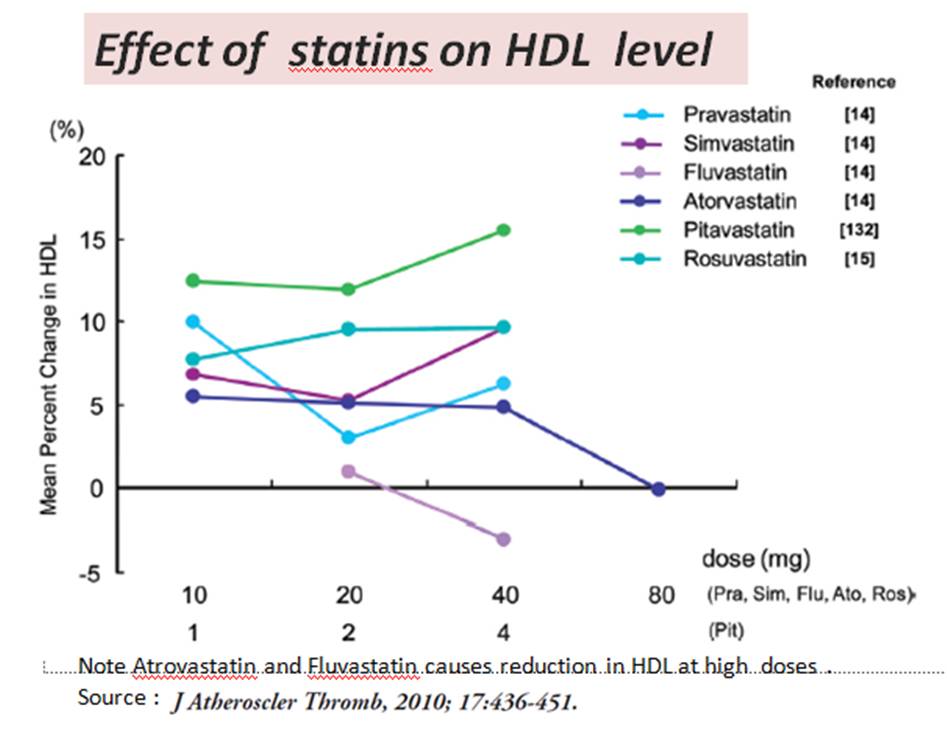
Statins have revolutionised the treatment of coronary artery disease .Intensive lipid lowering is the fundamental prerequisite in the management of both acute and chronic coronary syndromes. One question  is  always difficult to answer , ( rather reluctant to find the answer )  “The effect of statins on the HDL cholesterol”. Logic and the mechanisms of action would suggest HDL is not much affected , but in reality  I believe , in a given patient statins  do  reduce the HDL by at-least 10-20 % .This might have some significance. However ,  the marked  reduction in LDL  may nullify the adverse effects of lowering HDL.   Does this happen in all

What does the scientific evidence say ?

It says the opposite .  It seems  HDL is raised by statins that too significantly . The following paper also  suggests mechanism of  HDL  elevation by statins .It is Independent  to that of LDL reduction , I believe .

This JAMA article  adds more evidence

http://jama.jamanetwork.com/data/Journals/JAMA/5100/jpc70001_499_508.pdf

This paper  from  the  premier  Journal  of   Lipid research  agrees  to the   mechanism of  HDL reduction by statin  is a complex process  but still  it vouches for it .

http://www.ncbi.nlm.nih.gov/pmc/articles/PMC3035518/?report=printable

In spite of  all these  evidence . . .   it  remains a  huge suspect . . . from my personal point of  view ( My patients are  my evidence !  )

Coming soon

The above articles also raise an important  concept of dysfunctional HDL.  Simple raise  in HDL is not suffice . . .it should be functional as well !

Read Full Post »

Let us not forget the basics !

  • HT management has been made  easier with the availability of  many  good drugs , at the same time it has become a complex  issue with as many classification and guidelines.
  • The management of HT has evolved over the decades. Now we have realised  HT  is not a simple number game . Reducing the blood pressure to target levels is not  sufficient and is not the primary aim !.
  • In fact we now know controlling the numbers alone is never going to work  , combined risk factor reduction is of paramount importance.
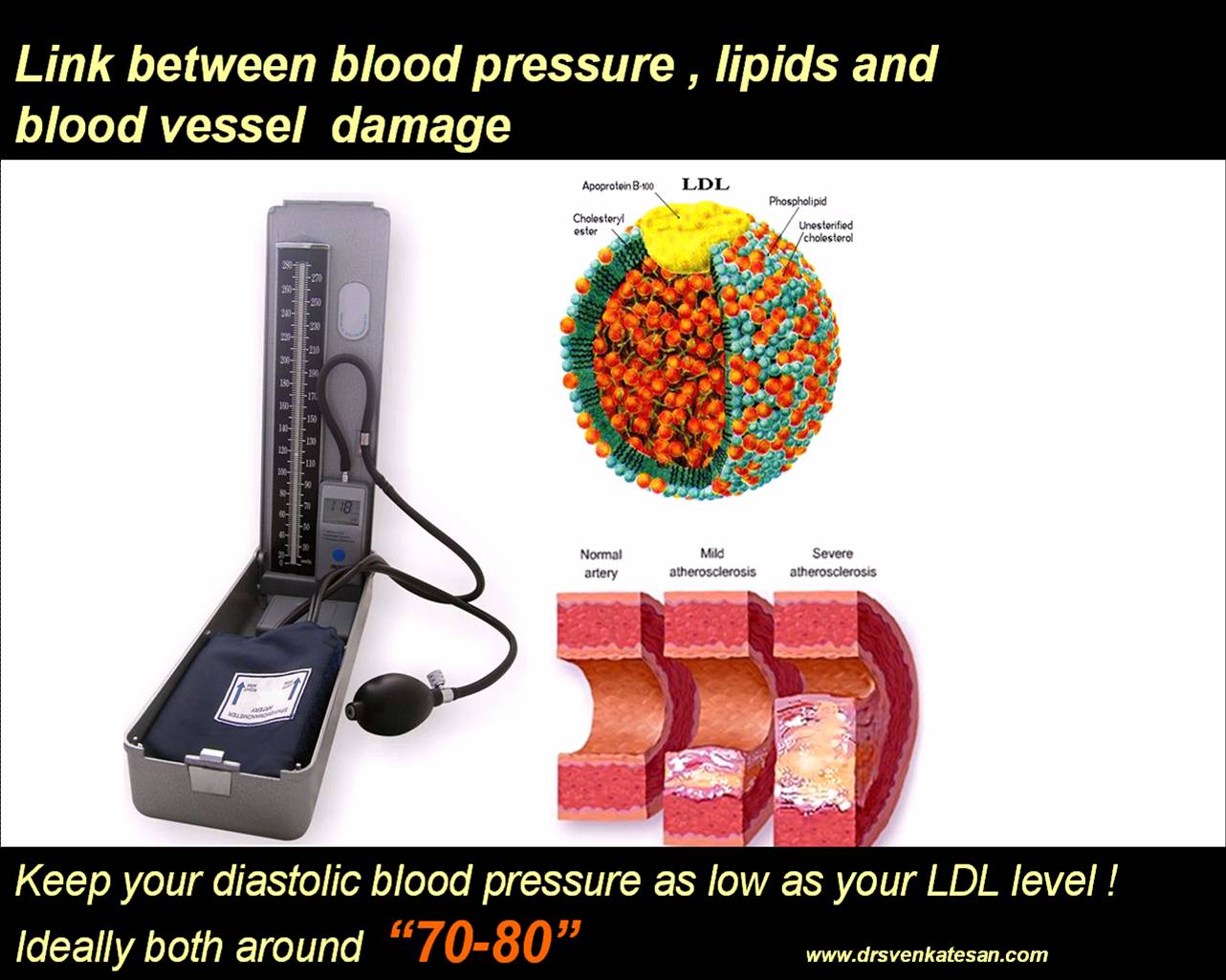
  • HT per se is less lethal but when it combines with hyperlipidemia and diabetes or smoking  it becomes  aggressive.The blood lipids  especially the LDL molecule  enjoy the high pressure environment  ,   penetrate and invade the vascular endothelium.
  • ASCOT  LLA  study has taught us,   for blood pressure reduction to  be effective and reduce CAD  events one has to reduce thier  lipid levels also.So , for every patient with HT there is not only a target BP but also a target LDL level .

picture1


Final message

The tip for better vascular  health is  , all  hypertensive patients should keep their lipids to optimal levels and all hyperlipidemia patients should keep their BP as low as possible .

“Keep your LDL  as low as  your diastolic blood pressure  and  let us  keep it around 70 -80

Read Full Post »