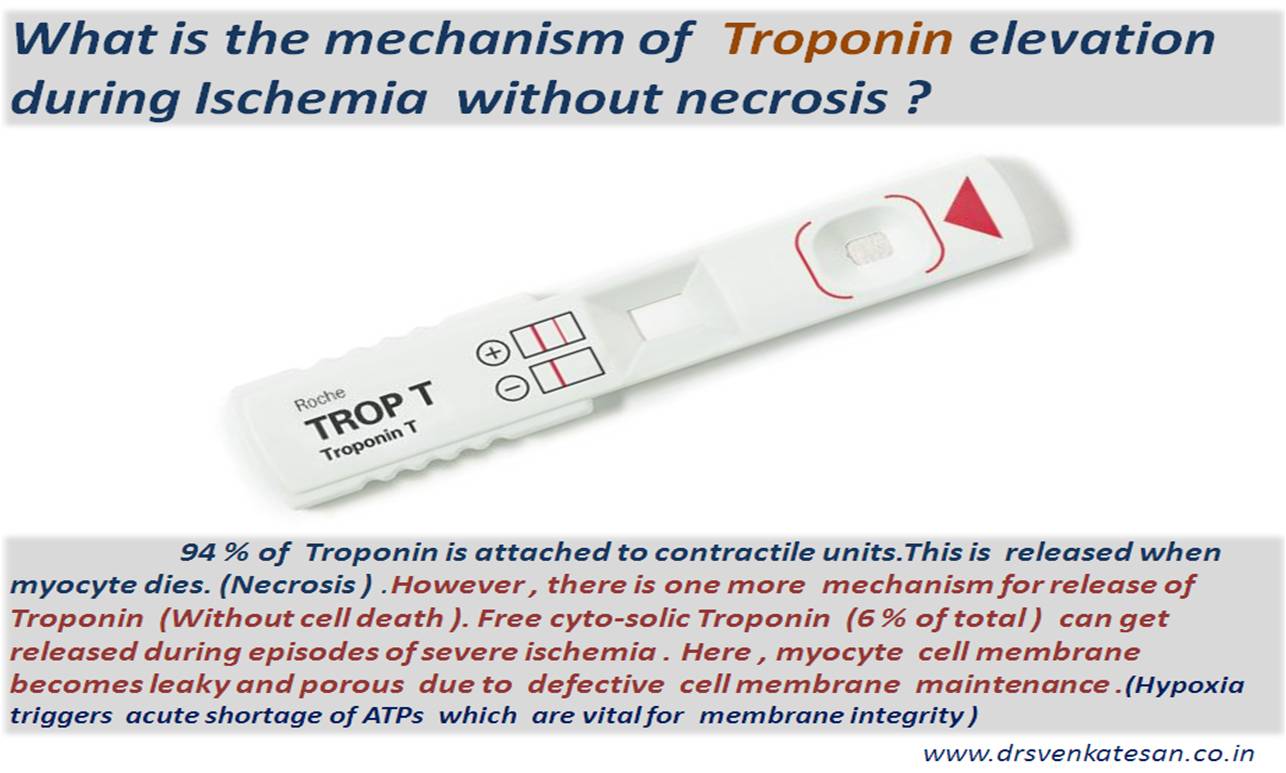
Does Troponin release during Ischemia ? (Without myocyte necrosis )
How often this happens ? . Some believe , it is rare . Here is a possible explanation for it .I feel the mechanism is still not clear . It all depends upon the degree of ischemia.
Posted in Cardiology - Clinical, Cardiology -Interventional -PCI, Cardiology -unresolved questions, cardiology- coronary care, STEMI-Primary PCI, tagged bio markers in nstemi, ischemia mediated troponin realese, mechanism of eelvation of troponin in unstable angina, troponin i, troponin in ischemia, troponin t on November 20, 2012| 1 Comment »
Does Troponin release during Ischemia ? (Without myocyte necrosis )
How often this happens ? . Some believe , it is rare . Here is a possible explanation for it .I feel the mechanism is still not clear . It all depends upon the degree of ischemia.
Posted in Uncategorized, tagged ethics in medicine, hippocrates, inappropriate stents, italian cardiologists on November 13, 2012| 2 Comments »
It doesn’t make news if police arrest Robbers , militants , or Terrorists ! Here is a shocking news !
A news clip from the Forbes November 11th 2012 .

Nine doctors were arrested . . . 12 device and pharma companies have been banned form entering Italy.
Reason : They indulged in inappropriate coronary interventions which has caused fatal injuries .
Do you think these cardiologist are at fault ?
Posted in Cardiology - Clinical, Cardiology -unresolved questions, Clinical cardiology, tagged diastolic dyspnea, dyspnea recovery time, heart rate recovery vs dyspnea, mechanism of dyspnea, systolic dyspnea on November 13, 2012| 2 Comments »
I don’t know, any one has tried to differentiate the mechansims of dyspnea with reference to systolic and diastolic dysfunction .We have made some observations in certain group of patients during EST . I do not know how far one would agree with this .
For the same amount of stress or work load persons with systolic dysfunction behave differently . However ,both will complete the activity but the onset and perception of dyspnea is slightly different in patients with predominant diastolic dysfunction.

Diastolic dyspnea (Dyspnea due to predominant diastolic dysfunction / HFPEF)

The pressure volume loop in various forms of heart disease will determine the degree of myocardial stretch and the resultant dyspnea .Image source : http://www.1cro.com/medicalphysiology/chapter10/chap_10.htm
Systolic dyspnea (Dyspnea due to predominant systolic dysfunction )
Summary
In primary diastolic dysfunction ,the maximum stress to ventricle occurs when the venous return peaks that usually happen in the exercising muscles , as they shed vaso-dilatory property in post exertion phase .
Management Implication
Fluid overload , Tachycardia are more related to diastolic dysfunction .(Beta blockers by prolonging the diastole can , provide important relief of dyspnea in diastolic dysfunction (In HOCM patients this action could be more important that the much hyped negative inotropism !)
Final message
Dyspnea is a complex cortical perception , influenced by filling pressure of heart, stretch receptor in lungs , respiratory and exercise muscle . It is further impacted by number of biochemical parameters (Lactate/ O2 etc )
Of-course , it could be a far fetched imagination to split dyspnea mechanism with reference to cardiac cycle. Combinations of both systolic and diastolic dysfunction is the norm in many cardiac conditions . However , I believe we need more insight in the pathogenesis of this , “most important symptom” that emanate from the heart .
Posted in cardiology -ECG, Cardiology -Interventional -PCI, cardiology- coronary care, Cardiology-Coronary artery disese, Infrequently asked questions in cardiology (iFAQs), STEMI-Primary PCI, tagged brugada syndrome, Early reploarisation syndrome, Hyperkalemia, Left bundle branch block/ Left ventricular hypertrophy, pericarditis, sgarbossa criteria, STEMI differential diagnosis on November 11, 2012| 4 Comments »
Top 5 conditions that closely mimic and often mistaken for STEMI !
ERS
The repolarisation is due to K + efflux . The K channel porosity is subjected to high degree of genetic variations .If the repolarisation starts even by 10 milli- second earlier, it would have early take off from descending limb of R wave and the J point ST segment appear elevated.
* STEMI in ERS : The issue becomes too delicate , if a patient with ERS develops a true ACS . ERS being a common ECG pattern in general population , it is not wise to label every chest pain in ERS patient as benign . Suspicious ones demand observation in step down units , at least !
LBBB
“Any patient with LBBB & chest pain . . . suspect MI” .
Unfortunately, this rule is too reverently followed by physician community. In fact , ACC/AHA guidelines reinforced this behavior , as it added a key word in their STEMI guidelines “New onset” or “presumably new onset ” LBBB is an indication for PCI/Thrombolysis .( Physician presumption is a too delicate thread to hang our concepts ! )
Every LBBB is new onset unless you have a documented proof otherwise . . . it seems to suggest !
Probably , this is the reason many of the LBBBs are thrombolysed when they present to ER in an acute fashion . Of course , we can apply criteria of Sgarbossa to differentiate ! however flimsy it may appear . It help us to exclude few benign LBBBs. Still , Sgarbossa will struggle to differentiate an acute STEMI in Chronic LBBB from an acute LBBB in old AWMI .
Simply put . . . even old MIs are at risk of acute intervention if they have LBBB and vague chest pain !
How to overcome this ? Always rely on clinical features . If STEMI is causing the LBBB , it should be a large extensive one and you can not expect the patient to be comfortable .(Logic would suggest necrosis of large parts of IVS is necessary to cause LBBB ) Chronic LBBBs are relatively comfortable .
Of course , there is one another issue to comprehend ie transient ischemic LBBB .We do not know the true incidence and long-term significance of this entity . Here , LBBB is not due to necrosis of the bundle but due to ischemia . (Almost impossible to differentiate it from rate dependent LBBB with aberrancy )
Role of enzymes and Echocardiogram in LBBB and suspected STEMI .
You can always ask for Troponin T / CPK MB .(They are helpful only if 3 hours have elapsed , can we afford to wait ? ) . LBBB due to STEMI will purge a large quantum of cardiac enzymes from the infarcted zone . (So a marginal elevation is not going to help!)
Unfortunately, LBBB can induce wall motion defect in septum that may awkwardly simulate an ischemic wall motion. Even experts have erred in this . One clue is, the motion defects can not extend into anterior wall . It is confined to septum ,the second clue is a little delayed post QRS thickening of IVS (Septal beaking sign will vouch for benign LBBB with fair degree of success )
LVH
Hyperkalemia.
With aging population and rampant acute and chronic renal disorders it is becoming a daily affair to get calls from medical units for ECG changes .We know the rapidity of efflux potassium is responsible for ventricular re-polarisation .Phase 2, and 3 are K + exit zones. This is the same phase ST segment and T wave are inscribed.In hyperkalemia K + accumulates inside the cell and keep ST/T segment elevated .T wave also becomes tall . It can mimic both as hyper acute STEMI .
Read a related article (Dialyisable current of Injury )
Pericarditis
Link to Read regional pericarditis
Brugada syndrome
Brugada syndrome is an ECG -Clinical complex in which ST elevation in pre-cardial leads is associated with ventricular arrhythmia. The defect lies in sodium channel . It reflects a mis -match between RV and LV epicardial repolarisation forces .It keeps the RV epi-cardial current afloat and the pre-cardial leads facing the RV records ST elevation that mimics STEMI. It often shows a RBBB pattern and varying patterns of ST morphology . The ST segment is also subjected to dynamism , due to change in autonomic tone and myocardial temperature .(Febrile VTs)
After thoughts
Other close contenders for the top 5 slots
Myocarditis
Acute pulmonary embolism
Dissection of aorta
More
(Cocaine hearts / Coronary arterial spasm / LV dyskinetic segments and LV aneurysms were not nominees ! )
Posted in Cardiology - Electrophysiology -Pacemaker, cardiology -ECG, cardiology -Therapeutics, Cardiology -unresolved questions, echocardiography, Infrequently asked questions in cardiology (iFAQs), tagged arrhythmogenic rv dysplasia, arvd, rvot vt vs arvd, ventricular tachycardia on November 6, 2012| Leave a Comment »

*Please note -Micro reentry and triggered activity mimic each other at the cellular level . For all clinical reasons there is generally no purpose in differentiating the two.
*RVOT- Right ventricular outflow tract. ARVD/ARVC -Arrhythmogenic right ventricular dysplasia /cardiomyopathy
(Caution : RVOT vs ARVD -In the traditional medical teaching system , we are often taught to differentiate two closely related entities.Our brain also loves to look things in either black or white . Realise , medical science always brings surprises . There can be significant overlaps between the very entities we want to differentiate.Bear that in mind)
Reference
T wave inversion in V1 TO V3 for diagnosing RVOT VT .
3.Daniel P. Morin, Andreas C. Mauer, Kathleen Gear, Usefulness of Precordial T-Wave Inversion to Distinguish Arrhythmogenic Right Ventricular Cardiomyopathy from Idiopathic Ventricular Tachycardia Arising from the Right Ventricular Outflow Tract .Am J Cardiol. 2010 June 15; 105(12): 1821–1824



 Dr.S.Venkatesan MD