Feeds:
Posts
Comments

Archive for the ‘acute coroanry syndrome’ Category

LIMA to LAD anastomotic site lesion ,is an important subset of CAD that can occur either as acute post operative event or an ACS , CCS. Interventional cardiologists have, thus far, been reluctant to intervene in this type of lesion, often refer to a surgeon instead.

Here is case report by by Tahir et al. wherein a 75‑year‑old post‑CABG patient who developed acute LIMA→LAD anastomotic failure under cardiogenic shock within 24 hours of surgery. Considering the risk of of perforation or avulsion with standard PCI, the team deployed a PK Papyrus covered stent directly across the anastomosis—restoring TIMI‑III flow and myocardial blush successfully.
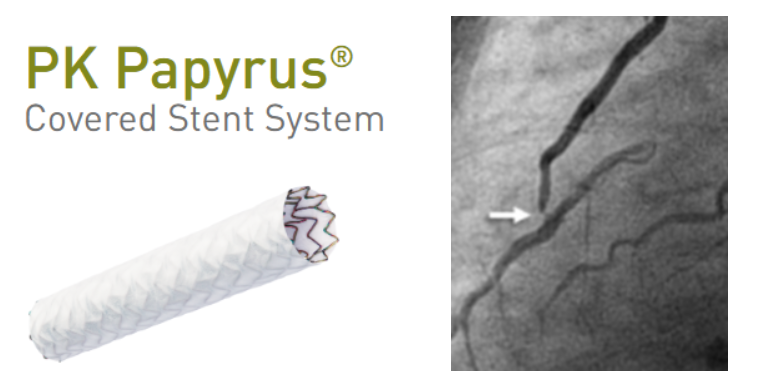
This highlights the covered‑stent’s potential as a first‑line semi‑emergency intervention, offering controlled sealing and avoiding repeat surgery in hemodynamically unstable patients.

What about chronic anastomotic site Lesions ?

Beyond acute rescue, the covered‑stent may play a valuable role in chronic anastomotic stenoses at the LIMA–LAD junction—lesions notorious for tortuosity and perforation risk. The PK Papyrus platform, with improved deliverability compared to older models like Graftmaster, offers a safer option for such high‑risk anatomical sites . Surprisingly, this indication is absent from covered‑stent guidelines, despite its clear utility in both acute and chronic settings.

Implications of blocking Native LAD Flow

There can be downsides in blocking the native LAD flow by the covered stent. ,However, in reality the proximal flow and to potential branches till the covered stent block is found to be flowing well. In contrary, a key advantage of covering the LIMA–LAD anastomosis is the elimination of competitive flow. In many bypass scenarios, flows between the graft and native vessel compete, potentially compromising graft patency. With the covered‑stent sealing the anastomosis, distal LAD circulation becomes exclusively graft‑dependent, which may actually

  • Stabilize hemodynamics by directing full perfusion through the graft.
  • Reduce competitive flow dynamics, promoting long‑term graft patency.
  • Lower ischemic risk if native LAD disease progresses proximally.
  • Finally, the cover acts as a distal protection device against thromboembolic material from proximal friable lesions.

Role of DEB /DES in LIMA to LAD anastomotic lesion

This can be an alternate option. If native LAD flow is considered important and lesion is less complex and risk of perforation is low.

Ref : Marcos Garcia-Guimarães, Ramón Maruri-Sanchez, International Journal of Cardiovascular Sciences. 01/Jul/2018;31(4):454-6.

Final message

A simple DOBA (Drug eluting POBA) , or a covered‑stent at LIMA–LAD anastomoses can be a game‑changer, saving lives in emergencies, possibly improving chronic graft outcomes as well. It’s time for interventional cardiology experts to recognize and acknowledge this application, supported by further registry data or trial.

Reference
1.Tahir H, Livesay J, Baljepally R, Hirst CS. Successful Rescue Intervention of Internal Mammary Artery Anastomotic Site Acute Graft Failure With Direct New Generation Covered Stenting. J Med Cases. 2021 Jul;12(7):271-274. doi: 10.14740/jmc3695. Epub 2021 May 13. PMID: 34434470; PMCID: PMC8383698.

2 .Marcos Garcia-Guimarães, Ramón Maruri-Sanchez, International Journal of Cardiovascular Sciences. 01/Jul/2018;31(4):454-6.

Case Reports

Read Full Post »

How can we use AI as a tool of knowledge distillation ?

Here is a deep discussion with Grok 3, on the merits, limitations & validity of DANAMI 2 and PRAGUE 2 , the two old studies on pPCI. Curiously , we don’t have any other studies to quote. As on 2025 , superiority of pPCI hangs precariously on these two decade old studies, which has some serious omissions in the primary end point and its Interpretation. To get into the facts , please go through the following link.

https://grok.com/Is primary PCI really superior to lysis in a global perspective /

It is a long chat, I am sure most of you can’t spare your vital time. But, the truth comes out only at the fag end of the conversation.

Read Full Post »

Question

A cath lab is an “optional accessory” in the management of Acute coronary syndrome (ACS).

True or False ?

Answer

Without a CCU…you can never, treat any Acute coronary syndrome … while we can treat most ACSs successfully without a cath lab “ (If you still got the answer wrong …sorry, no comments)

Best comment

Accessory is ok , but it is “20% foolish” to state cath-lab is optional, it should be mandatory.

Read Full Post »

Answer : Is the coronary dissection really painful ? As in most situations of scientific medicine, the answer to the question is, It “may or may not”. But, for some strange reason, it is more often painless . Mind you, even if it occurs, it is atypical, continuous, non-anginal if flow is unaffected, and not relieved by nitro-glycerine. This has important clinical significance , as many successfully lysed STEMI patient might have minimal segments of dissection/deep plaque fissures. , may be misdiagnosed as post infarct angina.

Spontaneous coronary dissection vs Iatrogenic dissection

SCAD is a rare , different entity , enjoys a popular space in the patho-physiology of CAD. it is a disorder more common in women, especially in pregnancy where hormones tend to soften the connective tissue in vascular EC matrix. An important therapeutic caution is PCI is contraindicated in SCAD except in critical locations such as left main.

Image courtesy : An amazing learning resource by Charles Bruen, MD at http://www.rhesusreview.com

Reference

A best review article on SCAD from NEJM Esther S.H. Kim N Engl J Med 2020; 383:2358-2370

Next query

What is the difference between plaque fissure and coronary arterial dissection? Is plaque fissure painful ?

Answer could not be synthesised with the available cardiac literature.

Read Full Post »

Why didn’t you do it … for this patient?

 “I thought, he was not the right patient for the procedure. I believe, what I did was the correct decision. Why all this fuzz? after all, the patient is doing so well without that procedure,.. are you worried about that? 

“No, I need an explanation, we have a fully functional cath lab in our center. The patient came in the right window period. Still, you haven’t offered the best mode of treatment”.

“I can reiterate it again sir. Just because a lab is available 24/7, it doesn’t make all patients eligible for a  PCI. I think I didn’t commit a professional misdemeanor when I decided in favor of fibrinolysis. In fact, I would be guilty had I rushed him to the cath lab, just to satisfy the misplaced scientific position we have decided to adopt. If you think, I am culpable for successfully treating a patient without taking the patient to the cath lab, you may proceed with the penal action.

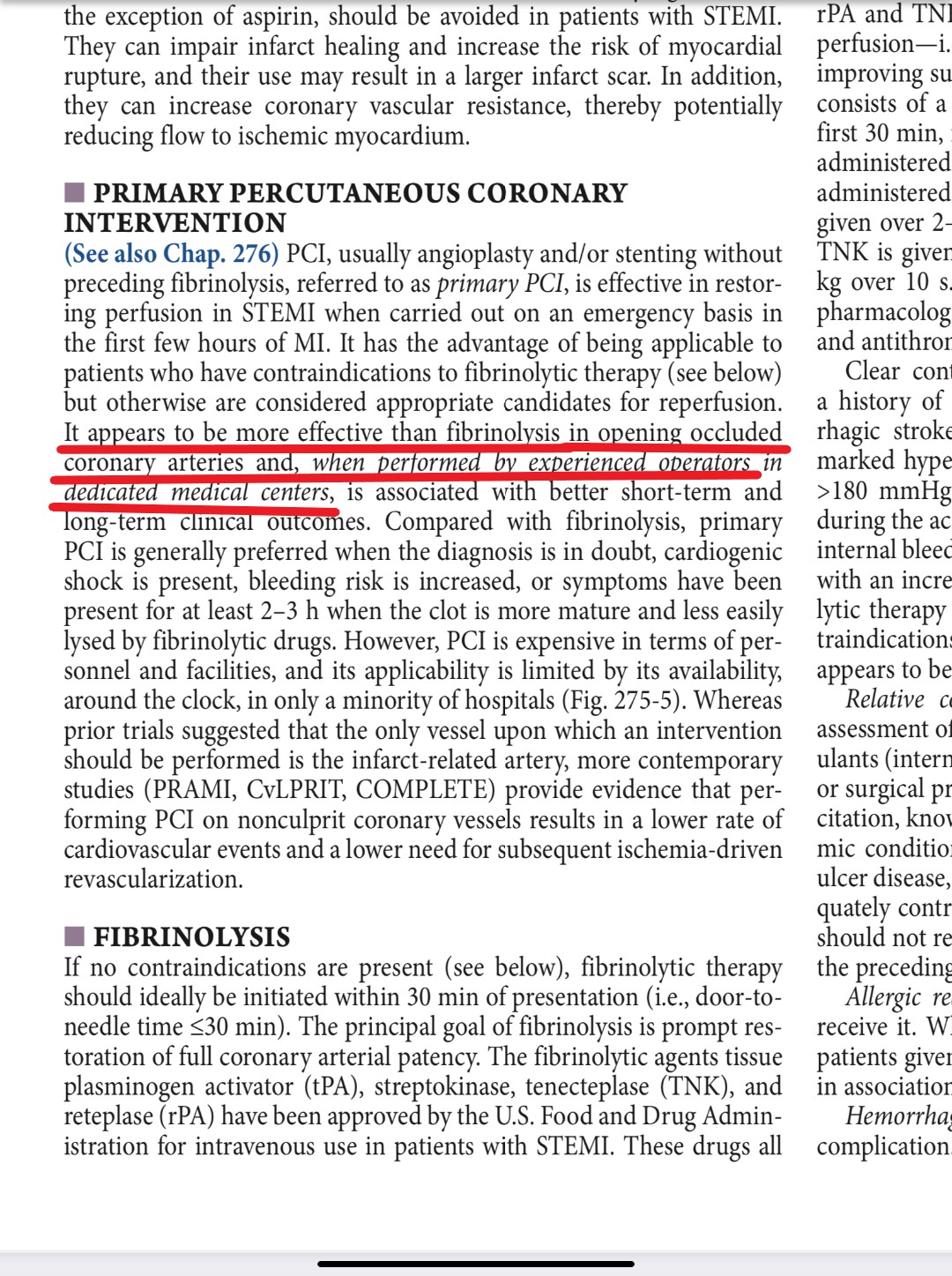
Before that, I would request you to please read the current edition of this book we all revere. (Which continues to mentor physicians all over the globe for the past 50 years)


The current edition of Harrison 2022 is just out. I thought, there is something great learning point in Cardiology chapter, specifically about the reperfusion strategies in STEMI

My hearty thanks to the editors of the chapter for the crystal clear expression about this much-debated procedure* and specifically choosing the word “PCI appears* to be more effective ” (even) if it is done in experienced persons in dedicated centers. The choice of the word used by the authors is Intentional and must be applauded. This message must be propagated to all our fellow physicians. What a way to convey an important truth pertaining to the management of the most common cardiac emergency, while many in the elite specialty are so dogmatic in their assertion without verifying the reality.

*  The verdict is still under the jury even after 3 decades, since the PAMI days of the early 1990s. Thank you, Harrison. What a gentle, but a righteous way to express an opinion about a procedure that is apparently enjoying a larger-than-life image based on a handful of studies and a flawed meta-analysis.

Final message 

Primary PCI is just an alternate form of treatment to fibrinolysis in STEMI. Both are equipoise in the majority of patients. Extreme care and diligence are required to harvest the small benefit the PCI seems to provide.  There are lots of ” if and buts” that decide the success of this procedure. Get trained, and do it selectively for those who really need it.

Postamble

You may call yourself a super-specialist. But, please realize, If you have any doubt about key management strategies, never feel shy to take a cue from Internal medicine books. The greatness of these warrior books is that, it comes devoid of all those scientific clutters backed by premature evidence. 


Read Full Post »

William Heberden first introduced the term angina to the medical community in 1772. His descriptions became immortal. Still, no one would ever know what was the angina-related artery, Heberden was alluding to.

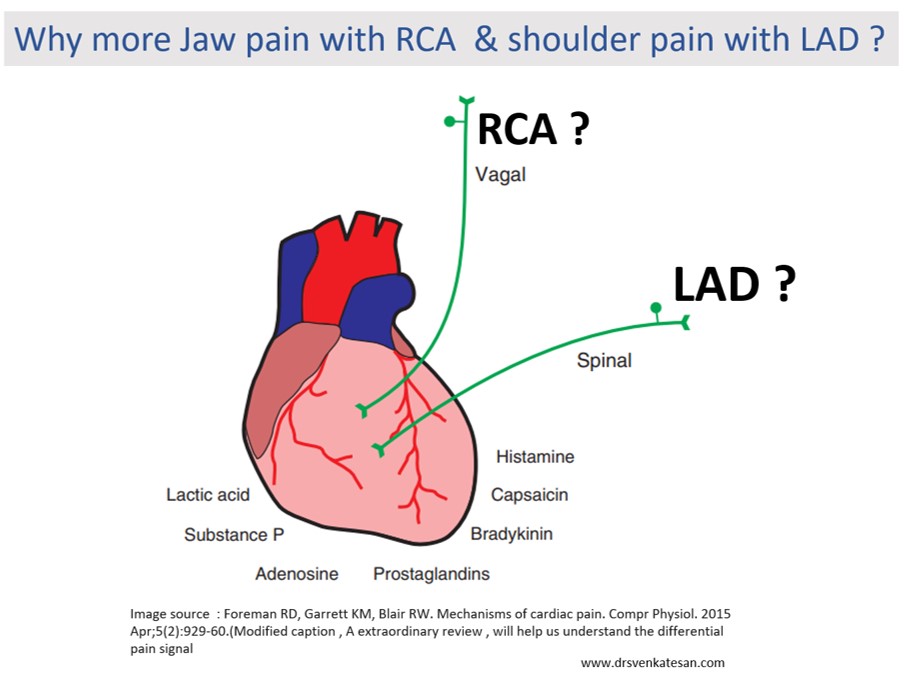
Now, some jobless cardiologist is asking this question after 200 years. How is angina from the LAD system differ from the RCA  system? or let me put it another way, How does angina of anterior circulation (LAD) differ from posterior circulation (RCA/LCX)? Though there is distinct hemodynamic profiling of RCAvs LAD ACS, surprisingly, cardiology literature does not answer the chest pain aspect of it. One rare study, done  4 decades ago throws some light

Here is a curious little study, with a simple & crisp conclusion.

chest pain and IRA localisation angina LAD angian RCA

It concludes, that LAD angina rarely radiates to JAW or epigastrium. While RCA angina relay radiates to the left shoulder.

So, why does this happen?

What I could guess is the ubiquitous vagal fibers that travel in the posterior aspect of the heart, and carries pain signal directly up to the jaw whenever these areas become ischemia. LAD is less likely to irritate the vagus. Of course, there can be a definite overlap.

OMG, give me some time to keep in touch with  basic science 

Now, fellows of cardiology, please take a  pause from your regular aggressive cardiac cath lab workouts and get a break at least once in a while. How does the ischemia of myocardial tissue generate pain? Why it is severe in some, trivial in others, and even dead silent in some, 

The chest pain genesis is initiated by sensory electrical neural action potential, that captures the epicardial neural plexus first, switching over from somatic to the visceral pathway and trespassing the para ganglionic plexus and traveling further to the spinal cord. Where it may collide with other incoming sensory signals ascends in specific myelinated and non-myelinated neural cables, reaching the brainstem, interacting with local nuclei, and finally reflecting on subcortical and cortical pain matching centers.  We haven’t yet located the exact center for anginal pain. (Perithalmic and amygdala could be closer to real centers) 

So, it is a really complex sensory world yet to be understood fully. Mind you, I haven’t touched upon the neurophysics of referred pain, linked or clandestine angina.

  • What is the effect of cardiac denervation, autonomic neuropathy, or on the perception of chest pain(Does a quadriplegic feel angina ? or post-transplant heart immune to angina ? (Gallego Page JC,Rev Esp Cardiol. 2001) 
  • Is it biochemical or neural, can substance P in blood cause pain hitting the amygdala? 
  • Will hypoglycemia and anemia cause angina due to lack of glucose and oxygen?
  • Finally, how is Infarct pain is different from ischemic pain (Ischemic)

Where do get the answer to these questions?

This paper from Dr. Robert Formean(Ref 2) university of Oklahoma is just the best source I think, to explore and understand the topic. (Reading time 60 minutes: Let me tell you, it is worth more than a time spent on an insignificant angioplasty of painless PDA lesions)

Final message 

So, what have you learned from this post? Does this question about angina matter at all? Surely not. in this space-age cardiac care where we are right inside the coronary even before we listen to the patient’s complaint properly. We are always at liberty to do what we want( or love) to do. But, the urge to understand the foundations of clinical science is the last remaining hope, that will keep the specialty of cardiology enchanting. 

Reference
 
 
A comprehensive reference for the genesis and signal processing  of chest pain 


Read Full Post »

“We have a 24/7 cath lab with an open door policy. Our cardiologist arrives at 15 minutes’ notice. Door to balloon time is less than 60-90 minutes”, 

“Great, so, you can always offer a successful treatment for STEMI”

“No, that we can never guarantee.” 

 “Oh, It Is not the answer, I  expected”

“I agree, it sounds disappointing, but. truths are less pleasing. What I am trying to say is, there are a number of factors other than the availability of a grand cath lab and agile and effortless hands, that try to reperfuse the myocardium in distress.  I agree, we do save lives occasionally in a dramatic fashion. Recently we resuscitated an almost dead man with CPR and ECMO-guided PCI. But, most times it turns out to be just a customary ritual that takes us to the legal and therapeutic  endpoint* of STEMI management”

*Both salvage & non-salvage

“I didn’t get you, Can you explain further?

See this curve and try to understand it yourself. (I would say, this is the ultimate curve to understand in the entire field of coronary care)

Can you guess what will be the outcome for C to B, or B to A ?  In the real world, a substantial number of interventions take place at an Invisible point E beyond A  Source: Gersh BJ, Stone GW, White HD, Holmes DR Jr. Pharmacological facilitation of primary percutaneous coronary intervention for acute myocardial infarction: is the slope of the curve the shape of the future? JAMA. 2005;293:979–86

Read Full Post »

Just roll over the virtual marker along the coronary lesion to get the underlying flow ratio. Blue is an absolute normal segment. Green is ok, orange and red slow-moving coronary traffic jam zones. it’s just like drawing a google map showing life traffic. No wire, no adenosine FFR comes inbuilt in every angio shot. Looks great Isn’t it? This is called QFR. Quantitative flow ratio derived from routine coronary angiograms. It can also guide us to find the optimal sites of both proximal and distal stent landing zone in the best physiological manner.

Which company makes this ?

Any studies done with QFR ?

FAVOR 2 study was reported in TCT. This modality is expected to evolve.

Final message

Whenever possible every anatomical lesion in the coronary should be substantiated by physiological parameter and possibly coronary Imaging to know plaque morphology and vulnerability. Though it is wishful thinking, still for all logistic reasons, most of the real world stenting will be based only on the blind anatomical luminogram.

At this point, please let me utter a non-academic hyperbole. Even a casual query to your beloved patients about their true symptoms and exercise capacity shall make these ultra-modern coronary physiology studies redundant in many. A well-performed and well-interpreted stress test is a good, objective, non-invasive indicator of coronary flow across lesions. It is wise to keep this as a basic clinical foundation in the evaluation of CAD, even as we continue to learn and forget half evolved modalities with rapid expiry dates like FFR, IFR, CT-FFR. QFR shows some promise though. Please watch for next in line coronary physiology – OFR, Optical flow ratio from OCT run through.

Reference

Read Full Post »

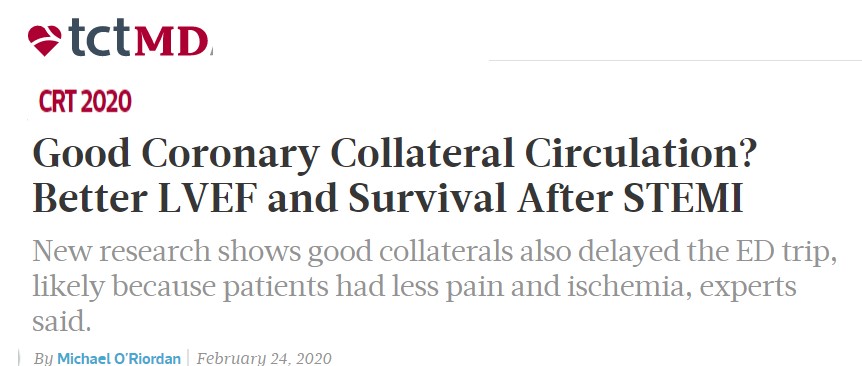
Coronary collateral circulation is one of the major determinants of symptoms and outcomes in chronic CAD. But, we generally shrug off the value of coronary collateral circulation in acute coronary syndrome. The fact is, it has a myocardial mitigating effect following sudden total occlusion.

When does it appear? We did a small analysis (PDF version)

We found it is noted in 25% of patients. With reference time of appearance,  6% had it within 12hrs and in few, it was noted as early as 6 hrs. One caveat is,  we may not know whether its preexisting collateral due to chronic multivessel CAD. I am sorry to note this study did not address the outcome analysis. We however documented patients with good collaterals had negligible wall motion defect and near-normal function post PCI. Some of you can pursue research in this area. 

Potential role of collaterals in ACS

  1. It limits the infarct size
  2. Keep the myocardium alive and give us time to intervene
  3. Can converts a potential Q-MI to non-Q MI
  4. Possibly prevent primary VT/VF and hence dreaded sudden death in early STEMI
  5. Prevent early adverse remodeling of the left ventricle.

When these points appeared just my assumptions, Dr. Ali Aldujeli, (Lithuanian University of Health Sciences, Kaunas) in his presentation, at TCT 2020 confirms many of them are  Indeed true

Final message

I agree, in the era of instant gratification with primary PCI,  relying on coronary collaterals may appear a lesser professional virtue. Still, we may need to respect nature. Many times it bails us out.

Current update 2020

Alsanjari, O., Chouari, T., Williams, T.,  Angiographically visible coronary artery collateral circulation improves prognosis in patients presenting with acute ST segment‐elevation myocardial infarction. Catheterization and Cardiovascular Interventions.  Volume96, IssueSeptember 1, 2020 Pages 528-533


Read Full Post »

Science is a journey in pursuit of truth. Hence, we search for it again and again.  (Thus, recurrent search becomes Re-Search)

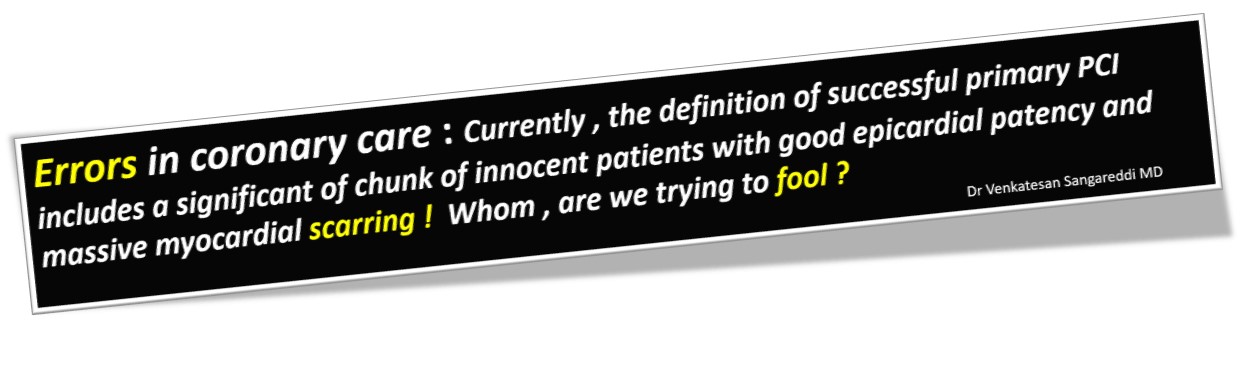
As we try to progress in our knowledge towards absolute truth,  we need to admit our errors first. I think, one such error is blinking right in front of us in the vibrant corridors of coronary care and cath labs every day!  It is about the definition with which we deal the success of primary PCI. (A supposedly revolutionary acute coronary therapeutics  this century)

Waiting for the day . . . when all those fancy primary PCIs that leave the myocardium hurt (& retire ) with significant LV dysfunction to be reclassified as clear cases of primary PCI failures.

Read Full Post »

Older Posts »