Feeds:
Posts
Comments

Archive for the ‘myocardial disease’ Category

An  unwanted , unexpected , unpleasant sound  is  often referred to as  noise

Human ears , are  not meant to  hear  only the  pleasant  sound . We live in a noisy world. It is believed every cell in the body has ( Auditory ?) sense  receptors. But , the noise is perceived  only at brain .It is  incidental our ears  are located  right beside the brain , adjacent to  parieto  -temporal cortex . The auditory nerve  has   its  nucleus  located dangerously close to vasomotor centers of  brain stem .

.

When  excess noise enters our ears it vibrates  the brain stem as well . Noise travels in the nervous system as electrical  impulse , so it is natural  for  to expect a  spill over to the  nearby  adrenergic  centers  .

A sudden explosion or a thunder will skip a few heart beats is it not ?  Similarly , when   we experience  pleasant  sound /  melody**   it  soothes   the nerves ,  this forms the basis of musical  therapy.

So  it is logical to conclude   , when the  nice  music  has a capacity to heal ,  unwanted  noise  is expected   to injure  our biological system.

** A rock fan under the influence of  drug  may feel a every nonsense  as melody . . . is a different  story !

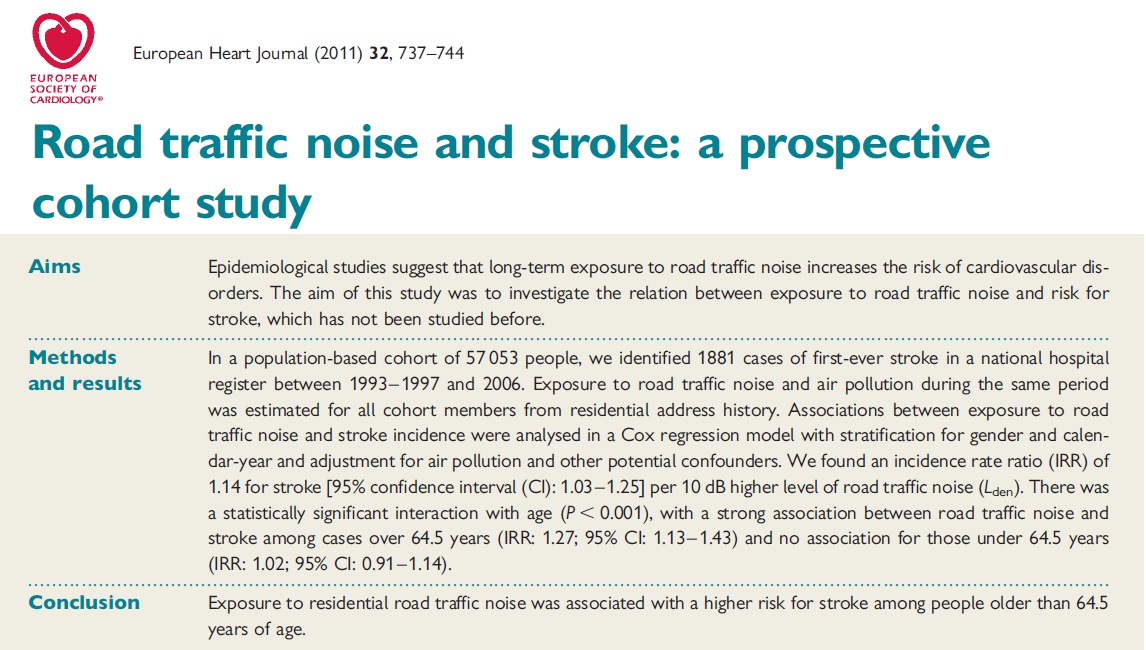
It is observed strokes and MI are more common in urban areas congested  with traffic chaos. Here is an article from European  Heart  journal   with  solid evidence on this topic.

Excess noise   could  result in  cerebral  or coronary arterial  spasm ,  thrombotic  occlusion or even a hemorrhage ?*

  • Noise  induced adrenergic trigger and spasm of blood vessel
  • Adrenergic  surge  and resultant hypertension

Associated  Phenomenon along with noise

  • Anger
  • Anxiety
  • Fear (A noise associated with a  missile attack  in the  war zone )
  • Relative  hypoxia , Air pollution in noisy  environment .

*A distinction must be made between   chronic noise  pollution  vs  Acute noise intoxication.

For  those who want  more depth in this  topic , I  was surprised to find  this  exclusive journal  that documents noise and human health .

Final message

Excessive noise  can have a detrimental effect in the nervous system . Since  cardiovascular system  is also under    neurological command  it  is  expected to  share the ill effects.

A comforting news for healthy men and women  . Noise per se  can not be termed  as a  coronary  risk factor . It can  (at worst ) be a  trigger  for an event  in individuals who have other major risk factors.


Read Full Post »

Diabetes is a systemic disease affecting  almost every cell  that metabolises  glucose .What begins  as  a minor  functional impairment  ,   worsens gradually and ultimately   end up in severe  structural changes.The basement membrane of  cells  face  the brunt of the attack .  (In the strict sense every cell has a basement  but it is well  developed only in kidneys ) . We also  know , diabetes  is able to inflict universal damage by targeting the vascular endothelial cells.

In the kidneys DM makes the  glomerulus  more porous causing protein leak*  and ultimately damages the tubules and end up in CRF. In the retina it excretes the  proteinaceous  material into the vital layers  and result in  retinopathy and progressive visual loss.

* Micro/Macro albuminuria

In fact , there is  a very close link between eyes  and the kidneys  Nephrologists   hesitate to make a diagnosis  of diabetic nephropathy without ocular  changes. The peripheral vascular disease and diabetic foot are  another expression of this microvascular  dysfunction.

What is the impact on cardiac micro-circulation ?

Whenever significant diabetic nephropathy is present there must be a significant cardiac micro- angiopathy as well.This is now  a fact than an assumption. We are not recognizing it rather  ! (If only we have a cardiac  creatinine we can easily identify diabetic myocardial protein leak !)

When kidneys lose protein , cardiac capillaries  lose proteins to interstitial   space  and result  in progressive  fibrotic reaction . We know  extravasaation   of high osmolar  proteins   can play havoc  in cardiac interstitium  !

Proteins are the particles of life   . . . but in wrong places  it can  transform into deadly  molecules  in a fraction of time !

Hence ,  the cardiac protein leak in diabetes can cause  any of the following clinico -pathologic entities.

  • A mild left ventricular  hypertrophy .
  • Increase global  cardiac  mass (Similar to bulky kidneys  seen in early diabetic nephropathy )
  • Simple diastolic dysfunction.
  • Severe restrictive features
  • NDCM (Non dilated cardiomyopathy )
  • Finally a DCM  like  transformation

How to recognize cardiac protein leak ?

  • Clinically it presents either as  angina or early heart failure symptoms ( not both usually ) .Diastolic dysfunction  in echo,  positive stress test , patchy thallium uptake abnormality  often with  features  of   syndrome X  is also recognised.
  • Many of the low flow or slow flow phenomenon  in coronary angiograms  might reflect micro-circulatory dysfunction .
  • This is recognised by prolonged TIMI frame counts  and  prolonged  coronary sinus filling and emptying time .

What about macro-vascular  complications  in diabetes ?  How is it different from micro-vascular complications ?

Though we expect a direct  link between  micro and macro  vascular complication ,   the later  appears  to a  patho-genetically  independent  process . This will be addressed later.

Read Full Post »

We know,  electrical deaths constitute the bulk of sudden cardiac deaths in MI.  Mechanical deaths due to pump failure, muscle rupture , valve leak , also cause significant deaths   .(Surprisingly many of the mechanical deaths   may also   fulfill  the sudden death criteria !)

Free wall rupture is  invariably a fatal event. Papillary  muscle trunk  rupture  leads to severe LVF and unless intervened sure to result in fatality.

The ones who tear their interventricular septum  are some what blessed ! Here ,  the rupture does not result in instant death as there is  no loss of blood ,   instead , there is an  volume over load of right ventricle  followed by the  left ventricle  after a  few beats. Hypotension is the  rule. Even though this is a major complication there is something about  VSR which makes it unique.

Sudden giving way of IVS has  a decompressing effect on the ailing left ventricle.This many times  bring a  temporary relief to LV and if the patient survives the first few hour he is likely to stabilise  further . In fact , sudden deaths within 24hours after the onset of VSR is an exception.This defect always gives the cardiologists and surgeon some time to plan the management. We need to use this time judiciously.

The natural history is delicate . Five themes are possible

  1. Very unstable Instant death( Fortunately a  rare theme )
  2. Unstable – Deteriorating further
  3. Unstable to Stable * fit for discharge even without surgery
  4. Stable from the onset and  continue to be stable* .
  5. Stable to Unstable (Probably the most common theme )

* Pleasant themes occasionally witnessed !)

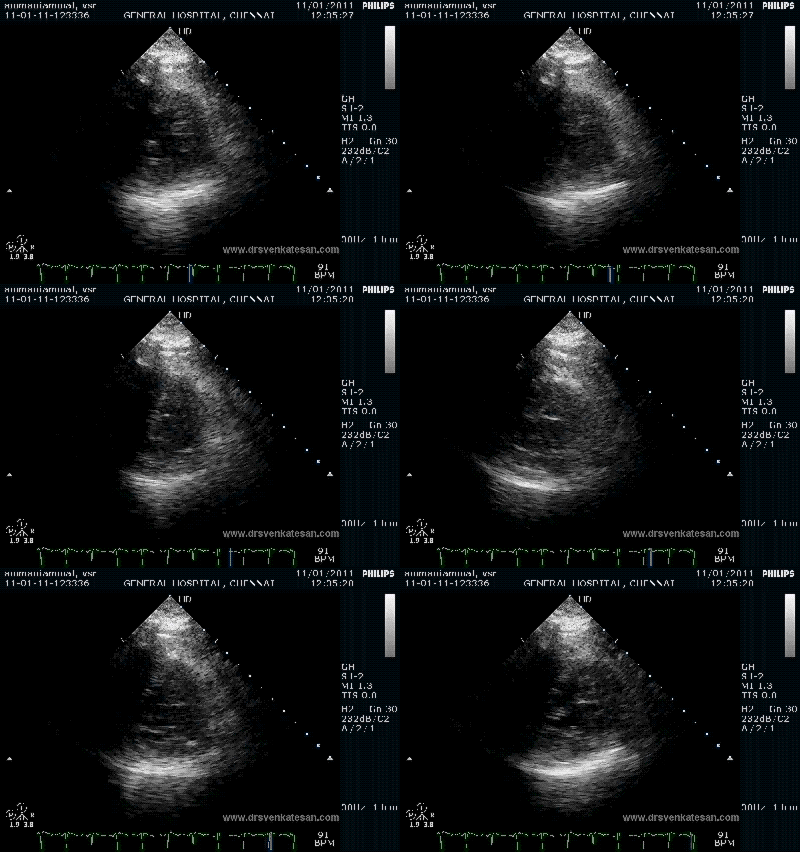
Here is 55 year old women came with extensive anterior MI with lower septal rupture.(She belonged to type 3 of the above scheme)

)
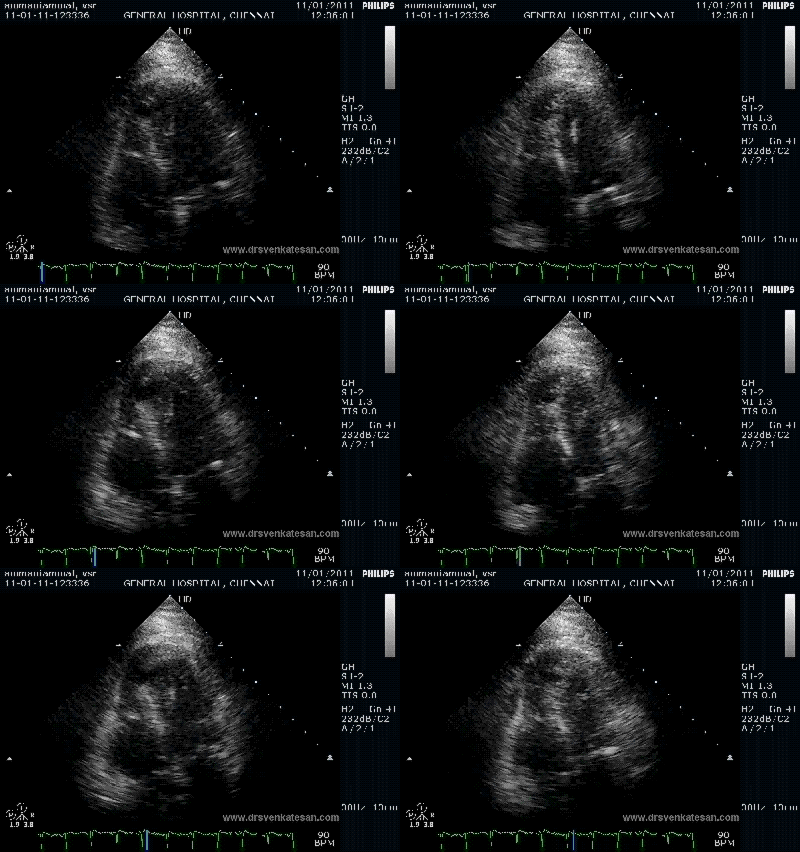
Note the septal rupture is visible even in 2D Echo
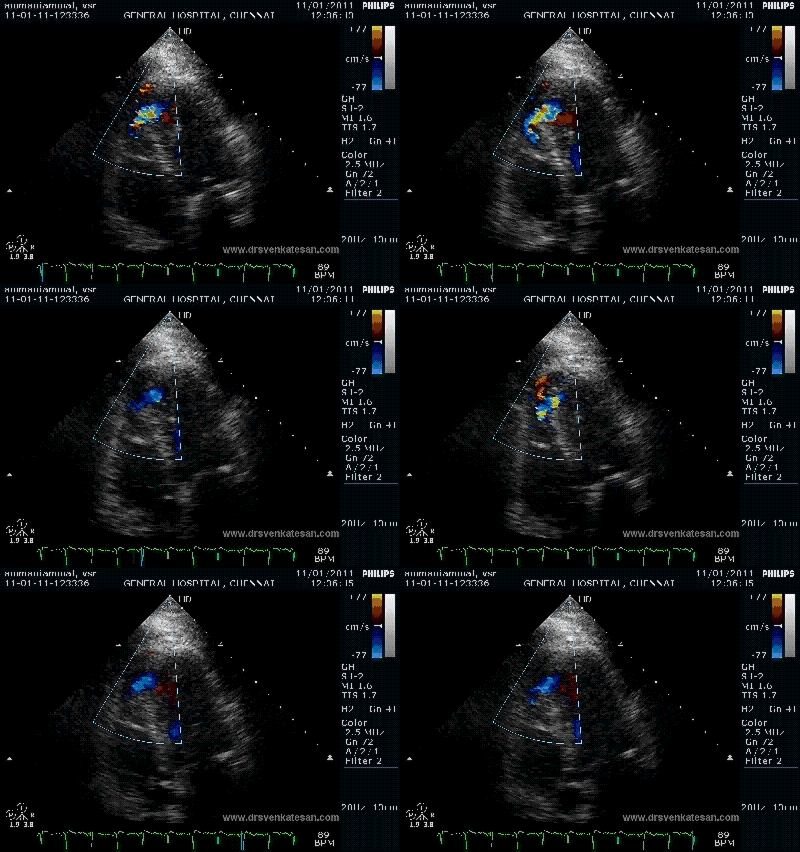
 

Color flow showing significant shunting from LV to RV.This shunt depends upon the LV contractile function, LVEDP and ofcourse the RV pressure
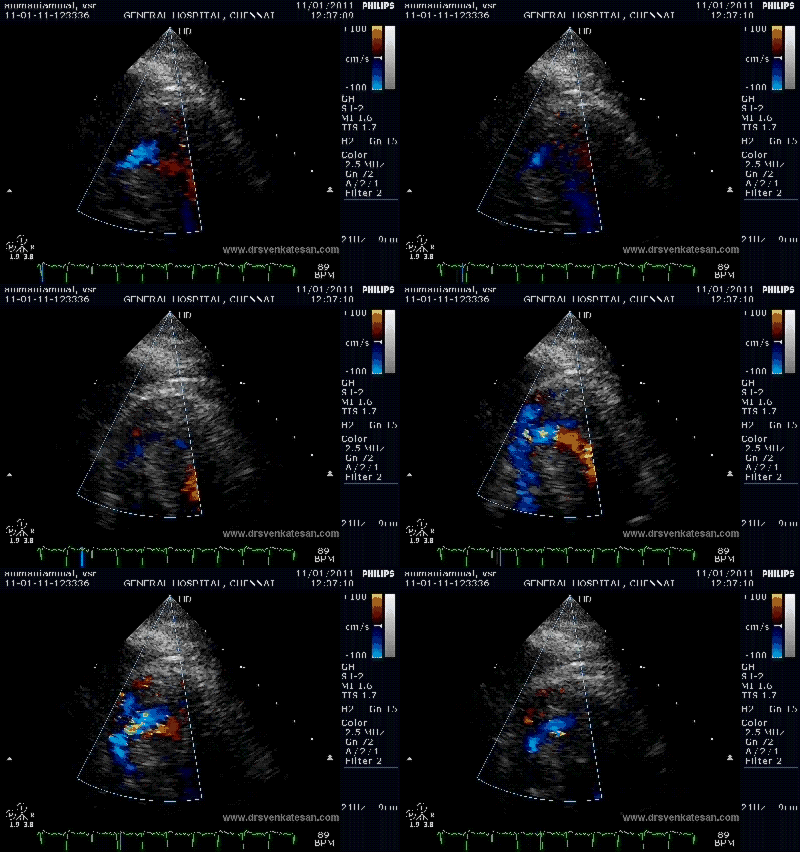
 

If there is severe RV dysfunction or bi ventricular dysfunction flow across the defect is inconspicuous.Brisk left to right shunting may be an indirect marker for good LV systolic function and absence of significant pulmonary hypertension.Both imply a better outcome.

The main determinant  of survival is the  underlying LV dysfunction and associated co morbidity(Renal function ) and complications .

Infero -posterior ruptures tend to be complex and  may have multiple irregular tracks  that makes it difficult to repair.

Investigations

Echo cardiogram is the mainstay .Serial echos should be done to assess the mechanical function and the progress of VSR.Hemodynamic monitoring may be done without injuring the patient .

Medical management

  • Often supportive , but  effective . Dobutamine infusion can maintain a life for few days.
  • Paradoxically , LV dysfunction and elevated LVEDP restricts volume overloading of VSD.
  • Associated MR, Arrhythmias  need to be taken care of .

Surgeons role

  • Very Vital.
  • Experience counts.(Individual as well as  Institutional )

Timing of surgery

Continues to be a controversy . Surgeons love to operate in a stable patient. But they need to realise , surgery is often needed to stabilise  many  patients. . The issue of tissue friability  is blown out of proportion in the literature .When a  life is  is at danger we can not worry about  friable tissues !

The rule of thumb could be

  • Operate as early as possible in unstable patient.
  • Post pone surgery in stable patient as late as possible ( Late here means . . .elective non emergent surgery )

Surgical options

  • Simple VSR closure without  knowing coronary anatomy
  • Simple VSR closure after knowing coronary anatomy
  • VSR closure with CABG ( total revascularization)
  • VSR closure with partial revascularization

In our experience  each of the above , has a role in a given patient depending upon the logistic , financial , social and even  the available expertise. (A good surgeon in bad Institution !)

Is coronary angiogram mandatory  before attempting to close VSR ?

Logically yes. If it is not available  just do not bother .  But, many times , when issue is saving lives , we can not afford to be too scientific , many lives have been saved by not following  such strict  protocols .A simple emergency  thoracotomy and closure of rupture site (Without even touching the LAD ) can be a distinct  and viable option in  a selected few .

Role of cardiologists

Contrary to the popular belief the role of cardiologists is minimal , except  to prepare  the patient and hand over to the surgeon.

Interventional approach to close  a VSR  is currently  be termed as an  adventurous option ! The VSRs  can assume unpredictable shapes  and the  tears can be multiple  in  different planes. The devices , catheters and  other hard ware are not specifically made to tackle these  issues  .An acquired VSR  should never be compared with congenital VSD.

Read Full Post »

Dilated cardiomyopathy (DCM )  is the commonest  cardiac muscle disease .Diagnosis is simple and straight forward. All that we  require is,   documentation of LV dilatation and contractile dysfunction.The nomenclature of cardiomyopathy has remained a difficult exercise .This   is primarily  due to   iatrogenic  & intellectual confusion  among  cardiologists . They mixed up etiological and morphological entities together ,   later on  they  wanted to de-link  etiology from morphology  ,  ultimately they realised  when illness strikes the heart ,   it   can not differentiate the  morphology, etiology and pathology as we would want to   . So , whenever possible we have to label  cardiomyopathy with all components (Dilated cardiomyopathy due to alcohol with some restrictive features.)

This article  tries to evoke  some thoughts    about  why  LV dilatation  is central to the understanding of cardiomyopathy.

DCM is the prototype where LV dilates with global hypokinesia.The upper limit of   LV diameter is generally considered to be 56mm in diastole.  (Range 35 -56mm) .This cut off  point is too empirical  for the simple reason, the  left ventricle can dilate   up to  50 %  from it’s basal diameter and still technically  be within normal limits.( A 3.5 cm LV ( end diastolic diameter ) can dilate to 5.6 cm ,i e  a 50 % dilatation , still LV  has not reached the upper limit of normal  )

Even as we do not have a clear  answer to the above issue , we  recognise  left ventricle muscle can hypertrophy, progressively  dilate , transiently dilate, fail to  dilate ,  regressively  dilate  or  hypotrophy .These changes can be dynamic and heavily influenced by hemodynamic and local pathologic factors like fibrois, interstitial proliferation etc. Meanwhile , the pharmacological ,   surgical /catheter injuries we  inflict    , modifies  the muscle behavior in a positive or negative manner.

In this back ground ,  we have found a new entity called NDCM .

Apart from  DCM, a newer form of  cardiomyopathy  is being recognized  .This is often referred to as NDCM (Non dilated cardiomyopathy)  .Global  systolic LV dysfunction  with normal  LV dimension.This a similar to the terminology MDCM (Minimally/Mildly  dilated  cardiomyopathy  where LV dimension  do not  increase  beyond   15 %  upper limit of normal  ) .

This is seen in CKD and diabetic individuals.Atria may be enlarged .Diastolic dysfunction may co exist.  It is no surprise,  this entity closely mimics RCM. But in RCM LV systolic function  is not greatly compromised till the  late stages , while NDCM it begins with systolic dysfunction. This is the only difference .There can be overlaps .

MDCM was reported in 1990  . Keren gave a excellent insight about the condition  ,  It is unfortunate it failed to take off as a popular  clinical entity .  Cardiologists are argued to use this term liberally in their clinical practice .

Final message

Cardiology is not  that  simple as one would like to ! The two components of cardiomyopathy ie   LV dilatation and LV dysfunction can be temporally dissociated  one may precede the other. To  complicate the matter further, one of them may not manifest at all !

Few ,  still consider many of the RCMs and NDCM are one and the same entities that present in different time frames in their natural history.

So the simplified  concept  to decode the cardiomyopathy conundrum  could be

  • When both  dilatation and dysfunction occur it is classical DCM
  • When dysfunction  alone occur without dilatation it is NDCM
  • When both dysfunction  and dilatation are less it is RCM*(Relaxyl dysfunction must)
  • When dilatation is mild and dysfunction is severe it  is MDCM

Read Full Post »

The term cardiomyopathy generally denotes a  progressive disease  in clinical cardiology.There was a time   diagnosis  of dilated cardiomyopathy (DCM )  was synonymous with a  delayed death sentence !  Of course , the situation has vastly improved over the years  with the availability of  new medical , interventional and surgical management. Still ,  there is no denying the  fact  ,  DCM continues to  have a grave outcome  especially when it occurs without any identifiable cause .

While we have  variety of aggressive DCMs , we also  have  patients with relatively benign forms of   dilated and dysfunctional hearts  which recover totally .

This reversible forms of DCM is observed in  the following  situations.

Hypertensive dilated cardiomyopathy . The left ventricle  in  some of the  patients with severe SHT  respond to the stress (Increased  after load) by dilatation rather than hypertrophy. This is especially common after an episode of LVF.  If we do an acute echocardiogram the LV function is severely impaired and the LV may  also be dilated. With good control of BP and fluid management the ventricle promptly return  to it’s baseline dimension. The recovery is complete in many . (The mechansim of LV dysfunction acute severe Hypertension is referred to as Pre-load /After load mismatch) Link to concept of Pre load mismatch .

* Note in the past these entities were not called as  cardiomyopathy .

Peri partum cardiomyopathy.

This is a serious disorder of cardiac muscles that occur during pregnancy  few months before  or few months after delivery  . There is correlation between PIH and this entity. Prognosis varies between very bad to excellent. Very few cardiac entities  have a  natural history like this one disease of women.Most of the pregnant women regain their original cardiac status within  year or so. It should be recalled there is high chances of recurrence in next pregnancy.

Alcoholic cardiomyopathy.

The toxic response to alcohol or the additive cobalt can result in DCM .There is overlap  between holiday heart syndrome and alcoholic DCM , where atrial fibrillation is the major problem. Wet Beri beri is the advamced form of clinical DCM that respond to vitamin B therapy.

Tachycardic cardiomyopathy.

This is also a common entity that occur during persistent sinus tachycardia or AF , thyrotoxicosis.Beta blockers are  of great use here.  Recovery is usual if the primary cause is correctable.

Toxic and drug related  reversible LV dysfunction

Adriamycin cardiomyopathy

Tako -Subot  Cardiomyopathy canbe termed as classic form of reversible  stress cardiomyopathy

Miscellaneous conditions

Diabetes and chronic kidney disorders are known to have a reversible form of cardiomyopathy

Some rare toxins  , scorpion envenomation , selenium deficiency can result in reversible DCM

**Ischemic DCM are partially  correctable in many , still  we don’t include it as cause for reversible DCM

*** Many episodes of acute myocarditis can have transient or short term LV dialtation and  dysfunction.they are classified as myocarditis .But there is little  difference (Except acadmeic . . .)  between chronic myocarditis with LV dysfucntion  and cardiomyopathy.

Read Full Post »

« Newer Posts