Feeds:
Posts
Comments

Archive for the ‘Cardiology – Clinical’ Category

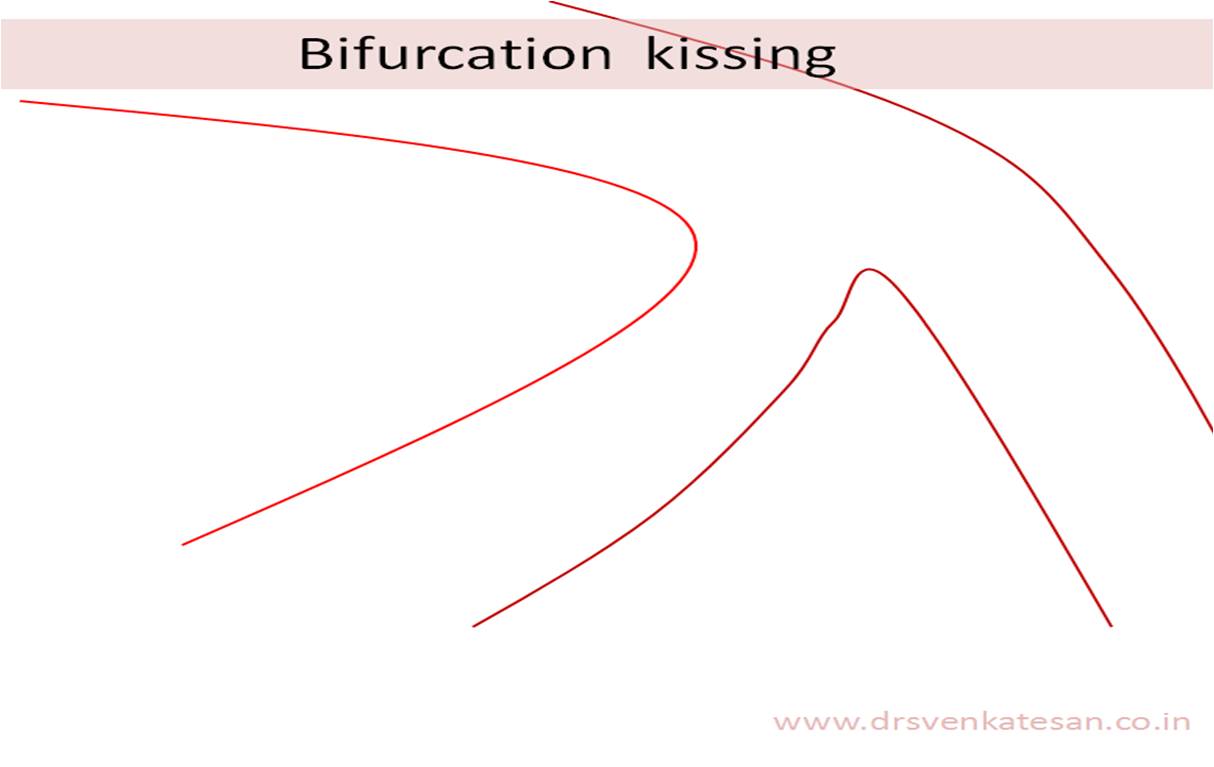
Kissing balloon is the standard technique used to tackle   branch vessel stenosis . When a vessel branches out and both branches has a lesion,  single balloon can not dilate a lesion optimally . This  is  because , the side branch  not only shares a common ostial tissue but also  shares  plaque material within the walls of main and side  vessel . Dilating one vessel alone could result in unpredictable plaque shift.
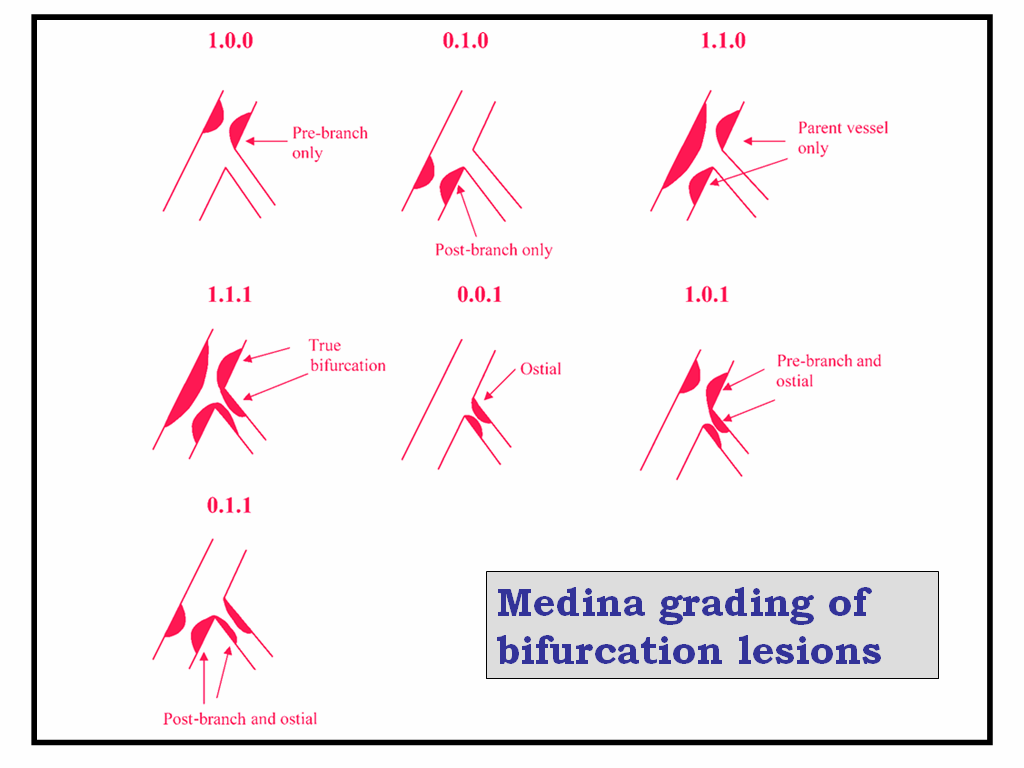
Carina is the most important anatomic structure in a bifurcation zone . It acts like a grade separator. Diverting and deflecting blood flow .The  length and angle of this grade separator determine the ostial  shape as well . A right angled side branch will have  a circular ostium .An acute-angled branch  will have oval orifice .  The plaque burden and distributions at this point becomes vital for many reasons.

When we do PCI this carinal area should be  optimally pressed and plastied  and of course covered well with the metal struts.The  simultaneous kissing with two balloons ,  one in main vessel another in side branch will reduce many of the issues . This area is a weak link for interventional cardiologists. It needs lots of efforts to protect the side vessel.

When do we do kissing balloon ?

Two broad categories.

  • Pre-dilatation and preparing a lesion ( Not routine  )
  • Post dilatation is more often done .
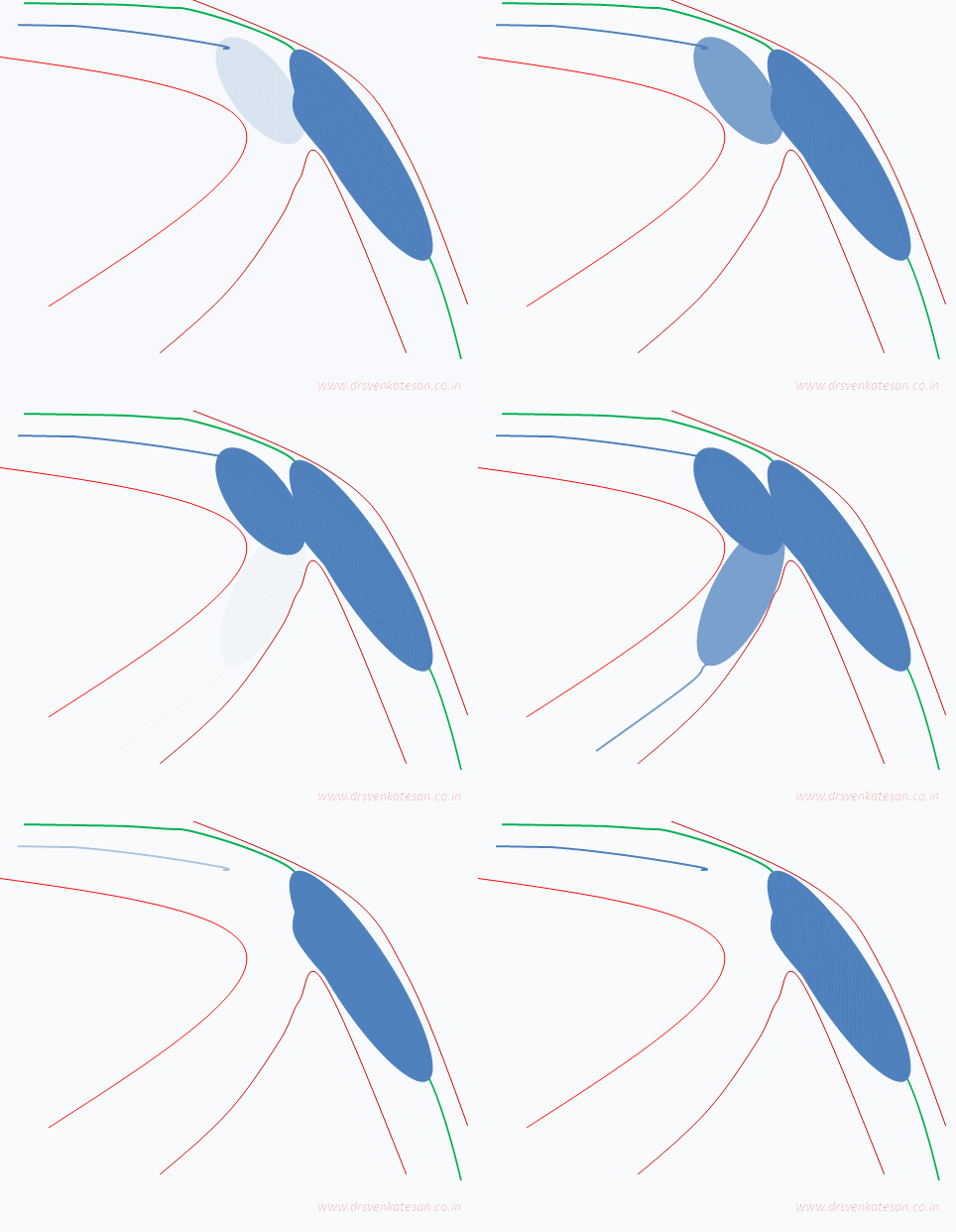
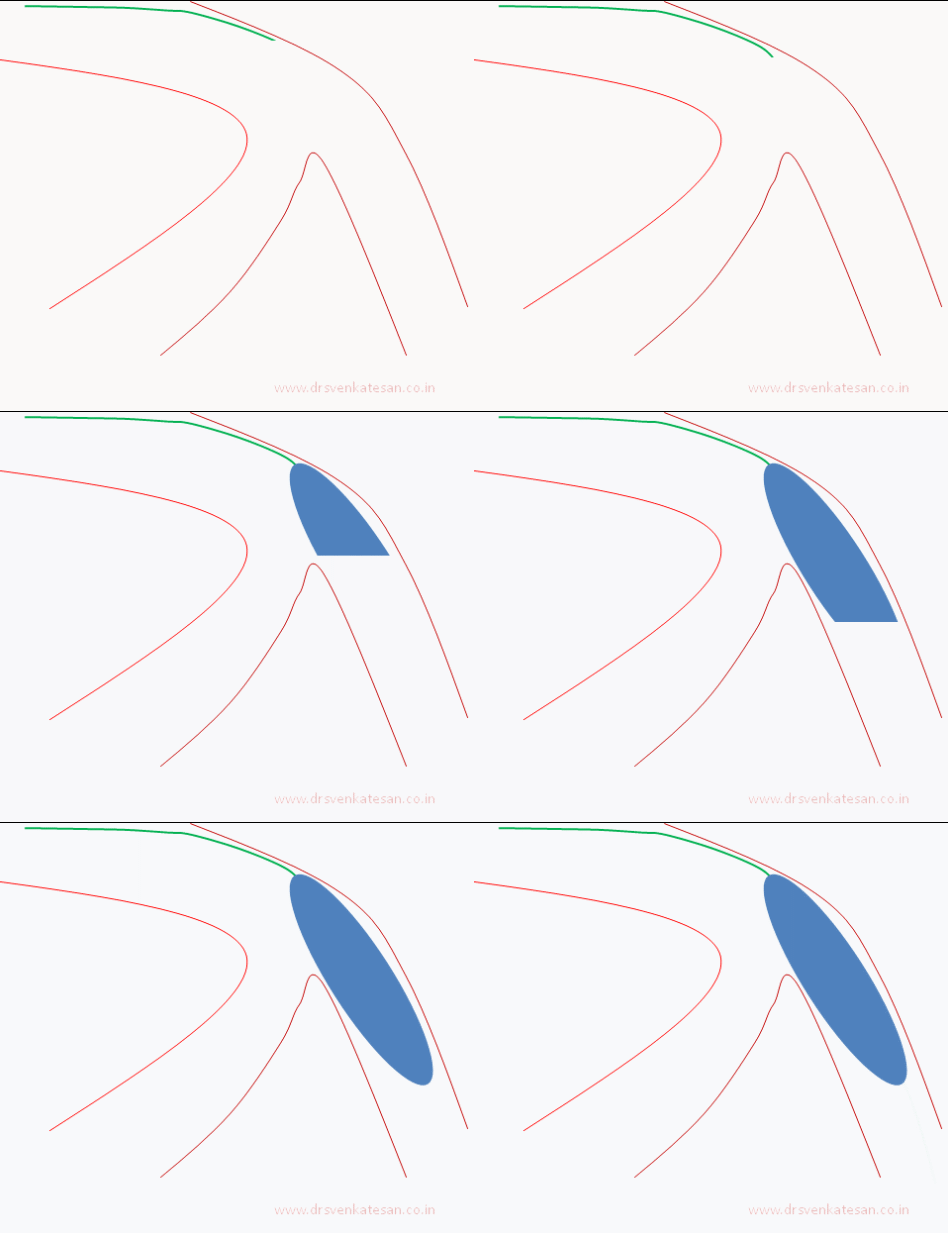
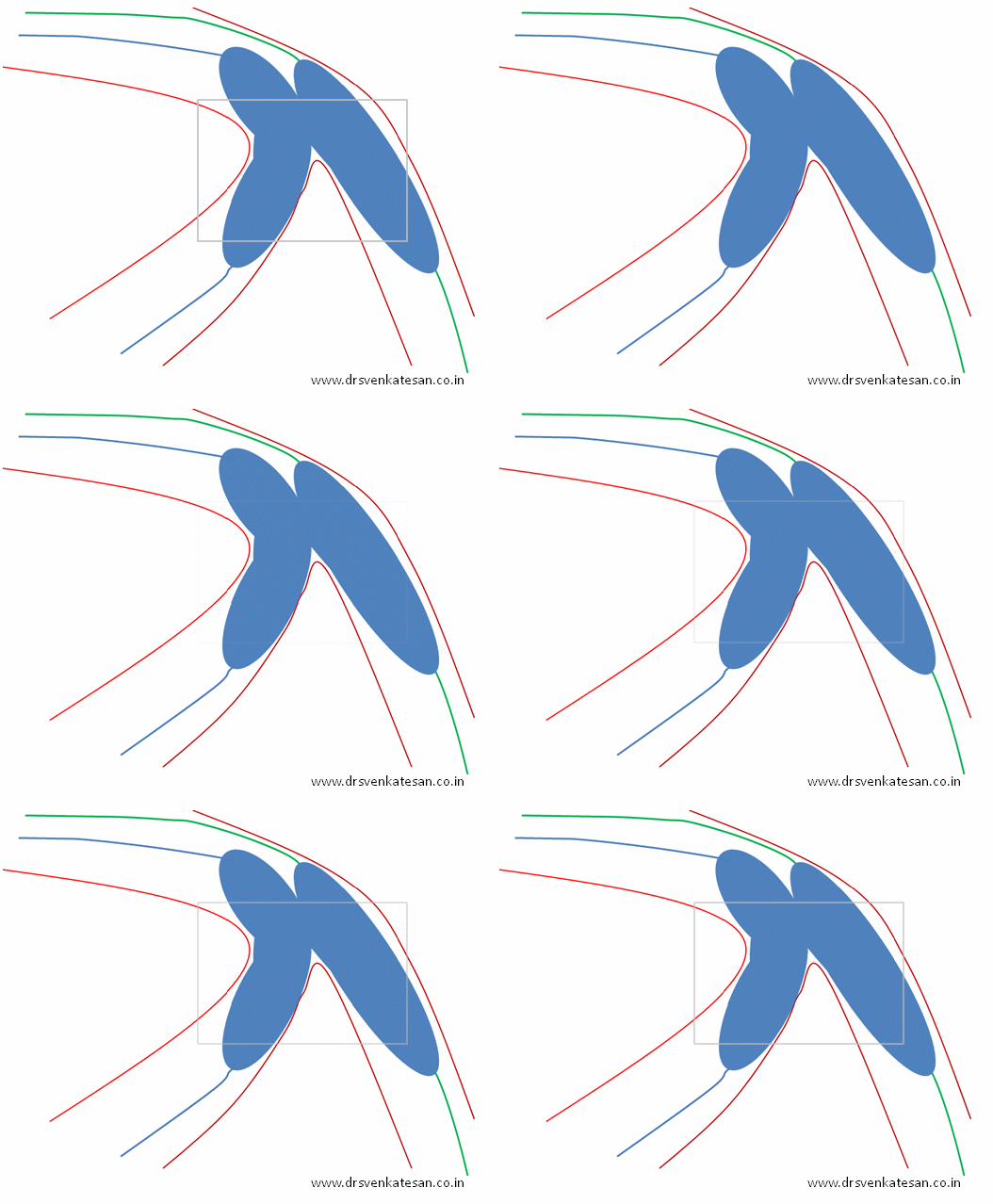
Look closely the layers of contention in the carinal zone. Lesion not depicted .

Kissing interface : When the balloons kiss  what lies  in between ?

  1. Simple  Balloon to Balloon Kissing with nothing intervening(Proximal to branch point )
  2. Balloon- Single layer of Stent-balloon kissing
  3. Carinal  Kissing -Balloon -Two layers of Carinal tissue -one layer of Stent -Balloon Kissing ( See above image )
  4. Twin stent kissing

When do  balloons refuse to Kiss ?

When there is a hard interface between the vessels like a severely  calcified intima /Adventia .

Eccentric /overhanging  lesions intervening.

Incomplete kiss

It need to be emphasized balloons come  into contact easily in  acute-angled lesions.

In right  angled lesions the balloons come to contact only in the proximal part.

Definite indications  for  kissing ?

Kissing is not without complications . While two guide wires are placed in all  bifurcation lesions  , kissing is  not necessary in many  lesions  .Of course it is a must in all true bifurcation lesions (Medina 111 , 011, 101, )  It may not be required in  1,0,0 if carina is away from lesion.

*Kissing can rarely aggravate the same issue which is supposed to prevent  ie plaque shift .This is due to differential pressure transmission by two balloons.

Is there a role for  twin balloon POBA  without any stenting ?

Most cardiologists would not believe  in POBA anyore (For wrong reasons though ! )

A distal RCA with a PDA ostial branch lesion could be tackled with twin balloon POBA.

Which  balloon is to be used?

It depends on whether we use the technique  as POBA, single stent or double stent technique. Non compliant balloons are  ideal  as it exerts   more pressure on the vessel wall .

Kissing   at  what  pressure ?

The pressure used is often between 8-14 ATM.

Experts may use differential pressure inflation depending on the lesion characters.

Which  is the Most complex form of kissing ?  

Two stents, two balloons . Here the interface contains two metal layers . At carnia the two metals engulf   two layers of  tissue as well .

Final message

Bifurcation lesions  are being  conquered with more success in recent years.

The techniques have refined. Stent designs and drug eluting stents  are  helping us in many ways.

We have learnt  from our  mistakes and accepted the limitations.

Wisdom  prevails now , there is a universal consensus  for less  metal in the notorious  carinal  area.

Still, ignorance  remains*  as  a major  guiding force   . . . when  we  navigate  the difficult atheromatous terrains  in  live human  coronary arteries !

*With due respects to IVUS, OCT and FFR .

**Forward looking IVUS, and camera tipped guidewires may change the scenerio.


Further reading

What-is-the-simple-approach-to-bifurcation-pci ?

Read Full Post »

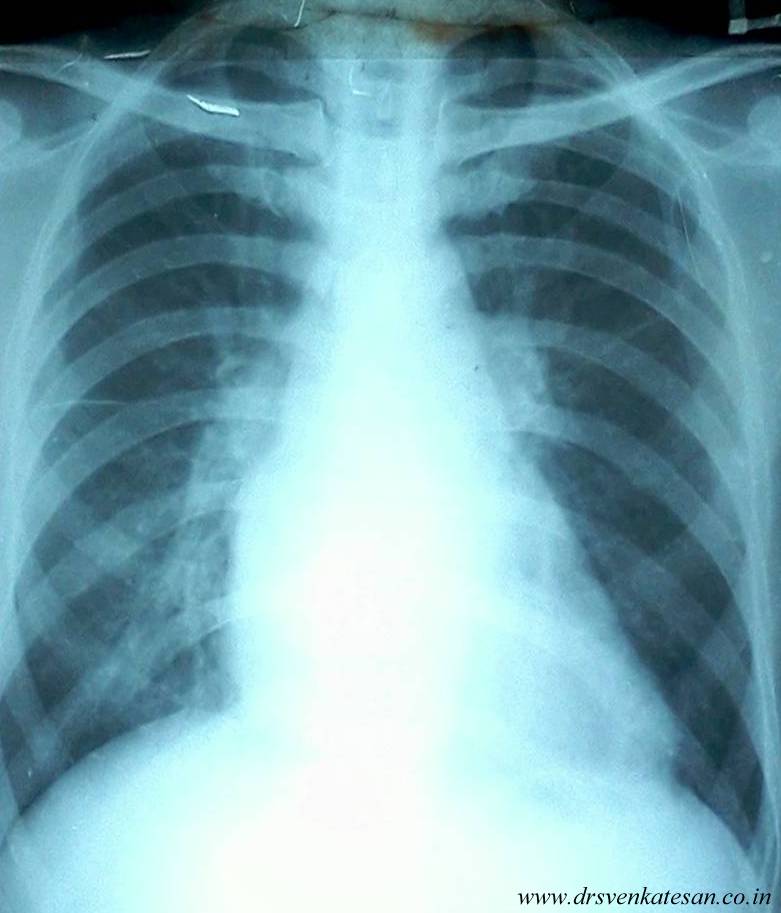
Here is an X-ray of classical rheumatic mitral stenois with a mitral orifice of  .8 square cm.

Why the left heart border is straight in mitral stenosis ?

It is due to 4 factors.

  1. Hypoplastic aorta
  2. LAA
  3. PA
  4. Under filled LV

Note :

  • This straightening occurs   only  in  isolated , severe forms of mitral stenosis  as it requires under filling of left  ventricle   and Aorta.
  • Significant mitral regurgitation will lift the lower end of straight line .
  • In associated aortic valve lesions especially in aortic regurgitation the straightening can not occur as LV and  Aorta continues  to be conspicuous.
  • If mitral stenosis  causes severe PAH and tricuspid regurgitation , RV  can  become  huge  and form the left heart border and distort the straight line.

Read Full Post »

Amiodarone acts  by

  1. Correcting the  rhythm  to sinus .
  2. Controls  ventricular rate  alone
  3. Does both ?

Answer is 3

How can it correct the rhythm alone ?  If  the rhythm is corrected ,  rate will automatically be controlled,  unless Amiodarone converts AF into Sinus tachycardia  which is very unlikely !

Of course  Amidarone  is not a  magic drug .The success rate of  Amiodarone  restoring  sinus rhythm is far . . . far less . . . than our expectations ! . It fails to  convert to sinus rhythm in a significant chunk *. Interestingly ,   it may still  control the  ventricular response  by its beta blocking action .

*Our estimate is , the failure rate Amiodarone  is  between  30-40%  or even higher ,  as   bulk of AF we witness   is due to Rheumatic heart disease.

Read Full Post »

Ventricular tachycardia is  a major cardiac electrical disorder. Even though it  connotes a deadly meaning the prognosis and outcome vastly vary.It can be a benign arrhythmia in  structurally normal heart that present as occasional fasicular VT  or Exercise  induced RVOT , to dangerous ischemic polymorphic VT which rapidly degenerate to VF and SCD if not reverted . It is ironical we are  trained  to put all VTs in a single basket and  propagate fear psychosis among   physicians and patients .

Management of VT has certain broad principles.

  • Identify the cause
  • Whether  specific structural heart diseases present or not
  • Identify the mechanism if possible
  • Rule out transient metabolic cause as a trigger

Therapeutic targets

  • Stabilising the cell of origin
  • Passifying the scars
  • Interrupting bundle branches in  BBR  mediated tachycardia
  • Ischemia related  Focus – Re-perfusion
  • Reversing LV dysfunction

Management

General

  • Correct Cell hypoxia /Acidois
  • Pharmacological ( Class 1A/1B /1C , class 3 and Beta blockers , Magnesium  )
  • Role of  beta blockers for VT management is largely under recognised.It has an important role to play in both acute and chronic  VTs)

Electrical (DC shock ,Ablation and ICD)

  • DC shock is treatment of choice  all emergency VTs
  • Ablation  aims  at preventing episodes of VT .Ablation needs EP study and  expertise of  an electro physiologist.
  • ICDs  revert it only after the VT emanates from the focus . ICD can be implanted without knowing the focus .May not require a EP consult.

Surgical

CABG + Surgical scar excision , Aneurysectomy  might help in certain refractory VT.

Read Full Post »

I  wonder  this  question is being  asked  over many  generations in medical schools ,  yet to be answered clearly. The traditional explanation  given is   ”  mitral valve is  kept  open wide till onset of systole and it closes with a bang due to a long excursion it has to make ”   This concept is no longer tenable and acceptable ( For the simple reason  if the valve is wide open  . . .  hemodynamically significant  mitral stenosis  cease to exist !)

There are  two major factors that determine the loudness of S1 in mitral stenosis

  1. Hemodynamic
  2. Valve structure and morphology

Mitral valve closes whenever the ventricular pressure  curve crosses above the LA mean pressure . This is the pressure crossover point (LV/LA) .

In normal persons it happens very early after the onset of  ventricular contraction  .(ie  the LV pressure has to raise only to  about 8-12mmhg . At this point the LV pressure curve has  certain  force of contraction (Dp/Dt) .Since in mitral stenosis the mean pressure is raised well above normal  (Often 20-30mmhg)  the LV pressure cross over point is slightly delayed  and more importantly occur at a higher  slope  of LV pressure curve  . Even this slight delay adds a punch in the ventricular contractility .The impact of LV contractility on mitral valve closure especially the  AML is forceful .

(Imagine the force of  impact of a  stone hitting you  from a distance of 1 meter from above ,   is different from a stone hitting you from 10 meter above   as it gains the momentum )

The second phenomenon is  probably  more important as it involves acoustics the final step in the genesis of loud  S1  .

The mitral valve need to be  not only pliable  but also the conduction properties should be intact.

Acoustic principles state that even a speck of calcium in the AML  can dampen the sound that is generated  by leaflet motion.

(Try touching a speaker cone while it is playing  .The sound immediately drops and dampens.)

Similarly for S1 to be loud  the valve should pliable without any significant calcification or extreme rigidity or subvalvular  fusion .)

It is important to realize the PML  contributes less to the intensity of S1 . Hence even if some calcium present in PML it won’t  affect the intensity of S1

Other important factors that affect the intensity of S1 include

  • LV function ( Onset of LV dysfunction elevates LVEDP reduces the net gradient across mitral valve )
  • Presence of  mitral regurgitation .
  • Aortic valve disease (Especially AR )
  • Heart rate
  • Rarely associated Tricuspid stenosis make T 1 component of S 1 louder

Final message

The loud S 1 is due to both physiological and anatomical factors  of mitral valve   .The condition of valve may be  more important  for the simple reason , whatever be the hemodynamic  predispoistion  for loud S1 ,  the  prevailing  valve morphology  has a potential to nullify it !

Acknowledement

The image modified from  http://www.texasheart.org

Read Full Post »

Echocardiogram in pulmonary HT has many aims .

  •  Identify the etiology
  • Assess the effects of PAH  on the right heart
  •  Estimate the severity of PAH.
  • Possibly prognosticate

Echo helps us to confirm the valvular, myocardial or congenital heart diseases in the evaluation of PAH. Apart from these etiological diagnosis of PAH predominantly lies in a systematic medical work up .(Read Dana Point classification )

2-D features

  • RA RV dilates
  • RVH*may occur (Dilation is more common )
  • IVS assumes  a D shape  ( RV pressure is close  to or   even > than  LV pressure )
  • Tricuspid annulus dilates

* For some reason RVH  does not occur commonly in pulmonary hypertension ,  while LV hypertrophies promptly in systemic hypertension .

Doppler

  • Tricuspid valve begins to leak  and RV ejects   with giant “cv”  waves into RA/JVP

Other Echo  findings

  • MPA may dilate
  • Pulmonary regurgitation

At what pressure RV begins to dilate  in PAH ?

It is  not known .It is highly variable . But most will dilate their RV at a systolic pressure > 50mmg.

It is also possible the onset of TR and the magnitude of  TR has a major say in the  timing  of RV enlargement .

We know RV is more sensitive to volume overload than pressure overload .

Paradoxically , it is often observed   acute elevation in RV pressure  dilate the RV faster than chronic ones.

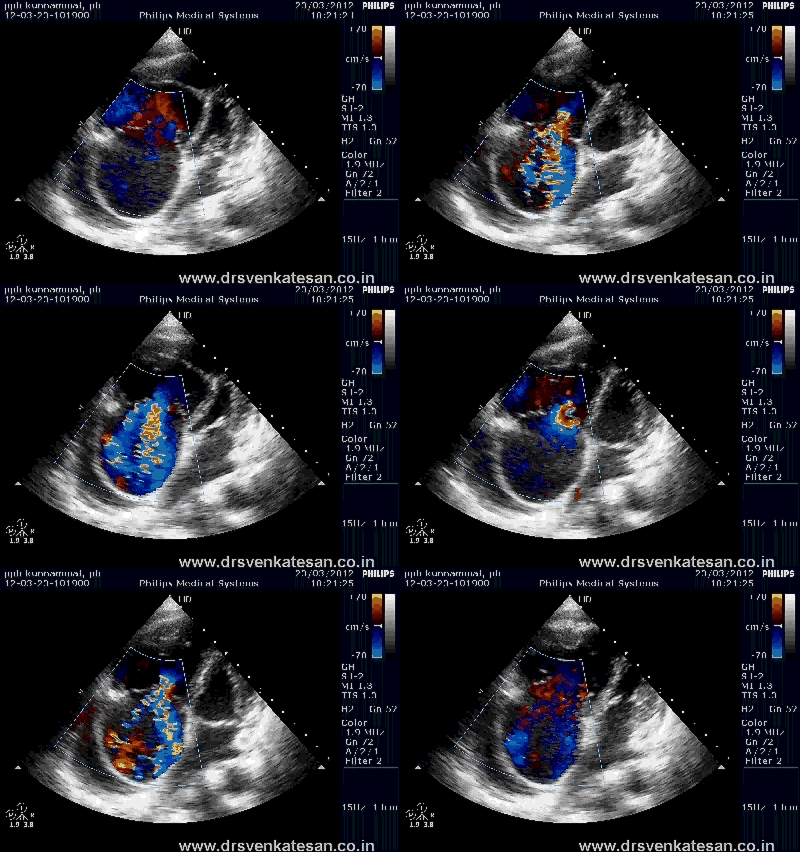
Right atrium and right ventricle are significantly

The tricuspid annulus is dilated .Note the severe TR with twin jet morphology.

Estimating Pulmonary artery pressure

PA systolic pressure  :  TR jet + 10 mmhg

PA diastolic pressure : PR end diastolic jet + 10

PA mean pressure  :  Peak PR gradient

Other complex methods to arrive ar PAP in the absence of TR or PR

The Dabestani -Mahan  ‘s equation*   – The  mean PA pressure = 90 – (0.62 X acceleration time).

It is popular   for  calculating PAP by measuring pulmonary artery Doppler  acceleration  time  .

Many   believe  it is  neither  sensitive  nor practical  in real  clinical setting.

*Even though Dabestani is the first author of this paper   Mahan  got the full credits for the simple reason his name is easily remembered   !

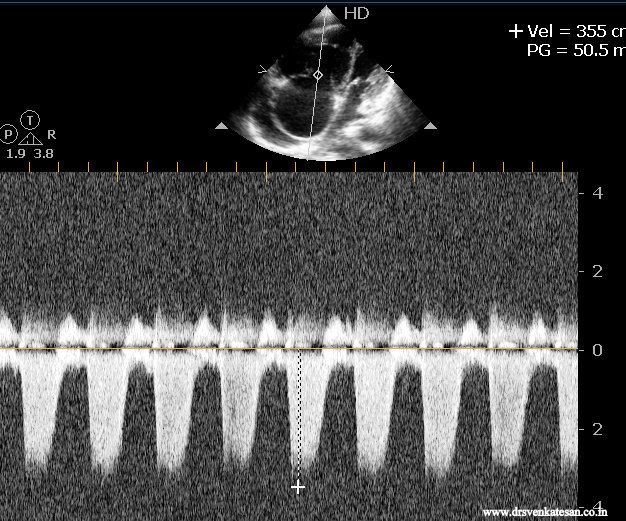
Note the peak TR jet is around 50mmhg and predicted RVSP would be 60mmhg.One would have expected still higher RV pressure but since the RV is dysfunctional the true PAP may be underestimated.

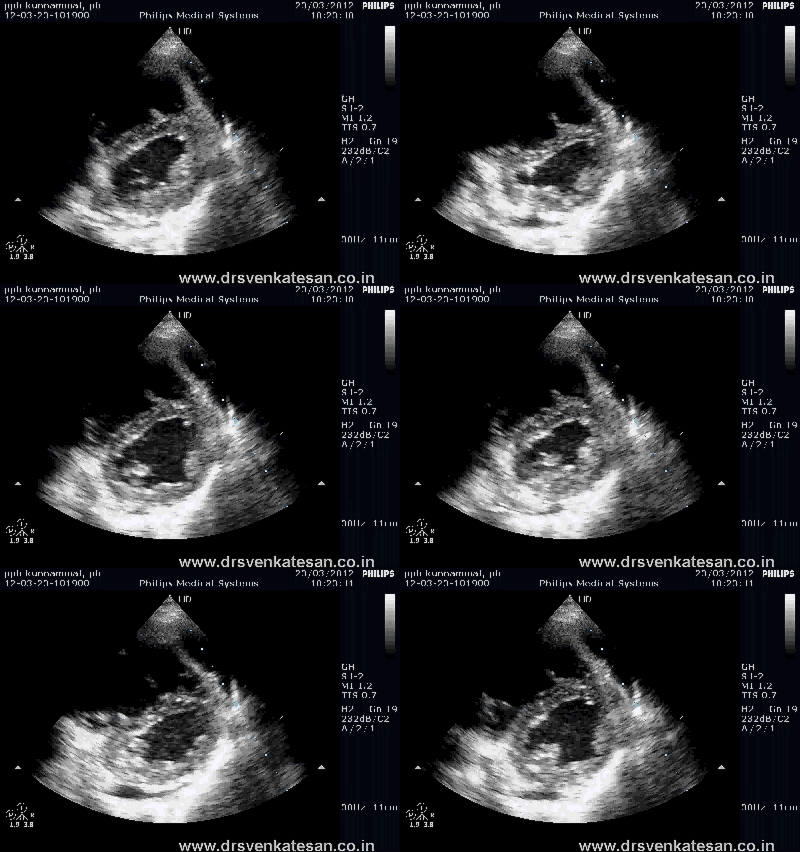
The classical D shaped IVS during systole . D shape indicates RV pressure during systole is almost equal or even higher than LV. ( Please recall D shape occurs in Volume overload also but the timing is in diastole !)

Pulmonary valve  M-Mode

According to Wyeman  the following M mode signs are useful in diagnosing PAH.

  1. Presence or  absence and the amplitude of the “a” wave
  2. magnitude of the e-f slope
  3. presence of mid-systolic closure or notching
  4. fluttering of the posterior pulmonic leaflet

Currently ,  one may consider M-Mode echo to be  an obsolete  ,  but still the foundations help us understand the hemo-dynamics.

The most important principle in  the motion of  pulmonary valve ,   is  the relationship between pulmonary “a” wave and right atrial “a” wave

Normally atrial contraction produce an inward movement* on the closing pulmonary leaflet . This  happens because the MPA  end diastolic  pressure is usually lower than  right atrial a wave    .In severe PAH  the elevated pulmonary diastolic pressure  does not  allow  the atrial contraction to   intend the pulmonary leaflet in pre-systolic atrial contraction .Hence pulmonary valve  a wave in m -mode  is  diminished or even absent .

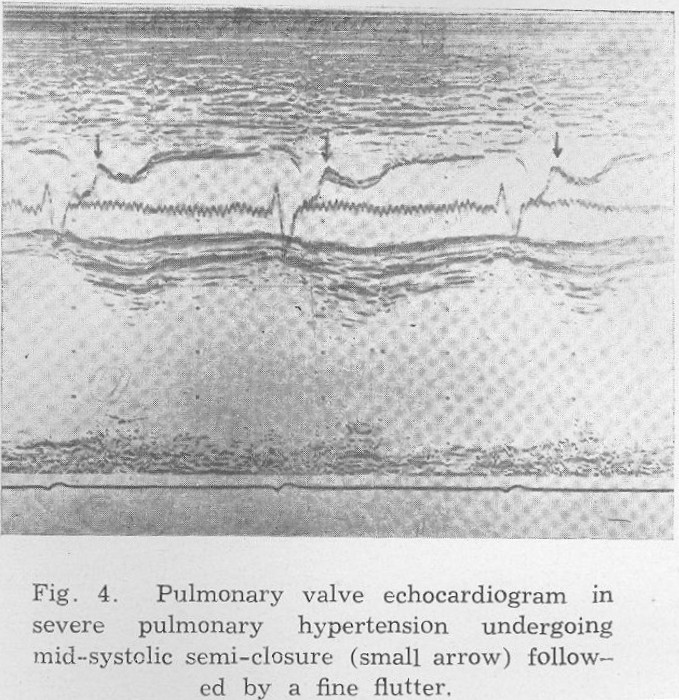
In PAH even   premature closure of pulmonary valve may occur resulting in mid systolic notch   .This  is referred to as flying “W” -Mid systolic notch.   (See below)

* The motion  we see in  short axis M-Mode is that of   left pulmonary cusp that moves  posteriorly.

Image source : Karmarkar SG. Pulmonary valve echocardiography. J Postgrad Med 1979;25:219-23

Absence of a dip is a hemo-dyanmicaly important sign pf PAH  but with one important caveat  .This absence of a dip is valid  only until RV failure occur.In th presence of elevated RVEDP a begin to appear again

Reference

1 Karmarkar SG. Pulmonary valve echocardiography. J Postgrad Med 1979;25:219-23

2.http://circ.ahajournals.org/content/50/5/905.full.pdf

4.Kitabatake A, Inoue M, Asao M, Masuyama T, Tanouchi J, Morita T. et al. Noninvasive evaluation of pulmonary
hypertension by a pulsed Doppler technique. Circulation. 1983; 68(2): 302-9.

5.Stevenson JG. et al, Comparison of several noninvasive methods for estimation of pulmonary artery pressure. J Am
Soc Echocardiogr. 1989; 2: 157-71.

 6.Yock PG, Popp RL. Noninvasive estimation of right ventricular systolic pressure by Doppler ultrasound in patient  with tricuspid  regurgitation. Circulation 1984; 70:657-62.

Read Full Post »

What will be the  pulmonary capillary wedge pressure ( PCWP ) in grade 1 LV diastolic dysfunction ?

  1. Significantly elevated
  2. Marginally elevated
  3. Usually Normal
  4. It depends upon  age, LA size and LV  function.

Answer is 3 . (Of course  it depends on  4 )  Normal PCWP  is  4-12mmhg

Are these patients with grade  1 LV diastolic dysfunction  are at  risk for  acute pulmonary congestion at times of stress ?

Probably not ( in  most )*

                                             The grade 1  LV diastolic dysfunction or defect is the most used (abused ! )  echo terminology .The diagnostic simplicity of this condition namely  a simple documentation of “a”velocity more than “e” , has made it  as an epidemic in echo labs  world wide. After all  , it reflects a simple  fact that  left ventricle  has  summoned   the atria  for assistance   (Which is  all the more  physiological   at times  of stress   !)

When does this physiology becomes pathology ?

As long as  the atria is  doing its job of assisting the LV without any fuss  ,  the mean pressure of LA(PCWP) is maintained  within  normal level . Only if the atrial function is stretched  beyond the limits ,  PCWP begins to raise.  It can happen  in a variety of  ways . Most commonly it happens   elderly hypertensive /Diabetics  especially with LVH .

It can also occur in healthy individuals when they become physically deconditioned. (Left ventricle   goes  for  disuse and find it difficult to relax)

Final  message

Isolated  grade 1 LV diastolic dysfunction in people  > 40 years   generally do  not indicate a serious  abnormality.

Only if they have DM/HT and myocardial  disease they need to be evaluated further.

One practical clue is ,  if LA size is normal one can rule out  significant  diastolic dysfunction.

Caution

* In elderly population ,   when they undergo any major  surgery ,  presence of even grade 1 LV diastolic dysfunction can be a marker for peri -operative LVF and  lung congestion .

Read Full Post »

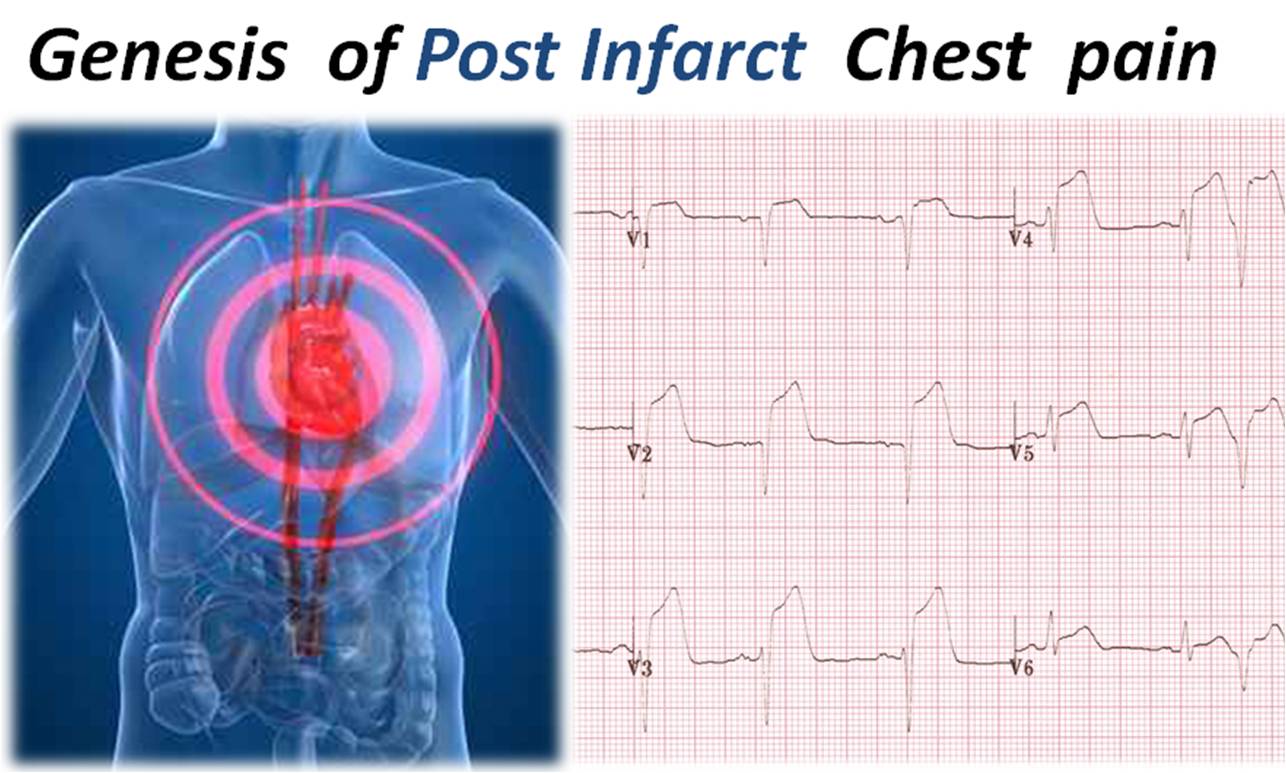
Up to 24 hours

  • Failed thrombolysis and persistent infarct related chest pain
  • Prolonged  Infarct pain  in spite of successful thrombolysis (Rare)
  • Dual STEMI and Dual ACS ( Combination of STEMI/NSTEMI)  *

* Generally  until   after  24 hours one should not make a second coronary syndrome  though  logically  it is possible ( Dual acute coronary syndrome)

After 24 hours -up to 2 weeks

  • Post MI angina  – IRA related (Re-occlusion, Threatened reocclusion)
  • Post MI angina -Non IRA related ( Critical  non -IRA lesion)
  • Thrombus migration /Side branch occlusion
  • Re infarction -Same territory
  • Re-infarction-Remote territory
  • Infarct extension, Infarct expansion , Dyskinetic segments  ( Acute ventricular  remodeling  has a potential to generate pain )
  • Combinations of the above

Caution

24 hour is  arbitrary cut off .There can be spill overs and over laps

*Refractory non ischemic  chest pain often atypical not relieved by anti anginal  medication   – Pericardits, Coronary dissections , myocardial /Pap muscle  tears .

After thought

Do we need to break our brain  to  find  the source of angina  following STEMI ?

Principles of scientific medicine  would demand it  . However   in this era of  hyper active interventional  cardiologists  there is little purpose  as they  tend to  open up all occluded arteries   guided by the  their  ignorance about the source of chest pain.

Reference

Video on Dual  coronary syndrome

Read Full Post »

Click  to down  load a PDF  version

This was presented in the cardiology fellow training course in Chennai – March 2012

(Acknowledgement : Paul wood collection , J.K Perloff , Credit to Images from open source )

Read Full Post »

I stumbled upon this presentation which deals  how to approach to a problem of  congenital heart disease. In a newborn or an infant . It is clearly a master piece .  A life time experience  of a pediatrician  condensed in  130 slides . It is from Kerala .India.

Link to the  presentation

To  quote an  example  from this presentation.

When you want to rule out  urgently a congenial cyanotic heart disease in the bed side *  What will you do ?

What is  hyperoxia test  ?

Axminster 100 % O2 . Measure satutration.If the  PO2 crosses  200 ,  virtually any cyanotic heart disease is ruled out.

If it is less than 150 , it  is very much  likely the baby has  a CHD !

(* Echocardigram may not be available everywhere . Even if it is there it needs a certain expertise to do it  new-born  )

Read Full Post »

« Newer Posts - Older Posts »