Feeds:
Posts
Comments

Archive for the ‘Cardiology – Clinical’ Category

Aortic stenosis is one of the commonest valvular heart disease.Degenerative, calcific aortic valve is the underlying pathology . Many of the degenerative aortic valve is thought to be  a sequel to bicuspid aortic valve .The exact incidence of BCAV  contributing to degenerative aortic  stenosis is difficult to determine as many of these leaflets  lose  it’s  identity  . Rheumatic aortic stenosis continues to be a problem in developing world.Though ,primary aortic stenosis  is the  dominant theme , some amount of aortic regurgitation is commonly observed in all these conditions.

Apart from the severity of aortic stenosis  there are two  other important factors that determine the long term outcome.

  • LV function
  • Associated CAD.
  • Timing of surgery

Left ventricular dysfunction is a common  companion in severe aortic stenosis .Once the LV dysfunction sets in , there is a rapid decline in the clinical outcome.Some  of these patients have very severe LV dysfunction (EF< 30%) .

LV dysfunction  ,  underestimates  the true gradient across LV .  Cardiologists are  often  preoccupied with assessment of  true severity  aortic stenosis  in the presence of LV dysfunction .Sophisticated dobutamine stress echo, is supposed to help us.

Unfortunately cardiology literature has  little to offer  regarding the mechanism of  LV dysfunction in critical aortic stenosis

Some of the possibilities are

  1. Sub endocardial  contractile dysfunction   due to long standing high wall stress.
  2. Diffuse myocardial fibrosis , scarring , apoptosis.
  3. Associated CAD and ischemic cardiomyopathy
  4. Finally it could be a “Pseudo LV dysfucntion”  ie , simple mechanical stunning due to high afterload.This is a distinct possibility as some of  these   patients with  worst   LV function  recover fully following AVR.
  5. Combination of the above mechanisms  can occur

How will you determine  whether , the LV dysfunction of aortic stenosis is reversible or irreversible ?  Is viability an issue in LV dysfunction associated with aortic stenosis ?

Even though it is logical to think  LV dysfunction of CAD and LV dysfunction of aortic stenosis  are similar it  may  not be so ! ( Unless the LV dysfuntion  due to obstructive coronary  disease coexists)

Following rules need to be applied in patients with AS and severe LV dysfunction.

  • Every patient with critical aortic stenosis should undergo CAG.
  • The question of reversible vs irreversible LV dysfunction generally need  not arise.
  • There is no better way to predict the recovery of LV function other than the trial of relieving the obstruction.
  • So ,all patients* irrespective of  any degree of LV dysfunction shall undergo AVR
  • If there is obstructive CAD they need to be taken for AVR with CABG

*AVR  is  probably contraindicated , in  systemically ill &  co morbid patients , with grossly  dilated  ventricles. Here balloon aortic valvotomy  and  possibly PVR(Percutaneous valve replacement)  could be an answer.

Final message .

LV dysfunction of aortic stenosis is a poorly understood phenomenon. Since it is very difficult  to predict whether it’s reversible or irreversible , real world clinical experience  would suggest there is no need to predict it at all !  and every one should have AVR  irrespective of their LV function.

Read Full Post »

It is the  embryological remnant within right atrium  often observed as , mobile strands within RA extending fromIVC orifice to IAS. Some  times  it is difficult  to differentiate from eustachian valve  of IVC.The network is formed by collagenous material  and mimic valvular tissue

chiary network echo

Incidence

2% of general population . ( Means 10 crore persons  in our world ! )

What is considered  a benign echocardiographic observation for long  ,  may not be innocuous  . It  can predispose to certain clinical events , although rare.

  1. Mistaken for right atrial mass
  2. May produce  innocent murmur
  3. Catheter entrapment within RA
  4. Infective endocarditis of the network , and tricuspid valve
  5. Abnormal P waves and trigger for  atrial tachycardia
  6. Disrupted chiary network  prolapsing into RV
  7. Associated  foramen ovale  may induce  streaming  .This maintains  an embryonic right atrial flow pattern into adult life and directing the blood from the inferior vena  cava preferentially toward the interatrial septum

Reference

http://content.onlinejacc.org/cgi/content/abstract/26/1/203

http://ats.ctsnetjournals.org/cgi/content/abstract/76/4/1303

http://content.karger.com/ProdukteDB/produkte.asp?doi=10.1159/000096780

Read Full Post »

The right ventricle  is a unique  chamber of the heart . It is the anterior most chamber and  triangular in shape.  Even though  the walls of RV are  not  clearly demarcated ,   it does  have  anterior ,  posterior, and lateral free surfaces   . Anatomically it has a inflow  body, apex and outflow portions . The apex of right ventricle , blends with the lower IVS at an acute angle.

How does RVH occur anatomically ?

The anatomy of RV is such that  it does not allow  it  a concentric  RVH ( like LVH ) . In fact , there is a  disproportionate free wall , anterior  wall   hypertrophy  many  situations  like  PHT/Pulmonary stenosis. The  infero posterior aspect of RV rarely show hypertrophy.

Since RV is the anterior most chamber, located just beneath the left border of sternum   RVH brings the RV  further closer to chest wall .This makes the V1 lead to show  tall R in V1.

What happens in RVMI ?

Unfortunately, when we  refer to RVMI , we generally do not make any efforts to locate or estimate it’s  size.  Since RV has , anterior , lateral and posterior surface  , the site  and  the  extent of the  mI will have a major impact  on the  ECG  features .

Most often  the RVMI occur as a  part of infero posterior MI  .Hence ,  it is uncommon for the anterior surface of RV to get involved.  But ,  it can be involved if  RCA gives of a   large RV branch  that reach the anterior surface of RV.

Anterior RVMI can occur as a part  of LAD MI  , if a large conal branch cross the RV surface.

What prevents the lead V1 from showing the  ST elevation of RVMI ?

  • Most of the RVMI do not involve the anterior surface of the RV so , less chances for ST elevation
  • Further , if a true posterior wall  MI  occur as a part of  RVMI (Which is often the case !)  V1 can never  show ST elevation  as the  posterior MI  tend to have a ST depressing effect in the V1, V2 leads.
  • Extensive IWMI , can have reciprocal ST depression in V1-V2.This again , prevents V1 lead to show the ST elevation

So many times , even though V1 lead is just sitting over the chamber RV it fails  to  pick  the  ST elevation forces of RVMI

Advantage of V4 R ?

V4R records remote RV forces , as these  signals are not contaminated by the inferio posterior ST forces. Hence  a  1mm ST elevation in right sided chest leads have good sensitivity  and specificity to diagnose RVMI .

When can V1 show ST elevation in RVMI ?

If the RV anterior wall is predominantly involved (Ie Anterior RVMI ) ST elevation can occur in V 1 like a anteroseptal MI.

rvmi ecg

Rarely a q RBB can occur in V1 in isolated RVMI.

Final message

V1 lead , though anatomically proximal to RV has less value in diagnosing RVMI since this lead picks up  Infero posterior  negative ST forces  and  the anterior  forces of RVMI get neutralised . So relying on lead V1 to diagnose RVMI is not adviced , except when  the anterior surface of RV is predominatly  involved.

Read Full Post »

Exercise  stress test ( Also called treadmill test ) is an important investigation  not only in patients  with suspected  CAD  but also in  established CAD . In the former  group ,  it helps us to exclude CAD in patients with chest  pain and in the later group ,  it helps us to assess  functional capacity , risk stratification and to detect any  additional ( New or residual ) ischemia.

Stress test being a physiological test , has a huge  advantage of assessing the adequacy of myocardial blood flow without even  knowing the coronary anatomy , while Coronary angiogram (CAG)   has a zero physiological value* in spite of   excellent assessment of the coronary anatomy !

It is an irony , in the assessment of angina we are expected to assess the physiological adequacy of myocardial blood flow ,  we have kept coronary angiogram as a gold standard  over and above the much  neglected  physiological stress test.

Of course, the limitation of stress test is that ,  it has only 75%  specificity(  to rule out CAD ) and about 80% sensitivity (To detect CAD ) .In simple terms  stress test is likely to miss  20% times to miss a CAD  in patients with CAD  and 25% of times falsely diagnose CAD  in patients without CAD.

In the above statistics  ,  coronary angiogram was considered   gold standard . The problem with this data is that , CAG is not the real gold standard ,but it was  nominated  as a gold standard . We now know normal coronary angiogram is not equivalent  to  normal coronary arteries and vice versa.

While both test have limitations , it is logical to believe CAG has an edge over stress test since it visualises the anatomy. But ,  once an obstruction is demonstrated by CAG, stress test scores over in assessing the physiological impact of the lesion.

Is a 70% LAD lesion significant or not ?

Stress test will give vital information to answer this question.If this patient performs 10-12Met exercise without symptoms it means , the obstruction is not impeding the flow even during stress. He may do well with medical therapy.

What does a positive stress *mean for the patient and for the physician ?

(* A false positive EST in LVH, anemia, baseline ST shifts are included in discussion )
  • A positive stress test  with or without angina at low workload <5 METS  indicates very significant obstructive CAD either in left main , or proximal LAD/LCX. They should get immediate CAG.
  • A positive stress test at load  5-10METS  is again significant and patients should get early CAG
  • A positive stress test with angina at good work load >10-12 mets  would indicate insignificant or minimally obstructive  CAD.
  • A positive stress test at  the peak of exercise  at good work load > 10-12METS without angina could indicate a false positive or very minimal CAD.

For the physician , the proper way  of interpretation  should be , the fact that a person performs 10-12  METS  indicate the myoacardial blood flow  would  be  more than adequate in most life situations. Knowing the coronary anatomy serves no purpose here, as no revascularisation will be attempted even if he is going to have a significant CAD ( Which again , is also highly unlikely ) .He should be managed with appropriate lifestyle (Diet, activity, relaxation )  anti anginal drugs,  aspirin , good lipid control and plaque stabilisation with statins .

Can a  patient with critical left main  or proximal LAD  perform >10METS in exercise stress test ?

No , large clinical experience (Also refered to Class C evidence  by ACC/AHA!) indicate no patient with critical  left main or equivalent disease  can perform 10 METS  excercise

While  ,  EST may be less hyped investigation, but it is the  only  noninvasive test , ( that too , simple and  cheap ) that can rule out * a significant left main  or equivalent almost   100%  correctly .

Now that,   the results of COURAGE  and BARI 2D have clearly indicated medical therapy is best form of management  in chronic  CAD , ( except in severe obstructive CAD in vital locations)  a  positive EST  at > 10-12Mets  , has absolutely no indication* to for doing a CAG.

*Some would advocate a policy of  doing a  CAG as a baseline investigation in all patients with positive EST  to know the coronary anatomy and will not proceed onto revascularisation if there is insignificant lesions.

Further ,  real life experience has taught us , routine  CAG in these patients

  1. Increases patient anxiety as he is given a report with a diagram of obstructed heart vessels
  2. Leads to multiple cardiac consultations
  3. Divergence of opinions
  4. Finally end up in  the likely hood of a inappropriate  revascularisation for a  insignificant distal CAD.

Final message

Every patient,  who has positive stress test  , ( Please note , it could  even be  true positive  )  need not undergo CAG .  Most  interventional cardiologists could  feel  otherwise , but one should also  remember ,  There is one  more role  for the interventional cardiologist ie  , to intervene when inappropriate interventions are done to their patients.

//

Read Full Post »

When  a doctor is confronted by serious  doubt  ,  what will be the outcome for the patient  ?

Can  doubting  be beneficial for a patient ?  . It seems so ,  according to  EBM which  stresses   about statistical outcome at every turn of events in a  patient who  is critically  ill .

Is  something ,  always  better than  nothing   ?   Our  limbic  system tends to think so .  It  may not be true. But  in  dire situations ,   many  things  (Proven , unproven)  need to  be tried  however doubtful it ‘s  efficacy  may be  .This is  akin to an  emergency in an  airplane. Even here there need to be a logic.

Then ,this question  arises . How do we make  sure ,  we have a  dire situation on hand  ?

This is the key issue ,  in  the  decision making  for the   critically ill patients .  It  needs  experience ,  only experience !  Though the principle of uncertainty  is the fundamental rule in medicine ,   EBM  aims to bring some degree of certainty in medical therapeutics.

ebm evidence pci coronary

Benefits of doubting in coronary care unit.

In  a  sinking patient  with cardiogenic  shock  , try  the maximum treatment . Even if , the patient is  in severe shock  , take him to the  cath lab ,  try  open the coronary artery . Give the benefit of doubt  to him even though the chances of reviving him is less than 10%.

Risk of doubting in Coronary care unit.

A.Elderly STEMI  with SHT,(Arriving late ,  with  an unknown time  window  after an MI ) To thrombolyse or not ?  . There is  no benefit of doubt here.  Do not thrombolyse. Here , apply  the benefit of doubt against thrombolysis .

B. Chest pain with  LBBB (Thought to be new onset LBBB ) don’t ever rush to thrombolyse.  Wait for the enzyme result . Don’t try to thrombolyse your doubt , instead  thrombolyse the  confirmed thrombus !

C. Patient with persistent ST elevation following thrombolysis ,in an  otherwise asymptomatic and stable patient. Don’t  pass on  ” your doubt ” of salvaging   at least  some myocardium  by rescue PCI .Rescue  should be done before death. You can not resuscitate  dead myocytes.

Final message

The concept of   giving  the  benefits of doubt  to the patient   is a widely prevalent practice  in medicine .This concept is alive  and popular , not because it has proved effective, but because of the primitive   human perception and cognition  , namely “Something is better than nothing ” !

Common sense and logic would suggest , whenever  there is  a benefit  for doubting there would be a  equal (  or  even  more ) unmeasured  hazards and risks . This  becomes  especially  true ,  when   a   physician makes  a therapeutic move  based on doubting than on conviction .

Read Full Post »

Thrombolytic therapy ,  has been  the specific treatment  for STEMI for  many decades. Primary PCI*  is  shown to be  superior  than  thrombolysis  if   performed   early  by an experienced  team in a dedicated facility. (*Conditions apply). It is estimated ,   currently only a  a fraction  STEMI  population get primary PCI (<5%) in ideal conditions . Another fraction , get  primary PCI by inexperienced cardiologists  in low volume centres.

So , thrombolysis   remains, and  would continue to remain ,   the    primary  mode of therapy for STEMI  in the  present and near  future !

How do you assess the successful  thrombolysis ?

It should be recognised ,  there is a fundametal flaw in this  question !

The aim of thrombolytic therapy is  not  to   lyse  the thrombus  , but also  to restore the coronary blood flow to the  myocardium – also called reperfusion . One may wonder , why the term ,  thrombolysis  should ‘t be  used interchangeably with reperfusion. 

A successful thrombolysis  never guarantees  a good reperfusion , for the simple reason ,  distal blood flow in an  obstructed coronary artery  is dependent on ,  many factors  other than relief of obstruction.

Apart from the potency of drug,     other   important factors  that determine  successful  lysis &  reperfusion are  . . .

  • Timing of opening of artery , if the thrombolysis is delayed  ,  the distal myocardium is dead , and   it won’t allow blood flow to enter the mycardium.
  • Microvascular integrity is as vital as epicardial vessels.
  • Distal microvascualture  plugging by the thrombotic debri . This is called”no reflow “

So , we should  primarily assess myocardial reperfusion rather than epicardial thrombolyis ! following thrombolysis .

What are the parameters available to assess successful reperfusion /thrombolyis?

  1. Clinical : Relief from chest  pain. Angina relief  , though subjective is an indication for adequate reperfusion of ischemic myocardium.
  2. ECG-ST segment regression > 50%
  3. Cardiac enzymes: Early flushing of  intra myocytic CPK into systemic circulation and hence early peaking of CPK MB (<1ohours instead of 24h)
  4. Reperfusion arrhythmias(AIVR-Less specific) .Primary VF is now thought to be reperfusion related.
  5. Infract related artery(IRA) patency by coronary angiogram
  6. Distal TIMI flow/ myocardial blush score/ TIMI frame count

ECG ST regression ,  is a direct indicator  myocardial reperfusion   as the ST segment shifts  towards baseline ,  implies  of infarct current of injury . ST regression almost always correlate with good  recovery of LV function  in STEMI .

IRA patency , is an epicardial index , it  does not give information about myocardial blood flow . But ,  a good  distal TIMI flow generally indicates good reperfusion.This  again ,  is  not a fool proof  index,  as even many of the TIMI 3 flow patients  have severely damaged myocardium by echocardiography .

Final message

For the above reasons, one should always  make a distinction between successful lysis and successful reperfusion . Surprisingly ,  ECG  is  the gold standard for assessing successful reperfusion of myocardium ,  while CAG tell us  about epicardial patency and possibly reperfusion also.

Read Full Post »

Apart from  acute  coronary syndrome,    cardiac  failure is   the most common clinical  presentation of  CAD. Cardiac failure ,  classically present with dyspnea on rest or on exertion , while angina is the dominant presentation in ACS.  

What if  ,  both these  occur together in an acute fashion ?

Yesif it occurs  together it is called ischemic cardiac failure . Fortunately , this is quiet uncommon . It has   an adverse outcome,  especially if it occurs  as a companion of NSTEMI . Let us see how . . .(  Most of the episodes of cardiac failure  in CAD  means only  LV failure )

For cardiac failure to occur , there need to be a mechanical contractile dysfunction or defect . In CAD population , this can  occur in  one of the following way.

  • Loss of LV muscle (Acute  Myocardial infarction as in STEMI)
  • Mechanical defects (Mitral regurgitation/VSR etc)
  • An arrhythmia (Commonly VT or AF / CHB )  can precipitate  cardiac failure

Apart from these three , there is  an important mechanism of acute LVF, namely ischemic stunning of major part of LV resulting in severe mechanical dysfucntion.This is a dangerous form of cardiac failure (Pathologivcclaly it is thought to represent  contraction  band necrosis !) this occurs in global ischemic situations manifested as gross global ST depression.

So,  there are two types of  ischemic LVF  .  STEMI   occuring due to infarct( ± ischemia ) Other  one (NSTEMI)entirely due to ischemia.

Logically ,  one  may n’t   refer  STEMI related LVF as  ischemic LVF at all  , as infarct has already occured. While , NSTEMI related LV could be the ” True ischemic LVF “


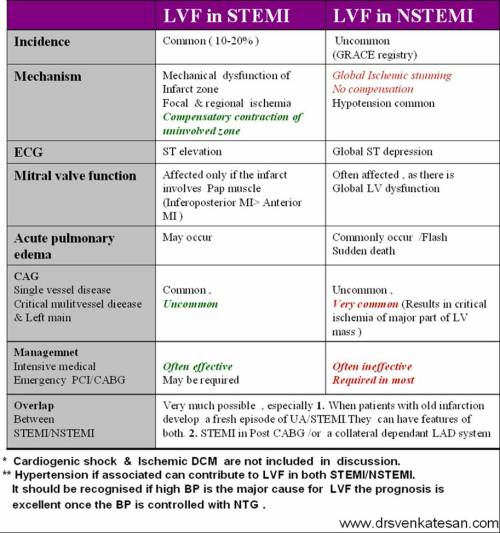
What are the differences between cardiac failure that occur in  STEMI and NSTEMI ?


lvf in nstemi stemi

Is post infarct failure  ( The commonly used terminology  , now out of vogue ! )  a type of ischemic LVF ?

In the strict sense , it is not . Here the dead myocardium , is responsible  for the   failure .To label a  LVF , as  ischemic , ongoing ischemia must  be  documented and further it  should  be shown to  contribute   for the  mechanical dysfunction .

This is of vital importance ,   if you wrongly attribute ischemia  as a cause for  the LVF , the patient may be taken up for emergency  revascularisation .It is not going to help much (Infact , it may  worsen !) as  this cardiac failure is not going to be corrected  .What we require ,  here is an  aggressive medical management  protocol .


Read Full Post »

Acute coronary syndrome is the commonest cardiac emergency. STEMI and NSTEMI are the two clinical limbs of ACS. Generally they have distinct clinical, ECG, angiographic features.(Ofcourse, with some degree of overlap) . It is  a  mystery , both clinical presentations differ so much inspite of the common denominator  , namely ,  an injured plaque with add on thrombus  within the coronary artery. The primary difference between these two entities is, in  STEMI the occlusion occurs sudden and complete and in NSTEMI it occurs slow and incomplete

Cardiac arrhythmias in ACS

It is a  much published factoid  for  many decades, that  only one third of STEMI patients  reach the hospital alive ! The reason being , STEMI  is very much prone for primary VF.  Contrary  to this ,  most pateints with NSTEMI reach the hospital alive ! How ?

Both are ACS, if ischemia is a powerful trigger for dangerous ventricular  arrhythmia’s , NSTEMI should also behave  similarly .So what protects against arrhythmias in NSTEMI ?

  • We realise ,  by observational experience (Not EBM !)  It is the suddenness and totality of ischemia that trigger dangerous form of arrhythmia  .
  • Further, a balanced  ischemia in two contralateral segments (or global  ischemia) some how protects against development of ventricular  fibrillation .This may be due to preservation  of  electrical homogeneity  , and the spherical VT spiral waves are not sustainable.
  • In contrast , STEMI has a sudden  focal , ischemic  zone that initiates the VT and    ischemia free  contralateral segment  welcoming  and sustaining the  reentrant wavelet.
  • The observation of primarily single vessel disese in STEMI and multivessel disease in NSTEMI also give credence to this concept.
  • Further , ischemic preconditioning can exert an important anti arrhythmic  effect in NSTEMI as  patients with unstable angina have   slow, repetitive episodes of ischemia prior to the index event .
  • Post MI scar mediated VT/VF is independent of degree of overall ischemia
  • It is also established ,  a sub group of  STEMI pateints  who  had  preinfarction angina(  ie . a brief  period of UA/NSTEMI) have very low risk of SCD  supporting the concept of sensitising the myocardium against ventricular arrhythmias.

Final message

Even though , there is a convincing concept  of  Ischemia induced  cardiac arrhythmia in literature ,in real patients it is very difficult to link the two in many situations..UA/NSTEMI is the most common  acute ischemic event but the incidence of VT/VF here,  is far less than one would expect.In ACS , focal , total  ischemia is more likely to precipitate a VT/VF than multifocal and global ischemia.

Read Full Post »

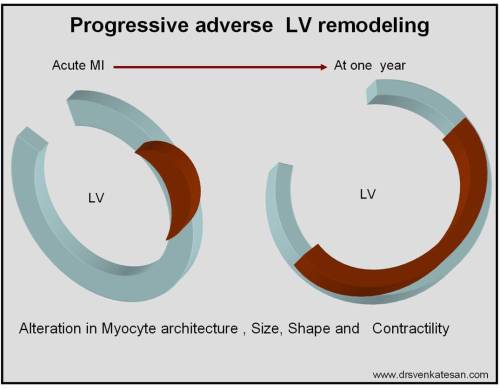
Ventricular remodeling  follows large myocardial infarction .This term denotes to  change in size , shape  and function  of the ventricle   due to altered  myocyte geometry .It is now believed  , this  process begins to occur very early  following a STEMI.(less than 24hours)

lv-remodeling

In which MI remodeling is more common ?

Any MI of large size , especially  anterior  and lateral MI.  Inferior and posterior MI are less affected by adverse remodeling.The incidence is up to 20% of all myocardial infarction ,  if left untreated. Ventricular aneurysm formation and dyskinetic segments can be termed as the worst form of remodeling. The old terminologies of infarct extension and expansion could by synonymous with ventrilar   remodeling .(Note : Every patient with STEMI undergoes some form of physiological remodeling that should not be confused with progressive pathological remodeling , we are discussing  here ! )

What is the clinical impact of remodeling ? How to prevent it ?

Progressive cardiac failure and a  poor outcome .  It may provoke ventricular arrhythmias. ACE inhibitors (CONSENSUS study 1992 )  has since revolutionized  the pharmacological  prevention of adverse remodeling.

How to recognise left ventricular remodeling ?

Many methods are available .

  • 2 D Echocardiography
  • Tissue doppler
  • LV angiogram
  • MRI

These imaging methods diagnose remodeling  only after it manifest* .We know remodeling is a cellular and molecular process .The earliest trigger for remodeling is the mechanical stretch and wall stress on the ventricles.Large areas of necrosed myocardium and  the adjacent normal myocardium sets a perfect stage for eccentric pulling of myocardial segments and unregulated slippage of myocytes.

* Diagnosing fully established  ventricular remodeling  serves ,  no great   purpose as it is very difficult to reverse it by pharmacological methods.it requires complex surgery.

What is the effect of mechanical stretch on cellular function ?

It is well known  myocyte granules secrete Type B  -Naturetic peptide  in response to stretch. It could be a very early sign of adverse remodeling. So monitoring of  BNP may give us an opportunity to intensively treat those patients who are likely to land in progressive cardiac failure.

A baseline level of NT-proBNP >120 pmol/L identified patients  prone for adverse remodeling .Serial measurements showed further increase. It is possible to identify adverse remodeling of LV by documenting fresh elevation of BNP following MI .

Reference :

1 )Nilsson JC, Groenning BA, Nielsen G, et al. Left ventricular remodeling in the first year after acute myocardial infarction and the predictive value of N-terminal pro brain natriuretic peptide. Am Heart J 2002;143:696-702.

2)http://content.nejm.org/cgi/content/full/352/7/666#R24

Read Full Post »

The importance of venous system

Cardiovascular system  consists  not only of  heart  but also   the blood delivery and retrieval   system namely  the arterial and venous circulation .As  the heart pumps , 6  liters   of blood  every minute  , it  has to   traverse the  entire venous circulation promptly ,  to  complete  the hemodynamic circuit.
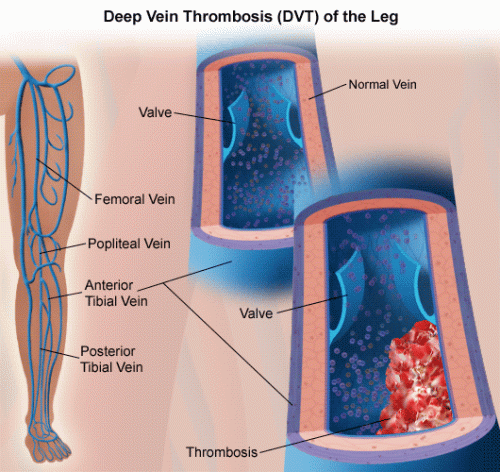
ei_2401

Source : From web. Thanks to whoever created this Image

While  physicians are preoccupied with disease  of heart there is an important  groups of disorder of venous system .The  deep vein thrombosis  (Also called venous thrombo embolism . VTE ) is the  most important  entity .This disorder even though is a cardiovascular  disease  ,  it   rarely presents to a cardiologist .

As  we tended  to ignore the  veins   for decades  now, “sudden venous deaths ” other wise called massive pulmonary embolism  is calling for our attention

What are the deep veins ?

Popleteal , femoral , iliac (External , Internal , common ) . Upper limb axillary and subclavian veins.

Clinical classification of DVT  :  Femoro popleteal  , Pelvic  ( Ilio femoral) , Mesentric DVT.

What are the high risk population for development  DVT ?

  • Genetic predisposition  constitute  the  strongest risk(Factor V lieden mutation )
  • Major orthopedic surgery
  • Pregnancy /Oral contraception
  • Disseminated  malignancy

And now  ,  the more fashionable risk factor “DVT after long distance flights”

What is key diagnostic issues in DVT ?

Key to diagnosis is clinical alertness .Local swelling  , edema legs and inflammation should alert the physician.

  • Homan’s sign(Pain on  dorsiflextion of  ankle) .
  • Louvel’s sign (Leg pain on coughing ),
  • Lowerberg’s sign  (BP cuff induced pain on affected leg at low level inflation  )

( Well’s score  is based on pre test propabilityLancet 1997 )

Many times DVT is diagnosed only after it embolises into lung.So remember shortness of breath and acute dyspnea  could be the first manifestation of DVT.

Once diagnosed  DVT  it should be  risk stratified either as low risk or high risk .

Biochemical diagnosis of DVT : DVT is a form of intra vascular coagulation and it activates fibrinolysis.D Dimer estimation has strong negative predictive value .If D dimer is negative it excludes DVT by 99% .Positive D dimer does not confirm it .

Is  it  necessary  t0 image  the venous clots ?

No . It is rarely required.  Instead we need to know the site of occlusion .Doppler and ultrasound scan can help locate the site of obstruction .

Other modalities *  may help evaluate the thrombus

Venous angiography (Filling defect, collateral )

MR angiogram

Fibrinogen tagged nuclear scan

Management

  • Acute management
  • Long term management .

Acute management

Immediate Heparin ,  bolus followed by infusion ( 5000U, 1000U/h) followed by oral anticoagulation forms the corner stone of  management of DVT .

Once a DVT is documented should we attempt  to  improve the venous circulation or try to slow down  the venous circulation ?

There is a paradox here.The therapeutic strategy is to improve the venous circulation . A sluggish venous circulation predisposes fresh thrombus. So even though ,  it is  logical to expect some  migration of  thrombus  proximally  with the standard  therapeutic methods of DVT  ,  it is the ultimate principle of management of DVT.

How heparin infusion achieves  it’s  therapeutic goal  of clearing  thrombus burden in the venous circulation is not clear .It is believed sub clinical PE  occurs in every case with large DVT and these thrombi get   microlysed either  within focus of  DVT or in transit circulation  or within the pulmonary vascular  bed.

What is effect of intensive anti coagulation on DVT ?

  • Lyses the thrombus
  • Dissolves the thrombus
  • Dislodges thrombus
  • It can prevent only fresh thrombus

Answer : All of the above can occur

Can we track the movement of deep vein thrombus ?

It is not an easy thing to track the movement. Doppler will give an idea. Invasive investigation to track the thrombus is neither practical nor necessary.

What is aggressive management * for DVT ?

* Aggression is rarely required in DVT management.

Interventional

  • Thrombolysis : Systemic/local catheter based
  • Venous angioplasty/Stenting
  • IVC filters

Surgical

Indication for thrombolytic therapy

Surprisingly,   thrombolytic therapy has limited role in the  management of  DVT. There  is absolutely no role for routine thrombolysis in DVT (Heparin does the same job , more consistently with less risk )

It is used only when there is limb threatening or lung threatening situation .

Pulmonary embolism already occured

Massive iliofemoral thrombosis .

When will you call a vascular  surgeon ?

Thromboembolectomy as a treatment for DVT is rarely advocated .

The 2004 American College of Chest Physicians consensus statement on the treatment of thromboembolic disease recommended against the routine use of venous thrombectomy in acute DVT except in cases of phlegmasia cerulea dolens . ( Severe necrotising venous edema )

The issues against surgery are

  • Generally these patients are more sick and co morbid conditions
  • Complex nature of surgery in deep iliac veins
  • Blood loss  from deep friable veins
  • The surgery further traumatizes the vein, recurrence  of DVT is  very much possible
  • Primary cause is not addressed by surgery

What are the indications for IVC filter ? What  are the types of filter available ?

The indication for IVC filter in the acute management of DVT * has been ( Rather continues to be  . . .) controversial .The major reason for the controversy is the risk  ( The wasted effort  too !)   to benefit ratio and  is not clear.
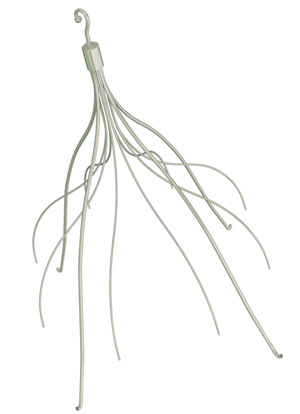
gunther-tulip-ivc-filter

There are three types of IVC filter available

  1. Temporary venous filters
  2. Temporary retrieval IV filters ( Gunther tulip ) Nitinol recovery filter Bard
  3. Permanent IVC filters

*In long term prevention of PE the indications are fairly established.

Differential diagnosis

Is there an entity  called  superficial venous Thrombosis (SVT)

Superficial venous thrombosis and thrombophlebitis are more common than DVT and should not be confused with DVT. ( Easier said, some confusion is bound to occur !especially ,  when it occurs  over  thighs ) .This is common  following IV line  and  varicose veins in lower limb Present with pain, tenderness, or an indurated cord along a palpable  superficial vein  with erythema. It is less likely to propagate into pulmonary circulation.

How often a superficial venous thrombosis convert into deep vein thrombosis ?

Patients with superficial phlebitis above the knee have an increased risk of deep venous thrombosis and should probably have ultrasonography.They may require  warm compression , NSAIDS and  local thrombectomy.

What is the post-thrombotic syndrome? How to differentiate it from recurrent  DVT ?

Post-thrombotic syndrome is  due to the damage  to the  valves in the veins  that leads to chronic venous edema of extremities. It may mimic like an DVT . usually occur within 2 years of DVT.

Unanswered questions

1. What will happen to  the thrombus following filter insertion ?

Large thrombus gets trapped in IVC .The problem gets shifted form the legs to the vena cava .This makes it mandatory  for these  IVC  clots  to be cleared either manually or  pharmacologically. Small thrombus and embolic showers continue to cross the filter without  difficulty.

2. IVC filters are recommended in DVT , if a patient has an absolute contraindication to heparin but , is it not a fact ,  filters also demand  anticoagualtion ?

It is true , filters demand anticoagulation. So ,  oral anticoagualtion should be given whenever possible in all  even after IVC filter. This is  , not only to make sure filter does not get clogged but also prevent further  clot formation in the legs and also   distal to the filter in   (Procoagualnt )  individuals .Further , anticoagulation forms the mainstay treatment in patients with chronic thromboembolic PAH ,  which the filter does not address to.

3. Is there safe venous clots that the pulmonary circulation can effectively tackle ?

Typically PE occurs  as

  • Massive acute PE
  • Sub acute PE
  • Chronic pulmonary thrombo embolism (Showers of microemboli lead to PAH )

Consider the following pulmonary  vascular anatomy : MPA 2.5cm ,  RPA,  LPA 1cm segmental pulmonary artery 5 mm ,  pulmonary arteriole 3  mm ,  pulmonary capillaries 200 microns . The  deep venous thrombus typically has  a diameter of  up to 1-1.5 cm . It needs a at least  2. 5 cm   diameter  clot to occlude the main pulmonary artery.Micro thrombus may get cleared by pulmonary vascular bed.There can be safe venous clots.

Final message

  • DVT and PE are the common venous emergencies.
  • Prevention of PE is the major aim of acute managment.
  • Identifying the underlying cause and prevention of DVT per se is the long term aim.
  • Aggressive local approach is largely  unnecessary except in leg / lung  /life  saving situations

Intensive Heparin protocol  followed by long term oral anticoagualnats (1 year or more)  is  an excellent approach in most patients.
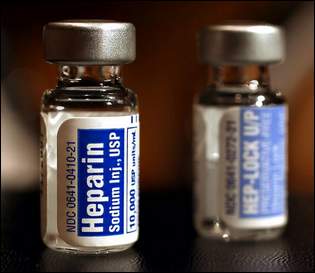
heparin

The most important point to remember is the treatment for high risk DVT and suspected  or established PE is exactly same

*Only 10% of PE  are candidates for thrombolytic or surgical  therapy so at times of real dilemma , there is nothing wrong in administering  heparin in all patients with suspected  high risk  DVT/PE  even without confirmation.

All those hi fi stuff of V/Q scan , pulmonary angiography may be a misadventure .Remember empirical (Some call it as unscientiifc ! )  therapy  too , can save many lifes

Further reading

Best Link for  IVC filters   http://www.tigc.org/eguidelines/VenaCava.htm

References

  1. Decousus H, Leizorovicz A, Parent F, et al. A clinical trial of vena caval filters in the prevention of pulmonary embolism in patients with proximal deep-vein thrombosis. N Engl J Med 1998;338:409-415.

What is new in catheter thrombolysis in DVT ?
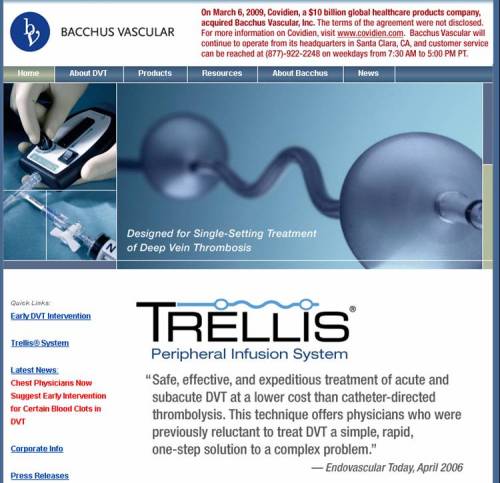
dvt thrombolysis

http://www.bacchus-vascular.com

A interventional catheter based clot lysis for  DVT

For the comprehensive  ACCP 2008 guidelines of managing DVT  reach the following site
Read Full Post »

« Newer Posts - Older Posts »