Feeds:
Posts
Comments

Archive for the ‘cardiology- coronary care’ Category

We owe a lot to our past genius minds for our current understanding of  cardiology.Youngsters   should  know how the filed of cardiology  evolved .Few  great  brains  taught us how to think   hemodynamically  in the setting of  STEMI.

The Diamond and Forrester classification is  an  undisputed achievement of  modern cardiac  hemodynamics.They gently converted the  clinical classification of  Killip into more scientific  hemodynamic  one .Both these classification continue to fascinate  us even in the era of instant PCI for STEMI .

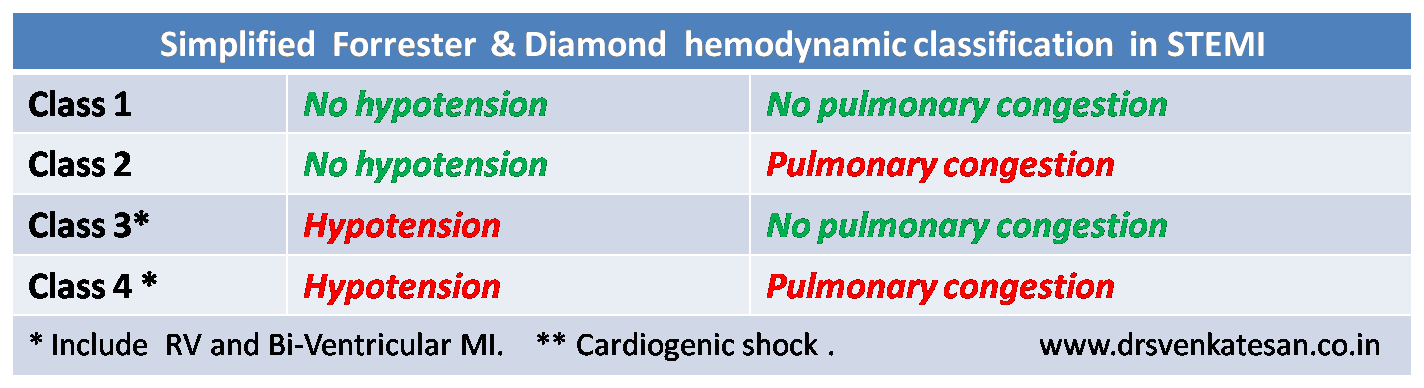
And youngsters  should read this again and again and critically evaluate their patients  within this system.The two key parameters he used was PCWP of  18mmhg /And cardiac Index 2.2liters . He also suggested a simplified version where  intra- arterial monitoring is not feasible.  The   cardiac Index could be replaced by systemic blood pressure  lung congestion   represents PCWP >18mmhg .

The DF classification would become

An important inference from DF classification !

The class 3  of   DF   grading  has no pulmonary congestion  but persistent hypotension . What does it mean ?

It is a stunning proof of a great concept.  As the patient moves (Worsens)  from  DF  two  to   DF three  , the lung congestion tends  to regress . This sub-set  actually  means   development of  bi-ventricular failure or isolated RV failure  . This is an ominous sign and indicate a bad prognosis . ( One may call it a paradox  , according to conventional thinking   “The more the lung crackles  , dismal  is the outcome”   DF  grading clearly proves this is  not  always true ,  as long as  the systemic pressure is maintained  crackles can be managed effectively  . In  DF 3  the right ventricle  as a pump is  becoming so weak it is not able to congest the lungs  at the same  process leads to  systemic hypotension.

James Forrester

http://www.cedars-sinai.edu/Bios—Physician/A-G/James-Forrester-MD.aspx

Forrester is also a pioneer in how we evaluate chest pain in the emergency rooms and cardiology OPDs .  His thoughts on utilization of Besean theorem revolutionized   the interpretation of exercise stress testing.

* Killip is a genius of different caliber would be discussed later .

Reference

Forrester, J, Diamond, G, Chatterjie, K, et al Medical therapy of acute myocardial infarction by application of hemodynamic subsets (first of two parts). N Engl J Med 1976;295,1356-1362


Read Full Post »

The entity of stress cardiomyopathy ,  other wise referred to as  Takotsubo  cardiomyopathy is a popular clinical entity in recent decades.The heart and mind are closely linked entities even though they are  situated apart physically . Extensive neural and hormonal control  mechanisms  exist.

In extreme stress ,the hyper- sympathetic  drive triggers a rush of adrenaline ,  which some how makes the  left ventricle  to bulge out !

The clinical features  are varied .

  • It can exactly mimic an acute coronary syndrome .
  • ECG may  show ST elevation and mimic an anterior STEMI
  • Echo shows a wall motion abnormality  classically  described  as the apex alone dilates /Bulges or elongates
  • LV  may acquire a shape of a  banana. (See below )

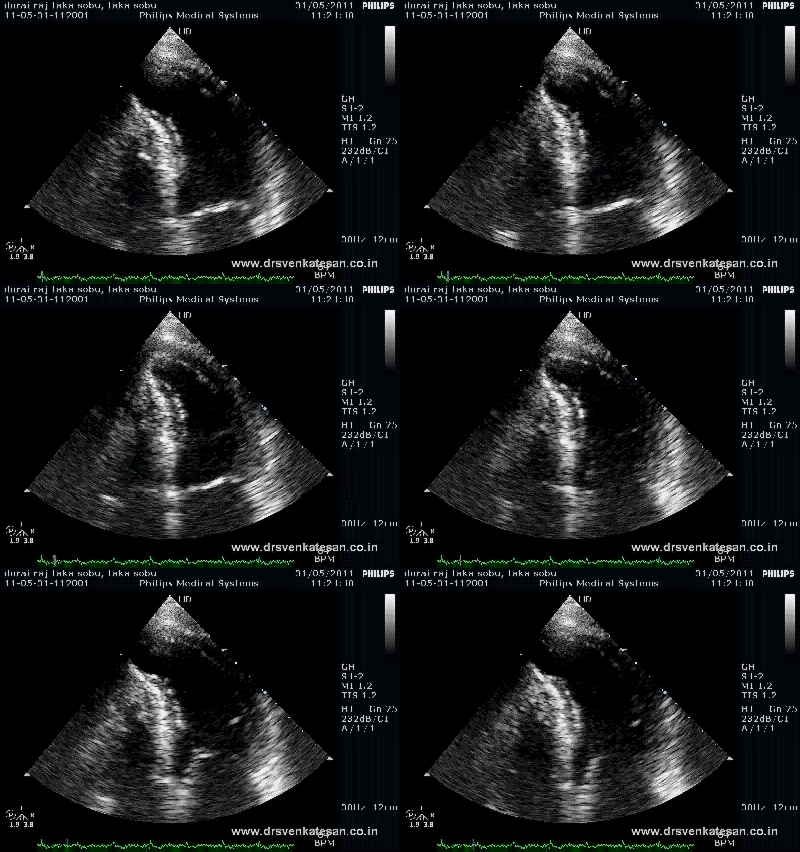
A 45 year old man came to the ER with severe chest pain , dyspnea and minimal ST elevation in anterior leads. He  was a smoker and was experiencing  recent major office stress  . Echo showed an elongated LV apex with some thinning .We made a diagnosis of stress cardiomyopathy .( It was disputed by my professor as the LV  apex was contracting well   ! but we  learnt later there are many varieties of Takatsubo )

Echo showed an elongated LV apex with some thinning . Note the LV apex goes  out of plane  with RV apex.

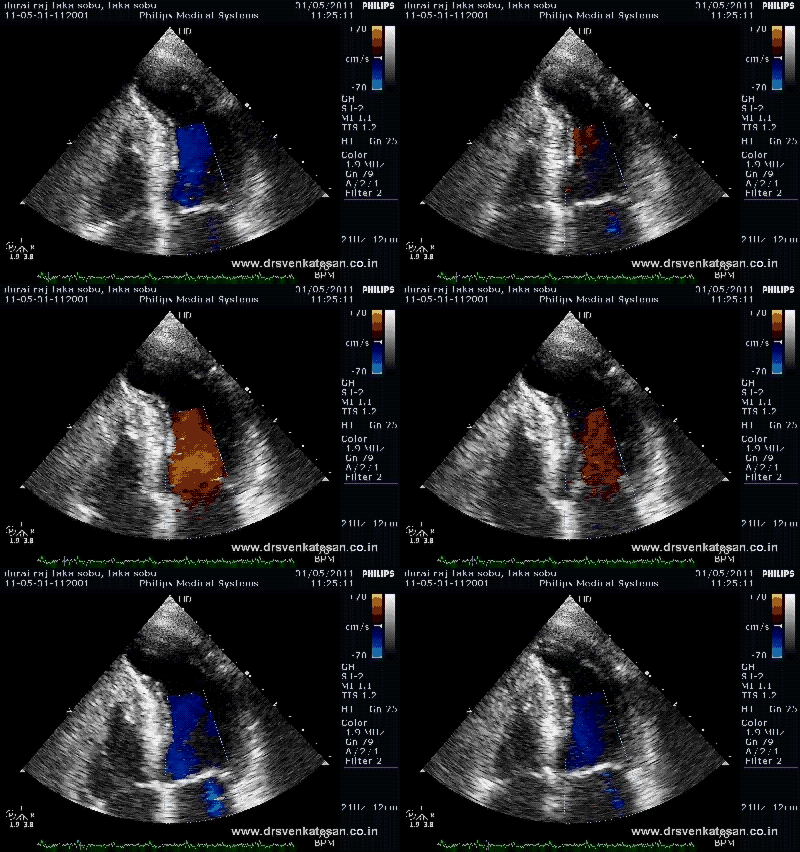
Color  Doppler revealed Trivial Mitral regurgitation

Follow up

He underwent coronary angiogram.  Had  no significant lesions ,   in 48 hours time the wall motion defect disappeared and was discharged with beta blockers.

Incidence

Up to 2 % of ACS could be related to Takatsubo . More common in women especially post menopausal  , with stressful/emotional background like loss of loved ones.

Synonyms

Apical ballooning , Broken heart syndrome ,  Stress cardiomyopathy.

Mechanism

Not clear . Microvascular spasm , excessive catecholamines  ,  are thought to be major culprits.

Echocardiography

Hyperkinetic base and akinetic or dyskinetic LV apex .

Lots of variations are reported .

Shimizu described 4 types

Courtesy : Shimizu et al J Cardiol. 2006 Jan;47(1):31-7.

  1. Apical akinesia and basal hyperkinesia,
  2. Reverse  Takotsubo  (Basal akinesia and apical hyperkinesia)
  3. Mid-ventricular ballooning   with  basal and apical hyperkinesia
  4. Localised  to any one segment

*The Banana type which  is described here (Elongation  of LV apex > Widening )

Histopathology

Focal myocytolysis are described. (Broken heart)   Monocytic infiltrations are common.These are  believed  to be transient .

How to differentiate it between a STEMI ?

  • Enzymes are only mildly elevated.
  • Wall motion defect do not confine to a specific arterial territory.
  • Most importantly coronary angiogram do not reveal any significant obstructions.

Prognosis and outcome

  • Generally good
  • The initial presentation may be turbulent in few with cardiac failure or arrhythmia .Other wise these patients do well

Treatment

  • Mainly supportive
  • Major principle is to avoid inotropic agents as they  are already  heavily expose to it
  • Beta blockers  could be the mainstay therapy .

Final messge

Think about  Takatsubo  whenever an acute coronary syndrome presents atypically . Not surprisingly few of them land in the cath lab !

Reference

http://www.cardiologyrounds.org/crus/cardus1206.pdf

Read Full Post »

We know prompt reperfusion of infarct related artery( IRA) by any means  constitute the specific management of  STEMI .However, It needs  to be emphasized ,  treatment process of STEMI  is not over after  primary  PCI or thrombolysis .Early hours after a PCI or thrombolysis  is vital as well .The ill-fated coronary arteries are as  vulnerable as before.  In the setting of multi-vessel CAD  (Which usually is the case) the unpredictability is still more.

Image courtesy New york times , January 5 , 2009

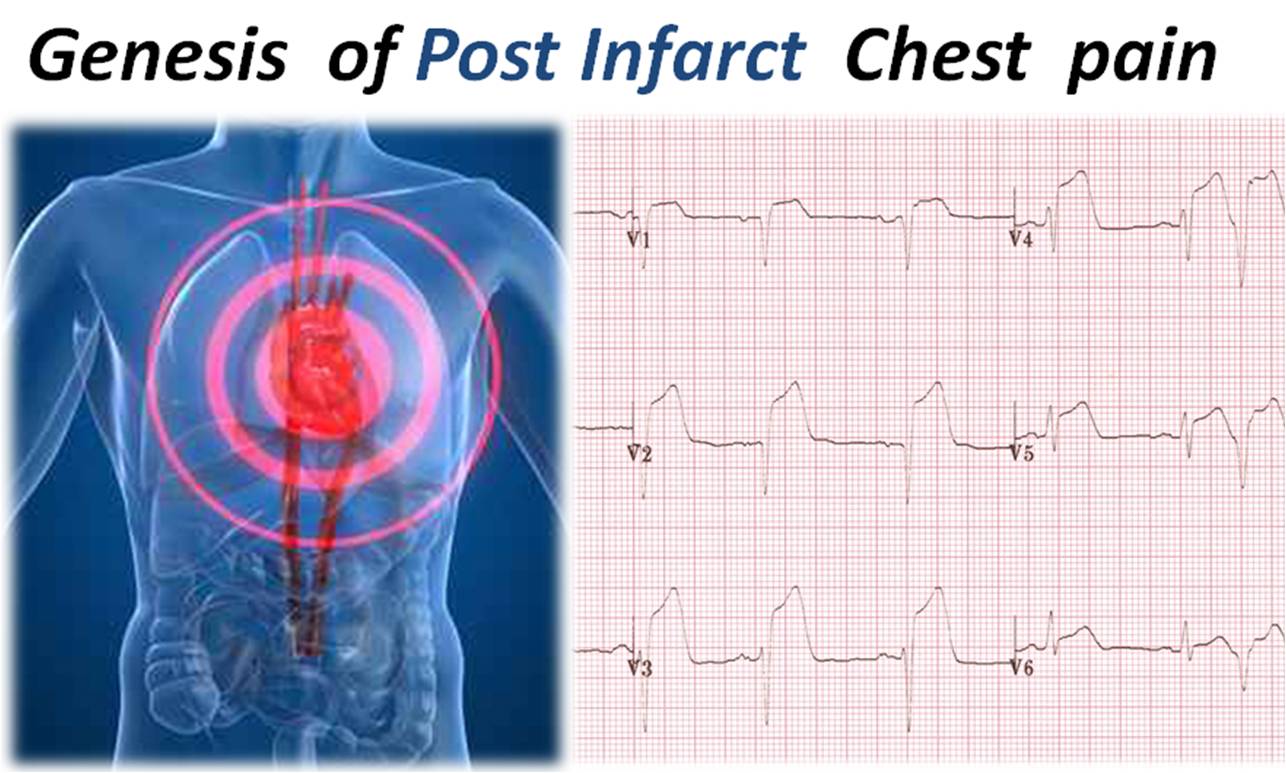
When a patient complaints of chest pain  24 hours after a STEMI . Think about any of the possibilities and act accordingly.

  1. Infarct related pain ( Dull aching pain from residual neural signals from infarct zone,  till type C  un-medullated  nerve endings  die of hypoxia )
  2. Post infarct angina –From IRA zone (Residual ischemia)
  3. Post infarct angina-From Non IRA zone(New Remote ischemia)
  4. Re-Infarction
  5. Infarct expansion/ Extension /mechanical stretch
  6. Pericarditis
  7. Intra coronary dissection adjoining  a plaque (Plaque fissures  are same as dissections if they extend into media ! But plaque fissures are painless since they lack nerve endings  )
  8. Myocardial tear /Rupture (Generates  severe pain , usually transmit to back , patient often become violent and poorly respond  even to narcotics)
  9. Post resuscitation/DC shock / chest wall contusion . ( I know at least one patient  who was rushed to cath lab for a  suspected  acute stent thrombosis  ,  it was indeed   a rib fracture during an  earlier resuscitation at ER  on his arrival !)
  10. Finally ,when the  pain is refractory and atypical   non cardiac chest pain which might have been pre existing to be considered as remote possibility .

Read Full Post »

A 55  year old man came with a BP of  1o0/70 with vague symptoms of back  pain to our ER.

Troponin T  was positive

Can we thrombolyse ?

There is a minimal ST elevation in inferior leads  but not amounting to  the required criteria 1 mm

Technically No , Academically yes , scientifically No , logically  yes

*I wont thromolyse but i will take him to cath lab maybe the modern answer

 What we did ?

We did neither !

Just observed in CCU with heparin infusion , Aspirin and clopidogrel .

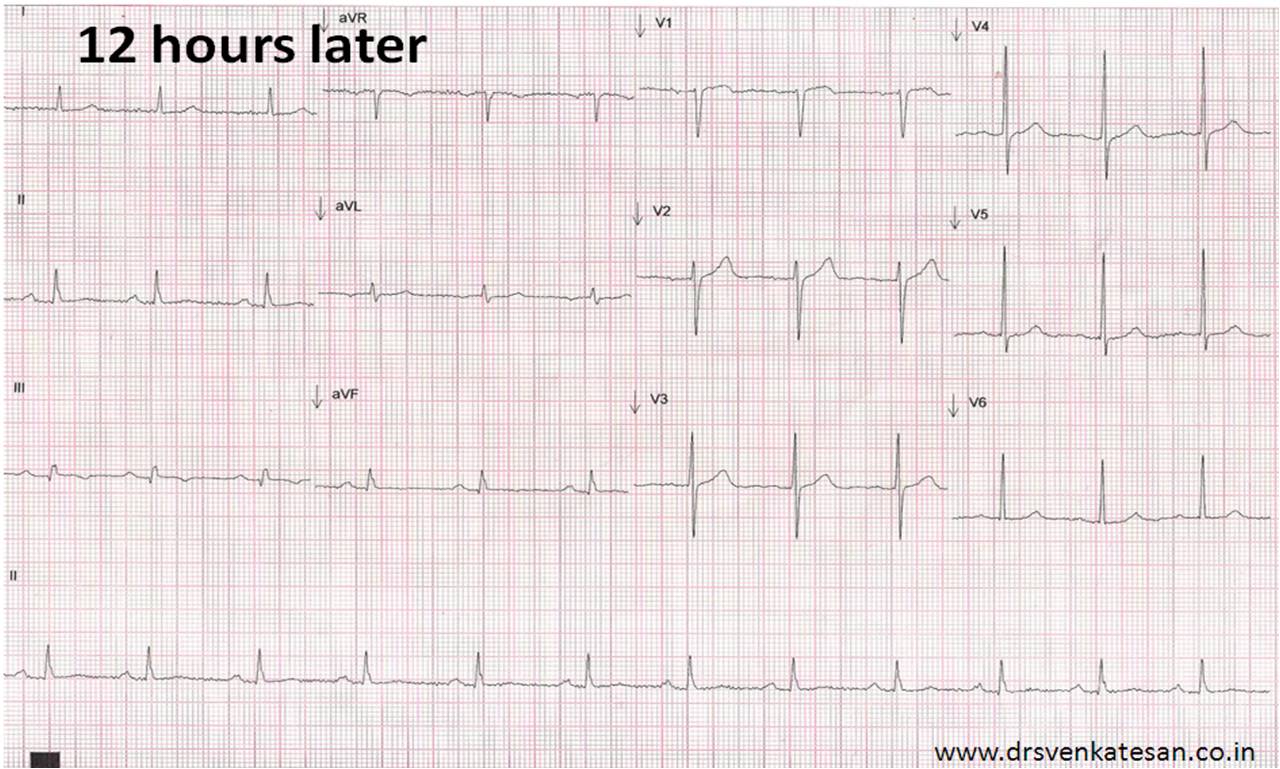
Note: The ECG becomes almost normal .The initial suggestion of inferior MI is stands questionable

Serial ECGs  were taken .

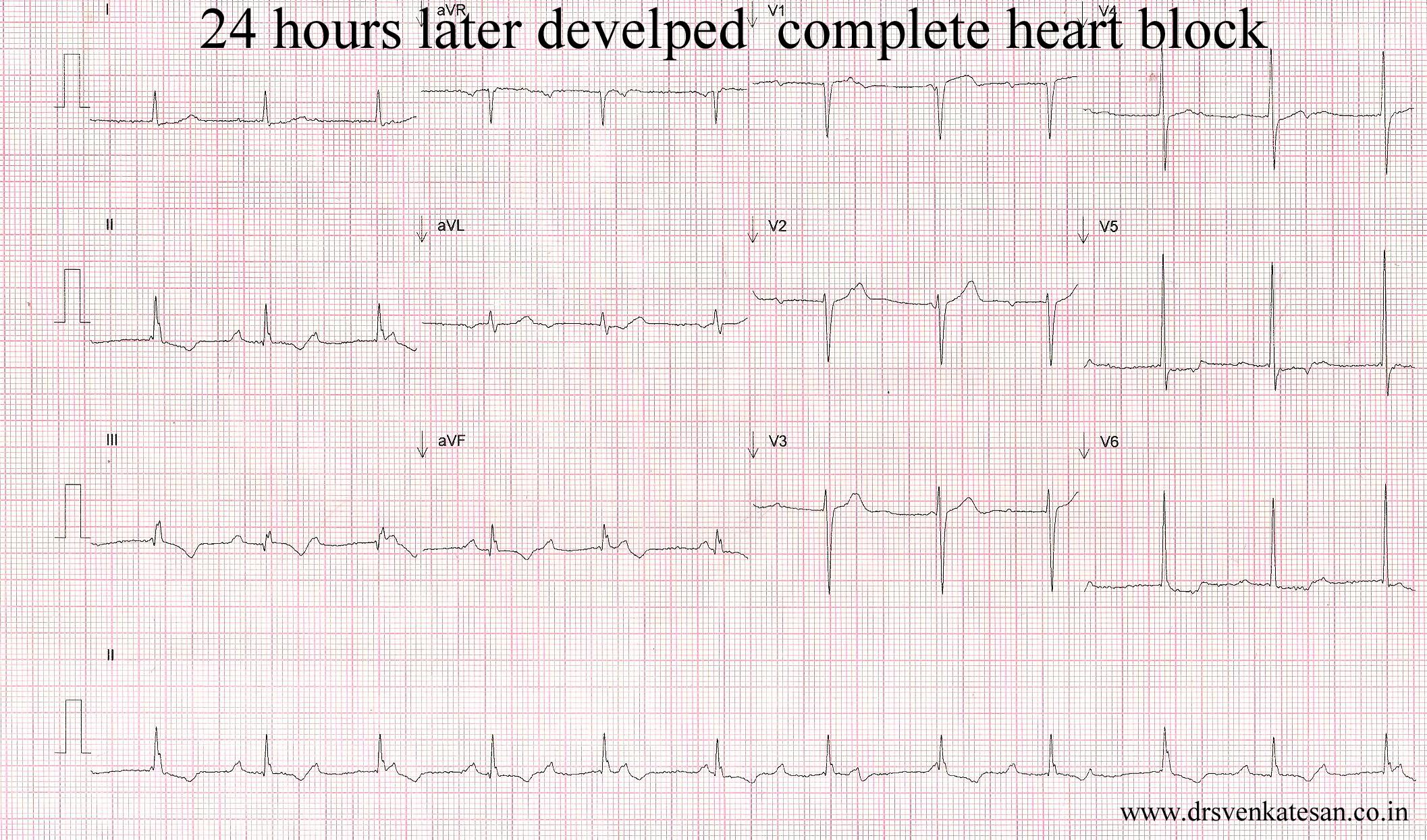
And now . . . after 24 hours a new complete heart block appear with classical evolved pattern of inferior MI.The most interesting feature is patient has been comfortable all along even as his posterior aspect of heart is experiencing terrible electrical earth quakes.

Is troponin Guided thrombolyis  an accepted  concept  ?

Yes ,  only in few situations like , posterior MI ,   LBBB  , pacemaker rhythm, re infarction .(Note , true posterior MI do not elevate the ST segment but depress it ) .

One may be surprised why we shouldn’t lyse a patient  whenever  troponin is elevated in acute coronary syndrome  (After all it denotes myocardial necrosis and infarct !)  The point here  is ,  troponin can raise in all forms of MI (NSTEMI, even in some cases of chronic stable angina )  Read in this link Why thrombolysis is contrindicated in UA/NSTEMI

The benefits of thrombolysis  is not proven in small and micro infarcts.  ECG  ST  eelvation   remain the  sole criteria for thromolysis for STEMI because  of  high degree of  correlation with total coronary occlusion .

In this era of rapid interventions the treatment concepts has blurred as we tend to do PCI and stenting  most cases of ACS including UA/Unstable angina

OK , what happened to this patient ?

Temporary pacer  was kept stand by with a sheath and catheter in situ.

Next day  morning  AV block disappeared .Patient was comfortable .

To our surprise , in the same  evening his ECG showed a complete heart block with AV dissociation . Still the heart rate was good . The demand temporary pacemaker didn’t take over .

On the third day , every conduction disturbance disappeared and  patient was sent to the wards. He is being discharged in a  stable condition with std drugs .there was  a minimal wall motion defect in infero-posterior segments with an ejection fraction of 50 % . He is  scheduled for coronary angiogram  2 weeks later.

What is the pathology ?

Pathologicallyit could be a small focal area of Infarct  incidenataly invloving the AV node .(This is alss refered to as vital area Infarct”  )It is hard to differentiate whether AV block is due to revrible ischemia or necrosis  , simple tissue edema ,  high vagal tone . or combination of above .If the block recovers it can be concluded necrosis is not the dominant theme.


Final message

STEMI presenting  primarily as heart block is less common .  When such a presentation occurs extra caution is required.

Many  of these patients  may not show a classical ST elevation  and hence do not permit us to thrombolyse   as per criteria.

It is  the  individual physician’s discretion to do so ( or not to do  ! ) . No body is going to fault. After  all  5 % of thrombolyis world over is for  benign early  repolarisation syndromes.

The above description is  an example of complicated inferior MI  . . .  still managed effectively by conventional methods.

Further reading

Why inferior MI is considered Inferior ?


Read Full Post »

Cardiac arrhythmias by nature connote a serious implication ,especially  so  with ventricular ones. Here is an  arrhythmia which arise from the ventricle by excessive automaticity  ,   fires independently  ,   still  very   benign compared  to others ventricular arrhythmias.

Why AIVR is a stable arrhytmia ?

Primarily due to its low rate.

Since  it is a  reperfusion arrhythmia the outcome is good.

Mechanism

It is not due to reentry , it is thought to be due to enhanced  automaticity  without pathological  intra-myocytic  calcium spikes  (Like true VT )

Absence in surface  ECG does not mean it is not existent.  In-fact there  is some  evidence to call this arrhythmia as a form of ventricular parasystole.

Focus of arrhythmia

Since it is a reperfusion arrhythmia it has to arise somewhere from  re-perfused myocardium.

The fact that  it  can occur in both RCA and LCA reperfusion  indicate the focus can be  in any of the ventricle .

Usually it follows the reciprocal rule of bundle branch block  pattern  (RBBB in LV focus LBBB in RV focus.)

Septal AIVR  can have either RBBB or LBB morphology.   Usually  left axis is noted .

How to differentiate it from  non sustained VT ?

  • Ventricular rate in AIVR should be between 60 -110 .(Note -The inherent ventricular rate is 35/mt .There is three fold acceleration )
  • Basic idoventricular rhythm is about 35.  Three times accelerated
  • Characteristically   AIVR  starts with an escape beat rather than an  ectopic beat .

AIVR  is common  in  RCA or   LCA reperfusion ?

It is supposed to be more common in infero-posterior MI  as sinus slowing is an important predisposing factor  for releasing   the idio ventricular rhythm.

AIVR after primary PCI

Is not reported much as  current interventional  cardiologists  do not bother much to watch about this arrhytmias

Other causes for AIVR

  • Myocarditis.
  • Digoxin toxicity

Management

(The commonest issue with AIVR  could be    . . . Nurses  /Fresh interns may mistake it as VT and  pressing the false alarm ! )

  • Rarely  requires treatment .
  • Atropine ,Isoprenaline to increase sinus rate.

Read Full Post »

Read Full Post »

Up to 24 hours

  • Failed thrombolysis and persistent infarct related chest pain
  • Prolonged  Infarct pain  in spite of successful thrombolysis (Rare)
  • Dual STEMI and Dual ACS ( Combination of STEMI/NSTEMI)  *

* Generally  until   after  24 hours one should not make a second coronary syndrome  though  logically  it is possible ( Dual acute coronary syndrome)

After 24 hours -up to 2 weeks

  • Post MI angina  – IRA related (Re-occlusion, Threatened reocclusion)
  • Post MI angina -Non IRA related ( Critical  non -IRA lesion)
  • Thrombus migration /Side branch occlusion
  • Re infarction -Same territory
  • Re-infarction-Remote territory
  • Infarct extension, Infarct expansion , Dyskinetic segments  ( Acute ventricular  remodeling  has a potential to generate pain )
  • Combinations of the above

Caution

24 hour is  arbitrary cut off .There can be spill overs and over laps

*Refractory non ischemic  chest pain often atypical not relieved by anti anginal  medication   – Pericardits, Coronary dissections , myocardial /Pap muscle  tears .

After thought

Do we need to break our brain  to  find  the source of angina  following STEMI ?

Principles of scientific medicine  would demand it  . However   in this era of  hyper active interventional  cardiologists  there is little purpose  as they  tend to  open up all occluded arteries   guided by the  their  ignorance about the source of chest pain.

Reference

Video on Dual  coronary syndrome

Read Full Post »

The key word for  successful  primary PCI  is

  •  Suction &  Aspiration of thrombus  with   micro catheters like  export catheters
  • One can do away with a stent during primary PCI but can never do away aspiration
  • Distal protection as concept is rapidly dying out as we aim to remove all the thrombus .

Tips for effective thrombus aspiration

  • Apply continuous negative pressure once catheter reaches the thrombus do not release  it till you enter back into the guide.
  • Make sure  you are sucking only  blood  products  not the  endothelium
  • Watch out for  side branch spill over.
  • 7F sheath 7F catheter ideal for aspirating  with a  micro catheter
  • Please be informed some thrombus require more negative pressure especially  in the late  presenters of STEMI

* During dire emergency when you do not have a specialized suction catheter do not hesitate to push  even a diagnostic catheter into the coronary .We have  saved few lives !

Crazy   questions  in primary PCI  ( or Is  it futuristic )

Can we connect the suction apparatus into LAD micro catheter ?

Do we have camera guided suction catheter ?

Can you flush the thrombus if you are not succeeding in aspiration ?

Is ultrasonic desiccation  of thrombus possible ?

Acknowledgement

Some of the tips were  gathered from the recently concluded  India Live  2012  conference   in New Delhi .

Read Full Post »

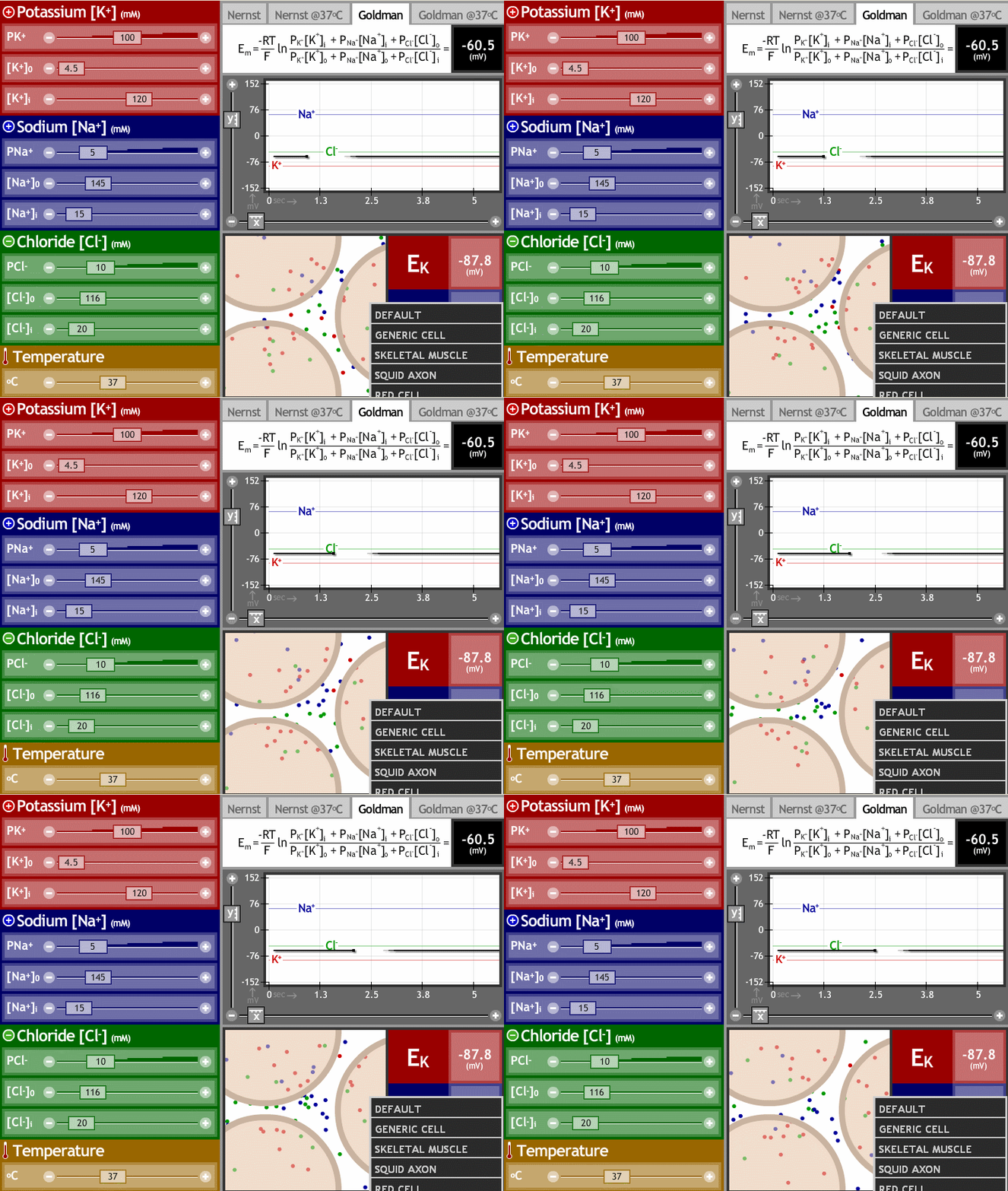
Human life is a bundle of energy orchestrated by ions coming  in and  going out  of  every cell . Potassium is the life sustaining ion which  determines the  resting membrane potential  of our cells.

When the  heart  suffers a massive necrotic attack  what  would  happen to the potassium dynamics  inside the  myocytes ?

K  + is the dominant  intracellular cation  ,  when  about  100 million myocytes   die  suddenly ,  a chaos in the  potassium  metabolism  is expected  is it not ? .

When skeletal  muscles dies  it  releases  potassium  . We  know   this  from typical crush injuries and rabdomyolyis.

It is  more of a  common sense  to expect this   . . . from myocardium as well .


Which ion is responsible for the current of injury ?

We know a  strong and continuous  negative current that  emanates from the necrotic zone after STEMI  .  (It is so powerful it  shifts the baseline  itself  !), We do not know yet what exactly  is causing this current of injury .  It goes without saying sodium should sustain the depolarisation wave but  potassium will  also have a major role in the  propagation  of this injury current.

Do dying myocytes   excrete the potassium into the circulation   ?

Is    k+  a marker of extent of MI  ?

What is the mechanism of hyper acute tall T waves in  MI ?

Questions  galore  . . . Answers struggle !

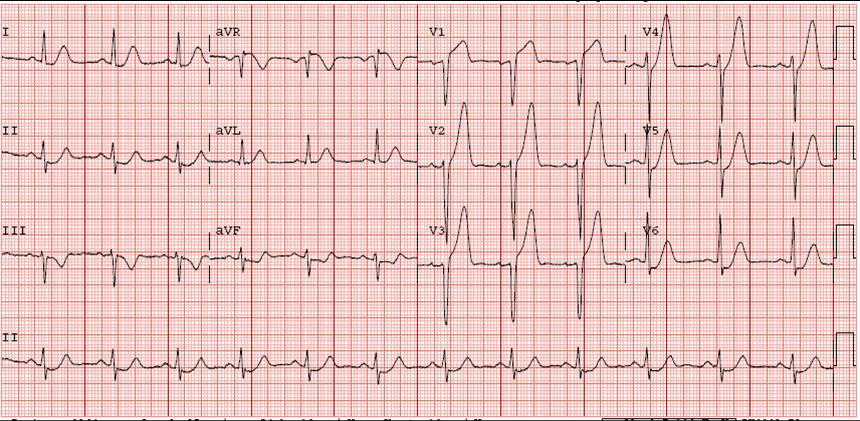
When a  large  area of  cardiac muscle goes for necrosis  it  leads to  leaking   of   K +    . If it is true  , it  is expected to be a marker for extent of  infarct. In reality it is not . Why ?  This is because cardiac  potassium pool is much  small . A  leak from  an organ which weighs   400 grams   do not elevate the ECF  potassium .  Still , there is ample evidence  for   K + to accumulate  in the local  intracellular milieu. (Myocardial hyper-kalemia ) In fact ,  one of  the mechanisms  suggested  for tall T waves in  hyper-acute MI phase   potassium excess .
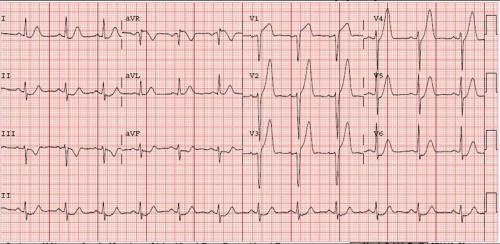
Image courtesey hqmeded-ecg.blogspot.in/2009/02/hyperacute-t-waves.html

http://hqmeded-ecg.blogspot.in/2009/02/hyperacute-t-waves.html

Potassium levels and incidence of  ventricular tachycardia.

Many of the primary ventricular arrhythmias  are  due to acute ischemia .  We  have conflicting evidence  for  the effect of ischemia on QT interval. How does ischemia trigger VT  ?
The answer to this question  remain as a missing link !  . Grossly simplifying ,  one could suggest it is  due to   ischemic cell membrane damage that alters the ion channel function  , resulting  in intracellular accumulation of calcium and triggered  activity  .

What is the effect of potassium  on cardiac contractility  ?

Myocardial paralysis.  (Please note  it is the  hypokalemia  that primarily  causes paralysis in skeletal muscles !)

It causes  myocardial  stunning  a manifestation of local potassium  leak ! A temporary myocardial paralysis.

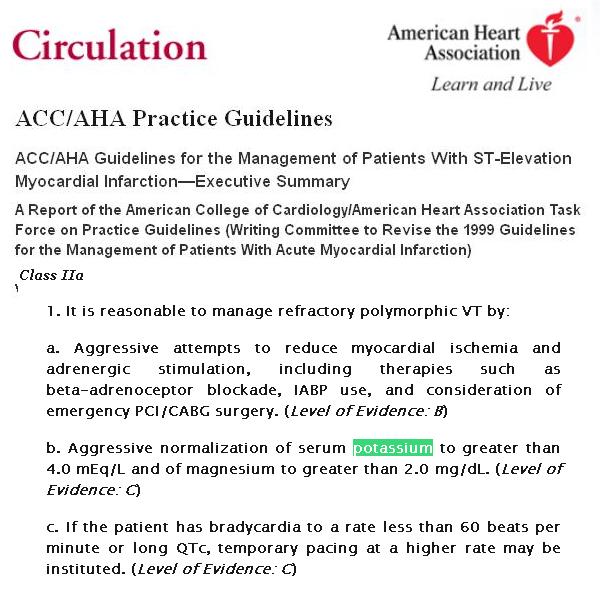
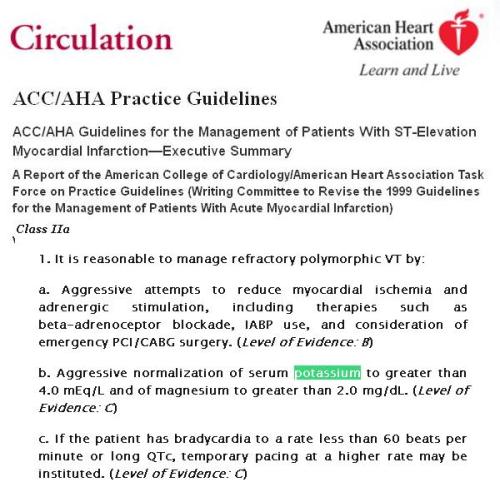
What does the current guidelines of ACC/AHA state about potassium hemostasis  in STEMI ?

It suggests   a fairly aggressive  maintenance of potassium levels  to  upper normal levels. Traditionally we are worried more about hypokalemia than the hyper. It is  surprising   we had the facts wrong . . .  for so long !
What is new in the regulation of potassium level during STEMI ?

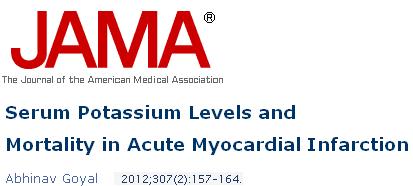
This landmark paper from JAMA seeks  to set right the misconceptions about potassium during STEMI. It suggests  K + levels  has a U shaped  morbidity curve in STEMI . One need to be cautious in  correcting borderline hypokalemia .  Serum   K +   is   absolutely useless  surrogate marker for myocardial K +   . We do not know how  K  +  behaves in the vicinity of MI  zone . So  extreme caution is required  when giving IV  K +  supplements in coronary care units .
Watch out :  Beta blockers /ACEI   may worsen  hyperkalemia

Early introduction of ACEI and ARBs   is a strong risk factor for systemic as well as myocardial  hyperkalemia . This  is  especially true  in diabetic individuals  who have  low rennin  levels due to diabetic micro circulation defect in kidneys .(Hypo-reninic  hypo-aldosternosim )

Beta blockers are also known to raise potassium by two mechanism

1.Blocking rennin

2.Reduced uptake of K + in to  the cells.

http://medicineforresidents.blogspot.in/2010/09/hyperkalemia-with-beta-blockers.html

Final message

In the management of STEMI  ,   revascularization  of  the myocardium    is  considered as  the only  therapeutic aim . We  need to realise it   is  much more than that .  There are some subtle but important ways of resuscitating and  protecting  myocardium .  Over  indulgence in electrolytic management  in coronary care  is to be avoided.

Reference

Importance of sympathetic drive and  potassium levels
http://www.nejm.org/doi/full/10.1056/NEJM198002213020803

http://ccn.aacnjournals.org/content/23/6/14.full.pdf+html

Read Full Post »

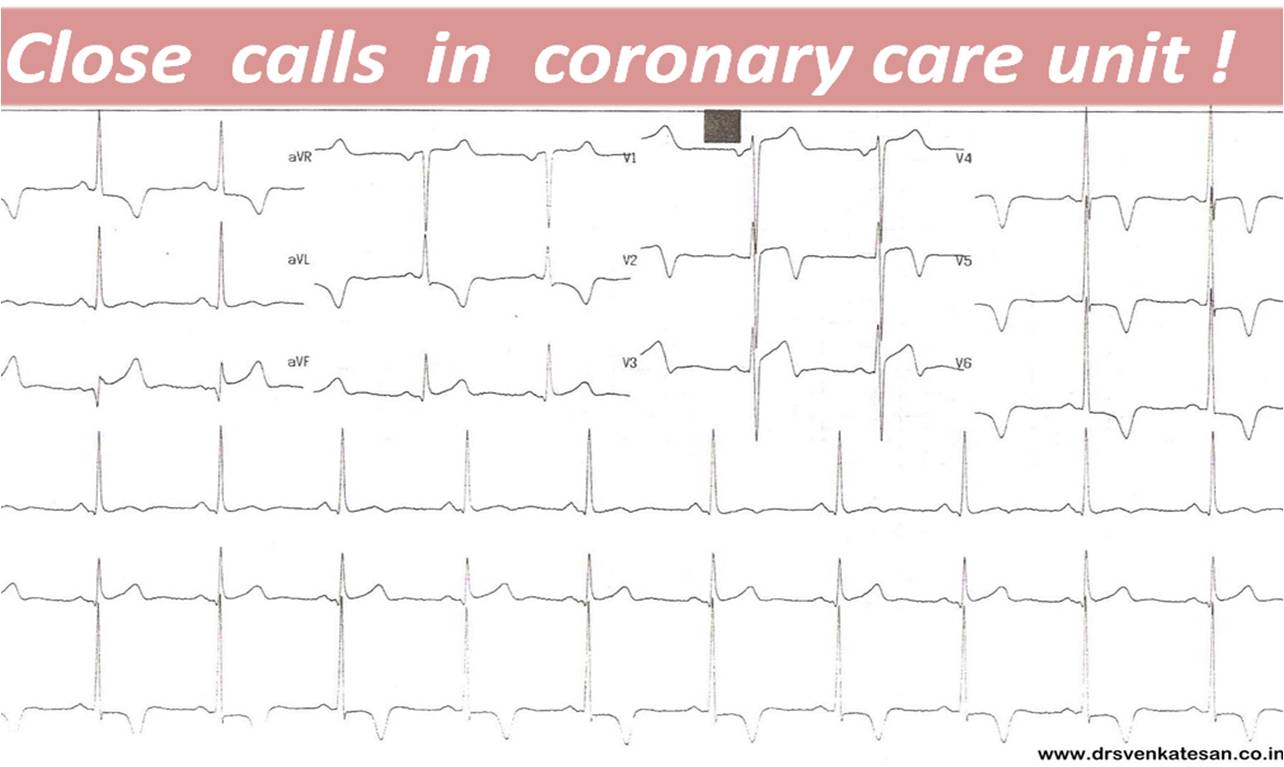
This  is the ECG  of  a  45 year old man with  H/O hypertension  and  chest pain .The general practitioner who first saw him alerted this  patient about a possible  heart  attack  asked to meet a cardiologist immediately. The cardiologist who  saw  this ECG   tended to confirm  the diagnosis  and advised admission in  a coronary  care unit .

The patient   defied  both  and  somehow landed in my echo lab  .  Looking at the ECG   I also  expected  it to be a  STEMI  evolving into a  Non Q  MI .

I was surprised  to find  only LVH with absolutely no wall motion defect  . There was no evidence of ASH,  HOCM or apical cardiomyoapthy as one of my fellows initially  suspected . His  EF was 70 %.   Cardiac enzymes were sent by then. When  I spent few minutes  with him ,  listening the history , it was very clear  what  he had was  non cardiac pain . In the anxiety ,  no one  got it right  about the character of pain ,which  was localised , lasted  for few seconds and  least suggesed angina.

The moral of the story is   listen to the patient  however dramatic the ECG may look !

What is special in this ECG ?

It is common for LVH with ST depression to be  mistaken for  ACS/NSTEMI

Here , there were  other  observations that  added  more  complexity .

  • Presence  of  ST/T changes in inferior leads(ST elevation in lead 3)
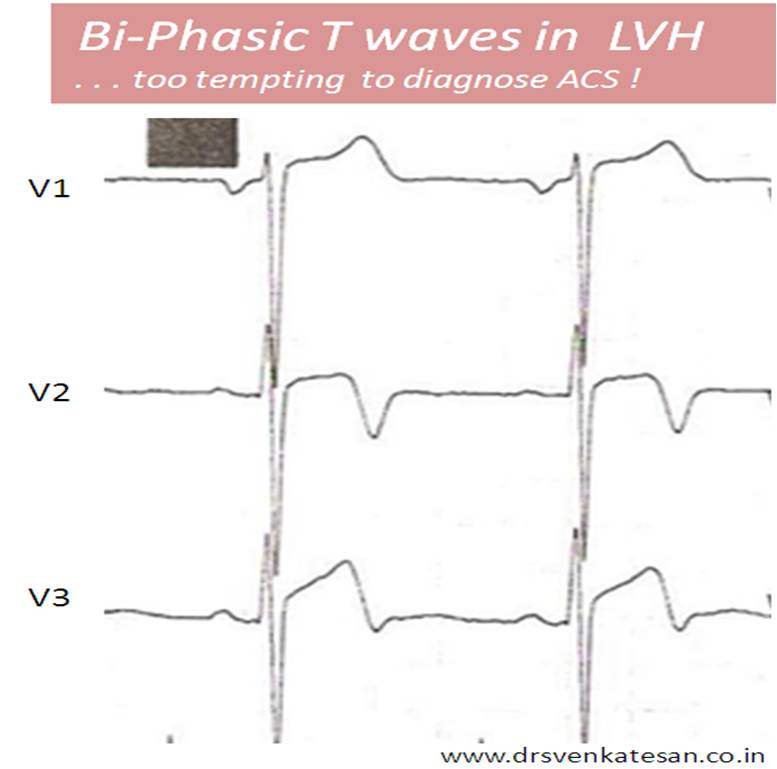
  • Bi-phasic  T wave in v1 to v3
  • ST elevation  in precardial leads

In LVH  it is usual  to note  ST depresion , how do you explain ST elevation in LVH ?

ST elevation in LVH   may occur in  leads  v1 to v3   . It is very rare  for LVH to inscribe  ST  elevation in   v4 v5 v6  .   Why certain  leads elevate the ST segment while others depress  in LVH  is not clear. It may represent  incomplete LBBB pattern where the ST segment deviates opposite to the  dominant QRS  complex. Septal  hypertrophy often elevate  while free  wall  hypertrophy depress the ST segment . Since V5,V6 leads are free wall oriented , these leads  record  classical  ST depression .

Importance of Bi-Phasic T waves

Please remember  Bi phasic T waves are notorious for it’s  unpredictability. An  innocuous looking bi-phasic T waves  (especially  with dynamic behavior )   is a  harbinger of proximal  LAD or even left main disease.

Finally , what will be ECG  changes if a patient with classical  LVH  who  develops a  real  STEMI ?

  • LV strain  pattern normalises ?
  • Further ST depression  occurs ?
  • No great changes . ECG  Looks near normal ?

Answer : ?

What is the significance  of   Bi-phasic T  waves : A  link to  a related post

Read Full Post »

« Newer Posts - Older Posts »