Feeds:
Posts
Comments

Archive for the ‘cardiology -ECG’ Category

Implantable cardiovertor defibrillator(ICD)  is one of the major revolution in cardiology practice  that happened last century. We know , the number one killer of mankind is the ventricular fibrillation induced by acute or chronic CAD.

In the  later half of 20th century we  learnt  that , the only way to prevent a sudden cardiac death is the defibrillating   the  heart as soon as the deadly killer arrhythmia strikes !

Whenever cardiac arrest happens  in  a susceptible population , following  things are possible.

  • Call 911 /108  start CPR .
  • Have  Automatic external defibrillator AED at home
  • ICD implantation -Percutaneous trans-venous approach

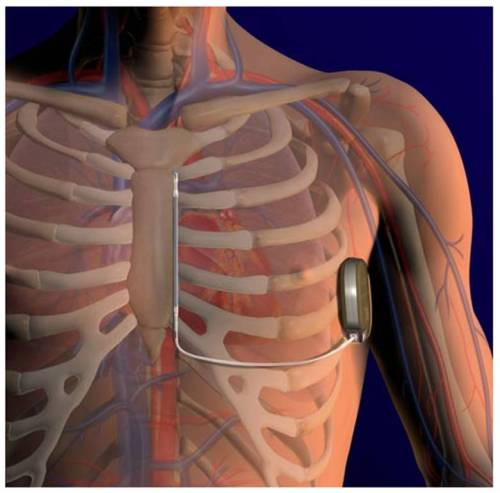
And now new mode of defibrillation

Transvenous implantation  becomes  technically complex in many  .Abandoning the procedure  or using subcutaneous pads are necessary in few . Then , this question was asked

Why not the entire ICD implantation be in  subcutaneous plane ?

Yes , it is possible . After all , current can reach the  place where  it is needed ,  irrespective of the site it is delivered. The aim of this technique is to  simplify the ICD implantation  , so that it can be practiced in a wider clinical set up Preliminary  results  of subcutaneous ICD are available and was published  recently in NEJM.

The issues that need to be tackled are

  • Amount of energy required
  • Battery life

http://www.cameronhealth.com/product-info.htm

Read Full Post »

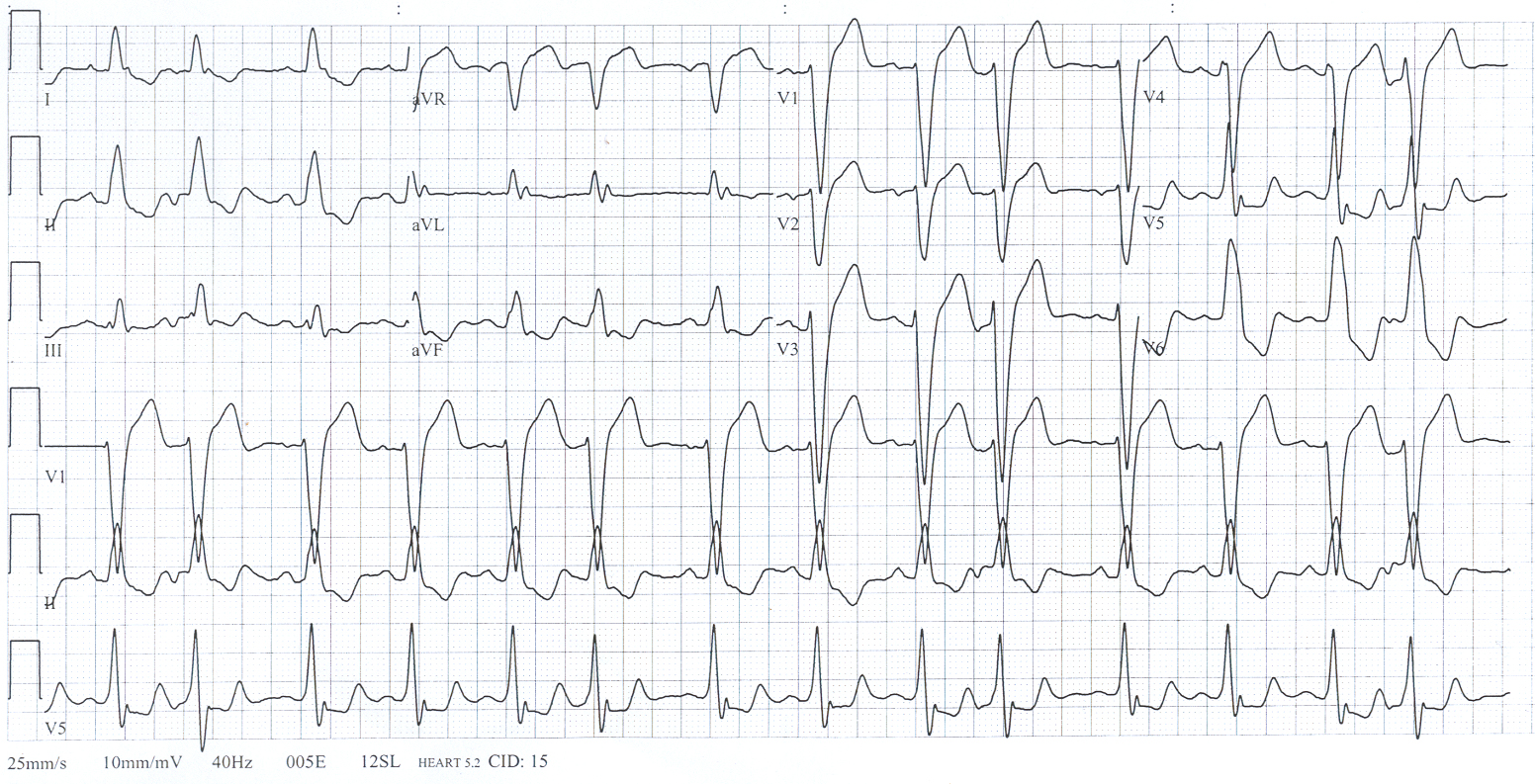
Why the qrs complex becomes wide and tall in LBBB ?

The qrs  complex is  wide , due to delayed conduction over non specialized fibres .The qrs  becomes are  tall due to temporal dissociation of RV  and  LV forces ,  which  leaves  the LV forces  unopposed , thus  a tall qrs  is inscribed  , without the neutralizing effect of RV forces.

Is muscle to muscle  conduction a hall mark of LBBB ?

No , it is not . Even though the left bundle is blocked , much of the conduction tend to occur in

specialized  conduction  system  . It depends upon the level of block of LBBB.

What is the mechanism and clinical significance of left axis deviation in isolated LBBB?

The mean qrs axis is surprisingly  not  altered greatly ,  in LBBB . If there is a significant left ward shift  it may imply associated organic LV pathology or involve ment of predominately  left anterior fascicle

What is  the impact of IVS contraction and timing in LBBB ?

In isolated LBBB, it is expected an abnormal septal motion due to altered sequence of septal activation. This results in an abnormal appearance of  septal motion in Mode (Septal beak immediately following qrs complex) .In fact , this sharp downward movement indicate good LV  function  .Absence  of which  is a  good clue  for a pathological LBBB due to structural heart disease

Why does the abnormal  septal motion in LBBB  ,  do not  desynchronize  the normal LV ?

CRT is the much fancied  treatment in patients with LBBB and cardiac failure. In normal ventricles LBBB do not destabilize LV function in spite of septal /free wall desynchronisation  .This is still a mystery how IVS is cope up with the totally unexpected  insult of asking to work in head over heal situation !In spite of  this the ventricle gets used to the altered conduction pattern and the contractile pattern.(Nature’s  at it’s best !)

What are the mechanical disadvantage of LBBB

  • Septal contraction is  ill-timed
  • Mitral  regurgitation

Most isolated chronic LBBBs  do not  confer  any hemodynamic  disadvantage  to LV  – why ?

LBBBs are dangerous looking ECG , but in most patients it is benign , in the absence  0f structural heart disease like valvular , myocardial or ischemic  disease.

Can there be a small r wave in V1 and V2 in LBBB ?

Yes . Though we expect the  reversal of septal depolarization  extinguish  the initial r in v1 to v3 .It is  noted in many. Hence presence of small r in v1 to   v3 does not rule out LBBB. 

  1. The commonest explanation given is un-masking of RV free wall forces which is   normally  masked by early LV forces .
  2. Another possibility is the   orientation of septum  in pathological states.
  3. Third possibility is  “r” may  actually represent  the  septal q waves as in LVH or old AWMI  .(Counterpart of small  q in lateral leads )

How do we explain concordant  pattern  of QRS  v1 to v6  in LBBB ?

We expect the qrs to  transit from QS  complex  to RS ,  at-least by lead  v5/v6 .Some times even V6  shows a RS complex.This is usually due to faulty lead  position or a grossly enlarged  LV,  ie  if we  record V 7 or V8 we will be able to pick up the qs complex.

What will be the morphology of a VPD that is arising  from LV in the presence of  LBBB ?

A premature beat arising  from a  ventricle which is having  a bundle block  is  sort of  electrical blessing !The VPD often bye  passes the block and makes  the conduction near normal  and a normal  qrs may be  recorded. So , when a patient with LBBB suddenly develops a normal qrs beat or  normal qrs tachycardia  one  should consider a VT arising from the  Left ventricle .

And a studious electro physiology fellow  should  be able to answer the following !

What will be the morphology of  VPD if it arises from RV and septum in the presence of  LBBB ?

Kindwall has tried answer  this question

What is the effect of  LBBB on S1 and  S 2 ?

The classical  description in LBBB   is

  • Paradoxical split of S2
  • Wide split of S1

You are supposed to hear  4 components in complete LBBB  !  In reality this does not happen . At best you can hear the reversed  split of  S2 with difficulty .

One  more reason  for the  non manifestation of these splits is  confounding factors like LV dysfunction , MR , PR interval etc .(Each one tend to pull or push  S1 and S 2 in different directions )

Do  patients with LBBB  , are at increased risk for developing  complete heart block   when

beta blockers , calcium blockers etc  are administered ?

Common sense would say yes. Scientific  sense has  no answer .

We know, ventricles are innervated by two bundles  .When only one bundle  is  functional, it means the ventricles  are experiencing  50 % power shutdown .   In CAD  , single vessel blood supply due to a CTO  is considered  dangerous but in electrical  flow it is not so !  In spite of the fact  that  ventricle has numerous  cell cell electromotive conduction   it is  always better to exercise caution  when administering  beta blockers, calcium blockers and digoxin in patients with LBBB . If it is a must periodic  monitoring is advised .(HV interval in isolated LBBB is slightly prolonged ) Never administer beat blocker in a patient with recent onset LBBB and ACS

Also read the related article  in this blog  Incomplete LBBB

Read Full Post »
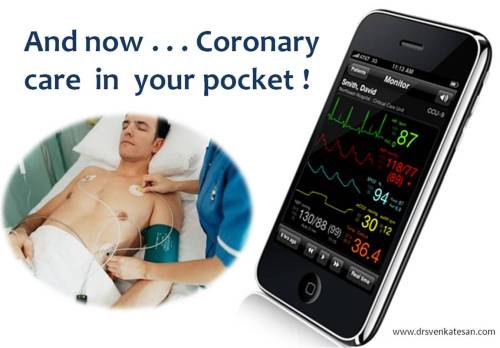
Welcome to the new era of “medical avatar “

Cardiologist’s ultimate dream  of  monitoring  their patients

Live ECG feed in your cell phone  !

Thanks to the American “scientific  pursuit” and the mankind  will be  the beneficiary !

Courtesy :

Airstrip technologies

What’s next ?

Remote DC shock and pacing  .

Watch out  . . . it is going to happen in next 5-10 years !

Read Full Post »

LVH is one of the commonest ECG abnormality . We know the hall mark  of LVH is increased QRS voltage .We also know , ECG is not a fool proof method to detect LVH .It has very good specificity , but little sensitivity , meaning that increase in  QRS voltage is  fairly accurate in predicting LVH  but absence of  which cannot exclude LVH.

Why Increased QRS voltage does not occur in many with LVH ?

Even though we think myocardial mass  is  the  sole determinant of QRS  voltage  , in reality  it   is determined by many other factors.

  • Distance between the ECG lead , and the myocardium is an important factor. In classical concentric LVH , the LV  cavity is not enlarged ,in fact it may shrink a little as the hypertrophy grow inwards and obliterate the LV cavity.(We do not know yet , how much of LVH grow out and how much  muscle grow in ! )
  • The blood volume within LV is a very good conductor of electricity.A good volumed LV may augment a QRS voltage.
  • This can be observed in some of the patients with DCM , where high voltage QRS  is recorded mimicking LVH.

But ,what really matters is the fine balance of blood volume and myocardial mass that determine the incidence and magnitude of LVH pattern in ECG.

QRS voltage as a tool to differentiate pathological from physiological  LVH

We know QRS current is generated from within the myocytes .If the myocytes  are  uniformly hypertrophy without altering the  basic mechanical and electrical architecture QRS complex will be amplified in a sm0oth manner and result in  classical high voltage  QRS  of LVH.

If the hypertrophy occurs in a disorganised fashion, where in myocardial fibres slips out of plane  with adjacent muscle bundles, the QRS  voltage may not increase and even be slurred or notched as we see in many cases of LVH with non specific intravascular conduction defects

The classical disarray of myocardial fibers that occur in HCM causes  pathological q waves.

* Other factors that determine LVH include bundle branch conduction delay or blocks which is not discussed here.(Ex: An incomplete LBBB can amplify the qrs without any LVH )

LVH with fibrosis

Fibrosis is not a standard feature of LVH. It occurs in few who are genetically predisposed , and  mediated by heightened sensitivity to circulating growth factors.

  • Fibrosis can have wide impact on the electrical as well as mechanical function of heart.
  • Fibrotic heart has a  potential to  blunt the  high voltage  QRS complex.
  • It  may even cause  pathological q waves .It predispose to ventricular arrhythmia
  • It prevents regression of LVH , even after the loading conditions corrected.

Other conditions that  attenuate LVH features in ECG

  • Diabetic hypertensive show less ECG voltage than isolated HT .
  • CKD patients often do not show ECG features of LVH inspite of LVH

Final message

Diagnosis  of  LVH by ECG is a  simple clinical exercise , but we realise now , the underlying mechanisms are too complex .

A simple question , ie  Why  every one  with LVH  do not increase  their  QRS voltage  ?  . . . exposes  our ignorance on the subject!

But one thing is clear, physiological LVH (Meaning LVH ,  purely due to loading conditions including SHT/Aortic stenosis)  more often result in high voltage , while  in true pathological LVH(infested with fibrosis ) the  increase in voltage is not consistent .

Read Full Post »

Bradycardia is a common cardiac arhythmia. Sinus bradycardia  is  often considered an arrhythmia from a disciplined heart. It denotes high vagal tone .  A  heart rate  of  40 , some times even 35 is well tolerated . But bradycardia due to heart blocks are dangerous.

Sinus bradycardia can not get lower than 30/mt or so , as invariably either the  junction or the  ventricle , escapes with its own rhythm. Near syncope, dizziness , giddiness followed by  syncope  occur as the  heart rate  slows progressively below this level .It is often taught humans can not survive  when the heart  rate  goes below 10/mt .

Case report :

Here is middle-aged man who  presented  with a history of  recurrent syncope over a period of  3 days . He has no  history of CAD.

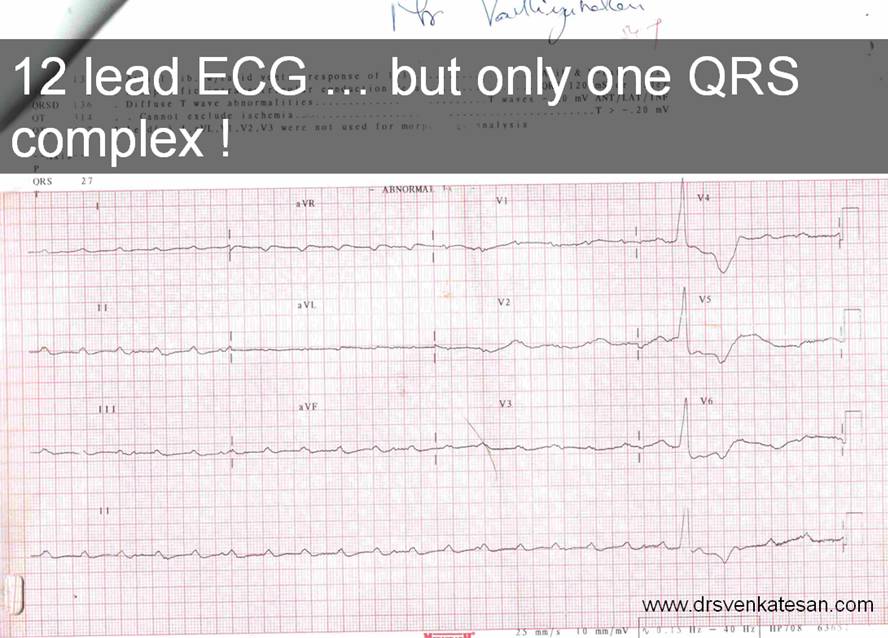
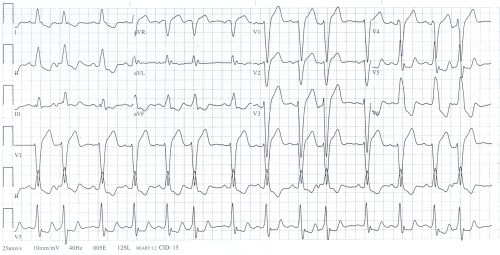
As he entered  the ER, this ECG was recorded.

At this pint of time  , when the ECG was recorded,  he was  conscious and talking ,  only to complain  of  little dizziness. After seeing this ECG , he was immediately put on a  temporary pacemaker.

Note : The ECG shows a single qrs complex per tracing of 10  sec duration .Ie HR of 6 /mt.One qrs complex for 50 large squares !  .Divide  300/50 and HR is 6 . Note also the p waves fire at 150/mt due to atropine effect .

The procedure  took 15 minutes to perform  , he was comfortable  and was administered atropine , and isoprenaline *, which increased his heart rate  from  6/mt to 10/mt .

Later he went on to receive a permanent pacemaker a week later.

* Temporary trans-cutaneous pacing using paddle stickers  is  an another  modality available in such situations where trans-venous pacing is  likely to be delayed  .

Message from this case

Cardiology’s  ultimate  moment of glory and truth  is experienced  when a  life  is saved with  a pacemaker.

Extreme bardycardias are  often  fatal , but here is a patient with  dangerously  low heart rate , still not resulting in asystole  or brady induced VT/VF . We had adequate  time to plan a strategy . Severe bradycardias  need not result in cardiac  arrest always.  Some hearts  have amazing capacity   and their  fighting spirit   amazes  us !  .It should be noted that , the above example may be  an exception than a rule .

Read Full Post »

Stable angina is graded by Canadian cardiovascular society classification ( CCSC ) by 4 grades. Angina at rest  usually  denotes unstable angina. But,  patients with stable angina  may also experience rest angina according to CCSC ,  still this is   not considered as  unstable angina by many . Post prandial angina is one such  example.

Few consider post prandial angina as unstable angina . This sort of reasoning can not be faulted .

In  the logical sense ,  we are dealing with varied  categories of unstable angina.  The importance of diagnosing unstable angina is to intervene early ,  so that we can avoid  major adverse outcome .

The problem in CAD is , often , the plaques and angina do not  obey the conventional  rules  !

.The following permutations and combinations could be  observed in any coronary care unit .

  1. Unstable angina –  stable plaques  – stable ECG – stable patient
  2. Unstable angina – unstable plaques  –  unstable patient
  3. Unstable Angina  – unstable plaque  –  stable patient
  4. Stable Angina –  unstable plaque  –  unstable patient
  5. Stable angina  –  stable plaque  –    stable patient
  6. Stable angina –  unstable  plaque  – stable patient

Among the above 6 categories  2nd  is   probably  the most dangerous group and category 5 is most benign.

Post prandial angina is a serious  form of angina.It implies  , even   diversion of  little blood to GI system immediately after a meal can provoke an episode of  ischemia  .This infers a  very tight  lesion somewhere in the coronary tree,  very often it could be the  left main or proximal LAD.

Of course ,  there is  another mechanism for post prandial angina, namely GI neurotransmitters  like gut peptides acting as a coronary vasoconstrictor.

Snippets on  post prandial angina  .

It is also recognised , post prandial angina occurs more often during dinner, followed by lunch and breakfast. Carbohydrate foods are  more likely to precipitate it .

Does PPA cause ST depression ?

Logically it should .In reality It happens in few .

How to manage it ?

It is very important to recognise , even though this article  argues  for including  PPA  as UA, there is no acute thrombotic process during  an   episode of  post prandial angina . In fact , it is  more of a secondary UA due to altered  blood flow pattern.

So , do not admit these patients  in CCU and administer  heparin or 2a 3b blockers.  (Unless of course ,they have other forms of rest angina )

Link to reference

1 PP angina angiographic correlation

2.Effect of carbohydrate diet on postprandail angina

3.Hemodynamics of eating !

Final message

Post prandial angina has all the characters  of a severe form of angina  .There  is every reason to label it as UA .It is suggested , ACC,ESC, AHA  should consider including  post prandial  angina as  UA or at least  UA equivalent .This would help intervene this entity early.

Read Full Post »

What will be the pulse rate in a patient who has ventricular bigeminy in ECG with a heart rate of 90 ( 45 sinus beats 45 VPDS/minute ) ?

A.Exactly Same as HR , ie 90/mt

 B.Exactly half of HR , ie  45/mt

C.Can be anything between 45 to 90/mt

D.Any of the above can be true

 The  answer is D . 

I have  noted  ,this simple question in cardiology resident examinations cause great anxiety among students .

Why is it difficult to arrive at an easy answer to this question ?

Traditionally , ventricular ectopic beat were also called extrasystole , implying every ectopic beat shall produce a peripheral pulse .Since ,  we learnt this is not true , we started refering them as VPDs.(Simple ventricular depolarisation which may or may not have a mechanical activity ) So , in a patient whose alternate beat is a VPD  , things become little complicated.

What determines a VPD to acquire  mechanical  energy  or simply  remain as an  electrical event ?

  •  Timing of the VPD* .
  • LV residual volume(LVEDV ) at the onset of  VPD
  • Force of contractility of LV( Of course ,  it is directly related to LVEDV)
  • Temporal relation to  aortic valve opening**

If  the VPD is too early or too late it can not have a mechanical activity . It should be optimally timed midway between two sinus beat to have a good mechnically active VPD. Some refer this as an interpolated VPD .Here, the VPD  becomes a  true extra systole for that individual. So , in patient with ventricualr bigeminy in ECG the pulse rate is usually half , can be same as HR when the coupling interval is optimal or it can be totally irregular as someof the  VPDS gain a mechanical activity and some do not (as often occurs multifocal VPDs. )

* Among the above  four factors timing of the VPDS is the most crucial as it can influence all the other three factors.

** Whatever be the timing or force of contraction aortic valve should be opened to generate a pulse wave. If for some reason this does not happen  there can be intermittent mechanial activity what  we refer to as pulse deficit .

Read a related phenomenon:  Ventricular  paired pacing

Read Full Post »

Wide qrs tachycardia often  evoke a   OCD like reaction  among  many  cardiologists (Obsessive compulsive disorder).  Whenever we are given a strip of wide qrs tachycardia  we are compelled to initiate a  conscious or  subconscious debate , whether it is VT  or SVT . Tens of thousands of articles, seminars, CMEs , have been conducted for over 30 years  for  decoding  wide qrs tachycardias  . The fact that the confusion  is still widely prevalent indicate only two things

  1. Either , it is not possible to arrive at a simple fool proof  bed side modality  to confirm either VT or SVT
  2. Or it is a too trivial  electrophysiological   issue  that   need  not be worried about  as we have broad spectrum antiarrhythmics (Like antibiotics ! , where we  rarely  bother about identity of the culprit  bacteria  )

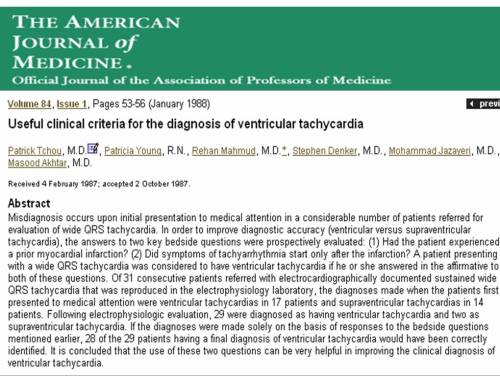
The power of statistics and commonsense have never been applied  in the management this vital cardiac entity  .While a  75% sensitive  exercise  stress test (EST) has a huge following in clinical cardiology , a   99 % sensitive   clinical criteria*  for diagnosing VT is  not respected .

*All wide QRS  tachycardia  in patients with   with history of   CAD/STEMI would be VT

If only we had applied our mind to this article published in 1988 we will never ever have the need to split our hairs for decades.(That too without success !)

In  pursuit of  knowledge , are we often  chasing  an imaginary  issue ?

The cardinal  principle of medicine says

“Diagnosis should precede treatment  whenever possible

But there need to be a correction  in the above statement .  Time , effort , cost involved in arriving at a  diagnosis  should be meaningful .( Needless to say  . . . it should  a correct diagnosis  too ) And if the power of statistics far exceeds the  frivolous scientific data  , street sense can be applied  liberally even though current generation may call it un scientific .

The issue here is  not being  scientific or unscientific , but whether you are right or wrong  . The article  which is quoted here  has a great insight  about the philosophy of VT diagnosis.

The message form this article goes something like this . . .

In the diagnosis of  wide qrs tachycardia , If we apply  the so called scientific principles   the chances  for missing   a real VT is extraordinarily high , while  if you blindly apply common sense and logic you are going to be 90% right .

What a powerful  statement this !  even though it appears  absurd ,  it is absolutely true !

A young physician  should realize the importance of this . Scientific  decoding of arrhythmia  may be an academic  pursuit but in a given patient at bedside  diagnosing by experience and common  logic are  far more productive and accurate. Miss diagnosis of VT was not common prior to 1980s .  It has become a recent phenomenon .

Probably too much of electrophysiology haS  made a simple diagnostic pathway a complex one. When we relied only on commonsense the errors were less . I  have  often observed  fellows  making mistakes quite frequently  while  nurses  were too confident  to call a wide qrs tachycardia   as VT .

Final message

Medical decision making is an art , in fact it is  a “fine art ”   We keep saying this for centuries , still medicine as a  science  easily overtakes medicine as an art. Here comes the problem . Some times (or is it many times ! ) too much of inquisitiveness in the   name of  science  make practice of medicine  complicated and the victims are often the patients !

Let us simplify medicine  . . . let us accept an occasional  bad outcome  . . . for not being 100 % scientific  ! After all  , a million mistakes happen every day in the  pure  scientific  pathway .

Reference

http://www.amjmed.com/article/0002-9343(88)90008-3/abstract

Also read Knowledge disease

Read Full Post »

Like in neurological disease, one can locate the site of block in bundle branch blocks. Though it has never been thought ,  to be clinically important to localise a BBB . (Unlike coronary lesions)

Generally ,  RBBB can be proximal  or  distal peripheral type.The commonest site could be the distal  type.

It should be realised , for over 100 years in  electrocardiology , we have been using some inaccurate terminologies just because it is easy to understand or being traditional .It is difficult  to assimilate a fact , even today that   “An electrical delay in conduction and block are one and the same ”

In fact,  bulk  of  the RBBB is nothing but delayed conduction over this bundle. So whenever we say RBBB  , we imply an incomplete block  ie conduction still occurring   over the  so called blocked bundle.(This dogma applies for LBBB and AV blocks also to a lesser  extent)

Examples of delayed  RV /RVOT conduction

  • Any disease where  RVOT dilatation  occur can cause a RBBB
  • Atrial septal defect
  • Many cases of RVH
  • Pulmonary arterial hypertension

What is the benign rSr’ pattern in V1 ?

This is nothing but a relatively late depolarisation of  RV outflow or conus that produce a terminal RV activity .

Many of the ostium secundum ASD may show just this rSr’ pattern   confirming there is no organic damage to RBB in ASD .

Calling rSr’ pattern as incomplete RBBB is not advisable (As many ECG books may suggest ) .This is because , even full blown RBBB pattern may actually be an incomplete one .Further , the degree of terminal r’ in V1 or s in lead 1  does  not always   determine the completeness of RBBB.

Is there a totally blocked right bundle branch block ?

Yes , it is not common .

  • It can occur in extensive anterior MI .
  • Some cases of Ebstein anomaly.

It can be an working rule , complete RBBBs  locate the lesion proximally and incomplete  ones distally .

What is the other evidence for RBBB in ASD  is  only a simple   delay  in conduction ?

After ASD closure  in many of the patients the RBBB pattern may disappear.This indicate RVOT regression .

Can you clinically differentiate the proximal from  distal RBBB ?

Ironically ,what is difficult in ECG may some times be possible clinically.The classical description of wide splitting S2 occur often in peripheral RBBB.

It represents a delay in the closure of pulmonary valve due to delayed electrical activation or increased hangout interval as in ASD .Logically S1 should also be split in RBBB. But this is not often discussed.

This is because , the split in S1 is lesser in magnitude and is not influenced by the hangout interval .(Hang out interval is the time taken for the blood ejected from RV to fill the pulmonary circulation. Due to the low impedence of pulmonary circulation the the blood that is ejected into the MPA continue  to run off for about 100milli seconds even after the RV/PA pressure crossover .)

S1(T 1) occurs  immediately with the onset  of RV contraction . Similarly M1 occur with LV contraction.It should be recalled it requires hardly 5mmhg of RV pressure to close the tricuspid valve and about 10mmhg for LV to close the mitral valve.

If for some reason if  there is a delay  in RV contraction , as in very proximal RBBB the T1 is delayed and hence S 1 split.

Note in most of the peripheral or distal RBBB the bulk of the RV free wall contraction is not interfered with . So , in distal RBBB it is highly unlikely the S1 will be delayed or split while S2 will be delayed.

What happens to S2 in proximal RBBB ?

Logic would dictate both S1 and S2 should be wide split.

Final message

There is a simple way (Some would call this an futile  academic  excercise  !)to  differntiate proximal from distal RBBB.If the first heart sound is split wide , it fixes the lesion proximally. This may  indicate a more adverse outcome than a simple peripheral delay in conduction.

Read Full Post »

Echocardiography is an imaging tool . Can it  be used as a non invasive  EP lab ?

Heart is an  electromechanical organ . For every mechanical activity there must be a electrical event preceding it . So, when we analyse the cardiac contraction and relaxation it indirectly provide us clues how the electrical activity spreads across the heart.

The concept of using echocardiography for diagnosing cardiac arrhythmias have never been popular for the simple reason we have a cheap and best modality : The ECG.  But, it  does not give us the temporal relationship with the cardiac contraction. When these two are combined it can be a really powerful tool to analyse many cardiac arrhythmia.

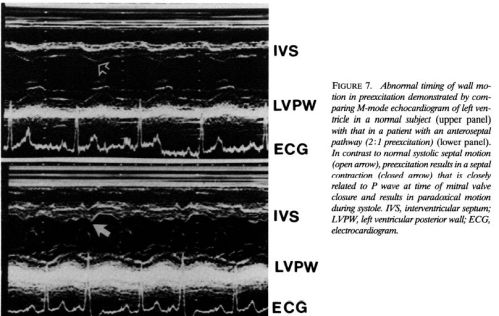
  • In fact ,  for every brady and tachyarrhythmia there has to be an unique pattern of IVS motion and mitral , tricuspid valve movement.
  • Almost all bradycadias can be diagnosed with echocardiogram by virtue of analysing the timing of  atrial vs  ventricular  contraction.
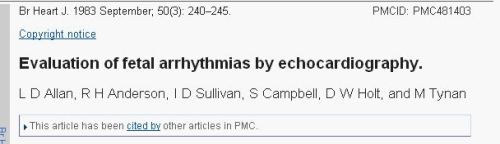
  • We know echocardiogaphy is the only modality available to diagnose fetal cadiac arrhythmias.* (How can  this modality becomes useless when the baby comes out of the mother’s womb  !)
  • Apart from this there is an  unique use for echocardiography to locate accessory pathway in WPW syndrome

The premature contraction of LV can be seen in few as  an early systolic dip in IVS movement -Type B WPW.

Image courtesy :  Helmut F. Kuecherer Circulation 1992;85:130-142

Abnormal jerky movement of LVPW indicate left accessory pathway -Type A WPW

Newer modes of echo like tissue doppler will improve the phase analysis of tissue motion and may provide us accurate information about preexcitation

Final message

The future looks bright . Time is not  far off . . .  where ,  we shall  use ultrasound as an adjunct  EP  study .

Reference

*Fetal Echo  =  to  Fetal electro cardiogram

WPW syndrome

http://circ.ahajournals.org/cgi/reprint/85/1/130.pdf

http://content.onlinejacc.org/cgi/content/full/33/3/782

http://www.heartjnl.com/cgi/content/full/82/6/731

Read Full Post »

« Newer Posts - Older Posts »