Feeds:
Posts
Comments

Archive for the ‘cardiology -ECG’ Category

Failed thrombolysis is a well debated concept, while failed primary PCI is a conveniently neglected phenomenon .

How to assess successful reperfusion following PCI or thrombolysis?

I do not know how many  of us know this vital fact !

Coronary angiogram is squarely beaten by the humble  ECG in assessing the effectiveness of myocardial  reperfusion . This is not hard to understand as  coronary angiogram *  can  tell us only  about epicardial  patency ,  while ECG  sends vital perfusion  data from within the  myocytes ! Which do you  think is superior ?

And now  interventional cardiologist have realised this fact . they  measure the ST segment  regression instantly once the primary  PCI is  completed . How ?  An ECG is recorded from  right inside the infarct  related artery .

*Of course myocardial blush score , TIMI frame count are poor alternatives !

This paper just published in CCI is  a fascinating revelation .

http://onlinelibrary.wiley.com/doi/10.1002/ccd.23455/abstract

Read Full Post »

This is a true story  . . . happened  many years  ago under my direct  vision.

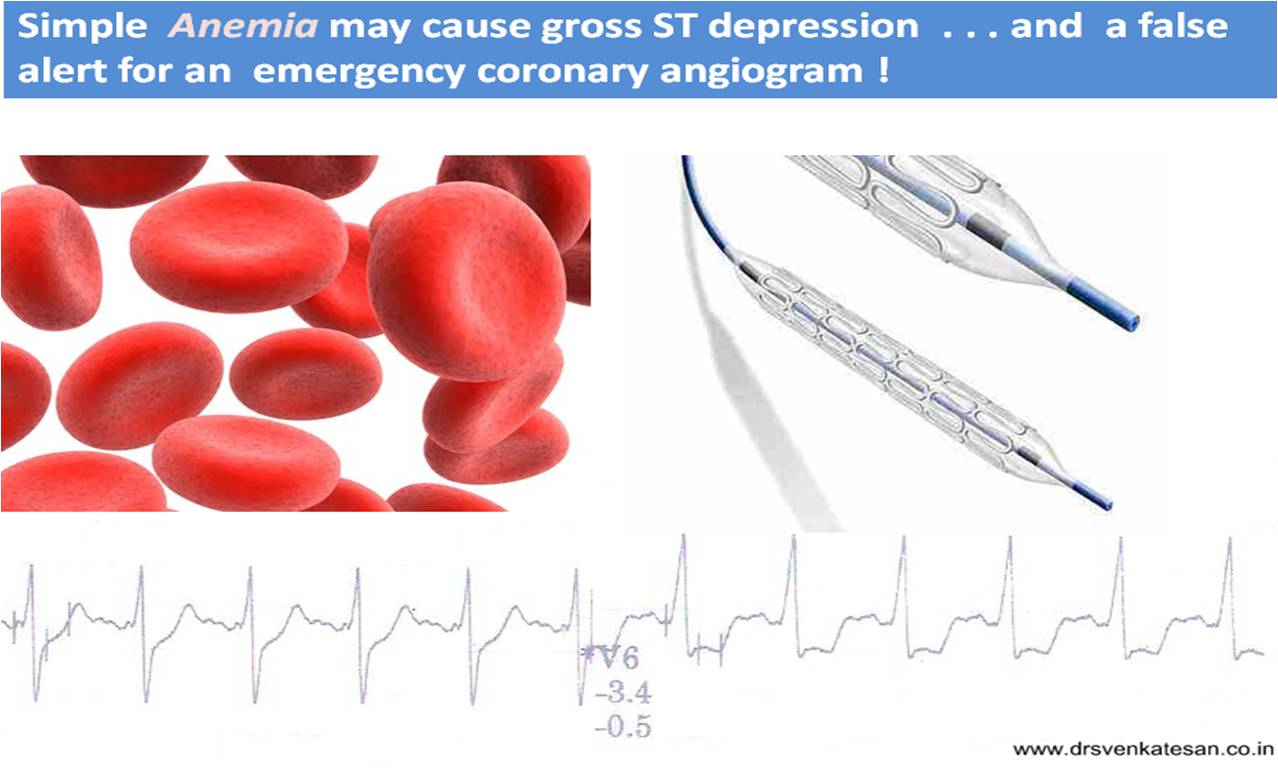
A  48 year old women came with significant breathlessness and catchy  sub -sternal chest pain .

“I  was exerting too much in recent days  doctor” , she said .

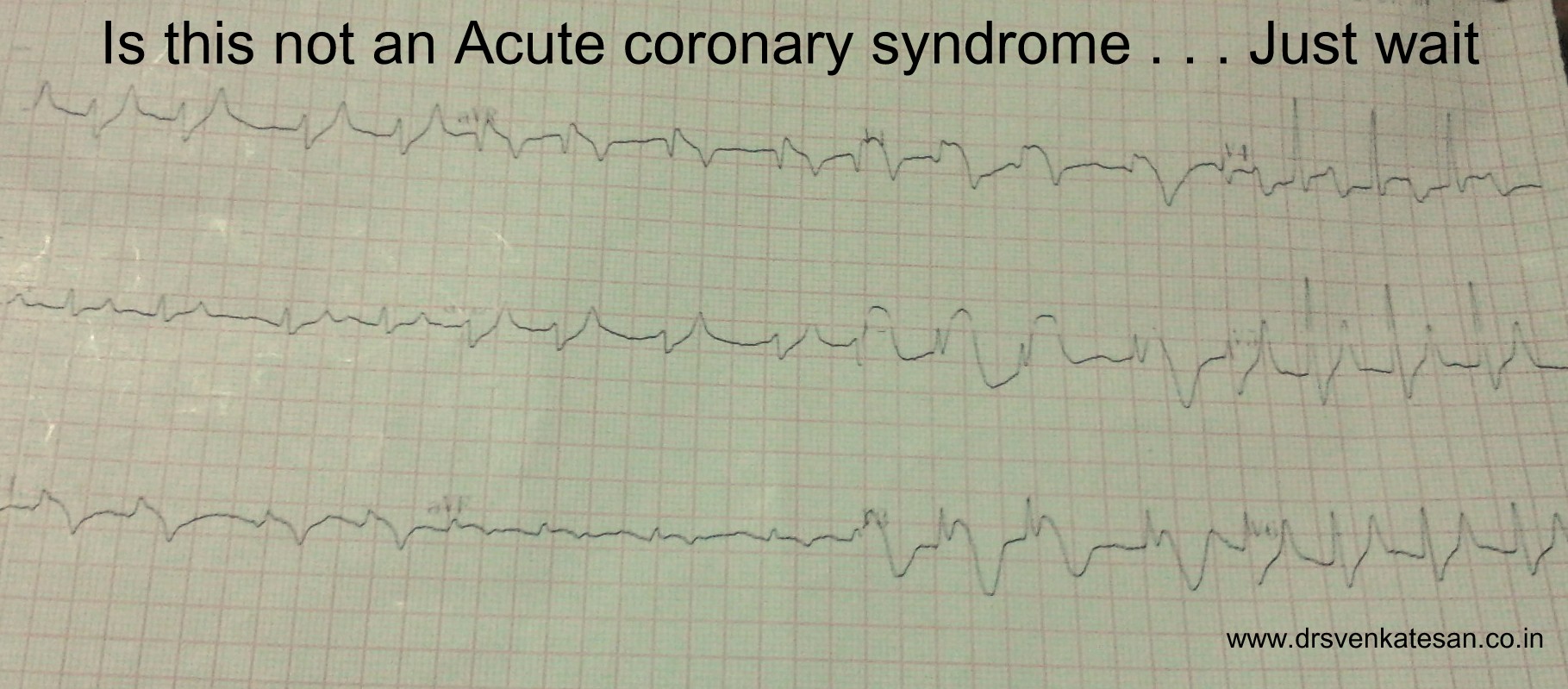
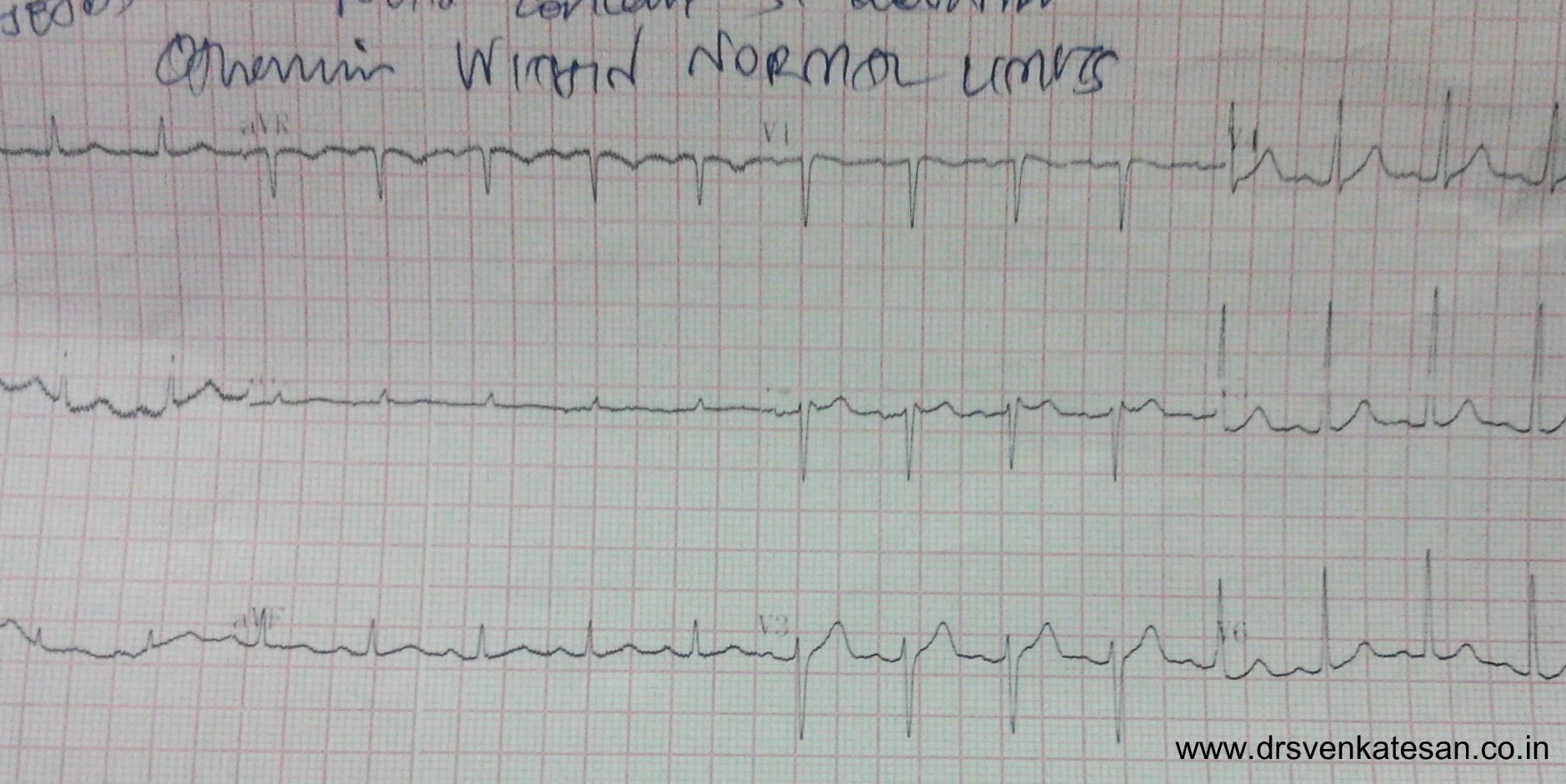
Her ECG  showed  a tachycardia and dramatic ST depression in most leads .

The ER in charge promptly texted the cardiologist .
The moment he saw the ECG ,he  had no hesitation , to order for an emergency angioplasty  (  How can he plan a angioplasty  , without even  knowing the coroanry anatomy . some one murmured  . May be   . . what he probably  meant was emergency angiogram   the other explained )    Further , he was telling his    fellows  . . . that  this is going top be  tough case and a possible  left main PCI .

An emergency  angiogram was done .  On table  it was a huge  surprise for every one ,  it was a  a classical  text book   look alike normal coronary arteries !

The moment normal CAG was  visualized  the consultant  concealed his momentary  surprise    and went on to say  it is classical case of syndrome  X   with severe micro- vascular disease causing ECG changes !

As  the patient did not give any opportunity to poke her coronaries   she was wheeled out of  wheeled out of cath lab.

Meanwhile ,  first year  fellow came rushing with the blood reports and biochemistry .

Is everything  alright ?   Yeh sir ,  except her Hb %  . . .  it is  5.6  Grams !

The bewildered  consultant *  realized   the  high  coronary drama , that is  been enacted  over the  past 2 hours !  and  learnt  (and taught) a most important  lesson to their fellows !

Hi guys , this is neither  a NSTEMI nor  a microvascular syndrome X  . . . this is simply anemia related  extreme  ECG changes !  We have erred in our reasoning and  our pre cath clinical scrutiny has  gone awry ! 

He went on to say  ,  don’t worry  many times medicine is learnt in  hard ways  . After all nothing adverse has  happened here .

The women was subsequently investigated and handed over to  gynecologist for a probable hysterectomy .

Final message

Please be reminded  , anemia  can produce  variety  of  ECG changes.  In extreme anemia  global ST depression is  common especially if  tachycardia is associated .

The lesson here  is ,  whenever  gross  ST depression is witnessed  with vague chest pain  check the hemoglobin first . This is an unusual story of a women  ,  with simple  anemia  (due to   chronic mennorhagia )   landed in cath table in an acute fashion .  Luckily  she  did not have any  incidental coronary  lesions  that prevented her becoming a  greater cath lab  victim !

* The bewildered consultant is none other than the author  of this blog.

Read Full Post »
Why Junctional rhythm has huge variation in P wave morphology ?

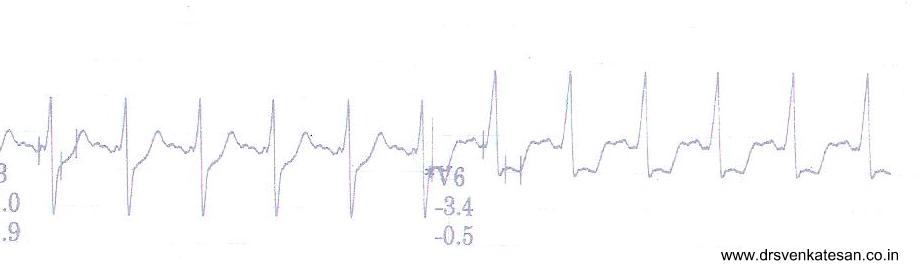
P waves in junctional rhythm can be

  1. Upright
  2. Iso-electric
  3. Inverted
  4. or  even absent

It depends upon the origin of junctional focus

  1. Site of  entry into RA
  2. Ability to capture inter -nodal pathways  and inter -atrial pathways ,
  3.  VA conduction velocity

Further ,the appearance and timing of P waves will be determined by the underlying structural heart disease also.

Final message

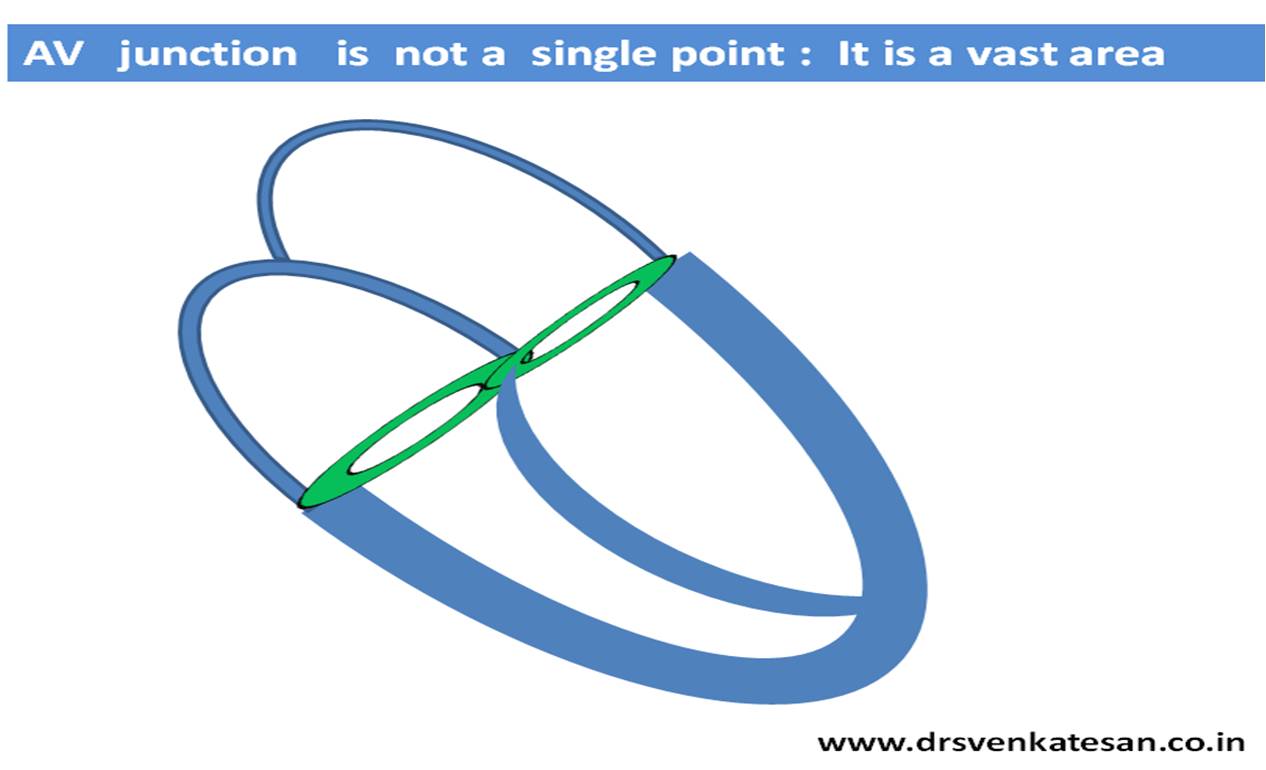
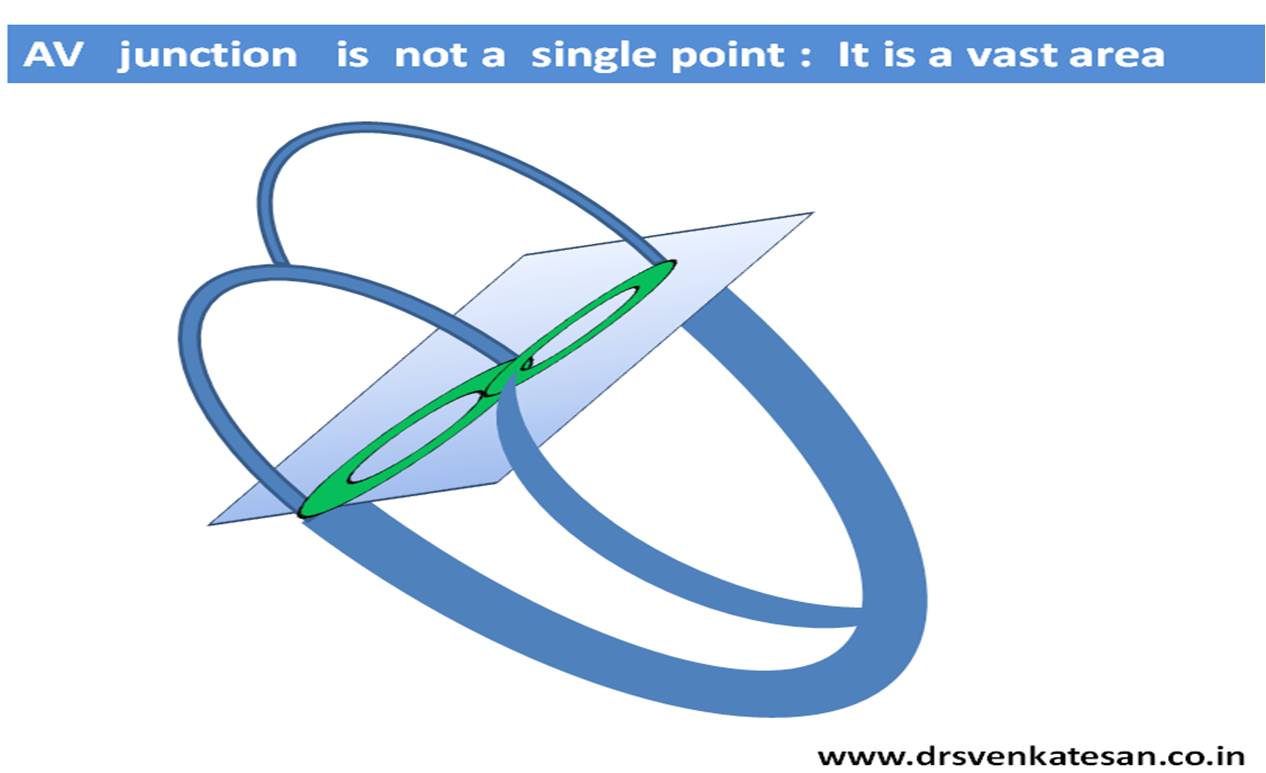
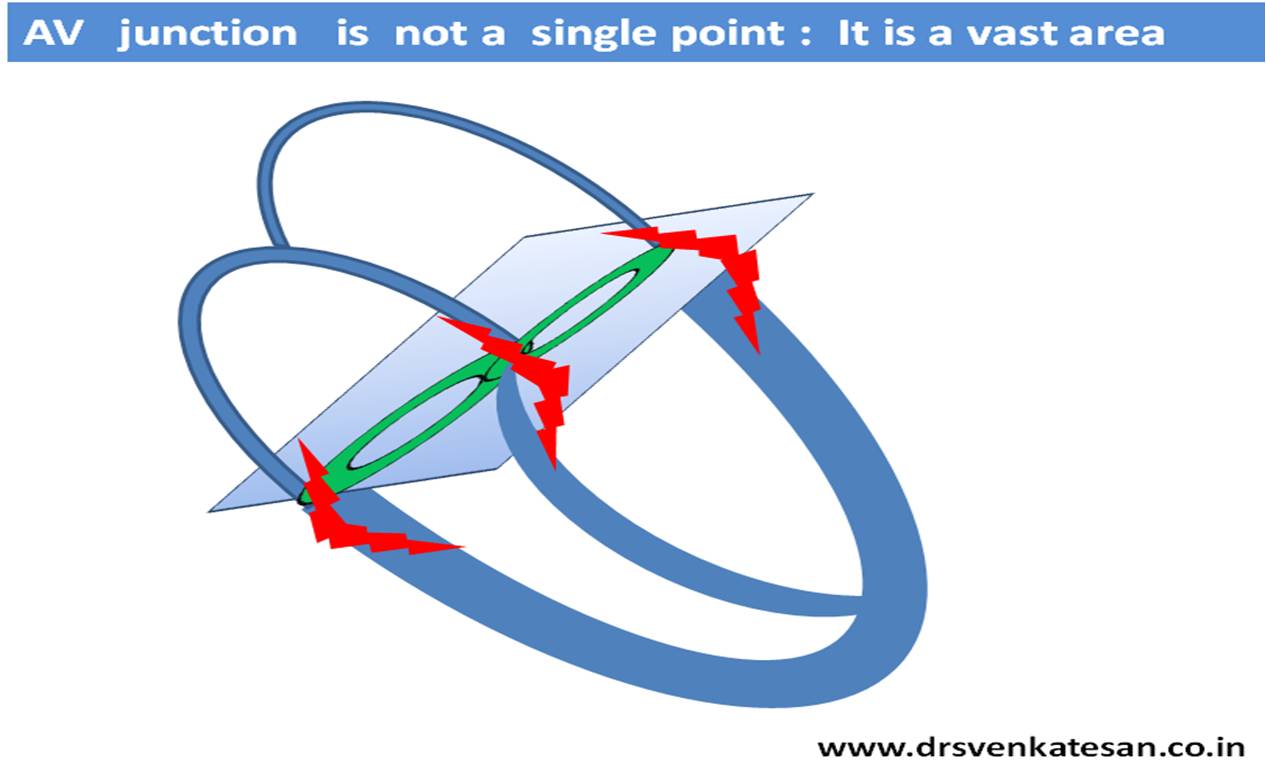
Medical  students  have  grown  up with the belief that  AV junction is a single  focused point .It is  true  in terms  of electrical circuitry  of  normal AV conduction .However  during pathological electrical disorders ( Which arise often because of structural disorder) it should be realised   the AV junction is a huge plane   .   Arrhythmia can occur anywhere from this plane .The entire plane  can become electrically active which may also  acquire the  ability to conduct bi-directionally .

Read Full Post »

AVRT is  a second commonest cause of  narrow qrs tachycardia.  While , all narrow qrs tachycardia in AVRT must be  ortho-dromic. wide qrs tachycardia in WPW  can either be ortho-dromic or anti-dromic ,

The classical one is the much popular and fancied Antidromic  AVRT . Please be reminded  AVRT can conduct  orthodromically  through AV nodal tissue  but still  become  aberrant , as it travel downwards thorough the bundles   and result in a wide qrs tachycardia .

Among the two which  is more common ?

My observation is  ortho-dromic  wide qrs  AVRT  is  more  prevalent . Do you agree ?

Final message

Not all wide qrs tachycardia  in WPW  is anti-dromic !

Read Full Post »

The fundamental difference between  accessory pathways (APs) and AV nodal tissue is the former lacks decremental properties . That is  , APs continue  to conduct whatever the  impulse   it receives. (Unlike  the AV node which has a filtering  mechanism , A heart rate sinker / Dampener) . This is what we were taught and we believe in that .

If it is true  , every episode of   atrial fibrillation should conduct with 400-600 ventricular responses . In reality it does not happen .  The usual ventricular rate in AF with WPW is  250-300 /mt .

What happens to the rest of atrial impulses ?

I am sure it must  get   blocked in APs . Of course it is possible the block need not be in a fixed ratio  .It  changes in a  dynamic   manner with  reference to the   refractory period . (Please note , blocks and increased refractory  periods  can be  used inter changeably in most  physiological situations .

Final message

All APs are not dangerous .They do have a   restrictive mechanism in place .This is evident in every patient with AF and WPW syndrome with a fairly controlled ventricular  response  . Hence  one can conclude   APs in WPW syndrome do have a physiological block in most episodes of  Antidromic AF . The cut off  for safe  refractory period is defined empirically as > 250 ms.

Coming to the title  question , Is  there a physiological  2 : 1  block  in accessory pathway  during AF and WPW syndrome  ?

Yes . It seems so !  A WPW  patient who has  just recovered from a  well tolerated AF ,  is  sort of a natural screening test which effectively rules out a future SCD .(Unless of course he has multiple APs with varying RPs  , one for AF other for VF !)

Is that a correct way of reasoning ?  Experts may provide further  input .

Read Full Post »

A 38 year old man presented with  acute breathlessness  and chest pain .His ECG is  posted  below . The ER in charge   medical officer promptly handed over the patient to   STEMI  alert    group (This is how  cardiologists are   referred to !   in one of the leading corporate hospital in India )

Note Atrial fibrillation , ST segment elevation, in pre-cardial leads

A team of  white coated  humans  in  various  gender and ages  swarmed the patient . ECGs and text where shared  among  the  STEMI alert group  through  I pad 3 which transmitted  HD  quality ST elevation with a  retinal  precision . A senior consultant   insisted   to shift the patient to cath lab direct  . Since he had  signs of cardiac failure , one of  the wise Junior fellow wanted  to correct the failure with Nitroglycerine  and  Dobutamine before rushing him to cath lab . Hence he was put on hold in the side room of ICU .

Echo examination showed LVH and wall motion defect could not  either confirmed or ruled out .  Initial  Troponin was negative . In the mean time the bio chemistry results came. He had a creatinine of  5.2 and Potassium of 6 meq . Hence the patient was diverted to Nephrology unit  and  dialysis was done. The next day morning  his ECG   looked like this .

It  may  sound a  pessimistic , but  still I would consider   the above  episode  is  a rare  example of appropriate care happening  ! This patient was diverted in a timely fashion from cardiology  care  to the  Nephrology . Please note , it is not the  the  clinical acumen that   helped  here.  If  he had  not presented with  LVF   he would have been a victim of inappropriate care  and landed on the cath-lab table directly  !

Final message

Every moment in clinical medicine is important , especially during the genesis of  diagnosis.  Where the patient lands  . . . in a frighteningly  large  hospital is as important  as the disease process itself. In this scientifically arrogant medial atmosphere  most of us, are  tuned  to view every problem as their own  ! This is  the default mode of modern medical  thinking process . How faulty  we are ?

The future is worrisome  as the field of  Internal medicine is  at risk of dying a premature death (or is it dead already !)

By the  way  what is the mechanism of ST elevation and Tall T waves in hyper-kalemia ?

Many factors contribute .

  1. Is it a true ST elevation  ? There is reason to believe   the tall T waves drag the fag end of ST segment along with it .
  2. Next is  related to QT interval . Hypo-kalemia widens while hypo-kalemia does  the opposite .(  though not classically) .
  3. When QT is shortened the segment gets squeezed in within a limited space ,  in order to accommodate the  ST segment it   gets rolled up and elevated . (Like an up sloping ST segment  in extreme tachycardia during stress  testing)
  4. Whatever  be the mechanism it is something to do with potassium ion flux .Transient intra-cellualr hyper-kalemia.
  5. Another possibility is diffuse uremic peri-carditis , which is a common accompaniment  of renal failure.In fact this patient did have a peri-cardial rub

Read Full Post »

Angina is the classical clinical counterpart   of  myocardial Ischemia.

True  Ischemia , by electro- physiological rules  must elicit some sort of  ST segment shift .(Usually  ST depression rarely Elevation  )

But  . . .  we know Ischemia and ST depression do not always go together !  Dissociation can occur in both ways.

ST depression without angina is more prevalent  (often referred to as silent ischemia)  , while angina without ST depression is  less common but by no means rare .

We observe both these  phenomenon  during EST.  The  critical issue  here is ,  any pain without ST depression during a EST , the physician is likely to reject it as  non cardiac.

How wise  it is ,  to ignore such chest pain  ?

If a patient  complaints  true  compressive , squeezing  pain  it should be taken as angina  and EST should be  stopped and labelled as positive   even without  ECG changes .

According to the much   famed (De ) theory on ischemic cascade chest pain is supposed to come last. Time and again the rule of ischemic cascade  goes awry in the bed side. Clandestine angina without any ECG evidence be more important clinical entity than we realize.

                                      The argument against this ,  “If you start believing  patient’s  word  more than  ST depression  then the very purpose of EST documentation is lost  !

According to the now  de-famed theory on ischemic cascade ,  chest pain is supposed to come last. Time and again the rule of ischemic cascade  is found to go awry in the bed side .Clandestine angina without any ECG evidence be more important clinical entity than we realize.

Another clinical situation where we  encounter  ST segment  : Angina dissociation is ,  during balloon inflation of PTCA.

Two  explanations can be offered  for Angina in the absence of ECG changes .

1 .Cancellation of ST vectors  due to ischemia of two diagonally opposite areas of ischemia.

2. Electrical  blind spots  in 12 lead ECG. This  is especially common with LCX ischemia  where most of the electrical events are directed to back of the chest.Conventional leads can easily miss .

Read Full Post »

Identifying the P wave is the key to decode  any  narrow QRS  tachycardia . Though the  the relationship to  p and  qrs is vita ,  many times it is  not  easy to  relate them.More easily one  may  get  a  clue to the mechanism by analysing   P wave timing .This is the basis of calling narrow qrs tachycardia as short RP and long RP.

Wonder   . . .  why  the  relation “P to R” became  “R to P” here !

Since  in the   common narrow qrs tachycardias  AVNRT/AVRT  ,  atria  activates  the atria  in a  retrograde manner , we look  for the relationship of qrs complex on subsequent P wave . Hence the interval between R to P become the focus.

In other words RP interval indicates retrograde  conduction property of AV tissue .

If it is slow the P wave will be well separated from QRS .

If it is fast it will be close to QRS complex .

If it is ultra fast as in some AVNRT ,it can fall within the qrs complex and completely invisible .

(The so called  r’ prime in classical AVNRT is nothing but a distorted p wave on the terminal qrs complex.)

Based on  RP interval  the following classification is used (List is incomplete)

Short RP Tachycardia

  • AVNRT (Slow-Fast )
  • AVRT

Long  RP tachycardia

  • Atypical AVNRT(Fast -slow)
  • Atrial tachycardia*
  • Sinus tachycardia*
  • SA nodal re-entry*
  • Some forms of AVRT

* Please note ,  here the P wave is not determined by the preceding qrs unlike other tachycardia in the list.

What is the  cut off point to call it is Short RP /Long RP ?

It is arbitrary . Following may help

If RP interval > PR interval it is long RP.

If the absolute RP interval is >  100  ms  with the heart rate of > 160 it would  generally  Indicate a long RP tachycardia .

The timing  of  retrograde P can be very complex than we believe  as the following factors heavily influence it.

  • The autonomic tone
  • Site of retrograde atrial  breakthrough point .
  • Atrial size ,
  • Atrial  refractionaries
  • Effect of drugs
  • Intact-ness of inter atrial conduction
  • Chances of the retrograde atrial activation capturing Internodal pathway

Final message

The P wave location in narrow qrs tachycardia is primarily determined by the retrograde VA  conduction and less  on the antegrade AV conduction  . Looking at the interval between R and P is a  quick way of getting the VA conduction in the bed side.

Once we get an  idea how the VA  circuit  conducts , we can narrow down the possibilities  in  Narrow qrs tachycardias !

Comming  soon

What determines the morphology of retrograde P waves in AVNRT/AVRT ?

Read Full Post »

Tachycardia – Bradycardia syndrome is the hall mark of sinus node dysfunction.

  • The commonest tachycardia in sinus node dysfunction is Atrial fibrillation . Followed very closely by sinus tachycardia . In fact alteration between sinus tachycardia and sinus bradycardia without other pathological arrhythmia is rare . (Of course , we have a name for such an entity as inappropriate sinus tachycardia / bradycardia )
  • Atrial tachycardia occurs a distant 3rd
  • Ventricular tachycardia may be an exception (Please note , extreme bradycardias which lead to pause dependent VT is not directly related to sinus node disease )

The commonest bradycardia in SND is

  • Sinus bradycardia (This fact is undisputed unlike the tachycardia component of SND !)
  • Followed be sinus pause , SA blocks and sinus arrest .
  • AF with slow ventricular response ( Bradycardic AF) We are not sure about the rhythm here (Is it truly junctional /or conducted atrial ? )
  • Associated AV block can occur up to 20 % of patients .If AV block is present the true nature of SA node disease is masked and it’s function becomes almost irrelevant .

Read Full Post »

IRA localization for both LAD and RCA , LCX  is a fascinating  exercise for cardiologists.I suspect  our understanding  about this crucial issue is  far from complete .While  localizing  level of lesion within LCA  or RCA requires more precise data and erring is acceptable  , it is not uncommon to  call  even the  IRA wrong  especially in multi -vessel disease.

Why current   criteria of IRA localisation goes awry many times  ?

The  factors  that operate are not few   . . .  it  runs into a dozen  at least  !

  1. Dominance  is never considered during IRA localization  (A right dominate system can vastly influence the LAD localization  algorithm PLV branches  can protect LV postero- lateral segments in spite of proximal LAD lesions )
  2. The length of  mid LAD   IS  controversial entity ( Traditionally  it refers  to  the  segment  between first major diagonal to second  major diagonal or septal  leads to faulty   coronary mensuration .It is not uncommon to have a  mid LAD measuring few  mm  when  full the full  length of  LAD  is about 15-19cm
  3. Diagonal vs OM  trade off occurs  in every alternate patient which is ignored  !
  4. Ramus  is never considered worthy enough  to be included in the IRA  localization scheme (In spite its presence  in 20 % )
  5. Type of LAD is not given allowance.
  6. Finally &  most importantly these rules of IRA localization will not apply in  the setting of  multivessel  CAD
  7. In the presence of Pre existing CTO
  8. STEMI following chronic stable angina
  9. Extensive collaterals
  10. Re Infarctions
  11. Post CABG etc

Final message

Decide for yourself  . . .  how good is the value of IRA localization  after  considering all the above variable. . It is not a great thing to predict  correctly RCA from LCX in an  inferoposterior MI  with a  70 % accuracy  . (It actually means  20 % accuracy  )    statistically when there are only two options  . . .  we are blindly  right 50% of times   !

Read Full Post »

« Newer Posts - Older Posts »