Feeds:
Posts
Comments

Archive for the ‘cardiology -ECG’ Category

Brugada syndrome continues to fascinate  us for two reasons.

One , it deals with mysterious sudden  deaths of young  men and women

Two , it is one of the  fine  examples  of how  advances in molecular biology , links  physical defects in ionic channels to  sudden electrical  death (Most of them  are due to inherited defects  sodium channels  of myocyte cell membrane )

While high risk subsets of Brugada are easily managed , it is  the asymptomatic  ones  that bother us.

The following are some of the  difficult  questions ,   a  cardiologist faces when dealing with   patients , who exhibit  only Brugada pattern in ECG .

  1. Should I go for an EP study Doctor  ?
  2. Will  I  require an ICD  Doc ?
  3. Do I carry a significant risk of  dying  suddenly  ?
  4. Do  I need a genetic test for sodium channel mutation ?

Fortunately,  we can answer  all these questions with much  courage than before.

(Thanks  to the European Finger registry published in 2010  !)

“No” is the  clear  answer for all of them !

Summary from the FINGER registry. 

(France  , Italy, Netherlands, GERmany)
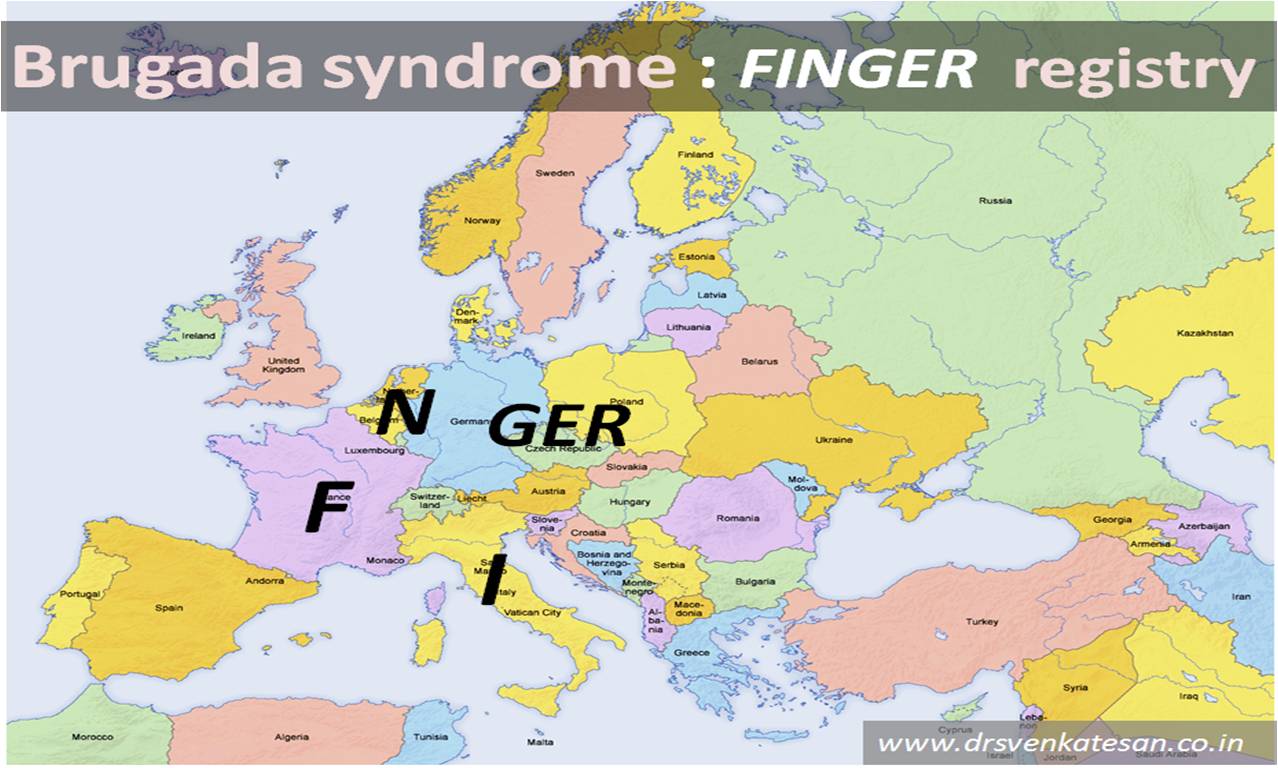
The registry included 1029 consecutive individuals

(1) Aborted SCD (6%);

(2) Syncope otherwise unexplained (30%);

(3) Asymptomatic patients (64%).

In the  follow-up of 31.9 (14 to 54.4) months . A total of  7 death occurred .

The cardiac event rates per  year was 

  • 7.7% in patients with Aborted SCD,

  • 1.9% in patients with syncope

  • 0.5% in Asymptomatic patients.

Predictors of cardiac  event

  1. Previous syncope
  2. Spontaneous type 1 ECG

Non predictors ( Surprisingly there were more non predictors ! )

  1. Gender has no predictive role
  2. Familial history of SCD,
  3. Inducibility of ventricular  tachy-arrhythmias during  EP study,
  4. Presence of an SCN5A mutation


Follow up

PRELUDE study  almost reaffirms  Finger data

(PRogrammed ELectrical stimUlation preDictive valuE)

Just publicized in JACC 2012 from the pioneer of   Brugada Silvia  Priori of   university of Pavia  Italy

Reference

http://circ.ahajournals.org/content/121/5/635.full.pdf+html
http://content.onlinejacc.org/cgi/content/abstract/59/1/37

Read Full Post »

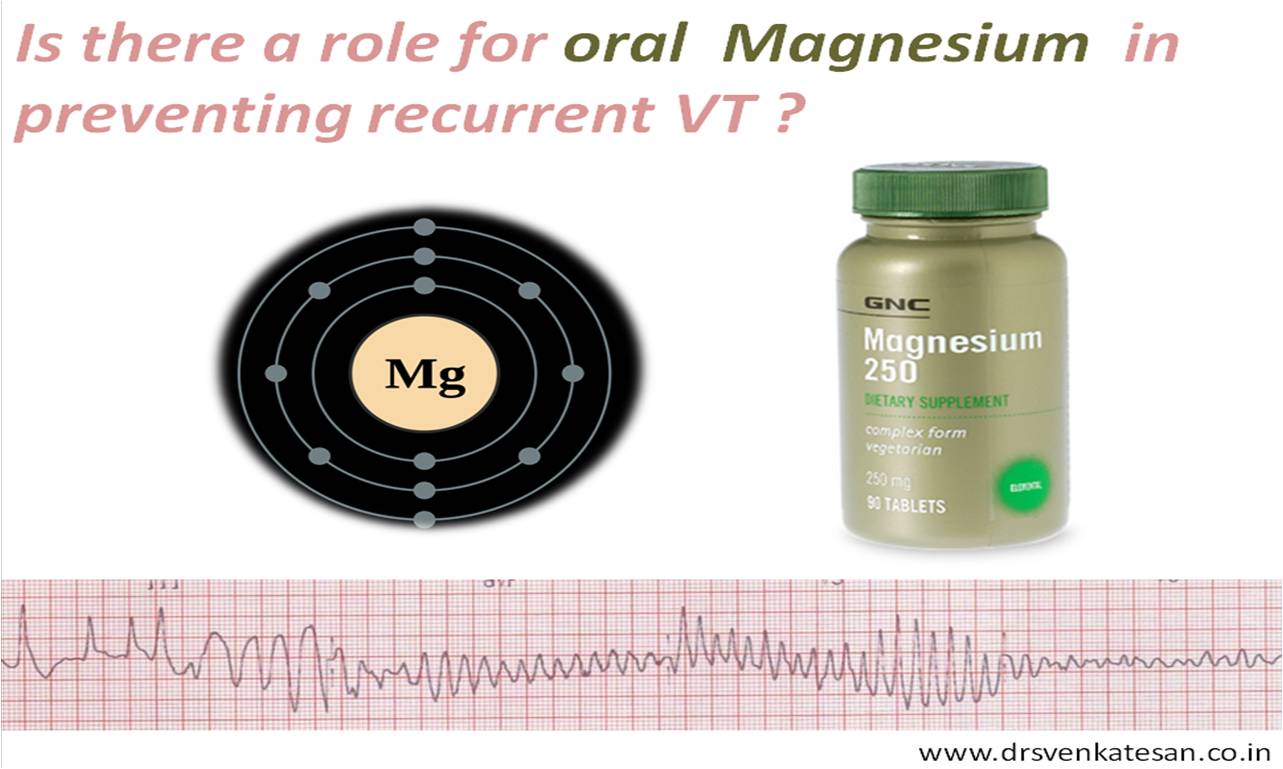
Magnesium   is a powerful anti-arrhythmic drug . It has a well  established role in controlling VT when administered  Intravenously   especially in polymorphic VT .

Mechanism of action

  • It acts at the cell membrane.
  • It has a unique action of blocking calcium channels  that reduces the number of oscillations of  both  early and late  after potentials

Link for more  on mechanism  of action

https://drsvenkatesan.wordpress.com/2010/01/13/how-does-magnesium-acts-as-an-antiarrhythmic-drug/

How often cardiologists administer oral magnesium for long-term control of VT ?

As for as I know ,  no one uses it ! but dietary  supplements are used for general well  being .

Why ? Is it because

  1. Magnesium does not get absorbed in the gut
  2. Magnesium levels are un- predictable in plasma if administered orally

Answer : No one has really tried  it as a  chronic therapy in VT  yet  !

Final Message

Tablet Magnesium can give a tough fight to Amiodarone and Flecanaide in refractory VT at a fraction of the cost !

Who has the audacity  to  compare Magnesium  with Amiodarone head on ?

Reference

Magnesium as health supplement . 

Magnesium is available  in tablet form as  Malate , Stearate, Taurate and Aspartate  along with calcium and Zinc etc .

Read Full Post »

The entity of stress cardiomyopathy ,  other wise referred to as  Takotsubo  cardiomyopathy is a popular clinical entity in recent decades.The heart and mind are closely linked entities even though they are  situated apart physically . Extensive neural and hormonal control  mechanisms  exist.

In extreme stress ,the hyper- sympathetic  drive triggers a rush of adrenaline ,  which some how makes the  left ventricle  to bulge out !

The clinical features  are varied .

  • It can exactly mimic an acute coronary syndrome .
  • ECG may  show ST elevation and mimic an anterior STEMI
  • Echo shows a wall motion abnormality  classically  described  as the apex alone dilates /Bulges or elongates
  • LV  may acquire a shape of a  banana. (See below )

A 45 year old man came to the ER with severe chest pain , dyspnea and minimal ST elevation in anterior leads. He  was a smoker and was experiencing  recent major office stress  . Echo showed an elongated LV apex with some thinning .We made a diagnosis of stress cardiomyopathy .( It was disputed by my professor as the LV  apex was contracting well   ! but we  learnt later there are many varieties of Takatsubo )

Echo showed an elongated LV apex with some thinning . Note the LV apex goes  out of plane  with RV apex.

Color  Doppler revealed Trivial Mitral regurgitation

Follow up

He underwent coronary angiogram.  Had  no significant lesions ,   in 48 hours time the wall motion defect disappeared and was discharged with beta blockers.

Incidence

Up to 2 % of ACS could be related to Takatsubo . More common in women especially post menopausal  , with stressful/emotional background like loss of loved ones.

Synonyms

Apical ballooning , Broken heart syndrome ,  Stress cardiomyopathy.

Mechanism

Not clear . Microvascular spasm , excessive catecholamines  ,  are thought to be major culprits.

Echocardiography

Hyperkinetic base and akinetic or dyskinetic LV apex .

Lots of variations are reported .

Shimizu described 4 types

Courtesy : Shimizu et al J Cardiol. 2006 Jan;47(1):31-7.

  1. Apical akinesia and basal hyperkinesia,
  2. Reverse  Takotsubo  (Basal akinesia and apical hyperkinesia)
  3. Mid-ventricular ballooning   with  basal and apical hyperkinesia
  4. Localised  to any one segment

*The Banana type which  is described here (Elongation  of LV apex > Widening )

Histopathology

Focal myocytolysis are described. (Broken heart)   Monocytic infiltrations are common.These are  believed  to be transient .

How to differentiate it between a STEMI ?

  • Enzymes are only mildly elevated.
  • Wall motion defect do not confine to a specific arterial territory.
  • Most importantly coronary angiogram do not reveal any significant obstructions.

Prognosis and outcome

  • Generally good
  • The initial presentation may be turbulent in few with cardiac failure or arrhythmia .Other wise these patients do well

Treatment

  • Mainly supportive
  • Major principle is to avoid inotropic agents as they  are already  heavily expose to it
  • Beta blockers  could be the mainstay therapy .

Final messge

Think about  Takatsubo  whenever an acute coronary syndrome presents atypically . Not surprisingly few of them land in the cath lab !

Reference

http://www.cardiologyrounds.org/crus/cardus1206.pdf

Read Full Post »

Irregular  wide qrs tachycardia is a fairly common clinical entity in any cardiac emergency room. The moment you ask about  such tachycardia ,  9/10  fellows will  come out with a  prompt answer   ” AF with WPW syndrome” even before you complete the question !  It is not that common  as we perceive .The problem is with  our traditional teaching methods and the attraction of human brains to  rare and exotic disorders.

traditionally   SVT with aberrancy  is   diagnosed  mainly  in the setting of regular tachycardia .

We often  forget  “AF with aberrancy”  is equally common  , and  it presents   with a  irregular  wide qrs tachycardia . 

I  wonder whether  this phenomenon  can be termed as  orthodromic aberrancy .This can directly compete  in the differential diagnosis  of  antidromic AF  with  WPW !

It should also be mentioned antidromic  AF can run into very high rates  as accessory pathways do not check the incoming signals while orthodromic aberrancy the ventricular rates can not exceed 220 or so at least theoretically . (This simple clue can clinch the issue in favor of  WPW )

There is no proper  published data available for the true  incidence of AF with orthodromic aberrancy in general population

In fact , there are  many  electrical  environments for AF  to  become a  wide qrs AF

1. AF  with  Antidromic conduction through accessory WPW pathway.

2. AF with Orthodromic aberrancy ( Non WPW – Similar to  any SVT with aberrancy )

3. AF with pre existing LBBB

4. AF  with Amiodarone effect. (Especially with DCM and cumulative load of Amiodarone )

5. AF with electrolytic /  especially excess  intra-cellualr  potassium

6. Finally , even  Atrial based pacing (DDD)  can cause wide qrs irregular tachycardia when  mode switching  fails .Here the  ventricles  may track the  atrial irregularity  and respond with a  wide qrs  bizarre tachycardia .

Final message

There are many causes for  wide qrs tachycardias  in  Atrial fibrillation . WPW with anti-dromic conduction is just  one of them .We need to approach the issue with an open mind .Please  be reminded , once contemplated  WPW syndrome  can be a powerful thought blocker  !

Note : *We are not including   polymorphic ventricular tachycardia here .It is an  important subset of  wide qrs irregular  tachycardia.

** VT can co-exist with AF .This is not   surprising  as  many of the diffuse cardiomyopathies  involve  both atria and ventricle  with extensive scarring and fibrosis  a perfect trigger for  both atrial and ventricular arrhythmias .

Read Full Post »

You are asked to see a patient with a pulse rate of 45 /mt .  Is it sinus bradycardia  or  complete heart block  ? 

Only one condition , . . .  you must conclude in the bed side !

  • Heart rate  may give a clue ( HR of  30-40 is common in CHB . Less common in sinus bradycardia.)
  • Pulse volume is large in both (More so in CHB )
  • JVP  shows occasional cannon waves hitting the neck  in CHB. Cannon wave can never occur in sinus rhythm
  • S 1 intensity may vary in CHB (As  Marching through  of  P waves  occur in CHB  ,  when it falls close to QRS  , it results in a  short PR interval  and a  loud S1   . Since marching through is a intermittent phenomenon S 1 intensity also varies.)
  • A short systolic murmur may be  heard intermittently due to   trivial MR/TR in CHB  ( Competitive AV valve movement )
  • A  simple bed side test  . Ask the patient  to exert for a minute -Sinus bradycardia raises  the HR with a fair regularity  to 80-90/mt  or so. CHB doesn’t  (Note :  CHB with  junctional rhythm can  sometimes increase the HR  significantly )
  • Finally response to Atropine   is prompt with sinus bradycardia.

Final message

Bed side skills in recognising cardiac arrhythmias are still relevant even in the current  era of carto and 3d electro anatomic mapping .

After all ,  the 19th century clinical wizard Wenke back recognised the second degree  AV  block at the bed side  well before  the ECG machine  was invented. He meticulously observed progressive prolongation of a-c interval and subsequent drop of c wave in the jugular  vein !

Read Full Post »

Ventricular tachycardia is  a major cardiac electrical disorder. Even though it  connotes a deadly meaning the prognosis and outcome vastly vary.It can be a benign arrhythmia in  structurally normal heart that present as occasional fasicular VT  or Exercise  induced RVOT , to dangerous ischemic polymorphic VT which rapidly degenerate to VF and SCD if not reverted . It is ironical we are  trained  to put all VTs in a single basket and  propagate fear psychosis among   physicians and patients .

Management of VT has certain broad principles.

  • Identify the cause
  • Whether  specific structural heart diseases present or not
  • Identify the mechanism if possible
  • Rule out transient metabolic cause as a trigger

Therapeutic targets

  • Stabilising the cell of origin
  • Passifying the scars
  • Interrupting bundle branches in  BBR  mediated tachycardia
  • Ischemia related  Focus – Re-perfusion
  • Reversing LV dysfunction

Management

General

  • Correct Cell hypoxia /Acidois
  • Pharmacological ( Class 1A/1B /1C , class 3 and Beta blockers , Magnesium  )
  • Role of  beta blockers for VT management is largely under recognised.It has an important role to play in both acute and chronic  VTs)

Electrical (DC shock ,Ablation and ICD)

  • DC shock is treatment of choice  all emergency VTs
  • Ablation  aims  at preventing episodes of VT .Ablation needs EP study and  expertise of  an electro physiologist.
  • ICDs  revert it only after the VT emanates from the focus . ICD can be implanted without knowing the focus .May not require a EP consult.

Surgical

CABG + Surgical scar excision , Aneurysectomy  might help in certain refractory VT.

Read Full Post »

A 55  year old man came with a BP of  1o0/70 with vague symptoms of back  pain to our ER.

Troponin T  was positive

Can we thrombolyse ?

There is a minimal ST elevation in inferior leads  but not amounting to  the required criteria 1 mm

Technically No , Academically yes , scientifically No , logically  yes

*I wont thromolyse but i will take him to cath lab maybe the modern answer

 What we did ?

We did neither !

Just observed in CCU with heparin infusion , Aspirin and clopidogrel .

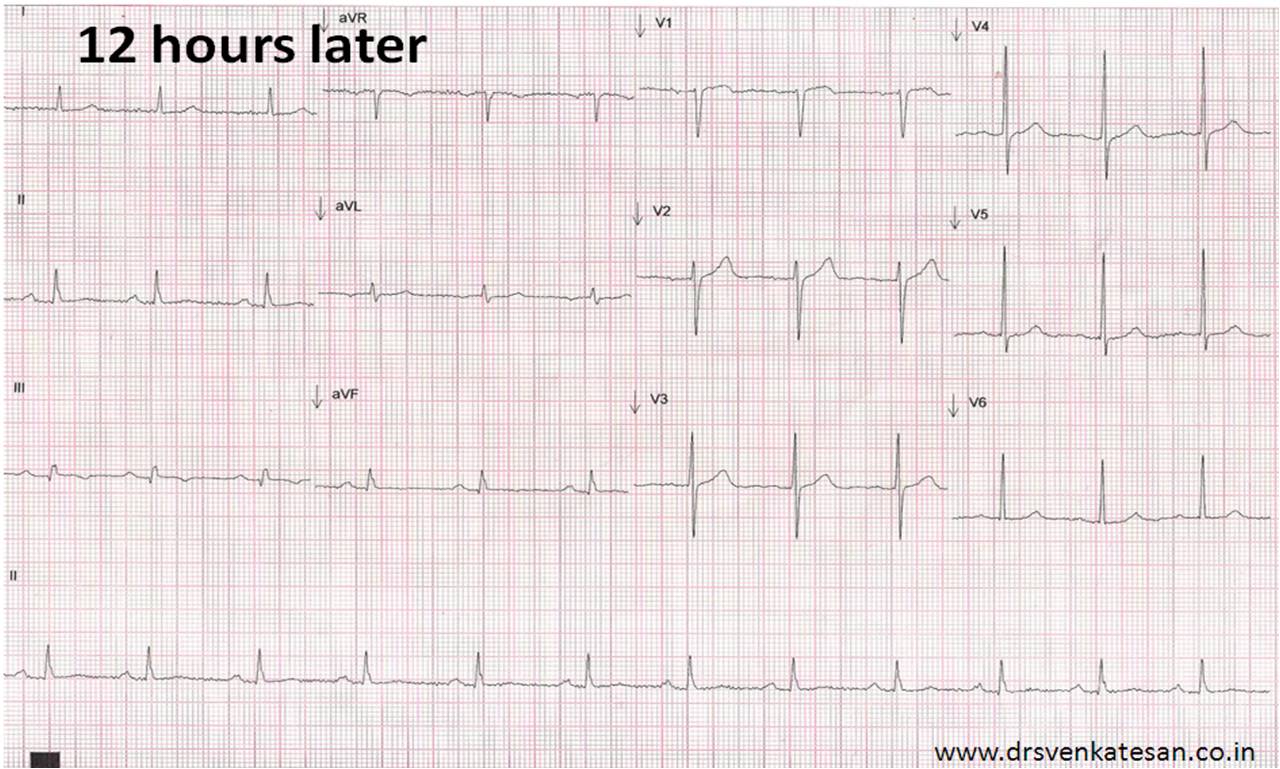
Note: The ECG becomes almost normal .The initial suggestion of inferior MI is stands questionable

Serial ECGs  were taken .

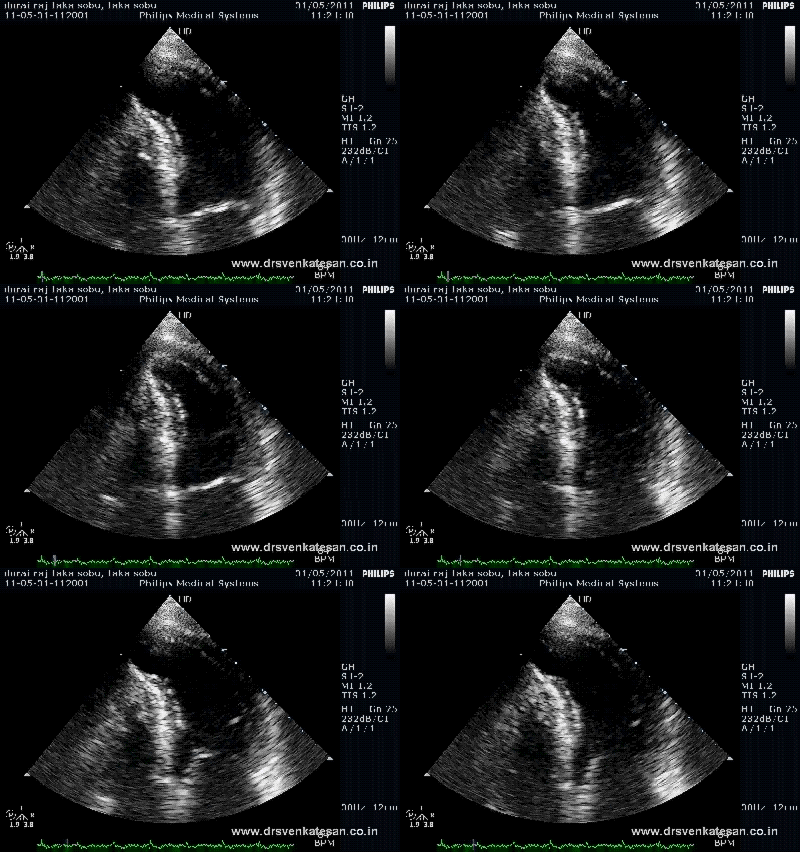
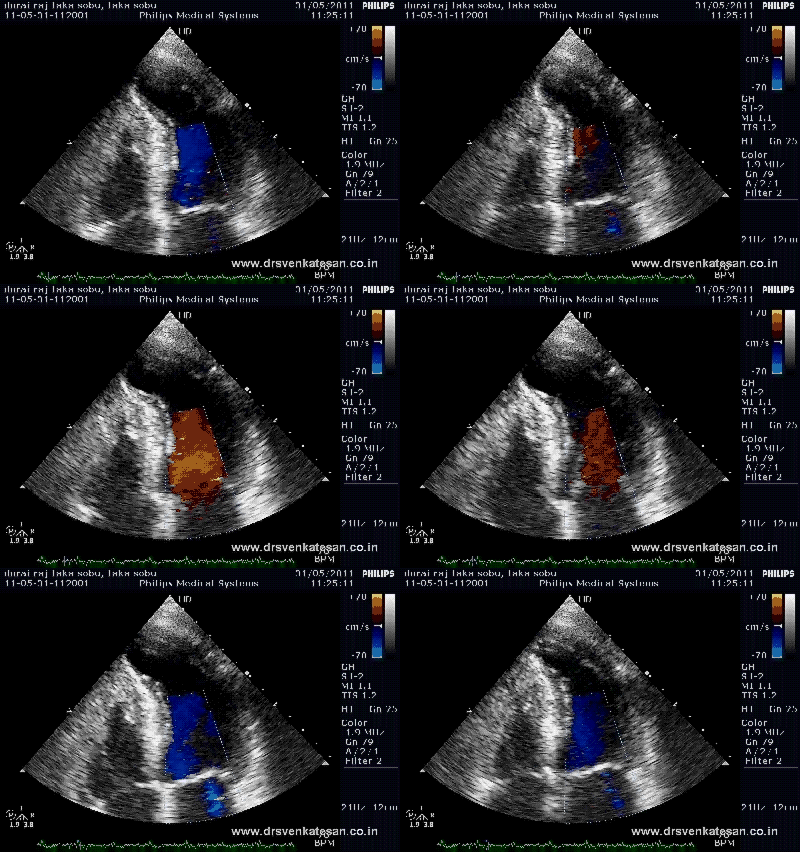
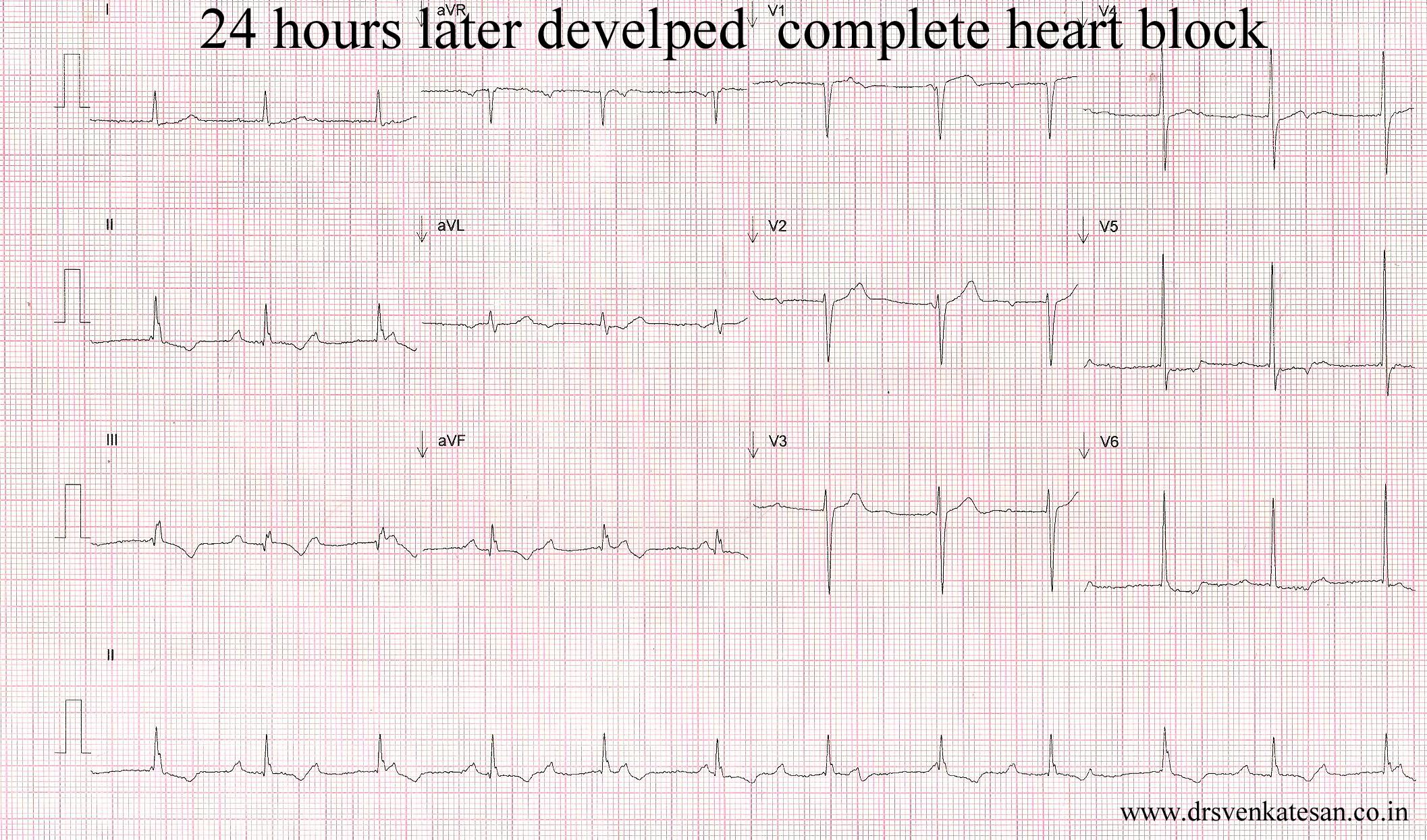
And now . . . after 24 hours a new complete heart block appear with classical evolved pattern of inferior MI.The most interesting feature is patient has been comfortable all along even as his posterior aspect of heart is experiencing terrible electrical earth quakes.

Is troponin Guided thrombolyis  an accepted  concept  ?

Yes ,  only in few situations like , posterior MI ,   LBBB  , pacemaker rhythm, re infarction .(Note , true posterior MI do not elevate the ST segment but depress it ) .

One may be surprised why we shouldn’t lyse a patient  whenever  troponin is elevated in acute coronary syndrome  (After all it denotes myocardial necrosis and infarct !)  The point here  is ,  troponin can raise in all forms of MI (NSTEMI, even in some cases of chronic stable angina )  Read in this link Why thrombolysis is contrindicated in UA/NSTEMI

The benefits of thrombolysis  is not proven in small and micro infarcts.  ECG  ST  eelvation   remain the  sole criteria for thromolysis for STEMI because  of  high degree of  correlation with total coronary occlusion .

In this era of rapid interventions the treatment concepts has blurred as we tend to do PCI and stenting  most cases of ACS including UA/Unstable angina

OK , what happened to this patient ?

Temporary pacer  was kept stand by with a sheath and catheter in situ.

Next day  morning  AV block disappeared .Patient was comfortable .

To our surprise , in the same  evening his ECG showed a complete heart block with AV dissociation . Still the heart rate was good . The demand temporary pacemaker didn’t take over .

On the third day , every conduction disturbance disappeared and  patient was sent to the wards. He is being discharged in a  stable condition with std drugs .there was  a minimal wall motion defect in infero-posterior segments with an ejection fraction of 50 % . He is  scheduled for coronary angiogram  2 weeks later.

What is the pathology ?

Pathologicallyit could be a small focal area of Infarct  incidenataly invloving the AV node .(This is alss refered to as vital area Infarct”  )It is hard to differentiate whether AV block is due to revrible ischemia or necrosis  , simple tissue edema ,  high vagal tone . or combination of above .If the block recovers it can be concluded necrosis is not the dominant theme.


Final message

STEMI presenting  primarily as heart block is less common .  When such a presentation occurs extra caution is required.

Many  of these patients  may not show a classical ST elevation  and hence do not permit us to thrombolyse   as per criteria.

It is  the  individual physician’s discretion to do so ( or not to do  ! ) . No body is going to fault. After  all  5 % of thrombolyis world over is for  benign early  repolarisation syndromes.

The above description is  an example of complicated inferior MI  . . .  still managed effectively by conventional methods.

Further reading

Why inferior MI is considered Inferior ?


Read Full Post »

RR interval in Atrial fibrillation is irregular because . . .

  1. The Atria  fires irregularly
  2. AV node conducts irregularly
  3. Atria confuses the AV node  with  its random firing  and varying penetration *
  4. The ventricle just reflects  irregular  response of atria .

The answer is all of the above. Response 3  explains  best.

*Please note , the AV nodal property is predominantly  responsible for the irregular RR interval in AF  . Atria confuses the AV node  with its random firing .The varying penetration into different depths of AV nodal structure and  the resultant concealed conduction make the   the AV nodal refractory period into continuous oscillation .This  random delays in AV node  is reflected in RR interval as irregularity   )

The response we get in ventricles  in AF  can be summed up as  “A filtered atrial rhythm”

Paradoxically,  amidst the chaos in atria  the rate  is fairly constant within the atria (Fibrillatory   wave firing  at up-to 600/mt )  Of course  , the FF interval in the atria will also be varying  .  At a rate of 450-600 this is difficult to quantitate  especially in fine AF.

When does RR interval becomes regular in AF ?

  • When the patient develops complete heart  block.
  • Digoxin toxicity
  • Associated Sinus node dysfunction

For advanced readers in EP : A mystery explanation for irregular  rhythm in AF  in the offing ?

AV node is a physiological and electrical sink .

When atria fires at 600/mt it absorbs about 60-70  % of the atrial response .Whether it releases the original impulse or initiate a new rhythm in the junction  is not clear.

There is some evidence to suggest the rhythm that control the ventricle in AF may not be  filtered original rhythm from the atria .Instead it could be a fast junctional  escape rhythm (Is that a junctional fibrillation ?)


Read Full Post »

Cardiac arrhythmias by nature connote a serious implication ,especially  so  with ventricular ones. Here is an  arrhythmia which arise from the ventricle by excessive automaticity  ,   fires independently  ,   still  very   benign compared  to others ventricular arrhythmias.

Why AIVR is a stable arrhytmia ?

Primarily due to its low rate.

Since  it is a  reperfusion arrhythmia the outcome is good.

Mechanism

It is not due to reentry , it is thought to be due to enhanced  automaticity  without pathological  intra-myocytic  calcium spikes  (Like true VT )

Absence in surface  ECG does not mean it is not existent.  In-fact there  is some  evidence to call this arrhythmia as a form of ventricular parasystole.

Focus of arrhythmia

Since it is a reperfusion arrhythmia it has to arise somewhere from  re-perfused myocardium.

The fact that  it  can occur in both RCA and LCA reperfusion  indicate the focus can be  in any of the ventricle .

Usually it follows the reciprocal rule of bundle branch block  pattern  (RBBB in LV focus LBBB in RV focus.)

Septal AIVR  can have either RBBB or LBB morphology.   Usually  left axis is noted .

How to differentiate it from  non sustained VT ?

  • Ventricular rate in AIVR should be between 60 -110 .(Note -The inherent ventricular rate is 35/mt .There is three fold acceleration )
  • Basic idoventricular rhythm is about 35.  Three times accelerated
  • Characteristically   AIVR  starts with an escape beat rather than an  ectopic beat .

AIVR  is common  in  RCA or   LCA reperfusion ?

It is supposed to be more common in infero-posterior MI  as sinus slowing is an important predisposing factor  for releasing   the idio ventricular rhythm.

AIVR after primary PCI

Is not reported much as  current interventional  cardiologists  do not bother much to watch about this arrhytmias

Other causes for AIVR

  • Myocarditis.
  • Digoxin toxicity

Management

(The commonest issue with AIVR  could be    . . . Nurses  /Fresh interns may mistake it as VT and  pressing the false alarm ! )

  • Rarely  requires treatment .
  • Atropine ,Isoprenaline to increase sinus rate.

Read Full Post »

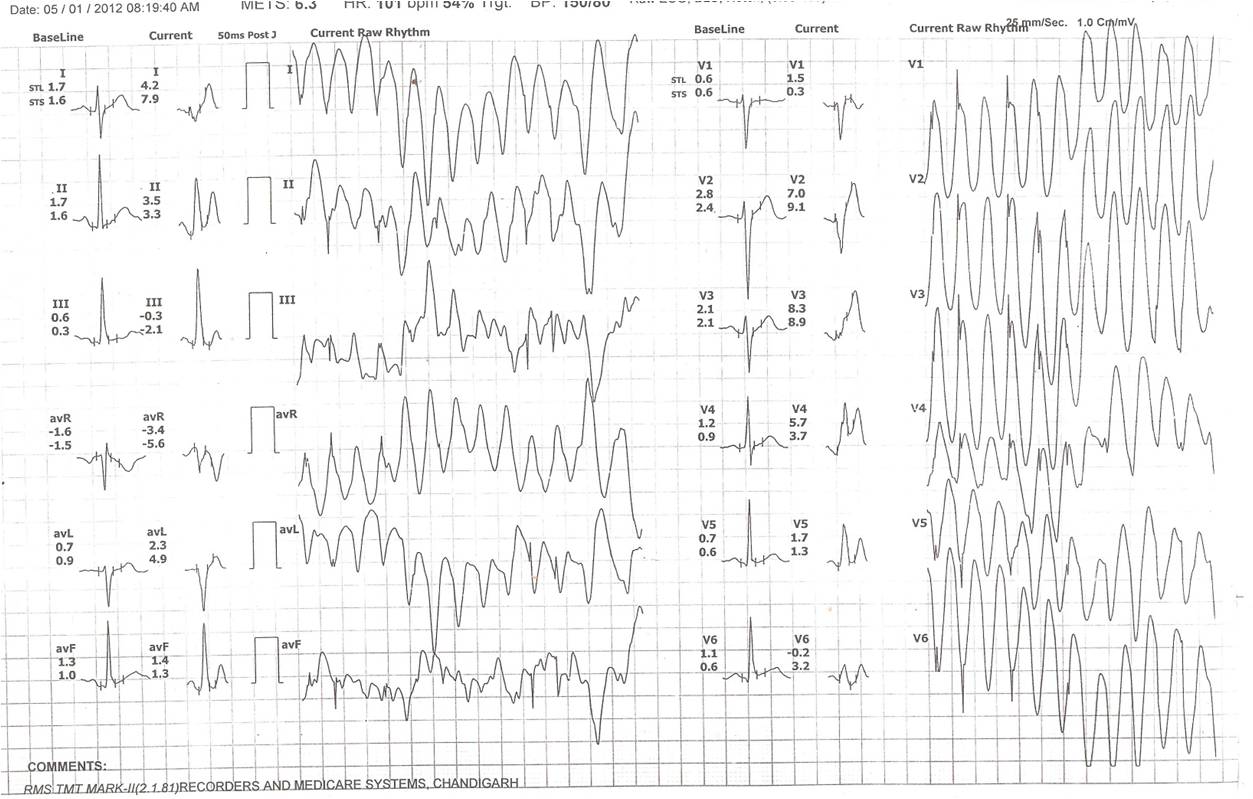
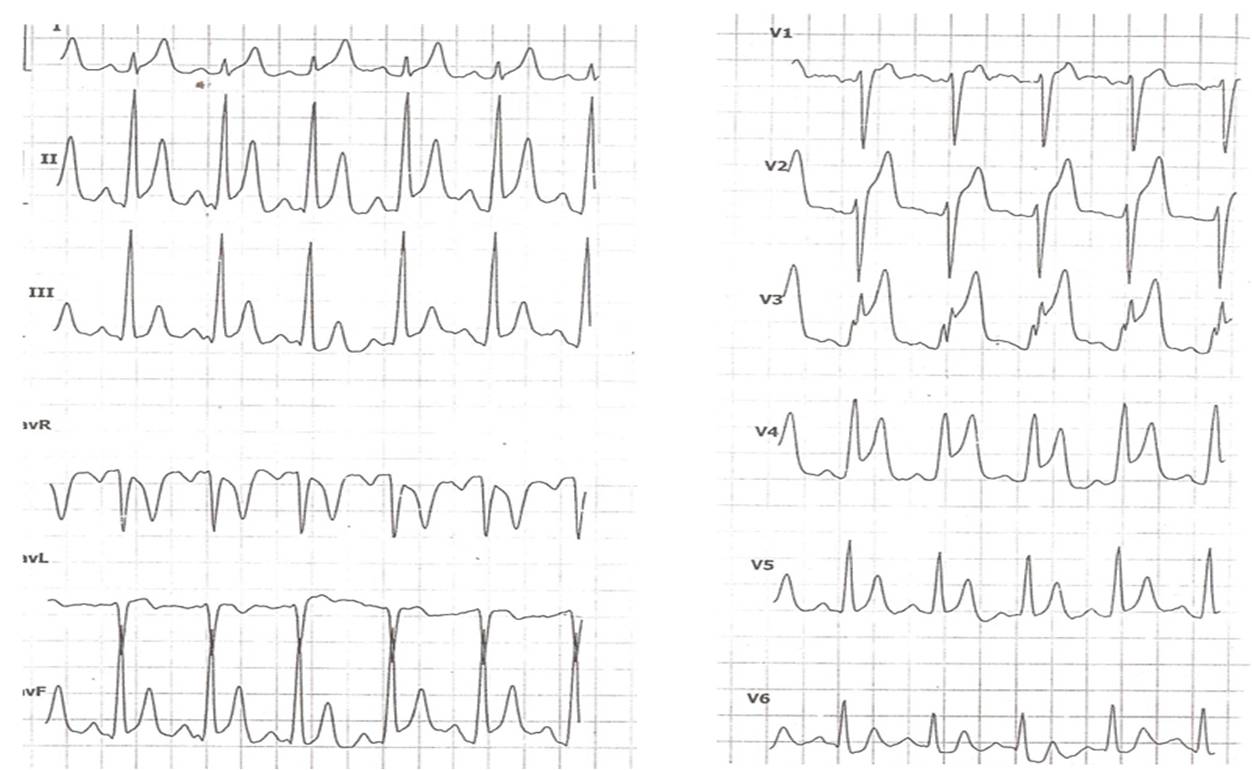
A young  man  fell  off the tread mill  soon  after complaining of chest pain in the immediate recovery  phase.

He had just completed 8 minutes of standard Bruce without any difficulty .

Even as the defibrillator was being  moved near him , he was  successfully   shocked with hands  of a hefty nurse !  ( 25 joules ? )   . He  got into this rhythm !

Note the ECG shows diffuse ST elevation .  The ECG soon settled and a diagnosis of  variant angina was  presumed.

He was shifted to CCU. There was no elevation of enzymes , though he showed a transient wall motion defect lasting up to 48 hours.

The subsequent elective  angiogram did not reveal any critical CAD favoring  Prinzmetal angina.

Provocative tests for vaso spasm is not practiced in our part of the world  (I wonder  whether it is still in vogue at all !)

* The classical  angina of prinzmetal is not related to exertion .  Can we call this as a variant of the variant angina ?

Final message

  • VTs are rare arrhythmias  during EST. However , there are important link between exertion ,  VPDs and VT .
  • Exercise induced RVOT  VTs are  supposed  to  more  common. However , ischemic VT during exercise has to be ruled out in every patient.
  • Non sustained VTs in patients who have baseline VPDs are usually benign .
  • Paradoxically VPDs disappear in many  during exertion indicating overdrive suppression by sinus rate .This again can be ignored.
  • Mono morphic VTs  would suggest structural defects.
  • Polymorphic VTs during exercise indicate either ischemia or electrolytic origin

Also read

Wrong concepts in coronary spasm

Acknowledgement

ECG Courtesy:  Dr G.Gnanvelu MD,DM  Professor of cardiology . Madras medical college

Read Full Post »

« Newer Posts - Older Posts »