Feeds:
Posts
Comments

Archive for the ‘Cardiology -Interventional -PCI’ Category

Pharmaco Invasive approach (PIA)  is the new mantra in the management of ACS.It simply means the intention to do PCI   should always  be the  driving force in every STEMI patient , whether the Initial lysis is successful or failed .

This concept is exclusively created  for centers where there is no cath lab (This would include  hospitals  with  inactive labs ,  cardiologist  team  who lack required expertise !)

What to do after lysis ?

  • If  the initial lysis has failed  “Rush” them  for an emergency  PCI.
  • If  Initial lysis is successful  “Send”  them for PCI in a  less emergent manner.

Generally the  time window for PIA is 3-24 hours.  In failed lysis  technically it could be as early as 1 hour as that is the time to assess the efficacy of initial lysis. (Of-course the theoretical transfer  time to be added )

Why the 3 hour period for PIA ?

We know routine   facilitated-PCI(f-PCI)  with various combinations of  fibrinolytics  and 2b -3a antagonists is a failed concept. (FINNESS )

One of  the primary reason for f-PCI to fail is , the  very narrow time window  between drug and balloon which somehow  end up in more hazard  (Needle -Balloon window)  .

If they are very close the harm is likely to be more ,still they have to be closer if lysis has failed .(This is the reason many old studies had depressing results with even with the  concept  of rescue PCI !)

Lytic agents and PCI  even though we assume to compliment each other real world evidence indicate they share a love hate relationship .


Beware, PIA is one form of facilitated  PCI.

If we agree routine  f-PCI is a failed concept we are in for real trouble. PIA indeed may  masquerade as f-PCI  if  you combine lytic and PCI in sequential fashion in a hurry !

My point of view is is a  successfully lysed STEMI should not be rushed to cath lab .If  he  some how reach the  cath lab ultra fast manner , it behaves like a  f-PCI and he is going  to harmed more !  by the current evidence base  isn’t ?

If the  inital lysis was successful , with a  less complex anatomy, it is  possible your PCI  that is going make the lesion more vulnerable.

(The other  issue is tied with flawed human instinct. One can’t stop with CAG in a PIA* .Interventional  cardiologists rarely have the courage to leave a well recannalised IRA  without PCI.)

**Still , you need to facilitate the PCI in complex intervention in  true rescue situation.That’s were we require the collective wisdom.

Assumptions galore in ACS

We have difficulty in  identifying true success and failure of lysis .Vagueness with which we make decisions  in CCUs and cath labs  , is exemplified by the following facts. Post thrombolysis , 40%  patients with persistent ST elevation are asymptomatic and 30 % of all those with complete  ST regression , still have occluded IRA.

We are also uncertain when do  the muscle  truly  die after a STEMI ! It is 6 hours in some, 12 in many, 24h  in few , 36 h in a lucky ones .The role  of collaterals, intermittent patency , individual variation  resistance to myocardial hypoxia injury cannot be  be quantified .

Final message

  • The importance of Needle to Balloon  time (NBT) time in PIA  is to be strongly emphasized.
  • This time can vary between 1-24 hours .But practically it will start from 3 hours .
  • The irony is , we have conflicting  engagement with time in PIA. We have to  strive for both narrowing as well as intentionally  prolonging this time window .
  • It has to be narrowed in true rescue situations and   optimally prolonged (Or is it indefinitely ! ) in non rescue situations !

After thought

Can we do pharmaco-Invasive approach(PIA)  in PCI capable center ?

  • Even in PCI capable centre one may get struck in proceeding with anticipated primary PCI for various reasons . If delay is anticipated we  have to fall back on thrombolysis .This we call as  unscheduled  or bail out  phamaco Invasive strategy .
  • Intentional PIA   in a PCI capable hospital for all low risk MI is also a viable and option .Never think  primary lysis   for STEMI  even if we  have lab ready is serious medial crime . After all , pPCI has a very  marginal benefits in if any in all low risk STEMI!

Read Full Post »

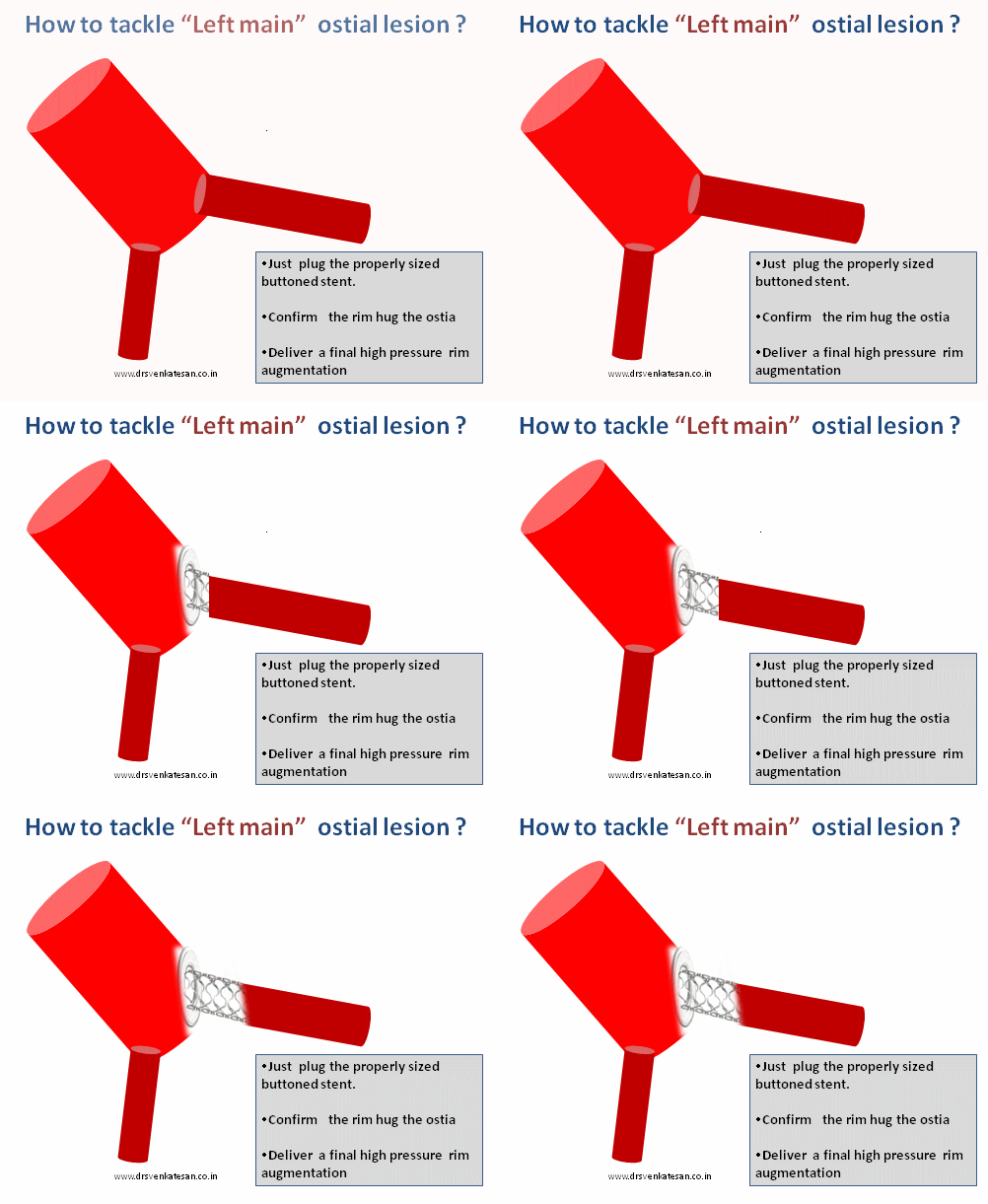
Left main ostial lesion remains a  challenging task .A new stent design is  proposed here.

The lesion

Left main  ostial  stenting lesion003

The hardware 

left main ostial coronary stent drsvenkatesan

The technique

Left main  ostial  stenting lesion002

Final message

This thought came  when I  recently encountered a patient with a left main ostial  stent which was projecting well into aortic root .It is an open access patency ,whoever is capable of converting this idea  to a clinically applicable technique is welcome to proceed !

Read Full Post »

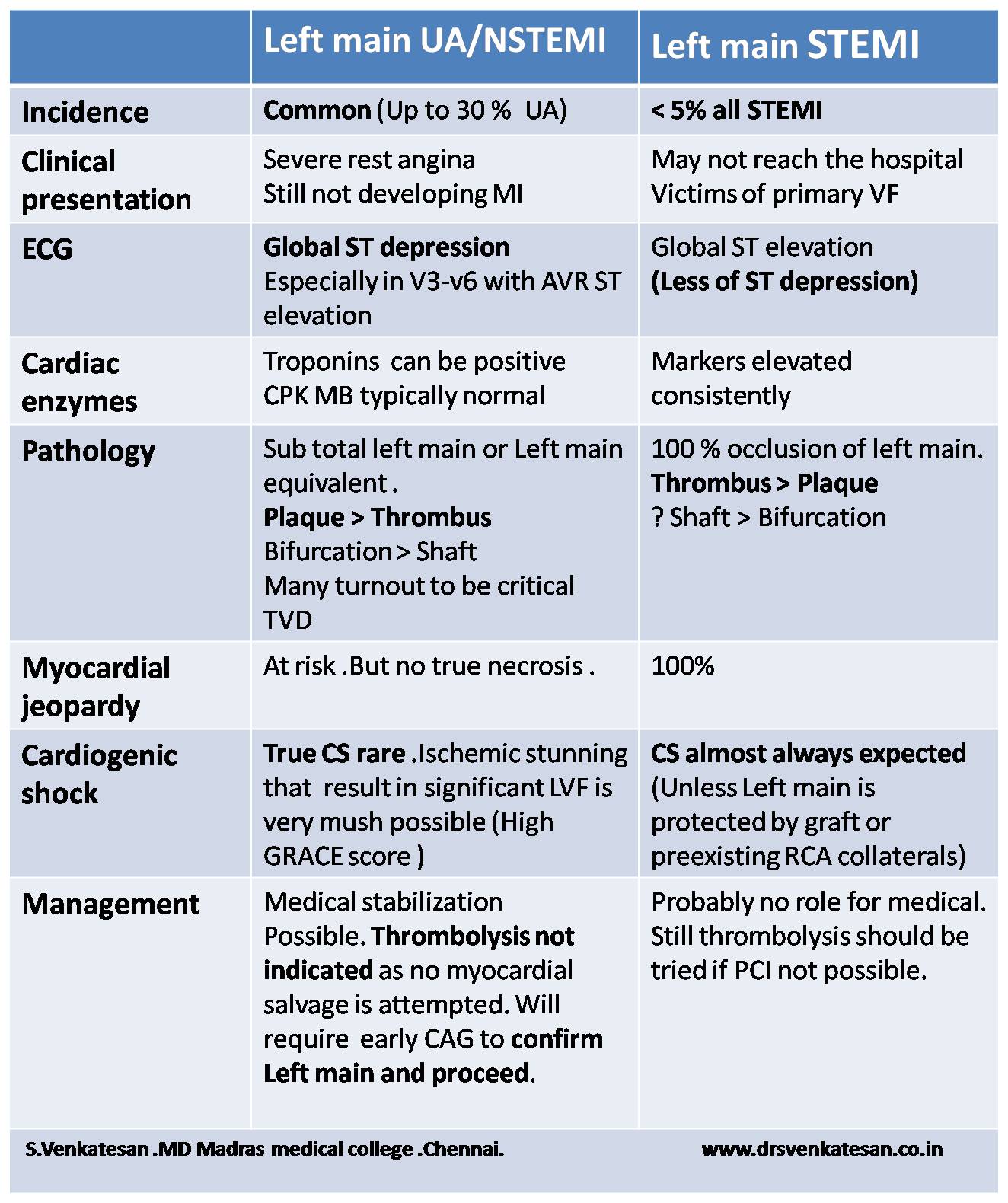
Last week  there was a heated debate in our CCU regarding thrombolysis for  a patient with severe rest angina  and ST elevation in AVR  and ST depression in V2-V5  as it implies  Left main disease  Few argued left main disease is an exception where one can thrombolyse even with unstable angina !

One of my fellows argued ACC guidelines vouched for lysis in UA involving left main .( I do not agree )

A logical attempt to differentiate Left main NSTEMI//UA and STEMI

(In the strict sense Left main NSTEMI is misnomer as AVR shows ST elevation  isn’t ? )

left main disease

Final message

Such  patients with suspected LMD   are to be rushed to cath lab .  . . agreed . If it is not feasible , manage it as high risk unstable angina and do not thrombolyse .Let it be left main disease . Indications for lysis are clear. ST  elevation in AVR alone can not be taken as an Indication for lysis.For thromolysis to be effective there should be high thrombus burden with total occlusion . ST elevation in single lead (AVR ) is not a good  marker for left-main thrombus !

Read Full Post »

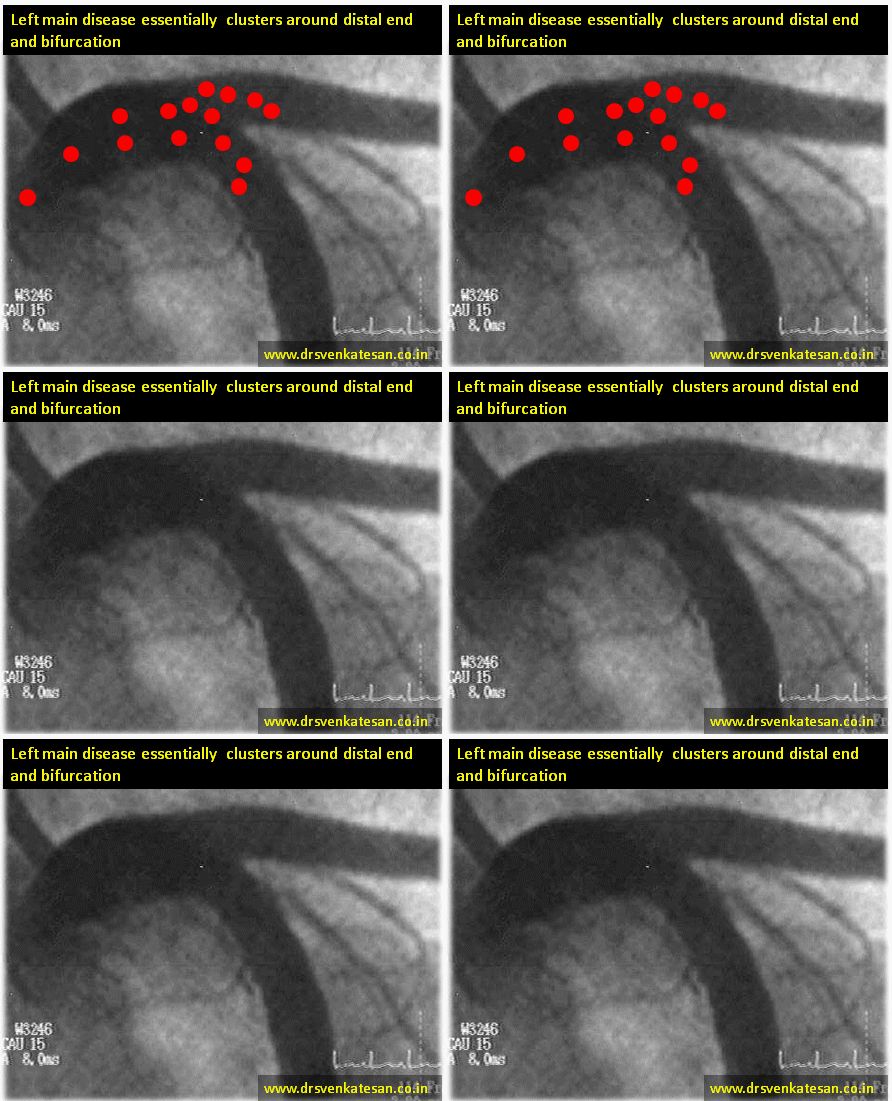
Distribution of Left main disease.

  1. Ostial
  2. Ostio-proximal (Within 1 cm of  origin )
  3. Shaft -Discrete  mid left main
  4. Shaft -Diffuse
  5. Isolated distal shaft( 1.0.0)
  6. Bifurcation ( Medina 1.1.0 -LAD)*
  7. Bifurcation (Median 1.1.0-LCX)
  8. Bifurcation ( Median 1.1.1)*
  9. Trifurcation ( With ramus )

* These three locations account for nearly 75% of all left main lesions.

left main disease coronary angiogram

We know atherosclerosis is  a branch point disease .Normal left main measures 1 mm to 20mm.The shorter the left main lesser is the the incidence of LMD. Short left main can not engage the atherosclerosis much (No left main = No left main disease ) However ,very short left mains  may increase ostial lesions .

  1. The commonest left main lesion is distal left main with one of the branch involvement (1.1.0.LAD is more common )
  2. Least common entity is discrete mid shaft lesion.

Simple strategy.

First dictum : All complex looking LMDs should be referred to a good  surgeon.

Final dictum : Remember medical management for left main disease is still an accepted strategy in stable , non flow limiting situations .

Interventional  Cardiologists  feel they have the exclusive rights   to indulge between these two  spectrum of LMD .May be true! But extreme caution is required as we are playing  our game in the most critical  coronary high way .

Some suggestions and thoughts.

  • 50 % diameter stenosis is significant. But significance does not mean we should tackle the lesion by aggression.
  • Symptomatic flow limiting lesion only to be intervened . (Flow limiting means both angiographic and a stress test .FFR <.8 is also an index for flow limiting .Symptom means Angina on exertion )
  • IVUS, OCT, FFR,NIR ,SYNTAX  are not path breaking tools .They essentially  add  more glamor  to left main disease than anything .
  • Most bifurcation LMDs are  managed by single stent with stent jailing the major side branch (Yes side branch can be LCX !)
  • However ,two stent strategies is not banished .It can be vastly  superior in some selected cases .(Especially with huge plaque load at carina )But needs expertise .
  • In very small vessels two stent strategies are risky .

Reference (2012 update)

left main disease  coroanry angiogram management  Fajadet

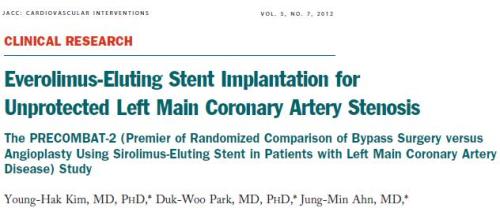
PRECOMBAT left main disease south korea everolimus
Link to related articles in this site

Read Full Post »

CAD is growing as an epidemic in most  parts of the globe. It  is  a major determinant of health status of any country .Great strides in diagnostic, treatment modalities of CAD  have been made in the last few decades. Still , the core principle of management of CAD resides in simple things like  risk factor reduction / optimization , life style changes and few essential cardio-protective medications  Aspirin, beta blockers and statins.

However , modern scientists have made a  firm statement that  knowing the coronary anatomy before starting the treatment is the only scientific approach . It is a huge assumption !

Is it practical ? or is it really required ?

CAD can be managed  by  means of medicines  ,  interventions or surgery. Revascularisation is required  only for  those , who have  critical , symptomatic lesions.

It is estimated , in only  a fraction of CAD patients ,  we would require to know the anatomy . We have set criteria to choose  patients  for CAG , who are  likely to have critical lesions.Physicians  are trained for that elusive wisdom to choose  such patients .Standard text books do mention clear-cut Indications for doing  CAGs. Unfortunately , it is  least respected and followed .

Cardiac physicians who  would boast  they  can’t treat a CAD without knowing  the coronary anatomy  are clinically handicapped  or poorly trained.

I am afraid such a class of  cardiologists are rapidly breeding in the country side. They are  encouraged to attend  CME on clinical  cardiology and basic principles of  clinical decision-making  .

We can’t  keep  on doing CAGs like ECG for every episode of  angina . In fact treating CAD without knowing  the anatomy remains (And it should  be ) the dominant theme contemporary  clinical practice . CAG is multi -edged sword

The most important side effect of routine  coronary angiogram  is , it  ends up in infinite number of inappropriate interventions ! 

I think , we should pray in Hippocratic  temples for sufficient wisdom  to choose our patients. We can also learn it from Neurologists , they  somehow  manage most  forms of cerebrovascular  diseases (scientifically too ! )  without asking  for angiogram of  circle of Willis !  Mind you. . . brain is equally a vital organ !

Final message

It needn’t be a crime to treat  CAD*  without knowing the coronary anatomy. Rather  . . . it would be so  , to ask for CAG indiscriminately  , in every episode of chest pain , without applying clinical sense !

* Emergencies included.

Read Full Post »

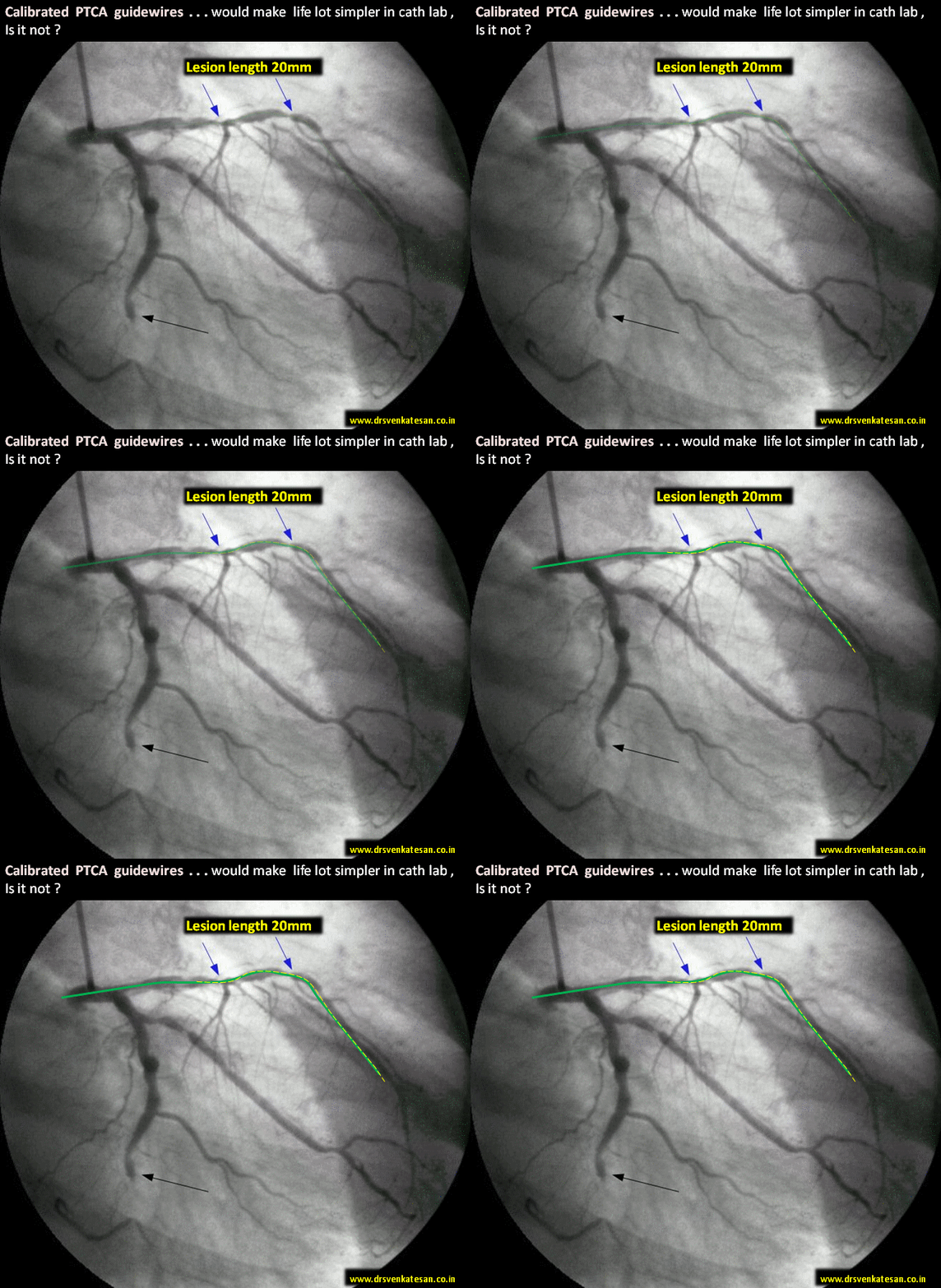
It is estimated nearly half a  million PCIs are done all over the globe every year .Evaluating diagnostic angiogram is a critical  vital step, but  often times it is given less time and left to fellows .This is done mostly offline by Image  processing software. Curiously , lesion assessment  becomes a causality to the   visual acuity .It ends up  with lot  of whims , intuition and bloated egos of senior cardiologists !

Technical issues

The fundamental flaw in the  lesion assessment is ,there is  a dissociation in choosing the  “best view”  for lesion morphology  and  length  . Size need not be well  assessed in  the same view as morphology . For example , LAD is fore shortened  in LAO caudal view  ,  length measurement would be  erroneous  ,  still morphology may be well delineated .(Vice versa in RAO caudal view )

PTCA guidewire calibratedcalibrated ptca guidewire

Other source of errors

Reference catheter may be far  away in the Aorta , and confer a  magnification error . This becomes important especially in ostial lesions and associated  major branch lesions. The computer uses the edge detection algorithm  which carries an   inherent error .

Advantage of guide wire as a scale

  • Instant online measurement
  • Always on . Repeatedly used in multiple views .
  • You can’t ask for more accuracy .The scale is within the coronary artery  hugging the lesion
  • The end on view is effectively nullified .
  • Magnification  factor do not operate.
  • Finally , and most importantly in complex  tortuous , tandem lesions few mm errors can be disastrous .These calibrated guide wires will make our life lot easier.

Final message

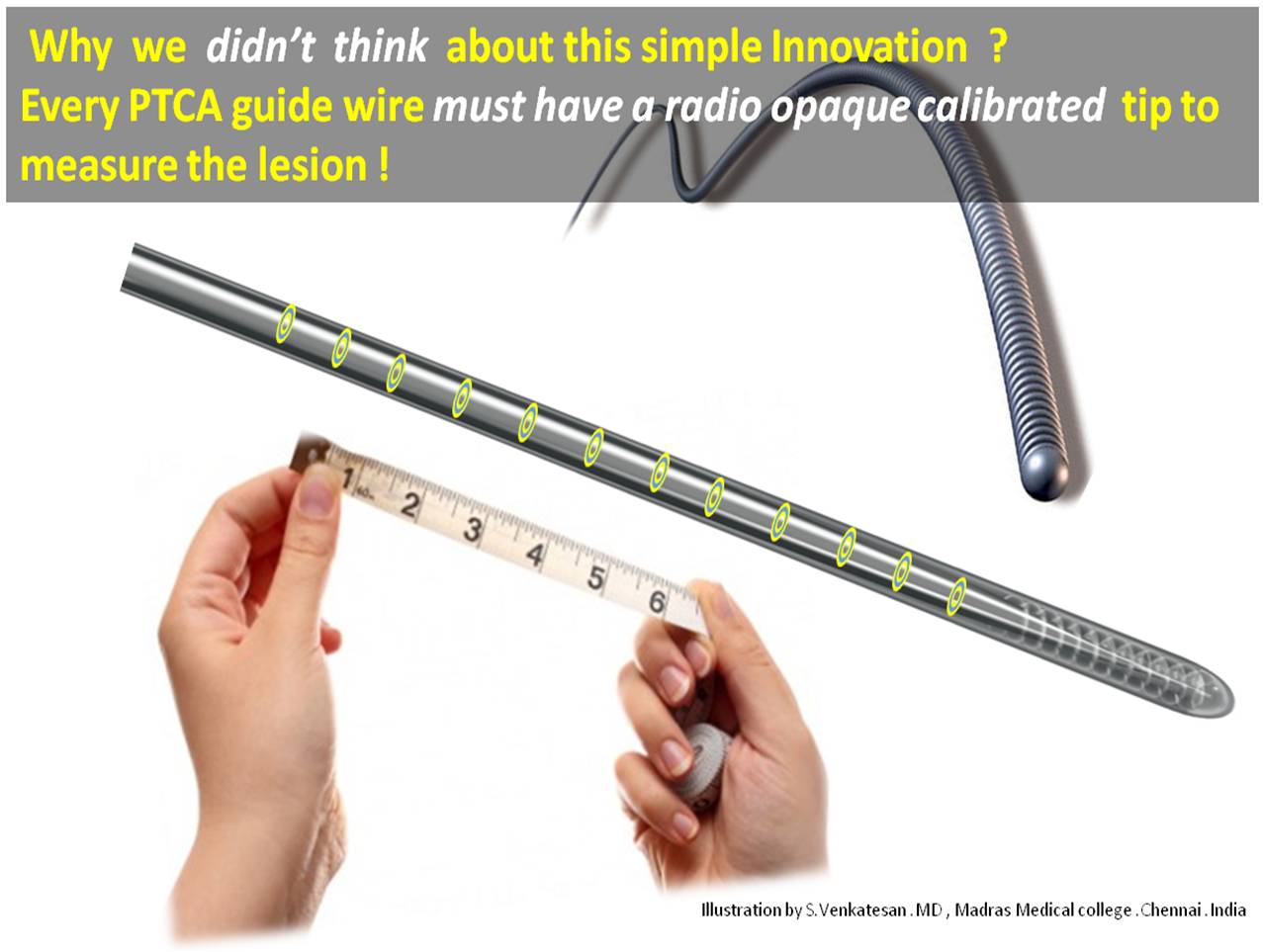
Measuring  a coronary lesion remains a delicate issue . If only we have radio opaque  rings every 1mm or so in the distal end of the guide wire , we can measure the lesion  instantly and most accurately.

This will  definitely make our life  not only simple but help our patients with accurate stent sizing and avoid costly geographical miss (or inappropriately  long stent  that increase  metal load .)

After thought

I do not know whether  any of the existing  guide wires have this facility .(I guess it is not   . . .then , let this idea  be patented in my name !)  After all , It is a mean  task for all those mighty coronary hardware companies to add  few radio opaque rings to all  PTCA guide wires!

Medtronic, Abbot, Boston  are you listening ?

And . . . your opinion please !


Read Full Post »

Time is muscle. This quote  became  sort of ” cardiology sermon”  in the last  few decades .Cardiologist think  they stand  on a 100 meters sprint track once a patient with STEMI arrives .This is indeed true ,  if we  agree  time is  muscle and  our urge is to reduce the door to balloon time .Please  remember ,  this rush matters  much ,  only if the patient comes through very early  when the muscle is really getting damaged . (No issues  . . . even if the fire engine comes in  slow motion if the  house is burnt fully !)

Time is muscle agreed  . . .  but  muscles are  kept alive by  factors other than time  !  So muscles can  defy time if God  is willing !

Time is one of the important components of management of STEMI.  Other things matter too !  Age , baseline co-morbidity ,  underlying extent of CAD, collateral support of IRA territory , and finally  individual variation in hypoxic damage in myocyte is (Rarely  been studied in detail.)

Door  to balloon time for a patient  who lands up within  1 hour window need  to be  much  different from a patient who comes at 10 th hour .The issue is important  because  we use a procedure which requires delicate decision-making ,(IRA-Non IRA issues etc)  the results can be  sub optimal ,  and even be hazardous in low risk STEMI . So , door to balloon time  may be a less  important  component of  time window in a patient who comes after 6 hours .This is the reason  overall outcomes are not changing in a large cohort  of rapidly performed PCI.

The presumed  absolute  relationship  between  “Time  and  muscle”  concept is  always been a suspect . This  is proven by a flawless study from  NEJM .

nejm stemi most important article

http://www.nejm.org/doi/full/10.1056/NEJMoa1208200

This study should infuse more sense to  us ,  time and again, we are  hijacked and sedated by high dose of  pseudo scientific concoction .In fact ,  indiscriminate rapid PCI may not be in  the good interest of  all  patients with STEMI ,  if it is not properly done  .Without realising this fact many developing countries are indulging in extravagance of  costly STEMI programs wasting  the exchequer.

This landmark NEJM  paper convincingly underscores a fact  that  achieving  rapid door to balloon time  is not  going to be the game changer in  conquering  the Global   STEMI  championship  . We have to take the coronary care into the streets  or to their homes as well .This is where the pre-hospital thrombolysis will  emerge in a big way in the future .

A slow and steady thrombolysis beats a fast and furious primary PCI on any given day in all uncomplicated STEMI .This we have proven for over three decades in  one of the India’s largest coronary care unit .( Where is the data man ?  Genuine experience is data . Why  we require , the act of publication to convert an experience into evidence . Often times ,  I  would feel , data is the most unscientific word in medicine . Many Truths  lack evidence , false hoods come with plenty !  For all those  scientific  homo sapiens  , please recall  70 % of ACC/AHA class 1 recommendations are backed by level C evidence ie simple opinion from  perceived experts! )

Final message

A fast and furious primary PCI may not be  the answer in all STEMI population

Thrombolysis  can be  done  with near  zero time delay , it does not require special expertise where an ambulance driver can reperfuse   a myocardium without much fuss and glamor ! He does not have to  split his hair to identify which is the IRA in a complex multivessel STEMI as well ! The streptokinase and TPA will home in  to the target site  smoothly and swiftly .

If indeed ,  time is the major factor in STEMI , we have many other ways to tame  the time . If muscle is more important than time ,  pPCI is  rarely  the answer !

Some India specific  thoughts

Is it not a shame  , we talk about primary PCI  for all  our patients  who do not even get timely Aspirin* after a STEMI! .It is something akin to what we witness every day ,  as our country folks  wield touch screen  Androids  . . . conversing  in open air toilets !

* While the importance of  Aspirin is undermined , It is different story altogether , these patients  get sorbitarate promptly whenever they get chest pain  (mis-placed and  dangerous priority ! )  prescribed by the  roaring  GPs ,  who suffer from discontinuous medical education ,  propelled  by the deeply penetrated 1000 crore oral Nitrate market .

And STEMI workshops are conducted by self-proclaimed experts  every few months in posh  7 star hotels all over India .

Read Full Post »

The doctrine  of  modern medicine  goes  something like this   . . .

For most medical problems ,  there  would be a solution. Keep  trying . . . till you get it !

*But , just make sure that problem on hand deserves a solution in the first place !

Modern medicine continues to  remind us  every day , the much hyped solutions  often end up in new problems and  many  times worse than the original problem !

Oh ! what a  great a quote ! When I  was boasting   myself  . . .  My wife reminded  me ,  this is just  plagiarized version of  a  2000 year old Hippocratic thought !

Primum non nocere  . . . first do no harm !

But , Hippocrates’  life  was  not  contaminated  with  drug eluting stents, I pads, and  BMWs

If   Hippocrates  arrives  in   cath lab  today  by BMW which sucks  50000 Rs EMI  ,Everolimus coated  coronary  jewellery   will  definitely  tempt him !

You  can’t  simply   compare lives separated by 2000 years

. . . I told my wife !

Read Full Post »

Dual LAD is an interesting coronary artery anomaly proposed  originaly  by Spindola in 1983 .He classified it into 4 types. In recent years the  dual LAD has increased from 4 to 6 types.

The essential criteria to diagnose  could be summarised.

  1. Two LADs should be identified.
  2. One would be  large and another small
  3. Both should give a  diagonal  branch .

* Ramus is virtually unknown  if there is dual LAD .

The origin  of second LAD can be from

  • LMCA
  • RCA
  • Direct from Right coronary sinus

Course

  • Can be epicardial
  • Intra -myocardial
  • Or both

Branches

  • Diagonal
  • Septal
  • or Both

Drainage area

  • Highly variable

Implication for intervention

  1. Apart  from  the surprise element , the second LAD   has  little impact on the interventional protocol.
  2. However , it may confer a  ischemic protection  as the critical anterior wall has a twin blood supply.
  3. Whether  they are protected from primary  VT or VF is to be studied  because of better electrical stability
  4. Second LAD may act as an additional collateral channel.

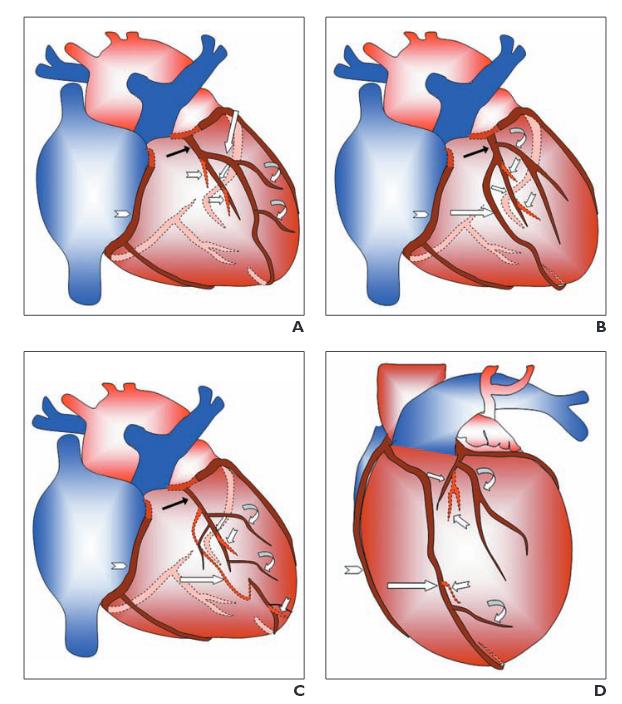
Spindola’s  classification of Dual LAD (Types 1 to 4  was called sometimes A,B,C,D )

classification of dual LAD

Source : Lee et al. BMC Cardiovascular Disorders 2012, 12 :101

Spindola type 1 to 4 classification of dual LAD

An illustration of  first 4 types  of Dual LAD .Note  the type 4 originates from RCA. Image courtesy : Prachi P. Agarwal Ella A. Kazeroon . AJR:191, December 2008

Surgical issues ( This is  excellent data  from India . I convey  my   greetings to one  the authors Dr D.B Baruah,  my friend  from  CMC Vellore !)

dual lad classification Spindola-Franco H, Grose R, Solomon

Reference

Spindola-Franco H, Grose R, Solomon N. Dual left anterior descending coronary artery: angiographic description of important variants and surgical implications. Am Heart J 1983:105;445-55

Dual Left AnteriorDescending CoronaryArterySurgical Revascularization in 4 Patients Tex Heart Inst J 2000;27:292-6

http://www.ncbi.nlm.nih.gov/pmc/articles/PMC3509398/pdf/1471-2261-12-101.pdf

Dual LAD  CT  Angiogram : http://www.ajronline.org/doi/pdf/10.2214/AJR.08.1193

Read Full Post »

Only fools will   manage unstable angina  medically !
 
That was exactly the statement ,  one popular Interventional  cardiologist   told a small gathering  in one of the weekly meet .
 
Do you agree ? 


Answer
 
We can’t  make a blanket  statement like that . We have clear  guidelines (Of course as licensed and certified cardiology  practitioner  you have  every right to violate it !)  .
 
UA is risk stratified in Low , Intermediate and High risk  categories .Only high risk group  require emergency Intervention .Even in high risk group there are some reservation.(ICTUS  study )
 
There are some very mild forms of  UA (High grade stable angina precipitated by an emotional stress will exactly mimic UA. Similarly most  secondary UA due to tachyardia , Anemia  etc should not  cause an alarm .)
 
 
*Please note  , currently coronary angiogram is included in medical  investigation  in most  patients with UA . The  confusion in interpreting  such statements  is partly because many physicians/ cardiologists consider  doing a coronary angiogram by itself an  Interventional  management
 
 
Reference

Read Full Post »

« Newer Posts - Older Posts »