Feeds:
Posts
Comments

Archive for the ‘cardiology -Therapeutics’ Category

Cardiac arrhythmias by nature connote a serious implication ,especially  so  with ventricular ones. Here is an  arrhythmia which arise from the ventricle by excessive automaticity  ,   fires independently  ,   still  very   benign compared  to others ventricular arrhythmias.

Why AIVR is a stable arrhytmia ?

Primarily due to its low rate.

Since  it is a  reperfusion arrhythmia the outcome is good.

Mechanism

It is not due to reentry , it is thought to be due to enhanced  automaticity  without pathological  intra-myocytic  calcium spikes  (Like true VT )

Absence in surface  ECG does not mean it is not existent.  In-fact there  is some  evidence to call this arrhythmia as a form of ventricular parasystole.

Focus of arrhythmia

Since it is a reperfusion arrhythmia it has to arise somewhere from  re-perfused myocardium.

The fact that  it  can occur in both RCA and LCA reperfusion  indicate the focus can be  in any of the ventricle .

Usually it follows the reciprocal rule of bundle branch block  pattern  (RBBB in LV focus LBBB in RV focus.)

Septal AIVR  can have either RBBB or LBB morphology.   Usually  left axis is noted .

How to differentiate it from  non sustained VT ?

  • Ventricular rate in AIVR should be between 60 -110 .(Note -The inherent ventricular rate is 35/mt .There is three fold acceleration )
  • Basic idoventricular rhythm is about 35.  Three times accelerated
  • Characteristically   AIVR  starts with an escape beat rather than an  ectopic beat .

AIVR  is common  in  RCA or   LCA reperfusion ?

It is supposed to be more common in infero-posterior MI  as sinus slowing is an important predisposing factor  for releasing   the idio ventricular rhythm.

AIVR after primary PCI

Is not reported much as  current interventional  cardiologists  do not bother much to watch about this arrhytmias

Other causes for AIVR

  • Myocarditis.
  • Digoxin toxicity

Management

(The commonest issue with AIVR  could be    . . . Nurses  /Fresh interns may mistake it as VT and  pressing the false alarm ! )

  • Rarely  requires treatment .
  • Atropine ,Isoprenaline to increase sinus rate.

Read Full Post »

Read Full Post »

Clinical sense

  • First and fore most  dictum  is  not  every  prosthetic valve obstruction  is  thrombotic (Most cardiologists are tuned to think that way )
  • Pannus, Mechanical failure  and  vegetations can increase the gradient across prosthetic valve.
  • If the clinical presentation is acute (< 48 hours ) it is  more likely to be a thrombotic event .
  • History of  recent discontinuation of oral anticoagulants /sub optimal INR will favor thrombosis.

A meticulous Echocardiography is vital (TEE though gives more information in an emergency TEE is suffice )

  • Thrombolysis is to be considered in all .
  • For right sided prosthetic obstruction thrombolysis is the  initial modality of choice.
  • For left sided valve thrombosis   surgery is the preferred option .However a trial of  thrombolysis for 24 hours may be tried .
  • For a high risk mobile thrombus , thromolysis is contrandicated.

The success rate is less with Mitral than Aortic valve  . Success depend upon more on the  location / Freshness of thrombus than the type of the lytic agent used.

Is there a time window for prosthetic valve thrombolysis ?

Thrombus organisation takes 2 weeks at- least.Hence , it better not to attempt thrombolysis in documented late prosthetic valve thrombosis.

Thrombolysis of left-sided valves has inherent risk of  stroke .

Heparin controversy

Simultaneous usage of heparin along with streptokinase or TPA is  perceived as risky (No good evidence for this perception )It is logical to expect even as the thrombus  lyses the clot lots of pro-coagulant debri  are released . Concomitant usage of heparin  will definitely help accelerate thrombus dissolution. (I am glad  Joseph S   Alpert also feels the same ! )

Assessing successful  thrombolysis

  • Can be a tough task .
  • Relying purely on gradient is vested with risk of huge error.
  • In a patient with shock or LV dysfunction gradients are not reliable as low flow status masks the gradient.
  • A accelerated thrombolytic  protocol 15lakhs streptokinsae in 60 minute may be tries in unstable patient .
  • It is wiser to rapidly asses for clinical improvement in high risk subsets  and refer the  patient for early surgery .

Surgery

Prohibitive mortality reported in many centres.

It need to be remembered no surgeon will operate on a  sick patient in  shock  exposed to  cocktail of heparin and streptokinase.

Valve replacement is required in most case. Simple valve debridement  (servicing the  valve ) and releasing  discs  from the  sticky thrombus is  also possible in an occasional patient.( Do not ask reference for this !)

Reference (Surprisingly most of the good papers in the topic appeared  in JACC)

http://content.onlinejacc.org/cgi/reprint/41/4/653.pdf

http://content.onlinejacc.org/cgi/reprint/41/4/659.pdf

http://content.onlinejacc.org/cgi/reprint/35/7/1881.pdf

http://content.onlinejacc.org/cgi/reprint/35/7/1874.pdf

After thought

I have not seen a single case of acute prothetic valve thrombosis involving Starr Edwards valve  in the  last  20 years of  of clinical cardiology practice.

Is it true   . . . the new age valves  with more mechanical stress points  are proving more injurious to our patients. Our  pursuit  towards a  perfect artificial  valve need some introspection .

Read a related article in my site :  Who killed Starr Edwards valve ?

Read Full Post »

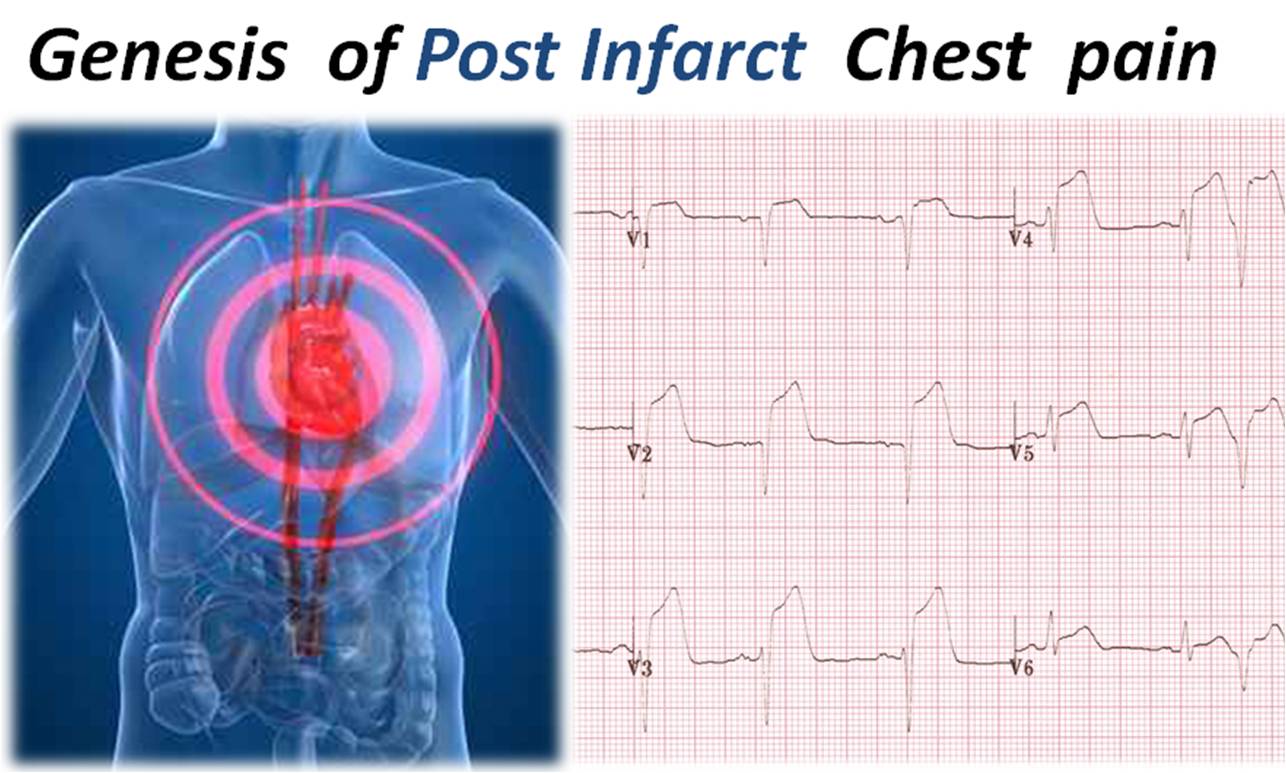
Up to 24 hours

  • Failed thrombolysis and persistent infarct related chest pain
  • Prolonged  Infarct pain  in spite of successful thrombolysis (Rare)
  • Dual STEMI and Dual ACS ( Combination of STEMI/NSTEMI)  *

* Generally  until   after  24 hours one should not make a second coronary syndrome  though  logically  it is possible ( Dual acute coronary syndrome)

After 24 hours -up to 2 weeks

  • Post MI angina  – IRA related (Re-occlusion, Threatened reocclusion)
  • Post MI angina -Non IRA related ( Critical  non -IRA lesion)
  • Thrombus migration /Side branch occlusion
  • Re infarction -Same territory
  • Re-infarction-Remote territory
  • Infarct extension, Infarct expansion , Dyskinetic segments  ( Acute ventricular  remodeling  has a potential to generate pain )
  • Combinations of the above

Caution

24 hour is  arbitrary cut off .There can be spill overs and over laps

*Refractory non ischemic  chest pain often atypical not relieved by anti anginal  medication   – Pericardits, Coronary dissections , myocardial /Pap muscle  tears .

After thought

Do we need to break our brain  to  find  the source of angina  following STEMI ?

Principles of scientific medicine  would demand it  . However   in this era of  hyper active interventional  cardiologists  there is little purpose  as they  tend to  open up all occluded arteries   guided by the  their  ignorance about the source of chest pain.

Reference

Video on Dual  coronary syndrome

Read Full Post »

The key word for  successful  primary PCI  is

  •  Suction &  Aspiration of thrombus  with   micro catheters like  export catheters
  • One can do away with a stent during primary PCI but can never do away aspiration
  • Distal protection as concept is rapidly dying out as we aim to remove all the thrombus .

Tips for effective thrombus aspiration

  • Apply continuous negative pressure once catheter reaches the thrombus do not release  it till you enter back into the guide.
  • Make sure  you are sucking only  blood  products  not the  endothelium
  • Watch out for  side branch spill over.
  • 7F sheath 7F catheter ideal for aspirating  with a  micro catheter
  • Please be informed some thrombus require more negative pressure especially  in the late  presenters of STEMI

* During dire emergency when you do not have a specialized suction catheter do not hesitate to push  even a diagnostic catheter into the coronary .We have  saved few lives !

Crazy   questions  in primary PCI  ( or Is  it futuristic )

Can we connect the suction apparatus into LAD micro catheter ?

Do we have camera guided suction catheter ?

Can you flush the thrombus if you are not succeeding in aspiration ?

Is ultrasonic desiccation  of thrombus possible ?

Acknowledgement

Some of the tips were  gathered from the recently concluded  India Live  2012  conference   in New Delhi .

Read Full Post »

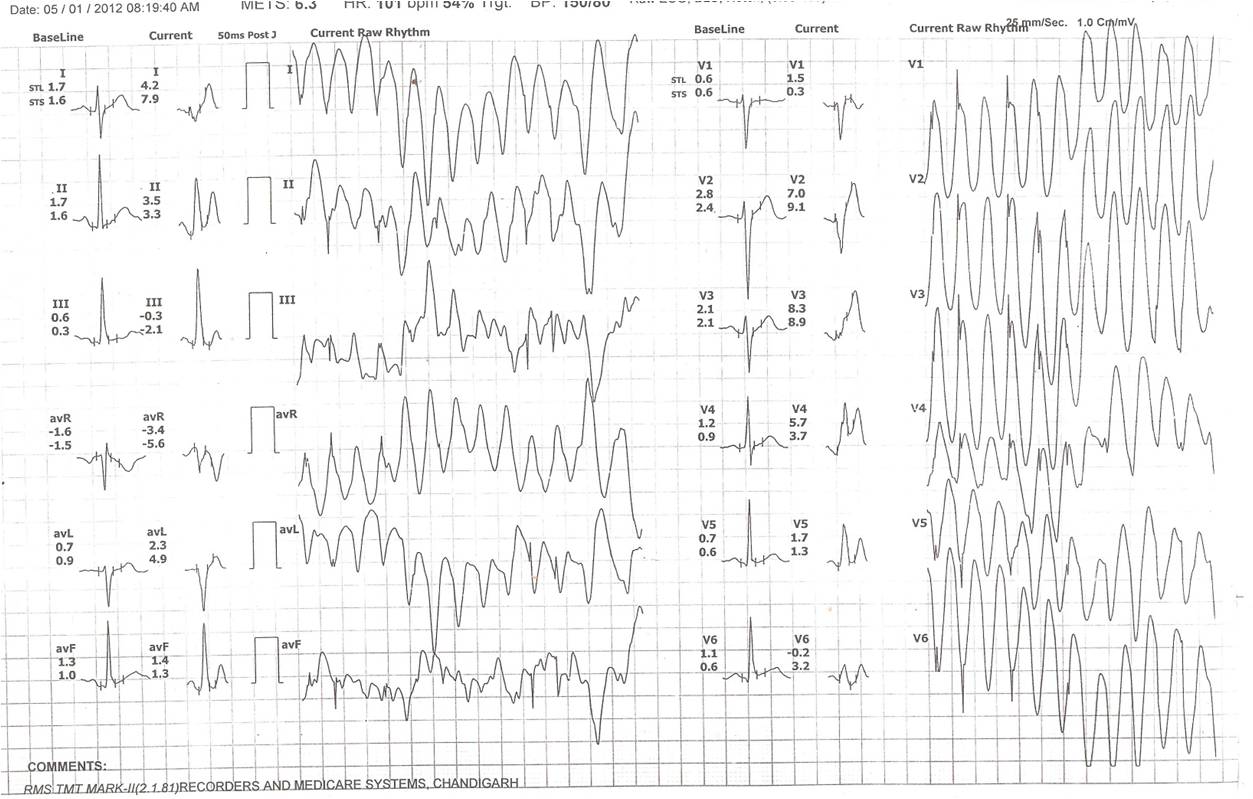
A young  man  fell  off the tread mill  soon  after complaining of chest pain in the immediate recovery  phase.

He had just completed 8 minutes of standard Bruce without any difficulty .

Even as the defibrillator was being  moved near him , he was  successfully   shocked with hands  of a hefty nurse !  ( 25 joules ? )   . He  got into this rhythm !

Note the ECG shows diffuse ST elevation .  The ECG soon settled and a diagnosis of  variant angina was  presumed.

He was shifted to CCU. There was no elevation of enzymes , though he showed a transient wall motion defect lasting up to 48 hours.

The subsequent elective  angiogram did not reveal any critical CAD favoring  Prinzmetal angina.

Provocative tests for vaso spasm is not practiced in our part of the world  (I wonder  whether it is still in vogue at all !)

* The classical  angina of prinzmetal is not related to exertion .  Can we call this as a variant of the variant angina ?

Final message

  • VTs are rare arrhythmias  during EST. However , there are important link between exertion ,  VPDs and VT .
  • Exercise induced RVOT  VTs are  supposed  to  more  common. However , ischemic VT during exercise has to be ruled out in every patient.
  • Non sustained VTs in patients who have baseline VPDs are usually benign .
  • Paradoxically VPDs disappear in many  during exertion indicating overdrive suppression by sinus rate .This again can be ignored.
  • Mono morphic VTs  would suggest structural defects.
  • Polymorphic VTs during exercise indicate either ischemia or electrolytic origin

Also read

Wrong concepts in coronary spasm

Acknowledgement

ECG Courtesy:  Dr G.Gnanvelu MD,DM  Professor of cardiology . Madras medical college

Read Full Post »

Pulmonary  arterial hypertension (PAH ) is  an uncommon manifestation of dilated cardiomyopathy .While pulmonary venous hypertension of some degree is expected in most patients with DCM,  it is rare for these patients to go for severe arterial hypertension.

The reason for this may be the  natural history of DCM do not allow these patients to live that longer to manifest severe PAH.  Still ,  we encounter this problem  atleast in tertiary hospitals. Presence of moderate to severe PAH (> 50mm peak PAP) is a sinister sign in  DCM. They not only do badly , they also make  the transplant outcome dismal .

What causes this severe   PAH in DCM ?  The following observations are made in our institute .

Now we know , isolated  systolic dysfunction is  rarely associated with PAH  .It is the presence of  LV diastolic dysfunction (Often restrictive )  that raises the pulmonary pressures.  PAH of DCM is rarely progressive.

One important suggestion is the DCMs  which are associated with  severe  PAH may indeed represent  late stages of RCM , when the LV begin to dilate.

Associated mitral regurgitation   contributes  to PAH

Atrial fibrillation has a significant impact on elevating  pulmonary  venous and arterial  pressures in DCM.

Hypoxic PAH can occur in any medical situation  in susceptible population . DCM is no exception

For some reason  idiopathic DCM is more often result in PAH than ischemic DCM . (Is that possibel , some form of  idiopathic   PAH and DCM are etiologically  related ?)

Further , the positive inotropic agents when liberally used will worsen the diastolic  properties of LV.

Finally involvement of  right ventricle  in the cardiomyopathy  process can have an ameliorating effect on PAH.  A good RV function is essential to lift the PA systolic pressure. If RV failure is causing a low PAP , do not be happy .It simply means RV is going to  say  good bye  . . .  for the final  time !

How to manage PAH in DCM ?

There is no specific management strategy .

We do not know yet  whether Sildenafil ,  Bosentan, and Epoprostenol  have any role in this  form of  PAH. These are all basically vasodilators. It’s use in DCM is vested with a risk of  catastrophic hypotension . Of course ,  we do have a role for balanced vasodilators in cardiac failure .(As most of these patients would be already on adequate ACEI )

Presence of PAH should be considered as an independent indication for anticoagulants as in situ  pulmonary thrombus is common.

The effect of  cardiac resynchronisation therapy in reducing the PAH of DCM is not convincing.

Final message

PAH  in DCM is an unwelcome development. It makes the situation  tough .  The mechanisms are diverse  .Understanding the mechanism would help us deal  this problem better .  Conventional anti failure treatment may help  ,but  it is wiser to try  reserve drugs.

Read Full Post »

Clinical cardiac  problems can be very demanding at  times. Here  is a  situation even the toughest will struggle.

A 52 year old man comes with a wide qrs tachycardia  with a blood pressure of 90 /70 with class 4 dyspnea .He was restless , trying to sit up because of  orthopnea. The ECG showed  a definitive ventricular tachycardia  with LBBB morphology.The patient was   connected  the   oxygen line ,  cardiac monitor, oximetery, etc

The consultant  on call instructed   immediate DC shock   and  he  warned  about  impending ventricular fibrillation .He  casually told the fellow to  do a echocardiogram also and rule out any structural heart disease. Even as  the staff was  arranging the defibrillator , the fellow did   a  rapid bed side echocardiogram . He was  shocked to find a  large mobile LV clot   with a  dilated ,  severely dysfunctional left ventricle  having an  EF  of  25 % .

Now comes  the critical time . Should we shock this man with VT and LV clot?

What will be your option now ?

  1. I will not mind the LV clot  ,  will go ahead with DC  Shock . Let him dislodge his LV clot . If It is his fate  let it be !
  2. Defer the   DC shock . Fall back on medical cardioversion like  Bretyllium, Amiodarone or magnesium  . After all . . .  it is not a pulse less VT. He is not in cardiac arrest . He can afford to wait .We can’t risk a stroke .
  3. Give a low energy  shock  25 joules  with paddles  avoiding the LV apex.  .It may not dislodge the apical clot , still  VT may be terminated.
  4. Try overdrive  pacing instead of DC shock
  5. Refer the patient for emergency surgical removal of LV clot
  6.  Suck out the LV clot with a   LV suction catheter and plan elective DC version*
  7. Insert a temporary Aortic filter and shock the patient **

*  Such catheters are in preliminary stage of development . Is  that true ?  ( If  no I  should get the royalty for the idea  ! )

(Read the related article in my blog )

** A loud imagination . Such filters do not exist.( If  IVC  can be filtered   why not  Aorta ? )

What was finally done ?

After analysing each  of the above  , we decided   option one “Prey the  God  and shock the heart” ) After all if it is  a VF ,  this  issue becomes null and void !  . Luckily God was with us.  The  patient  was  reverted to sinus  rhythm with 50joules   and  had  no  untoward events . He was subsequently anti-coagulated .  He is being planned for CRT/ICD therapy

Final message

Critical care  medicine is all about risk taking .Many times , therapeutic maneuvers  confer a  significant   risk  to life  comparable  to the   index problem.  But that  should not be a deterrent .  A careful learned decision  is warranted.

Read Full Post »

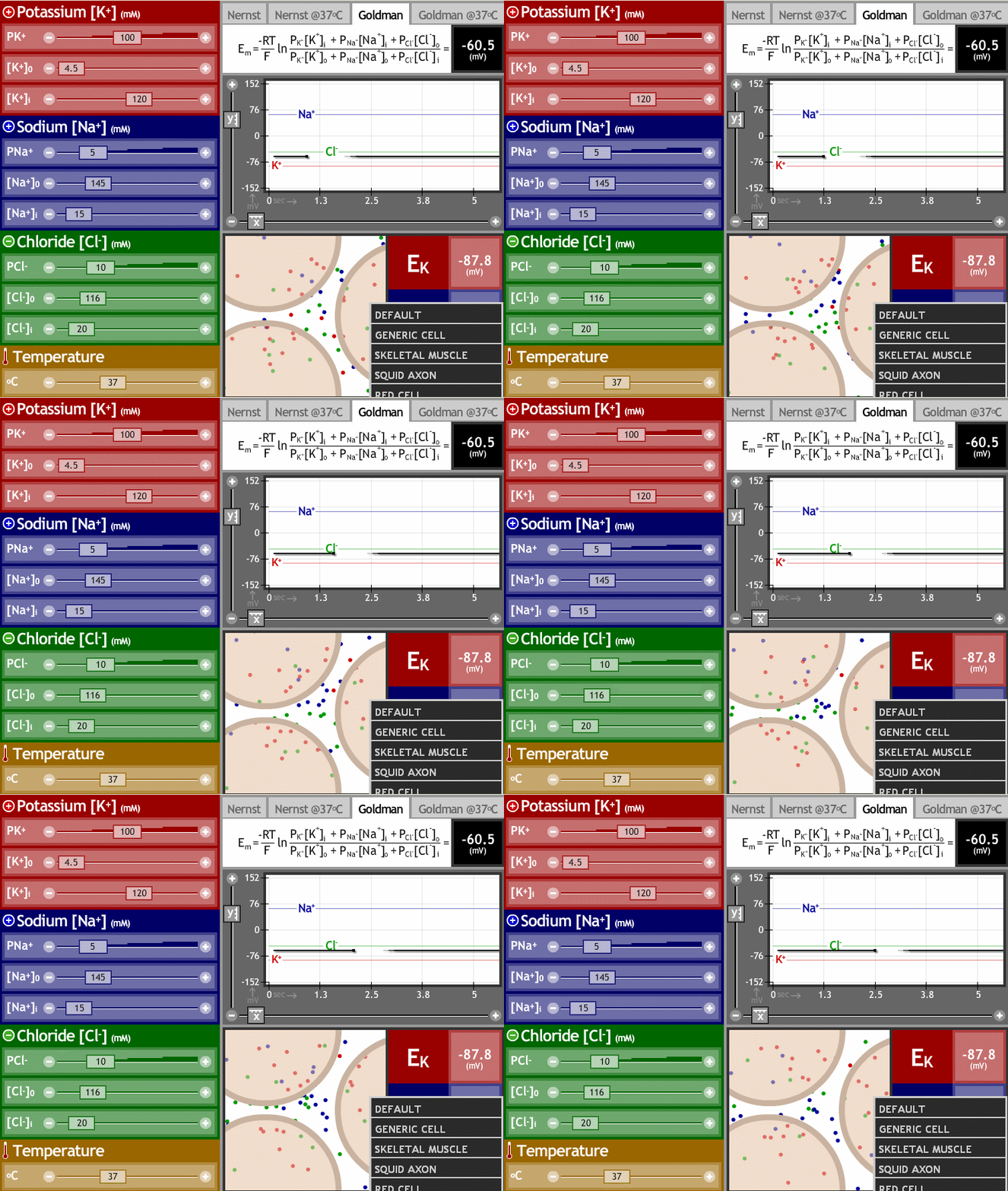
Human life is a bundle of energy orchestrated by ions coming  in and  going out  of  every cell . Potassium is the life sustaining ion which  determines the  resting membrane potential  of our cells.

When the  heart  suffers a massive necrotic attack  what  would  happen to the potassium dynamics  inside the  myocytes ?

K  + is the dominant  intracellular cation  ,  when  about  100 million myocytes   die  suddenly ,  a chaos in the  potassium  metabolism  is expected  is it not ? .

When skeletal  muscles dies  it  releases  potassium  . We  know   this  from typical crush injuries and rabdomyolyis.

It is  more of a  common sense  to expect this   . . . from myocardium as well .


Which ion is responsible for the current of injury ?

We know a  strong and continuous  negative current that  emanates from the necrotic zone after STEMI  .  (It is so powerful it  shifts the baseline  itself  !), We do not know yet what exactly  is causing this current of injury .  It goes without saying sodium should sustain the depolarisation wave but  potassium will  also have a major role in the  propagation  of this injury current.

Do dying myocytes   excrete the potassium into the circulation   ?

Is    k+  a marker of extent of MI  ?

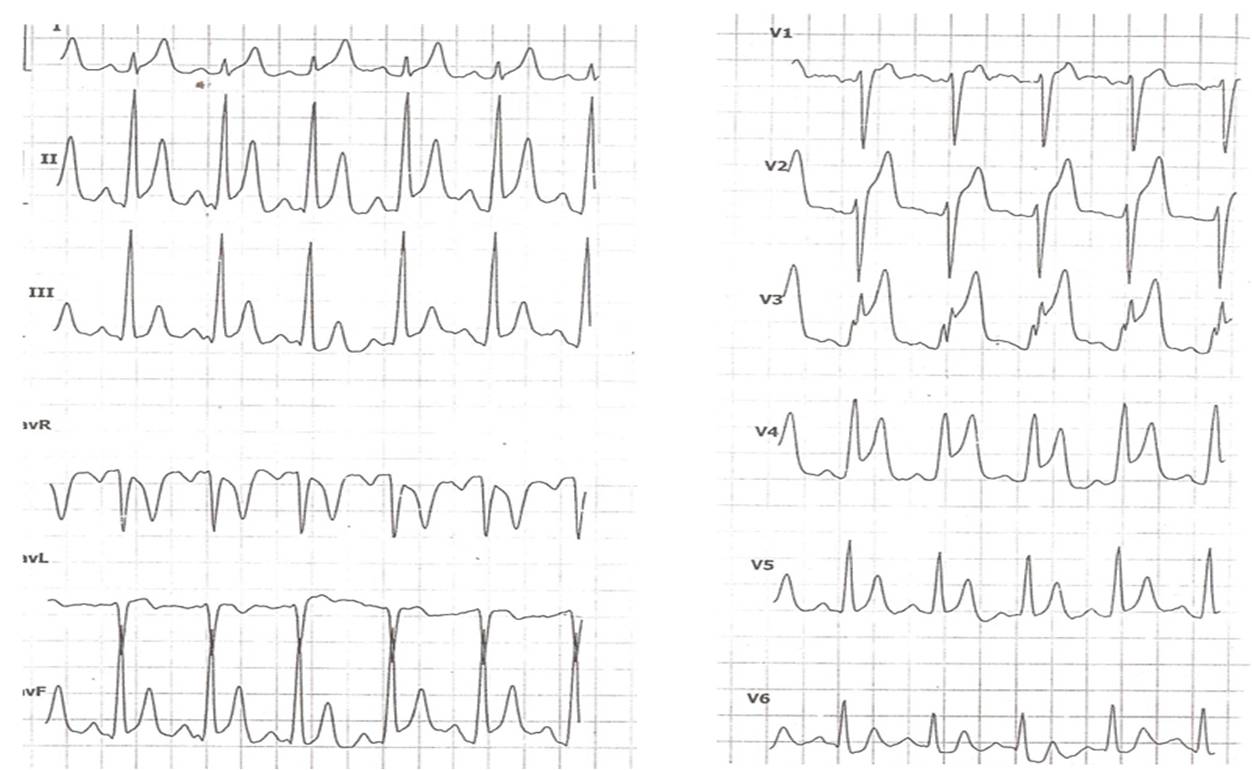
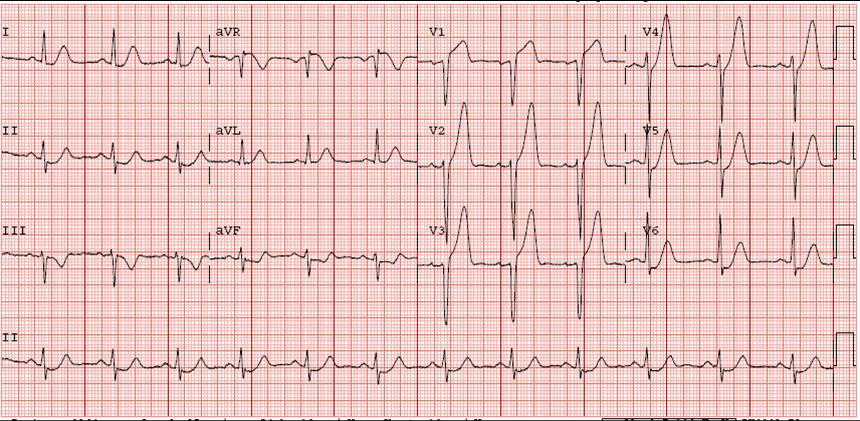
What is the mechanism of hyper acute tall T waves in  MI ?

Questions  galore  . . . Answers struggle !

When a  large  area of  cardiac muscle goes for necrosis  it  leads to  leaking   of   K +    . If it is true  , it  is expected to be a marker for extent of  infarct. In reality it is not . Why ?  This is because cardiac  potassium pool is much  small . A  leak from  an organ which weighs   400 grams   do not elevate the ECF  potassium .  Still , there is ample evidence  for   K + to accumulate  in the local  intracellular milieu. (Myocardial hyper-kalemia ) In fact ,  one of  the mechanisms  suggested  for tall T waves in  hyper-acute MI phase   potassium excess .

Image courtesey hqmeded-ecg.blogspot.in/2009/02/hyperacute-t-waves.html

http://hqmeded-ecg.blogspot.in/2009/02/hyperacute-t-waves.html

Potassium levels and incidence of  ventricular tachycardia.

Many of the primary ventricular arrhythmias  are  due to acute ischemia .  We  have conflicting evidence  for  the effect of ischemia on QT interval. How does ischemia trigger VT  ?
The answer to this question  remain as a missing link !  . Grossly simplifying ,  one could suggest it is  due to   ischemic cell membrane damage that alters the ion channel function  , resulting  in intracellular accumulation of calcium and triggered  activity  .

What is the effect of potassium  on cardiac contractility  ?

Myocardial paralysis.  (Please note  it is the  hypokalemia  that primarily  causes paralysis in skeletal muscles !)

It causes  myocardial  stunning  a manifestation of local potassium  leak ! A temporary myocardial paralysis.

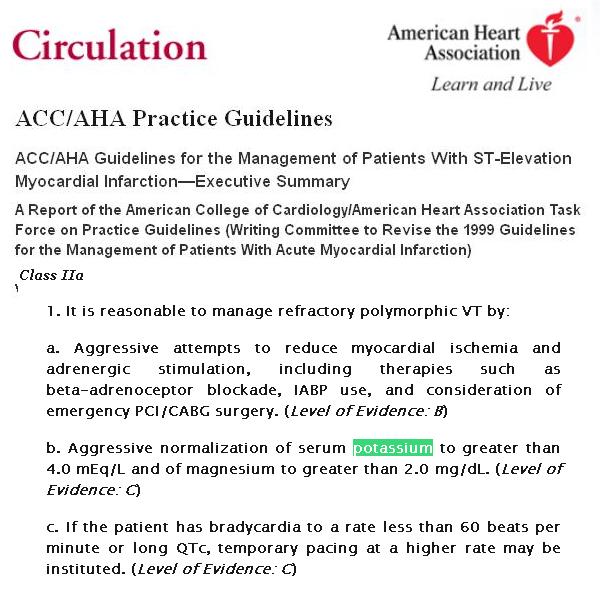
What does the current guidelines of ACC/AHA state about potassium hemostasis  in STEMI ?

It suggests   a fairly aggressive  maintenance of potassium levels  to  upper normal levels. Traditionally we are worried more about hypokalemia than the hyper. It is  surprising   we had the facts wrong . . .  for so long !

What is new in the regulation of potassium level during STEMI ?

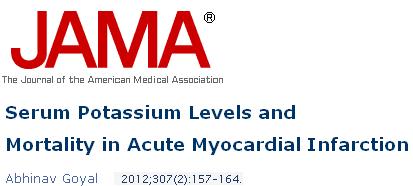
This landmark paper from JAMA seeks  to set right the misconceptions about potassium during STEMI. It suggests  K + levels  has a U shaped  morbidity curve in STEMI . One need to be cautious in  correcting borderline hypokalemia .  Serum   K +   is   absolutely useless  surrogate marker for myocardial K +   . We do not know how  K  +  behaves in the vicinity of MI  zone . So  extreme caution is required  when giving IV  K +  supplements in coronary care units .

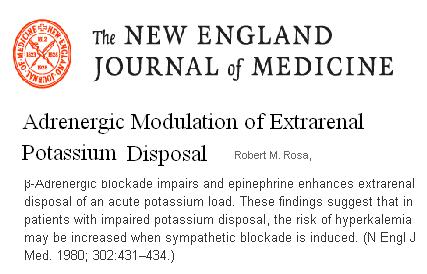
Watch out :  Beta blockers /ACEI   may worsen  hyperkalemia

Early introduction of ACEI and ARBs   is a strong risk factor for systemic as well as myocardial  hyperkalemia . This  is  especially true  in diabetic individuals  who have  low rennin  levels due to diabetic micro circulation defect in kidneys .(Hypo-reninic  hypo-aldosternosim )

Beta blockers are also known to raise potassium by two mechanism

1.Blocking rennin

2.Reduced uptake of K + in to  the cells.

http://medicineforresidents.blogspot.in/2010/09/hyperkalemia-with-beta-blockers.html

Final message

In the management of STEMI  ,   revascularization  of  the myocardium    is  considered as  the only  therapeutic aim . We  need to realise it   is  much more than that .  There are some subtle but important ways of resuscitating and  protecting  myocardium .  Over  indulgence in electrolytic management  in coronary care  is to be avoided.

Reference

Importance of sympathetic drive and  potassium levels

http://www.nejm.org/doi/full/10.1056/NEJM198002213020803

http://ccn.aacnjournals.org/content/23/6/14.full.pdf+html

Read Full Post »

Angina occurring at night is relatively uncommon . It is  still  more rare  for angina to occur exclusively at night (With a possible exclusion of  syphilitic aortits with AR !) The underlying conditions and mechanism  of nocturnal angina  are largely unexplored. In most clinical situations nocturnal angina  is  associated with day time angina as well .

Various mechanisms are proposed

  • It is primarily due to  increased demand  (Holter monitoring has documented  brief bursts  of  HR acceleration  just before  nocturnal angina with  manifest  ST depression )
  • Increased demand  during  REM sleep .
  • Dreams  related adrenergic surge has been implicated.
  • Rarely it is due to supply side defect .
  • Coronary vaso-spasm ( Mostly  in a pre-exisiting lesion )
  • It could  simply  represent  paroxysmal nocturnal dyspnea (pnd)
  • Sleep apnea can precipitate angina  ( Ironically angina occur during   re-breathing  phase )
  • Altered hemo-rheology
  • Nocturnal gap in anti anginal medication *

* May be more  common than we realise.

Cardio vascular hemo-dynamics  at night

If we  believe , sleep is  the great relaxation , and the heart   would enjoy the   “night time”   we  are absolutely wrong . Even in sleep ,  heart has to pump the same 250 ml of blood every minute. Of course , the sleeping heart rate slows down considerably , still  it is interspersed with spikes of activity.  When the heart  rate  slows down  , diastole is prolonged , coronary blood flow  is expected to be copious  unless there is critical CAD.

                                      We  know , sleep is not a passive process  , even as the  autonomic nervous system takes complete control over the  somatic  system .The true colors of  our delicate autonomic system will come to light only during sleep.The muscle tone ,  the sympathetic drive fluctuates according  a pre-set degree . Dreams and REM sleep disturbance can have considerable impact on the sympathetic nerve terminals which ooze  catecholanines  .

Sudden awakening  from  early sleep  is vested with a risk of dangerous   spikes of adrenaline release  .This becomes especially  important in compromised coronary circulation .In fact , this is commonest  sleep -awake  sequence  in patients with nocturnal angina.

Silent ischemia at night

It is curious to note 24 hour Holter  monitoring  reveals  most episodes of ST depression at night are silent. There must be a  specific pain threshold above which a patient awakens  with angina.   The  available  studies   do not  answer this issue   and are not perfect  . We have no way to find  true   silent ischemia  during  sleep.(PET scan in thalamus ?)

Nocturnal angina  in  Aortic regurgitation

Aortic regurgitation  has special relationship with dusk  .For angina to occur AR must be severe and usually isolated .

  • Prolonged diastole at night   -Regurgitation time is prolonged .
  • Dilated LV . Increased  LV mass .Increased demand.
  • Raised LVEDP due high wall stress.
  • Diastolic coronary stealing . Venturi  effect of AR jet

Nocturnal Angina : Is it stable or unstable ?

Most  consider it   as a type of stable angina .Now ,we have reasons to suspect  it could a  marker of unstable angina as it is an  expression of rest angina .

Nocturnal angina vs nocturnal STEMI

How often an episode of nocturnal angina end up in STEMI ?

STEMI is more  common in the early hours of the day and is more related to the hemo-rheological factors  . Please  note ,  STEMI is  a supply side defect  while most episodes of nocturnal angina is due to  demand ischemia . However  it is possible   nocturnal angina episode can precipitate STEMI if  vasospasm is  the underlying mechanism  and if  it is prolonged can trigger thrombosis.

We do not know the answer as yet.

Nocturnal  Angina : Can  it  be PND equivalent ?

Paroxysmal nocturnal dyspnea (PND)  is a classic manifestation of  episodic LVF.  We  know dyspnea can be an anginal  equivalent.  What prevents angina  to  become a  dyspnea  equivalent ! ( Especially the nocturnal ones ,   since the  mechanism  of generation of PND   are very similar  to the  genesis of  angina ). It is distinctly possible  one  may  be mistaken for the  other .  Both occur when  sudden hyper-adrenergic  state  is evoked  which demands   high MVO2 .  An  ischemic heart has every reason to  respond with  angina  .

It is well known  ischemia can result in transient diastolic dysfunction and  elevate the PCWP simultaneously  and PND  would be  the sequel .  When we analysed the  nocturnal calls (  Our fellows ,  do get lots of  such calls from   general wards  at night ),  many  patients with LV dysfunction  who complained  of  classic  chest pain  had  some degree of  dyspnea  and few crackles over lung base as well  .

Nocturnal angina and obstructive sleep apnea

The incidence of nocturnal angina is more common in obese population with obstructive sleep apnea.

The reason is two-fold

1 .Hypoxia mediated

2. Inappropriate tachycardia during recovery phase

Is there any  specific management strategies  to control nocturnal  angina ?

  • General  principles apply .
  • The timing of  anti anginal medication can be adjusted . Long acting preparations taken  in  morning hours to be avoided as they do not cover night time.
  • A calcium   channel blocker   (with optional  beta blocker )  at night may be the best bet to prevent nocturnal ischemia.
  • Dinner to sleep time to be widened.
  • Heavy diet at night to be avoided.
  • Sedatives role is not clear. (Can Diazepam suppress nocturnal angina ?  If so . . .  we  can call it as anti anginal drug  . . .  is isn’t )

References
http://www.thelancet.com/journals/lancet/article/PIIS0140-6736%2884%2991693-3/abstract

http://www.ncbi.nlm.nih.gov/pubmed/8419815
http://www.nejm.org/doi/pdf/10.1056/NEJM199302043280502
  Obstructive Sleep apnea  and  Angina 1  : http://www.ncbi.nlm.nih.gov/pubmed/7715342

 Obstructive sleep apnea and Angina 2 http://content.onlinejacc.org/cgi/reprint/34/6/1744.pdf

Read Full Post »

« Newer Posts - Older Posts »