Feeds:
Posts
Comments

Archive for the ‘cardiology -Therapeutics’ Category

Surprisingly it is common !

A .Abandon the procedure call the surgeon for an emergency CABG

B. Open the most critical lesion.*

C.Attempt to open and stent all possible lesions.

D.Send the patient back to CCU for a conventional  thrombolysis or attempt a intracoronary thrombolysis.

Answer : All  can be a right response depending upon the available expertise ,  time window, associated complication and hemodynamic stability etc .

* Please note ,the most tight lesion may not be the culprit artery. Though there is high chance for that  being the culprit , it  can be very deceiving   especially when  there is multi-vessel  CAD with  chaotic collaterals.

The site of lesion and site of infarct can unimaginably remote.  (A traffic snarl at remote flyover  can have its impact  right on the busy commercial street due to diversions ! ).

What will happen if you open  a non culprit artery first mistaking it for a culprit ?

This could lead to  dangerous turn of events as whatever little perfusion the patient was getting through the ill-fated  IRA will be challenged by the fresh diversion  facilitated by non IRA angioplasty. Extreme caution is required.

Emergency CABG  within 3 hours  of MI even though advocated  by few ,  is still considered a risky  way to reperfuse  the heart.(In India  there  is  nothing called primary CABG!)

An energetic interventional  cardiologist would vouch for opening all lesions . Only thing  , he has  to  make sure is  , the patient also has enough energy to withstand  his  onslaught. Never   non culprit lesion if a patient is stable . 0ur aim is not that.If the patient  is in shock or impending LVF one can justify opening  few more lesions  that improve total muscle function which can be vital.

What about fall back on thrombolysis?

This may be seen a defeatist attitudebut  when the aim is  in the  well being of patient ,  there is no defeat or success. If severe  CAD is encountered and both  CABG / PCI  or not an option,  the cardiologist need not feel guilty or  humiliated to refer him back for thrombolysis. (Of course , Intracoronary thrombolysis  is  an option !)

Final message

Primary  PCI  is often made  to  appear ” As  a  kids play”  by many modern  day cardiologists . It is not so.  It requires a team effort. It is  race against time.   Feasibility depends largely on the coronary anatomy. The failure rate of  primary  PCI is often camouflaged .(Currently Success of pPCI is boasted at 95%)   Logically it should include pPCI ineligible anatomy as well . Many still do not understand the real purpose of pPCI.   The aim is to salvage the myocardium  at risk , sure and fast. Never attempt for total revascularisation in an emergency situation however tempting it is !

In young persons with discrete single vessel disease  the procedure is simple and outcome is straight forward. In elderly , diabetic , STEMI on  preexisting CAD,  diffuse  multivessel disease  ,   complex main left,  bifurcation lesions , one requires  lot of brain sense  to provide optimal outcome . Many times that sense includes abandoning the procedure !

Please read a related article in this site  Primary CABG
Read Full Post »

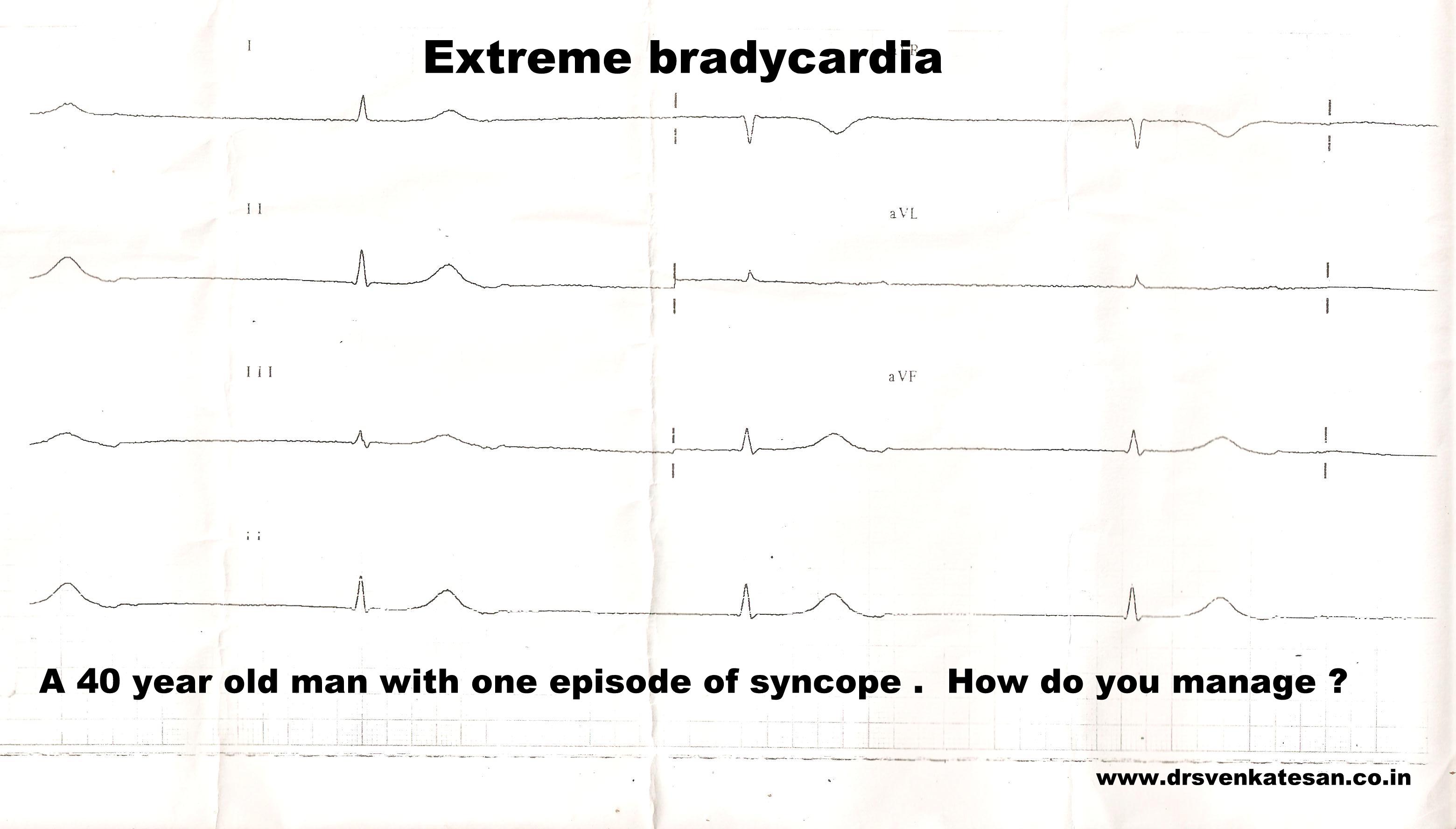
A man  in his 40s presented with an episode of syncope and followed by recurrent episodes of near syncope.

His ECG showed (See image)

  • ECG shows absolutely no evidence of sinus activity . That is  sinus arrest.
  • He lives by the mercy of his AV node.(“Great  escape” junctional rhythm  ! ) . Please note ,  It  fires at less than its intrinsic rate indicating AV nodal sickness as well.
  • The Heart rate is around 18/mt.

SA node is dead(Sinus arrest ) as evidenced by absent p waves. AV node is sick(Depressed) because the junctional rate is less than 20 /mt.

At what  heart rate a person  would develop syncope and near syncope ?

There is no fixed cut off rate for  syncope. It all depends upon the baseline LV function, his exercise capacity, vascular tone etc.

Most will develop some symptoms at  a heart rate less than  40/mt .

Dizziness occur and 30, syncope is sure  when hear rate  dwindles  less than 20 /mt.

A heart rate of 10-15 circulation tends to stall. But still few men are found alive at this rate.

What is the  risk of this patient dying suddenly ?

Contrary to the expectation SCD is not common in  isolated sinus node dysfunction .

It is more common with AV block. The reason being as long as the AV node is fine it will support the rhythm at least at about 30 or s0.

The cause of death in SND is extreme bradycardia induced phase dependent VT /VF.

Will you do a  EP study for him  ?

No. He  does not require it. He is symptomatic ,  and his  ECG shows  tell- tale evidence for SND with AV node depression.

So the there is not even the  necessity to assess  AV nodal status. But .one should  be aware  , there is a battery of tests for SND evaluation (SNRT, cSNRT SACT, etc*) .These are  done only when diagnosis is in doubt or for an academic purpose in teaching hospital.

What pacemaker will you use ?

  • DDDR
  • AAIR
  • VVIR

AAIR can not be used as we have evidence for AV nodal  slowing .

DDDR may be ideal.  In India we still  use VVI mode extensively . Ventricular pacing always safe when you have no EP facilities.  It makes EP study to assess AV nodal function  redundant.

* In all patients with severe bradycardia , a complete workup for systemic diseases like hypothyroidism and other chronic inflammatory pathology must be ruled out. Drug induced bradycardias can exactly mimic pathological  SND. Recognizing these entities could avoid  inappropriate pace maker implantation for  transient reversible bradycardias.

* SNRT – Sinus node recovery time. cSNRT -Corrected sinus node recovery time .SACT-Sino atrial conduction time.

Read Full Post »

How common is edema legs in diastolic heart failure ?

  1. Can not occur.
  2. As common as systolic failure
  3. Can occur in significant number.
  4. Rare.

Answer : 4

Response  3  may be  correct as well .

When cardiac failure was originally defined by Framingham criteria many decades ago , the entity of diastolic heart failure was non existent .The classical  triad of edema legs, raised JVP, basal rales invariably meant systolic ,  congestive hart failure. We will , never ever know how many of the Framingham cohort had isolated diastolic  heart failure .

Mechanism

For edema to occur there need to be water and sodium retention .For  sodium and water to accumulate either of the two things should happen (Hypoprotienemia, Lymphatic dysfunction excluded)

  • Increased venous pressure
  • Reduced renal clearing of water and salt.

When both join together edema is classical and full blown.

In isolated LV diastolic  heart failure the raise in systemic venous pressure is less pronounced .So ,  edema legs is less conspicuous. but in any type of failure  the net cardiac index tend to decline at least marginally . Kidneys are the first organ to sense this , and the nephrons  goes for  a huddle and begin to retain sodium and water as if body is going to face severe water and salt scarcity .(It is a false alarm actually ! )

Neuro humoral mechanism is   “Alive and well”   in any heart failure whether it is  systolic diastolic , forward ,backward  etc. so  , edema  can indeed occur  in isolated diastolic heart failure

Please note ,  the classical edema  that occur in restrictive cardiomyopathy , constrictive  pericarditis  are due to severe  impediment  to right sided filling and  elevated the lower limb venous  pressure .

Other important determinants of edema legs.

  1. The baseline renal function.
  2. Intra vascular volume status.
  3. The associated  HT induced vascular  changes.
  4. Serum protein  levels.
  5. Venous tone.(A good venous pump   in conditioned  legs develop edema late )
  6. Integrity of lymphatic circulation.
  7. Subcutaneous fat  density and interstitial tissue resistance.

All can modify the local hydro static pressure .These factors operate in various quantum’s  and for this  reason only selcted few develop  significant  edema in cardiac failure .

Also  read  . Why some patients  with cardiac failure never develops edema legs ?

* Please note , the terms diastolic dysfunction and failure can not be used interchangeably. Dysfunction is often a  echo parameter while   failure is its  clinical counterpart .Both can be dissociated in time ,   failure may never follow dysfunction .Most episodes of diastolic dysfunction is transitory   in nature.

Read Full Post »

Patent foramen ovale (PFO) is the new generation hole in the heart for  21st century  cardiologist. Present in about 20% of population  , would correspond to 140 crore  “man holes”  as  on  2012   in this planet. PFOs are embryological remnants across the inter atrial septum.

These minute  holes measuring few mm  are largely a  benign finding .In the recent  decades , it is being increasingly debated these holes  may  not  be innocent after all .Extensive  use of echocardiography in recent times   has contributed to  the awareness  as well as anxiety.

Evidence  is mounting  linking PFO to

  • Migraine,
  • Stroke and
  • Peripheral embolism.

While the above   observation may be true  ,  the  fact that >100 crore people have this entity   , raises  a serious question ,  as labeling  all of  them as heart disease will create chaos among the already health obsessed   population .

So , the main purpose should be ,  to identify the high risk subsets* of PFO population .(This will be a <5 %  at the most). People with PFO may  carry  a mental  stigma because it is referred to as a hole in  the heart by the  general  public .For many  the sense of living with a hole in heart is often more damaging than the hole itself ! (Incidentally , many develop  migraine only after reporting about this hole !)In a strict sense  PFO  is not a hole , rather  it is a communication it may be tunnel  or  slit like .It is argued physician should avoid calling PFO as a hole .

*What is a significant PFO ?

  • Large PFOs >5mm
  • PFOs that shunt blood
  • PFOs with septal aneurysms
  • PFOs with documented stroke or embolism
  • PFOs with atrial chiary network
  • PFO in  persons with systemic pro-coagulant states (Except probably in  pregnancy )

Final message 

PFO is a common residual congenital  atrial septal  anomaly . Usually  benign  . One can  live with it perfect harmony. Only occasional patients  are  at risk.

So the prime job of cardiologists is to not diagnose and create panic about  this entity. rather reassure  them (Is it better do not reveal to them if it is found incidentally ? Patient empowerment group would call  this a  foul !  I do not support blind empowerment  )

At the same time our main  aim is to identify the  high  risk subsets who are prone for events.

Closure of   PFO with device is required in a fraction . (*By the way ,  if   PFO is really dangerous ,  why It is never an indication for surgical closure ?  )

Reference

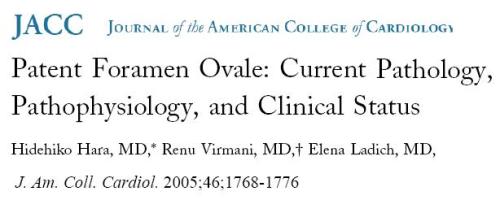
Your  search for best information  on PFO  would end here .  Here is  land mark   article  in JACC  by  Hara   also contributed by  Renu Virmani . A US  Japan  combines initiative  : A must read by every cardiologists

http://content.onlinejacc.org/cgi/reprint/46/9/1768.pdf

http://www.anesthesia-analgesia.org/content/93/5/1137.full

Read Full Post »

Atherosclerosis follows a general hemodynamic  rule.

It has a predilection for medium and small  sized vessels and love to  home in  on the  branch points .

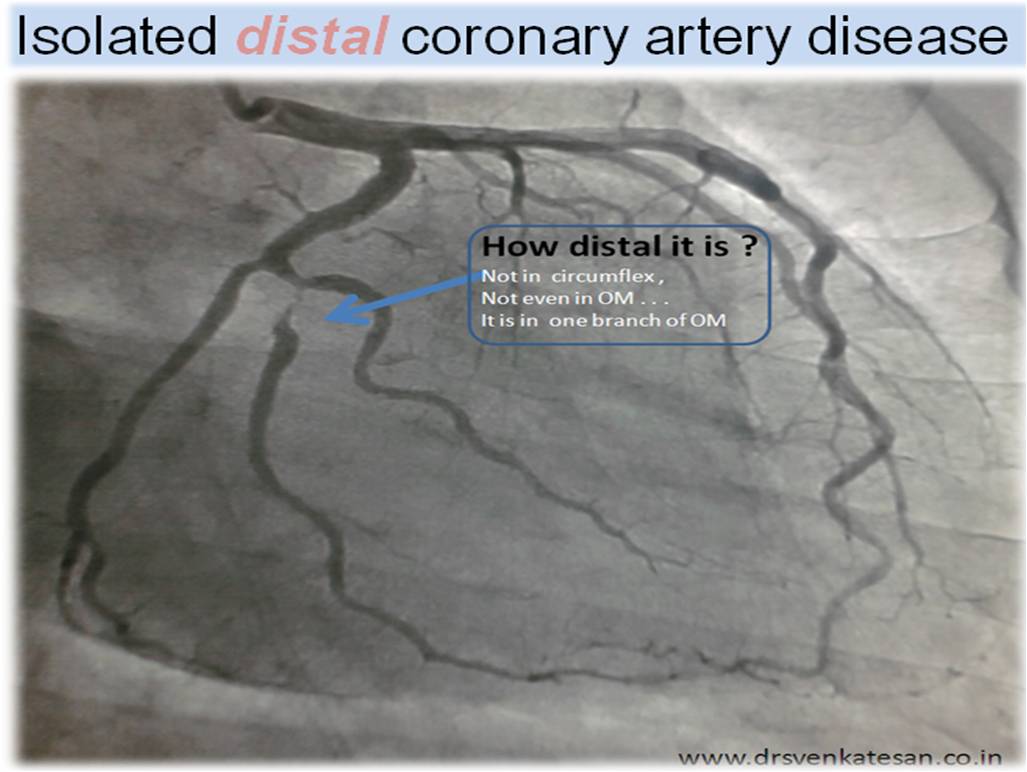
We know coronary  artery disease  mainly involve the proximal tree. We get occasional patient  with mid or distal CAD.

This again ,  in  combination with atleast one  proximal  lesion. Decision making  is easy if there is critical proximal lesion.

Here is a patient who has isolated  critical distal CAD . He created a heated debate in our cath meet

His LV function  was normal , He had TMT  borderline  positive , but no angina ,

What has to be done for him ?

A fellow suggested  a thallium

It was countered by other  ,  we can take it as granted   there is  cold spot in  thallium in a small  posterior segment , then how will you proceed ?

  • PCI, medical , CABG ?
  • CABG definitely  not ,
  • PCI  . . . may be . . .Medical  may be !

When you are confused about  the choice and outcome  . . .confuse the patient* as well ! And , let him decide after a mini  , (but exhaustive ) lecture on coronary blood flow , risk of heart attacks etc .

So in this modern  era of pseudo   empowerment , it is ironical  patients will prevail over doctors after learning   half or quarter  truths  from their android powered smart phones and i pads  !

By the way finally  what  was decided ?

The patient and overwhelming majority voted for a drug eluting stent for  the OM lesion event  as  it appears technically a bifurcation lesion ! This is how cardiology is practiced.

Reference:

Isolated distal coronary artery disease. Presented in cardiological society of  India meet 2005

A clarification .

** One  definition for “confusion” is  being in a  “unclear”  state of mind !

**The aim of this blog is never to confuse the patient. The  above statement is necessary because many patients do believe(or rather want to)  they  understand every thing about their illness even as doctors are baffling with the  great uncertainties and intricacies of  most medical conditions.

Can medical management convert TMT positive into negative ?

Read Full Post »

Ventricular  fibrillation is the most dreaded cardiac  arrhythmia  during  STEMI .If  it occurs  outside the hospital , it is usually a  farewell arrhythmia to most  patients . If it occurs within CCU , it is a well tackled arrhythmia  and has  little impact on long term mortality.

When it occurs in early hours of STEMI it is referred  to as primary VF.

Even though it is a killer arrhythmia ,   primary VF is  often  an  one time re- perfusion arrhythmia. There is no entity called recurrent primary VF  .

If recurrent VF occurs some other mechanism is to be suspected (Drug, hypoxia, scar, ion channel defect etc)

Mechanism

Primary VF is ischemia triggered and secondary  VF is  infarct area triggered .Hypoxia ,  LVF or old  scars  also could  contribute .

How to terminate primary VF ?

Immediate defibrillation  is the only option.

After a successful reversion of VF should we follow it up with anti arrhythmic drugs routinely ?

No . It is not routine.(This is  what  we are debating today !)

What if ,  multiple VPDs  and  non sustained VT  continue to occur in the ensuing hours after an episode of   primary VF ?

It is indeed  appropriate ,   to use an infusion of Amiodarone or lignocaine  in such situation . Following  it with oral Amiodarone is generally not required if the LV function is well-preserved.

Advantage and disadvantages of Amiodarone

  • Pro arrhythmia – A undermined issue.
  • Myocardial depressive action of Amiodarone is a deterrent  for its routine use.
  • Amiodarone induced bradycardia (If it is not a AV block )  may be an  advantage  as MVO2  may be reduced.

By the  way , Lignocaine  how  does it fare vis-a-vis Amiodarone ?

It is equally a good drug  with less side effects .But  the  ALIVE  study delivered a  death knock for this wonder drug. Many (At-least me !)   would still   believe  the unpopularity of    Lignocaine  among the    current generation   cardiologists   is  not due to   academic reasons .

So what is the final message  ?

  • Even though  popular  opinion and ( even some guidelines )  suggest  it may not be  necessary to give anti arrhythmic drugs  after successful reversion of primary  VF . It is prudent  to weigh  the risks. We can’t use it as  a routine .
  • Still , it is always   wiser to prevent further episodes of VF (Rare though ) .
  • If you have a well  performing   CCU , routine  post shock Amiodarone is not advised .
  • If you do not trust your CCU staff  one may  have to rely on  these drugs.
  •  Patients with complicated MI ,  high risk VPDs ( Akin to after shocks after an earth quake ! ) especially in large anterior MIs should receive intensive anti-arrhythmic  therapy (IV followed by oral )

Please note 

**Never plan  for an ICD in patient’s with primary  VF it is an absolute  contraindication.

***Recurrent VT/VF in the setting of STEMI  is  often  termed as electrical storm .It is a rare event which will require immediate CABG/PCI with VT ablation. Again ICDs are  contraindicated  here as the battery depletion will be fast .Further ICDs  it does not cure the VT rather it allows it to emerge from within and then try to tackle it,    while RF ablation eliminates VT focus and prevents it,s origin and provide a potential cure. But , remember only 20%  of VT are amenable for RF ablation ,  while ICD counters all VTs wherever it originates . So there is a role for combination of ablation and then putting an  ICD .

Read Full Post »

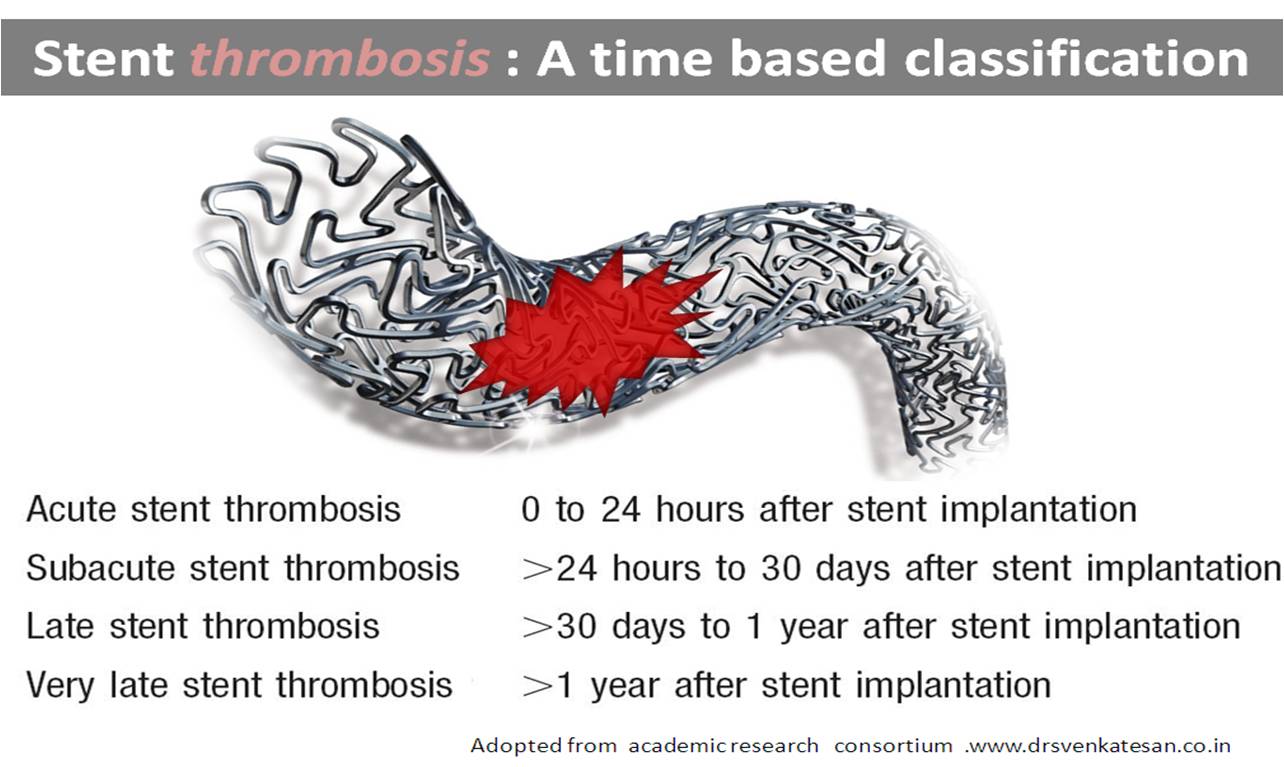
  • How do you classify  stent thrombosis ?

  • What is target vessel revascularisation ?

  • How do  you define  peri-procedural MI ?  Is  troponin elevation alone  enough ?

Want answers for all these ? Your search ends here  . . . The academic research consortium criteria committee provides everything free .

A must read for both  mature and immature  cardiologists . http://circ.ahajournals.org/content/115/17/2344.full.pdf+html

Here is a cartoon for classifying  stent thrombosis (Time based )

There is another etio-pathological /Geographical classification for  stent thrombosis  that will be discussed later.

( Entry block , exit block  , diffuse thrombosis  etc  Read -Geographical miss.)

A word about Academic research consortium

ARC is a consortium of clinical research  from the  Harvard medical school and their associates . The aim of which is  to bring clarity in the  definition of  medical  terminologies and study endpoints.A universal  criteria is being prepared  so that  the study results are comparable which currently use  different criteria  and end points.

For cardiology ARC came out with standardized definition in the year 2007.

Read Full Post »

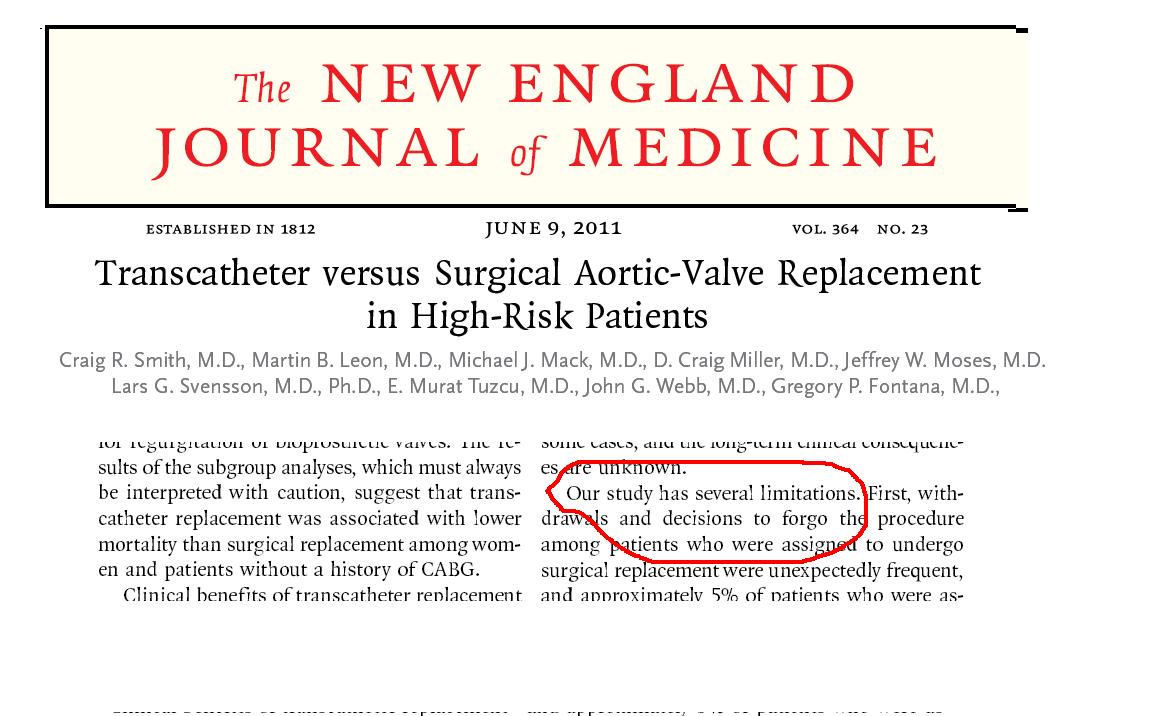
“Limitations of a study”   column appear in scientific articles  because . . .

  1. It  offers   lame excuses
  2. It  informs us  ,  not to get  fooled by  their  finding  .It could  be terribly wrong
  3. The editors won’t publish the paper  without this customary paragraph!
  4. Judge yourself . . . we are transparent !
  5. No study is 100% perfect . Just to make sure the readers are aware of it.

I fail to understand , why even  good articles are rejected for minor  errors  in methodology by many   journals.

Meanwhile ,  how on this earth it’ s  possible  ?   for  some articles to  appear in  top journals ( with questionable conclusions )  embellished
with   major errors in methodology ,  but has  a proud declaration and confession about the  flaws  of the study  in the “Limitations of study” column !

So , in this  modern scientific world  ,  it suggests to me ,  one can  can write whatever  you think as science , as long as  you  declare it and able to impress the editors  to  shift the errors into  limitations column ,  you  are likely to be excused  and also  rewarded !

Read Full Post »

Can you diagnose inferior MI with poor R waves ?

No , you need  a “Q ” that’s  for sure !   Do not diagnose inferior MI without a  q wave  . ( The luxury of diagnosing MI without q waves  is available  only for LAD region )

Any axis deviation ( even 30 degrees) from  base line  can alter the inferior lead qrs morphology to a great extent. R wave amplitude is  primarily determined by the  initial septal depolarisation .  So if the  inferior septum is intact  it will never allow to inscribe a q wave  . Further ,  limb leads are bi polar leads and they are   sum-mated  potential  reflected along the entire  bottom half of the  torso . Hence it is not  reliable to attribute  significance  to presence or absence of  r wave (Unlike  chest leads).

The lung and diaphragm  exert  not only electrical insulation but   also mechanical  alteration of septal profile with phases  of respiration.

Counter point

Not really  . . .  you do not need a  Q   waves  to diagnose inferior MI  ,  electrically  diminutive R  is same as  “Q”

There is  an alternate way of  reasoning  too  . R wave is muscle , We diagnose LVH with tall  R waves so muscle loss should be equivalent to R wave loss .We have innumerable examples where  low voltage R waves are  recorded in inferior leads after a well documented inferior MI.

How do you diagnose old inferior MI by ECG ?

  1. Near normal ECG with degeneration of q waves and regeneration* of  R waves
  2. Residual T wave inversion
  3. Simple low voltage inferior leads
  4. Slurred or notched qrs  complex in 2 3 AVF
  5. Rarely with atrial abnormalities and AV nodal prolongations

The concept of regenerated R is well established . And it brings to the age-old debate of R with live muscle Q is dead muscle

Regeneration is salvaged muscle (Natural salvage , awakening from hibernation etc)

How good is Echocardiogram in diagnosing old Inferior MIs ?

Surprisingly , echocardiography do not help much either .Technically inferior transmural MI  is expected to  leave  a residual wall motion defect.  But many times it do not. Many non q inferior MI (Is there such an entity ?)  do look perfectly normal by echo .

The primary reason  for this is ,  infero-posterior surface is anatomically remote and it makes  wall motion analysis difficult .Newer tissue motion analysis (Velocity vector imaging)  could aid us better.

Some times a trivial or mild  mitral regurgitation is the only sign of   old inferior MI  as  the pap  muscle  lags behind in it’s  functional recovery  while  free posterior wall is  fully salvaged and contracting well .

Final message

It needs  that extra bit of   of  knowledge to  expose  our ignorance.

Even in this  maddening   scientific  era  we have valid  reasons to  go back to fundamentals  of  R wave and Q  wave genesis in MI ,  where clarity  is lacking .

Read Full Post »

Cardiac myxoma  is  an  infrequent cause of  stroke in young . LA myxoma is the commonest  tumor  that can partially dislodge to cause a stroke.

It is not necessarily a  tumor emboli that causes the stroke  , super added thrombus is   common in cerebral artery histological  studies. ( In fact , some have advocated successful thrombolysis for myxoma and stroke !)

When do intervene in stroke due to myxoma ?

Image  courtesy: http://www.medicalscale1.com

As soon as cardiac  myxoma is diagnosed by echocardiography  it is customary to call the cardiac surgeons for their  opinion and feasibility of removing the tumor  at the earliest.

Myxomas need not be removed in an emergency surgery even if it has caused a stroke!

What is the optimal timing of cardiac  surgery in patients  with a cardiac cause of stroke ?

  • Stroke is a major vascular  event .Immediate cardiac  surgery is another major vascular  insult .
  • Extra corporeal circulation is known to affect cerebral perfusion  even in normal persons. In  patients with  acute stroke  this   can  have vital impact.
  • Anticoagulants used  peri -operatively  increase the risk of   converting  a simple stroke into hemorrhagic  one.

Hence , it is advisable to wait for 4 weeks after a stroke before removing the myxoma . One can not expect a controlled studyon this issue .  It  is to be  based on collective  experience of many.

Who should decide ?

A cardiologist, a cardiac surgeon and neurologist should  collectively decide along with patient’s input ( or his proxy)

When there is  a dispute in timing of surgery  Neurologists opinion shall prevail over others as the immediate concern is brain function.

Is there any  indication  at all for doing early surgery ?

High risk mobile tumors demand early removal as further strokes can be avoided. Individual discretion and institutional preferences apply.

Reference :

1 http://www.ncbi.nlm.nih.gov/pmc/articles/PMC2627525/pdf/TOCMJ-2-115.pdf

2.http://asianannals.ctsnetjournals.org/cgi/reprint/8/2/130

3.http://www.ncbi.nlm.nih.gov/pmc/articles/PMC3064861/pdf/crn0003-0021.pdf

Read Full Post »

« Newer Posts - Older Posts »