Feeds:
Posts
Comments

Archive for the ‘Cardiology -unresolved questions’ Category

Exertion and  acute coronary syndrome (ACS) has a tricky relationship. On the one  hand, it  would  appear they are not related at all  as only a miniscule of patients   give history of recent severe exertion prior to ACS   , while  few others  tell us  a clear- tale of   unaccustomed  exertion ,  just prior to the onset of chest pain.

Here is case history  of a  man  who was rushed to our  ER from  Madras central station ( Our hospital is located just opposite to it !  )

A  48 year bank officer  was  about to board  a train to Patna   . It was a rainy  November  evening ,  his car got struck in traffic .He along with  his family members were rushing to catch the rain  .He had  to run fast with his heavy luggage  .Even as they boarded  the train successfully and occupied their  seats  ,   within minutes  he  developed intense chest pain and sweating . The distressed family de-boarded the train and was rushed to our hospital  . Yes  you guessed it right   . . . he  was showing an extensive ST elevation  in anterior leads on arrival.

So what  has  happened ?  What is the coronary hemo-dynamics during heavy unusual physical exertion ?

The above patient did  not have any obvious risk factor . He vaguely recalled ,   one if his family doctors telling him ,  he had borderline high BP and was never prescribed a  drug . His wife told us  he has been a emotionally  liable individual .

It is well  known  , sudden exertion in an  emotional  milieu   would  result  in  intense  adrenergic drive  . (Here the emotion was anxiety/ fear of missing the train )  Adrenergic drive was  amplified with the  isometric exercise (heavy suitcases ) ,   shoots the intra  coronary blood pressure (normal 45-60mmhg)  into  dangerous spikes . (By the way , what happened to  coronary auto regulation  ?) . We also  realise simple raise  of  intra coronary pressure alone is not sufficient  .These patient  will  harbor at least some degree of  atherosclerosis  which face a  shearing stress and give way /tear  or fissure resulting in  a sudden substrate for intra coronary  thrombosis.  Some of them may manifest  only  as coronary vasospasm  .When sustained  it can also result in a full-blown acute coronary syndrome.

The concept of trigger vs risk factor

One should remember  both physical and mental exertion   act  mainly as a  trigger (They are not  major risk factors  like DM/HT/Smoking /Dyslipedemia) . All that is required ,  for  this   vulnerable population  to fire  is a trigger.  Physical exertion ( especially  isometric)  when  associated with  emotionally charged  brain  sends a  perfect  invitation  for an impending  ACS !

Another example  for untoward  effects of  exertion

A middle aged man who had  impaired glucose intolerance and dyslipdemia  was referred for an  EST.He did complete  12 minutes of  Bruce  protocol  comfortably . But  on the same day evening  ,  he felt  uneasy  and came to our ER ,   only to record a full blown STEMI .

These events may be rare but if properly understood   these  patients can teach  us  few   lessons in the genesis of ACS and coronary hemodynamics .

Special  issues  about   exertion in post PCI patients

One of the purpose of doing  PCI  for CAD  is to improve the  functional  capacity  (and possibly to prevent future ACS) . Paradoxically ,  we  continue  to have  some apprehension about subjecting post PCI  patients  into early stress testing . (I remember reading some guidelines that advice us to  avoid stress testing strictly for 6 months post PCI  ! Is it true ?)

If a  cardioloigst  is  not too comfortable  putting their  patients  into a  treadmill  post PCI ,  it only implies they doubt their efficacy ! It   would  also imply  these  patients   should  not be allowed to exert to their full capacity in day to day  life events as well .(Attention  cardiologists   . . . Yeh  . . . we have a  fundematal problem on our hand !)

Read Full Post »

Read Full Post »

Sustaining a STEMI  may be a  pathological  end  point  for  coronary  artery disease. But ,  from the  management point of view it is  actually  a starting point for CAD evaluation  .Strategies to prevent further   cardiac  events   must be formulated .

How do you manage a asymptomatic  un-complicated  post  STEMI   patient*  at discharge ?

  1. Do a sub- maximal symptom limited EST and then discharge.
  2. Advised  to come back after 2 months for a  stress test or Perfusion imaging
  3. Continue  with intensive  medical management without EST or  CAG and monitor only the symptoms
  4. Advice coronary angiogram   in all and decide depending upon the lesions (Pre -discharge CAG )
  5. I am a modern day cardiologist  . This question does not arise . . .  as I do only primary angioplasty for all my cases !

( *Please note ,  this forms the bulk of  STEMI population (up to 60 %  )

Answer : Your guess is the correct answer!

Why we need to risk stratify STEMI at discharge ?

The  morality and outcome in STEMI  though appears  to be a   continuously falling  curve ,  the slope is not linear.

The classical   mortality till discharge is about 6-8  %. Between discharge and 3oth day there is 1-2 % additional mortality

At end of first year there is  further   2 % mortality. From  second year onwards there is an annual attrition rate up to 3 %.

The aim of doing  a pre-discharge  EST is to do identify  ” patient  subset ” who are destined to die  within 30 days of STEMI.  If you schedule the   EST  after 6-8  weeks  one can not prevent these two deaths out of 100 !

( Of course ,  we assume   a prompt revascularisation in those vulnerable would prevent this !).  By doing so , we can avoid the bulk of unnecessary PCIs  that  happen  with  routine CAG following STEMI.

Pre discharge EST can be done safely  within 5-7 days  with  a symptom  limited test (70 % of  THR or up to HR of  120 /mt ) This  simple test if it is negative can virtually R/O  a  critical proximal  lesion with near 100% sensitivity.

Should we  risk stratify patients  who have undergone pPCI as well ?

Most of us  would love to believe ,   once  pPCI is  done to the  patient , he  reaches  a therapeutic end  point. But  it is not the truth . It is  the degree of  LV dysfunction ,  extent of contrary coronary lesion  ,   co existing risk   factors  and  the  intensity of medical treatment  only  would  determine the long term outcome.

It is very important to  realise  the pPCI is aimed at opening the IRA  and other lesions are  often left alone. So never  believe  pPCI   per se  would confer total risk reduction following a STEMI  .  There is considerable evidence to suggest  the opposite may be true at least in high high risk pPCI  ,where  metals are   placed  in  complex ,   vulnerable thrombotic milieu.  Hence it  seems logical  to risk  stratify  all patients   after primary PCI   (In fact, this population require  more vigilance )  .

When will you advice an  EST following  pPCI ?

It is usually not needed in the immediate discharge phase in single vessel disease which  would have been  tackled during pPCI.In multi-vessel CAD , where  only the IRA was tackled during pPCI  ,the same guidelines that of  thromolysed  STEMI shall apply  .Since we know the coronary anatomy already ,  EST helps us to evaluate the hemodynamic status of non IRA lesions if  there are any  . While ,  this is a  logical debate , logics has a rare place in medicine . It is ironical ,  stress test   is rarely  done  even after 6months following pPCI  in most centers.

Final message

It is  a  pity  ,  anatomical risk stratification  has squarely beaten  the scheme of   physiological risk stratification in most cardiology centers . A pre -discharge EST* was a  good concept that gave us an idea about the coronary reserve  after the ACS.  It was a collective wisdom of cardiologists  that has hanged this useful concept.  It is still more shocking ,  to note even the  scheduled  6 week   EST is  dropped from the  post MI work up in some  institutions.

* Many would consider  ordering an early EST in STEMI is an act of bravery ! The fear seems to be genuine   and most will agree with that.  But , please remember a physiological test  (Cheapest and simple is EST or a  Nuclear perfusion )  should precede  CAG  in all  asymptomatic  post STEMI  population  whenever possible . If  EST could not be done  prior to CAG for some reason   , at least do it following the CAG . It  will have  an  important impact  on the downstream decision making  which is often an  inappropriate  PCI  !

Read Full Post »

What is  the most important factor that  will decide  the revascularsation following a  STEMI  ?

  1. Patient’s  symptoms
  2. Residual Ischemia documented by stress  test /Perfusion scan
  3. Presence of  significant  LV dysfunction
  4. Coronary anatomy and lesion profile
  5. Wealth  of the  patient (Insurance  limit  and  other  financial  resources )

Response  2  is   academically correct ,   but    practically  and politically   response 5  would be   the right one  for most cardiologists . At  any given day  ,  affordability and availability  of PCI  will prevail over all other factors  .

Affluence based cardiology

Image courtesey : Jupeter images

What is the  height of  inappropriateness in modern cardiac care ?

This world will never forgive the medical profession , if they do not fight  against  grossly inappropriate medical  care system especially in the life saving situations  .While one  cardiologist    just watches   a  left main disease patient  with unstable angina die peacefully in a Govt institution ,  while  another  patient with asymptomatic  distal PDA lesion gets a 3rd generation drug eluting stent in a  nearby corporate hospital !

Please note : Harm is the ultimate outcome in both rich and poor.One suffers with non availability while the other is the victim  of   affordability .

Read Full Post »

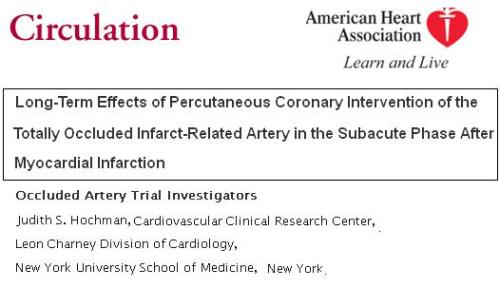
The  OAT   extension study  ,   a  6 year follow-up study on total occlusion following STEMI has just out in circulation 2011  October , online first . http://circ.ahajournals.org

There were two  important conclusions  from this study

  1. Long term follow-up  to  6 years  confirmed  the  lack of benefit of routine PCI  in  post MI total occlusions.
  2. Inappropriately   done  PCIs convert   stable coronary occlusive  disease into potentially dangerous subsets  with  risk of re-occlusion (Which  could  very well be an acute coronary syndrome )

The second one is  of critical  important than the first  .In a nut shell ,  it  suggests  routine PCI in  CTOs  could  increase the   risk of ACS many fold in other wise stable patients.

Final message

This OAT extension study  should  not experience the same fate  of  COURAGE and OAT -1  which  were  successful bitten and buried  by most  interventional cardiologists.

This time they   have to  swallow  the  unpalatable truth ! If they don’t ,  our  patients  would be the ultimate  losers and

will pay the  price dearly !

Personal foot note :

One of my colleague asked me  . . . Why am I  always  after the Interventional   cardiology  community !

I said ,  it is not my job to pull down any one group.  I am just exposing   the  irony of  “selective usage” or “selective  neglect”   of scientific  data by many of us !

Read Full Post »

The other day when  I was  observing  my colleague   puncturing  the inter atrial septum  with heavy bore needle  during a PTMC  procedure  the patient   was  comfortably watching and   enjoying   the procedure .

Even as  multiple wires  criss-crossed  the left atrium  and  the  balloon  hitting  the mitral valve repeatedly   there was  absolutely no pain.

Next day ,   in an another  patient  when IAS was punctured  it got stained  along with pericardium  ,  the patient had   severe  back pain and procedure was  to be  stalled temporarily  .

What  is the lesson learnt  ?

The pericardium and the epicardium (same as visceral pericardium )  has rich  pain  fibers. The above  patient  who had  stain  of epicardium had severe pain .

The former patient who had a perfect IAS puncture did not develop pain while the  later  who  had an  epicardial track   experienced pain.

The same analogy can be seen in patients  with myocardial rupture .While  sever chest pain is a rule  with a free wall tear , it is very rare for  patients with ventricular septal  rupture  to complain  sever pain as  IVS   rupture do not cleave the epicardial layers  .It is also uncommon for papillary muscle or chodal rupture to generate  significant pain .

What is the difference between  epicardium and endocardium in terms of pain fiber  innervation ?

Sub- endocardium has less  dense nerve supply than sub-epicardium. This is one more reason why isolated sub-endocardial  stress  less commonly result   angina ( Eg Hypertension and sub endocardial strain  often silent  ) while  even minimal irritation or insult of sub-epicardium induce severe  pain.

Further , cardiac  pain receptors   respond differently to type of stimuli  .The density of these receptors also  vary depending on planes of myocardial  tissue  .

What are  triggers for cardiac pain ?

Any of the following can trigger cardiac pain.The pain receptors in heart are not well developed as that of somatic system.

It is not clear whether the layers of heart has specialized receptors for various sensations.

  • Stretch*
  • Prick
  • Guide wire poke ,
  • Needle prick
  • Temperature .
  • Infection ,
  • Inflammation of  myocardium , pericardium*
  • Pressure injections
  • Cardiac ischemia*

These  three factors   are responsible for bulk of the cardiac pain . Please note needle prick on the heart is least painful !

How does ischemia   generate pain ?

The ischemia of myocytes secrete

Bio chemical

Substance P ,  prostaglandins, serotonin, adenosine, bradykinin,   and other mediators are involved

Neural

Carried by  myelinated A-d and unmyelinated C fibers run in the cardiac sympathetic nerves . It is understood ,both the fibers  respond to mechanical stretch while Type C fibers also carry chemo signals from bio chemical mediators as well .

Vagus  nerve has a major role in carrying  afferent signals of pain . It is  well known ,   if pain stimuli  is substantial the vaso vagal reflex is activated and bradycardia  and hypotension  occurs.

How is infarct pain different from Ischemic pain ?

Necrosis of nerve terminal will result in more intense pain and lasts longer .

Clinical examples for stretch induced cardiac pain

  • Acute RV/LV dilatation of any cause
  • Pulmonary artery/Aortic dilatation
  • Pericardial stretch could contribute more in generating this   pain
  • Mitral valve prolapse (Stretches  LV free wall )

Interventional  cardiologist should thank god for not innervating  the heart extensively . This  only allows  us to  spend  hours  together  inside the patients heart , other wise one would require a general anesthesia for doing a PCI

Does pericardium  suffer from  ischemia or necrosis ?

Pericardium is not an  avascular  structure . Pericardium gets its blood supply from twigs  of LIMA and phrenic arteries.So there  must be some impact of ischemia on pericardium . Since pericardium has  rich nerve supply there  is every reason to suspect existence of ischemic  pericardial  pain as well .

But  pericardial pain induced by   mechanical stretch  and inflammation is much more common  .While acute pericardial stretch is painful chronic stretch as in slowly accumulating    pericardial effusion is  a painless event !

Pain relief  after CABG

One of the reasons for angina relief  post CABG is attributed to the interruption to  pericardial nerve supply.

Reference

This 1957 article from circulation still  rules cardiac pain literature . http://circ.ahajournals.org/content/16/4/644.full.pdf+html

http://www.annualreviews.org/doi/full/10.1146/annurev.physiol.61.1.143

Read Full Post »

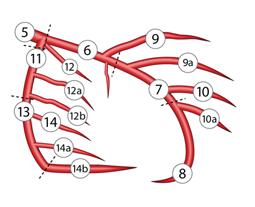
Proximal LAD lesions require  specific and early Intervention.Hence we need to know what exactly  we mean by proximal LAD disease.Unfortunately , it means different things to different cardiologists .There is no dispute regarding the  origin of  LAD since it begins with bifurcation point  .The problem comes with  this question !

Up to what distance LAD can be termed as proximal ?

  1. Bifurcation  to   “First   diagonal” of  any size
  2. Bifurcation  to   “First Major diagonal”
  3. Bifurcation to     “First septal”  of any size
  4. Bifurcation to    “First  major septal”
  5. Bifurcation  to   “Any major  first branch ” (Either septal or diagonal )

Answer : I think  4 is the correct answer . But many believe  5 can be correct as well !

Why  there is  confusion in the  definition of proximal LAD ?

This is because the first branch of LAD itself is not a  constant one  . It can either be a septal  or  uncommonly  a diagonal.

It should be noted , the septal and  the diagonal  branches  neither respect   seniority  nor follow a  hierarchy .The first diagonal may be diminutive while the   second or third diagonal may be major one  and vice versa .Further  ,  there can be a trade of  in length and caliber of   septal and diagonal branches  .This  phenomenon is also  common between  diagonals  and   OMs  . All these confound the picture .

Cardiologists even though they are  primarily physicians they are  pro-anatomy  like surgeons when it comes to coronary interventions .

                                  In the strict sense ,  we  need to differentiate a  lesion  from being   physiologically proximal  or anatomically proximal  !

Is there a proximal LAD equivalent ?

There are three  situations  this can occur .

  • Some times a lesion  by  definition may not fit in  as proximal  LAD  but physiologically  few major diagonals  will arise after the lesion.
  • Other situation is , LAD lesion may be  mid or distal but  a major first  diagonal may be diseased  , making it  equivalent  to proximal LAD in terms of physiology.
  • A mid LAD  with a large OM lesion which is running in the D1  territory

Final message

It is ironical  millions of cardiology interventions happen  for proximal  LAD lesions  every year without  even  proper understanding of what we mean by  it ! Youngsters are argued to ponder  over this issue whenever  they indulge in  such cases for revascularisation!

Reference

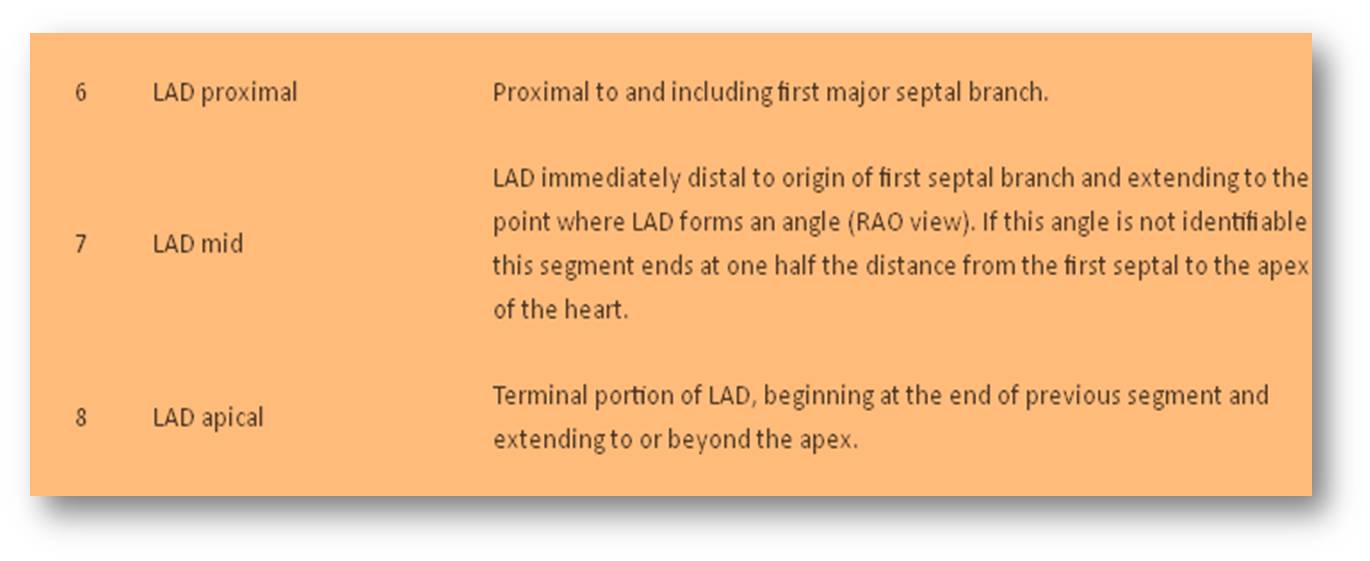
Text books differ in their definition about proximal LAD. Currently , the  SYNTAX  scoring system  has defined the coronary segments in a practical way.

http://www.syntaxscore.com/index.php?option=com_content&view=category&layout=blog&id=1&Itemid=32

Definition from SYNTAX

Read Full Post »

If  we   think we have  unraveled  all the  mysteries  of   human coronary  blood flow   we are  sadly  mistaken . Most cardiac physicians spend  their  prime life  in opening the  obstructed coronary arteries  playing  a role of coronary plumber.

Like any plumber ,  it is not going to be  one time job and   our patients  would  have to hire their  services  periodically  . Many times  it turns  out to  be a 108/  911 call  as well !

Unfortunately , hem0dynamics  of  coronary blood flow  do not follow  the principle of  water flowing across  a domestic  pipeline.The most dramatic   difference  between  the  coronary blood flow and   water pipe  is ,   in the later  ,   as  the water is being ferried   across the house  ,   neither the building   nor the   pipe    contracts    (Unfortunately all our understanding , derivations and research were  based on simple physical  modules  of  hydrodynamics in a static  delivery  system )

Pressure flow relations especially in biological system is  not  simple. Since  our  foundations on principles of   blood flow  is based on this simplistic model  ,  every assumption  could be proven  wrong. This  is what  is happening now . Nothing seems to work  in a  learnt  manner.

A patient  with  100% occlusion  walks comfortably  without damaging his muscle.While an other patient  would  develop cardiomyopathy even if the occlusion is  gradual   and  incomplete  ! Hemodynamic  logic tells us blood flows from high pressure to lower pressure  zones  like a water fall !

But coronary waterfall is not a simple and smooth affair. It is not a free fall  ,  even as the water falls there are  pumpy  interruptions .When these  pumpy ride  occur  even in physiology one can imagine  the pathological states  , when  the coronary  artery is blocked ,  the myocardium is  scarred and the systemic blood pressure fluctuates .

While every  organ welcomes   the systole  ,  as they are fed  with  blood  during this time of cardiac cycle  . Heart  is only organ which sacrifices  its own blood flow during this phase  as the systolic contraction  interrupts the blood flow .

Determinants of coronary blood flow

What we learnt over the years has been too simplistic. It is not the  patency of vascular  system that matters. The coronary micro vasculature, the metabolic demand, the neuro  humoral regulation etc.  For  most cardiologists  the epicardial  patency   or stenosis remains the only relevant  issue

The reality is  much complex  to comprehend

  1. The coronary perfusion pressure
  2. Coronary flow reserve
  3. Coronary wave forms
  4. Sub endocardial vs subepicardial flow ratio
  5. Effect LVH on myocardial flow
  6. Coronary venous tone and arterial ischemia.

Now,  we have an entirely new concept which proposes (Rather proven concept !)   the  integrity of  myocardial contraction and relaxation on the coronary blood flow. This land mark paper in circulation has identified  six wave forms of coronary blood flow This include 4 positive  waves and two negative waves

Questions need to be answered 

During diastole  myocardium relaxes . Only if  the myocardium  relax   optimally  the compressive effect of systole  on coronary  coronary   micro vasculature is reversed  ,  intra coronary resistance  falls so that coronary blood flow can occur smoothly. We do not know  whether diastolic dysfunction would  affect the diastolic coronary filling waves  jeopardizing the coronary flow.

Myocardial viability is important for one more reason  , in the distribution  of   coronary blood flow .A dysfunctional muscle can not receive  and  inject  the blood  deep into  sub  endocardium (Note this becomes  important  when  revascularising   severely  dysfunctional segment )

Does myocardium has a  calf muscle analogy   and  behave like  a  powerful  intramuscular perfusing pump .

A breakthrough concept  from Davies et all in circulation .  These are not new ( Buck -Berg  ?)thought  about this decades ago .  The interest is rekindled in recent years  ,  as  complex angioplasties  following myocardial infarctions  failed  to improve outcome and relive symptoms in many .

During primary PCI ,  no- reflow  often  denotes a meaning  of  failed  PCI .The issue involved  is  hydrodynamics of intra myocardial  blood flow .The following  article partly  answers the  issue  underlying no re flow .http://circ.ahajournals.org/content/113/14/1721.full.pdf+html

Final message

Young  physicians  need to  spend  more time  in  basic  cardiac sciences . Lest, what  we  do  in cath lab blindly  will become a laughing stock  ! We have to go back to the golden years of  research in cardiac physiology  (1960 -1970s)  . Mastering coronary  angioplasty  may increase the blood  flow  up to the  myocardium ,  but pushing the blood beyond the muscle requires more sense  and effort .

A simple  hemodynamic  model based  on  physical  principles alone is a  greatest error we make in cardiac science . * Further, human heart muscle is not only influenced by the quantum of blood  it receives  but to the great extent the content of blood.The blood caries all the ill effects of  systemic diseases and  damage   the vessels and muscle .The interaction  between the  blood and  the muscle  is never  an issue in  the pure  physical labs .( Even animals misbehave !)

Read Full Post »

Is there  an  anginal equivalent  in cerebral circulation ?

Coronary Ischemia produce  angina . . . Cerebral  ischemia do not produce  corresponding   ischemic cerebral pain ! Why ?

Exertional angina  is the dominant  event when coronary artery is  stenosed  . When cerebral artery is stenosed   exertional  head ache do not occur .  So , how does brain respond to  exertional  ischemia ? (EST is also  a stress  to our  cerebral circulation  .  If only we record  EEGs  during treadmill we will  know the truth !)

But in the clinical setting  ,  we are not only surprised by lack of head ache during cerebral  ischemia   , even  exertional   giddiness  is not a common presentation . Instead ,  brain  primarily   respond to ischemia  with focal neurological  deficit instead  of  generating  pain within the skull. This is often referred  to as TIAs .

But,  chronic ischemia  has its effect in the form of lacunar  infarct with its  clinical counter part  – vascular  dementia.

Electrical rhythm  disturbance   like   Ischemic cerebral  arrhythmia are also  known to occur .

The reason for these coronary vs cerebral stenosis behavior is  not clear . Number of possible explanations can be offered.

  1. Paradoxically ,   in spite  of  brain  being a central neurological  command , by itself  has less pain receptors  especially to ischemia
  2. The hypoxic threshold for cerebral cells may exceed many fold to  that of myocytes.
  3. Cerebral  auto-regulation is more developed than coronary regulation.
  4. The circle of  Willis  , though   do not help  much when individual  cerebral arteries are  occluded  suddenly , it does  play  a role in balancing cerebral circulation  at times of chronic  low flow states and  ischemia .
  5. Finally , even in physiology  many of us are comfortable with  little  brain function. One estimate says we  hardly  use   2-3 % of  brain’s processing power (Like our computer  CPU) .Hence  intellectual , deterioration  are  very  late  phenomenon of cerebral ischemia.


Reference 

How often head ache occur in  acute stroke ?

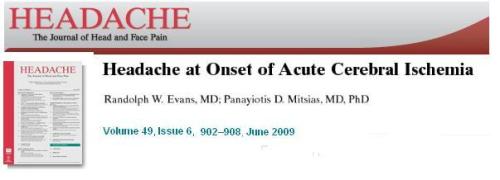
It occurs in less than 15 %  in acute ischemia .( In chronic ischemia it is very rare ? non existent ?)

The exact source of pain is not clear .

A stretch induced pain , dull infarct zone pain, cerebral edema induced transient  ICT may also contribute .

http://onlinelibrary.wiley.com/doi/10.1111/j.1526-4610.2009.01440.x/abstract

It  was a real surprise ,  when I found this journal exclusive for  head aches !


What is the mechanism of vascular head ache ?

It is ironical  ,  more often an excess blood flow by inappropriate vasodilatation that cause many episodes of vascular head ache . These confirm the complexities of  ischemic vs non ischemic pain within the brain .

Read Full Post »

The answer to this  seemingly innocuous  question is not  that simple at all.  We know ,sinus tachycardia is  a common expression of thyroid  excess while  sinus bradycardia is the  hall-mark of thyroid depletion. So  obviously ,  the first thing that would  strike us  is ,  there must be  something  cooking between thyroxine and the SA node .

We realised much later , there is no direct action of thyroid hormone on the SA node instead it has a crucial interaction with adrenergic system which   has the major influence on chronotropy.

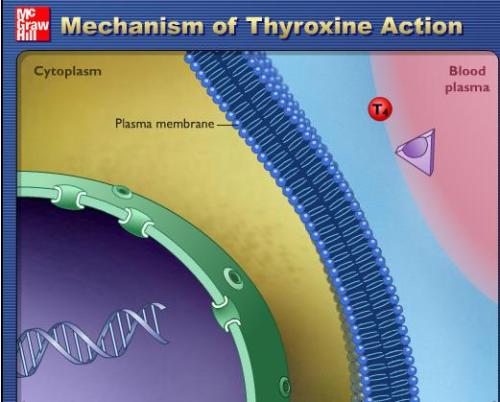
Click on the image for flash Animation (Courtesy Mcgraw Hill )

How does thyroid interact with adrenergic system ?

Thyroxine (T4)  is an inactive molecule , it has to get converted to  T3 for its action. This conversion takes place inside target cells like myocytes, pacemaker cells  (of course  it has action  on virtually any metabolically active cell !  )

The most important point to remember is , unlike catecholamines the thyroid receptors are located  in the surface of  the nucleus  inside the cell , instead of cell membrane . Surprisingly T4 does not require any specialised transporter to enter the cell.It simply diffuses into the bi-lipid layer of cell membrane as T4 is immensely lipid soluble.  . After entering the cell in the cytoplasm it gets converted into  T 3.

This T 3 is attracted towards the nucleus. Once  it is attached to nucleus , it brings about  changes in the gene configuration and  through  messenger RNA results in new protein generation . These cellular  elements are vital for maintaining the  ionic channels and ports and anti-ports.Among these the most important is adrenergic receptor molecule , an its  signal system namely the GTP/Adenyl cyclase/Cyclic AMP units in the cell membrane .

Thyroxine is a physiological hormone  required to maintain these adrenergic  receptor complex on day-to-day basis. (It can be called as cell servicing hormone )

The circulating catecholamine’s  action is  heavily  influenced by the thyroid hormone status.   Sympathetic  nervous system is the live wire for human biological system.  So , when thyroid is in excess the entire metabolism of  cell is increased and vice versa happens.With the close interaction with adrenergic system  , one can understand how thyroid excess causes anxiety state and depletion causes  depression.

Coming back to heart ,

  • Thyroid hormone   up-regulates  beta receptors in cell membrane and augments the action of epinephrine and  result  sinus  tachycardia .It can have positive inotropic action as well (Hyperdynamic  state )
  • Aguments intracardiac  conduction.
  • The action of thyroid hormone on heart can well extend to the pathological phase, where in it can cause multiple ventricular ectopics and atrial fibrillation. (Note the striking similarities between  these arrhythmias   and   adrenergic  arrhythmias !)

What is time frame for  thyroid  hormone action ?

Obviously thyroid hormone can not  have a rapid onset action  since it invites the nuclear synthesis  (Like steroid hormones)  it may take few weeks time for thyroid hormone to express its effects.

How does beta blockers exert its action in thyrotoxicosis ?

This occurs in two ways.

  • The beta blockers occupy the adversely up-regulated dense  beta receptors of cell membrane and  prevents excess adrenergic  action.
  • There is some evidence beta blockers prevent conversion of T4  into T3 .This seems to be less important than its direct sympathetic blockade.

For effective control of thyrotoxicosis one need to administer beta blocker in combination with anti-thyroid drugs.

Will calcium blockers be effective in controlling the tachycardia of thyrotoxicosis ?

No it is not . It may  reduce the heart rate a little but never to the extent of beta blocker. This is another  indirect evidence for  the interaction between thyroxine and adrenergic system.

If thyroid hormone is able to potentate the circulating catecholamine action why not it be used as a

positive Inotropic in cardiac failure ?

A very valid question.  It was tried by many researchers especially in dilated cardiomyopathy. .For some reason it has not worked well , except in patients with  associated with hypothyroid  state.I personally believe thyroid hormone must have  a major role  in chronic heart failure in spite of the fact  we have  proposed sympathetic blockade as concept for regulating cardiac failure.

Read Full Post »

« Newer Posts - Older Posts »