Feeds:
Posts
Comments

Archive for the ‘Infrequently asked questions in cardiology (iFAQs)’ Category

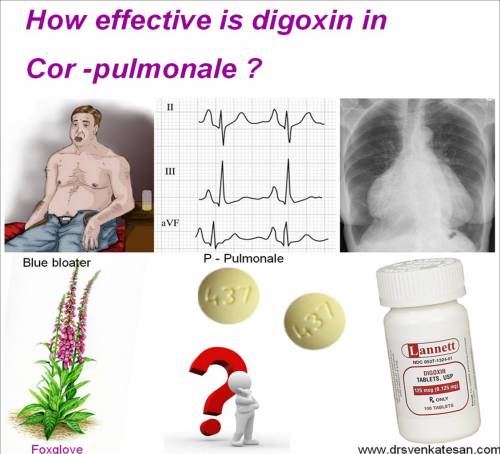
Digoxin is a wonder cardiology drug used for more than a century.We know the pioneering efforts  of  William withering  in detecting the potential  of the unknown  herb  Foxglove.

Mechanism of action

The beneficial effects of Digoxin is attributable  to

  • Positive inotropic  action
  • Vagal action

Digoxin blocks the sodium potassium ATPase in the  myocyte cell membrane .

This cause accumulation of NA + ions within the cells. The excess  Na , then   facilitates  the Na -Ca exchange port .

This pumps in more calcium   into the myocyte.

Increased  calcium means more forceful contraction and that is positive inotropism* .

* This is a  highly simplified version of   Digoxin’s action . It should  be remembered  simple availability of excess calcium can not guarantee  contractility,   as it requires adequate number  of receptors.

Digoxin  is used in which type of cardiac failure  ?

Digoxin is used for both for LV and  biventricular  failure .

Digoxins is still  often  in isolated RV failure  of any cause (Cor pumonale, PPH, Eisenmenger etc)


Digoxin and RV dysfunction

Digoxin  has a tendency  to  hit the atrial muscles  at random causing  multiple short circuiting (Micro reentry )   forming  a perfect nidus  for complex atrial arrhythmias  including MAT .The coexisting    hypoxia  (which is all the more common here )  aggravates the problem .

Inotropism of RV : Does it really exist ?

It is often quoted , RV is a passive pump. It does not mean inotrpism is an exclusive property of LV.

RV has to generate about 30mmhg to pump the blood into  the lungs.

In cor-pulmonale the RV works against an afterload of around 50-70 mmhg  , making  RV inotropism  much more important  concept.

Rate control in atrial fibrillation Digoxin lowers the heart rate by vago mimetic action ,  primarily in  AV node  and to a  certain  extent in SA node .Ventricular rate reduction  is the prime requirement  in the management  atrial fibrillation and this property  is still the crowing  glory of  Digoxin.

Though beta blockers and  verapamil  can be used as rate controlling agent ,  lack of negative  inotropism makes  digoxin    prevail   over , especially in severely dysfunctional  ventricle .

But , one disadvantage of Digoxin is , since it requires  a vagal traffic to mediate it ‘ s rate controlling effect , it  is less effective ,  when there is  high sympathetic activity as during exercise.

What is the action of digoxin on interventricular  septal contraction ?

Digoxin , simply does not know where it acts when administered in cor pulmonale  ! We believe in cor-pulmonale the maximum action would be the area of maximum dysfunction .This is purely  an assumption. In cor -pulmonale septum shifts it’s loyalty from LV to RV as the later is the distressed chamber.So , logic would be there  is a theoretical  compromise of LV function in  patients with cor -pulmonale. These factors make  the   inter ventricular  interaction and dependence a complex one.

Some believe  the improvement of sub clinical LV dysfunction in cor pulmonale may be more important factor in giving relief  to  the patient’s  symptom.

What are the other RV inotropes ?

Doubtamine has some RV inotropy  .This again may be due to a spill over effect from LV rather than a primary RV inotropism .

As such , there is no great breakthrough  in creating a powerful isolated RV  isolated RV inotropic dug.

Probably  the best way to  give relief to RV is to reduce the pulmonary artery pressure as invariably sever PAH  is the predominate  accompaniment

(Nitric oxide ,  Epo prostenol etc)

Final message

  • Digoxin , indeed has  some useful  role in cor- pulmonale .
  • But ,the benefits are more pronounced in late stages of RV failure.
  • Since the dose required to get an optimal RV inotropy is high the safety margin  is reduced.
  • Since there is a propensity   for complex atrial  arrhythmias  ,  it has to be used very cautiously in management  of   atrial fibrillation due to cor pulmonale .(Than in other forms of AF)

Read Full Post »

Regional wall motion defect( WMD) is the hall-mark of myocardial infarction.It can vary between complete akinseia to mild hypokinesia.

The wall motion defect is a gross terminology which is used  to describe any abnormal motion of the ventricular   segments.Technically,  hypo,   hyper , dyskinetic , akinetic  ,  even any vigorous  movement of LV segments will also come under the general category of  wall motion  defects. For example in extensive  anterior MI   the posterior segments show vigorous  contraction.Though . this compensatory motion  benefits many , it has a potential to adversely stretch the  scarred myocardium and promote aneurysm formation

What causes the regional wall motion defect ?

  • Infarcted segment
  • Ischemic segment
  • Adjacent normal segment behavior (Piggy pack effect, )
  • Loading conditions
  • Heart rate

Finally ,  and  most  importantly the timing and arrival electrical signal to these ill-fated segments determine the sequential activation fronts. Wall motion defect is a more complex phenomenon than we would tend to believe.

What are the  the classical examples of electrical wall motion defect ?

  • LBBB
  • Pre excitation
  • Some forms of VPD

*LBBB causes a paradoxical septal motion with  reference to lateral fee wall contraction.It is still a mystery ,  this paradoxical motion does not cause any  mechanical  disadvantage in structurally normal hearts  .

WMD  in combination  of  LBBB  and  STEMI

We know ,   LBBB   due to ischemia or infarct carry a  sinister prognosis .

Here , there  is  “Double wall motion defect”  . One electrical and two ischemic .  We do not know , how LBBB influences the ischemia/Infarct related wall motion defect and vice versa. .  This is the reason ,  there is a large chunk of  poor or non responders  for cardiac resynchronisation therapy.

Can peri infarction  blocks and other non specific   intra  ventricular  conduction defects alter the sequence of  ventricular  contraction ?

We do not know .It is distinctly possible.Tissue doppler studeis have indicated this.

What is the influence  of  heart rate on the  of Wall  motion defect ?

An  otherwise insignificant regional wall motion defect  could be  amplified with tachycardia . Paradoxically , (as in a biphasic response to dobutamine stress test )  a significant WMD may be attenuated at a particular heart rate.  So, the influence of  HR on  WMD is  as simple as  it could be  ! ! !

Which  is the best time to assess  LV  function  after  MI ?

Considering these issues , LV function  assessed  at discharge ,  may not give us the exact quantum of  muscle damage.  4 weeks may a  reasonable  time frame . This is important in the current era  as presence of  significant  LV dysfunction  becomes an indication for revascularisation  .We  can’t be offered,  to err on this vital LV functional parameter.

Final message

WMD  is a combination of  electrical, mechanical , structural,  alteration in response to variety of myocardial insults.It is very hard to assess  individual components contributing to the net WMA. The easiest and surest way to  quantify  WMD  due to  muscle damage is to  do a deferred echocardiography , when all time related WMD ( Ischemic  stunning , perinfacion block )  disappear.

Coming soon

Diastolic wall motion defects .Is wall motion defects exclusive phenomenon of  ventricular systole ?

No , definitely not. Regional relaxation abnormalities are quiet common .it is poorly recognised .

Read Full Post »

Stable angina is graded by Canadian cardiovascular society classification ( CCSC ) by 4 grades. Angina at rest  usually  denotes unstable angina. But,  patients with stable angina  may also experience rest angina according to CCSC ,  still this is   not considered as  unstable angina by many . Post prandial angina is one such  example.

Few consider post prandial angina as unstable angina . This sort of reasoning can not be faulted .

In  the logical sense ,  we are dealing with varied  categories of unstable angina.  The importance of diagnosing unstable angina is to intervene early ,  so that we can avoid  major adverse outcome .

The problem in CAD is , often , the plaques and angina do not  obey the conventional  rules  !

.The following permutations and combinations could be  observed in any coronary care unit .

  1. Unstable angina –  stable plaques  – stable ECG – stable patient
  2. Unstable angina – unstable plaques  –  unstable patient
  3. Unstable Angina  – unstable plaque  –  stable patient
  4. Stable Angina –  unstable plaque  –  unstable patient
  5. Stable angina  –  stable plaque  –    stable patient
  6. Stable angina –  unstable  plaque  – stable patient

Among the above 6 categories  2nd  is   probably  the most dangerous group and category 5 is most benign.

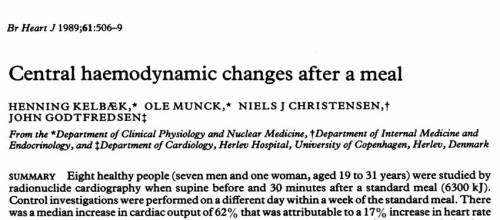
Post prandial angina is a serious  form of angina.It implies  , even   diversion of  little blood to GI system immediately after a meal can provoke an episode of  ischemia  .This infers a  very tight  lesion somewhere in the coronary tree,  very often it could be the  left main or proximal LAD.

Of course ,  there is  another mechanism for post prandial angina, namely GI neurotransmitters  like gut peptides acting as a coronary vasoconstrictor.

Snippets on  post prandial angina  .

It is also recognised , post prandial angina occurs more often during dinner, followed by lunch and breakfast. Carbohydrate foods are  more likely to precipitate it .

Does PPA cause ST depression ?

Logically it should .In reality It happens in few .

How to manage it ?

It is very important to recognise , even though this article  argues  for including  PPA  as UA, there is no acute thrombotic process during  an   episode of  post prandial angina . In fact , it is  more of a secondary UA due to altered  blood flow pattern.

So , do not admit these patients  in CCU and administer  heparin or 2a 3b blockers.  (Unless of course ,they have other forms of rest angina )

Link to reference

1 PP angina angiographic correlation

2.Effect of carbohydrate diet on postprandail angina

3.Hemodynamics of eating !

Final message

Post prandial angina has all the characters  of a severe form of angina  .There  is every reason to label it as UA .It is suggested , ACC,ESC, AHA  should consider including  post prandial  angina as  UA or at least  UA equivalent .This would help intervene this entity early.

Read Full Post »

What will be the pulse rate in a patient who has ventricular bigeminy in ECG with a heart rate of 90 ( 45 sinus beats 45 VPDS/minute ) ?

A.Exactly Same as HR , ie 90/mt

 B.Exactly half of HR , ie  45/mt

C.Can be anything between 45 to 90/mt

D.Any of the above can be true

 The  answer is D . 

I have  noted  ,this simple question in cardiology resident examinations cause great anxiety among students .

Why is it difficult to arrive at an easy answer to this question ?

Traditionally , ventricular ectopic beat were also called extrasystole , implying every ectopic beat shall produce a peripheral pulse .Since ,  we learnt this is not true , we started refering them as VPDs.(Simple ventricular depolarisation which may or may not have a mechanical activity ) So , in a patient whose alternate beat is a VPD  , things become little complicated.

What determines a VPD to acquire  mechanical  energy  or simply  remain as an  electrical event ?

  •  Timing of the VPD* .
  • LV residual volume(LVEDV ) at the onset of  VPD
  • Force of contractility of LV( Of course ,  it is directly related to LVEDV)
  • Temporal relation to  aortic valve opening**

If  the VPD is too early or too late it can not have a mechanical activity . It should be optimally timed midway between two sinus beat to have a good mechnically active VPD. Some refer this as an interpolated VPD .Here, the VPD  becomes a  true extra systole for that individual. So , in patient with ventricualr bigeminy in ECG the pulse rate is usually half , can be same as HR when the coupling interval is optimal or it can be totally irregular as someof the  VPDS gain a mechanical activity and some do not (as often occurs multifocal VPDs. )

* Among the above  four factors timing of the VPDS is the most crucial as it can influence all the other three factors.

** Whatever be the timing or force of contraction aortic valve should be opened to generate a pulse wave. If for some reason this does not happen  there can be intermittent mechanial activity what  we refer to as pulse deficit .

Read a related phenomenon:  Ventricular  paired pacing

Read Full Post »

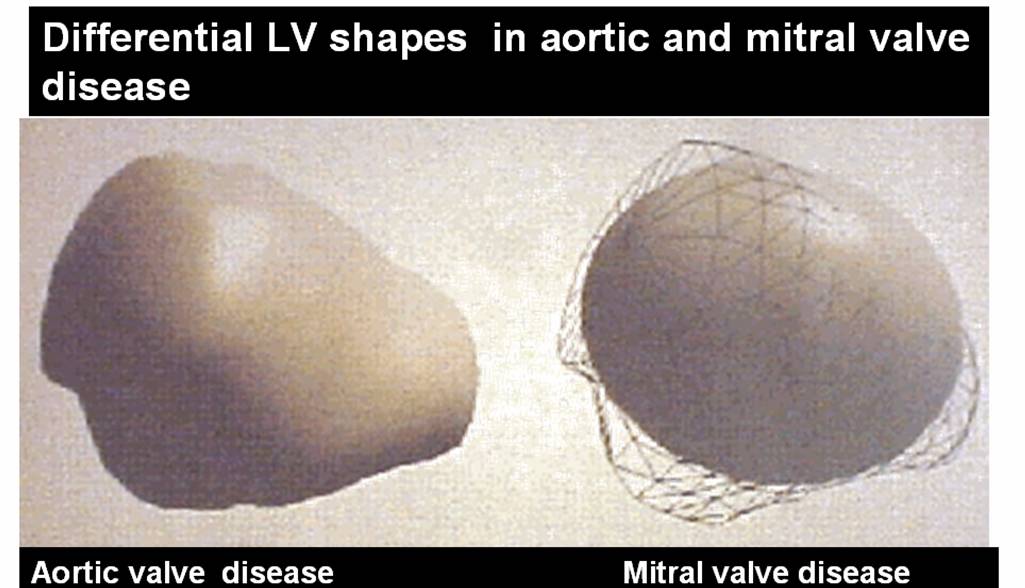
Let ventricle is an elliptical or ovoid chamber .The pattern of LV enlargement can vary considerably in different pathologies. We know a dilated , globular heart is the typical feature of terminal congestive heart failure. But in the early stages of cadiac enlargement there are some distinct differences in the contour. (Aortic stenotic lesions retain the ellipitical shape till late in the course )

LV enlargement due to mitral regurgitation is somewhat different from aortic regurgitation. A globular configuration occurs more often in severe MR than AR. This is due to the fact, the long axis and short axis ratio of LV  is maintained till late in the course  of aortic valve disease . Cardiac long axis enlargement is more pronounced in aortic valve disease than in MR. The AR jet reaches LV  at a higher pressure gradient (Diastolic pressure of aorta) than mitral inflow velocity . (Often mimic physiological flow with an S3)

For a given degree of regurgitant volume AR will cause more cardiac enlargement than MR. In the same note , one should realise  the LA becomes huge in MR which receives high pressure regurgitant jet . Further ,mitral valve disease is more likely to result in early PAH and that results in right sided chamber enlargement giving the cardiac contour a more globular configuration

Is the cardiac contour different in rheumatic and degenerative(Myxamatous) mitral regurgitation ?

Yes , rheumatic MR results in less enlargement of the base of the heart as the fibrotic process restricts and restrains LV and prevents uncontrolled LV dilatation . In fact , giant LV are often  reported in mitral regurgitation due to mitral valve prolapse than rheumatic MR.

Why the configuration of LV important in the management of cadiac failure ?

The globular configuration of LV implies , the papillary muscles are attached in a disadvantaged angle and keep the free wall stress high. Specialized procedures are required to restore the LV shape especially in secondary to mitral annular dilatation. Isolated aortic valve disease rarely require LV remodeling surgeries , even if AVR is done late stages.

What is the maximum dimension of LV reported in cardiac failure ?

The upper limit of normal for LV diastolic dimension is 5.6cms. In MR it often reaches 6-7 cms . The maximum of 10cm has been reported with AR. An LV beyond this level looses it’s elasticity and likely to be incompatible with survival unless LV reduction surgeries like Batista are performed.

Is secondary valvular cardiomyopathy an accepted entity ?

 The  term cardiomyopathy when originally defined decades ago ,  required exclusion of all known cases of cardiac enlargement. But now we have a more liberal working concept , if the LV enlarges disproportionate to the loading conditions of the valvular lesions  , secondary cardiomyopathy is said to be present. If cadiomyopathy sets in,  the cardiac shape invariably takes in a globular configuration irrespective of the valvular lesions. So, the simple parameter of shape of LV in X ray chest can give us a clue regarding the outcome in valvular heart disease.

Further reading

Also read sphericity index by echocardiography A spherical LV can be easily quantified by echocardiography

Read Full Post »

 Excercise physiology has been studied most extensively in the last century.The hemodynamic impact of excercise in various disorders of heart has been well established.
Dyspnea on exertion is the commonest symptom in clinical cardiology practice. It is well-known pulmonary stretch receptors located in pulmonary vasculature is one of the  major mechanism of dyspnea.

Excercise increases the cardiac output manyfold.Transporting  up to 10-12 litres of blood every minute across the lungs with a narrow pressure  head (about 10 mmhg ) is not an easy job . It needs lot of lung discipline .

It is surprising to note, there is little data on excercise induced pulmonary hypertension in the evaluation of patients with unexplained dyspnea.

We know, excercise increases the systemic blood pressure ,we  presume it should not raise the PAP (however severe the exertion is 1 )as pulmonary circulation  is a  high compliant low pressure system. 

Is our presumption correct ?

Exercise induced PAH can occur in both   health and disease 

In patients with preexisting disease

  • Stress induced LV dysfunction and resultant raise in LVEDP-PCWP-PAP .This is the most common mechanism in valvular and myocardial  disease.

Apparently healthy population

  • Excercise  induced PAH as a  marker for silent CAD .
  • Transient Hyperkinetic PAH* (Note :Here PCWP is usually normal )

This is similar  to hypertensive response to EST in systemic circulation.Existence  of this entity , is controversial, But this may reflect  reduced pulmonary vascular reserve  or reduced pulmonary nitric oxide secretion.

*The main difference here is the PAH is more often an  isolated systolic PAH. While LV dysfunction induced PAH is  a combined diastolic and systolic PAH .
How to assess excercise induced  PAH ?
It is not an easy job. Invasive catheter derived pressure measurements have been done ,but it is not practical .

The simplest way is to look for the TR /PR jet in echo in both pre and post excercise phase.

Final message

Excercise induced PAH is an inadequately studied entity in cardiology , in spite  it’s great significance .
This phenomenon is observed  in both diseased and normal heart.

The quantum of excercise induced PAH  is  widely variable depending upon the cardiac  status especially  LV function and the  functional integrity of pulmonary microvasculature .

Read Full Post »

Ego can be a  great  motivator and destroyer as well. It has the  potential not only  to damage the self  but also the people in the near domain .This has been proven in all walks of life. Medical practice is no different . In fact ,it can have the more devastating effect as the victims are often the poor patients.
The medical ego can be individualistic,  departmental, institutional, etc.

Often in the dormant  form , can raise to gargantuan  levels when stimulated or challenged.  In its mildest form it occurs every day in the office practice. A physician  often thinks he is always right and fails to get a second opinion even in difficult  cases . Some where  along  the medical  curriculum  ,  doctors have to be taught that ,  what we know is only a fraction of what we are supposed to know ,  and  the importance of self auditing. This never happens in most medical schools.

Individual Physician ego

This exist in several forms . Ego with fellow colleagues is the most common type . Failure to accept a error in diagnosis is the most  frequent form injured physician ego. There are many instances doctors carry on with the wrong diagnosis tag (On their patients)  even after some authentic documentation is available against it. This especially happens when the correct diagnosis is made by  a junior colleague . Eg : “I still think it is a pheochromocytoma let us do the scans again”  Same tests  are repeated . In the intervening period  involves  treatment delay  and  financial costs for the patient. It is obvious , such an  ego in emergency rooms can be  disastrous .

Few doctors have a habit of asking for fresh set of investigations even if the patient has recent records of his illness . This is because many  feel interpreting   investigations ordered by other doctors is an inferior job .(Of course ,  financial incentives for repeating the  tests  could also be a motivation  )
Ego with paramedics and fellows

This is also quiet common. Doctors expect  their orders to be carried out at any cost.  They take it very seriously , if a nurse or a junior doctor behaves independently . This is understandable as it raises the fundamental question  who the  boss is ? !  But ,  the problem here is, even a smart move in the interest of patient is  not always relished  the physicians . (Because it is  perceived as an  insult to the consultant ) . You can’t act smarter than me !

We know the major responsibility  of caring a patient lies with staff nurses and  junior doctors .(It is a universal medical rule the consultant will be remote from the patient care unless of course it is needed).If the specialist exerts an  academic ego on them , there is every chance for the patient to suffer as  even vital interventions could be delayed.

(Eg :   Sir , I withheld  the beta blocker in  this  patient  as he  had a  bradycardia ! I thought it is  better to remove the urinary catheter as the patient was struggling with it  etc and etc )

I have observed  , even  some of the shrewd  directives  from the residents and junior doctors have elicited  big hue and cry from some of the renowned physicians of our region.While many   recognise the good work done by the junior colleagues  , still  their  ego does not allow to  appreciate and complement them . This is not a good sign for the  medical professional .

Specialty ego and departmental ego

This is new phenomenon . Traditional ego was between surgeons and physicians. Now , with medicine growing leaps and bound there is probably a medical and surgical specialty for every human organ . This helps the physicians ,  to shrug of the collective responsibility . It  has become a  dangerous trend in many institutions.

God created  human body as a single entity  . Specialists  share their  organs  , convert a  human body  into a commodity (Has to  make a living out of it )  As the medical science is branching out at a phenomenal rate  it becomes   a difficult task for them  to come to the rescue of the patient when they need a collective intervention  . Further , conflicts of interest and ego clashes take a front stage.

Even in an  academically and ethically superior medical center it is a  herculean task to arrange   for . . .example
An ENT surgeon and neuro surgeon to operate a nasal tumor together.

A hybrid procedure of PTCA and CABG (Could be very useful in many situations)  can not be practiced  that easily .

The issue here  is not simply logistic .It goes beyond that . . .

(Why should I  sweat for some one else’s fame ?)

Institutional Ego

It has a peculiar issue .The  admitting  physician is  vested with supreme powers – he becomes  the sole caretaker  for the given  patient .Though it fixes responsibility , it has a potential  risk , as this  patient automatically  becomes untouchable for other consultants . There are centers in which even intra departmental  consultations are lacking .I know at least a handful of cardiologists who  do not talk with each other  even at times of crises in cath lab. This is more prevalent in fully commercial institutions .

In this regard  group practice with fixed financial remuneration may be a  lesser breeding ground for ego clashes.

Another form  egoism may be financial  discrimination , which  is seen in some of the big corporate hospitals . There are instances some doctors and institutions  shy away poor or relatively poor  patients .There are institutions which feel allowing entry to   less sophisticated public  inside  their premises is detrimental to their reputation and ambiance.  

Ego issues with patients.

Generally doctors show great respect for their patients. Information sharing is the major issue. What to tell and what not to,  can  some times reach really difficult proposition. Does the patient have a right to criticize the treatment ? Whether you like it or not some patients do it .

Few suffer from a  worst  form of physician ego , that is directed  against their own  patient. Doctors are  rarely  comfortable when patient ask probing questions.This is acceptable in few instances. The root of the problem is doctors rarely accept their ignorance .

There are many instances  where a consultant   refuses  to see  his own patient  once he  gets  a second opinion from another doctor . It need to be realised  this is actually the fundamental right of the patient he is executing .No need to get offended .

Why this ego ?

It is the  part of normal human psyche. There is no reason to believe doctors  are different . But the following could be unique factors .

  • A subconscious feel of  ” demi god” status  conferred  by the patients .
  • Failure to have an open mind approach .
  • This translates into fixed ideas about a patient and his illness.
  • This is especially common in countries  where , single doctor or a family of doctors run nursing homes .

The other substrates  for ego growth among physicians are

  • Academic  excellence
  • Practical skills
  • Popularity in the society
  • Financial superiority

Negative ego : A feel of inferiority also creeps in for many physicians  who  find to hard to acquire the above .And this  can  have  a serious effect on  the patients .It is  shocking to note many of  the academically incompetent  have a strong  dose of ego .This is most dangerous for the society.   A deadly combination of  incompetence  and arrogance

What is to be done ?

  • Containing  the  physician egoism  could be more important for doctors  than attending to  sophisticated CMEs and conferences and workshops .
  • Counseling is required for many .
  • Behavioral science with the specific tips for  self-regulation is to be included in the basic undergraduate medical curriculum
  • Courage to tell the truth to their patients to be imbibed.

Final message

Hippocrates said some 2000 years ago the fundamental quality of a doctor  is  to accept his limitations and ignorance .Every action of his or her, should aim  only at removing the suffering of the patient .

Now we are in the era where , market force  have literally hijacked the medical filed  . A  medical degree  can be bought in a weekend university shopping (At least in India it is possible ! )  .

In this scenario  if our students grow with one more wise  ie “hyped up ego”  one can imagine  where our profession is heading for !

We need to initiate a debate on the issue . And there need to be a movement to cleanse  the contaminated profession. It should be  in the league of nuclear  treaty ,  war on terror or the global environmental protection.

Read Full Post »
ERS -Early repolarisation syndrome  is known as a   benign ECG finding  for  many decades  .Now it  is beginning to look dangerous as evidence is accumulating  it may have a link with ventricular arrhythmias.

ERS represents complex changes in  ionic movements during  cardiac repolarisation . (To be specific , it is due to a functional gain of  K + ionic channels during phase 3 of action potential).Generally this is a very benign condition. But , what concern us is ,  it can predispose to ventricular arrhythmias when these patients are confronted with ischemia .

When repolarisation occur early it indirectly shorts the QT interval .We know QT interval is a notorious period in human ECG as both a short and long (<320ms, > 460ms)  can be dangerous.

Is ERS a marker for potential cause for primary VF ?

Read this article from NEJM 2009

Read Full Post »

Thrombolytic therapy  is the specific  therapy  for Ischemic stroke ,  when administered in less than 3 hours ( Now 6 h ?)  and has proven to  save lives and brain .The only issue is , we need a 100% exclusion of hemorrhagic  stroke by a CT/MRI. The mechanism of action of thrombolytic agent is simple .It lyses cerebral thrombosis and makes way for sustained reperfusion and arrest or even  reverse  the  ischemic damage to  neurones .

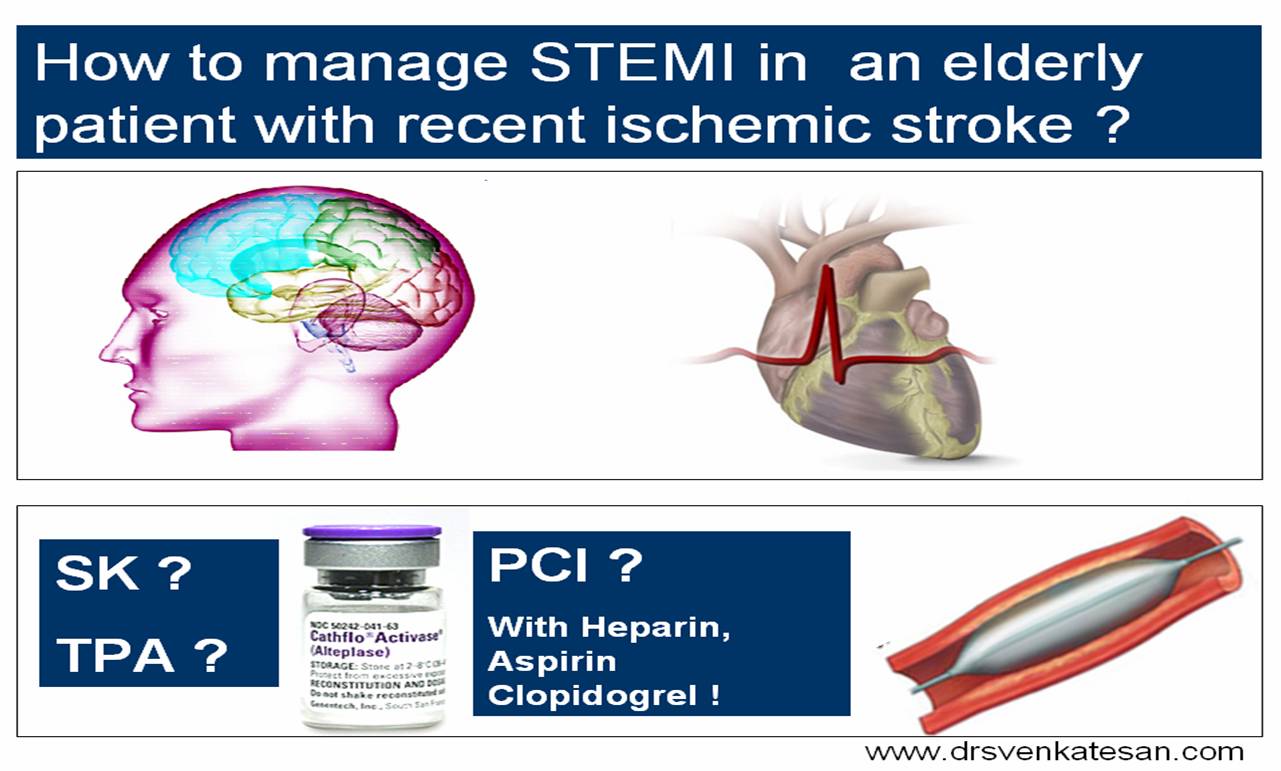
And now ,   let us see ,  how we perceive the same therapy in a patient  with a  history of  recent ischemic stroke  with an  acute STEMI .

The issue is two fold.

  • He needs urgent myocardial salvage in the form of thrombolysis or PCI .
  • The thrombolysis or PCI should not worsen the  cerebral infarct.

According to  most standard literature thrombolytic therapy is an absolute contraindication in a patient with STEMI and recent history of ischemic stroke (<3 months )

The  term absolute means ‘it is medical  crime” to give TPA or Streptokinase.

How  is it possible when the same drug  is  projected a savior in acute ischemic   neurological  emergencies  and  be dangerous when administered  few months later in an evolved ischemic stroke ?

The major  reasoning  against thrombolysis in recent stroke is  the  potential concern for  converting an  indolent ischemic  infarct into hemorrhagic  infarct in  a  patient who may start  bleeding  into brain.

This is  highly conjectural  , as  a previous history of  ischemic   stroke in no way increases the bleeding risk .Conversion of ischemic to hemorrhagic   infarct tend to  occur  in the very early  hours  of acute stroke (not weeks later) .This could be part of calcium induced  reperfusion injury .

Unanswered questions

The issue become further  complicated with our  skewed  thinking pattern.

If thrombolysis  is contraindicated  in STEMI , does  it any way imply a automatic indication for  primary PCI ?

It seems so , for most of us !

How safe is PCI in a patient  with a previous  history of ischemic stroke ?

  • An emergency PCI in a patient  who is expected to have   widespread  cerebral  carotid , and peripheral vascular  disease  is fraught with added hazard.
  • Aortic arch manipulation  and aortic  valve  atherosclerotic  changes  might  increase a risk  of another stroke.
  • The drug we administer  during PCI  are  not innocuous ones  . Aspirin ,  Heparin, clopidogrel (sometimes  even 2b 3a!) will  keep the  risk  of converting the ischemic infarct into  hemorrhagic infarct remain  at  dangerous  levels . This ridicules  the  very  logic  of   PCI being preferred over thrombolysis in such situations .
  • So it is not an  easy decision to do  primary  PCI in an elderly  patient  with STEMI and a recent CVA. It is only a mirage of  medical  intellectualism  and  the blind following  of unscrutinized  scientific  literature   that   determine  many of the decision  making  in cardiology .

The argument here is ,  in a patient  with evolved ,  uncomplicated ischemic  stroke thrombolysis can safely be administered  irrespective of the age of stroke.  .This is contrary to the published literature.Let us not make unethical practice against scientific literature  but let us also understand   it is unethical  not to realise  many of the so-called scientific  evidence  are  merely speculative.I  request  the  neurologists  and cardiologists give their   input on  the issue

As far as  I have searched  the superiority or inferiority  of thrombolysis   vs PCI in  recent  ischemic CVA has never been compared one to one. The fact may be ,  such a study is never possible in the future .But  it seems PCI has won the   trial  without  a trial .

Unanswered  questions

How  many deaths have happened due to worsening of stroke after thrombolysis ?

How safe is a  combination of aspirin, heparin and clopidogrel in a patient with recent stroke ?

How shall we decide about thrombolysis  in these situations  of STEMI and recent CVA) depending upon the

  • Age of  CVA
  • Location of cerebral infarct
  • Size of the infarct
  • Residual neurological deficit

It may be prudent to redefine  the indication for thrombolysis and PCI in a patient  with history of recent or remote stroke.

  • It is logical to assess the potential   risk of   converting the ischemic cerebral infarct   into hemorrhagic infarct.
  • It is expected only large infarct in vital locations need to be feared upon for this complication
  • All small healed cerebral infarct need not be worried about reactivation.

How to asses the healing of cerebral  infarct?

The healing  and gliosis  is highly dependent  on individual response to inflammation. Some heal  within weeks. Neo vascularisation within the necrtoic area may get hyperpermiable .These are very speculative concerns. In all probability   the risk of converting an ischemic necrosis into hemorrhagic  necrosis  is less than a  percentage .The 3 months time for  fixed for infarct healing  is an arbitrary one

How good is MRI to predict a healed infarct from nonhealed infarct ?

As of now,  we have no good tools to identify the  safe infarcts that can withstand intensive  anticoagulation or even thrombolysis .If the imaging techniques improve we may able to predict complete gliosis and the vascularisation  of cerebral scars.

Post blog query

How to manage an elderly man with STEMI in a patient with recent ischemic stroke ?

A.Take him to cath lab and do primary PCI
B.Thrombolyse with TPA or Streptokinase
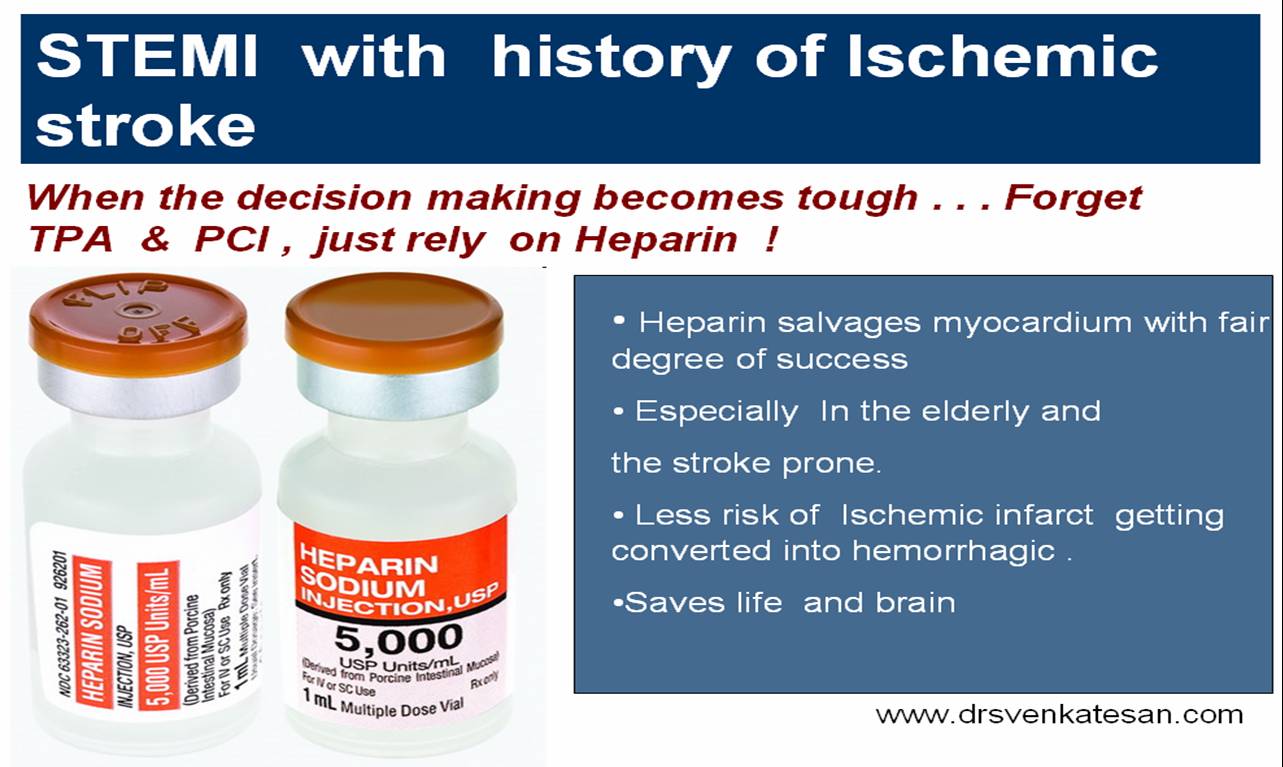
C.Just observe and  manage  with Heparin*

Answer : Any of the above can be correct answer .

If  we  still think  the answer is only   “A”  great reforms need to be done in  medical science  . . .

*Another important option for STEMI and recent stroke (Perceived  as inferior form of management of STEMI !)


An important option is ,  neither thrombolysis nor PCI just simple heparin for STEMI in these high risk individuals .This simple treatment has saved many lives .

See A Related video  from you tube : Forgotten hero  in cardiology

Final message

In this world of gross approximation  and perceived fears ,  it may be reasonable to  shift  the  indication of   thrombolysis for STEMI( with h/o recent stroke ) from absolute to relative contraindication.

Many of the  junior  physicians  in the learning curve may take it as granted  in the management of STEMI  “If thrombolysis is contraindicated  , then primary PCI must be indicated ” This again  is absolutely not true  !

//

Read Full Post »

Thrombus formation  and subsequent lysis  either spontaneous or pharmacological is the key events in acute vascular emergencies .We know both STEMI and acute strokes can get aborted  naturally.

The thrombus which initially forms , triggers a natural lytic mechanism and this fights vigorously against the clotting process , and tries to get rid  of the intravascular clot.

The early  minutes are vital. (Like the T 20 cricket )  the win or loss is decided in the first few overs . The mantra is unrelented attack of the ball . . .ie thrombus !  In some patients  the clot  can never grow big to fill the lumen.These are lucky few .The mechanisms are common in both cerebral and coronary circulation. Here is were comes the role of antiplatelet agesnt .An aspirin or clopidogrel administered within minutes can prevent the genesis of  central core of the thrombus .(This is the  secret of aspirin scoring over stretokinase in STEMI in ISIS2 study done three deaceds ago !)

It should be realised,  our understanding about spontaneous lysis is very little considering explosive growth of other aspects of cardiology. It is mediated by circulating  TPA and antithrombin 3  .  Remember  every humans have it in their  blood .But how much ? How to augment it ‘s power at times of thrombotic crises ?

What could be the clinical correlates of spontaneous thrombolysis ?

  1. In brain classically it is TIA .
  2. In heart do we have TIA equivalents ?  .Yes it transient rest angina

Link to video on TIA of the heart

Read this article to get a glimpse of  natural cerebral thrombolysis  and shall we   extrapolate it to coronary spontaneous thrombolysis  .Why not ?

Arch Neurol — Nonocclusion and Spontaneous Recanalization Rates in Acute Ischemic Stroke: A Review of Cerebral Angiography Studies, December 2002, Kassem-Moussa and Graffagnino 59 (12): 1870

Read Full Post »

« Newer Posts - Older Posts »