Feeds:
Posts
Comments

Archive for the ‘Hemodynamics’ Category

Estimation of right atrial pressure (Often referred to as  central venous pressure (CVP) is a common hemodynamic excercise both at the bed side and in echocardiographic lab. A venous catheter inside the right atrium is probably  the best way to measure it accurately .But, there are  practical issues  for  putting and maintaining a CVP catheter. ( & We also know , what happened to the concept of routine  swan  catheter in critically ill patients !).

A  rapid bed side echocardiography  can give us a fairly accurate estimation of RA pressure . We  don’t even need look into the heart , what you need is imaging the inferior vena cava , it’s size and it’s  behavior  with respiration  . You don’t require  a doppler probe either ! With these two parameters one can decode the mean RA pressure. This  modality is rarely used in the ICUs , it can be a simple aid to fluid management .

RA pressure echocardiography ivc collapse hepatic veins

ivc collapse ra pressure right atrial mean pressure

Shrewd clinicians would argue , we have a natural catheter inside the right atrium, ie the   internal jugular vein   This gives us a unique opportunity to study the moment to moment RV, RA pressure . And .  .  . yes ,  we know it but we rarely respect the neck veins !

Read Full Post »

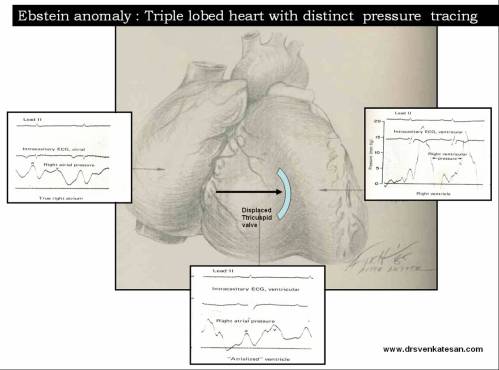
ebstein-anomaly

Down load high resolution PDF file

ebstein-anomaly

Ref:

An excellent article from H.Watson in british heart journal

HERNANDEZ FA  The intracavitary electrocardiogram in the diagnosis
of Ebstein’s anomaly. Amer J Cardiol 1: 181,  1958

Read Full Post »

Left main coronary artery disease (LMCAD) often evokes  a panic reaction  among cardiologists .Not every LMD deserve that re. To  label  it as  significant, we have a criteria ,  that is 50% diameter stenosis.  So what you do , for a tapering  or narrowed left main with 40% stenosis. Isolated insignificant left main is rare *, but real incidence is not known.  LMCAD  is  most often due to  , atherosclerosis of left main coronary artery without limiting the flow.

What are the options ?

  • Leave it alone, with intensive medical management assisted by high dose statin(80mg)
  • Elective PCI with stenting , even though the lesion is not significant.

*If associated LAD  or LCX is there decision making is easier .

How  significant is a coronary stenosis ?

The significance of a coronary lesion with reference to “lumen diameter obstruction” is basically flawed. The significance of a coronary stenosis, by tradition is  based on it’s hemodynamic impact ,right from the  CASS days in early seventies.Unfortunately our mind set has not changed even after realising    non obstructive – sub critical lesion is more prone for acute coronary syndrome.  Is it not ironical to call a  40% lesion a non significant one !

So, the  significance of coronary stenosis is two fold.

  1. Hemodynamic  significance
  2. Clinical and  pathologic significance

The former predisposes to often chronic stable angina, later likely to result in ACS.

How will you approach a apparently insignificant left main disease ?

A 40 % lesion in left main is hemodynamically not significant , but pathologically very significant.It needs intensive treatment. Plaque passification with medical approach is first choice.If the lesion morphology is eccentric,  has irregular margins or involves  LAD  or LCX ostium doing a PCI or even a CABG is to be considered in spite of the lesion is  hemodynamically insignificant .

Why , PCI is   considered  “not appropriate”  for   less tighter lesions , even though these lesions  have great clinical significance ?

The answer is simple, The risks  and the  potential cost are more than the benefit !

And further ,  stents are  not innocuous devices  either  , they  always carry a risk of sudden occlusion as like  a sub critical lesion  !

Answer to the title question

True incidence is not known . Our experince (Class 1 c evidence) would suggest Left main disease constitutes up to 10 % of CAD.Among this one third would be hemodynamically insignificant

Suggested reading

Handbook of Left Main Stem Disease


edited by Seung-Jung Park

hbleftmn

//

Read Full Post »

 Selected on the basis of ,  impact  on survival , relief of  human suffering index and also innovation

10.Percuateneous interventions

9.  Electrocardiography

8 . Hemodynamics of cardiovascular system

7.Fruesemide

6.Thrombolysis

5.Pacemakers

4.Defibrillation

3.Heparin

2.Prosthetic valves

1.Coronary care units


Waiting list

Concept of vascular biology

Statins

RF ablation

Nitric oxide

Total Artifitial heart

Echocardiography


Ten least important concepts and  inventions in cardiology

Selected based on duplication of research, futile scientific concepts and   of course impact on survival

10.Low molecular weight heparins

9.Cardiac resynchronisation

8.Rotablator

7.Multi  chamber pacing

6.Newer ARBs

5.C reactive protein

4.Three dimensional echocardiography

3.

Comments welcome  and please contibute

Read Full Post »

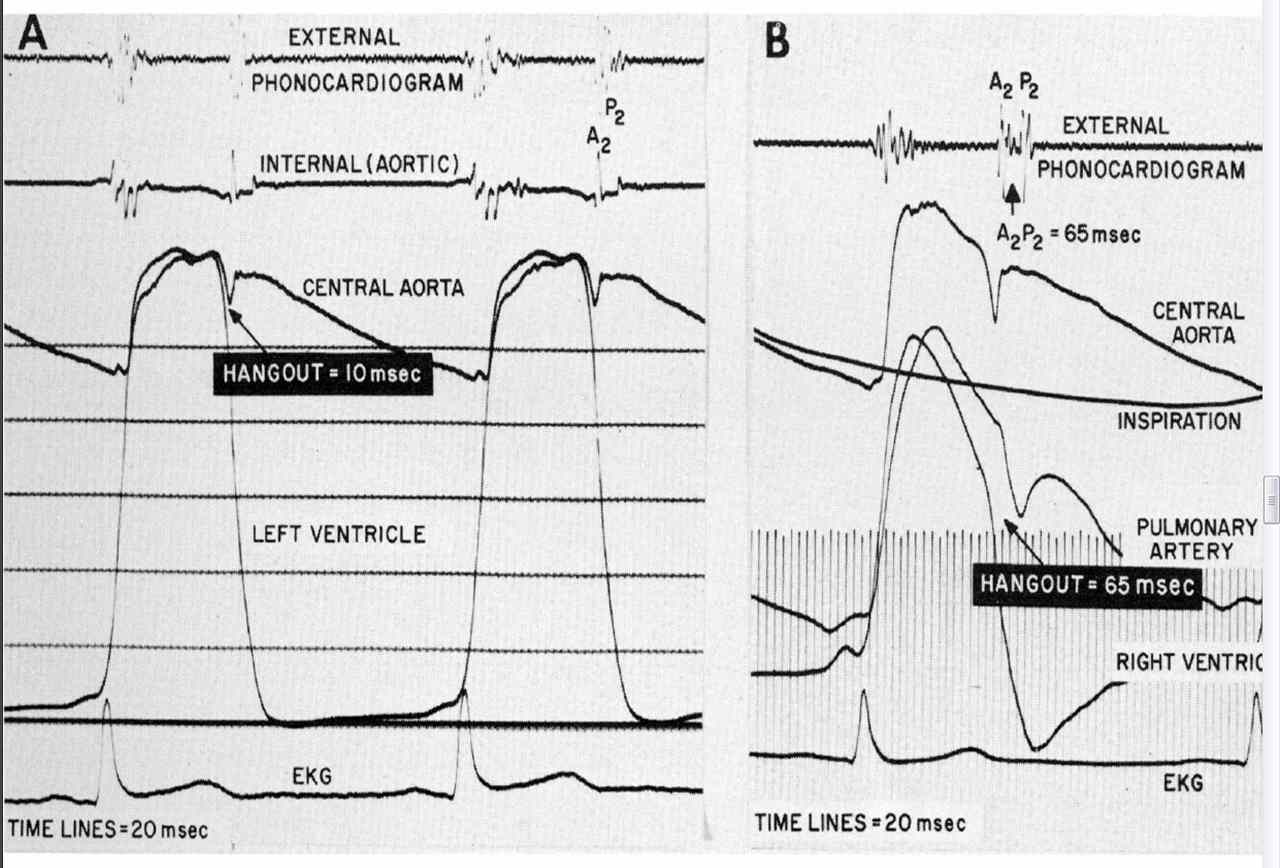
The pressure tracing between two chambers of the heart are distinctly different .

 Apart from the magnitude of the  pressure ,(LV at systemic pressure ) The morphology also changes.

  •  RV pressure curve is triangular in shape,
  •  Upstroke is not rapid , (Low dp/dt)
  •  There is no sustained peak ,
  •  There is an early fall and
  •  The pressure falls to zero which  never happens in LV.

Contary to this LV pressure curve is bullet shaped,  with a rapid upstroke, sustained peak, fall later, and does not touch zero.

RV/LV pressure curves in normal persons .Adapted from , Curtiss 1975 Circulation

Note : The shapes of RV curve will change in pathological states.Example in TOF, large VSD there will be left ventricularisation of RV pressure wave forms. Also  in pulmonary hypertension RV pressure may mimic a LV curve.

Read Full Post »

« Newer Posts