Feeds:
Posts
Comments

Archive for the ‘Cardiology – Electrophysiology -Pacemaker’ Category

VPDs are such a common cardiac arrhythmia . We also know most are benign .Still modern science demands to rule out structural heart disease in any patient with multiple VPDs.

When ventricles get irritated it reacts with VPDs . ( The irritants  can be anatomical , physiological or primary electrical)

Echo can detect only anatomical irritants .We are recognising  more such focus for VPDs . Hence idiopathic VPDs  may simply reflect our ignorance !  A focused  echocardiogram is  required .

The following conditions are often observed in patients  with recurrent VPDs

  1. Posterior Mitral annular calcification (Especially in women ) –Annular VPDs
  2. Aortic valve degeneration /Bicuspid aortic valve with calcification – Cuspal VPDs
  3. Mitral valve prolapse in young -Stretch induced  Pap muscle VPDs
  4. Minimal  pericardial effusions with adherent epicarditis
  5. LV false tendons-Stretch VPDs
  6. RVOT lipid focus -Subclinical ARVD
  7. LVH and Hypertension –Fibrotic VPDs    
  8. Asymmetric septal hypertrophy
  9. Scars in MI/ DCMs
  10. infiltrations in RCMs (Any Interstitial heart disease )

(Conditions 7 and 8 are  common disorders myocardium  just included to  complete the list )

**Please note ,above mentioned entites are anatomical irritants .There is a whole lot of physiological  irritants

that can induce VPDs .  ( Hypoxia, Excess catecholamines ,  K + fluxes ,  acidotic milieu etc ) .

*** Another group is primary electrical diseases inherited channel disease can induce VPDs

Also read

A crash course on ventricular ectopics


Read Full Post »

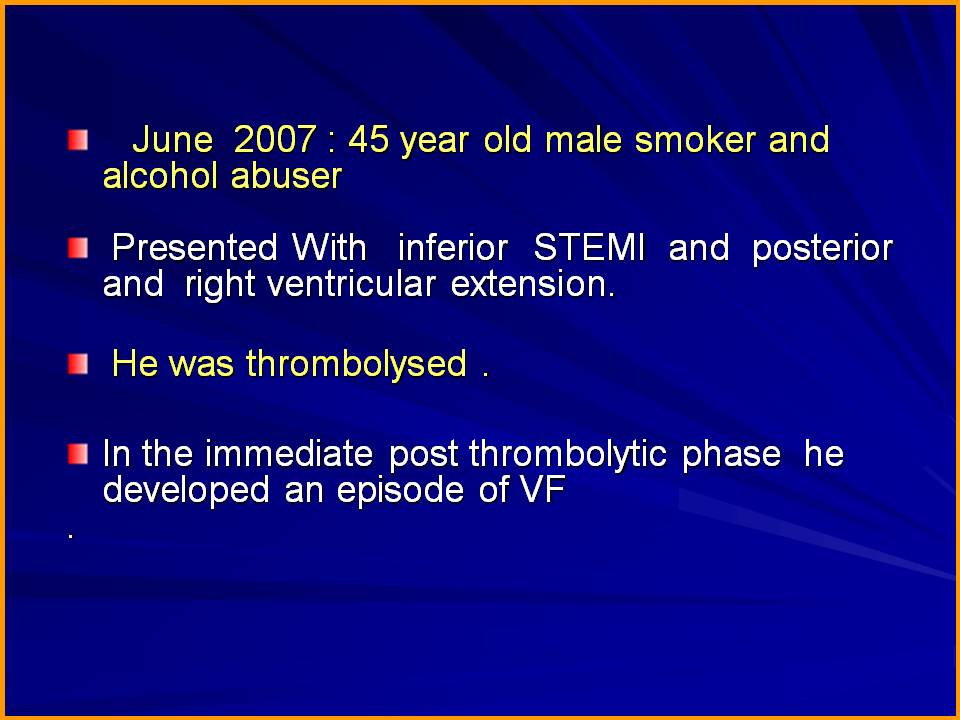
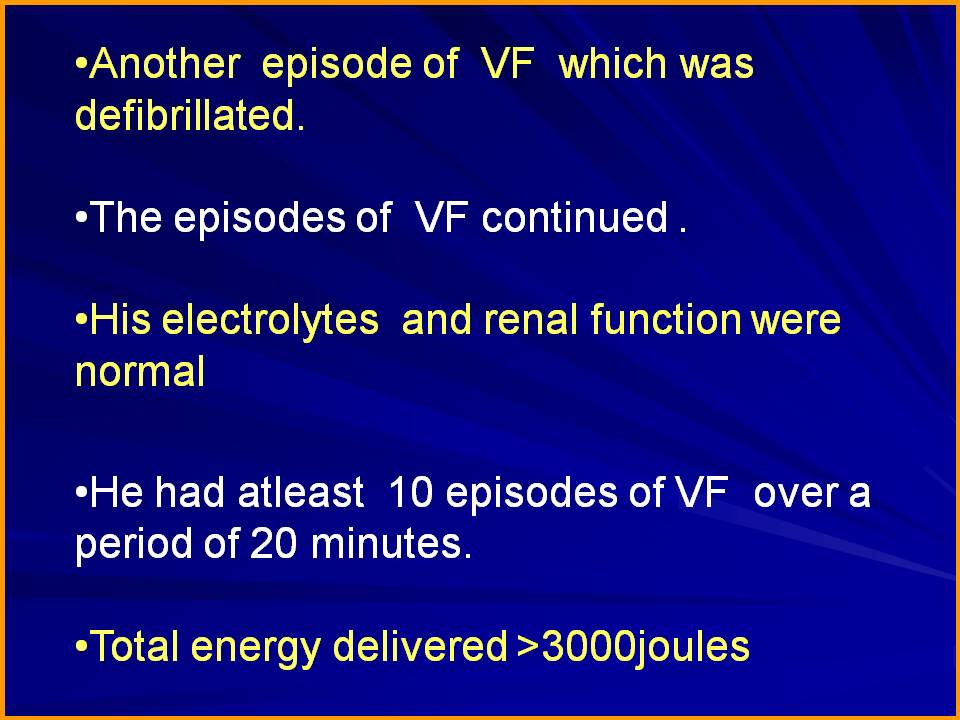
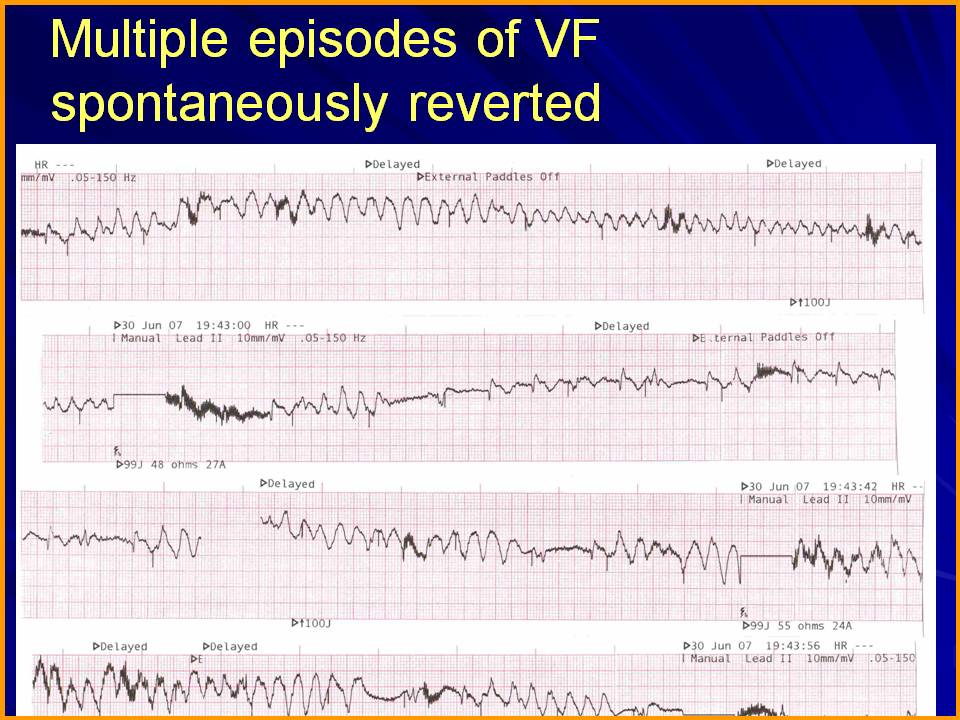
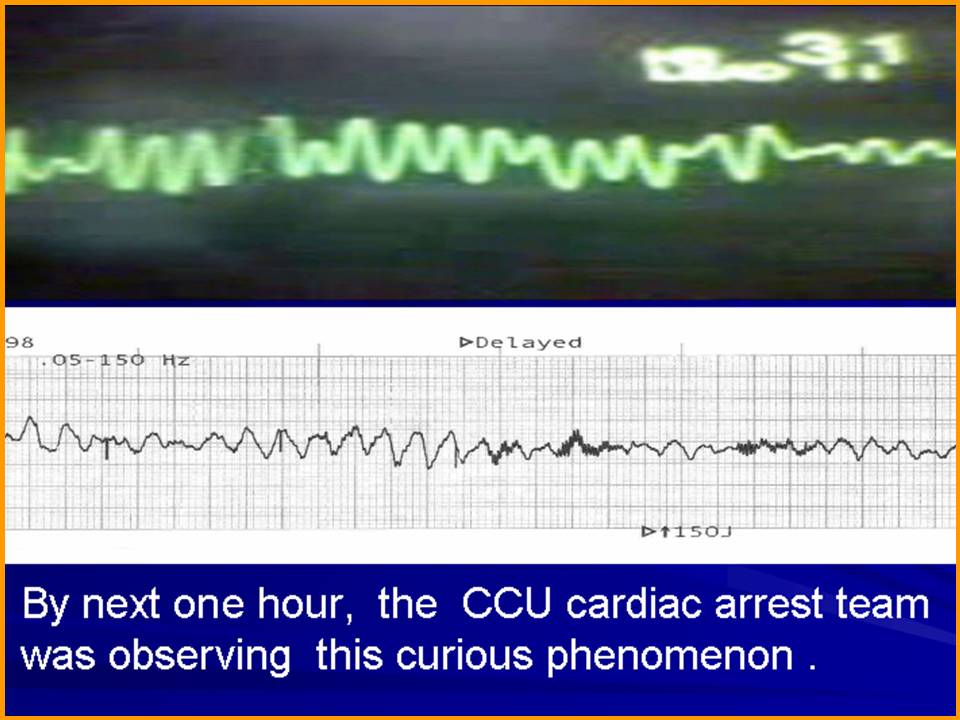
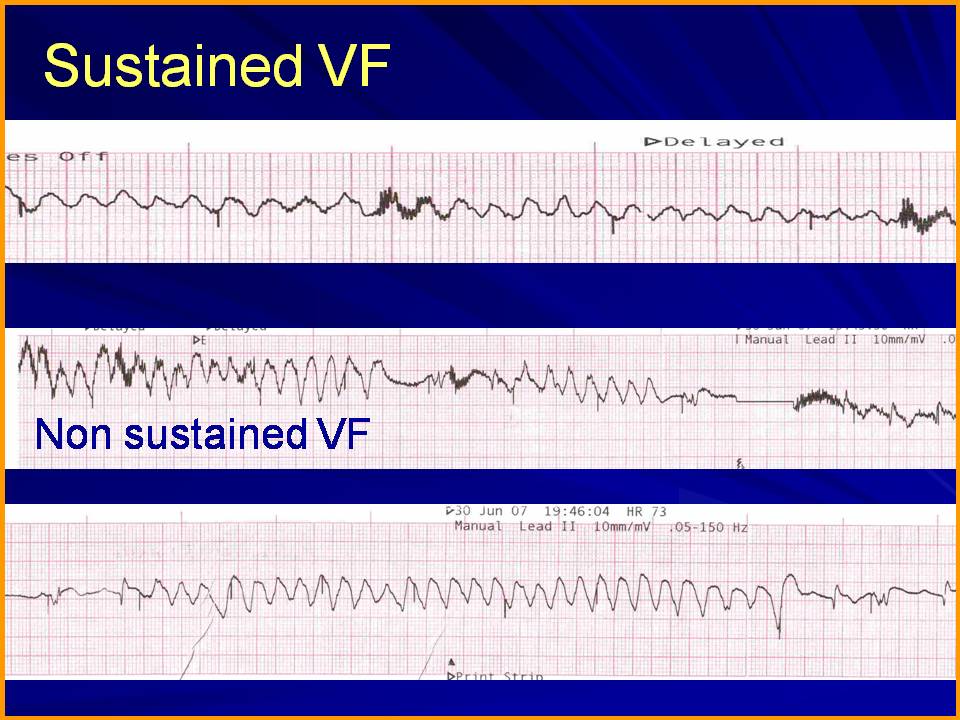
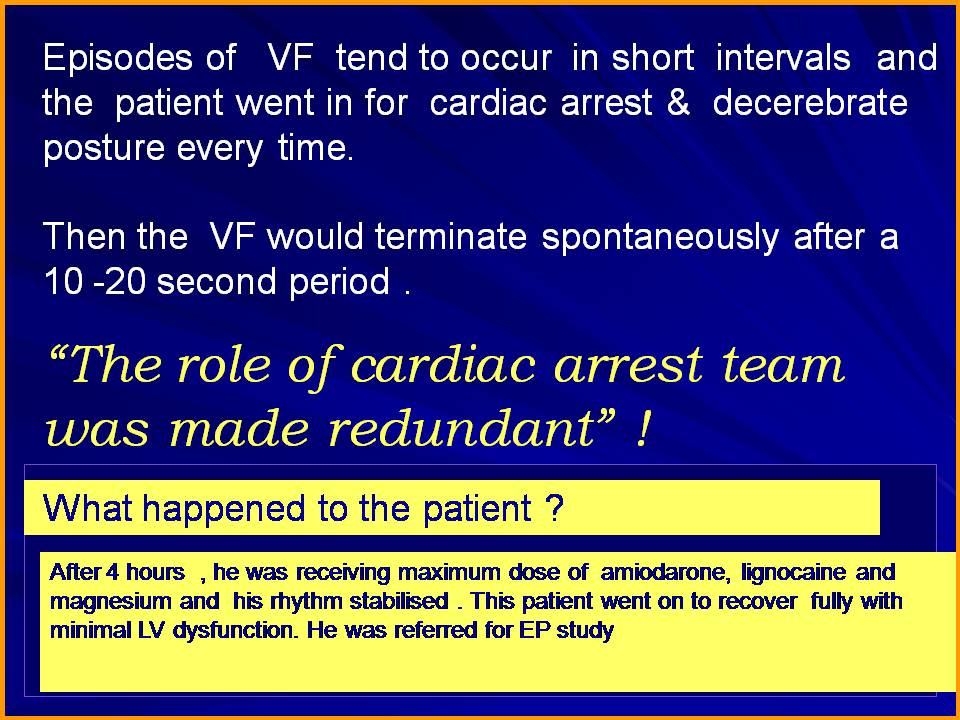
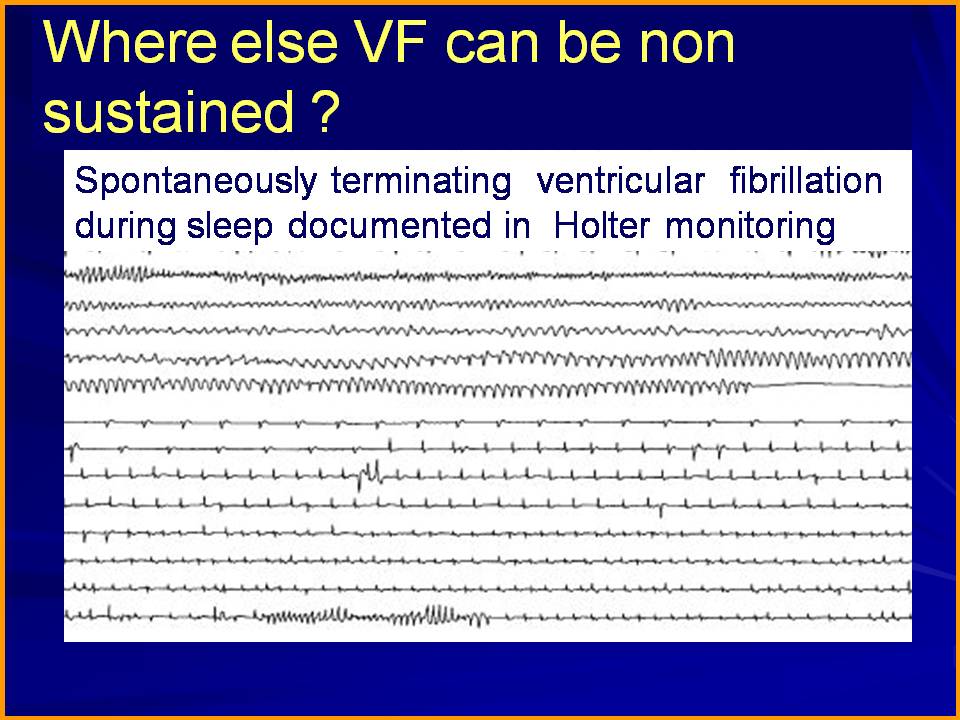
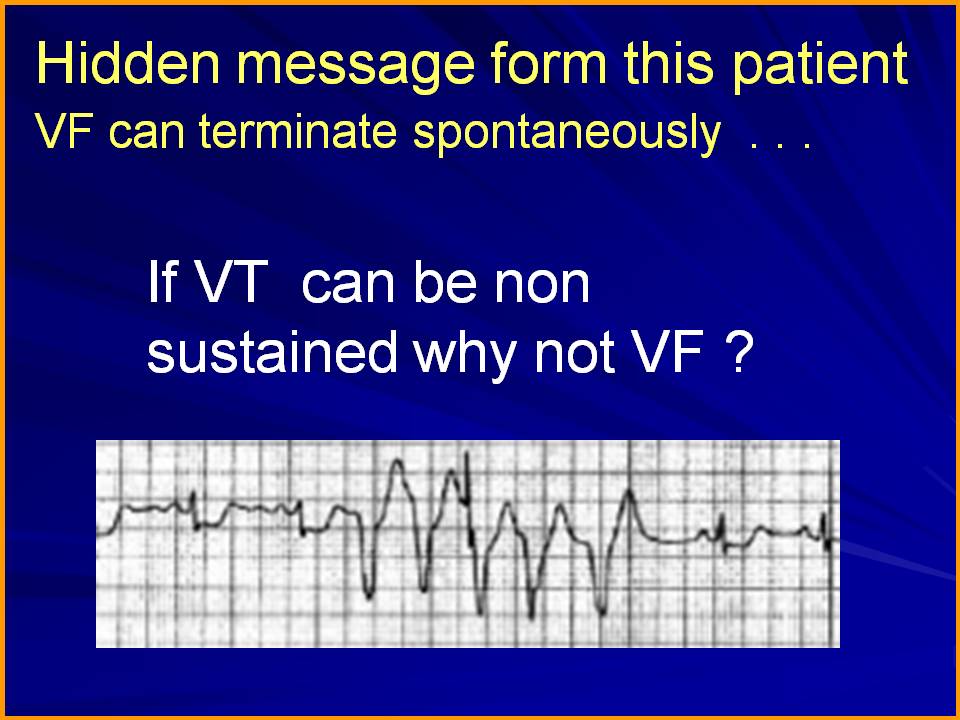
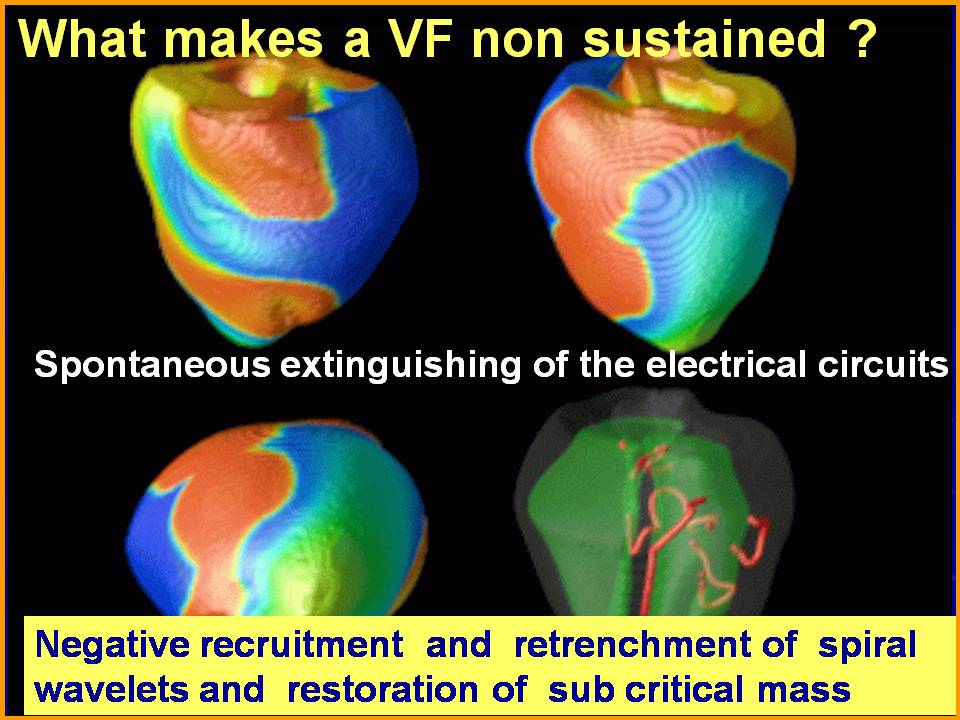
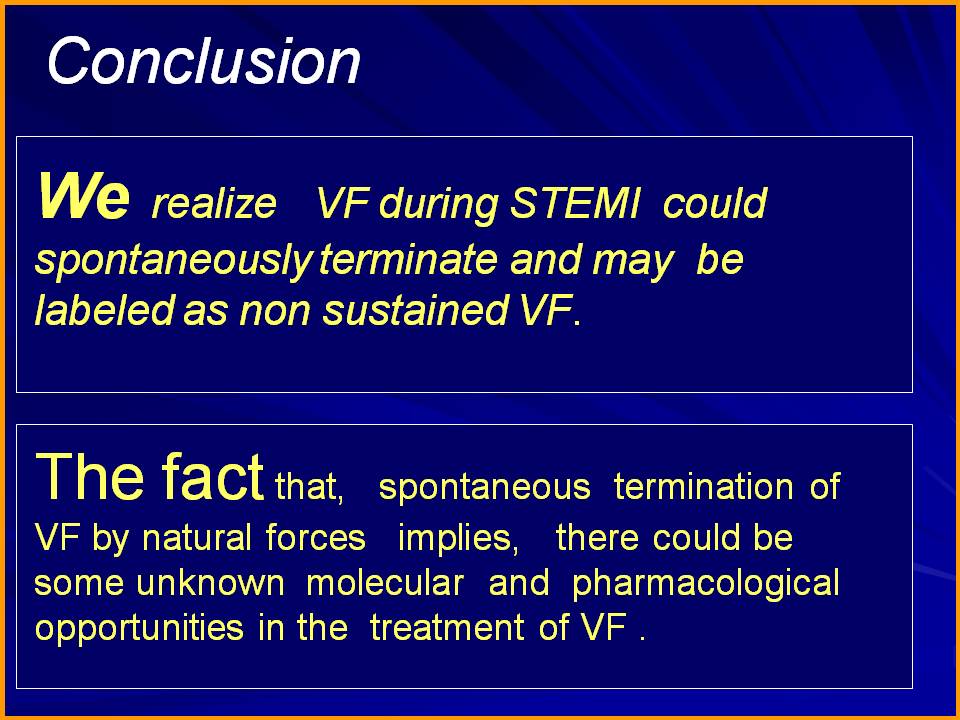
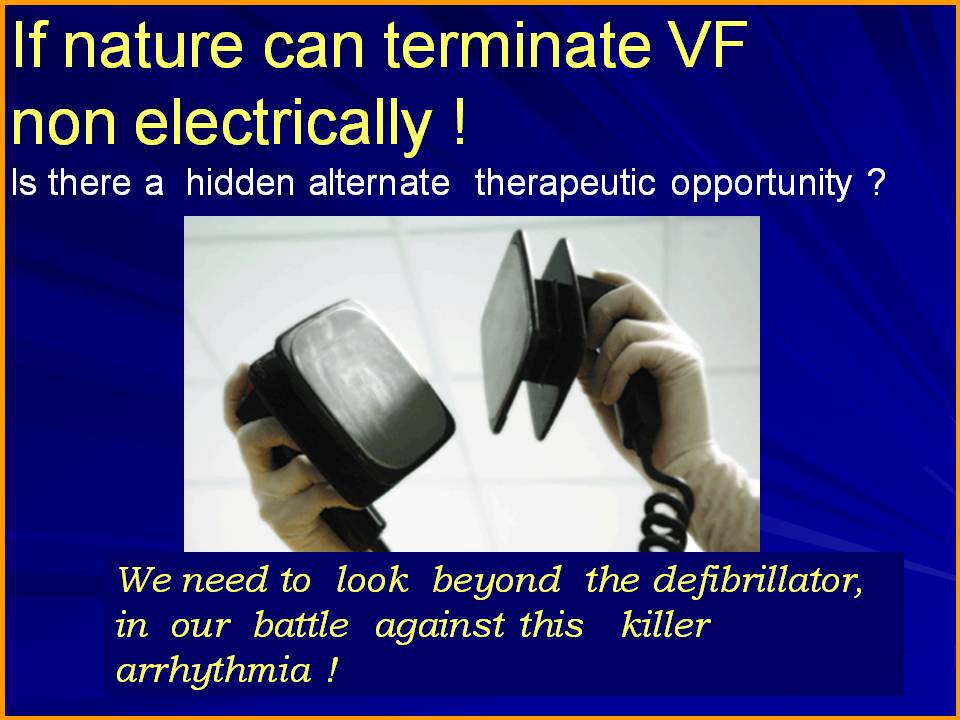
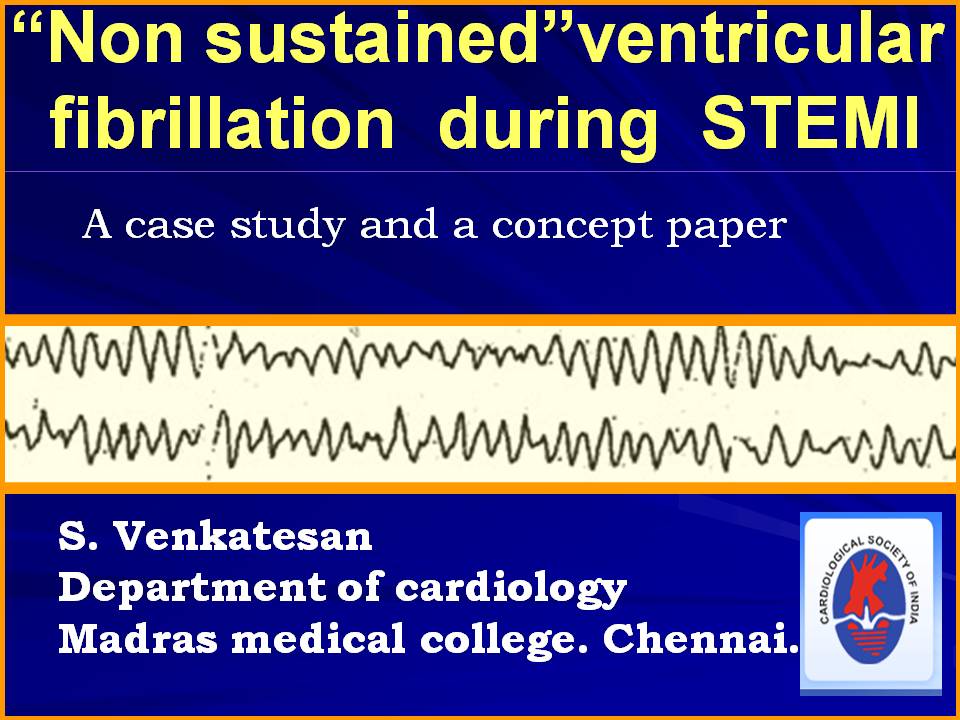
Can VF be a non sustained  arrhythmia ?   This question was raised and a single case report was presented

in the annual scientific sessions of  Cardiological society of India Meet in  year 2008 in  Chennai.

I am just reposting it from my archives .

Slide1 Slide2 Slide3 Slide4 Slide5 Slide6 Slide7 Slide8 Slide9 Slide10 Slide11 Slide12 Slide13

Slide14

Read Full Post »

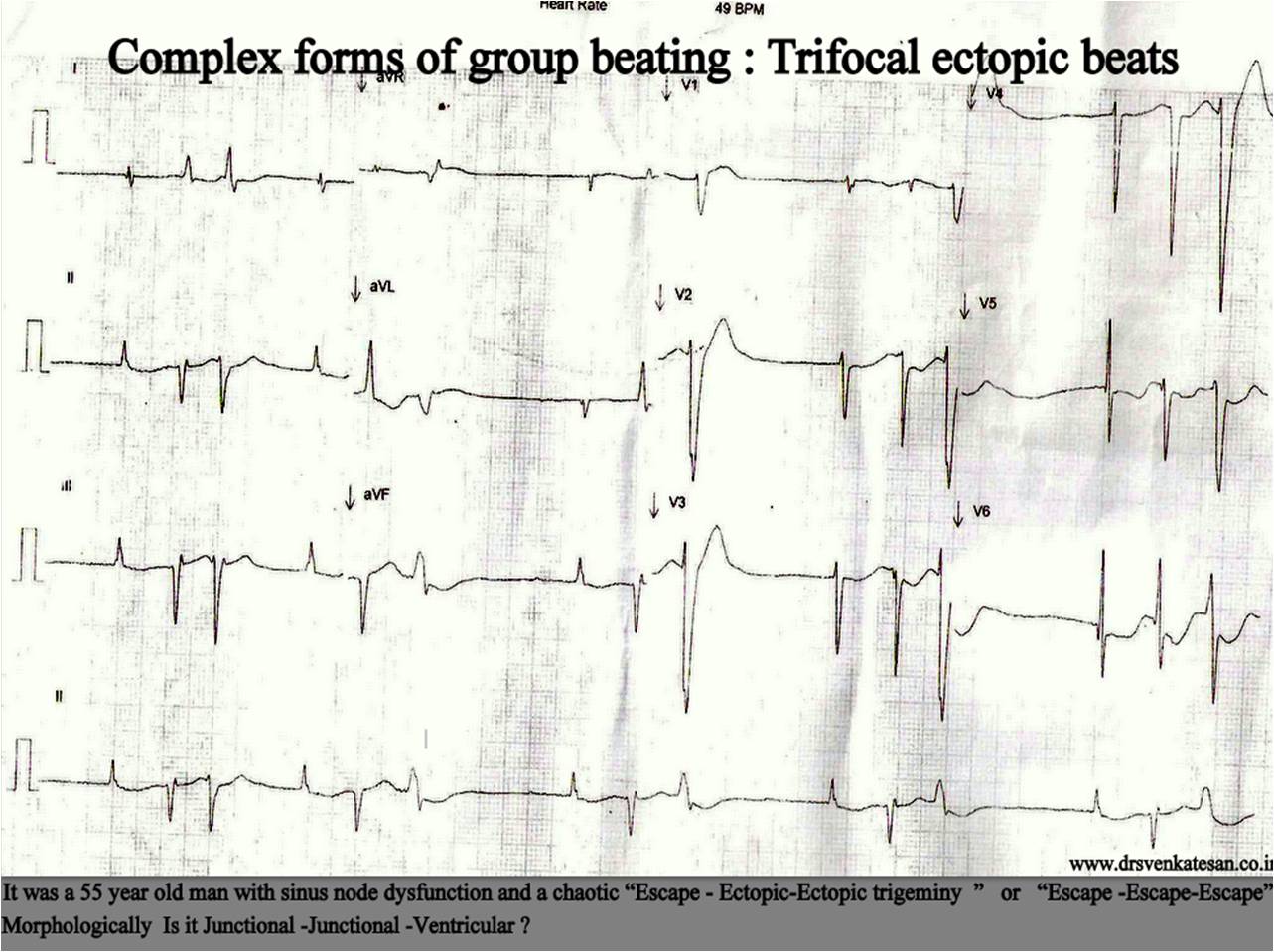
Sinus node is the electrical high command of our heart .When it gets injured  seriously (or shot down   as in sinus arrest ) there is utter chaos in the lower ranks !

This is what happened  in this patient .

trigeminy group beating vpds sinus node dysfunction escape capture

The lower pacemkers can either passively release  themselves as escape rhythm or actively fire with a  ectopic focus  . Any combination of escape / ectopic  beats can  occur .If occasional sinus beats capture the ventricles things  can become further complicated .

It is obvious , this  random intra-cardiac  shooting  makes the life of the  myocardium miserable . It is a perfect setting for syncope, tachcyardic cardio myopathy , extreme brady induced VT , VF  even SCD.

*Meanwhile , It is  heartening to note  SND   rarely lead to  sudden death in spite of all the chaos .However  extreme  bradycardias  that occur in  complete heart block  does  not enjoy this immunity as fatal complications are common if not intervened .

Read Full Post »

Answer

Each of the above can be important in diseased heart .The most important component seems to be Inter- ventricular  synchrony .This is closely followed by AV synchrony .In dysfunctional  ventricles Intra-ventricular  synchrony  also becomes important .In  structurally  normal hearts  none seems to be important  (This statement can be debated  )

VVI pacemakers causes  both AV  and Inter-ventricular (VV ) dys-synchrony

DDD pacemaker  may still  induce  Inter-ventricular ( VV ) dys-synchrony  whenever  RV is paced for any reason .This may happen up to 60 % of pace making time in real world.

Some more facts

*Chronic VVI pacing may  induce adverse  remodeling of both atria and may worsen LV dilatation. In contrast isolated chronic organic LBBB is well tolerated and with paradoxical septal motion rarely worsen the LV function.

**Please note the paradoxical septal motion , which is  noted in  all LBBBs is  same as inter-ventricular  dyssynchrony .

***Inter atrial synchrony is a less discussed issue .It becomes  important in diseased atria which manifest gross   intra atrial conduction blocks  , atrial inhomogeneity and AF .Onset and offset  of AF has a major impact in the way DDD pacing is going to fire .

Read Full Post »

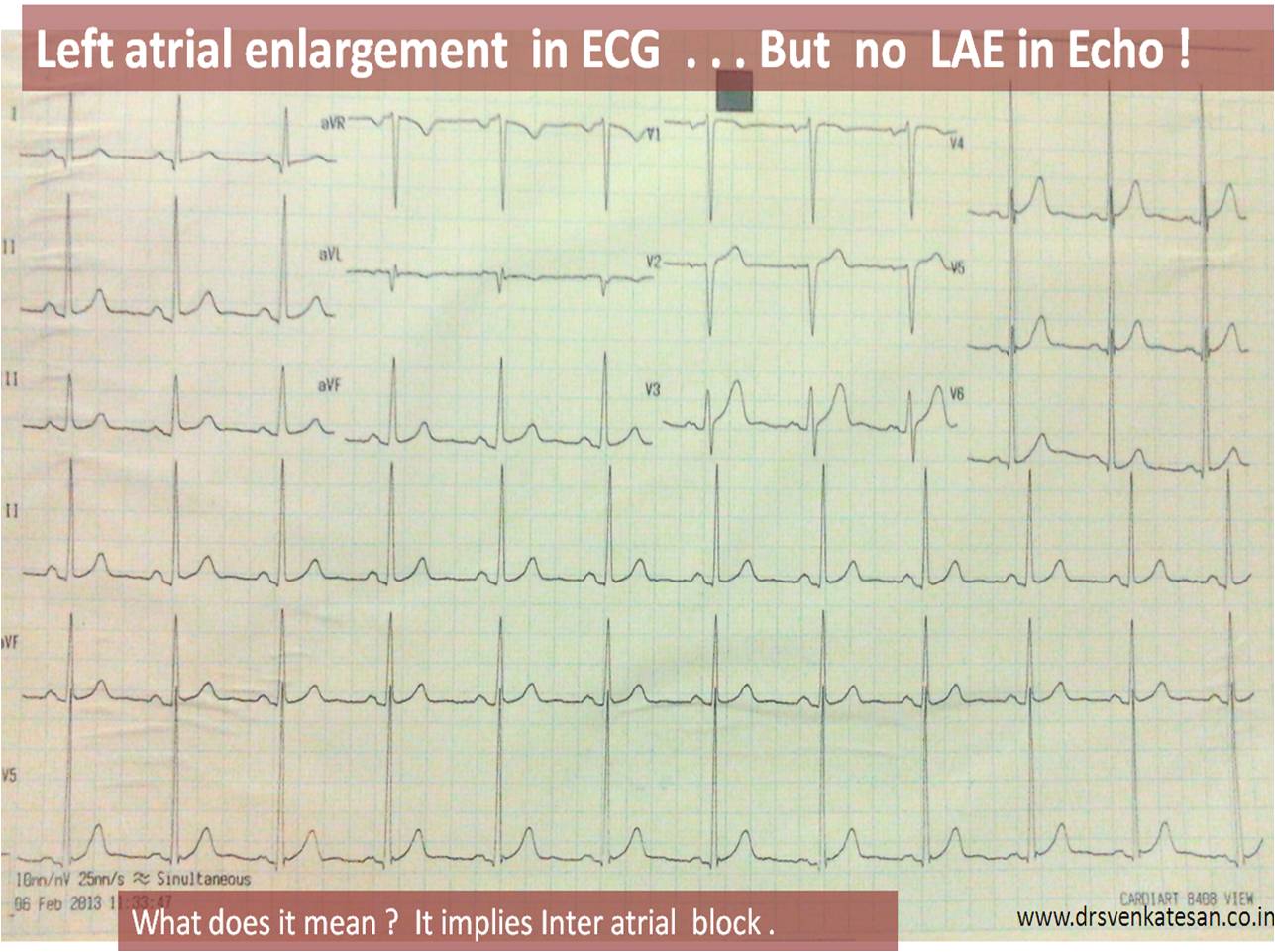
This is an ECG of a 42 year old man .He was reported as  Left atrial  enlargement (LAE) and was referred for  echocardiography . His echo was normal . LA measured 2.5 X 3.1 cm .The consultant  called back the echo lab ,  to verify   the left atrial dimension .He thought he was very sure of LAE .It took  considerable time to convince him about the credibility  of the echocardiographer . He was  right after all  . . . still . . .  ECG was  also looked  convincing  for LAE !

left atrial  enlargement by ecg limitations sensitivity

left atrial  enlargement by ecg limitations sensitivity  echo la dimension

                         Is this phenomenon  of wide P wave with normal atrial dimension  common ?

Yes it is . It  underscores  poor sensitivity of ECG in the  diagnosis  of LAE .The P wave abnormality in the above patient is due to Inter atrial block (IAB ) . This widens the p wave .

What  are the types of Inter atrial block ?

inter atrial block europace 1999 de luna


P wave widening is not synonymous with LAE .(Here P waves  widened   due to sluggish inter nodal pathway and inter atrial pathway .It is something like QRS widening in  bundle branch blocks  )

Final message

IAB is an important differential diagnosis for LAE . The significance of which is not entirely clear . It  is possible  IAB   precede LA enlargement  .It can even trigger AF due to  inhomogeneity.

Even though IAB was reported in 1950s  (Puech P* ) ,  it was  rarely  considered important With  increasing incidence of atrial arrhythmia in aging population , IAB is expected to  come into the lime- light again . The sophisticated electro anatomical mapping  can unravel the mysteries surrounding this entity .

Reference

INTER ATRIAL BLOCK

*Puech P. L’activite´ electrique auriculaire normale et pathologuique. Paris: Masson, 1956; 206.

http://www.jecgonline.com/article/S0022-0736%2812%2900227-0/abstract

http://europace.oxfordjournals.org/content/1/1/43.full.pdf

Bachman bundle branch block

Read Full Post »

Surprises are hall-marks of medical science . The cardiologists do  get  it ,   in enough doses   from  echo  labs  on a regular basis !   . One such thing is  the total ECG-ECHO myocardial  territorial  mismatch following  a STEMI .  Human myocardial segments are divided by cardiologists  by 17 segments by echocardiogram . Long before  echo came into vogue ,  electro-cardiologists  divided the  heart electrically into three zones to  localise MI . (Anterior , inferior and  the  poorly defined entity  lateral walls* ) .Inferior and posterior  segments are  almost used interchangeably. So , when we have 17  echo  segments to be fit into these three electrical category !   were  bound to have  some overlap . The issues of fitting in septal segments is really complex as septum  is a three dimensionally engulfs all three electrical surface of the heart .

* By the way , anatomists  never agreed about existence of walls in heart.They simply said  , heart has smooth  surfaces that blends with one another.  We cardiologist have  built imaginary walls and struggling to come out it !

We will   try to answer the question that’s been asked here .  “Inferior MI”  by ECG   . . . “Anterior MI”  by  echocardiography . How common is that ?

Possible causes for this wrong call

Technical errors  in  acquiring echo  imaging plane  or  it’s interpretation is the commonest . Many  times  ,  obliquely obtained long axis view  wrongly and strongly  suggests  a septal  MI  instead of   inferior posterior MI. This is  because  in  apical 4  chamber view  bulk of   septum  (Basal and mid third )  lies   in the  infero-posterior region .

wall motion defect

Perhaps ,  misunderstanding this  septal  geography is  the  commonest cause for  erroneously  calling inferior MI as anterior  in echocardiography . (A simple clue is the presence of MR . (It  fixes the infarct in infero-posterior zone with 90% accuracy )

Rotation  and  posture of heart

Alignment of the septum to the rest of the chambers  can influence  , how three inferior leads is going to look  at the septum (There can be  considerable errors  -Electrical myopia ? as these leads are located distantly )  . The plane of the septum is such that  in horizontal hearts  septal electrical activity  will be directed infero posteriorly inscribing a q waves in inferior leads rather than anterior leads . One can expect such ECG /Echo discrepancy in the following subset as well

  • Post CABG patients (Any pericardiotomy will make the septal motion  erratic )
  • Obese persons
  • COPD

There are three  more  situations  ,  which   mystified me   with  definite  ECG/ECHO  mismatch

  1. LVH and STEMI  is always an engima . Counter clockwise rotation when accopany  LVH  that masks anterior MI  electrically . It  however inscribes a   q wave in inferior leads.
  2.  In dominant LCX lesions  ( with at-least  one  major OM    )  and  left main bifurcation  STEMIs  ,  combination of  anterior and inferior  wall motion defects are  quiet common . When a such  a  MI evolves ( with or without  revascularization )   regeneration of R wave can be  time shifted . Septal R wave may appear  much earlier and inferior R may follow or vice versa . .Further,  anterior MI  may  evolve as  Non q MI  making it  ECG blind ,   still  echo may pick up the WMA . So there can be important  ECG-ECHO mismatch in myocardial segmental geography .
  3. Further , WMA  need not  always be an  infarct  .Any new episode of ischemia  can result in WMA . Hence a patient  with inferior Q waves  in ECG may experience anterior wall motion defect meagerly  due to fresh episode of   ischemia (This we should not attribute  to  old anterior  MI. It is also possible intra-myocardial conduction delays can elicit remote wall motion defects.

Final message

By general rule  , ECG  correlates  well  with  ECHO  for localising myocardial segments   . At times ,  it  can  really be tricky , and we  get into above situation  in echo labs.

While ,  it is common to observe  ECGs  to mimic  inferior MI  at the first look  and  subsequently echo  revealing  anterior  infarct ,  the reverse is also very much possible .

The  mechanisms are varied and technical  issues are for more frequent than true clinical discrepancy .The issue has important management implications.

Of course ,  coronary angiogram will pin point the   anatomy , still  it also has  strong limitations in localizing myocardial segments (to which it supplies ) especially with multi-vessel  CAD and  collateral dependent circulation .

Read Full Post »

As I expected ,  my earlier algorithm “An Idiot’s approach to tachy-arrhythmias” has  elicited  mixed reactions  .Some  EPs calling it a dud while few  physicians termed it awesome . Here is  a follow up .

Heart rate of a tachycardia is the most neglected parameter by physicians .  They are often seen spending  hours together for decoding  arrhythmia , splitting the brains   for P wave  location , VA conduction, Fusion beats etc .Finally they end up  either administering  Amiodarone a broad spectrum anti arrhythmic agent or DC shock.

Here is an unusual algorithm  for arriving at a diagnosis in all tachy-arrhythmias  based only on heart rate and the width of he qrs complex.

(Click over the table for high resolution image )
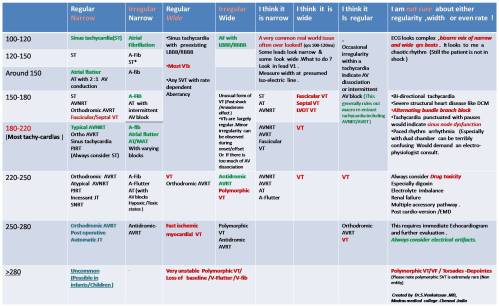
approach to cardiac arrhythmias narrow qrs vs wide qrs brugada wellens criteria

General principles in diagnosis of tachycardia

Narrow  qrs tachycardias.

90 % rule : If regular It is sinus tachy if irregular it is A-FIB . Take some efforts to r/o sinus  tachycardia . (In children and young adult it can be extremely difficult at times )* Please note : Sinus tachycardia can show some irregularity due to sinus arrhythmia and  frequent  APDs and JPDS . Further at  fast rates P may fuse with T it should not be confused with  A-fib .

Wide qrs tachycardia

Common things  are common , if  you sight a large animal with a huge trunk  in a Kenyan safari ,  it is most likely to be an  elephant and not a Dinosaur !  Please diagnose VT  when you encounter wide qrs tachycardia by default especially when the BP drops  !

  Management issues

It  would be  foolish to split our heads for decoding an arrhythmia when a patient is unstable .Any hemo-dyanmic unstable tachycardia needs DC shock . (Synchronized will be better unless it is dire emergency )There are very few arrhythmia where DC shock is contraindicated   ( MAT/Dig toxicity/Underlying sinus node dysfunction )

Only if the patient is hemo-dynamically  very much stable   the  physicians  have enough time to  confuse themselves  and the real  ordeal begins .Please remember  the 5 arrhythmias  constitute 98  % of all known tachy-arrhytmia . So where ever  you practice ,  whether  in remote Nigerian village  or  sophisticated  Cleveland  university hospital , when you are  confronted with a tachycardia  the diagnosis  should be one among the  following  five  !)

  1. Sinus tachycardia .
  2. AF/A-fib
  3. Atrial tachycardia  with  or without blocks
  4. ventricular tachycardia /VF
  5. AVNR/AVRT with or without aberrancy

All  other tachy-arrhythmiaa  are  largely  academic !

Regarding  drugs

Knowing the mechanism of  arrhythmia genesis  is less important  at bed side . They are  triggered , sustained, and maintained by either functional or structural component .Ionic basis operates in every arrhythmia  , but it is the anatomical  substrate that maintains it .This happens in only diseased heart.The only point worth remembering regarding mechanism of arrhythmia  genesis  is ,  automatic and focal tachycardias  will not respond to DC shock . All other can be termed some form of re-entry . Micro reentry  for all practical purposes behave like  triggered  activity. Ischemic and electrolytic VTs are primarily ionic based and often polymorphic.Structural VT are commonly mono-morphic. Any VT just prior to degeneration to VF become polymorphic

Every patient with cardiac arrhythmia should be checked for hypoxia,acidois , electrolyte defect or exposure to any  pro arrhythmic drugs. (The commonest  cause of tachycardia in any  IMCU , is inotropic induced (dopamine /doubtamine ) tachycardia .

We  have  5  pharmacological options

  1. Blocking  adrenergic  receptors(IV Esmolol, Metoprolol)
  2. Blocking calcium channel (Dilitazem,Verapamil)
  3. Blocking potassium channel  (Amiodarone  ,Sotolol Adenosine  to a cetian extent )
  4. Blocking sodium channel . ( Procainamide , Lignocaine (Wonder drug almost forgotten now ! ) Flecanide Mexilitene etc)
  5. Digoxin ,Adenosine  magnesium are special  anti-arrhythmic  agent which  has very useful role in certain specific situations (Magnesium -Torsades/Polymorphic VT / Adenosine in LVOT/RVOT VT etc)

General principle is ventricular arrhythmias  are blocked successfully  by sodium or potassium blockade  Atrial and functional tachycardia are blocked by calcium or adrenegic blockade  .Of course,  there would be  some degree of overlap  when the arrhythmia  origin  hovers  around the junction  on either side of the AV  ring . This is basis of verapamil sensitive VT .Clusters of  calcium  channels are scattered  in the junctional  region

Refractory tachycardia

  1. Consider ablation  in AVNRT/AVRT
  2. ICD +Drugs  in VT
  3. Ablate and  Pace(Some A-fibs)
  4. Ablate and ICD (Some  incessant VTs)
  5. Surgery in minority

In AVNRT/AVRT 90 % success can be achieved  in most EP centers .VT ablation  is still a complex process  with  success rate around 60 % ICDs  are indicated in all recurrent VTs except incessant forms .(Where the battery will deplete within a month !) Surgical cure (Maze etc  ) is possible in selected few while undergoing mitral valve surgery.Contrary  to the modern scientific  mood ,  I can ay with conviction most A-fibs can be managed medically except a fraction will require pulmonary vein ablation / isolation .

Final message

Mastering the field of of  cardiac  arrhythmias ,  though  appear a daunting task ,  it does not  require   immense  sense  to understand real world problems are  only a  few and can be tackled in a simplistic manner !

Read Full Post »
Heart rate of a tachycardia is the simplest of all  . . . but   neglected parameter by physicians.  They are often seen spending  hours together for decoding  arrhythmia , splitting their brain for locating P waves ,  VA conduction, Fusion beats etc Finally , most end up  either administering  Amiodarone a broad spectrum anti arrhythmic agent or a DC shock  without arriving at a correct diagnosis.

Here is an unusual algorithm  for arriving at a diagnosis in all tachy-arrhythmais  based only on heart rate and the width of  the qrs complex with acceptable accuracy.

(Click over the table for high resolution image )

approach to cardiac arrhythmias narrow qrs vs wide qrs brugada wellens criteria

Caution :

The above table is  an extremely simplified approach for tachy arrhythmias. Not applicable for scientifically inclined . But in my personal opinion ,  in an emergency room  pure science matters less !

Read Full Post »

When I posed the above question  to few  cardiologists including electro physiologists , the answer I got was surprising .  In the process ,  I could understand why cardiology is such fascinating subject !   Each one gave a different answer and all the 5 responses were forth coming .

The following post in my blog which  I wrote years ago tries to decode the reason for such wide variation in our understanding of AVRT of WPW.

By the way ,  is there a  real risk   for an  ortho-dromic AVRT into anti-dromic AVRT by a definite block in AV node  ?

Read Full Post »
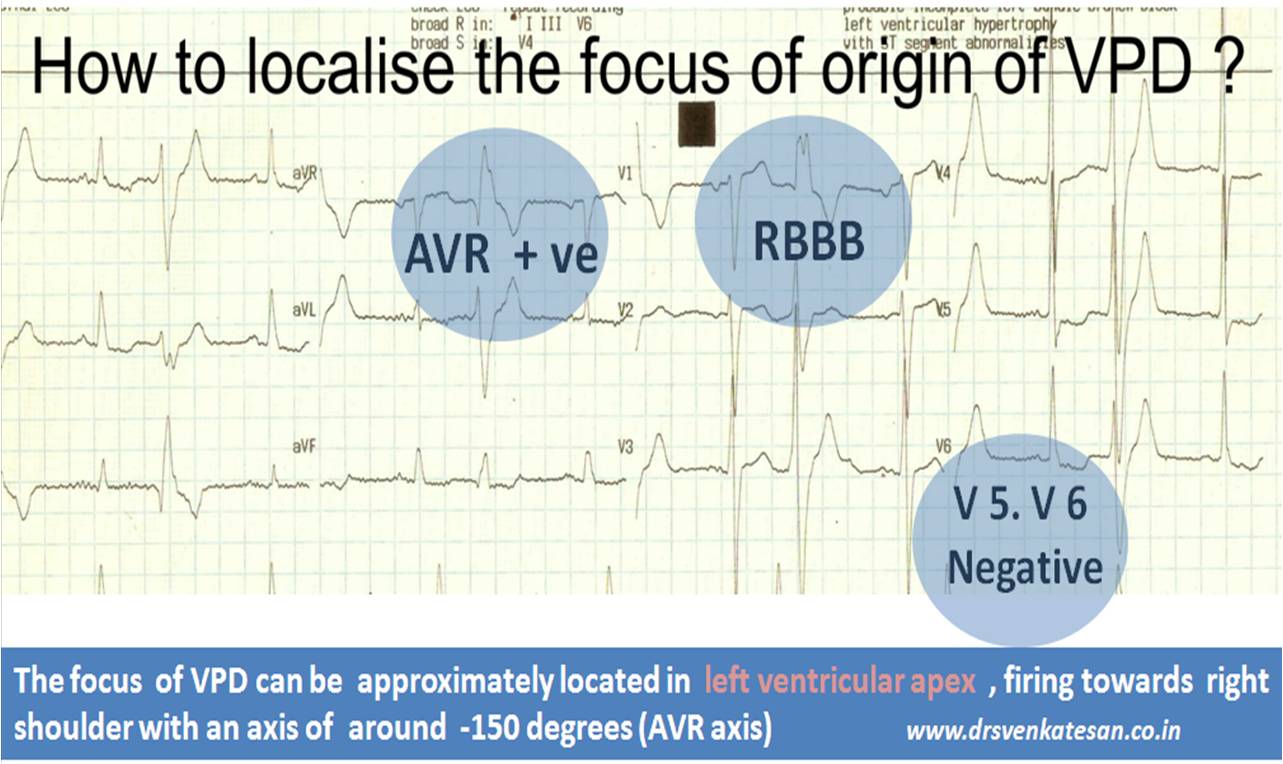
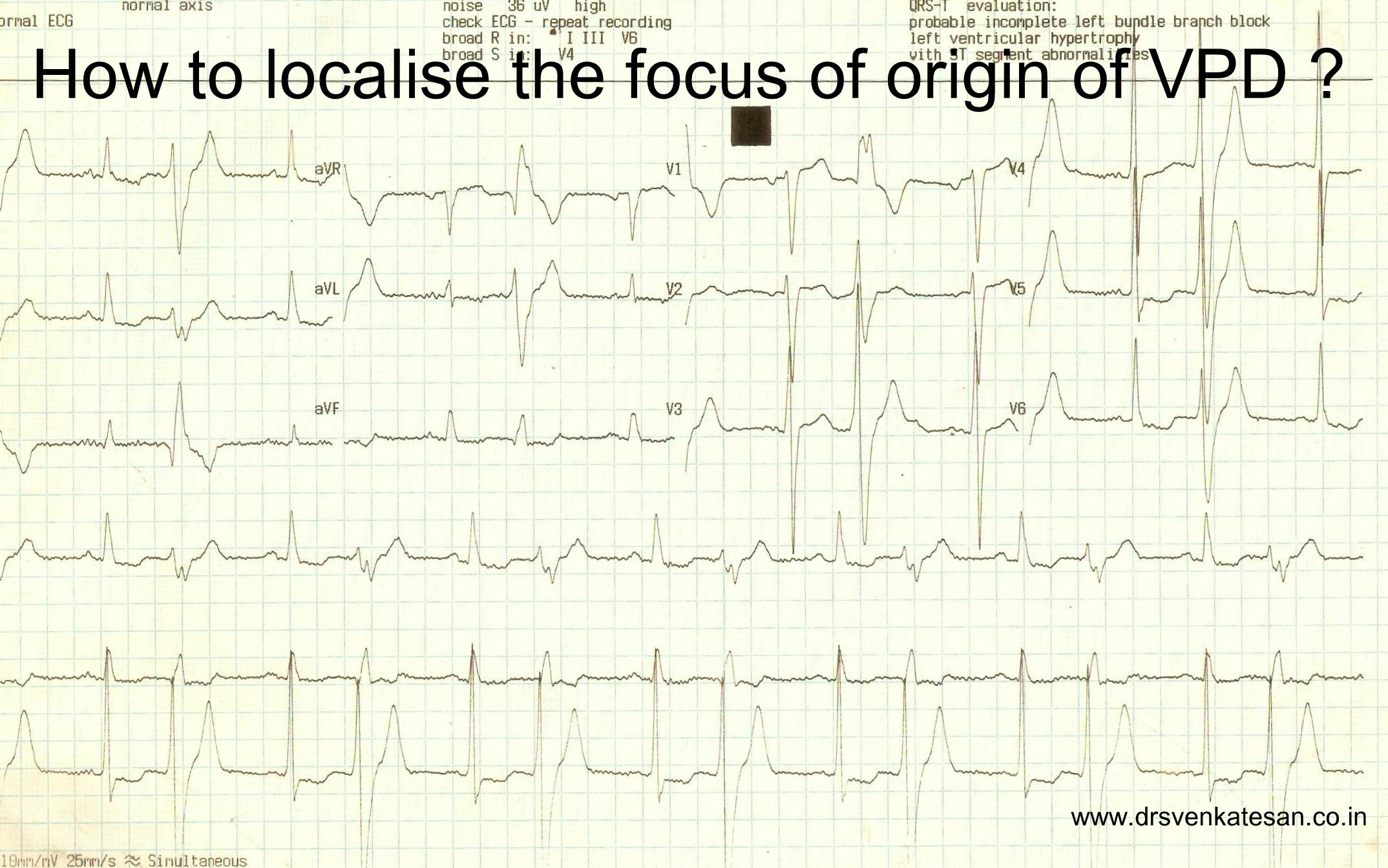
Some general rules are available

RBBB -Morphology -LV origin

LBBB morphology -RV origin

Exceptions : Interventricular  septum  is electrically  RV or LV ?

Electrically it is more of  a  LV .  Septal  focus often have RBBB morpholgy . Exist points  do  matter

Three lead  approach

Rapidly looking at lead  V1 , V6 and AVR  can give us a clue

AVR +ve  will immediately tell us the VPDs are  firing  towards right shoulder .

RBBB morphology points to  a  LV focus .

Negative VPD in V5 will further confirm  LV apex is in the trailing  end  of VPD

Common  sites  for  post MI VPD

  1. LV apex and Apical septum
  2. Infero posterio MI
  3. RV origin more common

Which VPD  morphology  has better localising value  RBBB or LBBB ?

It is  the LBBB  that has more localising value . LBBB invariably fixes the right ventricle

RBBB can either be  right ventricle or left ventricle .

To be continued .

Read Full Post »

« Newer Posts - Older Posts »