Feeds:
Posts
Comments

Archive for the ‘Cardiology – Electrophysiology -Pacemaker’ Category

Irregular  wide qrs tachycardia is a fairly common clinical entity in any cardiac emergency room. The moment you ask about  such tachycardia ,  9/10  fellows will  come out with a  prompt answer   ” AF with WPW syndrome” even before you complete the question !  It is not that common  as we perceive .The problem is with  our traditional teaching methods and the attraction of human brains to  rare and exotic disorders.

traditionally   SVT with aberrancy  is   diagnosed  mainly  in the setting of regular tachycardia .

We often  forget  “AF with aberrancy”  is equally common  , and  it presents   with a  irregular  wide qrs tachycardia . 

I  wonder whether  this phenomenon  can be termed as  orthodromic aberrancy .This can directly compete  in the differential diagnosis  of  antidromic AF  with  WPW !

It should also be mentioned antidromic  AF can run into very high rates  as accessory pathways do not check the incoming signals while orthodromic aberrancy the ventricular rates can not exceed 220 or so at least theoretically . (This simple clue can clinch the issue in favor of  WPW )

There is no proper  published data available for the true  incidence of AF with orthodromic aberrancy in general population

In fact , there are  many  electrical  environments for AF  to  become a  wide qrs AF

1. AF  with  Antidromic conduction through accessory WPW pathway.

2. AF with Orthodromic aberrancy ( Non WPW – Similar to  any SVT with aberrancy )

3. AF with pre existing LBBB

4. AF  with Amiodarone effect. (Especially with DCM and cumulative load of Amiodarone )

5. AF with electrolytic /  especially excess  intra-cellualr  potassium

6. Finally , even  Atrial based pacing (DDD)  can cause wide qrs irregular tachycardia when  mode switching  fails .Here the  ventricles  may track the  atrial irregularity  and respond with a  wide qrs  bizarre tachycardia .

Final message

There are many causes for  wide qrs tachycardias  in  Atrial fibrillation . WPW with anti-dromic conduction is just  one of them .We need to approach the issue with an open mind .Please  be reminded , once contemplated  WPW syndrome  can be a powerful thought blocker  !

Note : *We are not including   polymorphic ventricular tachycardia here .It is an  important subset of  wide qrs irregular  tachycardia.

** VT can co-exist with AF .This is not   surprising  as  many of the diffuse cardiomyopathies  involve  both atria and ventricle  with extensive scarring and fibrosis  a perfect trigger for  both atrial and ventricular arrhythmias .

Read Full Post »

Amiodarone acts  by

  1. Correcting the  rhythm  to sinus .
  2. Controls  ventricular rate  alone
  3. Does both ?

Answer is 3

How can it correct the rhythm alone ?  If  the rhythm is corrected ,  rate will automatically be controlled,  unless Amiodarone converts AF into Sinus tachycardia  which is very unlikely !

Of course  Amidarone  is not a  magic drug .The success rate of  Amiodarone  restoring  sinus rhythm is far . . . far less . . . than our expectations ! . It fails to  convert to sinus rhythm in a significant chunk *. Interestingly ,   it may still  control the  ventricular response  by its beta blocking action .

*Our estimate is , the failure rate Amiodarone  is  between  30-40%  or even higher ,  as   bulk of AF we witness   is due to Rheumatic heart disease.

Read Full Post »

Ventricular tachycardia is  a major cardiac electrical disorder. Even though it  connotes a deadly meaning the prognosis and outcome vastly vary.It can be a benign arrhythmia in  structurally normal heart that present as occasional fasicular VT  or Exercise  induced RVOT , to dangerous ischemic polymorphic VT which rapidly degenerate to VF and SCD if not reverted . It is ironical we are  trained  to put all VTs in a single basket and  propagate fear psychosis among   physicians and patients .

Management of VT has certain broad principles.

  • Identify the cause
  • Whether  specific structural heart diseases present or not
  • Identify the mechanism if possible
  • Rule out transient metabolic cause as a trigger

Therapeutic targets

  • Stabilising the cell of origin
  • Passifying the scars
  • Interrupting bundle branches in  BBR  mediated tachycardia
  • Ischemia related  Focus – Re-perfusion
  • Reversing LV dysfunction

Management

General

  • Correct Cell hypoxia /Acidois
  • Pharmacological ( Class 1A/1B /1C , class 3 and Beta blockers , Magnesium  )
  • Role of  beta blockers for VT management is largely under recognised.It has an important role to play in both acute and chronic  VTs)

Electrical (DC shock ,Ablation and ICD)

  • DC shock is treatment of choice  all emergency VTs
  • Ablation  aims  at preventing episodes of VT .Ablation needs EP study and  expertise of  an electro physiologist.
  • ICDs  revert it only after the VT emanates from the focus . ICD can be implanted without knowing the focus .May not require a EP consult.

Surgical

CABG + Surgical scar excision , Aneurysectomy  might help in certain refractory VT.

Read Full Post »

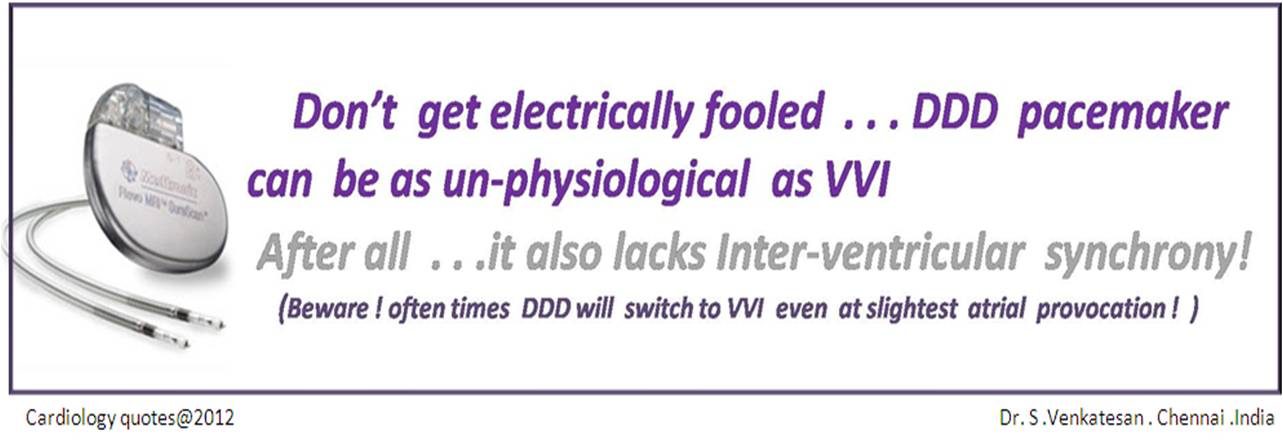
Choosing a pacemaker  is not a child’s play . It is a  complex game played by cardiologists , electro-physiologists and their  ill-informed

patients. The  superiority of dual chamber pacing over single chamber pacing  was never convincingly proven.

Still . . . usage of  dual chamber pacing is steadily increasing over the years  for various reasons.

“Every thing hangs around a key word called quality of life . DDD pacemaker is supposed to enrich life due to their AV synchrony “

World  health organization  says  quality of life  of homo-sapiens are  determined by at least few dozen factors .They are  mostly non medical.

How an extra lead at a cost of  2000 dollars more , is  going to  provide that  elusive “quality of life”  to all those poor patients with bradycardia  in  this world  ,   which     . . . they  any-way lacked even  in their best of times  !

Scientifically also there is  a major  flaw in calling DDDR as physiological pacemaker

Read Full Post »

Most  cardiologists  are familiar with  “Circulation” . We know  it  is a top  cardiology  journal with highest impact factor.  Few of us are  aware  of  a journal called  “Circulation  research” ( I wonder  why it is named  like that ,  as if  the regular   circulation journal  does  not carry research stuff  !)

It is one of the  path breaking   journals that regularly  churn out state  of  the art , often  mind  boggling research stuff.  Once in while we should get a feel of  basic science  research  as it  happens.

How else we are going to know an  atrial cell is to be bio engineered  shortly to behave like a  SA node  in patients with sinus node dysfunction. (Biological pacing )

This team from academic  medical  centre Amsterdam   should be credited   for  publishing   this gem of  an  article   from  a  study  involving the  measly mice !

It  deals elaborately  about the embryonic basis of AV nodal  disorders  . Specifically it  explains  the genesis of  WPW syndrome and how AV rings get muscularised  .

(It  is  due to   error in  bio-genetic forces ,which  affect the    incorporation  of AV nodal tissue  in the  fibrous  skeleton .This   results  in ectopic  junctional  tissues appear   any where along  the AV ring . This is the basis of  accessory AV pathway and   clinical  re-excitation.)

Final message

Once in a while  we should develop the habit of reading  tough  journals  like circulation research . After all ,   if a cardiologist  is not reading   these stuff who else  . . . will  ?

Reference

http://circres.ahajournals.org/content/107/6/728.full.pdf+html

Read Full Post »

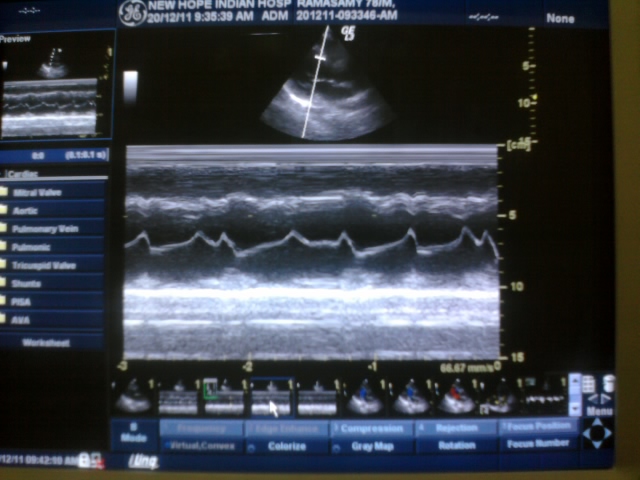
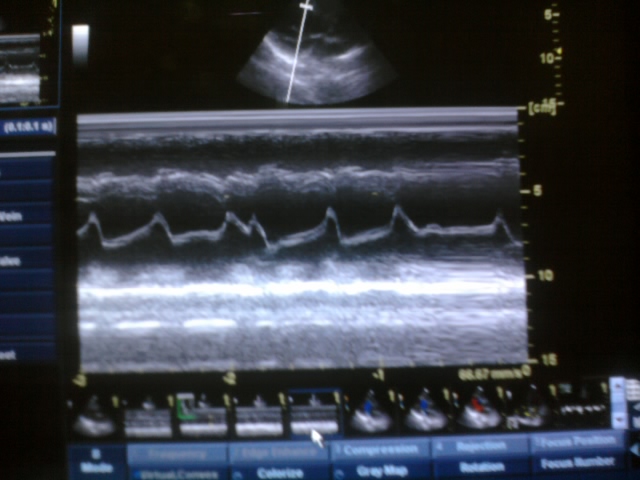
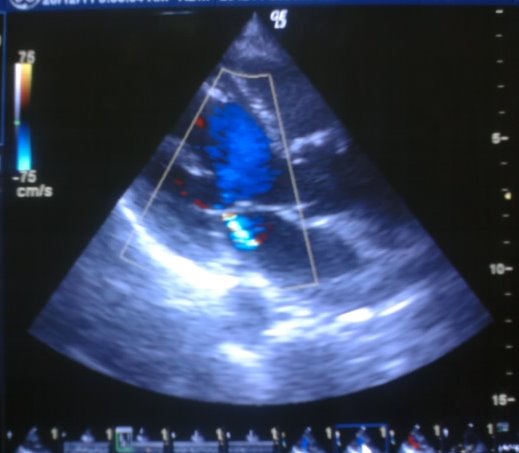
VPDs are the most common arrhythmia  that  confront  us  in  cardiology clinics .While  it can be a totally  benign   manifestation in some  ,  it may signify a sinister condition in others. ECG  is the easiest  and surest way to identify VPD.However  a shrewd echocardiographer can detect the VPDs while imaging the heart.It is often missed if one do not concentrate on the mitral valve motion.

Note :The VPD convert the typical M pattern into a inverted U pattern in mitral valve.

One of the important hemodynamic side-effect of VPD is intermittent mitral regurgitation.

Effect of VPD on mitral valve opening .

By  conventional thinking   VPDs  are expected   to impact  more on the  mitral  valve closure than it’s  opening .In reality it has indirect influence on mitral valve  opening as well. The retrograde  conduction(VA conduction) of the VPD determine the timing of atrial contraction and hence the   mitral valve opening. If the VPD gets blocked retrogradely  within AV node , the normal sinus impulse will activate the atria in an antegrade fashion .Note ,  he atrial activity  occur randomly when multiple VPDs occur.This makes the cardiac cycle too complex to assess especially the diastole. (In fact true  physiological diastole  may  not occur here !)

If  the mitral valve opening  is interfered by a   VPD  (Early diastole is  the  favorite time  for VPDs to  appear  !  )   .When it occurs the AML is    suddenly pushed  upon superiorly  by the premature ventricular activity and hence resets the  mechanical diastole. Please note electrical resetting of atrium is different from mechanical resetting.

It is also possible atria and ventricle contract simultaneously .This is the time , a cannon wave  may occur inside LA .VPDs can result in pulmonary venous canons and may even elevate pulmonary venous pressure   if  this  occurs repetitively .

Another possibility  is ,  VPDs  may not initiate a ventricular  contraction at all .It may be  simply  be an electrical event. That’s why  we changed the name of extra systole  and premature contraction into just   premature depolarisations.

Why is it important to know about M Mode motion of VPDs

Cardiologists  continue to  engage wide qrs  tachycardias   in the  wrong side  of their   brain for many  decades .The ECG debate about wide qrs tachycardia  is expected to  continue  for generations . !  Few smart cardiologists would  rapidly put  the echo probe  over the mitral valve and able to  differentiate  instantly a VT form SVT   with fair  degree of accuracy.

Detection  of regular M shaped mitral AML  will exclude a VT with a high degree of precision .(AV dissociation by echo )*

Even  presence of trivial  MR*  (More often diastolic )   which occur  irregularly  will  definitely indicate it is VT . SVT  hemodynamically   can not result in this  MR is gives us evidence for AV dissociation

* No reference for these observed indices in our lab. (Class 1 Level C expert opinion(  No one calls me as expert though ! )

What is the mechanism  of VPD induced  mitral regurgitation ?

It is well-known VPDs can cause   mitral regurgitation .Not every VPD cause MR.

  • The timing is important .
  • It can be  either systolic or diastolic MR .
  • If VPD occur in early diastole (After the T wave , the MR jet  will collide with  diastolic mitral flow. )
  • Paradoxical septal motion induced by VPDs can alter the pap muscle alignment transiently and result in MR
  • We dot not know how a LV apical VPD  differ from RVOT  VPD in the genesis of MR.
  • Logic would suggest RVOT  VPDs are unlikely to result in MR as there is  a time lag for the impulse to reach the LV base

What is  the effect of  VPD and Aortic valve opening ?

While  every VPD promptly  hits the mitral valve ,  aortic valve may or may not open with VPDs .Again timing and focus of VPD could be  important.This is the reason during  multiple  VPDs  only few open the aortic valve , that  explains  pulse deficit. (The so called missed beat )

Final message

Anterior mitral leaflet (AML) is the most mobile structure  of  the heart . Hence ,  it is not surprising to note  sudden unexpected ventricular contraction will  have maximum impact on this valve .

When VPDs occur in clusters or at random it has a complex effect on the mitral valve motion. This is responsible for  palpitation , minimal mitral regurgitation and rarely trouble some pulmonary venous cannons and raise in pulmonary venous pressure .

Careful analysis of  AML motion can give us useful clues to differentiate VT from SVT during wide  qrs tachycardia

Read Full Post »

Though heart is  primarily  known  as a  mechanical  organ , in reality   it is a vital  electrical organ as well . The entire mesh of electrical  pathway  from SA node to  Purkinje  fiber  would easily cross  a mile or two .Maintaining and protecting  such a  delicately  woven network  needs lots of  electrical sense  .  It is not surprising to note  , VT or VF  can be induced  virtually  in  every human heart  if stimulated rapidly. Electrocution  induced  by VF is  the typical example.Cardiac surgeons  do it regularly  before  surgery .

So , inducible  VT  in the EP  lab need to be  defined in a strict manner .

  •       VT must be triggered  by a  single stimuli  (or  two )
  •       Multiple sites should not be stimulated(ideally  single site , at most two )
  •       It should be sustained.
  •       Only mono-morphic VT has  significance
  •       Induced  p0lymorphic VT  has no clinical value.
  •       Pharmacological  stimulus  such as isoprenaline   can be used but reduces specificity.

*If a VT  rapidly degenerate  into VF  it  usually  means a polymorphic VT  while   unstable irregular  polymorphic VT   could be  same as   VF )

How do you make sure  what we induce in  EP lab is same as the clinical VT ?

This is the most difficult task for electro -physiologists. In real life setting VT is  often induced by ischemia hypoxia , local  acidosis and electrolytic imbalance. However  rarely mind this issue . In EP lab we induce  it  with  artificial electrodes  . Does it make sense to compare  these two totally different  set of triggers  in real life and a virtual EP life . Ideally  to confirm ischemic  VT  one has to induce ischemia  in EP lab and look for  VT . (Adenosine  stress ? )  Further ,  only re -entrant VTs  can be induced in EP lab by programmed stimulation . Automatic VTs can not be induced by stimulation .

The chances of inducing a VT in EP lab is  directily proportional to the aggression of the electro physiologists and patience  of  the  patient ! One can afford to use  more aggressive  protocols only   if a clinical VT was  recently the   documented .

 Electrical stress testing of heart

It may be tempting  to refer    induction of VT  in EP lab  as  electrical stress testing  for the heart. But fundamentally there is a difference  between this and  the conventional EST . Unlike exercise stress  test the  inducibility of VT highly unpredictable . It has far too many variables . (The surface area of contact , number , Intensity ,  site of stimuli , scar location , irritability of viable myocardium  ,  inertness of scarred myocardium ,  and finally the cellular milieu etc  )

Thoughts to ponder over Is it not  “a fundamentally a wrong concept”  to give importance  to inducible VT  ?

Why should we  treat a clinically non relevant inducible VT ? We do not know yet whether inducible VT in other wise normal LV function  has any long-term significance . Currently it makes   no sense   to intervene in VT  if the LV function is good and the episodes  are not clinical but only inducible.

Note: If there is severe LV dysfunction (EF < 30 % ) one can implant an  ICD without   an  EP study . ( Of course   to state more dramatically   without even single documented VT  !) MADIT 2

Final message .

A VT which is inducible in EP lab has no meaning ,  if the LV function is normal , while  even a  non-existent  (potential  )VT  in the setting of severe LV dysfunction is vitally important !

Though  we  differentiate cardiac function  into mechanical and electrical for academic purposes , it is astonishing to note   how the heart is able to function  as a  single unit  . We know today , the ultimate  outcome of   VT  is  not  dictated  by  electrical status of the heart rather , the mechanical ability  to  with -stand  sudden dis-organized  ventricular  contractions ( A ventricle with good contractile function has inherent  capacity  to extinguish most episodes  of VT .(Myocytes with inbuilt biological ICDs ?)

It is a million dolor question why some VT remain as non- sustained while others rapidly degenerate into  fast VT and VF thereafter

Reference

The two contrasting studies

The MUSTT (1999) trial exposed the limitation of   clinical utility of inducible VT . Multicenter Unsustained Tachycardia Trial (MUSTT) Investigators

While   MADIT 2  (2002)which recommends an ICD in every patients with  severe LV dysfunction following MI without even a EP study .

Read Full Post »


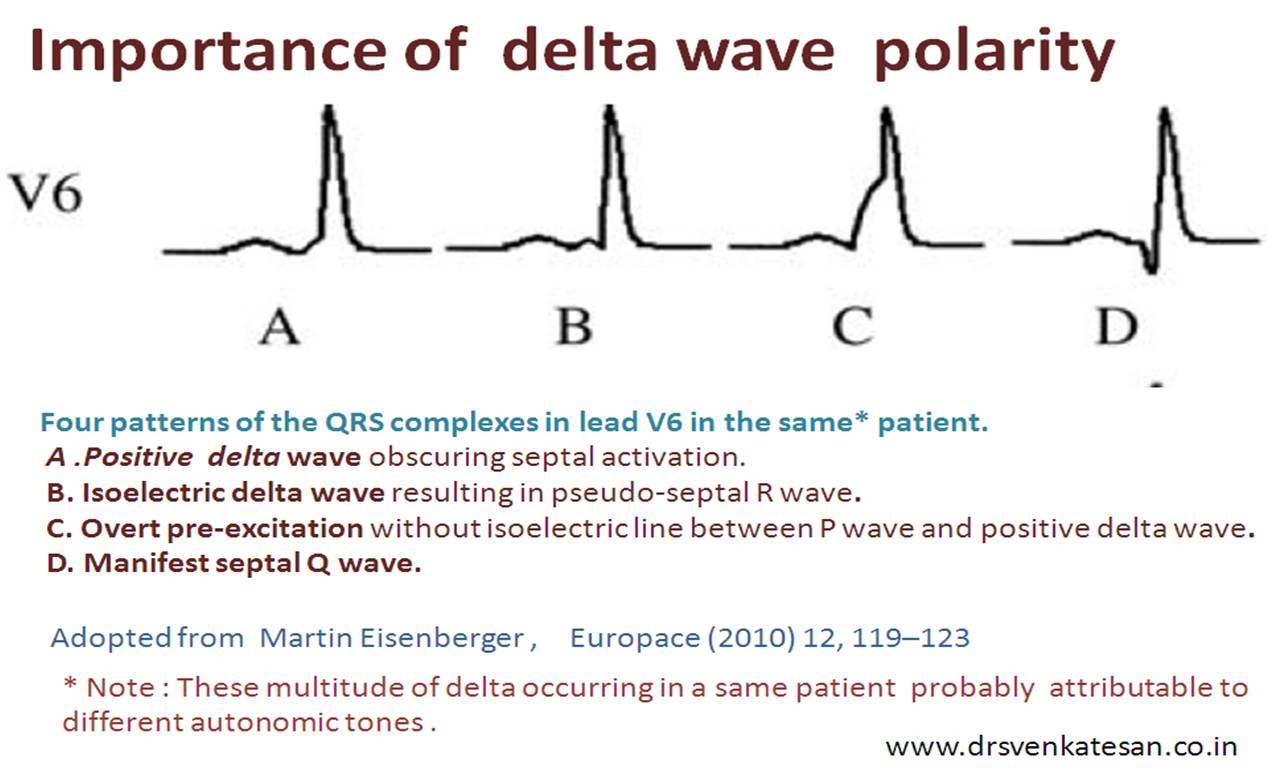
 Delta waves  are initial 20 ms  (or is it up to 40ms ?)  segment of  qrs complex that is  inscribed due to pre-excited depolarisation of the ventricle due to an accessory pathway .

It is more of a  fusion complex with  native normal qrs complex. The leads in which appear , the polarity and magnitude of these delta waves are determined by

  • Site of APs
  • Rapidity of  conduction through this AP
  • The quantum of native AV conduction
  • Influence of Autonomic tone  and the  refractory period of these accessory pathways .
  • Heart rate , distal conduction velocity , also can influence .

Can delta occur without AP ?
Like any other variation  isolated delta waves are reported in routine ECG finding.   It can be  be present in 0.15% to 0.25% of the general population. A higher  prevalence of 0.55% has been reported in first-degree relatives of   patients with accessory pathways.

How do you account for delta in general population ? We know concealed pathways can not record delta  . . . then it is possible some from of accelerated AV conduction  with twin pathway should be quiet common . ( It is very much possible  dual AV nodal pathway with grossly different conduction properties and distal insertion sites  inscribe a delta wave .)

  The crux of the discussion  of WPW syndrome revolves around  identifying delta wave and its direction .  If  the delta wave is well inscribed this job is easy  but at times  it  can be really difficult .

Many moods of delta wave

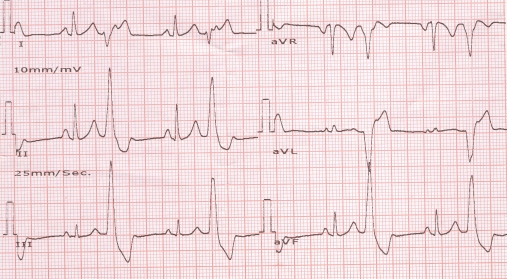
  • Positive delta  wave inscribes  above baseline. (See the above ECG  showing different delta in same patient )
  • Negative below baseline  and  iso-lectric on the baseline .
  • Please note , delta wave polarity and QRS polarity need not be in the same direction . If  they are in  the opposite  direction many time it appears as  small a pathological “q”  or pathological  “r”
  • It is likely  a delta wave can also drag  and  change the direction of qrs depolarisation  if  the  quantum pre-excitation  is large and with a fast conduction property.
  • It is also possible  the combined contribution of  negative delta with negative qrs together make a  deep  q waves . (Typical example is the LBBB type ECG in type B WPW in Ebstein anomaly )
  • Rarely the entire QRS can be  due to pre-excited  tract and native AV conduction contribute less.(This exactly happen in anti-dromic tachycardia ) but  this phenomenon is extremely rare to occur without tachycardia.

Final message

WPW  syndrome is such a dynamic  entity ,  one can realize how futile it will be to formulate fixed rules for ECG localization based on this wave .In fact,  we suffer from a  fundamental  electrical ignorance .How often delta wave polarity is discordant with qrs polarity and what is the  mechanism ? Standard text books do not discuss this issue . Many of the EPs skirt this question ! For this , we need  to critically decode the mechanisms of delta wave generation . Hope our youngsters take up the job !

Read Full Post »

Venous access for permanent pacing can be troublesome . Especially with anomalous subclavian ,  second implantation  ,obese patients with upper limb DVT . Temporary pacing through femoral vein is a well known concept.

Here is a concept of implanting the PPM  through femoral vein ,    in the upper thigh and the pacing  lead all the way reaches the right ventricle .There were few  issues which were  thought to be critical .As patients ambulate   there could be more  generator motion  than the sub pectoral location .(By the way , upper limb movement is equally common daily living is isn’t !)

Surprisingly excess  motion is  rarely an issue .  Even dual chamber  pacers were implanted  through femoral approach.Implantation  procedure  are simpler than one would have thought  and  complications are less as well .Since most of the leads are now screwing type  and  actively fixed   dis-lodgement  is never an issue.

Final message

The femoral venous access can be considered in all in whom SVC approach is difficult or not possible . 85cm lead is ideal . It is routinely available.

Always consider trans-femoral approach  whenever you encounter difficulty in subclavian .  Falling back on  epicardial  approach in such cases should be avoided at all cost. After all , epicardial approach is a major procedure.

Unfortunately,  very   few centers   practice transfemoral modality  for PPM right now . Brazil has some experience I understand.Royal Brompton  hospital ,London , Memorial  heart institute ,Long beach , California  have advocated this approach with good success.

We Indians , have a huge potential to propagate this useful concept.I wonder  why Femoral –  IVC approach  could  not be a  first choice for permanent pace maker implantation  especially in small children and adults ! The  main issue is  not technical , it is more of   perceived  fear  and reluctance to change the tradition.

Reference

The  article  by Ellsted  http://onlinelibrary.wiley.com

Read Full Post »

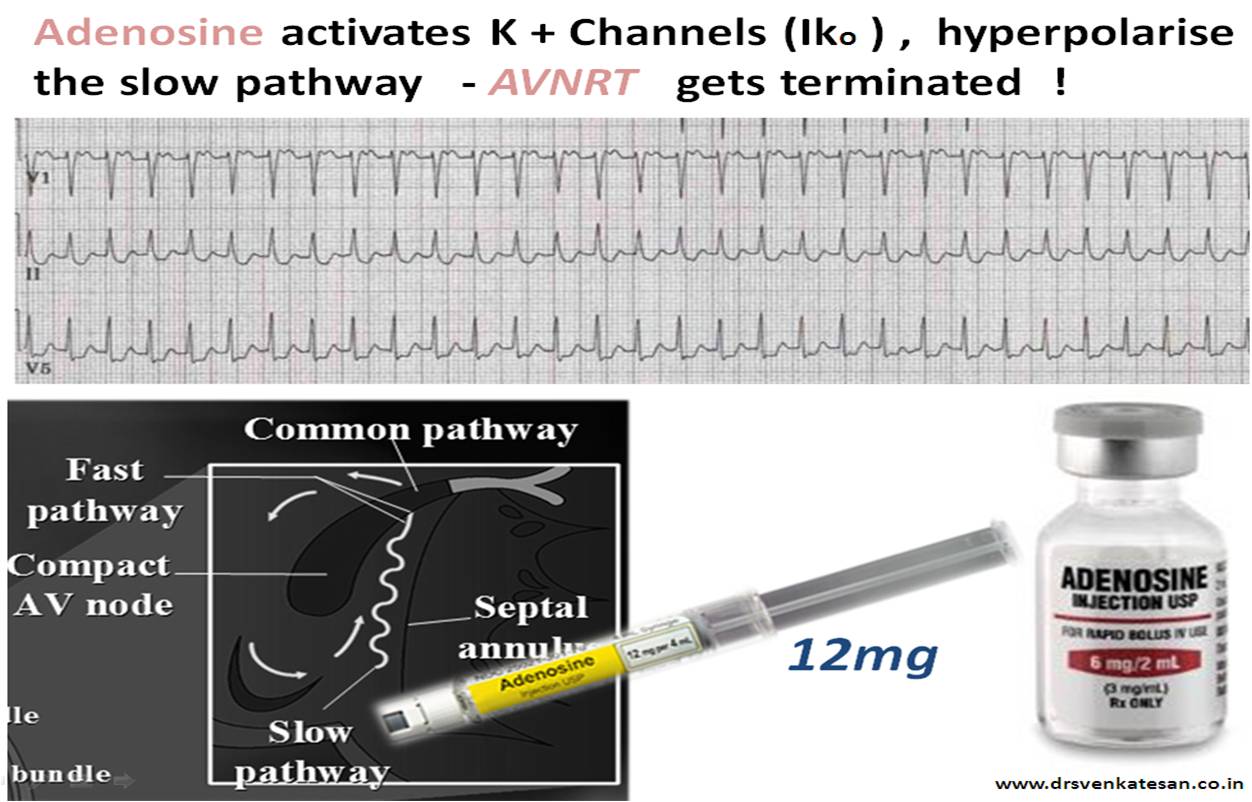
Adenosine is a  purine analogue. Acts by stimulating outward K+ channel  of AV nodal tissue, more specifically  in the posteriorly   located  slow pathway in the vicinity of  coronary sinus.

Another action of adenosine is inhibition of cAMP , which is similar to beta blocking action may also help in terminating the tachycardia.

Adenosine : A 10 second cardiac miracle

  • 12mg bolus is administered , preferably in a central vein (Not mandatory  though)
  • Termination is usually abrupt . Transient VPDs are observed during termination.
  • Transient flushing may occur.
  • If the patient is taking Aminophylline group of drugs (Which are adenosine antagonists) the AV nodal blocking action may be neutralised .

(It may be apt to recall  at this juncture ,  Aminophylline is used in sinus node dysfunction or AV block to increase heart rate )

Reference

A good one from Medscape http://www.medscape.com/viewarticle/585287_2

Read Full Post »

« Newer Posts - Older Posts »