Feeds:
Posts
Comments

ASD device closure is rapidly gaining  popularity . Amplatzer device occluder  has become a de-facto standard. Contraindications are declining . More and more young cardiologists want to  indulge in this  play . Fortunately  cost of  device is  acts as a major  deterrent  .

The pre procedural evaluation seems to be many fold important than the procedure itself.

  1. Evaluation of    Rims
  2. Thickness of  IAS
  3. Estimation of size of the defect
  4. Shape of the defect*
  5. RA /LA size  orifice  discrepancy*
  6. Proximity to Aorta, AV node
  7. Ruling out fenestrated  (daughter defects)

* You ask any cardiac  surgeon ,  How variable   the shape and size of ASD  can be ? To complicate the issue the LA side may show an entirely different shape and diameter compared to RA aspect. The orifice by itself may  travel obliquely.

Currently  the thickness of IAS* is not taken into account in device selection . It may be unwise to do so , because the thickness of the rim  and its interaction with device determines which direction the device will drag  (Homing in )  in the long run .

The potential dead space between the device and the septum can be a  late focus for thrombosis.  CVAs have been reported following ASD device closure.

Classification with reference to size

ASDs can be small (3 to <6 mm), medium (6 to <12 mm), or large (>12 mm),

What is the shape of Ostium secundum ASD ?

  • Round (perfect round very rare)
  • Oval
  • Irregularity oval
  • Irregularly round
  • Combinations

How is the orifice orientation with reference to plane of IAS ?

  • Horizontal
  • Oblique
  • Combination of the two

Which is the best method to measure the ASD size ?

  • Trans-thoracic Echo
  • 2DTrans-Esophageal Echo
  • Balloon estimated ASD size in fluoroscopy
  •  Real Time 3D TEE
  • Intra-cardiac Echocardiogram

Currently there is some degree of confusion about utility value of balloon sizing . Opinion differs. A meticulously done TEE  may be the  winner

How do you tackle an elongated and Oval ASD ?
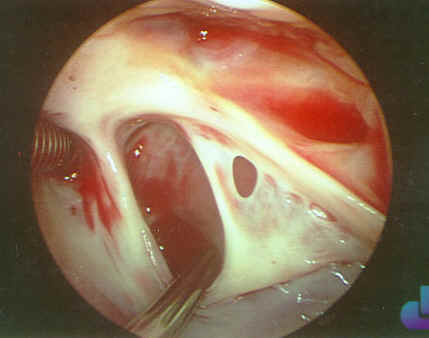
A large ASD with an adjacent daughter ASD . It is very difficult identify this daughter defect by conventional imaging . Intra cardiac Echo may help . Failure to recognize fenestrated defects especially in the edge can lead to poor device approximation

Con-founders in ASD size measurement.

Stretched ASD diameter. (How  much stretch ? )

Systolic vs diastolic ASD size

Practical tips for ASD sizing

Add 2mm to balloon/TEE  estimated waist.

TEE  may be more accurate than the balloon .

Balloon has a inherent issue of over stretching the ASD  and false high diameter.

Waists are often circular in the device   We do not  have oval Amplatzer device.

Accurate sizing is very difficult to achieve ,   so which side is better to err  ?    lesser or over  size  ?

Dangers of under-sizing

  • Mushrooming of the device
  • Dislodgment & Embolisation
  • Residual shunts
  • Thrombosis over metal gutter created by intending device

Dangers of over sizing

  • Aortic erosion
  • AV blocks

Newer modalities  for ASD imaging
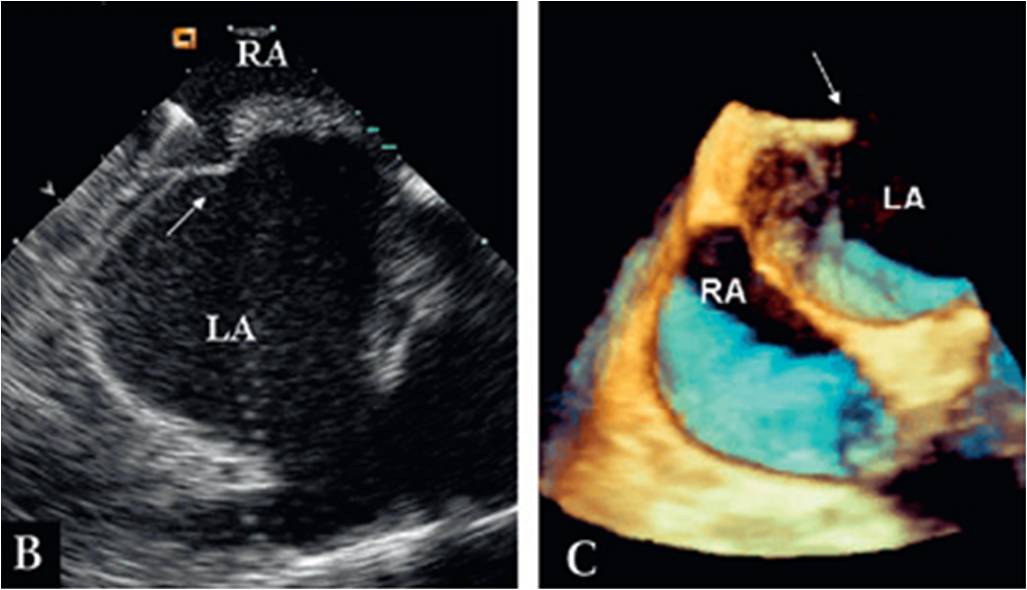
Intra cardiac echo and real time 3D TEE will facilitate the ASD device procedures
Image source : Heart 2010;96:1409e1417

Final message


ASD device closure is rapidly gaining  popularity . Contraindications are declining . More and more young cardiologists want to  indulge in this    play . Though  more children are getting benefited in this non surgical modality ,  complications are also increasing .

Small centers should not be allowed to carry out these procedures. Fortunately  cost of  device   acts as a major  deterrent  . A few centers (one or two per state )   is to be developed for high degree of expertise .

Without mastering the art of TEE never touch the ASD device .

The most critical step  in ASD device closure lies before the procedure  and   . . . it is often  outside the cath lab !

Always refer  large defects and  complex  ASDs  which are adjacent to Aorta and AV  to a good surgeon .Get an operative photograph of the defect and re analyse whether device would have been possible in retrospect .

References

1.An important study  about sizing of ASD  prior to closure  from Sri Chitra Institute . ( This study vouch for TEE for ASD size estimation )

2.Ann Pediatr Cardiol. 2011 Jan-Jun; 4(1): 28–33.

3.Sizing Balloon-Induced Tear of the Atrial Septum 

4.http://www.invasivecardiology.com/article/4716?page=2

5.J Teh Univ Heart Ctr 2011;6(2):79-84

6.Echocardiography in cath lab -An Excellent review in Heart

Further reading

Related Post in this  site. (ASD closure lagging behind surgery ?)


I stumbled upon this image from the Heart journal. A good depiction of  IAS aneurysm in three dimension.

Image courtesy  : Heart 2012;98:79-88   Three dimensional echocardiography in congenital heart disease   by  Joseph John Vettukattil

Further  reading

Clinical implication of IAS aneurysm

Echocardiogram in pulmonary HT has many aims .

  •  Identify the etiology
  • Assess the effects of PAH  on the right heart
  •  Estimate the severity of PAH.
  • Possibly prognosticate

Echo helps us to confirm the valvular, myocardial or congenital heart diseases in the evaluation of PAH. Apart from these etiological diagnosis of PAH predominantly lies in a systematic medical work up .(Read Dana Point classification )

2-D features

  • RA RV dilates
  • RVH*may occur (Dilation is more common )
  • IVS assumes  a D shape  ( RV pressure is close  to or   even > than  LV pressure )
  • Tricuspid annulus dilates

* For some reason RVH  does not occur commonly in pulmonary hypertension ,  while LV hypertrophies promptly in systemic hypertension .

Doppler

  • Tricuspid valve begins to leak  and RV ejects   with giant “cv”  waves into RA/JVP

Other Echo  findings

  • MPA may dilate
  • Pulmonary regurgitation

At what pressure RV begins to dilate  in PAH ?

It is  not known .It is highly variable . But most will dilate their RV at a systolic pressure > 50mmg.

It is also possible the onset of TR and the magnitude of  TR has a major say in the  timing  of RV enlargement .

We know RV is more sensitive to volume overload than pressure overload .

Paradoxically , it is often observed   acute elevation in RV pressure  dilate the RV faster than chronic ones.

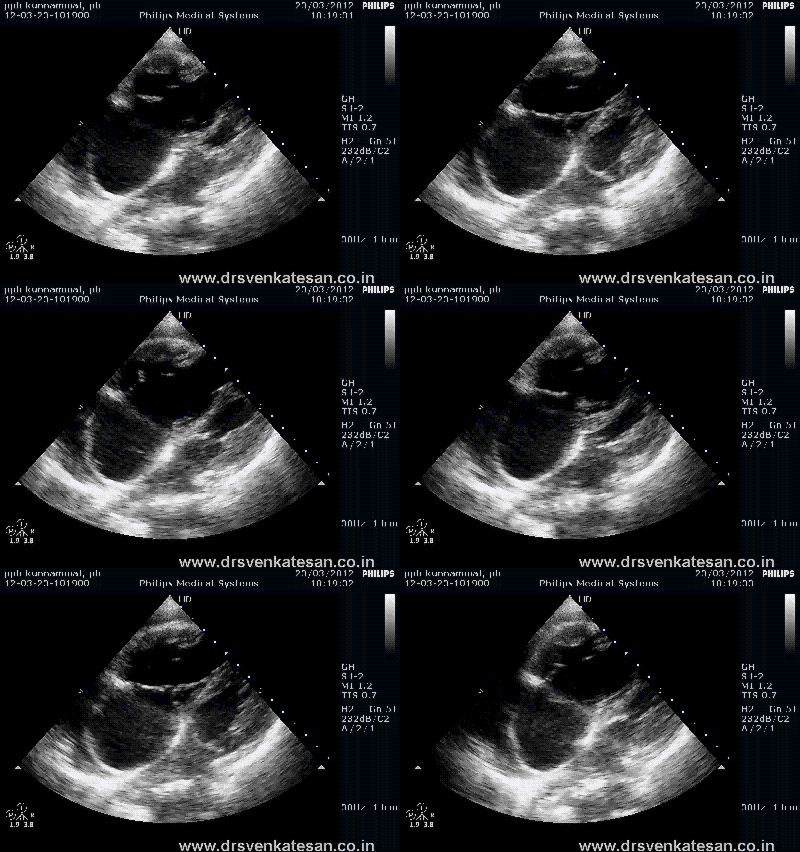
Right atrium and right ventricle are significantly

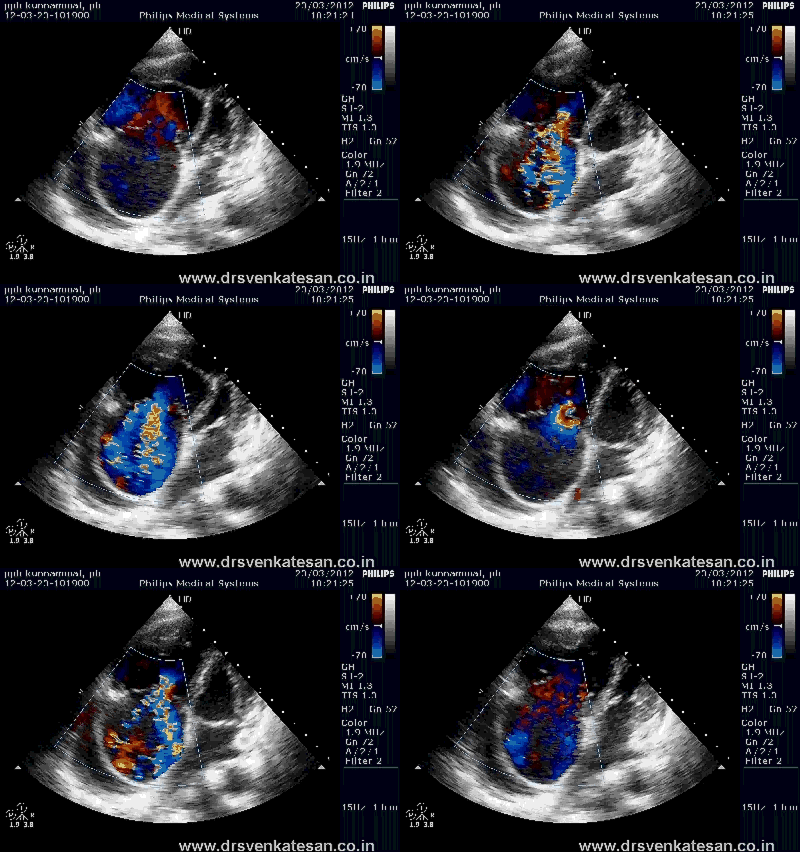
The tricuspid annulus is dilated .Note the severe TR with twin jet morphology.

Estimating Pulmonary artery pressure

PA systolic pressure  :  TR jet + 10 mmhg

PA diastolic pressure : PR end diastolic jet + 10

PA mean pressure  :  Peak PR gradient

Other complex methods to arrive ar PAP in the absence of TR or PR

The Dabestani -Mahan  ‘s equation*   – The  mean PA pressure = 90 – (0.62 X acceleration time).

It is popular   for  calculating PAP by measuring pulmonary artery Doppler  acceleration  time  .

Many   believe  it is  neither  sensitive  nor practical  in real  clinical setting.

*Even though Dabestani is the first author of this paper   Mahan  got the full credits for the simple reason his name is easily remembered   !

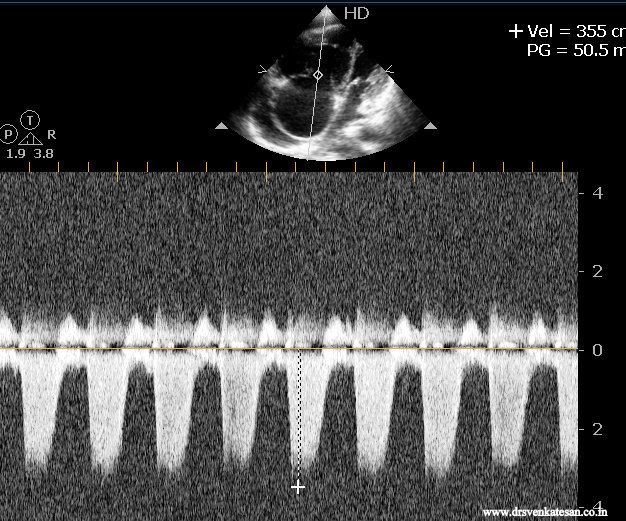
Note the peak TR jet is around 50mmhg and predicted RVSP would be 60mmhg.One would have expected still higher RV pressure but since the RV is dysfunctional the true PAP may be underestimated.

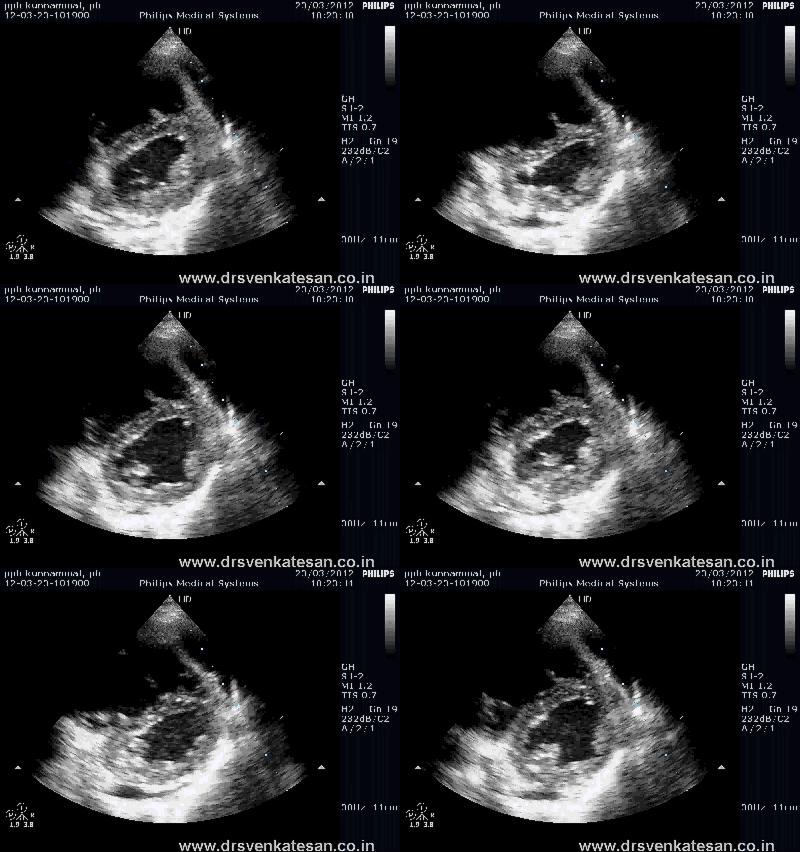
The classical D shaped IVS during systole . D shape indicates RV pressure during systole is almost equal or even higher than LV. ( Please recall D shape occurs in Volume overload also but the timing is in diastole !)

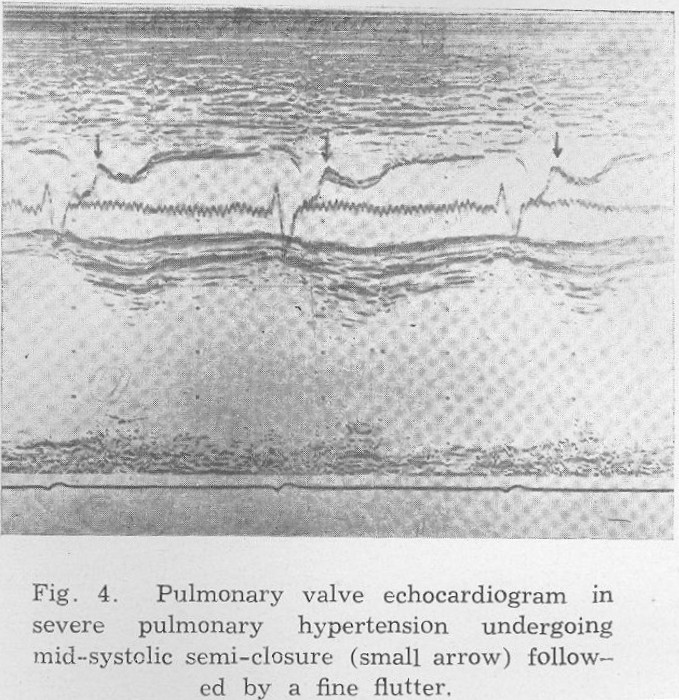
Pulmonary valve  M-Mode

According to Wyeman  the following M mode signs are useful in diagnosing PAH.

  1. Presence or  absence and the amplitude of the “a” wave
  2. magnitude of the e-f slope
  3. presence of mid-systolic closure or notching
  4. fluttering of the posterior pulmonic leaflet

Currently ,  one may consider M-Mode echo to be  an obsolete  ,  but still the foundations help us understand the hemo-dynamics.

The most important principle in  the motion of  pulmonary valve ,   is  the relationship between pulmonary “a” wave and right atrial “a” wave

Normally atrial contraction produce an inward movement* on the closing pulmonary leaflet . This  happens because the MPA  end diastolic  pressure is usually lower than  right atrial a wave    .In severe PAH  the elevated pulmonary diastolic pressure  does not  allow  the atrial contraction to   intend the pulmonary leaflet in pre-systolic atrial contraction .Hence pulmonary valve  a wave in m -mode  is  diminished or even absent .

In PAH even   premature closure of pulmonary valve may occur resulting in mid systolic notch   .This  is referred to as flying “W” -Mid systolic notch.   (See below)

* The motion  we see in  short axis M-Mode is that of   left pulmonary cusp that moves  posteriorly.

Image source : Karmarkar SG. Pulmonary valve echocardiography. J Postgrad Med 1979;25:219-23

Absence of a dip is a hemo-dyanmicaly important sign pf PAH  but with one important caveat  .This absence of a dip is valid  only until RV failure occur.In th presence of elevated RVEDP a begin to appear again

Reference

1 Karmarkar SG. Pulmonary valve echocardiography. J Postgrad Med 1979;25:219-23

2.http://circ.ahajournals.org/content/50/5/905.full.pdf

4.Kitabatake A, Inoue M, Asao M, Masuyama T, Tanouchi J, Morita T. et al. Noninvasive evaluation of pulmonary
hypertension by a pulsed Doppler technique. Circulation. 1983; 68(2): 302-9.

5.Stevenson JG. et al, Comparison of several noninvasive methods for estimation of pulmonary artery pressure. J Am
Soc Echocardiogr. 1989; 2: 157-71.

 6.Yock PG, Popp RL. Noninvasive estimation of right ventricular systolic pressure by Doppler ultrasound in patient  with tricuspid  regurgitation. Circulation 1984; 70:657-62.

RR interval in Atrial fibrillation is irregular because . . .

  1. The Atria  fires irregularly
  2. AV node conducts irregularly
  3. Atria confuses the AV node  with  its random firing  and varying penetration *
  4. The ventricle just reflects  irregular  response of atria .

The answer is all of the above. Response 3  explains  best.

*Please note , the AV nodal property is predominantly  responsible for the irregular RR interval in AF  . Atria confuses the AV node  with its random firing .The varying penetration into different depths of AV nodal structure and  the resultant concealed conduction make the   the AV nodal refractory period into continuous oscillation .This  random delays in AV node  is reflected in RR interval as irregularity   )

The response we get in ventricles  in AF  can be summed up as  “A filtered atrial rhythm”

Paradoxically,  amidst the chaos in atria  the rate  is fairly constant within the atria (Fibrillatory   wave firing  at up-to 600/mt )  Of course  , the FF interval in the atria will also be varying  .  At a rate of 450-600 this is difficult to quantitate  especially in fine AF.

When does RR interval becomes regular in AF ?

  • When the patient develops complete heart  block.
  • Digoxin toxicity
  • Associated Sinus node dysfunction

For advanced readers in EP : A mystery explanation for irregular  rhythm in AF  in the offing ?

AV node is a physiological and electrical sink .

When atria fires at 600/mt it absorbs about 60-70  % of the atrial response .Whether it releases the original impulse or initiate a new rhythm in the junction  is not clear.

There is some evidence to suggest the rhythm that control the ventricle in AF may not be  filtered original rhythm from the atria .Instead it could be a fast junctional  escape rhythm (Is that a junctional fibrillation ?)


I recently came across an unusual LIMA  arterial  branching pattern .

Random thoughts

  • A naturally dividing LIMA faciliates multiple sequential grafting of LAD or diagonal branches.
  • As branches steal the LIMA flow it is not good for the patient
  • Surgeons struggle to clip the branches.
  • A branching LIMA has tendency to have  small diameter (As in the above patient )

I need a surgeons Input here.

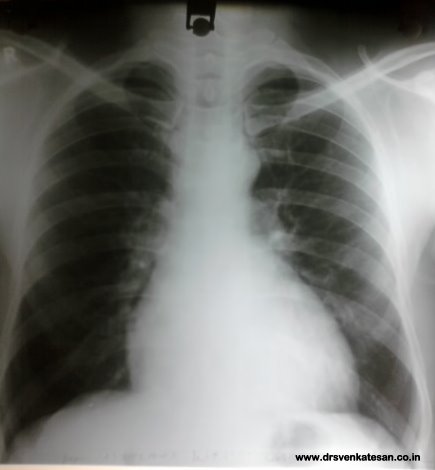
By statistics cardiomegaly   often implies  ventricular enlargement (especially left ventricular) .Right ventricle generally do not enlarge the  CT ratio until late stages .

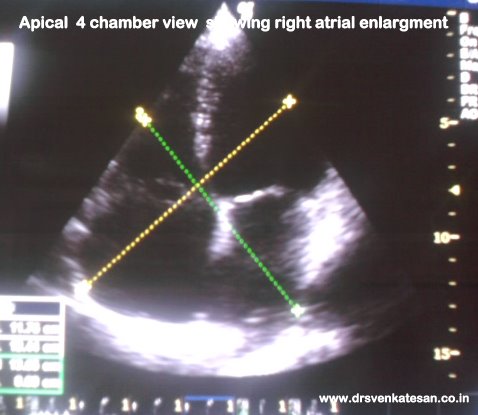
More important  is the impact of right atrial enlargement on the CT ratio. Here was a  patient referred to echo lab for evaluation of cardiomegaly

The x-ray chest  was suggesting a definite LV enlargement.  To my surprise  the LV was perfectly  measuring a normal dimension .

The right atrium was huge and measuring  more than 5 cms . This increased the CTR.

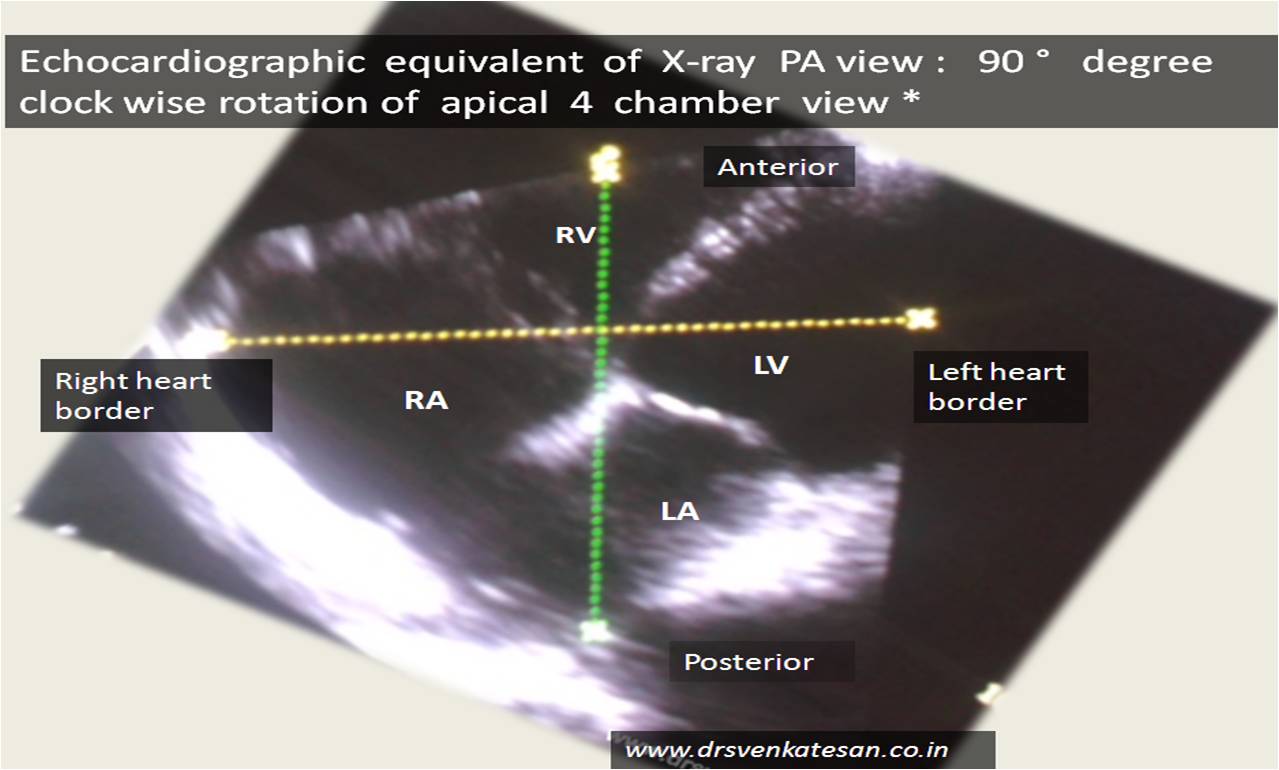
The following illustration  tries to create echo equivalent of transverse CT diameter by rotating apical 4 chamber view by 90 degrees.

The right and left atrium was significantly dilated . This patient had atrial fibrillation and the atrial enlargement was due to chronic AF.

Final message

Cardimegaly in  X- ray chest do not  necessarily  mean ventricular enlargement.

Pure atrio-megaly  especially right atrial enlargement can dramatically increase the CT ratio.

This is not a big  discovery , still fellows need   to reinforce  this fact  , as  mistakes are most often committed in well  known things !

COURAGE , BARI 2D , JASP

What is common in all ?

These are the studies which nailed the routine PCI in chronic  stable angina . Please note these articles came in prestigious  journals more than 5 years ago.

Nobody* seemed  to listen or learn  . Now the  Archives of Internal Medicine has  come out with another punch to PCI  .

Hope we refuse to learn again   . . .  and keep the interventionist spirit high !

And for a change  read this landmark paper from Forbes

http://www.forbes.com/sites/larryhusten/2012/02/27/meta-analysis-finds-no-advantages-for-pci-over-medical-therapy-in-stable-patients/

Beta blockers are vital drugs  to limit infarct size and  facilitate myocardial salvage. Myocyte death is  prevented by reducing MVO2.These concepts originated in early 1980s when thrombolysis was not in vogue .Studies like MIAMI  and BHAT were considered landmarks.

Later on ,  when IV thrombolysis came in a big way the importance of beta blockade in STEMI  suffered a little ,  still it  held on to their  benefits.

The real problem arose when few enthusiastic cardiologists introduced early multiple blouses of IV beta blockade in the setting of Acute STEMI without realising the potential danger. (In all probability man kind must have lost many thousands  of lives with this aggressive beta blocking protocol world over for nearly a  decade !)

Fortunately  we woke up and in early 2000  , a massive study called COMMIT was  initiated  to answer convincingly the utility value of  routine early IV bet blockade. Rest is history . It clearly showed us the what we were fearing was indeed true. An unacceptably excess cardiogenic shocks were reported in the early IV beta blocker arm .In the same period of time the concept of  primary PCI  exploded and the  BBs were pushed to sidelines

It is a different story  altogether   . . .

While  the funny world of cardiology showed the door for routine early  beta blockers  in STEMI ,  it  made a stunning  U turn   in the management of CHF  , after being dumped as an  absolute contraindication  for so many years !

Still COMMIT  fails to   answer many queries

  • Beta blockers in LBBB /RBBB –     Probably need to be avoided.
  • Beta blockers in bifasicular  block –   Should  be an  absolute contradiction

How do you know  tachycardia  in STEMI is due to high sympathetic activity or cardiac reserve ?

Young men with persistent tachycardia  will do well with beta blocker started within 24  hours .

Unless there is s3 or basal rales all tachycardia are to be considered as purely inappropriate  and  adrenergic

Tachycardia in elderly, women, and diabetic especially the blood pressure hover around 100mmhg is   more often a compensatory  phenomenon.Meddling  the heart rate with BB is vested with a risk.

Finally , if you have a doubt do a rapid echo ,  if the EF is > 45% one can safely administer BBs

Should we discontinue BBs  in those who are already taking it ?

Continuing the beta blocker is  thorough the STEMI phase is adviced .(Unless specific contraindication  exists  )

Beta blocker following primary PCI

The beneficial effect of early Beta blocker even in post thrombolytic era is blunted, it goes without saying primary PCI almost nullifies these effects.

still , beta blockers is to be introduced after a successful primary PCI in all patent for long-term protection.

Final message

Do not rush into start  beta blocker  routinely following STEMI .  The  risk is not worth taking  !

Reference

COMMIT  study from Lancet 2005

ACC/AHA guidelines on Betablocker and STEMI

The following is taken from the above  guidelines   When not to administer IV beta blocker  seems  to be more relevant !

Class 3 recommendation  for  Beta blocker in STEMI (Evidence A)

1. IV beta blockers should not be administered to STEMI patients who have any of the following: 1) signs of heart failure, 2) evidence of a low output state, 3) increased risk* for cardiogenic shock, or 4) other relative contraindications to beta blockade (PR interval greater than 0.24 seconds, second- or third-degree heart block, active asthma, or reactive airway disease). (Level of Evidence: A)

*Risk factors for cardiogenic shock (the greater the number of risk factors present, the higher the risk of developing cardiogenic shock) are age greater than 70 years, systolic blood pressure less than 120 mm Hg, sinus tachycardia greater than 110 bpm or heart rate less than 60 bpm, and increased time since onset of symptoms of STEMI.

I recall the guilty days during my fellowship  where many lives were lost due to delayed or  faulty intubation  in patients with cardiogenic shock. If only these devices were available those days  . . .

It is ironical , why we took such a long time to make a  scope  to see a structure just beneath the oral cavity ,  while we were able to see remote  duodenum and jejunum  with video  scope  some 25 years ago !

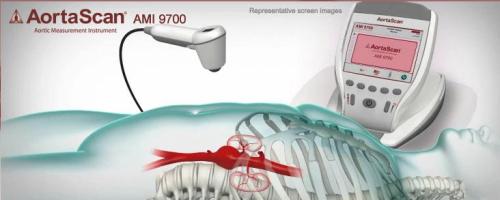
Another device ,  which will come as handy would be the rapid bed side measurement of Aortic dimension .

Image courtesy : Verathan

It doesn’t require an expertise of a sonographer I believe .

Both these innovation come from  Verathan

Reference

Video Laryngoscope  &  Aortic Scan

http://www.verathon.com/products/glidescope/avlsingleuse.aspx